Saturday, June 12, 2021

The social dynamics of violence in scripture

Not only is the logic of belief not necessarily the logic of believers, the use of scripture is itself subject to evolutionary processes.

Charles de Steuben, ‘Bataille de Poitiers en octobre 732', depicting Charles Martel confronting Abdul Rahman Al Gafiqi.

Educator and reform Muslim Irshad Manji and evolutionary biologist and secular Jew Bret Weinstein have a very thoughtful discussion about violence in scriptures and their different manifestation in (historical) Islam and Judaism. To state the obvious, there is a lot of violence in the Quran and there is a lot of violence in the Torah. Yet rabbinical Judaism, following the end of the Jewish revolts against the Roman Empire, has a very different history of religious violence than does Islam.

Well, than mainstream Sunni Islam. There are versions of Islam that have very similar trajectories to Rabbinical Judaism due to being historically embedded in very similar social dynamics and circumstances.

From Hebrews to Jews
Priestly Judaism (or, more accurately, the Yahweh worship of the Hebrews) was a violent religion. It was not, however, notably more violent than other religions of its time and place. It was also a religion of the Law of God, of law grounded in revelation, whose scriptures readily sanctified violence against other peoples and religions. (Including apostates within their own people.)

The Jewish lands were conquered by the Romans, also a people of Law, but of law explicitly made by humans. Having Roman law, based on very different presumptions than that of the Talmud, effectively override the Law of God was profoundly offensive to Hebrew sensibilities. This periodically led to violent revolts that the Romans put down with their customary brutal thoroughness.

Eventually, the destruction of the Second Temple saw the sacrificial role of the priests abandoned and the religious scholars, the rabbis, become the interpreters of scripture and the officiators of ritual. It also became clear that the Romans really meant it: they were prepared to deport, massacre, crucify and enslave whatever number of Hebrews were required to end revolts against Roman rule.

So, the rabbis evolved a new approach whereby Diaspora Jews were required to follow the Law of God but that law would be interpreted by carefully trained scholars in such a way as to permit the Jewish communities to survive and prosper as minority communities within gentile-dominated polities. Doing so while recognisably remaining themselves by remaining anchored in a tradition already many centuries old and which saw itself as reaching back to Creation itself.

Consequences
This socially and culturally evolved response to the clash between law grounded in revelation and law explicitly created by humans turned out to have monumental consequences. Christianity, evolving out of Judaism in a very law-concerned Empire, adopted the Roman notion that law, even Church law, was human, while developing its own priesthood.

A few centuries later, Islam adopted law grounded in revelation interpreted by religious scholars. It never developed a priesthood as such.

Meccan Islam took the rabbinical path of how to operate in a polity dominated by non-Muslims. But Muhammad became ruler of Medina, so the head of a polity; a wielder of violence who unified of Arabia by preaching and sword. The archetypal symbol of Muhammad is, after all, his sword. Medinan Islam is a religion of rulership, of dominion.

Sharia, the revelation-grounded system of law which evolved within the Islamic empire, is a system of law with no pre-imperial existence. It is also the only system of law that claims, by its nature, the right to apply to all humans everywhere. For it is the law of the Sovereign of the universe, discovered by trained scholars through the process of fiqh, of Islamic jurisprudence. The key differences in one’s fundamental standing as a human being is between those who have voluntarily submitted to Allah’s sovereignty (Muslims), those who have submitted to the rulership of those who have submitted to Allah’s sovereignty, and so His law, (dhimmis) and those who have failed to so submit.

The clash between the Law of God and human law that convulsed the Hebrew lands of the Roman Empire is a clash whose consequences have reverberated across the entire history of Islam and Christendom and down to our present day. When jihadis kill, they do so in the name of the universal sovereignty of Allah.

Pastoralist origins
Moreover, Islam evolved in a polygynous, patrilineal, kin-group pastoralist society. Actually, that is mostly redundant. Almost every pastoralist society has been polygynous, patrilineal and organised via kin groups.

Pastoral societies are polygynous because there is no reason inherent to pastoralism to evolve compulsory single-spouse marriage for elite males. On the contrary, that animals herds can increase undermines attempting to restrict the number of (usually male) heirs, or to maximise investment in the human capital of one’s offspring. That eliminates two powerful pressures for compulsory single-spouse marriage. While the value of extra connections encourages going for more wives, and more children, and so encourages polygyny.

Pastoralist societies are patrilineal because one cannot look after animal herds while minding children, making herding a male activity with the animals being bequeathed to the next generation of males. (So down the patrilineal line.)

Pastoralist societies are kin-group based as animal herds are mobile, so their protection is better managed through strong personal links (rather than territorial ones) that kin can provide, and provide better if related males are raised together.

Hence the social selection pressures operating on pastoralist societies are for them to be polygynous, to be patrilineal and to have strong kin groups. The mobility such societies train people for encourages them to trade (to broaden their access to goods and services) and to raid (to broaden their access to goods and services). Both trading and raiding can improve male access to (sexual and fertility services) by improving their appeal as marriage partners within the society. Raiding also enables the seizing of women from outside the society. With the latter dispensing with any pesky consent difficulties.

The Norse going-a-Viking were repeating this pattern on the seas, rather than across grasslands. (In the case of the Norse, polygyny operated through concubines, rather than multiple wives.)

There was a significant pastoralist element to Hebrew society, which is why Jewish tribes flourished in Arabia up until the time of Muhammad. Their example, and the commonality in subsistence circumstances, made it much easier for Islam to adopt and adapt the Jewish model.

But Hebrew society had also incorporated farmers and town dwellers. This gave monolatry (worship of one god) a powerful advantage, as it was a way of unifying farmers, herders and town-dwellers within the same ritual and moral community.

This was particularly advantageous in the Middle East, as it has the most socially permeable ecological boundaries between farming and herding of anywhere in the world. It is the region of the world where farming land and pastureland are most intermingled, both physically and socially, with people shifting from farming to herding and back again, according to circumstances.

This permability likely has a great deal to do with why monotheism is such a distinctive feature of the religious history of the Middle East. Any religious outlook able to unite people across the farming-herding divide had a powerful social selection advantage in the region. Monolatry, and even more monotheism (the claim that there is only one God), was thus adaptively favoured to evolve and prosper in the eco-geographical circumstances of the Middle East.

Islam evolved in a polygynous, patrilineal, kin group, raiding society. Sharia evolved in an imperial polygynous, patrilineal, kin group, raiding society engaged in the most dramatically successful waves of religious conquest in history.

The result is that Sharia not only sanctified polygyny, it also sanctified sexual predation against non-Muslim women. Doing so in the Quran, Hadith and the life of the Prophet, the key sources of Sharia. The 15 references in the Quran to those whom your right hand possess (ma malakat aymanukum) have been canonically taken to permit sex with captured women. Various hadith reinforce this. As does the actions of Muhammad when he ruled Medina, killing the males of defeated tribes and distributing the women and children as slaves to his followers. Hence Sharia holds that the marriage of a woman captured by a Muslim warrior is automatically annulled by the act of capture (obviously, so the captor can have sex with her).

This set up schemata (patterns of belief) and scripts (patterns of action) that have operated across the entire history of Islam, and still have life within mainstream Sunni Islam. Yazidi girls raped by ISIS warriors reported that their rapists cited religious justifications for their acts. Religious justifications that were also reported by the victims of “grooming gangs” in Britain.

A polygynous society, where elite men have extra wives and concubines, generates lower status men who are effectively excluded from the marriage market. One classic response of such societies to this surplus of unattached men is “those people over there have women, take theirs”. A response almost invariably adopted by pastoralist societies and other raiding polygynous societies, such as the Norse. The difference is, Islam sanctified this response. Which had the further advantage of making it much easier to recruit ghazis, holy warriors, to operate on the borders of Islam; to raid infidels and soften the border lands up for the further expansion of Islam. Islam is the only human civilisation explicitly and systematically structured to be violently expansionary: i.e. imperial.

Dominion and practicality
Islam is structured to be an imperial religion of domination. If, however, dominion is not practical, due to being a permanent minority, then such minority versions of Islam are in the same position as post-diaspora Jews: minority followers of the law of God in polities dominated by others. Hence the Ibadis, Ismailis, Alevis and Ahmadi’s generally look very “Jewish” in their behaviour and outlook: concentrating on the cohesion of their communities and avoiding being violent neighbours. (Parsees are an analogous case from outside the Mosaic religions.)

In the right social circumstances, the Quran can turn out to be the basis of much the same social dynamics as the Torah.

The Christian New Testament is considerably less violent in content than the Torah, Tanakh or the Quran. Yet states Christian in religion and culture conquered almost the entire globe. That is because (1) those states competed fiercely, and violently, against each other, evolving to be highly effective states and (2) because imperialism is what states do when they can.

The social dynamics of state competition mattered far more than the relatively pacific content of the Gospels and the Acts.

So, scriptures on their own tell us much less than we might imagine. We have to consider how the use of scriptures evolves in different circumstances, thereby generating various social dynamics. Quite different scriptures can evolve very similar (or at least overlapping) social dynamics.

[Cross-posted from Medium.)

Friday, June 11, 2021

Cousin marriage: it makes a difference which cousin

Cousin marriage in the Middle East works differently than does cousin marriage in South India.


Dr Alice Evans has a wonderful blog post, essay really, on why the situation of women in South India is generally better than that of women in North India. The piece is comprehensively researched and very well reasoned.

I do however, have one quibble. It is with Dr Evans using cousin marriage in the Middle East to argue that cousin marriage in South India is not likely to be a significant explanatory factor in the comparatively better position of women in South India. The trouble with this is that cousin marriage in the Middle East is marriage within the lineage group, so therefore is parallel marriage.

Given that kin groups in the Middle East are patrilineal (male line), women thereby marry male relatives within their own patri-lineage. Such marriages do not add to their kin connections but they also mean that women are not married into a completely different lineage. They are therefore not separated off from their natal kin.

Such parallel marriages mean the women are not further disadvantaged in the way that marrying into a completely different patri-lineage can entail, which is why women in the Middle East are likely to favour cousin marriages. A favouring that might well matter more than expected in such patriarchal societies, as women have long been the marriage intermediaries in those societies. These being societies with a long history of sexual segregation.

In South India, cousin marriages are cross-cousin marriages. That is, given that the kin groups are also patrilineal, they are marriages into a different patri-lineage with which there are already maternal kin connections.

Such cross-cousin marriages mean that, while women are married into a different patri-lineage, their connections with their natal lineages are reinforced. Indeed, it is a sign that those female kin connections are valued.

So women in South India acquire kin connections with such marriage but their natal connections retain significance. This is a stronger intermediary role than parallel-cousin marriage generally provides and gives them two sets of operative and valued kin connections to operate within and through. This puts them in a rather better position than women in North India.

In North India, marriages are often arranged at least two villages away. So women are more thoroughly separated from their natal kin group and more completely dependant on their husband’s kin group and kin connections. It is a way of making the patri-lineage more coherent, likely as an adaptation to North India having a much greater history of invasion. It is, however, done so very much at the expense of women.

Marrying out, marrying in
Parallel (i.e. within kin group) marriages are actually quite unusual in human societies. Normally, kin groups enforce strong taboos against marrying within the kin group. This is typically enforced through strong ritual boundaries requiring differentiation between the spouse with the ritually significant ancestors and the spouse who is an import to the kin group.

Such “ancestor worship” (though it is probably better understood as ancestor ritualisation) is incompatible with monotheism. Adoption of monotheism generally eliminates those ritual boundaries, leading to reasons to marry within the kin group becoming more socially dominant.

Though not so much in the case of Christianity, which is antipathetic to kin groups and has a history of expansively anathematising marriage between relatives, though nowadays much less than it used to. A very good book on this is Michael Mitterauer's, Why Europe?: the Medieval Origins of Its Special Path.

In the case of patri-lineages, marrying within the kin group means that daughters will be breeding warriors for the lineage, not for a different lineage. It also means that property (especially animal herds) remain within the kin group (as any bride price or bride wealth stays within the kin group) and that the genetic and kin-connection cohesion of the kin group will be increased.

South India is not an area where monotheism is strong. So it retains the more normal pattern of kin groups marrying out (of the kin group). In the case of patrilineal groups, that means kin groups trade daughters. (Matrilineal kin groups trade sons.)

In South India, it has been quite common for a man with an older sister to marry one of her daughters (i.e. a niece). Or else, the daughter of one of his mother’s siblings (i.e. a cousin). With the kin-connection consequences noted above. At the very least, they likely operate to facilitate or magnify the causal agents Dr Evans identifies.

So, while I agree cross-cousin marriage is not enough on its own to explain the better position of women in South India compared to North India, I would still argue that it helps to improve the situation of women in South India. Since parallel-cousin marriage in the Middle East is not a good analogy to cross-cousin marriage in South India, cousin marriage in the Middle East is not a good counter-argument against cousin marriage in South India having some significance for the relatively higher status of women compared to North India.

[Cross-posted from Medium.]

An accidental small businessman who reads a lot and thinks about what he reads, sometimes productively. Currently writing a book on marriage.


Thursday, June 10, 2021

Feminism is grounded in Christian social dynamics

The Women’s movement is a product of conditions that existed in Western society but nowhere else.


Feminism was a product of North-Western Europe (and the settler Anglosphere) for very specific cultural and institutional reasons. The women’s movement had to come out of a culture which already gave women’s choices sufficient standing, where elite women could organise and deploy resources, where kin-group loyalties did not dominate and constrain, and where explicit political bargaining was already part of the institutional landscape. This combination of features occurred in no other cultures other than in the societies that descended from Medieval Latin Christendom.

As I noted in my previous post, European and Chinese settlers in the American West provided a revealing natural experiment about the difference in that status of, and possibilities for, women in a society that had sanctified single-spouse marriage and (apart from some fringe regions) eliminated kin groups (Christian Europe and its descendant societies) as against a society with polygynous marriage and powerful kin groups (China).

The Church’s sanctification of a women’s consent as necessary for marriage elevated the status of women’s choices. As did the Church’s (admittedly bequest-hungry) support for the property and testamentary rights of women. Single-spouse marriage meant that elite women habitually had access to resources and were acknowledged as public organisers of resources.

The lack of kin groups required the development of alternative mechanisms for social cooperation. It also meant that women’s fertility was not an asset of their kin group, so giving more power to their consent being required for marriage.

Women’s fertility being an asset of their kin group — and connections within the kin group being essential for social standing, risk management, income prospects, wealth protection, etc — are fundamental drivers of (dis)honour killings; fatal enforcement of the restrictions on choices for women, with family members killing their own daughters in order to protect their standing within the kin group and local community.

Open source law
That in Christian Europe law was human (i.e. was not based on revelation) meant that those cooperative mechanisms could be entrenched in law, and so could the bargains they came to. A long history of explicit political bargaining developed with associated institutional structures. Structures that were most extensively established in what became Parliamentary states.

In both Islam and Brahmin civilisation, law was based on revelation and dominated by religious scholars (ulema) or priestly castes (Brahmins). A legal system can create new precedents. It cannot create new revelations. While the varying capacity to enforce rulings on people and groups affects the evolution of revelation-based legal systems, as does having to deal with new circumstances, it is not possible within revelation-based law to get together and legally create, ratify or entrench new social bargains. This made it much harder to develop alternative social-cooperation mechanisms to kin groups.

Moreover, neither Sharia nor Brahmin law were positive for the status of women. Sharia famously weights the testimony of male and female witnesses differently. While Manusmrti, the most famous Brahmin legal source, explicitly banned women from being independent and required wives to threat their husbands as if they were gods. This is, after, the legal-religious culture that gave us suttee (aka sati).

Between kin groups treating the fertility of women as an asset, dishonour killings, polygynous marriage lowering the status of women, and law enforcing (even sanctifying) subordinate status on women, other state-society civilisations were far more patriarchal than Christian Europe and its derivatives.

In the Christian Eurosphere (Europe plus the regions where European settlers became the dominant population), the women’s movement utilised available social status, patterns and resources in new ways. It was still, however, very much a mobilising of the cultural and institutional resources that were available to be used in such a way. Hence, there is often relatively little time gap in Western societies between all men getting the vote and women getting the vote.

The emancipation sequence
The women’s movement was part of what we might call the Emancipation Sequence (banning the slave trade, banning slavery, Jewish Emancipation, Catholic Emancipation, adult male suffrage, women’s suffrage, second-wave feminism, civil rights, queer emancipation …). Two centuries of mass movements organised to expand the legal rights and social participation of previously excluded groups, utilising the structures and possibilities within societies based on Christian social dynamics.

Other civilisations produced mass movements, but they were invariably organised around religious and mystical (even occult) ideas, as other civilisations lacked well-established mechanisms for such explicit political bargaining.

The key fight of second-wave feminism in the 1960s and 1970s was over women getting unilateral control over their fertility. This put second-wave feminism in direct opposition to the Church and Christian sexual mores and teachings. This has obscured how much the women’s movement was very much a product of specifically Christian doctrines and consequent social dynamics. Hence feminism in other cultures being both derivative, and somewhat pale shadows, of its Western origins.

The retreat from moral universalism that used to be a feature of progressive politics has seen Western feminists increasingly retreat from concern for women from other cultures, using the “but that is their culture” excuse. How far would the Western women’s movement have got if their opponents could simply close down their claims with “but that is our culture”? The women’s movement may have arising in Western societies but it also did very much seek to change key aspects of Western culture. It is very odd for contemporary feminists to deny that opportunity and lever to women from other cultures.

The women’s movement was also built on the Christian roots of Western culture and social dynamics. History, it’s complicated.


[Cross-posted from Medium.]

Wednesday, June 9, 2021

The Wild West as natural experiment

In the American West, both Euro-American and Chinese-American societies had a shortage of women: but that had very different consequences for women.

Annie Oakley in the 1880s.

Thanks to the Christian sanctification of single-spouse marriage, its insistence that a woman’s consent was required for a valid marriage, and the disappearance (under the pressure of Christianity and manorialism) of kin groups from Europe (apart from the Celtic and Balkan fringes, where manorialism did not reach), women had much higher status in Euro-American society than was the pattern in polygynous societies with kin groups, such as Islam (which permitted multiple wives) and China (which permitted multiple concubines).

In polygynous societies, particularly ones where men controlled the productive assets, and so wives were dependant on the incomes of their husbands, the wives (and concubines) of an elite male competed with each other for the prospects for their children. (Mistresses are concubines within a single-spouse marital system whose children therefore have no inheritance rights.)

In kin-group societies, particularly patrilineal kin-group societies, the fertility of women was an asset of their kin group. So, women tended to be married off early, to maximise the value of their fertility and to minimise the chance of something unfortunate happening. Frequently to significantly older men. Especially as it often took time for men to get together the assets and social standing to make them good (multiple) marriage prospects.

By contrast, in Christian society, an elite man would only have one wife, the joint parent of his heir and other legitimate children. She did not have to share that status of her husband with any other woman. It was thus common for even elite European Christian men to leave their wife in charge when they travelled. (Not something that was sensible for a husband with multiple wives to do.) 

A Christian wife, including of an elite male, was typically responsible for managing the household. Women having publicly acknowledged control of significant resources was a normal part of social dynamics. Both the Latin (Catholic) and Greek (Orthodox) Church held that a woman’s consent was required for marriage, with the lack of kin groups giving that consent greater weight.

In the American Wild West in the later part of the C19th, it being a frontier society, there was a shortage of women. This was true among both settlers of European origins and those of Chinese origins. The consequences for the women of this shortage, however, differed dramatically between the two cultures.

In Euro-American society in the West, married women tended to be treated with considerable deference. There was prostitution, but it was run by women. The prostitutes often made good incomes and pioneered social freedoms that contemporary American and Western women take for granted. The madams were often successful businesspeople: frequently, one of the most successful business people in their town. (Thaddeus Russell’s A Renegade History of the United States is a useful source for this social history.)

Western States pioneered votes for women, explicitly in the hope of attracting more women to their State. (The main argument against votes for women was that they would vote for Prohibition: which, of course, turned out to be true.)

In other words, in Euro-American frontier society, the women reaped the benefits of their scarcity premium.

The picture in polygynous-with-kin-groups (i.e. clans) Chinese society in the American West was very different. There, elite Chinese men mate-hoarded, regularly having a wife and concubines. The remaining women were largely forced into prostitution, controlled by the tongs or triads (which are substitute clans). So, in Chinese-American society in the American West, the scarcity premium of women was largely harvested by men.

As the natural experiment of the American Wild West demonstrated, what marriage system a culture had, whether it was polygynous or had a single-spouse marriage system, and whether it was based on kin groups (particularly patrilineal ones) or not, had quite dramatic effects on the status and prospects for women.

[Cross-posted from Medium.]

Tuesday, June 8, 2021

The courtesy of clarity: a profound philosophical point can be stated in clear language

What Heidegger took reams of obscure prose to do, C.S.Lewis expressed in a few, clear paragraphs.

Monks debating philosophy at Sera monastery, Tibet.

I have been struggling to get through Martin Heidegger’s magnum opus, Being and Time. I gave up on my first attempt. Fortunately, I then completed reading Thomas McEvilley’s much clearer, and historically informative, magnum opus, The Shape of Ancient Thought: an examination of the history of Greek and Indian philosophy and the interactions between them. Re-attempting Being and Time, I found it still unnecessarily obscure, but somewhat more approachable.

It was more approachable because Heidegger is attempting to supersede the entire Western philosophical tradition by going back to pre-Socratic thinkers and their wrestling with question of what is, and what it is to be. Subjects that many Indian thinkers wrestled with. Hence reading a history of Indian philosophy (and its interactions with Greek philosophy) was helpful.

The shape of ancient thought
The Shape of Ancient Thought makes clear that Indian philosophy had much stronger rational (even rationalist) traditions than Western philosophers and historians of ideas have often assumed while the Greek philosophy had much stronger mystical traditions than Western philosophers and historians of ideas have typically been willing to admit or be comfortable with.

McEvilley also makes a powerful case for each set of traditions having influenced the other. At the time of the pre-Socratic Greek philosophers, there was precisely one state between the Greek world and the Indian world: the Achaemenid Empire, the first mega-empire. As the Achaemenid rulers patronised philosophers and sages (both Greek and Indian), and attracted them to their court, this made it relatively easy for ideas to flow each way.

Moreover, trade between Mesopotamia and the Indus Valley dates back many centuries prior to the Achaemenid Empire. Similarly for trade between Mesopotamia and Egypt and, particularly via Phoenicia, the wider Mediterranean world. There were plenty of vectors for Mesopotamian ideas (e.g. Babylonian astronomy and mathematics) to flow both east and west, influencing both Greek and Indian philosophy.

Later, in the person of Alexander the Great (student of Aristotle) and his armies, the Greek world violently intruded on the Indian world.

McEvilley traces all sorts of convergences between Greek and Indian philosophy, including levels of specificity in ideas that make happenstance convergence implausible. Embracing the reality of the mystical in Greek thought, and the power of rationality in Indian thought, makes tracing the interactions both easier and much more vivid.

Convergent concerns
In his introduction to Zen Buddhism: Selected Writings of D.T. Suzuki, philosopher William Barrett writes:
A German friend of Heidegger told me that one day when he visited Heidegger he found him reading one of Suzuki’s works. ‘If I understand this man correctly,’ Heidegger remarked, ‘this is what I have been trying to say in all my writings.’
This convergence in ideas between Heidegger and Zen is not surprising. First, the Indian tradition and its derivatives (which, via Buddhism, spread to China, Korea and to Japan) continued to explicitly wrestle with the nature of being. Second, influential German philosopher Schopenhauer had been directly influenced by what he understood of Buddhist thought, so it was part of the backdrop of German philosophy.

After the publication of Being and Time, Heidegger entered into discussions with various Japanese interlocutors. This may have helped lead to that fact that, in the words of philosopher David Storey:
… he later recanted the residual metaphysics of subjectivity that he came to believe encumbered [Being and Time].
Storey also makes the point that both Heidegger and Zen hold that:
... the drive toward metaphysics — in the sense of a theory about reality — is a hindrance that draws us away from the richness of experience.
Being and Time is still a very difficult text and, about a fifth of the way in, I am still wondering whether there is any valuable point to be had at the end of it. Especially as it is easy enough to find summaries and explorations of Heidegger’s thinking that are much more approachable. 

It was therefore striking to come across a short essay by C.S. Lewis, a preface to a forgotten book, Douglas Harding’s Hierarchy of Heaven and Earth: A New Diagram of Man in the Universe, that put the concerns Heidegger wrestles with much more clearly. Lewis writes: 
This book is, I believe, the first attempt to reverse a process which has been going on since the beginning of philosophy.
The process whereby man has come to know the universe is from one point of view extremely complicated; from another it is alarmingly simple. We can observe a single one-way progression. At the outset the universe appears packed with will, intelligence, life and positive qualities; every tree is a nymph and every planet a god. Man himself is akin to the gods. The advance of knowledge gradually empties this rich and genial universe: first of its gods, then of its colours, smells, sounds and tastes, finally of solidity itself as solidity was originally imagined. As these items are taken from the world, they are transferred to the subjective side of the account: classified as our sensations, thoughts, images or emotions. The Subject becomes gorged, inflated, at the expense of the Object. But the matter does not rest there. The same method which has emptied the world now proceeds to empty ourselves. The masters of the method soon announce that we were just as mistaken (and mistaken in much the same way) when we attributed ‘souls’, or ‘selves’ or ‘minds’ to human organisms, as when we attributed Dryads to the trees. Animism, apparently, begins at home. We, who have personified all other things, turn out to be ourselves mere personifications. Man is indeed akin to the gods: that is, he is no less phantasmal than they. Just as the Dryad is a ‘ghost’, an abbreviated symbol for all the facts we know about the tree foolishly mistaken for a mysterious entity over and above the facts, so man’s ‘mind’ or ‘consciousness’ is an abbreviated symbol for certain verifiable facts about his behaviour: a symbol mistaken for a thing. And just as we have been broken of our bad habit of personifying trees, so we must now be broken of our bad habit of personifying men: a reform already effected in the political field. There never was a Subjective account into which we could transfer the items which the Object had lost. There is no ‘consciousness’ to contain, as images or private experiences, all the lost gods, colours, and concepts. Consciousness is ‘not the sort of noun that can be used that way’.

For we are given to understand that our mistake was a linguistic one. All our previous theologies, metaphysics, and psychologies were a by-product of our bad grammar. Max Müller’s formula (Mythology is a disease of language) thus returns with a wider scope than he ever dreamed of. We were not even imagining these things, we were only talking confusedly. All the questions which humanity has hitherto asked with deepest concern for the answer turn out to be unanswerable; not because the answers are hidden from us like ‘goddes privitee’, but because they are nonsense questions like ‘How far is it from London Bridge to Christmas Day?’ What we thought we were loving when we loved a woman or a friend was not even a phantom like the phantom sail which starving sailors think they see on the horizon. It was something more like a pun or a sophisma per figuram dictionis. It is as though a man, deceived by the linguistic similarity between ‘myself’ and ‘my spectacles’, should start looking round for his ‘self’ to put in his pocket before he left his bedroom in the morning: he might want it during the course of the day. If we lament the discovery that our friends have no ‘selves’ in the old sense, we shall be behaving like a man who shed bitter tears at being unable to find his ‘self’ anywhere on the dressing-table or even underneath it.

And thus we arrive at a result uncommonly like zero. While we were reducing the world to almost nothing we deceived ourselves with the fancy that all its lost qualities were being kept safe (if in a somewhat humbled condition) as ‘things in our own mind’. Apparently we had no mind of the sort required. The Subject is as empty as the Object. Almost nobody has been making linguistic mistakes about almost nothing. By and large, this is the only thing that has ever happened.
This does not remotely cover Heidegger’s entire enterprise in Being and Time. But it is the key problem he wrestles with, put far more clearly and succinctly than he does.

One is tempted to draw a distinction between English verbal parsimony seeking the courtesy of clarity contrasted with German verbal prolixity and insecure intellectual arrogance. But a deeper difference is that C.S. Lewis, as a Christian, has access to a wisdom tradition that Heidegger entirely lacks (despite going on about the importance of being rooted in a specific cultural tradition). Indeed, Heidegger’s lack of any connection to a wisdom tradition is also a difference between Heidegger and Zen thought more generally. A sense of the pervasiveness of blindness and error, including one’s own, so pervasive in wisdom traditions, perhaps gives one a clearer place to stand.

Heidegger’s influence on various French theorists is not surprising. Not only is there the grandeur of seeking to supersede the entire Western philosophical tradition, Heidegger also, in Storey’s words aimed
... at unseating the very notion of there being a master narrative, a complete system, a coherent body of doctrine.
Given how dominant Marxism, even Stalinism, had been in French intellectual life, those struggling with the shock of the manifest failures of Marxism could console themselves with not having made a singular mistake but a general one. A general mistake that they could now show everyone how to supersede. Heidegger’s own Nazi entanglements become, not a singular embarrassment, but the sort of error we all need to liberate ourselves from.

Heidegger’s opposition to the notion that philosophy could be a mirror of nature, his problems with language as a distorting medium, with subject-object distinctions, with the importance of lived experience, would all be picked up by the post-Marxist French theorists. As Storey says:
The attempt to get back to Being — to re-awaken to the forgotten meaning of Being, re-peat a heritage, re-tap some dormant reservoirs, to return to the roots and origins — that inheres in Heidegger’s early and late work lends itself to the idea that the modern world, and the mode of cognition by which it was constituted, namely, monological reason or calculative thinking, is a great mistake, a collective entanglement with entities in the world, and that we should therefore seek to regress to some sort of pre-modern, pre-rational form of society.
Or disconnect language from the world, and so from truth, and see Western society and civilisation as nothing beyond structures of power and oppression. The entire critical social justice apparatus that is grounded in the marriage of neo-Marxist critical theory with adaptations from post-Marxist French theory passing through Heidegger on the way.

The corruption from critical theory
The ‘social justice’ apparatus built on critical theory is grounded in a morally and intellectually corrupt choice. Faced with the failure of revolutions to either happen or, with the exception of Russia, succeed after the mass slaughter of the Great War, a group of German Marxists come together to answer why, even with all the blood and mass death of the Great War, the working classes failed to revolt, as Marxist theory says they should be primed to do.

One possibility was that the theory (or their understanding of it) was fundamentally wrong. The third possibility was that there was something wrong with the working class. As they were devout Marxists, the first hypotheses was unacceptable, the second version was too confronting for such self-consciously perceptive folk, so the third was adopted. The working classes were declared to be cognitively incompetent at judging their own interests. This was justified by notions such as false consciousness and cultural hegemony, Italian Marxist Antonio Gramsci famously going on to develop the latter idea. It also required some re-working of Marxism by going back to its Hegelian roots.

This morally and intellectually corrupt choice, protecting the splendour of their commitment to the transformative future at the cost of cognitively dismissing millions of their fellow citizens, the putative objects of their social concern, is the very opposite of wisdom. From this cognitively corrupt origin has grown a poisonous tree bearing many toxic fruits.

Such grounding of normative commitment in an unimpeachable imagined future functions much as revelation does in a religious system. It becomes the unchallengeable ground of authority. It is therefore not surprising that critical-theory derived faith systems have come to so resemble religions in their denunciation of sin and sinners, their blasphemy and heresy hunts, their identification of infidels. They even have, institutional penetration permitting, developed inquisitions. (In contemporary US academe, the flying squads of the new secular inquisition are called “bias response teams”.) One can even purchase latter-day indulgences, via diversity training and lectures. Hitler has become the secular Satan, the personification of evil, and Nazis (and the allegedly Nazi-adjacent) the demonic opposers of the unimpeachable future, the embrace of which is the source of all moral authority.

Embracing this collective self-worship of the splendour in their heads has meant a spiralling pattern of theorists and activists insulating said splendour from critique by declaring those who disagree cognitively delinquent. Thereby motivating and justifying using mimetic shaming to destroy the reputations and livelihoods of those that fail to conform. A mimetic shaming that the destructive attention-algorithms of Big Tech both encourage and give power to.

Enchantment fails
In a 1966 interview with Der Spiegel, published (as per his instructions) posthumously, Heidegger famously said “only a god can save us”. Only something superhuman in its reach and depth of meaning and psychic entanglement can save us from being lost in our technical, calculative, utterly disenchanted world. (One doubts that activists collectively worshipping the splendour in their heads was quite what he had in mind.)

Some folk have suggested that Western civilisation is suffering from a God-hole, a vacuum where the idea of God used to be. That we are suffering from the consequences of Nietzsche’s murder of God.

Yet monotheism is not the only basis for enduring culture and civilisations. I would suggest that we are suffering from a mythos vacuum, from the absence of a shared anchor of myth and meaning.

This is, after all, the burden of what C.S.Lewis is saying in the passage quoted above. In the search for explanatory power we shrank the realm which could provide such an anchor so completely that there is not enough to rest anything sufficiently useful and resonant on. Leading into what psychologist John Vervaeke calls the meaning crisis.

Destructive keyboard activism is a pathological response, fuelled by corporate algorithms seeking to profit from holding our attention, to a much deeper problem.

And always be wary of thinkers who do not seem to be able to manage the courtesy of clarity.

[Cross-posted from Medium.]

Saturday, June 5, 2021

Freedom, Democracy and Science: three things you cannot have without offending people

The UK Court of Appeal continues the march to give up on all three.


In a recent decision, the UIK Court of Appeal has decided it was fine to ends someone’s employment if they expressed public support for Christian views of sex and marriage, as such views may offend people.

Christians should not be surprised by this. After all, Jesus was nailed to a cross because what he said and did offended people.

Citizens of the United States should not be surprised by the notion that saying things may offend people. After all, the Declaration of Independence offended many, many people. Starting with King George III and most of the British Parliament.

It would be hard to find any major democratic movement, or any fundamental shift in science, that did not offend someone.

What is remarkable is granting such authority to the claim, or even the hypothetical possibility, of being offended so as to affect the employment of others. Loss of employment is surely a much greater harm than a few words, unless they are remarkably powerful words.

The essence of freedom of speech is that our status as citizens trumps the status of words, except in the most extraordinary circumstances. Hence we are free to speak.

The converse of freedom of speech is the heckler’s veto. The right to block the speech of others.

If given sufficient authority, it can extend to the ability to punish the speech of others.

This decision of the UK Court of Appeal is clearly a case of a heckler’s veto. A veto over speech of others that is remarkably empowered by such decisions but also highly selectively available. For granting a universal “right” not to be offended would obviously either bring public discourse to a halt or render it so anodyne as to pointless; any statement of substantive content being likely to, or being able to, offend someone.

What the notion of “offensive” speech does, under a very thin veneer of alleged concern, is set up a limited class of empowered people and perspectives that are granted the authority of the heckler’s veto. An authority that will clearly be used, and in an increasingly restrictive way, as the incentive is to use it, and so to expand its ambit so it can be used even more.

When people talk of “offensive” they mean offensive to right-thinking people. It is an instrument of cultural hegemony, thinly disguised as concern for others.

Indeed, it naturally transmutes into thinly camouflaged social thuggery: camouflaged, above all, for those engaged in it or acquiescing in it so they can, self-righteously avoid or deny any sense of being engaged in restrictive social thuggery. Social thuggery that the UK Court of Appeals has now given aid and comfort to.

In the words of Lord Justice Underhill, the motivating concern was:
... that the expression by the Appellant in the national media of his views about homosexuality risked impairing the willingness of gay people with mental health difficulties to engage with its services.
The Employment Tribunal, whose decision was being appealed, found that:
11.6 Both parties accepted in evidence that lesbian, gay, bisexual and transgender (‘LGBT’) members of the community suffer disproportionately from mental health problems. Both parties also accept that there have been significant difficulties with a lack of willingness on the part of LGBT members of the community to engage with mental health services such as those provided by the Trust.

11.7 The Trust (and the Respondent) see it as vital that its staff and Board should not do or say anything that could be perceived as giving rise to a risk of losing the confidence of trust of any section of the community it serves, including those, such as LGBT individuals, where there has been historic distrust and difficulty with engagement. The Claimant accepted that it was vital that LGBT members of the community should feel welcome in the Trust and should be encouraged to access its services if they need them.
In other words, the greater the deemed vulnerability, the greater the authority of the heckler’s veto.

As the Lord Justice Underhill says:
... they included opinions also on same-sex marriage and “homosexual activity” and were accordingly the more likely to cause offence or invite misinterpretation.
A simple statement that the views of one non-Executive Director about marriage, parenting and adoption do not represent the views of Trust or staff was not sufficient. His words had to punished by termination, they could not countered by other, more authoritative words. The judgement is saying that the only demonstrated harm from the words, the termination of employment of the utterer, is reasonable and lawful.

In particular, that it was the Appellant who had to acknowledge the problem with his statement of what he believed:
... the Appellant’s conduct made it in practice impossible to try to find a way forward that might have respected both parties’ interests … but for him to acknowledge the sensitivities and the consequent potential for damage of the kind noted above, and to engage with the Trust about how to best to address those sensitivities.
That the Appellant offered other reasons for his views apparently meant that their religious grounding was no longer sufficient protection:

The fact that that belief is rooted in his religious faith is part of the context, but the interview cannot be characterised as a “direct expression” of the Appellant’s Christianity.

So, the addition of reasoning beyond the religious was sufficient to remove the religious protection. A remarkable piece of legal reasoning that surely renders the protection for religious belief and expression rather moot. It is even more remarkable in this instance as it is, after all, true that children are statistically much safer if they are raised by both biological parents.

Lord Justice Underhill distinguishes between the belief and the objectionable manifestation of the belief. This is apparently based in recent case law, but it is a usage that should surely make one nervous. It makes it much easier to claim not to be restricting freedom of speech, or punishing beliefs, just their “objectionable manifestation”. A distinction that could easily amount to remarkably little difference.

This is a free speech issue. As the Lord Justice Underhill says:
The issue raised by this case is not about what beliefs such a person holds but about the limits on their public expression. …there are circumstances in which it is right to expect Christians (and others) who work for an institution, especially if they hold a high-profile position, to accept some limitations on how they express in public their beliefs on matters of particular sensitivity. …This is a decision on the facts of a particular case, and wider conclusions should not be drawn from it.
But, of course, they will be. The expression of Christian beliefs can lead to lawful sacking. The UK Court of Appeal has found so.

Freedom of speech is the freedom to be in error. If error has no rights, there is no freedom, just complete power being held by those with the authority to declare what is in error.

Causing offence is simply a way to be deemed to in error, and to be declared to be such.

Democracy, freedom and science all require the clash of ideas so error can be detected by emergent processes, not top-down diktat. The robust operation of democracy, of freedom and of science must entail offending people. Consider how many people were offended by Darwin’s ideas about natural selection.

Consider how many people are still offended by taking evolutionary biology seriously.

Judges of the United Kingdom swear (by the relevant ultimate religious authority) or affirm a Judicial oath of office, that:
I, ____________ , do solemnly sincerely and truly declare and affirm that I will well and truly serve our Sovereign Lady Queen Elizabeth the Second in the office of ____________ , and I will do right to all manner of people after the laws and usages of this Realm without fear or favour, affection or ill will.
Freedom, science and democracy are surely part of the laws and usages of the Realm. Perhaps British judges should not continue to march along the road of giving up on all three?

[Cross-posted from Medium.]

Wednesday, June 2, 2021

The distinctiveness of European imperialism

The remarkable thing about European imperialism is how ancillary it was to European states and societies.

The East India Company iron steam ship Nemesis, commanded by Lieutenant W. H. Hall, with boats from the Sulphur, Calliope, Larne and Starling, destroying the Chinese war junks in Anson’s Bay, on 7 January 1841.

Imperialism is what states do, and it is what they do, if they can. Imperialism expands a state’s revenue base and access to resources, to the benefit of rulers and officials and those seeking their favour. As soon as there were states, there began to be imperialism. Without some notion of there being some “rightful” limit to a state, an imperial state is just a particularly successful state. Perhaps with some notion of ruling over sufficiently diverse peoples to count as “imperial”.

What is most distinctive about European imperialism is not its success but its ancillary nature. Across human history, in the normal course of imperial expansion, imperial conquest was the central military activity of any imperial state, requiring the application of the bulk, often the overwhelming bulk, of its military forces. Empire becomes the central focus of the state.

What is striking about European imperialism is how much it did not involve the majority of European military forces. On the contrary, it was generally true that the bulk of the military forces of European imperial powers remained within Europe and its environs, facing the much greater threat of other European powers.

The British Indian Army was a very partial exception to this as, except for its officers, it was an Indian force. It was a European-officered and organised Asian army. It is the origin force for the Indian, Pakistani and Bangladeshi armies. Only the Gurkhas transferred to the British Army proper.

The rare occasions when the bulk of the military forces of a European imperial power were deployed outside Europe, it was because they were fighting other Europeans. In the case of Britain, during the American War of Independence and the Boer War. They lost the first because France and other European powers intervened. They won the second because no other European powers intervened. Given the overwhelming dominance of the Royal Navy at the time, none were in a position to.

European imperialism (outside Europe) was an ancillary activity because European states had such organisational (and increasingly) technological dominance. That dominance led to European imperialism being both startlingly successful and being an ancillary activity of European states, even in military terms.

Imbalance in state capacity
The most dramatic example of this huge imbalance in state capacity is the first Opium War (1839–1842). The Qing Emperor ruled over about a third of humanity, and about a third of world GDP. Yet the British state had over four times the income of the Qing central government (who had very little silver reserves), plus the capacity to borrow money, which the Qing government did not.

Chinese forces (numbering over 220,000) were defending their home territory against a British expeditionary force (of 19,000 troops and 37 ships, including only 3 ships of the line) that was a fraction of the British military capacity and yet the Qing forces were crushingly defeated. The British lost 69 killed in battle, plus another 197 prisoners executed (apparently by imperial order) and 87 who died of ill-treatment while in captivity. The Qing forces lost 3,100 killed in battle.

The European state most dependent on empire was the Spanish state due to the importance of American silver for its revenue. Over the longer term, this was not a strength but a weakness, as reliance on silver flows undermined the vitality of Spanish commerce and institutions, so that Spanish economic and institutional capacity increasingly fell behind those of other European states.

Dynamic capacity
As a result of competition between them, in a particular institutional context, European states had become hugely more capable than non-European states and increasing ruled over far more technologically and commercially vibrant societies. Imperialism was a by-product of the increased state capacity arising from dynamics interior to European states, economies and societies. Hence, European states abandoned or retreated from empire and yet their societies continued to become richer. The loss of empire caused remarkably little social or economic stress.

To see the colonial or imperial experience as central to European states, societies or culture is to misunderstand the state-driven nature of imperialism, the reasons for the success of European imperialism, and the dynamics of European societies that generated that imperial success. An imperial success that was as an ancillary derivative of their interactive dynamics within Europe.

This applied even to issues of imperial administration. The structure that the crown of Castile and Aragon used to administer its territories outside Europe was developed from the mechanisms the Kingdom of Aragon had developed to administer its island holdings in the Mediterranean.

Understanding European imperialism requires close attention to patterns and dynamics internal to Europe. Dynamics that were, to a remarkable degree, and despite the feedback of imperial revenues and imperial rivalry, independent of the dynamics of empire outside Europe.

Postcolonial theory, with its tendency to turn the imperial experience into the central reality of Western, well, everything is little more than self-righteous self-indulgence erected on bad history.

[Cross-posted from Medium.]

Tuesday, June 1, 2021

What is (and isn't) fascism?

Moving beyond political swear words (and grappling with very different life experiences).


Trying to define fascism is possibly a pointless exercise, as it has long since largely lost any specific meaning, becoming a political swearword used for denouncing those you disagree with and establishing how morally wonderful and heroic you are for being against such vile folk. It thus involves equal parts political slander and narcissistic self-promotion.

The more one is addicted to slandering those you oppose, and to narcissistic self-aggrandisement, the more freely one throws about the term fascist. In our time, given the dramatic lack of actual fascists (or Nazis), outside of the political fringe, constant use of the term fascist is an almost perfect indicator of self-serving political bad faith.

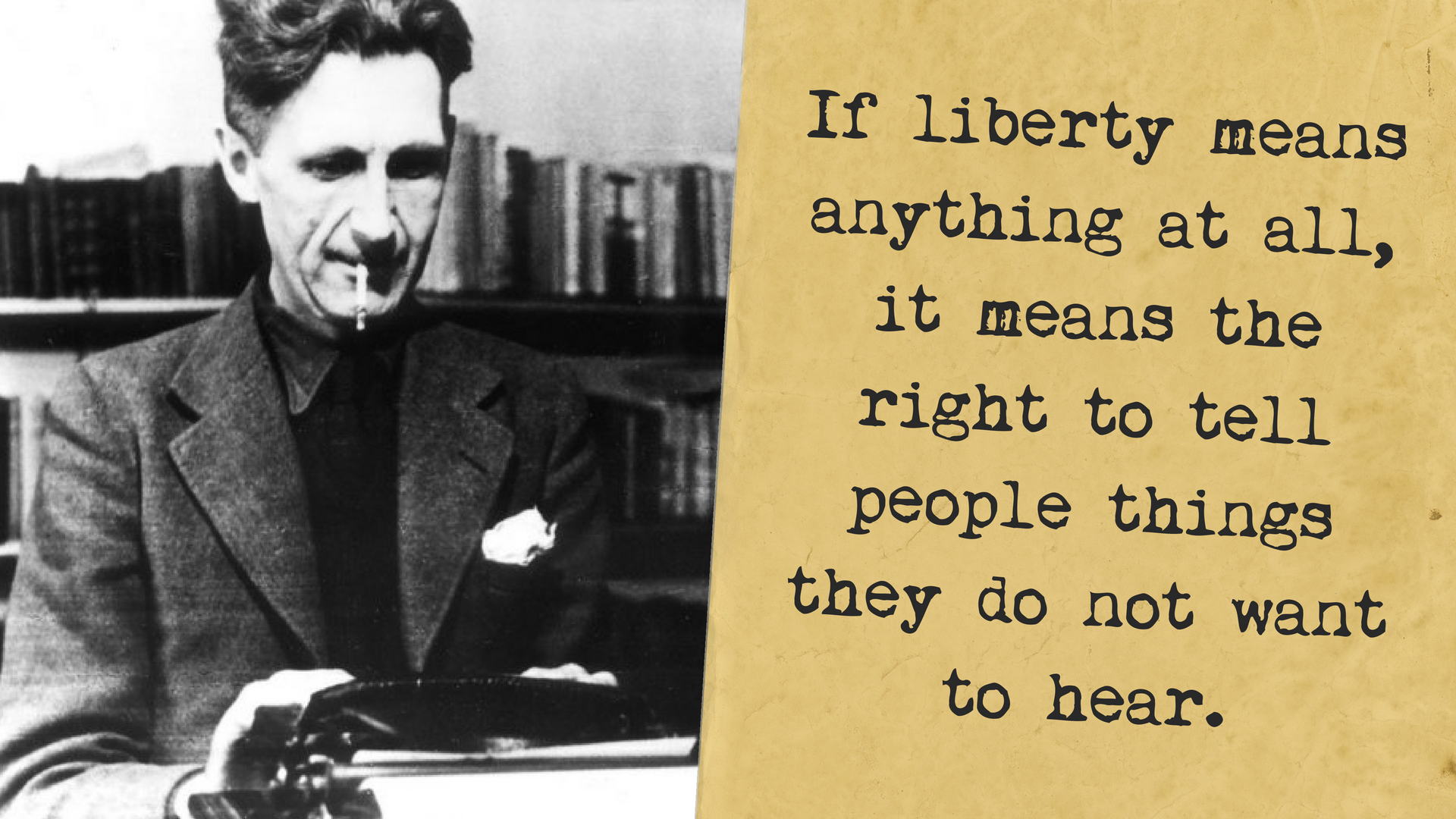
This is not remotely a new problem. George Orwell, in his 1944 essay, What is Fascism? set out the ludicrous prolixity with which the term had already been used. The problem has not got any better since.

A particularly useless contribution to the what is fascism? question is Umberto Eco’s Ur-Fascism essay, which does what so many participants do — take their preferred framing of politics and forces fascism into it. This is a common sin of political taxonomies. Robin Corey, for example, does it in his discussion of conservative thinkers. He comes from a political tradition centred around notions of equality. One opposed by conservatives. Who he therefore portrays them as motivated by concern for inequality.

This is an example of the ideologue’s syllogism:
People like me are for x.

Those people over there oppose people like me.


Therefore,

They are against x.
Which, of course does not remotely follow. It is much more likely they are for y more than they are for x. Indeed, they may simply rate y more highly than they do x. Rating y more highly than they do x does not make them against x. Indeed, they may be at least somewhat in favour of x. They are just less concerned about it, and much more concerned for something else, than are folk like you. Which may, indeed, lead them to oppose folk like you, if you rate x more highly than they do y.

For instance, conservatives typically focus on, and value, order and heritage. That leads them to rate those things more highly than equality and to significantly reduce what they are prepared to give up to achieve any specific form of equality. It does not mean they are against all forms of equality and certainly does not place questions of equality (and inequality) at the centre of their world view.

The ideologue’s syllogism also operates in reverse:
People like me are against x.

Those people over there oppose people like me.


Therefore,

They are for x.
Which also does not follow, but has become a mainstay of ostentatious anti-racism.

It is a great mistake, in trying to understand other world views or ideologies, to presume that they focus on the same issues you do, or that their framing of the world is some variation on, or derivation from, yours. Alas, folk regularly do precisely this. It means one can stay within emotionally comfortable territory, minimises the cognitive effort and so makes for easy and congenial rhetorical plays.

It is still a profoundly analytically deficient way to proceed.

The narrower the range of political opinion has become in academe, the more the ideologue’s syllogism has come to infect social science and scholarship generally. The more you deal with folk with similar viewpoints to oneself, the more alien people of different viewpoints are going to become and the more unopposed the use of the ideologue’s syllogism is going to be. If you literally never meet someone who speaks up for a particular viewpoint at conferences or in common rooms, then your understanding of such viewpoints is likely to be swallowed up by what is collectively congenial rather than what is true.

In contemporary society, this is aggravated by having a deeply Gesellschaft (dispersed networks based around formal structures) academe living quite different lives than do the far more Gemeinschaft (highly localised and personalised connections) working class.

Academics typically operate on the basic of transactional networks enmeshed within formal institutions run by folk like them that are not based on specific localities. They are David Goodhart’s Anywheres: happy to live anywhere with a congenial cafe culture, able to maintain and develop their networks irrespective of the specific locality they live in. They take this to be the natural and sensible way to live and presume all modern societies are basically formal-transactional, and so Gesellschaft.

This is simply false. Many folk live lives deeply based around their specific locality. A locality within which they have built a life-time investment in a dense network of local connections. Those connections form what anthropologists call their relational wealth, and economist call social capital (and then, alas, generally analyse in transactional terms, though Glenn Loury is a notable exception to this trend). Those connections provide a sense of place and identity, and a protective buffer against adversity. Such folk are Somewheres who live largely Gemeinschaft lives.

Anything that breaks up or otherwise degrades those local connections imposes major psychic and social costs on them. One that transaction analysis is unlikely to even notice, let alone attempt to quantify. In particular, fraying those local connections can profoundly degrade their capacity to have any control over their lives and the future of their local community.

When you can command little or no capital, social capital (or its lack) looms much larger in your life and prospects. It is, for instance, why social capital (aka relational wealth) looms so large in the lives of forager populations.

One way to undermine social capital is to set it against itself. The systematic failure to effectively police African-American urban communities means that the resulting low homicide-clearance rates (and so high rates of homicide) leads to folk, particularly young males, trying to generate the social capital of respect as a protective measure. This leads to patterns both predatory and protective (such as street gangs) that set the social capital of those communities against themselves, profoundly undermining the development possibilities within those communities.

Note, this is not a consequence of being “black” as African-Americans and Euro-Americans in rural areas have the same homicide death rates. The more urban the area, the higher the difference in homicide death rates, because the more the effective provision of policing can be racially coded and the more deleterious the effects of failing to provide sufficiently effective policing is.

The higher homicide death rates among African-Americans is, as it has always been, an artifice of American public policy. One has to understand, in Glenn Loury’s words, that relations precede transactions in order to fully grasp these dynamics and their (profound) knock-on effects.

Migration as test case
The failure to understand the importance of locality-based connections is a major reason why mainstream economic analysis of migration is almost ludicrously inadequate. It is a bunch of Gesellschaft academics and professionals applying transaction analysis in a way that pays no attention to, and so almost completely fails to value, local connections. Local connections that are most certainly degraded by mass migration.

This capacity to disrupt, degrade and replace local connections also means that mass migration is an excellent divide-and-dominate mechanism. This was true in colonial times in places such as Fiji, the West Indies, Sri Lanka and East Africa. It is no less true in London, Paris, Chicago and New York.

(NB: Despite their much higher levels of immigration than Europe, the UK or US, Australia and Canada are somewhat different cases. They have effective border control and their migrant intake is highly varied. This greatly increases the assimilative effect, because all the incoming groups are sufficiently small that absorbing the patterns of the majority becomes much more likely. Also, at least in Australia, the existing population was already unusually mobile. Even so, in Australia, opinion poll support for migration increased notably after stronger border control measures were implemented.)

Such pervasive failure to understand the realities and concerns of those living Gemeinschaft lives means that opposition to migration is therefore slotted into a congenial racism-and-xenophobia framing. That way, holders of capital, especially holders of human-and-cultural capital, get to self-righteously pursue their divide-and-dominate migration policies. Moreover, as holders of capital, they benefit from migration way more than providers of labour do. (Even if, under some highly debatable assumptions, there is a net economic gain to resident workers, it is dwarfed by the gains to the holders of capital, thereby further helping to entrench domination of politics by holders of various forms of capital.)

Self-righteous pursuit of self-serving class and status interests has generally become the defining feature of modern progressivism. With migration being the textbook example.

This why Gesellschaft academics, intellectuals and professionals are often so hopeless at understanding the national populist upsurge resulting from the political and cultural disenfranchisement of working class voters. The holders of human-and-cultural capital have essentially taken over centre-left political parties, turning mainstream party politics into a contest between various types of capital, a process well documented and analysedby French political economy Thomas Piketty. Hence, the working class has become increasingly political homeless. With, in voluntary voting jurisdictions, the falling voting participation to match.

It is not surprising that one of the better books on national populism is co-authored by an academic of working class background who still has a lot of working class friends.

This disenchantment is aggravated by workers’ quite rational angsts about mass migration, which is generally not in their interests (but generally is in the interests of holders of both commercial and human-and-cultural capital), being denied legitimate expression or outlet within “acceptable” mainstream politics. Especially as the massively expanded human-and-capital class has increasingly reached for the standard lever of social dominance of every such class in human history: control over the levers of public legitimacy.

Submit-or-be-stigmatised dominance plays
At the core of the contemporary reaching for social dominance through control of public-legitimacy is a submit-or-be-stigmatised choice. Either you submit to claims that are not true (e.g. “men have periods”) or you get set up for stigmatisation (“transphobe!”).

Trans-activism and trans-ideology is particularly useful for this social dominance strategy. It involves a set of phenomena with a great deal of complexity. It can be targeted at minors (adolescents, particularly adolescent girls, are a very suggestible group). It has a civil rights patina (and civil rights campaigns have acquired a strong presumption of moral correctness). It invokes claims about basic aspects of human existence that are nuts, but which dissent from gets treated as bigotry. (As you can be presented as opposing civil rights of an oppressed and marginalised group.)

The structure of misrepresentation and delusion starts with the term gender dysphoria, which is, as evolutionary biologist Heather Heying has noted, itself a mislabelling. Gender dysphoria is, for example, being a tomboy (you don’t conform to the expected behaviour patterns). What trans folk typically have is sex dysphoria (you are alienated from the physical sex of your body).

Trans and “gender identity” is just an example, a particularly useful-for-the-dominance-strategy example, of a much wider pattern. Various positions are set up as markers of moral correctness. The willingness to ignore contrary evidence (or contradictions between such positions) shows commitment to the collective status strategy; that you are sound, that you are “one of us”; one of the “good, smart people”. A strategy that gains power through forcing others to submit or be stigmatised. It is a strategy of dominance through collective gaslighting.

A fading mainstream media feeds the strategy by seeking attention-holding narratives that give folk a righteous illusion of being informed while making it clear who you should despise. Information-economising righteousness as an attention-grabbing strategy. By what is, or is not reported, and how, media folk who embrace the status strategy provide information management services to support the strategy. Hence the pressure that is mounted against any outlet that fails to conform.

While trans issues has become the cutting edge of the strategy of domineering gaslighting, migration has long since been established as central to the strategy. You don’t like the way mass migration is fracturing your local community? Racist! Xenophobe! You are worried about the well-documented cases of overwhelmingly Muslim gangs systematically preyingon under-age girls? Islamophobe! Etc.

A profoundly dishonest public discourse is set up, generating expanding levels of anger and resentment that are not permitted to be treated as anything other than manifestations of bigotry. For so treating dissent not only feeds the strategy, it is required for it. If it is legitimate to dissent from a claim, then that claim is not a marker of moral righteousness.

The dynamics of elite over-supply

As those credentialed in human-and-cultural capital have become massively over-supplied by a bloated higher education sector, the use of the public legitimacy lever for prestige, dominance and career purposes has become ever more frenetic. In particular, a metastasising structure of linguistic taboos has become a vicious and expanding mechanism of social dominance, used to unseat older cohorts within their own class in favour of younger graduates well-trained in proficiency in such self-aggrandising status plays. Though they are often much less well-trained in historical understanding or analytical capacity that gets in the way of such status plays.

The operative selection has been for status-efficiency, not genuine understanding of social dynamics. Being wrong about general patterns of social dynamics has much weaker feedback effects than does being well-versed in the various status-plays. Hence the latter is what is being selected for.

All this has left the working class increasingly politically and culturally disenfranchised. This is a world where, for instance, almost half of Britons do not believe that the BBC represents their values, only a third of Britons believe it does, with only 4 per cent believing it has recently come closer to their views.

This political and cultural disenfranchisement has been aggravated as the status-and-social-dominance strategy, focused on ever more complex linguistic taboos, cuts the blunt vulgarity of working class speech out of anything even remotely politically acceptable. Add in the costs and dislocations of globalisation, and working class voters have much to be disenchanted about.

And so national populism
A significant, politically disenfranchised, voting bloc is not going to remain so forever. Which is where national populism comes in. It is culturally oppositional to increasingly intolerant and self-aggrandising cultural politics coming from the “cultural commanding heights” of Western societies. National populism is also anti-immigration, because that is where there are votes to be had.

There is at least one similar political dynamic to the interwar politics that saw the rise of Italian Fascism and German Nazism. Neither Italian Fascism nor German Nazism would have become other than fringe political movements except for the rational fear of Leninism in the first case and of Stalinism in the second.

Similarly, national populism would never be able to get anywhere without the sneering, intolerant, self-righteous cultural politics that finds -ists and -phobes everywhere. That views itself as so wonderful because what it opposes is so vile. The product of an arrogant and self-aggrandising human-and-cultural capital class that avidly pushes the disenfranchising of (understandable and rational) opposition to mass migration.

The response to the rise of national populism has been to (1) denounce it as fascist and Nazi, (2) denounce it as racist and xenophobic, (3) denounce it as anti-democratic. In other words, to double down on we-are-so-wonderful-because-those-who-oppose-us-are-so-vile, sneering, self-righteous, self-aggrandising “we own morality” so ostentatiously well-intentioned, cultural politics that did so much to generate national populism in the first place.

Are the national populist movements generally illiberal and authoritarian? Yes. Does that make them anti-democratic? Not in itself no. In fact, as functionally the central point of democracy is to give the working class the vote, national populist movements are an expression of both demotic and democratic politics.

As citizenship is the only mechanism that has systematically provided the working class a serious say in politics — both in the sense of entitling them to a say and a vote and in the sense of being rooted in local connections — the systematic devaluing of citizenship by human-and-capital class politics is a more serious threat to democracy than national populism. Both because said devaluing has far more institutional and intellectual reach and because the sought control of public legitimacy explicitly degrades the right to have your say. The control-of-public-legitimacy weapon of finding speech “offensive” is a weapon against freedom of thought and speech, against democracy and against science because you cannot have any of these things (except as anodyne rituals) without offending people.

Increasingly, merely being a citizen does not give you any right to express yourself or be heard. On the contrary, acting against the burgeoning social taboos increasingly puts career, employment and livelihood at risk.

What is fascism?
If national populism is something different than fascism or Nazism, that brings us to the question of what is fascism? (And what is Nazism?)

Just as “woke progressivism” is not Leninism or Stalinism, even though there are some shared ideological roots and it increasingly does embrace a Jacobin model of politics (no restriction of the means of political action, no restriction on the ambit of political action), so national populism is not Fascism or Nazism reborn. That which national populism is opposing is different in crucial aspects from what Fascism and Nazism were opposing. This does much to make national populism different from either Fascism or Nazism in crucial respects.

There are also two large historical reasons why national populism is so different. The first is because it is not operating in the two decades after the 1914–1918 Great War and so within a time with mass living experience of the mass death and mass war experience of the trenches. The second is because it is operating after the Second World War.

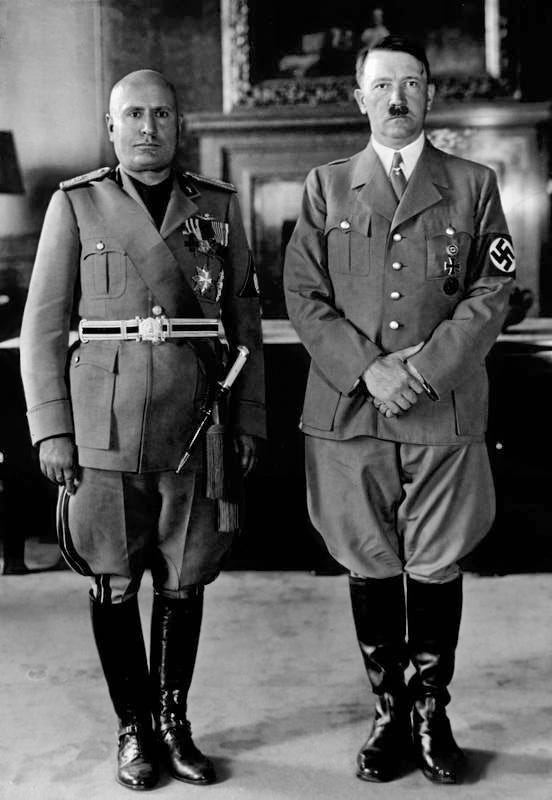
The first matters because the binding experience of fighting and surviving the trenches was crucial to the appeal of both Fascism and Nazism in general and of Mussolini and Hitler in particular. They were both war heroes and veterans of the trenches who played on, and to, that status.

We are so used to thinking of the horrors of trench warfare that we generally fail to grasp the bonding effect of surviving horror. We are such peaceful societies we often have difficulty understanding the binding exhilaration of combat. Yet that binding sense of shared agency is precisely what Fascism and Nazism focused on and appealed to. It is not remotely coincidental that both Fascism and Nazism had paramilitary forces, that Mussolini and Hitler both regularly wore uniforms, that both movements adopted military pageantry.

Fascism evoked that binding sense of shared agency in the name of the (Italian) nation, Nazism did so in the name of Aryan race. But they both evoked it, again and again and again. Not only in their rhetoric, but also in their organisational structures, and in their public pageantry and rituals. With the highly militarised nature of their politics — in organisation, pageantry, ritual and rhetoric — directly invoking the context in which so many had gained a sense of shared agency and which provided the model for the transformation of politics and society. Though the Nazi project of racial purification and imperial dominance required far more social transformation (and foreign aggrandisement) than did (the rather less coherent) Fascist project of national greatness.

Which brings us to very clear differences between national populism compared to Fascism and Nazism. No paramilitaries, no uniforms, no military pageantry and rituals, no fetishising of military action and organisation. Nor is there any systematic denunciation of democracy nor extolling of replacement of democracy. All of which means, of course, that national populism is neither Fascist nor Nazi.

Why the lack of such things? Because there is not a critical mass of veterans. Because its leaders are not war heroes. Because they are not responding to a waves of violent revolutions as occurred during and after the Great War. Because Fascism and Nazism were profoundly discredited by losing the Second World War and the crimes of Nazism.

Embracing Fascism and Nazism is now not a defence of heritage, but a denial of it.

The embracing of the military as an ideal of social action is not incidental to Fascism or Nazism. It is central to both. Without it, one does not have Fascism or Nazism. This is why essays such as Umberto Eco’s Ur Fascism fail. They impose their own ideological framings on movements that are orthogonal to them. Umberto Eco wants to take Fascism out of history and turn into a general category of authoritarian traditionalism, which both predated Fascism (e.g. Admiral Horthy’s regime in Hungary) and extends well beyond it.
Fascism: a movement that seeks to create a sense of binding agency centred on nation through pervasive military organisation, pageantry and ritual, embodied in an dictatorial leadership structure that replaces democratic politics.
Nazism: a movement that seeks to create a sense of binding agency via a socially purifying conception of race operating through pervasive military organisation, pageantry and ritual, embodied in an dictatorial leadership structure that replaces democratic politics, with the purpose of creating Lebensraum for that purified race.

So, Fascism and Nazism are movements that have some clear similarities with each other but are definitely not the same. As their very different trajectories in power demonstrated.

It is also clear that Nazism went way beyond mere racism. Hence the speciousness of using Auschwitz as the definitive icon of racism. (It is even more specious to use it as an icon of nationalism.)

By contrast, using the gulag as an icon of Marxism is rather more reasonable, as brutal labour camps have been a persistent feature of Communist regimes. As the People’s Republic of China and North Korea both continue to demonstrate.

That those who engage in waving the icon of Auschwitz about are often much less interested in the lessons of the gulag says a lot about them, rather less about Auschwitz. Even more as so much that made Nazism so horrific was enabled by institutional structures and rhetorical absolutism that were adapted from, or otherwise similar to, Leninism and Stalinism. A similarity that manifested precisely because the Nazi project of transformation was on a similar scale to the Marxist one. Even today, the People’s Republic of China is institutionally far more like Nazi Germany than either is like any Western democracy.

Nazism and Fascism are manifestations of history. They are not archetypes of evil that continue to manifest across time and space. However much it may be rhetorically convenient for some to think so.

Revealing vignette
In a recent online discussion with evolutionary biologist Bret Weinstein, academic, Muslim and person of colour Irshad Manji relayed a very revealing vignette. In 2009, she had gone on a book tour across the American heartland promoting her book calling for a reformed Islam. She kept hearing the question “why do they hate us?” Folk in the US heartland were not asking why Muslims hate them, they were asking why people (particularly highly educated people) on the East Coast of the US hated them.

If you want an example of the progressive cultural politics of hatred and contempt, The Stranger columnist Dan Savage’s 2004 essay “The Urban Archipelago” expresses it very clearly.

When Irshad Manji got back to New York, her NYU dean asked her how much Islamophobia had she had to ward off. Not whether she had experienced the same, that was simply presumed. In fact, she had experienced no Islamophobia or racism that she could discern. Her dean was operating on a malignant fantasy of heartland US, one that so much of academe and mainstream media is happy to create and relay.

That is, of course, precisely the cultural politics that generated the responses that saw Donald Trump win the Republican nomination and then the Electoral College, and so the US Presidency. Cultural politics that has continued to be double-downed on.

Trump was always likely to prove to be what he turned out to be: an unreliable champion too chaotic in his political management to be a successful President. He was also, very clearly, whatever his (many, many) flaws neither a fascist nor a nazi.

Trump was far more symptom than cause. And the cultural politics that produced him as a counter response is getting worse, rather than better. Playing the fascist! fascist! Hitler reborn! game is specious and toxic and shows how so many contemporary progressives are like the Bourbons of old: they forget nothing and they learn nothing. The pleasures of self-righteous contempt for masses of one’s fellow citizens are too great, and the demands of a toxic, but industrial-strength, status-and-dominance strategy too powerful.

They dominate the cultural commanding heights of Western societies but nothing unfortunate that happens in the culture is ever their fault. They have no wisdom, but apparently endless amounts of self-righteous narcissism. Things are going to get worse before they get better.

[Cross-posted from Medium.]