Showing posts with label fascism. Show all posts

Tuesday, June 1, 2021

What is (and isn't) fascism?

Moving beyond political swear words (and grappling with very different life experiences).


Trying to define fascism is possibly a pointless exercise, as it has long since largely lost any specific meaning, becoming a political swearword used for denouncing those you disagree with and establishing how morally wonderful and heroic you are for being against such vile folk. It thus involves equal parts political slander and narcissistic self-promotion.

The more one is addicted to slandering those you oppose, and to narcissistic self-aggrandisement, the more freely one throws about the term fascist. In our time, given the dramatic lack of actual fascists (or Nazis), outside of the political fringe, constant use of the term fascist is an almost perfect indicator of self-serving political bad faith.

This is not remotely a new problem. George Orwell, in his 1944 essay, What is Fascism? set out the ludicrous prolixity with which the term had already been used. The problem has not got any better since.

A particularly useless contribution to the what is fascism? question is Umberto Eco’s Ur-Fascism essay, which does what so many participants do — take their preferred framing of politics and forces fascism into it. This is a common sin of political taxonomies. Robin Corey, for example, does it in his discussion of conservative thinkers. He comes from a political tradition centred around notions of equality. One opposed by conservatives. Who he therefore portrays them as motivated by concern for inequality.

This is an example of the ideologue’s syllogism:
People like me are for x.

Those people over there oppose people like me.


Therefore,

They are against x.
Which, of course does not remotely follow. It is much more likely they are for y more than they are for x. Indeed, they may simply rate y more highly than they do x. Rating y more highly than they do x does not make them against x. Indeed, they may be at least somewhat in favour of x. They are just less concerned about it, and much more concerned for something else, than are folk like you. Which may, indeed, lead them to oppose folk like you, if you rate x more highly than they do y.

For instance, conservatives typically focus on, and value, order and heritage. That leads them to rate those things more highly than equality and to significantly reduce what they are prepared to give up to achieve any specific form of equality. It does not mean they are against all forms of equality and certainly does not place questions of equality (and inequality) at the centre of their world view.

The ideologue’s syllogism also operates in reverse:
People like me are against x.

Those people over there oppose people like me.


Therefore,

They are for x.
Which also does not follow, but has become a mainstay of ostentatious anti-racism.

It is a great mistake, in trying to understand other world views or ideologies, to presume that they focus on the same issues you do, or that their framing of the world is some variation on, or derivation from, yours. Alas, folk regularly do precisely this. It means one can stay within emotionally comfortable territory, minimises the cognitive effort and so makes for easy and congenial rhetorical plays.

It is still a profoundly analytically deficient way to proceed.

The narrower the range of political opinion has become in academe, the more the ideologue’s syllogism has come to infect social science and scholarship generally. The more you deal with folk with similar viewpoints to oneself, the more alien people of different viewpoints are going to become and the more unopposed the use of the ideologue’s syllogism is going to be. If you literally never meet someone who speaks up for a particular viewpoint at conferences or in common rooms, then your understanding of such viewpoints is likely to be swallowed up by what is collectively congenial rather than what is true.

In contemporary society, this is aggravated by having a deeply Gesellschaft (dispersed networks based around formal structures) academe living quite different lives than do the far more Gemeinschaft (highly localised and personalised connections) working class.

Academics typically operate on the basic of transactional networks enmeshed within formal institutions run by folk like them that are not based on specific localities. They are David Goodhart’s Anywheres: happy to live anywhere with a congenial cafe culture, able to maintain and develop their networks irrespective of the specific locality they live in. They take this to be the natural and sensible way to live and presume all modern societies are basically formal-transactional, and so Gesellschaft.

This is simply false. Many folk live lives deeply based around their specific locality. A locality within which they have built a life-time investment in a dense network of local connections. Those connections form what anthropologists call their relational wealth, and economist call social capital (and then, alas, generally analyse in transactional terms, though Glenn Loury is a notable exception to this trend). Those connections provide a sense of place and identity, and a protective buffer against adversity. Such folk are Somewheres who live largely Gemeinschaft lives.

Anything that breaks up or otherwise degrades those local connections imposes major psychic and social costs on them. One that transaction analysis is unlikely to even notice, let alone attempt to quantify. In particular, fraying those local connections can profoundly degrade their capacity to have any control over their lives and the future of their local community.

When you can command little or no capital, social capital (or its lack) looms much larger in your life and prospects. It is, for instance, why social capital (aka relational wealth) looms so large in the lives of forager populations.

One way to undermine social capital is to set it against itself. The systematic failure to effectively police African-American urban communities means that the resulting low homicide-clearance rates (and so high rates of homicide) leads to folk, particularly young males, trying to generate the social capital of respect as a protective measure. This leads to patterns both predatory and protective (such as street gangs) that set the social capital of those communities against themselves, profoundly undermining the development possibilities within those communities.

Note, this is not a consequence of being “black” as African-Americans and Euro-Americans in rural areas have the same homicide death rates. The more urban the area, the higher the difference in homicide death rates, because the more the effective provision of policing can be racially coded and the more deleterious the effects of failing to provide sufficiently effective policing is.

The higher homicide death rates among African-Americans is, as it has always been, an artifice of American public policy. One has to understand, in Glenn Loury’s words, that relations precede transactions in order to fully grasp these dynamics and their (profound) knock-on effects.

Migration as test case
The failure to understand the importance of locality-based connections is a major reason why mainstream economic analysis of migration is almost ludicrously inadequate. It is a bunch of Gesellschaft academics and professionals applying transaction analysis in a way that pays no attention to, and so almost completely fails to value, local connections. Local connections that are most certainly degraded by mass migration.

This capacity to disrupt, degrade and replace local connections also means that mass migration is an excellent divide-and-dominate mechanism. This was true in colonial times in places such as Fiji, the West Indies, Sri Lanka and East Africa. It is no less true in London, Paris, Chicago and New York.

(NB: Despite their much higher levels of immigration than Europe, the UK or US, Australia and Canada are somewhat different cases. They have effective border control and their migrant intake is highly varied. This greatly increases the assimilative effect, because all the incoming groups are sufficiently small that absorbing the patterns of the majority becomes much more likely. Also, at least in Australia, the existing population was already unusually mobile. Even so, in Australia, opinion poll support for migration increased notably after stronger border control measures were implemented.)

Such pervasive failure to understand the realities and concerns of those living Gemeinschaft lives means that opposition to migration is therefore slotted into a congenial racism-and-xenophobia framing. That way, holders of capital, especially holders of human-and-cultural capital, get to self-righteously pursue their divide-and-dominate migration policies. Moreover, as holders of capital, they benefit from migration way more than providers of labour do. (Even if, under some highly debatable assumptions, there is a net economic gain to resident workers, it is dwarfed by the gains to the holders of capital, thereby further helping to entrench domination of politics by holders of various forms of capital.)

Self-righteous pursuit of self-serving class and status interests has generally become the defining feature of modern progressivism. With migration being the textbook example.

This why Gesellschaft academics, intellectuals and professionals are often so hopeless at understanding the national populist upsurge resulting from the political and cultural disenfranchisement of working class voters. The holders of human-and-cultural capital have essentially taken over centre-left political parties, turning mainstream party politics into a contest between various types of capital, a process well documented and analysedby French political economy Thomas Piketty. Hence, the working class has become increasingly political homeless. With, in voluntary voting jurisdictions, the falling voting participation to match.

It is not surprising that one of the better books on national populism is co-authored by an academic of working class background who still has a lot of working class friends.

This disenchantment is aggravated by workers’ quite rational angsts about mass migration, which is generally not in their interests (but generally is in the interests of holders of both commercial and human-and-cultural capital), being denied legitimate expression or outlet within “acceptable” mainstream politics. Especially as the massively expanded human-and-capital class has increasingly reached for the standard lever of social dominance of every such class in human history: control over the levers of public legitimacy.

Submit-or-be-stigmatised dominance plays
At the core of the contemporary reaching for social dominance through control of public-legitimacy is a submit-or-be-stigmatised choice. Either you submit to claims that are not true (e.g. “men have periods”) or you get set up for stigmatisation (“transphobe!”).

Trans-activism and trans-ideology is particularly useful for this social dominance strategy. It involves a set of phenomena with a great deal of complexity. It can be targeted at minors (adolescents, particularly adolescent girls, are a very suggestible group). It has a civil rights patina (and civil rights campaigns have acquired a strong presumption of moral correctness). It invokes claims about basic aspects of human existence that are nuts, but which dissent from gets treated as bigotry. (As you can be presented as opposing civil rights of an oppressed and marginalised group.)

The structure of misrepresentation and delusion starts with the term gender dysphoria, which is, as evolutionary biologist Heather Heying has noted, itself a mislabelling. Gender dysphoria is, for example, being a tomboy (you don’t conform to the expected behaviour patterns). What trans folk typically have is sex dysphoria (you are alienated from the physical sex of your body).

Trans and “gender identity” is just an example, a particularly useful-for-the-dominance-strategy example, of a much wider pattern. Various positions are set up as markers of moral correctness. The willingness to ignore contrary evidence (or contradictions between such positions) shows commitment to the collective status strategy; that you are sound, that you are “one of us”; one of the “good, smart people”. A strategy that gains power through forcing others to submit or be stigmatised. It is a strategy of dominance through collective gaslighting.

A fading mainstream media feeds the strategy by seeking attention-holding narratives that give folk a righteous illusion of being informed while making it clear who you should despise. Information-economising righteousness as an attention-grabbing strategy. By what is, or is not reported, and how, media folk who embrace the status strategy provide information management services to support the strategy. Hence the pressure that is mounted against any outlet that fails to conform.

While trans issues has become the cutting edge of the strategy of domineering gaslighting, migration has long since been established as central to the strategy. You don’t like the way mass migration is fracturing your local community? Racist! Xenophobe! You are worried about the well-documented cases of overwhelmingly Muslim gangs systematically preyingon under-age girls? Islamophobe! Etc.

A profoundly dishonest public discourse is set up, generating expanding levels of anger and resentment that are not permitted to be treated as anything other than manifestations of bigotry. For so treating dissent not only feeds the strategy, it is required for it. If it is legitimate to dissent from a claim, then that claim is not a marker of moral righteousness.

The dynamics of elite over-supply

As those credentialed in human-and-cultural capital have become massively over-supplied by a bloated higher education sector, the use of the public legitimacy lever for prestige, dominance and career purposes has become ever more frenetic. In particular, a metastasising structure of linguistic taboos has become a vicious and expanding mechanism of social dominance, used to unseat older cohorts within their own class in favour of younger graduates well-trained in proficiency in such self-aggrandising status plays. Though they are often much less well-trained in historical understanding or analytical capacity that gets in the way of such status plays.

The operative selection has been for status-efficiency, not genuine understanding of social dynamics. Being wrong about general patterns of social dynamics has much weaker feedback effects than does being well-versed in the various status-plays. Hence the latter is what is being selected for.

All this has left the working class increasingly politically and culturally disenfranchised. This is a world where, for instance, almost half of Britons do not believe that the BBC represents their values, only a third of Britons believe it does, with only 4 per cent believing it has recently come closer to their views.

This political and cultural disenfranchisement has been aggravated as the status-and-social-dominance strategy, focused on ever more complex linguistic taboos, cuts the blunt vulgarity of working class speech out of anything even remotely politically acceptable. Add in the costs and dislocations of globalisation, and working class voters have much to be disenchanted about.

And so national populism
A significant, politically disenfranchised, voting bloc is not going to remain so forever. Which is where national populism comes in. It is culturally oppositional to increasingly intolerant and self-aggrandising cultural politics coming from the “cultural commanding heights” of Western societies. National populism is also anti-immigration, because that is where there are votes to be had.

There is at least one similar political dynamic to the interwar politics that saw the rise of Italian Fascism and German Nazism. Neither Italian Fascism nor German Nazism would have become other than fringe political movements except for the rational fear of Leninism in the first case and of Stalinism in the second.

Similarly, national populism would never be able to get anywhere without the sneering, intolerant, self-righteous cultural politics that finds -ists and -phobes everywhere. That views itself as so wonderful because what it opposes is so vile. The product of an arrogant and self-aggrandising human-and-cultural capital class that avidly pushes the disenfranchising of (understandable and rational) opposition to mass migration.

The response to the rise of national populism has been to (1) denounce it as fascist and Nazi, (2) denounce it as racist and xenophobic, (3) denounce it as anti-democratic. In other words, to double down on we-are-so-wonderful-because-those-who-oppose-us-are-so-vile, sneering, self-righteous, self-aggrandising “we own morality” so ostentatiously well-intentioned, cultural politics that did so much to generate national populism in the first place.

Are the national populist movements generally illiberal and authoritarian? Yes. Does that make them anti-democratic? Not in itself no. In fact, as functionally the central point of democracy is to give the working class the vote, national populist movements are an expression of both demotic and democratic politics.

As citizenship is the only mechanism that has systematically provided the working class a serious say in politics — both in the sense of entitling them to a say and a vote and in the sense of being rooted in local connections — the systematic devaluing of citizenship by human-and-capital class politics is a more serious threat to democracy than national populism. Both because said devaluing has far more institutional and intellectual reach and because the sought control of public legitimacy explicitly degrades the right to have your say. The control-of-public-legitimacy weapon of finding speech “offensive” is a weapon against freedom of thought and speech, against democracy and against science because you cannot have any of these things (except as anodyne rituals) without offending people.

Increasingly, merely being a citizen does not give you any right to express yourself or be heard. On the contrary, acting against the burgeoning social taboos increasingly puts career, employment and livelihood at risk.

What is fascism?
If national populism is something different than fascism or Nazism, that brings us to the question of what is fascism? (And what is Nazism?)

Just as “woke progressivism” is not Leninism or Stalinism, even though there are some shared ideological roots and it increasingly does embrace a Jacobin model of politics (no restriction of the means of political action, no restriction on the ambit of political action), so national populism is not Fascism or Nazism reborn. That which national populism is opposing is different in crucial aspects from what Fascism and Nazism were opposing. This does much to make national populism different from either Fascism or Nazism in crucial respects.

There are also two large historical reasons why national populism is so different. The first is because it is not operating in the two decades after the 1914–1918 Great War and so within a time with mass living experience of the mass death and mass war experience of the trenches. The second is because it is operating after the Second World War.

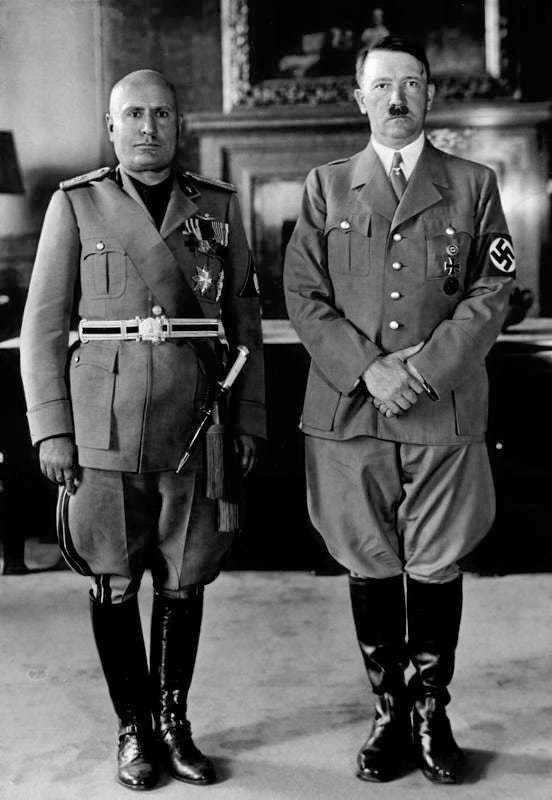
The first matters because the binding experience of fighting and surviving the trenches was crucial to the appeal of both Fascism and Nazism in general and of Mussolini and Hitler in particular. They were both war heroes and veterans of the trenches who played on, and to, that status.

We are so used to thinking of the horrors of trench warfare that we generally fail to grasp the bonding effect of surviving horror. We are such peaceful societies we often have difficulty understanding the binding exhilaration of combat. Yet that binding sense of shared agency is precisely what Fascism and Nazism focused on and appealed to. It is not remotely coincidental that both Fascism and Nazism had paramilitary forces, that Mussolini and Hitler both regularly wore uniforms, that both movements adopted military pageantry.

Fascism evoked that binding sense of shared agency in the name of the (Italian) nation, Nazism did so in the name of Aryan race. But they both evoked it, again and again and again. Not only in their rhetoric, but also in their organisational structures, and in their public pageantry and rituals. With the highly militarised nature of their politics — in organisation, pageantry, ritual and rhetoric — directly invoking the context in which so many had gained a sense of shared agency and which provided the model for the transformation of politics and society. Though the Nazi project of racial purification and imperial dominance required far more social transformation (and foreign aggrandisement) than did (the rather less coherent) Fascist project of national greatness.

Which brings us to very clear differences between national populism compared to Fascism and Nazism. No paramilitaries, no uniforms, no military pageantry and rituals, no fetishising of military action and organisation. Nor is there any systematic denunciation of democracy nor extolling of replacement of democracy. All of which means, of course, that national populism is neither Fascist nor Nazi.

Why the lack of such things? Because there is not a critical mass of veterans. Because its leaders are not war heroes. Because they are not responding to a waves of violent revolutions as occurred during and after the Great War. Because Fascism and Nazism were profoundly discredited by losing the Second World War and the crimes of Nazism.

Embracing Fascism and Nazism is now not a defence of heritage, but a denial of it.

The embracing of the military as an ideal of social action is not incidental to Fascism or Nazism. It is central to both. Without it, one does not have Fascism or Nazism. This is why essays such as Umberto Eco’s Ur Fascism fail. They impose their own ideological framings on movements that are orthogonal to them. Umberto Eco wants to take Fascism out of history and turn into a general category of authoritarian traditionalism, which both predated Fascism (e.g. Admiral Horthy’s regime in Hungary) and extends well beyond it.
Fascism: a movement that seeks to create a sense of binding agency centred on nation through pervasive military organisation, pageantry and ritual, embodied in an dictatorial leadership structure that replaces democratic politics.
Nazism: a movement that seeks to create a sense of binding agency via a socially purifying conception of race operating through pervasive military organisation, pageantry and ritual, embodied in an dictatorial leadership structure that replaces democratic politics, with the purpose of creating Lebensraum for that purified race.

So, Fascism and Nazism are movements that have some clear similarities with each other but are definitely not the same. As their very different trajectories in power demonstrated.

It is also clear that Nazism went way beyond mere racism. Hence the speciousness of using Auschwitz as the definitive icon of racism. (It is even more specious to use it as an icon of nationalism.)

By contrast, using the gulag as an icon of Marxism is rather more reasonable, as brutal labour camps have been a persistent feature of Communist regimes. As the People’s Republic of China and North Korea both continue to demonstrate.

That those who engage in waving the icon of Auschwitz about are often much less interested in the lessons of the gulag says a lot about them, rather less about Auschwitz. Even more as so much that made Nazism so horrific was enabled by institutional structures and rhetorical absolutism that were adapted from, or otherwise similar to, Leninism and Stalinism. A similarity that manifested precisely because the Nazi project of transformation was on a similar scale to the Marxist one. Even today, the People’s Republic of China is institutionally far more like Nazi Germany than either is like any Western democracy.

Nazism and Fascism are manifestations of history. They are not archetypes of evil that continue to manifest across time and space. However much it may be rhetorically convenient for some to think so.

Revealing vignette
In a recent online discussion with evolutionary biologist Bret Weinstein, academic, Muslim and person of colour Irshad Manji relayed a very revealing vignette. In 2009, she had gone on a book tour across the American heartland promoting her book calling for a reformed Islam. She kept hearing the question “why do they hate us?” Folk in the US heartland were not asking why Muslims hate them, they were asking why people (particularly highly educated people) on the East Coast of the US hated them.

If you want an example of the progressive cultural politics of hatred and contempt, The Stranger columnist Dan Savage’s 2004 essay “The Urban Archipelago” expresses it very clearly.

When Irshad Manji got back to New York, her NYU dean asked her how much Islamophobia had she had to ward off. Not whether she had experienced the same, that was simply presumed. In fact, she had experienced no Islamophobia or racism that she could discern. Her dean was operating on a malignant fantasy of heartland US, one that so much of academe and mainstream media is happy to create and relay.

That is, of course, precisely the cultural politics that generated the responses that saw Donald Trump win the Republican nomination and then the Electoral College, and so the US Presidency. Cultural politics that has continued to be double-downed on.

Trump was always likely to prove to be what he turned out to be: an unreliable champion too chaotic in his political management to be a successful President. He was also, very clearly, whatever his (many, many) flaws neither a fascist nor a nazi.

Trump was far more symptom than cause. And the cultural politics that produced him as a counter response is getting worse, rather than better. Playing the fascist! fascist! Hitler reborn! game is specious and toxic and shows how so many contemporary progressives are like the Bourbons of old: they forget nothing and they learn nothing. The pleasures of self-righteous contempt for masses of one’s fellow citizens are too great, and the demands of a toxic, but industrial-strength, status-and-dominance strategy too powerful.

They dominate the cultural commanding heights of Western societies but nothing unfortunate that happens in the culture is ever their fault. They have no wisdom, but apparently endless amounts of self-righteous narcissism. Things are going to get worse before they get better.

[Cross-posted from Medium.]

Thursday, May 10, 2018

Marx at 200 and Robespierre at 260

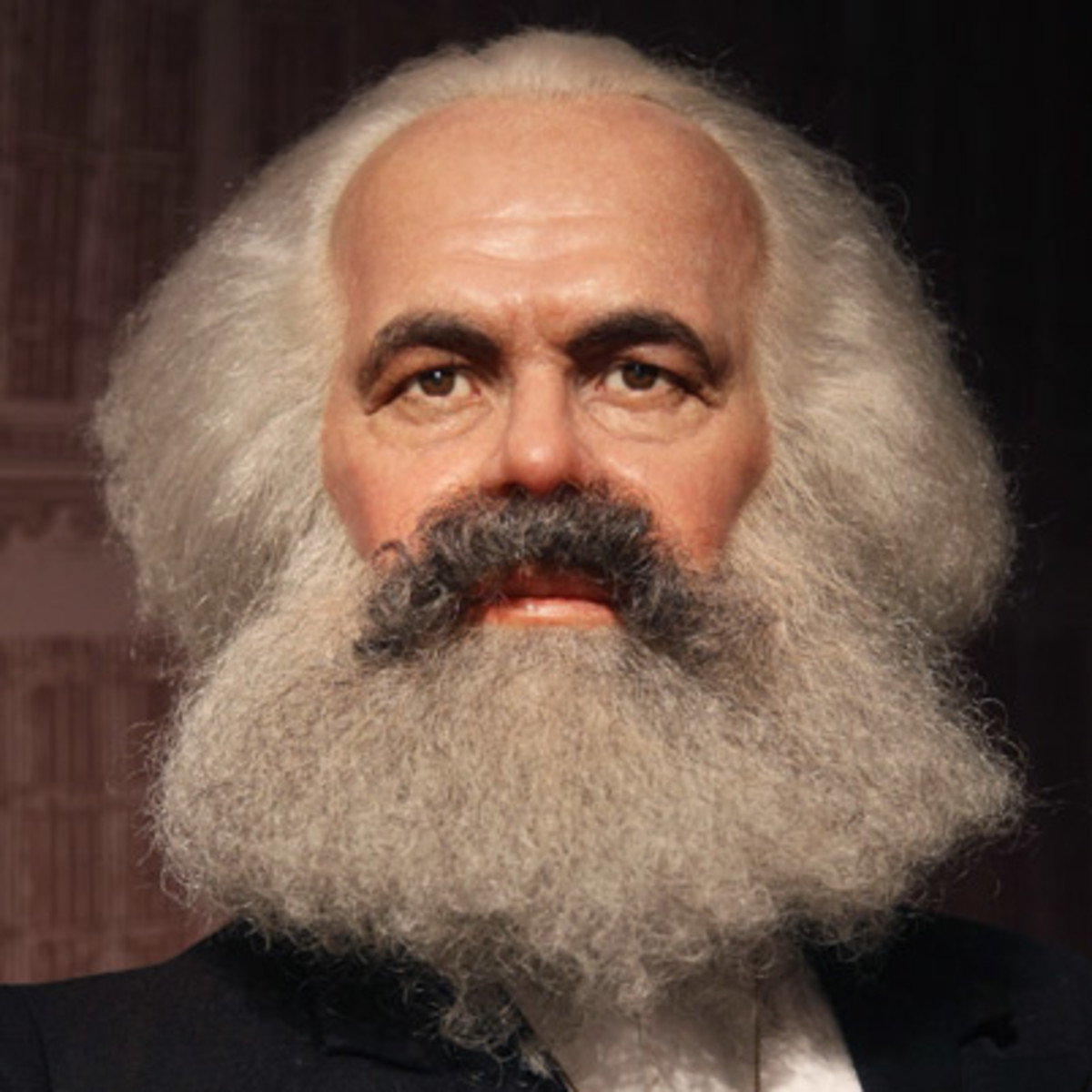
This year is the 200th Anniversary of the birth of Karl Marx (1818-1883). A recent biography of Marx (reviewed here) places him very much as a man of his time. It is a sign of the success of Marx that his legacy is still so debated; it is a sign of his failure that defending Marx involves separating him, and his ideas, from the record of mass murder and tyranny of regimes calling themselves Marxist.

The latter line of apologia has a major problem: the prescient predictions of various of his contemporaries about where his ideas (and his praxis) would lead. If perceptive contemporaries could perceive the potential for disaster in his ideas in advance, it seems a bit otiose to deny the connection in retrospect.

Conclusions becoming premises
Part of the problem is that Marx was not ideologically consistent. His ideas of proper social goals become somewhat more grandiose and totalising over time. So, one can cite earlier writings as a defence against the implications and influence of the later writings. Which leads into the “good intentions” defence—if we cite Marx’s morally engaging statements, we can then claim that clearly he has nothing to do with what was done in his name (see here). Marx, after all, did famously state that he was not a Marxist.

But neither was Freud a Freudian, or Kuhn a Kuhnian and so on. This is the progression pointed out by Etienne Gilson (1884-1978)—the conclusions of the master are the premises of the disciple. Which is a very old pattern. When Philo of Alexandria used Greek natural law theory to effectively re-write the tale of Sodom and Gomorrah (Genesis 19), rejecting the rabbinical oral tradition and proposing a claim that sits poorly with the actual text, one can see both old and new interpretations in his own writing (in On Abraham XXVI-XXIX). Those that followed just took his natural law imposition on the text and dropped the complexities. As can be seen in St John Chrysostom’s homilies on Romans. So, what had been a story about God destroying societies which were anti-moral, which actively punished good behaviour, became a story about how people of the same sex having sex was treason against the purposes of the Creator (hence worthy of death). Which Philo himself, in his polemical war with Greek religious and sexual culture, was clearly just fine with (see Special Laws III: VII).

So, conclusions have consequences. Hence Bakunin (1814-1876) and other contemporaries picking accurately where Marx’s ideas would lead. It is misleading and dangerous to put so much weight on stated intentions, especially moral intentions as it is precisely the making-trumps element of morality which makes it so potentially oppressive. How things are framed (especially how other people are characterised), the means extolled, scale of the purposes embraced: these all matter at least as much, and often rather more, than intentions, however morally engaging they might be. But we live in an age where many people are deeply invested in moral entitlement status games based on their ostentatious moral intentions.

The Left that was
From 1789 to 1991, across the long C19th (1789-1914) and the short C20th (1914-1991), the term Left in politics had broadly consistent referents. The term started off with who sat where in the French National Assembly. The 1789-1991 Left was, in all its forms, a product of the Enlightenment and largely framed its moral and social analysis in terms of class. It was divided between the Radical Enlightenment; those who believed that applied human reason could transform man, that human nature was plastic to applied social action: and the Sceptical Enlightenment; those who believed that human reason could improve human social conditions but nevertheless had to deal with humanity as it was and had been.

This division, and associated (albeit often implicit) claims about human nature, went at least as far back as the Grandee-Leveller Putney Debates (1647) during the English Civil Wars with Henry Ireton (1611-1651) leading the Grandees, and Thomas Rainsborough (1610-1648), leading the Levellers. The antinomian aspirations and totalitarian tendencies of the Radical Enlightenment Left went even further back, to the radical heresy movements so brilliantly analysed by historian Norman Cohn in The Pursuit of the Millennium.

But that the Left did not erupt ex nihilo does not invalidate that there was a coherent Left in European and European-derived politics across the two centuries from 1789 to 1991—a product of the Enlightenment among whom various class-framings of politics and moral action were dominant. That Left has remarkably little in common with contemporary progressivism, as it has abandoned class framings and embraced Post-Enlightenment ideas (often, somewhat over-narrowly, labelled postmodernism). If one resurrected Karl Marx—or, for that matter Lenin (1870-1924) or Keir Hardie (1856-1915)—they would find familiar and congenial remarkably few of the concerns and obsessions of contemporary progressivism.

Conversely, if one resurrected Adolf Hitler (1889-1945), he would absolutely find familiar the concerns of contemporary progressivism. He would, of course, have a somewhat different take (apart from blame-the-Jews and a functional preference for Islam and Muslims over Christianity and Christians) but the concerns of contemporary progressivism (sex, the stories we tell about sex aka gender, sexuality, race, ethnicity, population movements, environmentalism and the valorisation of nature, identity, subjectivity and emotion over reason) were absolutely his concerns. Nor is this some sort of weird outcome; it flows naturally from the reality that the Post-Enlightenment, with its concern for emotion, experience and subjectivity, is the Counter-Enlightenment rebooted and Hitler was the embodiment of the Counter-Enlightenment as a political project.

The Jacobin curse
While I do not agree with anything close to an absolute separation of Marx’s ideas from the history of the attempt to operationalise them, it is still an error to put all the blame on Marx. For there was another figure whose influence on politics across those two centuries, and beyond, has been more disastrous.

That was Maximilien Robespierre (1758-1794) who, along with his political associates, such as Louis Saint-Just (1767-1794), created, not merely as conception but as practice, the Jacobin model of politics. The Jacobin model of politics is politics unlimited in means and unlimited in scope. That, is, politics willing to engage in any level of killing and repression, and willing to expand into any aspect of society and social interaction, to achieve its ends. A model of politics which relies on its sense of profound moral purpose to justify its refusal to accept limits in means and scope and, somewhat more implicitly, relies on its sense of profound social understanding to give the required confidence that what it does will lead where it intends.

That Marx’s ideas were profoundly congenial for the Jacobin model of politics is obvious. They bring together both the sense of profound, trumping moral purpose and the sense of profound understanding of human social dynamics. Lenin very explicitly saw himself as applying Jacobin politics to Marx’s ideas as the necessary way to operationalise them. A bringing together that successfully established the first enduring explicitly Marxist regime and led to, at its height, a third of humanity being ruled by such regimes. A bringing together, furthermore, that many, many intellectuals who regarded themselves as followers of Marx implicitly or explicitly endorsed.

Not all, of course; Rosa Luxemburg (1871-1919) famously demurred. But her murder amidst the failure of the Spartacus uprising both silenced her voice and associated her ideas with failure. And those political Parties which were officially Marxist, but remained committed to democratic praxis, came to abandon Marx’s ideas. Something of a hint there, methinks.

The reality is, Marx’s ideas were ideally suited for the Jacobin temptation and it has been only by acceding to that path that they have come anywhere near implementation. Of course, the conjunction turned out to be nothing like any form of human liberation: a warning in itself. It is, moreover, a general problem: what looks like Morality’s Empire so easily and recurrently becomes Moral Tyranny and then simply Tyranny. Marx’s ideas had particularly weak barriers to that progression. On the contrary, they slid down it oh, so easily.

But the poisonous influence of the Jacobin model extends well beyond the history of Leninism and its offshoots. Italian Fascism and German Nazism both represented the application of the Jacobin model to political projects: in the case of Fascism, to the project of Italian nationalism. In the case of Nazism, to the project of Aryan racial supremacy. If Lenin was Marx+Robespierre, Mussolini was Mazzini+Robespierre and and Hitler was Houston Stewart Chamberlain+Robespierre.

Of the three meldings of the Jacobin model of politics to political projects, Italian Fascism was by far the least morally and humanly disastrous. That was because Giuseppe Mazzini (1805-1872) was by far the most liberal thinker, compared to Marx or Chamberlain (1855-1927), and Italian nationalism was by far the most limited political project of the three.

Hiding from oneself
One of the purposes in the promiscuous use of the term Fascist!, even to claiming that German Nazism (whose victims number in the millions and whose ambitions ignited a world war) and Italian Fascism (whose domestic victims numbered in the hundreds and whose ambitions led to minor wars of opportunistic conquest) were just instances of the same phenomena, morally indistinguishable from each other, is to obscure the fact that, without Nazism, no modern political movement had remotely the record of tyranny and mass murder of various forms of Leninist regimes. It is deeply embarrassing to leave intensive manifestations of the Left as the peak of mass murderous tyranny, hence the endless invocations of Fascism! and of racism as the worst sin ever.

It is even more embarrassing to note that what made Nazism so horrible was not how different it was from the radical Left, but how similar it was. The grandeur of its ambitions for social transformation, the intensity of its mobilisation of society, the depth of its organised penetration of social institutions, all these were far more like the radical Left than any part of the broad non-Left (aka Right).

Nazi Germany institutionally resembled the Soviet Union far more than it did any of the Western democracies. Even now, as the People’s Republic of China retreats from command economics, it increasingly institutionally resembles Nazi Germany, without the Jew-hatred and Lebensraum ambitions (whatever its South China Sea ambitions, barely anyone actually lives there). Though the overseas Chinese communities provide some potential for irredentist politics.

So, it is very expedient for progressivists to shout “Fascism!” a lot and treat racism as the worst-thing-ever; to talk about Marx’s intentions and ignore the prescience of his contemporary critics. And do it even louder so as to obscure the abandonment of the concerns of the Enlightenment Left and the adoption of those of the Counter-Enlightenment, politically personified in Adolf Hitler. With Paul de Man (1919-1983), Heidegger (1889-1976) and Carl Schmitt (1888-1985), not to mention environmentalism, even providing ideological bridges.

A lot of the moral outrage and moral tub-thumping of contemporary progressivism is about hiding unfortunate political resonances and commonalities: above all, from themselves. But they are people obsessed with their sense of moral status and entitlement burbling endlessly on about equality; so there is a lot of cognitive dissonance to be hidden: above all, from themselves.

Is-people versus Ought-people
The history of the Jacobin model, of grand moral intentions and social understandings, gives us plenty of insights and warnings. But that is so only if you are an is-person who thinks that history is what has happened; that human nature is fairly consistent, so history is a source of warning and insight. If you are an ought-person, who elevates moral intentions as the measure of all things, for whom is history is about the glorious imagined and intentioned future, not limited by the constraints of human nature, then this is just a catalogue of past sins with which the well-intentioned need not concern themselves. And so they don’t, except to distance themselves from it.

Which also makes then not the people you want in charge of anything serious, given how many facts and historical lessons they are hiding from; so it is worrying how much they are now in charge of the culturally significant. In their informative and fun How Women Got Their Curves, the authors observe that:
the Second Law of Thermodynamics, which states that entropy or disorder increases in natural systems unless energy is available to counteract this process, applies to organisms no less than to nonliving, physical systems.
And also applies to social systems created by organisms. The assiduous efforts, in the name of morality's empire, to exclude people and concerns from social life, the war on inconvenient facts, the pervasive attack on the wellsprings of culture: folk pursuing such are an increasingly pervasive force for social entropy, and not in any good way.

A certain sense of impending slow disaster seems appropriate, this 200th anniversary of Karl Marx’s birth, 260th anniversary of Robespierre’s birth and 231st anniversary of Robespierre’s election to the Estates-General of the Kingdom of France.

ADDENDA: Branko Milanovic reminds us that, without Engels Marx might have passed into obscurity and without Lenin Marx would have nowhere near the global significance his thought achieved.

[Cross-posted at Skepticlawyer.]

Wednesday, December 20, 2017

Islam as Philosophical Dead End

Classical (622 to c.940) and early medieval Islam was a civilisation and period with a rich philosophical tradition. Yet Islam became a philosophical dead end, an example of how societies, indeed, an entire civilisation, can stop supporting philosophy as a significant autonomous realm of enquiry. Islam is a civilisation where religion swallowed philosophy, with consequences we are still living with.

That Islam as a civilisation developed a rich philosophical tradition is obvious and well-documented. Thinkers writing in Arabic were particularly important in reconciling Aristotelianism with monotheism. Ibn Rushd (Averroes) (1126-1198) in particular was very influential in Latin Christendom. So much so that St Thomas Aquinas (1225-1274), in his writings, would refer to Aristotle (384-322 BC) as The Philosopher and Ibn Rushd (Averroes) as The Commentator.

Yet that rich philosophical tradition dwindled away to vanishing point. It did so as the result of interaction between ideas and social change.

The social dwindling

The social change was the dwindling away of any basis for supporting scholarship and learning outside explicitly Islamic religious schools. The movement to a fief-based military administration reduced administrative bureaucracies, by far the most significant basis for non-religious intellectual life within Islamic societies, while dominance by Turkish-speaking warlords, from the time of the Seljuqs (1037-1153) onwards, led to a surge in ostentatious support for religion by rulers making up for their non-Arabness via ostentatious religious adherence and patronage.

The shock and devastation of the Mongol invasion (much larger and far more traumatic than Crusader seizure of narrow coastal strips), including the sack of Baghdad (1258), the only time the capital of a living Caliph had fallen to non-Muslims, aggravated these trends. The Mongol invasion and conquests, particularly the violent ending of the Abbasid Caliphate, apart from a sad shadow-line in Cairo, both disrupted what non-religious scholarly networks remained and encouraged a retreat into an intensified Islamic identity. These processes are well set out in Lost Enlightenment: Central Asia's Golden Age from the Arab Conquest to Tamerlane by S. Frederick Starr.

The religious trumping
The two philosophy-swallowing ideas developed from the Ash'ari Islamic school, being given their civilisation-winning form by al-Ghazali (c.1058-1111). The moral claim was that revelation was the only ground for ethical judgement. This effectively eliminates moral arguments as the West understands them (indeed, as all the origin civilisations for philosophy—the Hellenic world, northern India and China — understood them). It is why Islamic states are the only ones who have seen fit to issue an adjusted form of the UN's Universal Declaration of Human Rights, the Cairo Declaration on Human Rights in Islam, because all ethical arguments and claims have to be grounded in revelation.

The metaphysical claim is that Allah is the source of all non-human causation. Not merely the ground of causation in the Aristotelian sense, but literally the immediate cause of everything that happens. Allah remakes the world at every moment; what we see as causal patterns are merely the habits of Allah, which Allah can change at any moment.

Unsurprisingly, the dwindling away of philosophy also saw the dwindling away of science within Islam, as intellectual effort was directed back into religion. Especially as law was part of religion and religious scholarship, apart from elements (qanun) allowed to operate in the silences of Sharia.

In this way, Islam pre-eliminates competition to itself from within Islamic society. It does so by eliminating the category of moral arguments beyond itself and allocating all non-human causation to Allah. So the levers to replace religious grounding of social and physical understanding which led to the Western Enlightenment are absent within mainstream Islam, as they have no resting points. Especially as the Quran is held to be the literal word of God, a manifested miracle, written in a single language and, according to mainstream Sunni thought, outside time, so far more insulated from critical scholarship than the Christian scriptures.

Adoption aborted
The expansion of the non-religious intelligentsia from the early C19th onwards that the (much delayed) spread of the printing press and efforts of modernising rulers created in the Middle East appeared to give the basis for Islam as a civilisation to “catch up” with the West. A modernising intelligentsia did develop, but largely as a by-product and support for modernising regimes and states.

This centrally-organised, copycat modernisation largely failed to put down deep roots in Islamic societies. Worse, it became tied to success of those states and regimes. (In some ways, a repeat of what happened to the original wave of reason-based modernisers, the Mu'tazila of Classical Islam: Islam is a civilisation of strong recurring patterns.)

Islamic Enlightenment: the Struggle between Faith and Reason, 1798 to Modern Times by Christopher de Bellaigue provides a history of this modern abortive Enlightenment: an informative and perceptive review is here.

The Islamic world became dominated by fascist-analogue regimes. But defeat in the Dictators’ War (1939-1945) had rather discredited Fascism and the Soviet bloc was willing to supply arms and support to friendly regimes, so socialism became the dominant rhetorical flavour of non-monarchical regimes in the Islamic world. (Note that I mean socialism in its command economy sense rather than its “free-floating good intentions insulated from any failures” sense.)

But Arab socialism fared no better than its alternatives elsewhere; though, being less actually socialist, rather less catastrophically so. In the West, the failure of socialism led to postmodernism and its close associates, such as Critical Theory. In Islam, the failure of socialism led to political Islam (Islamiyya) and to a search for a purified Islam (notably the Salafi and Deobandi movements).

This was somewhat less of a difference than it might appear, as al-Ghazali’s causal analysis was grounded in essentially the same epistemologically sceptical argument about what we can know from observation later developed by Hume (1711-1776), which so influenced Kant (1724-1804) and from there led to postmodernism.

Moreover, Critical Theory permits no moral argument beyond itself, as the purpose of all “proper” intellectual endeavour is to support the struggle against oppression and any critique of that goal is, by definition, illegitimate defence of exploitation and oppression. An attitude which has seeped into the wider society (particularly the "cultural commanding height" industries of media, education, entertainment and IT) to the extent that start-up entrepreneur Sam Altman can report that it is easier to discuss heretical ideas in China (under a Leninist regime) than in Silicon Valley in California.

Monarchy, mosque and military
So both mainstream Islam and PoMo progressivism pre-eliminate competition. In Islam, outside the monarchical societies, the weakness of civil society leaves politics suspended between mosque and military. (The monarchies tend to have richer civil societies precisely because the monarchies both incorporate and balance between mosque and military and failed to wage quite the war on traditional society that the modernising military regimes did.)

The revival of the headscarf both speaks to the power of Islam and the revival of political Islam. (Trying to spin it as some sort of manifestation of female power is pathetic, even given that reveiling has largely been driven by [pdf] expanded education and employment opportunities for women, as it is a response responding to the power of Islamic belief.) That the Islamic world still has significant patches of relatively low literacy rates (especially for women), and (in the case of the Arab world) a strikingly low rate of translation of non-Arabic books, does not help the develop of non-religious thinking and ideas within Islamic civilisation.

What intellectual life there is within Islam remains trapped within the concerns of the early Western Enlightenment—how to replace and overcome religious grounding of social and physical understandings versus how to insulate religion from the pressures of modernity—and remains without the levers that the Western Enlightenment relied on. While there is some dim possibility of a moderate modernising approach developing, Islam is not likely to stop being mostly a philosophical dead-end civilisation any time soon.

[Cross-posted at Skepticlawyer.]

Monday, April 24, 2017

Why there is so much nonsense spouted about fascism

If you are going to invoke the interwar period, particularly the 1930s, please do so intelligently.

By which I mean, non-propagandistically. And by interwar period I mean the phenomenon of fascism and neo-fascism.

Despite self-serving (look at me, I am opposing fascism!) shrieking, there is not a lot of fascism or neo-fascism in contemporary Western politics. Fascists and neo-fascists do, of course, exist but mostly as sad and nasty fringe groups--Golden Dawn in Greece is the most locally successful of the breed, as was the MSI in its early days in Italy (where it got much of its support as an anti-Mafia vote), though nowadays it is post-fascist as a necessary element in mainstreaming itself.

What has become conspicuous is a lot of shrieking-and-pointing about alleged fascists and neo-fascism. (E.g. treating Pauline Hanson, for example here, and Geert Wilders as neofascism and Marine Le Pen's National Front in France as fascism.) This has mostly been a result of intellectually impoverished frameworks interacting with moral grandstanding; in particular, the moralised cognitive tribalism that is such a feature of postmodern identity progressivists (PIPs) and their fellow cognitive tribalists.

Militarisation of politics
The reason there is not much fascism or neo-fascism in contemporary Western politics is because there is remarkably little militarisation of politics. By militarisation of politics, I do not mean being pro-military spending, extolling the worth of military service or supporting military intervention. Hillary Clinton and other folk supporting various military interventions are not examples of the militarisation of politics.

Actual Fascists, doing fascist politics. 
Mussolini marching on Rome, 1922.
By militarisation of politics, I mean something much more domestic and much more pervasive: seeing politics operationally and rhetorically in military terms; taking military virtues to be the central virtues all society should be directed to creating; seeing military service as the apotheosis that all true men should seek; glorifying military conflict itself.

The appeal of Italian Fascism and German Nazism was deeply pervaded with appeal to the heroic virtues of military service and conflict. It is no accident that both movements had their own paramilitary wings. Mass display of uniformed militarised masculinity was a key part of their political aesthetic, their operational methods, their motivating ideology, of their political branding. It was also no accident that both Fascist Italy and Nazi Germany were aggressive powers: it was something their entire mode of politics was inherently directed towards. (It is also a sign of Franco not being a fascist, rather a traditionalist authoritarian who used some fascist rhetoric and props, that he made the achievement and maintenance of peace a key justifying prop of his regime.)

As peacetime systems of rule, neither Fascist Italy or Nazi Germany were remotely as murderous or systematically oppressive as various Leninist regimes. But peacetime was not their time. It was particularly not in the case of Nazi Germany; lebensraum was Hitler's political aim, the object the policy of his Reich was directed towards. It was in the removal of normal constraints that war entails which let loose the true megacidal horrors of Nazism.

Nazi politics, 1928.
Indeed, as systems of domestic politics, Fascist Italy and Nazi Germany were relatively unremarkable tyrannies. Nazism was terrible because it exported its viciousness into war and then used war as a cover to let its full megacidal ambitions loose. Italian Fascism was less so in every sense, but engaged in its own, smaller, imperial military adventures and then made itself a co-conspirator in the grander horror.

There do most certainly exist in the modern world analogues of Fascism and Nazism; movements glorifying violent conflict and heroic virtues in grandiose imperial ambitions--the jihadis. Within Western politics, however, not so much.

Militating against
Nor is there any surprise in the lack of such militarisation of politics within the contemporary West. First, is the association of war with horror and vast risks (particularly as a result of the war that Nazi politics let loose), a factor reinforced by low fertility rates (the prospect of war looks very different to a society of families of 5-10 children than a society of families of 1-2 children). Second, it represents a grotesquely failed model of politics even in its own terms. Third, having paramilitary wings is an easy legislative target and a promise of the threat of disorder which is precisely the opposite effect you want to have to get mass political support in the contemporary West. Fourth, there is no issue in contemporary politics with mass appeal that such militarisation represents any sort of even vaguely plausible response to.

Thus, it is no accident that both the National Front in France and the MSI in Italy moved away from their neo-fascist roots in their drive to become more electorally successful: a form of the taming of the extremist fringe which is supposed to be part of the virtue of electoral politics.

Threat levels, then ...
Which leads to the other way such contemporary pointing-and-shrieking comprehensively fails to grapple with past and present political reality--in refusing to consider how much the appeal of Italian Fascism and German Nazism rested on the threat of Leninism and Stalinism. In other words, refusing to consider the dynamic nature of politics, its action-and-response nature.

That Fascism was a response to Leninism was both explicit in Mussolini's thinking and in how his movement was able to generate such high levels of support--the prospect of a Leninist revolution in the Kingdom of Italy in the immediate aftermath of the Great War seemed very real to many. With 20-20 hindsight, whatever risk there had been was in sharp decline before Mussolini's March on Rome, but that was not how it appeared to many at the time. Without Leninism as a model of total politics (which Mussolini adopted and re-directed) and Leninism as a multi-dimensional threat to social order (which Mussolini posed as the true defender against), Fascism's militarisation of politics would have seemed grotesque and threatening to the very support base it relied upon. With such a violent revolutionary threat, however, invoking the role of uniformed protectors had much more resonance.

Nazi-Communist street fighting, Berlin, 1930s.
The same points apply to the rise of the Nazis in the 1930s. In the prosperous 1920s, the NSDAP was a fringe Party precisely because its (para)militarised politics was disruptive and threatening. When the insane Bank of France, aided and abetted by a feckless US Federal Reserve, turned the interwar gold standard into a system of economic devastation such that the proudly Stalinist KPD began to electorally overtake the SDP, threatening to bring to Germany the confiscations, totalitarian tyranny, mass starvations and killings of Stalinism, and ordinary politics seemed incapable or unwilling to do anything effective, then the Nazis could point to a problem to which their militarisation of politics could be presented as an answer. Without Stalinism as a model of total politics (which Hitler followed and surpassed Mussolini in adopting and re-directing) and Stalinism as a multi-dimensional threat to social order (which Hitler posed as the true defender against) the NSDAP's militarisation of politics would have remained a grotesque and threatening folly to the very support base it needed for electoral success.

... and now
The nationalist populisms of our time (notably, One Nation, National Front, Sweden Democrats, Party for Freedom, Flemish Interest, Alternative for Germany, etc) are not Fascist or Nazi, or even neo-Fascist or neo-Nazi, in any useful sense. They are responses to the way globalisation is dividing Western societies into anywheres and somewheres (David Goodhart), into cosmopolitans and parochials (Katharine Betts), with increasingly distinct experiences, perspectives and interests; to contemporary progressivist politics, and to failures of the mainstream centre-right, but they are much less feral responses than Fascism or Nazism because they are not responding to things anywhere near as violently threatening as Leninism in the aftermath of the Bolshevik Revolution, and its various copy-cat risings, or Stalinism in the context of widespread, intense, and apparently entrenched economic misery.

The contemporary version:
Hezbollah swearing-in ceremony.
For the 1930s Depression was not enough in itself to generate such politics. Fascist politics remained fringe throughout the Anglosphere, despite the depths of the Depression in the US and Australia particularly. Without mass Leninist or Stalinist Parties, plus rural votes profoundly alienated from the centre-left, there was nothing anywhere near directly threatening enough to create any breakthrough into mass voter support for the militarisation of politics.

There still isn't in the contemporary West. (Unless relations with the growing Muslim communities in Western Europe continue to spiral downwards.)

What there is, are remarkably arrogant and insular globalist elites who use their sense of moral superiority as a socio-cultural club against any concerns they deem beneath their moral consideration. Folk who display a massive sense of moral entitlement in demanding absolute respect for their moral concerns while habitually displaying complete contempt for the moral concerns of other citizens. Sheer exasperation with their condescending self-involvement is driving working class voters in particular to embrace various forms of populist nationalism. (Or, in Spain and Greece, various form of populist socialism.)

Such populists are pushing nationalism (ethnicity politics) instead of patriotism (polity loyalty), and nationalist politics have all the nasty implications that identity politics do. But if the language of cultural placement and affirmation is not only abandoned by mainstream politics, but actively excoriated, then it creates a massive opportunity for nationalists. Just as if support for migration become a marker of membership of the oh-so-moral cognitive elite, so that any discussion of the downsides and costs of migration (and both exist) is deemed illegitimate, that creates a political opportunity too.

Politics as dynamic interaction
One cannot understand the rise of populist nationalists without understanding the dynamic nature of politics. But that would require the PIPish cosmopolitans to look critically in the mirror, and their entire mode of political, intellectual and cultural operation has become all about signalling their tribal membership and their multidimensional cognitive and moral superiority. So, no mirrors for them.

On the contrary, one signals one's cognitive tribal membership by blaming folk who display their intellectual and moral culpability by dissenting from progressivist signalling pieties. Which leaves us back to pointing-and-shrieking about fascism and neo-fascism. It's self-serving nonsense. (Consider, just for a moment, the vast gulf in methods, operations, ambitions and policies between the jihadis and the populist nationalists.) But it is very revealing self-serving nonsense. Unfortunately, the longer PIPish cosmopolitans remain trapped in their self-serving blindness, the greater the number of exasperated and infuriated voters is likely to become. (Because, of course, constantly shouting racist!, xenophobe! is such an excellent way to be persuasive and is not at all about displaying one's moral superiority.)

The AntiFa idea of being the opposite of fascists:
organised violence with improvised uniforms
to block other people's peaceful assembly and free speech.
If the ostentatiously morally concerned were really concerned with the rise of populist nationalist politics, they would stop pointing-and-shrieking about fascism and neo-fascism and start listening and considering. But that would involve sacrificing their profound sense of superiority, and the indications are they are happy to ride that indefinitely.

It is also a very old pattern, whereby a socio-cultural elite agrees furiously amongst itself how horrible the rustics/plebs/peasants/proles are. (As is pretty explicit in this post.) Made all the more blindly self-righteous in the contemporary West by the pose of being "subversive" and their addiction to explaining social outcomes as being the result of the malice of their fellow citizens (i.e. as being caused by racism, misogny, [fill in the blank]phobia ...) who, because they are the malicious, cannot be debated with, only shrieked at.

For the problem with turning moral beliefs into markers of status and tribal membership is that they become too precious to (re)consider, leading to an increasing hostility to reality and inability to deal with difference. The PIPish cosmopolitans are relentlessly, often viciously, tribal (which makes this post hilarious in its self-blindness). The pointing-and-shrieking fascist! fascist! is a symptom of the cognitive xenophobia, the inability to cope with difference in concerns and perspectives, among those holding the cultural and intellectual "commanding heights" in Western societies that is doing a great deal to make Western politics much more dysfunctional.

So, the fascism! pointing-and-shrieking is not only bad history, it is part of a wider, destructive, self-serving, pattern which is new in details but is otherwise tediously oh-so-been-here-before.


ADDENDA Also worth noting is that both Nazism and Fascism were very explicit in their anti-democratic rhetoric (which, of course, is a another way they parallel the jihadis). Fuhrerprinzip in particular followed logically from the idealisation of the heroic virtues--which come together in a hierarchy of heroic leaders which reached its pinnacle in the Fuhrer himself. 

Friday, January 13, 2017

Hitler defeated Lenin, Chiang defeated Mao

It is a commonplace that the victors write history. But which victors? The victors that are claimed to write history are normally taken to be those who win wars and other conflicts. But just because one side wins a war or conflict, it does not follow that its ideas triumph in the longer term.

Consider contemporary China. Mao Zedong defeated Chiang Kai-shek in their epic decades-long conflict, driving him and his Kuomintang forces to exile in Taiwan. Now, look at contemporary China--is it closer to Mao's vision or Chiang's?

Obviously Chiang's. As a wit observed, the story of post-1979 politics in both "Chinas" (the People's Republic and Taiwan) is the Communist Party of China trying to become the Kuomintang and the Kuomintang trying to become the Democratic Progressive Party. Mao may have won the military struggle, but Chiang's vision won the wider social war. It turns out that social reality is not entirely plastic to our visions, and Chiang's proved to be more human and achievable than Mao's. That matters, in the end.

Lenin's successor Stalin, with huge help from the Anglo-Americans (who provided trucks, rolling stock, canned food, and munitions crucial to the Red Army while their bombing campaign diverted the Luftwaffe and many thousands of tank-killer 88mm guns from the Eastern Front), defeated Hitler on the Eastern Front. But consider contemporary postmodern identity progressivism (PIP), with its concern for authenticity, identity, emotion over reason, environment, obsessions with the Jewish state, dismissive treatment of workers and belief that a sufficiently interventionist state does not have to own firms to control them: whose obsessions does it better reflect, Hitler's or Lenin's?

Obviously Hitler's (though also obviously not with his identity rankings). As post-Enlightenment progressivism turns out to be the Counter-Enlightenment rebooted (which is why it is so easy for more openly Counter-Enlightenment politics to adopt the political tropes of PIPism), this is less shocking than it appears.

For the triumph of Chiang's vision over Mao's, and Hitler's obsessions over Lenin's, is, in a deep sense, the same triumph (or, more accurately, the same failure). In both cases, the Radical Enlightenment (the belief that humans and society could be utterly transformed by applied social reason) turned out to be triumphant in direct military struggle and a failure thereafter.

Winning the war ...  
The Radical Enlightenment instanced by Leninism and Maoism was triumphant in direct military struggle because it both motivated and mobilised. It provided a vision, a goal, of such transcendent power that it could motivate enormous, focused efforts. Moreover, efforts that could not only motivate intensely but mobilise broadly. Since every aspect of society was to be transformed, every aspect of society was up for being contested and mobilised without inhibitions, moral or conceptual. No aspect of society, or social group, was beyond contesting or mobilising for a future that seemed to epitomise modernity. Mao could count on much more motivated allies and fellow-travellers than Chiang, including broader sympathy within the US State Department, for example--and not from communists or crypto-communists but from liberal/progressive folk repelled by the corrupt inefficiencies of Chiang's regime.

During the struggle on the Eastern Front, Hitler threw away potential allies on race-theory grounds while diverting resources to genocide. Stalin was even more willing to engaged in megacidal slaughter than Hitler, but was much better at sequencing slaughter than Hitler. Mobilising for the current struggle always came first.

Within Weimar Germany, interwar politics demonstrated that class theory was worse at alliance building than race theory. As a direct consequence, once in power being ruled by Hitler in peacetime was generally far safer than being ruled by Stalin: a typical German was much less threatened by Hitler than a typical Russian was by Stalin.

Internationally, it was the other way around--class theory was better at alliance building than race theory. While Nazism and Stalinism were even on the motivation stakes, Stalinism was better at allies and breadth of mobilisation.

... but failing human and social management 
Hence, Stalinism won (with help from its allies). But won the war, not history for, again, social reality is not entirely plastic to our visions. As political economist Mancur Olson pointed out, you can make Stalinism work (in the sense of providing a high proportion of social resources for the purposes of the ruler)--provided you are willing to engage in regular purges to break up the resource diverting and suppressing "self-help" (i.e. patronage and corruption) networks that command-and-control systems naturally generate. But as the people purges need to threaten (those in the power apparat) in order to work are precisely the people with the greatest ability to end them, they are not likely to be a permanent feature of any society. (Well, there is a way around that--have a hereditary ruler.) Once the purges end, then the self-servicing networks build up and the (now unchecked) pathologies of command-and-control begin to spread until the system is buried by them.

Nanjing, China
Unless you do as Deng Xiaoping did, and allow other social mechanisms (specifically those of markets and private property) to operate across wider and wider range of social space. You are still left with attempting to manage command-and-control mechanisms, but across a narrower span of social action supported by an expanding economy rather than a stagnating, or even contracting, one.

Hitler's obsessions, on the other hand, are much less directly destructive of economic activity while equally representing a rejection of the Sceptical Enlightenment (the belief that human nature and social dynamics--such as the problems of knowledge and incentives--provide a permanent constraints on what applied reason can achieve). The rebooted identity obsessions of the Counter-Enlightenment provide motivating purposes and grounds for social mobilisation compatible (mostly) with market mechanisms. In the face of the collapse of command economics as a plausible social model, they were a natural place for salvationist politics (i.e. politics that provides a substitute for religion in imparting a sense of meaning, importance and path to a transcendent future) to move to, and so it has.

It turns out, being good at military success is not enough; being compatible with longer run social success counts more. In the failure of the Radical Enlightenment because people and society are not as plastic to our visions as it claims--indeed, requires--we can see why Chiang's vision defeated Mao's and Hitler's obsessions overtook Lenin's.


[Cross-posted at Skepticlawyer.]