Showing posts with label violence. Show all posts

Sunday, February 7, 2021

Why it makes a difference which sex wears the distinctive headgear

It can mean assuming a protective role, or an off-limits status.
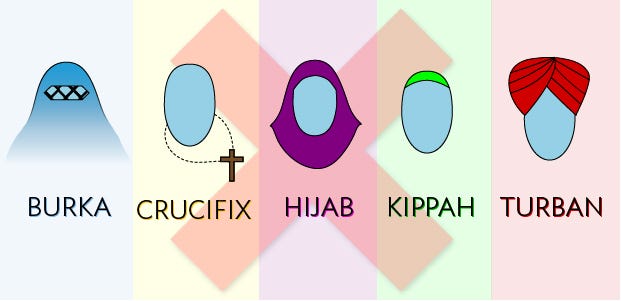
Source

Sikhi and Judaism have several things in common. They are both scriptural religions with a line of religious teachers: the prophets of the Torah and the Tanakh and the gurus of Sikh tradition. They are both minority religions who have suffered a long history of persecution. In both religions, it is the men who wear the publicly distinctive clothing, specifically head gear: turbans in the case of Sikh men, various hats and caps for Jewish men.

The last two similarities go together. By wearing publicly distinctive clothing, Sikh men and Jewish men become the first line of defence of their communities. They stand, clearly labelled as men of their community, and so ready to be the first to take whatever crap comes their community’s way. They thereby form a protective line around the women and children of their community.

If one is not prepared to embrace this role of publicly-marked protector, one is not fit to be a husband and father within that community. The distinctive garb is a test of character and commitment.

Dominion rules

In Islam, the pattern is rather different. There, it is the women who wear the most publicly distinctive clothing (also headgear). The garb of Muslim men can be somewhat distinctive, but that is also often about minority status. Even so, the publicly distinctive clothing of Muslim women is a very obvious feature of Islam, even if the adherence to such practices have varied widely across time and place.

Ever since Muhammad became ruler of Medina in 622, mainstream Islam has been a religion of domination. Much of the Quran, the hadiths and Sharia are concerned with how to behave towards non-believers, and with the regulation of non-believers under Muslim rule (the dhimmis), all based on the presumption of rightful Muslim dominion. The famous concept of people of the Book expresses this presumption of Muslim dominion and of its rightful expansion. Muslim dominion flows from, and is justified by, submission to the rules of the Sovereign of the universe.

What makes the various minority forms of Islam (Ibadis, the third version of Islam, Alevis, Ismailis, Ahmadis, etc.) much less problematic to deal with is that, as permanent minorities, their versions of Islam have had to eschew the outlooks of presumptive dominion. This is not the case with mainstream Sunni Islam, which retains the traditions and outlooks of the religion of domination it has been since 622 (so almost 1400 years).

Dynamics of polygyny

From it origins Islam was a polygynous religion. A Muslim woman can only marry a Muslim man. A Muslim man can have up to four wives, though he is also permitted sexual access to, as the phrase in the Quran goes, those that your right (i.e. sword) hand possesses. If 5 per cent of Muslim men have four wives each, that means that 15 per cent of Muslim men do not have possible wives from within the Muslim community.

This problem of substantial numbers of Muslim men having no marriage prospects within the community is one that all polygynous societies have to deal with. There are four possible patterns of response.

(1) Do nothing and so have a bandit problem. This is the pattern of Chinese history, where a polygynous elite left an underclass of males with no marriage prospects that turned to predatory behaviours. This is why bandits are such a feature of Chinese history and literature. Indeed, as more wealth and income inequality meant more polygyny, so more excluded underclass males, and as peace and stability (such as from the rule of a long-established dynasty) tends to lead to rising wealth and income inequality, the bandit problem tended to worsen as each Chinese dynasty aged.

The reason why peace and stability leads to rising economic inequality is, first, there is some tendency for the sorting processes of commerce to lead to the accumulation of property and, second, that all societies tend to form self-serving interest coalitions that impede the operation of the society and advantage their (generally well-connected) members. Both processes lead to rising inequality. Prolonged peace and stability gets in the way of the removal of such interest coalitions. Hence, prolonged peace and stability tends to lead to increased economic inequality.

(2) Also permit polyandry. Some polygynous societies have also permitted wives to have more than one husband. A low-status male might not be able to afford a whole wife, but he might be able to afford a half, a third, or a quarter of one. In such cases, brothers would often marry the same woman. That way, the children who weren’t their sons and daughters were their nieces and nephews. (China was too patriarchal a society, and Islam too patriarchal a religion, to accept polyandry as an acceptable social pattern.)

(3) Some version of wait-your-turn. This was generally a pattern of hoe-farming societies, where women did most of the farming, so wives were not dependant on their husband’s income. In such societies, a man who survived long enough had a good chance of entering the marriage ladder. Such societies could also have some version of the boy-wife phenomena, where a as-yet-unmarried male would enter into a relationship with a younger male. This relationship was typically formally acknowledged and involved some equivalent of bride-price, such as a gift of the spear. The expectation was that the relationship would end once the older male got married (to a woman). (There is some evidence of an analogous practice in Southern China.)

(4) Those people over there have women, steal their’s. This was the pattern of every pastoralist raiding society ever and of other raiding folk, such as the pagan Norse. Going a-Viking was the seafaring equivalent of pastoralist raiding on horseback. The various Great Walls of China had a range of purposes, but impeding the stealing of Chinese women by pastoralist raiders was one of them.

Arabia at the time of Muhammad was, of course, a few towns scattered among a pastoralist raiding society. From 622 onwards, Islam sanctified the stealing of women who had not accepted Muslim dominion. This sanctification appears in the Quran (the phrase those your right hand possesses occurs 15 times), in the hadiths, in the sira, the life of the Prophet (such as killing all the men of the two Jewish tribes of Medina and distributing their women and children as slaves), and in Sharia, where the marriage of any woman seized by a Muslim man is immediately annulled (so, of course, she becomes sexually available).

Islam never had any difficulty recruiting ghazis, holy warriors, precisely because (1) there were Muslim men without good marriage prospects due to Muslim polygyny and (2) Islam sanctifies stealing women who were outside the protection of the umma, the Muslim community. The virgins a Muslim martyr — someone who was killed fighting for the umma — is supposed to receive as his heavenly reward is just the after-life apex of an entire system of sanctified sexual predation.

The two great drivers of Islamic expansion were conquest, significantly driven by the pattern of polygyny and sanctified sexual predation, and trade (as Sharia also provided a generally superior commercial law system and network).

Hence, in Islam, it is women who wore the most publicly distinctive clothing. There were two main reasons for this. First, in a multi-wife household where the husband controls the wealth and income, wives compete for the prospects for their children. So elite Muslim women needed to protect their reputations and veiling signalled their “respectable woman” status. Second, in societies where sexual predation was religiously sanctioned, Muslim women wearing distinctive clothing made it very clear who was off-limits.

This is a very different dynamic than that of Sikh men and Jewish men wearing the publicly distinctive headgear.

Since the 1970s, a third reason has been added. Under Sharia, to convict a man of sexual assault generally required a confession or four male witnesses. This generated societies with a high level of segregation by sex that therefore generally did not evolve norms for dealing with women wandering around in public away from their neighbourhoods.

Muslim jurists actually discussed the issue of when it was permissible for women to go out in public. Up until the C19th, Muslim visitors to Christian countries would express their surprise and disorientation at how busy the streets of Christian cities were, because there were all these women going about in public. They would also express their surprise (and at times their contempt) for how deferential Christian men were to Christian women: the Muslim (male) observers sometimes describing it as the Christian men being unmanly.

During the C20th, there was a shift away from veiling by Muslim women, due to the influence of a westernising understanding of modernisation. This trend reversed in the 1970s among middle class Muslim women as they began to go outside their neighbourhoods for education and then employment. Wearing the headscarf, and even more the veil, broadcast their commitment to Islamic norms, thereby providing protection and self-commitment in societies with a long history of sexual segregation.

This massive increase in religious signalling by Muslim women presumably helped along the Islamic religious revival of recent decades. In the West, it sharpened the distinction between Muslim and non-Muslim women.

The underlying point remained to identify those women who had accepted the norms of Islam and so were off-limits. Thirteen centuries of sanctified sexual predation against women who had not accepted the norms of Islam deeply embedded within mainstream Muslim society social schemata (patterns of belief) and social scripts (patterns of action) of sanctified sexual predation against women not under the protection of the umma.

So, what happens if millions of Muslim men get imported into non-Muslim countries so that there are critical masses of men who accept such schemata and such scrips? You might well get mass sexual assaults and systematic sexual predation against (unveiled) women.

Oh look, we did.

With survivors reporting their attackers used religious justifications. The same ones used by Islamic State adherents in raping Yazidi women.

A problem cannot be dealt with if it is not acknowledged. And it really does matter which sex wears the distinctive clothing.

(Cross-posted from Medium.)

Friday, February 5, 2021

Is toxic masculinity a bullsh*t concept?

It is far more effective at attaching a negative adjective to masculinity than in helping to understand human behaviour.

I am using bullshit in its technical philosophical sense — statements made for rhetorical effect regardless of how factually accurate they are.

About violence

To understand the problems with toxic masculinity as an analytical concept, it is useful to start with looking at something that is highly patterned by sex: violence. Especially as the patterns of violence by sex are regularly linked to toxic masculinity.

A Swedish study found that 0.1 per cent of the population made up a fifth of violent crime convictions, 1 per cent made up almost two-thirds of violent crime convictions and 4 per cent were responsible for all of them. The offenders were overwhelmingly (87 per cent) male.

So, clearly violence is correlated with being male, right?

Wrong. Yes, violence is disproportionately male, but only 7 per cent of males were in the convicted-of-violent-crime group. Something that pertains to only 7 per cent of a group is not significantly correlated with membership of that group.

Conflating being disproportionately x with being correlated with being x is done all the time. Including, of course, by a lot of feminists.

If there is any group that the violent offenders are more than 7 per cent of, especially if such a group also includes the 1 per cent of women who were violent offenders, then membership of that group is going to be more correlated, potentially far more correlated, with being violent than is being male.

As it turns out, completely unsurprisingly, certain personality traits (often aggregated into the Big Five of Openness, Conscientiousness, Agreeableness, Extraversion and Neuroticism, or OCEAN) are way more correlated with violence than is being male. Given that no personality trait is only male, and no personality trait applies to all males, this is more or less bound to be true.

Once you starting asking about personality traits and behaviour, then biological sex becomes something that may generate patterns, but is not likely to be significantly causal.

Being of a sex changes the constraints one is facing. This, on its own, is enough to generate patterned behaviour.

As a general pattern, the small gamete sex (males) is likely to be more violent than the large gamete sex (females). This is for the obvious reason that violence is usually less risky for the small gamete sex than it is for the large gamete sex. The difference in the pattern of risk produces differences in the patterns of behaviour.

If the small gamete sex is also larger and stronger than the large gamete sex, this tendency to be more violent will be strengthened further. Amongst Homo sapiens, men are, on average 7 per cent taller and 13 percent larger than women: while women, on average, have 52 per cent of the upper body strength and 66 per cent of the lower body strength of men (in part due to male spines being more rigid and providing a better lever for strength) while women generally both have, and require for health, proportionately more fat as a share of body mass than men.

Given these biological realities (even without considering the risks of pregnancy and the constraints of child-minding), of course physical violence among humans is going to be disproportionately male. Of course aggression by human males is going to manifest much more as physical aggression than will aggression by human females.

That does not mean that men are more aggressive then women: actually, the two sexes are about equally aggressive overall. It is more the patterns of aggression that differ, due to the differences in risk patterns, with male aggression tending to be more physical and more overt while female aggression tends to be both more relational and more camouflaged.

Ask someone who went to a girls’ school whether they have ever experienced or witnessed toxic female aggression.

The patterns of aggression differ by sex, but they are not entirely separate. There is physical aggression from women and relational aggression from men. It is their relative distribution and ways of manifesting that differs. Those patterns of difference can also vary, depending on social circumstances. A result of us being so much the cultural species.

Arguing that biological sex matters is not remotely the same as postulating some deeply and pervasively essential differences between men and women (apart from the small-gamete, large-gamete distinction).

About domestic violence

While all this is enough to raise large questions about the concept of toxic masculinity, including tying any pattern of negative behaviour specifically to being male, it is worth looking at the use of descriptive terms in a particular arena of violence: domestic violence. There has been a strong (feminist) push to conflate domestic violence with intimate partner violence. In response, the term family violence is being adopted as the more general category.

Treating domestic violence as if it specifically means intimate partner violence is rhetorically very useful, because what form of domestic violence does conflating it with intimate partner violence leave out? Violence against children. And why is it useful for feminists to reducing the salience of violence against children? Because it is more often perpetrated by women than men.

This is partly because women have more opportunities to commit violence against children than men do. But it is also that children are generally smaller and weaker than adult women. That there is a pattern of (some) women engaging in violence against those who are smaller and weaker than they rather gets in the way of valorising women in general and deprecating men in general. Or otherwise essentialising violence or aggression along male-versus-female lines.

Acknowledging that intimate partner violence itself has two general patterns (1) violent men and women hitting each other, and (2) intimate terrorism, where one partner terrorises the other, also gets in the way of postulating some deep causal gulf between male and female. Especially as, while the pattern of intimate terrorism is wildly disproportionately a male partner terrorising a female partner, the reverse also occurs, just much more rarely. Much of the public discussion about intimate partner violence is, however, framed as violence against women, essentially writing any violence against men out of the social script.

Toxic aggression

Both men and women, both boys and girls, can and do engage in toxic aggression. While such aggression has patterns by sex — that is, the distributions differ by sex — no form of it is purely limited to a single sex.

The questions then become, is there any useful element of the concept of toxic masculinity that (1) is not about a form of toxic aggression, (2) is reasonably specifically tied to being male or to masculinity and (3) is to any significant degree characteristic of or, or caused by, either? Or are we, at best, dealing with a small sub-group of males who, due to specific personality traits and/or beliefs, choose to manifest their masculinity in particular ways?

The rhetorical value of the term toxic masculinity is obvious. It ties a negative adjective (toxic) to masculinity, it encourages the attribution of causality to being male and/or being masculine (as if it is what happen when masculinity “goes too far”, so masculinity is to be treated as potentially toxic) and it discourages attention to any analogous female behaviour.

So, it is excellent rhetoric, and it is excellent rhetoric regardless of its analytical soundness.

Given the above considerations, toxic masculinity is looking like a bullshit concept.

One reason toxic masculinity is excellent rhetoric, is that there is male behaviour based on a sort of hyper-masculinity that we are familiar with, and which is widely (often intensely) disliked. But, of course, it is disliked by a lot of men. That general dislike of such behaviour among both men and women gives toxic masculinity much of its rhetorical power.

Cultural phenomena

An objection to the above considerations is that the notion of toxic masculinity is not about violence and aggression as such, but pertains to a cultural phenomena.

One of the perennial problems of cultural analysis is that culture, and cultural patterns, can easily be turned into analytical “silly putty” — able to redefined to fit any analytical hole. Especially as culture itself is infamously so variably defined.

The overwhelming majority of human societies have had presumptive sex roles, driven by how expensive human children are to raise. This has led to very strong patterns of activities that could be done while minding children being presumptively female and activities that could not be done while minding being presumptively male. This is usually driven much more by relative risk and level of constant attention required than by strength.

Hence, in foraging societies, women generally gather, but they will hunt small animals, such as lizards. Meanwhile, men generally hunt, but they will gather more risky-to-get things, such as honey. In hoe-farming societies, women generally farm, as that can be done while minding the kids. In plough-farming societies, men generally farm, as ploughing cannot be done while minding the kids. And so on.

This very long history of presumptive sex roles probably has something to do with why Homo sapiens are so cognitively dimorphic. A recent study found that around 70 per cent of men have a mix of personality traits that no woman has and around 70 per cent of women have a mix of personality traits that no man has. Only 18 per cent of us are in the personality-trait-bundles overlap group. (An earlier study found even higher rates of cognitive dimorphism.)

We are, in fact, as a species more cognitively dimorphic than we are physically dimorphic (apart, from the mammaries-ovaries, testes-penis, small gametes versus large gametes pattern). Different patterns of risk-management behaviour, and associated interactions, can be expected between men and women, with both continuities and variations between cultures.

Dealing more with physical risk, men are likely be more drawn to philosophies such as Stoicism, or analogous outlooks. Declaring such stoicism to be toxic masculinity is just silly.

We live in the only societies in human history largely without presumptive sex roles. Thus, any implicit or explicit pathologising of the notion of presumptive sex roles is, analytically, pretty silly.

Similarly, tying any phenomena to masculinity that also manifests among women is pretty silly. it is, for example, fairly clear that the breakthrough for queer emancipation was a major shift in attitudes among women. The strictures against homosexuality being part of a moral order that raised the social exchange value of sex.

It is, after all, generally hard for any broad cultural patterns to persist, or to change, without significant numbers of both sexes “buying into” the persistence, or into the change. Hence second-wave feminism was as successful as it was because lots of men agreed with the goal of expanding opportunities for women.

Strictures against homosexuality have a complicated relationship to masculinity and patriarchy, because in some societies, the celebration of masculinity extended to celebration of male beauty and eroticism. They could be highly patriarchal societies (e.g. Ancient Athens) or rather more gender egalitarian societies (e.g. Sparta). If we are dealing with patterns that are specific to some culture or set of cultures, toxic masculinity is clearly a misleading label.

Unless we are dealing with attitudes and patterns of behaviour that are specifically male, are specifically tied to masculinity in general and are not tied to specific cultures (and would therefore have a specifically cultural source, not a generally masculine source) toxic masculinity is a misleading term.

It would also be helpful if the concept was, at least to some degree, quantifiable. How general is the pattern? If it is very much a minority phenomena, then it will be tied to something else more strongly than it will be to masculinity.

There is also a problem of context. Something that might be functional in one context may be much less so, or even dysfunctional, in another.

Drawing causal connections between specific behaviours and cultural patterns is also notoriously difficult. Especially as manifestations of cultural patterns can vary markedly between individuals within the same culture.

So, are we dealing with a well-defined concept, that is usefully quantifiable and tied to careful causal analysis?

Not really, we are dealing with something much more motte-and-bailey like. That is, there are discussions of toxic masculinity that have all the sophisticated trappings of careful analysis (the motte version) that defenders of the term point to. And then there is the much more blunderbuss rhetorical uses of the term (the bailey plays).

Any objection to the latter will be referred to the former. But the tying of toxicity to masculinity makes the concept of toxic masculinity ideal for such rhetorical games, given that the boundaries of the concept are so unclear. Or, at least, easily shifted. Especially as masculinity itself can mean or imply (1) to do with being male or (2) to do with conceptions of masculinity.

If the concept of toxic masculinity was part of a general taxonomy of masculinity, it may be of some interest. As a stand-alone pathologising tag, not so much.

So, yes some men choose to manifest their masculinity in particular, unfortunate or destructive, ways. Certain cultural milieus may encourage or discourage that. But it is not their masculinity that is driving that.

Ultimately, the giveaway is that toxic masculinity is a stand-alone pathologising tag. Part of a more general pattern of conflating disproportion with correlation and so treating disproportion as characteristic-of or specific-to.

So, toxic masculinity: rhetorically powerful, yes; factual or analytically useful, not so much.

(Cross-posted from Medium.)

Saturday, October 31, 2020

The Silence of the Lambs and the contemporary American elite


Source.

The Silence of the Lambs is almost 30 years old. But it is one of those classic films that has entered the general culture so that people who weren’t alive when the film came out can recognise classic lines or moments from the film.

Who does not get the resonance of “it rubs the lotion on its skin or else it gets the hose again”?

Members of the contemporary American elite, who are too settled and senior in some network or hierarchy to see themselves as Clarice, the plucky young FBI agent played by Jodie Foster, surely would identify with Jack Crawford. The wise, experienced and perceptive defeater of monsters; mentor to the Clarice’s who come into their orbit. Scott Glenn gave the character an engaged and engaging gravitas, who would not want to identify with him?

If the American elite, particularly the progressive elite, were made up of Jack Crawford’s, the US would be in much better shape.

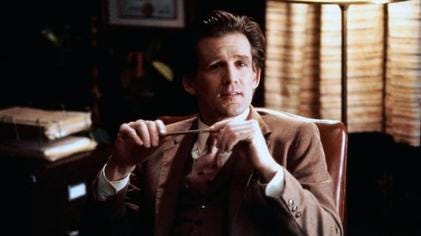
But neither Clarice nor Jack Crawford is the character from the film classic who best describes the typical member of the contemporary American elite. That goes to Dr Frederick Chiltern, played with such wonderfully sleazy arrogance by Anthony Heald.

It is all there. The condescension. The arrogance. The overblown sense of understanding. The destructive careerism. The false sense of being in control, of being able to use the monster of the moment for their own benefit.

And what happens to him in the end? Having let the monster loose through this own self-serving careerism, the last we see of Frederick Chiltern is his frightened flight to a false sanctuary, the monster he let loose wandering, unhurried, after him, toward that fatal consumption that Lector’s line to Clarice (“I am having an old friend for dinner”) moments earlier foreshadows with such delicious menace.

As we have watched US cities burn in nightly riots, and new forms of the totalitarian urge rampage through US institutions, the statues expressing American heritage be torn down, the explicit wish to abolish the American, Western and Enlightenment projects be violently proclaimed, much of the US mainstream media turn itself into vehicles of cult activism, people be intimidated into going along with moral urgency of the moment, for fear they will get the hose of mobbing stigmatisation, the lesson of Frederick Chiltern is there for those with eyes to see. This has all got as far as it has because an army of Fredrick Chilterns thought that the monsters would be useful for their careers, that they would remain in control and so could prosper from letting moralised rage do its thing.

That is not how these patterns play out.

How many will find out that they were not noble Jack Crawford’s but Frederick Chiltern’s, destroyed by their own careerist arrogance? And will they have that moment of self-realisation before the monsters they let loose come for them?

Cross-posted from Medium.

Saturday, September 26, 2020

Dark Triad politics attracts Dark Triad personalities


In my previous piece, I analysed how the Jacobin model of politics (politics unlimited in aims and unlimited in scope) was inherently a vehicle for Dark Triad politics. Moreover, that the moral or social grandeur of whatever project the Jacobin model was attached to was a vehicle for people to bullshit themselves into following politics that was narcissistic, Machiavellian and psychopathic.

Two recent studies in social psychology have highlighted the reverse problem: that particular forms of politics or social action attracts Dark Triad personalities. (I became aware of the studies through this podcast.)

Virtuous victim signalling

The first paper, ‘Signaling Virtuous Victimhood as Indicators of Dark Triad Personalities’, uses a series of studies to show that those possessing Dark Triad personality traits are particularly likely to engage in (pdf) virtuous victim signalling. The authors defined victim signalling as:
a public and intentional expression of one’s disadvantages, suffering, oppression, or personal limitations.
They defined virtue signalling as:
symbolic demonstrations that can lead observers to make favorable inferences about the signaler’s moral character.
The series of studies provide evidence that:
victim signals are effective tools of social influence and maximally effective when deployed with signals of virtue.
Which makes virtuous victim signalling a potentially successful social strategy, including for extracting resources. The authors conclude that:
our studies present converging evidence that the virtuous victimhood signal is an effective mechanism for persuading others to part with their resources in a way that benefits the signaler and that people who tend to engage in amoral social manipulation to achieve their goals are more likely to emit them.
As the authors note, the highly egalitarian norms of contemporary Western society, creating a presumption of social or moral failing by the wider society if people conspicuously do less well than others, combined with the high moral premium put on avoiding harm, makes the virtuous victim signal a potentially effective resource extraction strategy. Once an effective resource extraction strategy can be identified, those who are least inhibited are more likely to be attracted to the (deceptive) use of it. Which is what the studies suggest does indeed happen.

Extrapolating from the study, the more strongly the presumption of believe the victim is pushed, the greater the effective social licence is being provided for such behaviour. Any implied notion that some forms of social action are so pure than no bad actors will adopt them is an open invitation to exploitive behaviour. An open invitation that Dark Triad personalities can be predicted to seek to take up.

Political extremism and personality

That Dark Triad personalities may be prone to use the resource extraction opportunities that virtuous victimhood provides is not exactly a shock, though it is nice to have confirming evidence. The second paper, ‘The Dark Triad traits predict authoritarian political correctness and alt-right attitudes’, is somewhat more revelatory.

The paper makes a very useful distinction (pdf) between PC Authoritarians (PCA) and PC Liberals (PCL). The authors define Political Correctness (PC) as:
a set of related attitudes characterised by the desire to avoid offense and avoid disadvantaging certain groups in society.
PCL and PCA can be distinguished because:
Those holding PCL attitudes — or belonging to groups characterised by PCL attitudes — argue for the removable of ostensible social or emotional barriers of disadvantaged groups, whereas those holding PCA attitudes are primarily concerned with physical and psychological safety. A core aspect of PCA attitudes is the belief that aggression and force are appropriate methods to achieve ideological goals.
The third group studied were people who adopted White Identitarianism (WI), defined as:
a set of political attitudes characterised by strong feelings of white identity, solidarity and a belief in white victimisation.
What the paper finds is that PC authoritarians and White identitarians are both disproportionately likely to show Dark Triad characteristics, plus a sense of entitlement, and to do so to very similar degrees. Indeed, both groups are far more like each other on measures of Machievallianism, narcissism, psychopathy and entitlement than either group is like PC liberals, who score effectively no correlation with any of the four measures, apart from being mildly negatively correlated for psychopathy.

In my previous essay, I noted that the abandonment of the normative constraints of liberal politics make adoption of the Jacobin model of politics unlimited in means and scope that much easier. The quite stark contrasts found between PC Authoritarians and PC Liberals speaks to that.

Moreover, it points to a clear danger from reluctance among progressives to call out bad behaviour by people ostensibly pushing the same cause. It allows their moral decency to be used as cover by seriously bad actors.

The main contention of my previous essay was that the Jacobin model of politics itself fostered Dark Triad politics, regardless of whatever political project it was tied to. Though the scale of the political project did affect how much damage applying the Jacobin model did.

This PCA/PCL/WI paper points to the reverse problem, that the Jacobin model of politics attracts bad actors. A politics that denies limits is going to attract those who reject limits.

Jacobin model politics and Dark Triad personalities, especially if they have a strong sense of entitlement, are made for each other. They are made for each other regardless of where any particular political project may be placed on some political spectrum or what moral grandeur it may cloak itself in.

Indeed, the moral grandeur is much of the problem, as it justifies the abandonment of limits. It promotes self-deception by people, leading them to override the normative constraints that they would otherwise accept.

Politics that is unlimited in scope, politics that goes everywhere, is also politics that enables self-serving strategies to be pursued everywhere. The more politics is turned into the dominant pay-off strategy, the more it will attract manipulative, self-serving, personalities.

Virtuous victim signalling is a resource acquisition strategy open to manipulation by self-serving actors writ small. Politics unlimited in means and scope is a resource acquisition strategy open to manipulation by self-serving actors writ large. Potentially, an absolutely socially dominant resource acquisition strategy.

Those who argue in defence of looting, those who riot for ‘social justice’, those who seek to drive dissent out of the public sphere and various social arenas, may mask themselves under some grand moral project; but it is what they do, not why they say they are doing it, that is truly revelatory.

Physicist Steven Weinberg was far too specific when he said:
With or without religion, good people can behave well and bad people can do evil; but for good people to do evil — that takes religion.
Any moral or social project parading itself as absolute moral trumps is capable of having that effect.

Politics without limits is a profoundly destructive social force that naturally and inherently attracts destructive, manipulative, self-serving personalities. The grand moral claims that politics without limits are attached to provide the perfect cover for antisocial personalities to seek benefits for themselves, regardless of the costs to others. Adding in the capacity to allow otherwise decent people to justify to themselves doing, or acquiescing in, acts of social cruelty greatly magnifies the destructive effect.

Cross-posted from Medium.

Trump, like Lincoln, may yet spark a civil war

Image for post


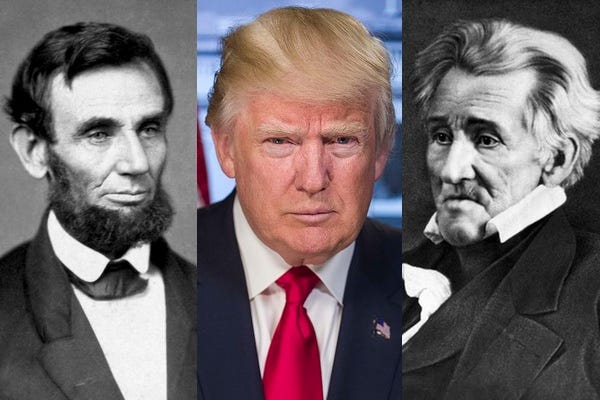
Searching through US history for a President like President Donald J. Trump, an obvious comparison is with the first Democrat President and seventh US President, Andrew Jackson (President 1829–1837).

Like Jackson, Trump is an outsider, despised, even hated, by much of the political establishment. Like Jackson, Trump is unashamed and blatant in his plebeian appeal. Like Jackson, he draws his strongest support from Greater Appalachia, the borderer (aka Scots-Irish or hillbilly) element of the US nation. Like Jackson, Trump draws wild enthusiasm from his partisans that seems both mysterious and aberrant to his (many) critics. Like Jackson, Trump brings a buccaneering style to politics that clashes with conventional notions of proper Presidential gravitas. While, unlike Jackson, Trump has not ignored the US Supreme Court, he has had some high profile clashes with the judiciary. Analysts of US politics still talk of Jacksonian politics, especially with reference to foreign policy. Trump is the strongest example of Jacksonian foreign policy in decades.

So, lots of similarities and analogies to be getting along with.

On the other hand, the United States managed to cope with a Jackson Presidency just fine. Indeed, so successful was Jackson that he was a key founder of the Democratic Party, the oldest still operating political Party in the world.

Thus, the Trump-Jackson analogies are striking, but not disturbing.

The disturbing analogy is with Abraham Lincoln, the 16th US President and the first Republican President (President 1861–5). Disturbing, because Lincoln is, of course, the Civil War President. It was his election, on 40% of the popular vote, that provoked the Southern States to secede.

Lincoln won the plurality of the popular vote against three major opponents with a clear victory in the Electoral College (180 out of 303). Trump was outpolled in the popular vote 46% to 48% but won a clear Electoral College victory (304 out of 538).

It is generally asserted that the South seceded because Lincoln was an anti-slavery President elected at the head of an anti-slavery Party. Yes and no. The US Civil War was absolutely about slavery. One only has to read the Confederate Constitution or transcripts of the secession debates to see that.

But it was not merely that Lincoln and the Republicans were against slavery that mattered. There had been anti-slavery Presidents before. It was the potential appeal of the Republican platform to ‘poor whites’ in the South that, added to the opposition to slavery, was the dire threat.

The Republican platform included what became the Homestead Acts, opening up landownership in the West to poorer settlers. The 1860 Republican platform also included tariffs and infrastructure projects, offering potential regular employment and higher wages. This was a program likely to be extremely attractive to the landless ‘masterless men’ of the American South.


With control of the Presidency, Lincoln could use federal government appointments to build up a Republican political base in the South. This was a nightmare scenario for the South’s plantation elite. Slavery depressed wages in the South and the status of manual labour. The worst possible outcome for the plantation elite was ‘poor whites’ and slaves (or, even worse, freed slaves) making common cause.

Hence Lincoln’s election sparked the secession of Southern States from the Union.

Fast forward, and the Democrat electoral coalition relies on keeping its extraordinarily high electoral support among African-Americans. If the Republicans can start making inroads among African-American voters, then it is very hard for the Democrats to put together a winning electoral coalition.

Since Trump’s election, his Administration, and his re-election campaign, have been attempting to target African-American voters, seeking to detach a sufficiently large minority from voting Democrat to voting Republican so as to overturn the Democrat electoral arithmetic.

The parade of minority speakers at the Republican National Convention was not some last minute add on, but the high point of an electoral outreach that has been underway throughout the Trump Presidency.

Which African-Americans?

African-Americans constitute three distinct groups. Descendants of Americans slaves, Afro-Caribbeans and recent African immigrants. Barack Obama was the son of a Kenyan immigrant. Democrat Vice-Presidential nominee Kamala Harris is mostly of Indian, and otherwise Jamaican (so Afro-Caribbean) descent.

Neither major US political Party has ever had the descendant of American slaves on their Presidential ticket. The African-ancestry candidates the Democrats have nominated have instead expressed the Democrat’s reliance on support from migrants.

This is an obvious weak point in the Democrat’s appeal to African-Americans. The descendants of American slaves do not noticeably benefit from migration. On the contrary, migrants and their descendants get to claim affirmative action benefits, crowding out the descendants of American slaves. Migrants congregate in major cities with significant African-American populations, where they compete for jobs, housing, and political access. Judged by who has, and has not, been represented on recent Democrat Presidential tickets, migrants have been winning the political competition.

Trump’s migration scepticism is a potential winner among African-Americans.

Another obvious weak point is that a significant number of African-Americans are conservative, and a strong majority identify as conservative or moderate. As the Democrat Party has moved in an increasingly progressive direction, that has widened the potential gap with many African-American voters. One reason why Biden won the Democrat nomination is that conservative and moderate African-Americans voted for him.

If Trump can open up the cultural distance between him and Biden, that is another potential winning point for him, particularly as he does not come across as a conventional Republican, but is very much a media-savvy culture warrior. Experience in the UK with Brexit and after shows that shaking up conventional politics along cultural lines is a way to detach former rusted-on voters, as well as the otherwise politically alienated. Riots and statue-topplings are potentially just such a cultural shocks.

The third potential weak point is, ironically, Black Lives Matter and the defund the police campaign. There is a long history of antagonism between police and African-American communities. But there are many African-Americans who do not want less policing, but more policing (or, more accurately, more effective policing). They are, for very good reason, deeply concerned about what would happen in their communities if police were withdrawn even further.

Fear of the consequences of the defund the police campaign is another potential winning point for Trump among African-Americans. It is true that Biden has explicitly not endorsed defunding the police, but many local Democrats have. Kamala Harris was a tough prosecutor, but that is a double-edged appeal in urban African-American communities.

Trump already has appeal among working Americans. Threatening to create an electoral coalition incorporating working Americans of both European and African ancestry: which President does that look like?

Threatened elites (again)

The networked elites of the major cities find identity politics very convenient. It breaks up citizens, residents and workers into competing groups based on identities that divide citizens, residents and workers. A lot of the metro-elite’s status-and-resource games would be upset if some bumptious upstart started putting together a citizen-worker-resident coalition.

The question is, how upset? How threatened?

The riots and statue-topplings suggest that there is a lot of political anger to harness. Given that the US’s ludicrously expensive university credentialing system leaves a lot of folk burdened with considerable debt and that restrictions on the supply of land for housing, and housing on land, creates ludicrously expensive urban housing markets that also shut lots of people out, there is much economic frustration being generated.

The US in the 1950s and 1960s was very socially stable. The combination of tight labour markets (so rising labour incomes) and loose property markets (so it was relatively easy to purchase middle class stability via home ownership) tends to encourage social stability. Thanks to migration, technological change and globalisation, plus the politics of zoning, aggravated by lockdowns, the US now has the opposite: loose labour markets and tight property markets. This is not a recipe for social stability.

Of course, it is the well-connected metro elites who have largely created or aggravated these problems. Supporting high migration AND land zoning drives up housing prices. Their universities create debt-burdened gimme courses in moral self-congratulation while new graduates in real disciplines have to compete with the educated of the entire globe.

The same well-connected metro elites whose long-term strategy of not providing sufficiently effective policing in African-American urban neighbourhoods results in much higher levels of violence in those communities. Violence that both stigmatises African-Americans and divides citizens, residents and workers from each other.

Violence, by the way, that is entirely an urban phenomena. There is no difference in homicide death rates in rural US between Americans of European and those of African descent.

No wonder the metro-elites love identity politics so much. No wonder also that the possibility of an ignoring-race coalition of local workers, residents and citizens must seem increasingly scary to them.

The question is, how scary? Are they as scared as the plantation elites of the Old South?

Or have they gestated from all this a network of genuinely revolutionary minded folk? A potentially explosive mixture of ideas that de-legitimise the American project with an over-supplied elite squeezed by under-supplied opportunities?

I guess we will find out, if Trump wins in November.

Imperial ideology: how elite networks push local connections and concerns out of the public space

Much of what has been going on Western societies is a struggle between the somewhere politics of local connections and the anywhere politics of elite networks.

Social analyst David Goodhart identifies the somewheres as people who are rooted in their local communities. Suppliers of labour, small business folk and others, often without university education, somewheres typically are born, live and die within the same local area. Anywheres are typically folk with university educations, so possess human capital, many with professional qualifications, who congregate in the major metropolises. They often travel for work and frequently reside in a very different community from where they grew up. They also often have more in common with anywheres in other countries than the somewheres of their own country. The dramatic fall in transport and communication costs have tended to expand and strengthen their networks.

It is the transnational nature of the networks of the anywheres, including their transnational commonalities in outlooks, perspectives and interests, that generates much of the rhetoric about globalism.

The decline of churchgoing, the decline of private sector unionism (and the takeover of the union apparatus by the university-educated), the decline of local sporting clubs and networks, the retreat into private entertainment, the flow of newcomers into urban neighbourhoods, the flow of the educated out of local neighbourhoods, the movement of women into the workforce (and so out of local networking), the decline of mass manufacturing, have all undermined local connections.

Thus, an interlocking web of economic, social and technological changes have tended to systematically undermine local connections and expand and empower elite networks. The anywheres, and their perspectives, more or less completely dominate the cultural commanding heights — arts and entertainment, media, IT, universities and much of education generally.

The one major political lever the somewheres still have is the vote. This is a less powerful lever than one might think, as having the vote on its own is not enough, there have to people to vote for who reflect your concerns and interests. As economist Thomas Piketty has nicely documented, politics has become increasingly dominated by a struggle between possessors of human capital (who he labels the Brahmin Left) and business capital (in his terms, the Merchant Right). That is two different set of anywheres trying to get the votes of the somewheres.

Increasingly, the somewheres do not hear their concerns and interests being articulated in the public and political spaces, so they retreat into not voting. Worse, attempts to articulate their concerns and interests are often de-legitimised; are construed as racist, xenophobic or otherwise beyond the moral pale.

Here we need to distinguish between being critical you are wrong because of (insert facts and logic) — and de-legitimisingonly evil and malicious people say such things. To de-legitimise a point or concern is to say that it does not belong in the public space at all. It is not even worth arguing over. De-legitimisation is all the more powerful if the person expressing such concerns is sanctioned for saying such things.

(As an aside, much of the hatred of President Trump can be explained by the way he deliberately, even gleefully, mocks such legitimacy plays.)

The phenomena of “cancel culture” (seeking to destroy livelihoods and reputations, seeking to exclude from the public space) is an attempt to impose social norms on what can be expressed in public (and private) via social sanctioning. To set the limits of opinion legitimacy. It is typically a form of mobbing, with all the problems that mobs, and mob “justice”, has. It is a mechanism of de-legitimising, not of criticism. It is, of course, fundamentally hostile to free speech.

It is also, fairly obviously, not a tactic of the somewheres, but of anywheres.

Throughout history, the possessors of human-and-cultural capital have been a significant class in complex societies. Their origins go all the way back to the shamans of foraging societies. They are often, but not only, priesthoods and religious scholars.

The Brahmins of Indian society are an example of possessors of human-and-cultural capital. So are the ulema, the religious scholars, of Islamic society. In both cases, they have traditionally controlled legitimacy: what it was, or was not, legitimate to do or say.

Granting-and-denying legitimacy is a standard social-dominance device of the possessors of human-and-cultural capital. Provided, of course, they can coordinate well enough to wield it. In contemporary society, much of the quality media fulfils that coordination role — selling a congenial sense of being informed around the opinions packaged as being what the good-and-smart people believe. In recent years, this coordination role has been hugely augmented by online media, particularly Twitter.

We live in an age with an ever-expanding list of linguistic and opinions taboos. Setting taboos is all about setting the limits of legitimacy. Piketty’s label of Brahmin Left is very much on-point.

It does not take much to see that granting-and-denying legitimacy is a powerful weapon in the hands of anywhere networks. If they can set the norms of legitimacy in a way that supports their status and resource claims, they can channel the votes of the somewheres, who outnumber them, into directions that minimise the conflict with anywhere interests.

Voting matters because it empowers social bargaining, it makes people’s concerns and interests matter. But if you can wield the weapons of setting legitimacy successfully, you can restrict the avenues of “legitimate” political bargaining in a way that systematically restricts, and so undermines, the value of the vote. Concerns that cannot be legitimately expressed can be quarantined off among designated political untouchables or simply do not enter into the processes of political bargaining in any effective way.

You can see this process at its most perfect in totalitarian states. The ruling Party completely controls what can be legitimately expressed, sanctioning (often severely) anyone who crosses the set lines. Elections are thus turned into rituals; rituals of dominance (we can get you to go through this ritual act) and of legitimacy (see, the people voted for us).

When people respond to the current American troubles by invoking comparisons with the Chinese Cultural Revolution or the Jacobin phase of the French Revolution, there are similarities in underlying dynamics to point to. Pulling down statues, censoring cultural products, having diversity(tm) struggle sessions, street violence, mock executions and so forth have an evocative similarity with those earlier social paroxysms. We are seeing networked efforts to so narrow what it is legitimate to say or do so as to establish the dominance of the wielders of yet another ideology of socially transformative virtue.

An ideology that manages to combine the worst of the Counter-Enlightenment — the primacy of emotion and feeling, the primacy of racial identity — and the worst of the Radical Enlightenment — the belief that social transformation is achieved by forcing everyone to act and believe together — in a single, highly potent, set of status claims presented as being what the virtuous believe. Virtue that requires adherence to a matrix of very specific assertions, paraded as moral necessities, opposition to which is declared to be inherently illegitimate.

As economist Glenn Loury and linguist John McWhorter have pointed out, the way racist! is currently being bandied about is much the same as previous uses of witch!. I would add in the examples of heretic!, infidel! and counter-revolutionary!. They are all ways of saying “evil and so not-legitimate”.

Even in its relatively mild forms, the politics of de-legitimising advantages the anywheres and disadvantages the somewheres.

Once the de-legitimising dynamic starts, however, it has no natural stopping point. On the contrary, it has an inherent tendency to spiral towards violence, as it empowers the virtuous to take any “necessary” actions to block those designated as evil and illegitimate.

Multiculturalism as cultural marker

In the struggle between the somewhere politics of local connection and the anywhere politics of elite networks, the shift in migration policy from assimilation to multiculturalism was a major cultural milestone.

The flood of new people into a local area can obviously break up local connections. The local connections that working folk in particular rely for various forms of social protection and ability to organise for common interests. The policy of assimilation was the implicit promise that newcomers would be brought in at a sufficiently low rate, from sufficiently diverse origins, and with strong expectations of “fitting in”, so as to minimise the disruption of local connections, either in their local communities or their workplaces.

While working-class concerns were still dominant in centre-left politics, migration was tied with assimilation.

With the postwar expansion of higher education, the number and reach of university-educated possessors of human-and-cultural capital steadily expanded. These were elite-network anywheres, not local-connection somewheres. Moreover, the social position of the anywheres is improved if their elite-network politics trumps local-connection politics.

As possessors of capital, anywheres generally get significantly more economic benefit from migration than do providers of labour. Migrants are much less likely to directly compete with anywheres (as anywhere skills are much more likely to be niche or otherwise remain relatively scarce). Generally migrants increase the demand for anywhere services/return on their capital (and do so whether or not the migrants work). The downward pressure on labour incomes increases access to goods and services by making them cheaper. An effect that is magnified, as anywheres have higher incomes.

So, on one hand, anywheres disproportionately benefit from migration. On the other, the disruption of local connections not only does not adversely affect them, it increases the relative power of their networks as against the politics of local connections.

It is not hard to see that anywheres will tend to be very pro-migration and not only indifferent to the costs of large-scale migration for local connections, but actually benefit from that disruption. It is even better if these effects can also be turned into a status play: such as getting a sense of moral prestige from one’s support of migration.

We see here a social selection opportunity laid out before us. A social selection opportunity that was, indeed, fulfilled.

Enter multiculturalism. (Or, as it has since become, diversity-inclusion-equity.)

Whereas the implicit promise of assimilation was that local connections would not be seriously disrupted, multiculturalism made no such promise. On the contrary, it rules any complaint about the newcomers not “fitting in” out of court. Their ability to do their own things in their own ways becomes sacrosanct. If newcomers come in in large numbers, if they stick to their own, that is just a wonderful contribution to cultural diversity, it being hard to maintain a culture in a new land without plenty of specific connections. And any complaints are clearly motivated by nothing more than racism and xenophobia.

Multiculturalism (and, in its expanded version, diversity-inclusion-equity) is more or less perfect anywhere politics. It serves anywhere economic interests. It serves their status interests — it being what good-and-smart people support and so shows their moral goodness. It breaks up local connection politics and elevates elite-network politics, not merely by relatively advantaging elite-network politics but by actively supporting and empowering such politics.

How so? By creating a multicultural bureaucracies, multicultural advocacy groups and multicultural political networks. (All now re-packaged as diversity bureaucracies, diversity advocacy groups, diversity training firms and diversity political networks.) All of them providing jobs, status and institutional power to the anywheres and their networks. A process nicely documented by political writer Ben Cobley in his book The Tribe.

Multiculturalism is an imperial ideology. It is so in two sense. First, because it can expand into almost any institutional or organisational space. As its expanded version, diversity, inclusion and equity, is currently demonstrating.

But multiculturalism is also an imperial ideology in a much more direct sense. All empires are, in one sense or another, multicultural. They are all diverse. It is inherent tendency of empire. It increases the number of subjects, it divides subjects into competing groups and generates jobs for imperial officials in managing those divisions.

When the British Empire imported Tamils into what is now Sri Lanka and Indians into East Africa, the West Indies, South Africa and Fiji, this was justified on the grounds that the newcomers would increase local commerce, local economic activity. Which they did. But scholars since have had no problem identifying that it also served imperial control by generating divide-and-dominate politics, creating competing groups that the imperial authorities could “manage” and who were unlikely to combine against the imperial authorities.

Well quite. But what is different about doing the very same thing in Birmingham, London’s East End or any major American city?

That it is being done within a democracy instead of an empire? Except, as we can see, it can be an excellent mechanism for breaking up the effective bargaining power of local, especially working class, voters.

So, how different is it really?

In American cities we can see rioters burning down local businesses in the name of classic anywhere diversity and anti-racism political tropes. This is not the somewheres fighting back (though there are now some signs of that), this is the next stage in anywhere politics. (With folk who like rioting along for the ride.)

And the politics of control through controlling legitimacy are not the politics of free speech, free citizens or open political bargaining.

We have in various forms, experienced patterns like these before. A good hard look at the events and patterns of the Cultural Revolution, and the Jacobin phase of the French Revolution, is entirely appropriate.

Thursday, August 13, 2020

Single-Spouse Marriage Systems: the elite male problem

While most human marriages have been one husband, one wife, most human societies have permitted multiple-spouse marriages. Most commonly, they permitted a man to have more than one wife.

Since fathering a child takes rather less inherent biological effort than mothering one, it is hardly surprising that multiple wives (polygyny) is the most common deviation from single-spouse marriage.

In societies where women make substantial contributions to subsistence — almost invariably, hoe-farming societies — rates of polygyny can get very high. For the cost of adding extra wives is much less than in societies where males dominate subsistence activity: typically plough-farming and pastoralist societies.

Foraging societies tend to have low levels of polygyny, as subsistence contributions are relatively even (the subsistence contribution of women is more constant, that of men more nutrient dense) and entirely labour driven. There are no productive assets, beyond weapons and other hand-held tools.

The landscape management and foraging complexity of Aboriginal societies in Australia generated distinctive patterns of gerontocratic polygyny. Old men married young women, young men married their widows and, in their old age, married young women. It kept fertility down and fostered the transfer of complex foraging knowledge across the generations. They also developed some extraordinarily complex marriage-and-kin systems as part of complex landscape management, as that preserved a rolling network of kin connections.

If women control the main productive asset, and there is no other basis for elite male status, then there is no elite male problem. If that is not the case, then if a society is going to have compulsory single-spouse marriage systems, it is the elite males who have to be convinced. There seems to be two general reasons for the elite males to accept single-spouse marriage.

First, there are very strong pressures for social cohesion. If there is a need to have maximum internal cohesiveness against outside groups — specifically, if there is a need to include low-status males — then a single-spouse system minimises internal sexual competition and maximises the breadth of stakes in the success of the group. The fewer elite males there are, the lower the cohesion pressures need to be for such an arrangement to emerge.

This is the pattern that seems to explain the emergence of single-spouse systems in the classical Mediterranean and in groups such as the early Christians and the Alevis. In the case of classical Greece and Rome, access to slaves further reduced the cost of single-spouse marriage to elite males.

The second reason for single-spouse marriage being accepted by elite males is if the education cost of raising a child, particularly a son, to elite status is sufficiently high. Multiple-wife systems mean less investment by the father in individual children. If such an investment is at a premium, then a single wife is a better option.

This is the pattern you see in the Indian caste system and in the modern world. Brahmins could theoretically have multiple wives, but very rarely did, as the training investment in raising a Brahmin son was so high. Indeed, this very high training cost seems likely to be the reason why the jati system developed — to ensure the daughters of Brahmin, who understood the needs of raising a Brahmin son, were available to marry Brahmin grooms.

Single-spouse systems did not develop as territorial or population expansion devices. On the contrary, polygyny is a much better territorial expansion device because it creates a shortage of wives. Polygyny creates a shortage of wives as a woman who gets married leaves the marriage market, but her husband does not. So low-status men end up excluded from the marriage market. The classic response to this problem is “those people over there have women, take theirs”.

Islam sanctified this pattern, with the Quran explicitly endorsing sexual access to “those your right hand possesses” (Ma malakat aymanukum: i.e. women acquired by the sword). Sanctified sexual predation helped drive the territorial expansion of Islam for a thousand years. From its rise in C7th Arabia to the turning back of Islamic expansion into Europe after the Battle of Vienna, 12 September 1683. (And yes, that is apparently why 11 September was chosen in 2001.)

The Norse (Viking) raids also seemed to have been significantly fuelled by polygyny and died away as the Norse lands Christianised.

If external expansion is fuelled by low-status men seeking women that the local marriage market does not provide them, then elite males have no reason to accept a single-spouse system. Which comes back to; if one wants to explain why a single-spouse system is being accepted, then one has to explain why elite males have accepted the system, as they are giving up the benefits of multiple wives.


These musings are part of the intellectual scaffolding for a book to be published by Connor Court looking at the social dynamics of marriage. As they are somewhat a work in progress, they may be subject to ongoing fiddling.

Friday, June 14, 2019

How to play intersectionality

I recently read, in quick succession, “Whiteness as Property” published in 1993 by Cheryl L. Harris and Kimberle Crenshaw’s 1991 essay “Mapping the Margins: Intersectionality, Identity Politics, and Violence against Women of Color” and her 1989 Demarginalizing the Intersection of Race and Sex: A Black Feminist Critique of Antidiscrimination Doctrine, Feminist Theory and Antiracist Politics. The latter two essays essentially launched intersectionality in academe.

These essays are either Law Review pieces, or written as such; the first being in the Harvard Law Review and the second in the Standard Law Review. All are clearly written and extensively footnoted. Neither writer is therefore subject to the sort of withering demolition that philosopher Martha Nussbaum handed out to gender theorist Judith Butler in her wonderful 1999 essay “The Professor of Parody” in The New Republic. (If you haven’t read that essay, do yourself a favour and read it: preferably right now, I’ll wait.)

Flattening
The essays of both Harris and Crenshaw are grappling with serious issues, largely centred around the role of racial categorisations in US history and society. I have commented on Harris’s essay at length (probably too much length) in my previous post. That they are grappling with morally serious issues is very much pertinent to how to play intersectionality, because a key element is to use moral concern to flatten the analytical landscape.

The game is relatively simple: any matters pertaining to the function or dynamics of things, including what constraints are operating, are ignored, played down or turned into a matter of oppression and subordination. This is important, indeed central, because it ensures that the invoked moral principles dominate the analytical landscape. This domination-by-denial nowadays extends into using a priori moral commitments to push outright and explicit exclusion of any contrary evidence or analytical framings. A professor of biology describes students attempting to impose this game on what it is permissible for her to teach:

In class, though, some students argued instead that it is impossible to measure IQ in the first place, that IQ tests were invented to ostracize minority groups, or that IQ is not heritable at all. None of these arguments is true. In fact, IQ can certainly be measured, and it has some predictive value. While the score may not reflect satisfaction in life, it does correlate with academic success. And while IQ is very highly influenced by environmental differences, it also has a substantial heritable component; about 50 percent of the variation in measured intelligence among individuals in a population is based on variation in their genes. Even so, some students, without any evidence, started to deny the existence of heritability as a biological phenomenon.

Similar biological denialism exists about nearly any observed difference between human groups, including those between males and females. Unfortunately, students push back against these phenomena not by using scientific arguments, but by employing an a priori moral commitment to equality, anti-racism, and anti-sexism. They resort to denialism to protect themselves from having to confront a worldview they reject—that certain differences between groups may be based partly on biology. This denialism manifests itself at times in classroom discussions and in emails in which students explain at length why I should not be teaching the topic.

Attempting to explain how things work, what processes and constraints are operating, is to be overridden by the invoked moral principles. But this is the intellectual regime of identity politics and intersectionality with years of operation, interlocking support and public mobbing behind it. Crenshaw is literally operating at the start of the game, so has to operate more circumspectly. 

There are two key elements in Crenshaw’s approach in her Mapping the Margin’s essay. The first is that at no stage does Crenshaw cite any statistics on the actual scale of either domestic violence or rape. The only statistics cited pertain to (some) patterns within the phenomena. Providing no evidence of scale not only elevates natural moral repugnance about domestic violence and rape, it also allows the second key element of the identity politics/intersectionality game to proceed much more smoothly—to make grand moral claims about social significance: in this case, of domestic violence and rape. 

Nowadays, the game has been somewhat augmented by the use of highly dubious, but much invoked, statistics about the scale of sexual assault. In reality, the evidence strongly suggests that rape is a declining phenomena, though domestic violence seems to remain at a consistent level. Nor have they remotely been at the level that can reasonably be described as structural.  Especially given that rape and sexual assault can also be a crime against men and boys (who are about 17% of student victims and 4% of non-student victims of rape in the US). 

Part of the problem with rape is that, as rapists tend to be serial offenders; so a small proportion of males end up preying on a significantly larger proportion of women. This, in itself, gives men and women very different perspectives on rape. Not least because for women the salient danger is rape itself. For men, the overwhelming majority of whom are not rapists, false accusation is the more salient fear.

Rape has always been a crime although, as is a sadly persistent feature of US history, the prosecution thereof was deeply polluted by racial stigmatisation. Rape’s abhorrent and criminal status was mobilised against African-American men while being underplayed (or even implicitly denied) in ways that stripped protection from African-American women. In her Demarginalizing essay, Crenshaw cites some truly appalling comments from the bench:
What has been said by some of our courts about an unchaste female being a comparatively rare exception is no doubt true where the population is composed largely of the Caucasian race, but we would blind ourselves to actual conditions if we adopted this rule where another race that is largely immoral constitutes an appreciable part of the population. Dallas v State,(1918).
And:
A judge in 1912 said: "This court will never take the word of a nigger against the word of a white man [concerning rape]."
As I have argued elsewhere, the denial of adequate police protection for African-American communities (particularly urban communities) has been crucial in creating a culture of bravado violence within African-American communities and, as a result, poisoning relations between Americans of different “racial” origin. The issue is not whether US history has been deeply marred by patterns of racial stigmatisation and subordination, it is how to understand and accurately characterise those patterns and legacies. 

Returning to the issue of domestic violence, Crenshaw engages in the typical feminist-led progressivist conflation of domestic violence with intimate partner violence, thereby glossing over violence against children. The obvious incentive for doing so being that women tend to perpetuate a majority of the violence against children. But grappling with the reality of female violence does not allow the intersectional game to be “played” in the correct fashion.

Except in extremely peaceful societies, most male violence is outside the home. Most female violence is inside the home. But the very notion of female domestic violence, including female intimate partner violence, is written out by the imposed intersectionalist framework. If, as is the case, the dominant pattern in intimate partner violence is violent men and women hitting each other, then one cannot build grand structural claims out of such a messy reality. 

Even for male perpetrators, the evidence is clear that they differ from men in general on several dimensions: hardly surprising, given the relatively low levels of domestic violence. That personality disturbance is a better predictor of domestic violence than sex (/gender) just reinforces this point.

The realities of female violence simply do not conform to the patterns intersectionality so grandly elevates. A study nicely summarises the evidence:

These include a meta-analytic study of 65,000+ respondents by Archer (2000) that found women to be slightly more violent (in terms of intimate partner violence (IPV)) than men. They also include a cross cultural studies of dating violence (n=6900) by Douglas and Straus (2003) that found college girls to be more violent than college boys across 17 countries. We could add to that the recent US National Survey (Gaudioisi, 2006) that found mothers were the most violent group in terms of physical abuse toward and lethality of children (N=718,000+) or Laroche's (2005) (n=25,876) finding (in a nationally representative sample) that women used “intimate terrorism” (instrumental abuse) nearly as much as men.

Privileging disadvantage
Which points to the problem of the privilege rhetoric that has become such a feature of identity/intersectional politics. Talking of advantage and disadvantage incorporates the multi-dimensionality of social phenomena very easily—you can be advantaged in one way and disadvantaged in another. It also permits probabilistic analysis very easily—a group can, on average, have an advantage. An advantage can be a tendency, rather than an absolute. This all accords with the reality and complexity of social dynamics. 

Privilege, on the other hand, is inherently both categorical (you are either privileged or you are not) and moralised (it’s a bad thing to have). Even better, it delegitimises an entire society and feeds into moralised analytical flattening. Eliminating disadvantage focuses on incorporating people into the wider society: acknowledging privilege focuses on blaming, ranking and dividing. The latter is first and foremost a status game.

A recent study indicates that privilege training tended to make Euro-American (“white”) liberals less sympathetic to poor Euro-American (“white”) males but had no effect on the attitudes of social conservatives. The study indicates what little role race plays in the perspectives of social conservatives in the US: social conservatives in the study either had the same (low) level of sympathy for poor Euro-Americans and poor African-Americans or slightly higher sympathy for poor African-Americans. 


This lack of salience for race among social conservatives is not surprising if you have been playing attention to the data on social attitudes in the US. First, that overt racial prejudice is low and declining. Second, that a series of African-Americans have been popular with US conservatives. Third, that as many African-Americans identify as conservative as identify as liberal. To the extent that “white” liberals are now “to the left” of African-Americans on various “race” issues.

Diversity against variety
To grapple with actual social dynamics, one has to be both sociological (concerned with structures) and psychological (attuned to the cognitive heterogeneity of the human). But such heterogeneity within categorical groups is precisely what the grand structural claims of intersectionalism cannot deal with.

Intersectionality does appear to be attempting to deal with the complexities of reality. Indeed, that its key selling point. Crenshaw has some sharp and pertinent observations about how universalising Euro-American (“white”) experience leaves out the realities of very different experiences among African-Americans (“blacks”). She is still, however, arguing for a layered application of what are still categorical structural patterns, which is why female domestic violence simply gets written out of the story. 

Intersectional analysis attempts to wrestle with the multidimensionality of advantage and disadvantage while retaining the categorical patterns of critical race theory, radical feminism and related strains of thought. Since those original categorical patterns (“black”, “white”, male, female, straight, gay) are profoundly inadequate characterisations of American (or any other Western) society, you can always find ways to “play” intersectionality, attempting to “solve” their inadequacies by adding another layer of categorical patterns (the “intersections), creating a multi-dimensional matrix (“black female”, “gay black female”, etc.). But you are still just playing with categorical patterns which are, inherently, too simple to accurately map social dynamics.

As they remain too simple, unable to cope with the diversity of the human and the social, it is not a playing with categorical patterns at all likely to lead to beneficial social outcomes. The same inadequacy that provides the room to “play” intersectionality ensures that any social gains are going to be, at best, an accidental by-product, as only social mechanisms which support the still-required-for-the-intersectionality categorical patterns are considered. Writing female domestic violence out of the analysis is both typical and predictably disastrous as a prescription for action (see this critique of the so-called Duluth model of domestic violence: a model which sees domestic violence as being an expression of "patriarchy"). 

Discrimination games
Crenshaw, being a legal scholar, is very much concerned with anti-discrimination law, critiquing various Supreme Court and other judicial decisions. Anti-discrimination law in the US is about establishing that one is a member of a relevant protected class: such classes being identified due to past discrimination and legislative action. There is therefore an inherent tension between “is one now acting in a way that does not discriminate?” and “are people affected by past discrimination?”. 

The answer to both can easily be yes, leaving it to the courts to negotiate between proper current action and past legacies. Since law is inherently future directed (what should or should not be legal to do?), there is likely to be a tendency for a yes answer to the first question to outweigh a yes answer to the second. This is not, in itself, a sign of privileging, more a natural tendency in law. But to see that requires thinking about social functionality and functioning in a way that intersectionalism, and privilege and oppression talk generally, inherently tend to downplay or ignore. 

PoMo evasions
Crenshaw explicitly invokes postmodernism: 

I consider intersectionality a provisional concept linking contemporary politics with postmodern theory. In mapping the intersections of race and gender, the concept does engage dominant assumptions that race and gender are essentially separate categories. By tracing the categories to their intersections, I hope to suggest a methodology that will ultimately disrupt the tendencies to see race and gender as exclusive or separable. While the primary intersections that I explore here are between race and gender, the concept can and should be expanded by factoring in issues such as class, sexual orientation, age, and color. 
...
One rendition of this antiessentialist critique—that feminism essentializes the category woman—owes a great deal to the postmodernist idea that categories we consider natural or merely representational are actually socially constructed in a linguistic economy of difference. While the descriptive project of postmodernism of questioning the ways in which meaning is socially constructed is generally sound, this critique sometimes misreads the meaning of social construction and distorts its political relevance.
...
But to say that a category such as race or gender is socially constructed is not to say that that category has no significance in our world. On the contrary, a large and continuing project for subordinated people--and indeed, one of the projects for which postmodern theories have been very helpful--is thinking about the way power has clustered around certain categories and is exercised against others. This project attempts to unveil the processes of subordination and the various ways those processes are experienced by people who are subordinated and people who are privileged by them. It is, then, a project that presumes that categories have meaning and consequences. And this project's most pressing problem, in many if not most cases, is not the existence of the categories, but rather the particular values attached to them and the way those values foster and create social hierarchies.
...
I follow the practice of others in linking antiessentialism to postmodernism.

What looks like, and parades itself as, informed and sophisticated scepticism actually rests on a series of trumping simplicities, as Crenshaw’s treatment of domestic violence nicely illustrates.

Talking of people and ideas as being instances of postmodernism raises problems of definition (what do you mean by the term?) and identification (do people see themselves as being, or practising, postmodernism?). What the various lines of thought that might be reasonably called “small p” postmodernism have in common is that they elevate the patterns and claims of discourse over empirical interrogation of reality. The moral urgency of the narrative overrides the complexity of reality. Indeed, as we can see, can preclude accurate characterisation, still less careful examination, of that reality. 

Characterising groups in racial terms has a flattening effect, as it strips away issues of cultural, norms, expectations, etc in favour of skin tone and physical markers of continental origin. Leading to such simplifying nonsense as dividing people into those who are “white-bodied” or “black-bodied”.

Use of the term whiteness by Harris and others has a revealing ambiguity: is it a state of mind, a social category, an inherent feature? It gives continental ancestry both a metaphysical grandeur and an ambiguity of nature that builds any cultural, normative or expectation effects up from one’s skin tone and physical markers of continental origin. Such ubiquitous characterisation in racial terms flattens social analysis all on its own. 

The move to make central notions of structural racism represents another triumphing of the conveniently sociological over the inconveniently psychological. It also illustrates the importance of the moralised flattening of analysis. If it is not intentional, why is it racism? Why is it not simply structural disadvantage? To protect the identity/intersectional narrative from criticism, and elevate the status of those pushing it, provide obvious reasons. 

Avoiding practicality
Crenshaw incorporates, in her Mapping the Margins essay, a critique of Daniel Moynihan’s notorious report on African-American families. Crenshaw attacks the idea that there is anything pathological about female-headed sole parent families. Whatever terminology one wants to use, there is lots of evidence that children raised in fatherless homes are significantly disadvantaged. The collapse of fatherhood in African-American communities has not been good for their children, particularly male children. But it is a lot easier to get huffy about terminological sensitivities if one does not interrogate the practicalities of making things work. 

If US jurisdictions were able to provide effective policing services for African-American urban communities, bravado culture could be successfully undermined and replaced. We know this not only because of indicative successes such as in Oakland but because there is no difference in homicide rates between African-Americans and Euro-Americans in rural US

But a program of more detectives, forensic services and connection-building is far too practical. It is wrongly practical, because it suggests what seem entrenched patterns are soluble if one pays attention to what is required to make things work

The grand structural claims of the identity/intersectional game require that there be profound structural flaws, not correctable disadvantages. Even better, claiming profound structural flaws means one can then play the intersectional game indefinitely. 

Molehills of truth ...
There is a tendency, illustrated here, to divide statements about reality into lies (i.e. deliberate falsehoods) or claims that are seriously attempting to be accurate. Philosopher Harry Frankfurt, in his great essay On Bullshit, points out that there are also a class of statements made without regard to their truth, typically for their persuasive effect. 

Given that morality, as social psychologist Johnathan Haidt points out, binds and blinds, it is entirely possible for people to be engaging in bullshit where the first person they are fooling is themselves. This is especially likely if various moral and cognitive commitments mark membership in a moral community or otherwise buttress a cognitive identityAn impoverished ability to self-correct appears to be a prominent feature of political radicals of all stripes. Our capacity for self-delusion is one reason why doing science well is hard. This is especially true of social science. 

It has become a standard feature of establishment (that is advocacy and institutional) feminism to create mountains of bullshit out of (selective) molehills of truth. The Duluth model of domestic violence as an expression of "patriarchy" is based on doing precisely that, for example. As is how establishment feminism wields the notion of patriarchy

So much of modern prestige progressivism, including intersectionality, arises out of feminism that it is not surprising that creating mountains of bullshit out of molehills of truth has become such a feature of prestige progressivism. Often molehills of truth about morally significant phenomena, all the better to create morally portentous mountains of bullshit. When we dig into, in this case, the actual patterns of domestic violence, we can see quite clearly how intersectionality creates its mountains of morally portentous bullshit out of (very selective) molehills of truth. 

Seeking grandeur
In all three essays, there are serious moral and social issues being grappled with. The problem is that all three essays use that seriousness and moral salience to create grand structural narratives that flatten the analytical landscape in ways that elevate the narrative but drown the practical, and the complexities of reality. 

Identity/intersectional rhetoric not only implies there has been no “real” progress since Emmet Till, it is not directed to anything that is likely to lead to generate genuine progress, just to allowing the intersectional game to be played indefinitely. One suspects that is the purpose. 


[Cross-posted at Skepticlawyer: there has been some minor edits of the post since it originally went up.]