Showing posts with label feminism. Show all posts

Saturday, September 11, 2021

The vulnerability gap and the collapse of courtship

Much of contemporary feminism is engaged in an unfortunate game of let’s pretend.


In any sufficiently complex and mobile species that uses conjunction of gametes to reproduce, the only evolutionary stable outcome is to have one type of gametes be small and motile (self-moving) and the other type to be large and sessile (not self-moving). Reproduction then requires the conjunction of a small gamete with a large gamete.

If there are no neuters in the species, and the species is divided into two sexes, one producing small gametes (males) and the other producing large gametes (females), then the only evolutionary stable outcome is for equal numbers of each sex, as shortage of one sex would lead to it having an evolutionary advantage, leading to production of more of that sex until the chances of being a vehicle for successful genetic replication equalise.

The existence of a small-gamete (male) sex and a large-gamete (female) sex is likely to lead to courtship behaviour, as the large gamete sex incurs more risks in reproduction. So members of the small-gamete sex have to demonstrate sufficient fitness to members of the large-gamete sex to be worth the risks of reproduction.

Courtship behaviour occurs in many species. The most extreme version being the male having to offer his body for the consumption by the female in order to mate. Courtship does not occur in every species: it is not a feature of herd/harem species, for example. But it is a common pattern among species.

Homo sapien children are, in terms of required parental investment to raise children able to also achieve successful reproduction, the most biologically expensive children in the biosphere. Among contemporary foraging populations, children do not reach calorie break-even point (providing as many calories as they consume) until around age 20. They have to be fed and taught across that time and are particularly helpless infants.

This means that Homo sapien women have particularly high risks in reproduction. This includes elevated risks of dying in childbirth due to the large heads of human babies. They also have to care for particularly helpless infants, supervising and feeding dependant children, and help socialise juveniles. (Humans have a particularly long juvenile period.)

So there are lots of risks in reproduction for Homo sapien women. It is therefore hardly surprising that human societies have tended to evolve elaborate and/or lengthy courtship practices. Given that Homo sapiens evolved grandmothers (i.e. women with particularly long post-reproduction lives, so they could invest in their children’s children, having stopped having their own children) this courtship could be also, or even mostly, directed towards the parents of the potential bride.

Lots of foraging societies required the prospective groom to provide one or two years of bride service to the parents of the prospective bride. This compensated the parents for losing services of the daughter but also demonstrated ability to provide; that the prospective groom was able to perform the food provision needed to support future children.

Courtship

Courtship is therefore a product of the vulnerability gap. This vulnerability gap is not only the gap in the respective risks involved in reproduction, both child-bearing and child-rearing, it also pertains to men being about 7% taller and 13% larger, with women having on average 66% of the lower body strength of men and 52% of the upper body strength of men. (Despite the current trend towards fictional presentation of the contact-fighting capacity of men and women as equal.) In upper body lean body mass, Homo sapiens are almost as sexually dimorphic as gorillas.

Compared to other mammals and primates, Homo sapiens are relatively under-muscled for their size, with a relatively high fat content, even in healthy, lean Homo sapiens. We are the fat ape because our very expensive brains need a high base level of energy, and our higher fat stores buffer our energy-expensive brains against fluctuations in food intake. Women have higher body fat content than men at healthy weights as they also have to cope with pregnancy and lactation: i.e. feeding a second energy-hog brain while buffering both brains’s energy intake.

Compared to other primates, Homo sapiens have relatively low levels of differences between the sexes in size and strength (even if more than is often acknowledged nowadays). This suggests that human males have invested less in muscles for mating success and more in behaviour for parenting success. (A complicated interaction, if parenting effort can also aid mating success.) In contemporary foraging societies, on average, men dominate the provision of calories to the group and overwhelmingly dominate the provision of calories to children that have been weaned.

In farming and pastoralist societies, if women were not confined to women’s quarters, and otherwise largely kept out of public spaces, and the choices of women (rather than their parents and kin) had sufficient status, various mechanisms evolved for men to signal their respect for the vulnerability gap. This was particularly a feature of Christian societies, given that Church doctrine said that a woman had to consent for a marriage to be legitimate and strictly mandated only single-spouse marriages. In Western society, the socially evolved mechanisms to show respect for the vulnerability gap involved such things as opening doors for women, letting women go first, and so on.

Muslim observers in Christian Europe were often bemused by the way Christian men publicly deferred to women. For instance, in the C17th, famed traveller Evliya Çelebi reported of Vienna that:
I saw a most extraordinary thing in this country. If the emperor encounters a woman in the street, then if he is on horseback he halts his horse and lets the woman pass. If the emperor is on foot and meets a woman, then he remains standing, in a polite posture. Then the woman greets the emperor, and he takes off his hat and shows deference to the woman, and only when she has passed does he continue on his way. This is the most extraordinary spectacle. (Bernard Lewis, The Muslim Discovery of Europe, Pp287–8.)
With (1) the legalisation of the Pill and abortion, giving women unilateral control over their own fertility, (2) advances in modern medicine massively reducing the risks of childbirth, and (3) expansion in low-risk employment opportunities outside the household available to women, the vulnerability gap has dramatically shrunk.

The result has been the collapse of courtship across developed Western societies into a pale shadow of its former self. Indeed, the very notion became suspect. So did the everyday chivalric courtesies towards women. They were re-read as implying the incapacity of women, their lack of equality (viewed in terms of comparative anthropology, a rather extraordinary claim, as such deference was a function of the status of women being higher than in many societies), and had to go.

The decline of male enforcement

As women essentially demanded control over the policing of treatment of them, previous mechanisms whereby men enforced proper behaviour by other men towards women have largely fallen into abeyance. This may have led to a paradoxical situation of more public deference to women (and public repression of male assertiveness) yet a range of predatory behaviour by a relatively small number of men becoming less socially policed. It has been suggested to me that one reason for women adopting “non-binary” gender identities is that they are saying “I will not be prey”. (The evidence suggests that rape has generally become significantly less common. But rape was always a criminal matter and there are other forms of predatory behaviour well short of rape.)

The previous normative dispensation of connecting sex strongly to marriage was a fairly easy set of norms to enforce. The enforcement was somewhat random, and was not particularly effective at stopping rape, but it did operate to inhibit a range of predatory behaviour by men within social networks.

It is, however, hard to enforce norms that are in flux. It is even harder to enforce norms if one is not told, if men are left out of the information loop. The previous normative dispensation of sex and marriage being closely connected, with people living in relatively dense social networks, was rather simpler to enforce than one where sex and marriage had become decoupled and social networks have frayed.

Enforcement also varied with social circumstances. Lower down the socio-economic scale, people are more vulnerable to things going wrong and are more likely to deal with men with little to lose. So, normative enforcement tended to be more physical: taking the transgressing male out the back and giving him a belting.

One of the consequences of decades of feminism is that men have, on average, become happier than women. Given that (1) the obligation to provide for one’s family is increasingly shared between the sexes and (2) there are more acceptable sexual outlets, it is not surprising that male happiness has risen compared to female happiness. But being functionally relieved of the burden of enforcing norms against other men has probably also had an increased-male-happiness effect.

The other element in play is the fraying of social connections. This can be understood in terms of what I call the Granovetter effect, the importance of the pattern of connections (i.e. social capital or what anthropologists call relational wealth) for life prospects. The Granovetter effect is:
the less of other types of capital one has command of, the more important social capital, and particularly local social capital, is for life prospects.
The Granovetter effect is derived from sociologist Mark Granovetter’s classic paper The Strength of Weak Ties (~61,000 citations) and, even more, his follow-up paper The Strength of Weak Ties: a network theory revisited(~12,600 citations). The Granovetter effect happens to be particularly important in understanding the dynamics of forager societies, as patterns of connection are one of the two dominant forms of capital in forager society (the other being human capital, i.e. learnt skills).

Part of what social capital provides is enforcement of norms. As people become less connected, there is less bottom-up enforcement of norms. That gives more power to public signalling of norms but likely leaves women more vulnerable to a range of predatory behaviour.

Admitting, yet not admitting

While the vulnerability gap had shrunk, it has not vanished. Indeed, over time, the vulnerability gap has come to be (without direct acknowledgement of its existence) subject to waves of intense focus, in terms of risks of sexual harassment and assault.

On one hand, to admit the vulnerability gap seemed to be an assault on equality between the sexes. On the other hand, its reality has been the subject of intense public discourse in terms of sexual harassment and other forms of predatory or transgressive behaviour. Much of feminism seems to be playing a dual game of let’s pretend: let’s pretend there is no vulnerability gap but let’s also really talk up its (real and alleged) consequences.

Maybe the chivalric courtesies were overdone. But they were a workable way of dealing with something real. Including having men enforce them on other men. A contradictory game of let’s-pretend-there-is-no-vulnerabilty-gap-yet-let’s-also-really-worry-about-its-consequences is not the path to evolving a new, workable, way of dealing with the (smaller but still real) vulnerability gap. Nor is having such dealing being something women decide the rules for, while men just passively go along with without being invested in their enforcement.

Part of the problem is much of feminism is committed to a notion that there are no basic biological constraints, so we can write any social script we want to, if we apply enough harmonising social power to the problem. This is simply not true. There are basic biological constraints, the trick is to deal with them intelligently.

Yet there are clearly feminists who regard admitting that reality as somehow to compromise the promise of equality between the sexes. Despite many folk pointing out that moral equality does not require identity in characteristics. One suspects, however, that the real objection is the threat to the vision of being able to remake human society in any way one wants.

Sex is a biological reality. It is not a social construct. Sex roles, the behavioural manifestation of sex, has an element that is socially constructed, but only an element. Gender, the cultural expression of sex (i.e. narratives, framings and expectations about sex and sex roles), is even more socially constructed. Sex is binary at its base, and bimodal in its physical manifestations, but gender is neither, though it riffs off that bimodality. Nevertheless, such social construction is still an interaction between biological reality and social and other circumstances (such as technology, local ecology and the transfer of risks away from the care of children).

The basic biological constraints do not invalidate moral equality between the sexes, however large a problem they may be for over-reaching social visions seeking to achieve some transformative notion of social equality. But we will not achieve stable and effective ways of dealing with the vulnerability gap unless we acknowledge that biological constraints are real: that’s why the vulnerability gap persists.

So, the trick is to find ways to deal with its reality. Not spin around and around playing a contradictory game of pretending the vulnerability gap does not exist while being so ostentatiously concerned (from MeToo to “rape culture”) by the consequences of it existing. Especially as any effective way to deal with the reality of the vulnerability gap is going to have to be one that works for, and is enforced by, both sexes.

(An earlier version was posted on Medium.)

Tuesday, June 22, 2021

Being sensible about Patriarchy

Just because something is used propagandistically does not mean it is not a thing.


Patriarchy is authority being presumptively male. The more presumptively male authority is, the more patriarchal the society is. At its simplest, authority is competence + deference. The wider and more significant the realm of presumed male competence, and of expected deference to the same, the more presumptively male authority is.

That an area of life is presumptively male does not, of itself, generate patriarchy. Having presumptive sex roles is not patriarchal. The addition of expected deference is crucial. For without such expected deference, there is no authority, just things folk generally do.

To understand patriarchy, we need to start with the basics of sex and gender.

Sex
Sex is determined by what gametes your body is structured to produce. If it is structured to produce small, self-moving (motile) gametes you are male. If it is structured to produce large, sessile (immobile) gametes, you are female. This is so whether or not viable gametes are produced.

If your body is structured to produce both, you are both male and female. If your body is structured to produce neither, you are neuter. (As distinct from being deliberately stripped of the ability to produce gametes, which is being neutered.)

If your body has elements of both male and female sexual structuring, then your sex can be somewhat indeterminate (i.e., intersex), but normally your body will favour one type of structuring over the other. Such mixed cases do not mean that sex is not binary. It just means that a (very small) proportion of folk do not have bodies that are entirely on one side of the border between sex-typical biological structures.

[Sex is binary at the level of reproductive function, due to there being only two gametes, but, in humans, is bimodal rather than binary at the level of bodies.]

We cannot do sex-reassignment or sex-change surgery. We cannot shift the structuring of your body to produce different gametes. We can only do gender-reassignment surgery that changes the visible physical manifestations of biological sex. Hence hormonal supplements are needed by trans folk, as we cannot change your body to change the pattern of hormones it produces.

Children
Homo sapiens are mammals. Female mammals have mammary glands so that when the child emerges, their immediate food source is on-tap.

In most mammal species, that means the male plays no role in raising children, as the female is already committed (via the mammary glands) to feeding the children. This is the cad strategy for reproduction. The more the children have to be taught how to feed, and the longer they have to be fed before they can feed themselves, the more likely some male involvement in the feeding of the offspring is (the dad strategy).

Male provision is not to be confused with mate-guarding. Mate-guarding is about taking possession of the fertility of a female for one’s own use, excluding other males. It implies nothing regarding the care of children. Most mate-guarding mammal species have cad-strategy males. They are just possessive cads.

In contemporary foraging societies, on average, children do not “break even” in producing and consuming calories until about the age of 20. So, a Homo sapien child, on average, has likely represented about a 20 year-feeding-protection-and-instruction investment. This was not possible without provisioning males.

In contemporary foraging societies, men provide a majority of calories to the group, an overwhelming majority of the protein to the group and almost completely dominate provision of calories and protein consumed by post-weaning children. The only evolutionary stable way to get males to invest that much effort in provisioning children is having them feed the children that are presumptively theirs. That is, to go beyond biological paternity and create the social role of father. Especially given the level of teaching required to get Homo sapien children able to fend for themselves.

The need for provisioning males for the raising of children gave a powerful incentive for women to adopt and follow norms regulating their sexual behaviour so as to encourage such male commitment. This is interactive. The stronger the restrictive sexual norms, the stronger male provisioning is likely to be. The weaker the restrictive sexual norms, the weaker male provisioning is likely to be. A common cross-cultural pattern is for men to be willing to use violence to enforce fidelity norms, as their social standing, including their identity as a father, is at stake. Another common cross-cultural pattern is for women expressing aggression towards another woman to cast doubt on her adherence to fidelity norms.

A very common cross-cultural pattern is for a man’s mother to be concerned with policing the behaviour of his wife (or wives). She has an obvious interest in ensuring that their children are indeed (biologically) her son’s and in the protecting the reputation of her son. Remembering that propriety is, in this context, fidelity + reputation. Or, at least, preserving the presumption of fidelity.

All known foraging societies recognise the social role of father. A small number of (farming) societies do not have the social role of father. Instead, men invest in their sister’s children. As a genetic replication strategy, given one shares less genes with a niece or a nephew than with a son or a daughter, unclehood is inferior to fatherhood — provided males can be reasonably confident about the paternity of children.

The above patterns are the result of us being the big-brain ape and so the cultural ape. We are the fattest ape, as our energy-hog brains (our brains consume about a fifth to a quarter of our calorie intake) require a certain base level of energy to function. Hence we have more fat reserves than other apes. Women’s body naturally have significantly higher fat content than men’s bodies, as women regularly support two brains (the extra energy-hog brain being supported either in their womb, or via lactation).

Our brains need time to grow after birth, due to constraints on the size of a baby head’s able to emerge through pelvis (aggravated by bipedalism requiring narrower hips for physical stability). Hence how helpless our infants are, as far more of their development is after birth. They have to be fed and then taught. We have the fattest infants in the biosphere. Being the cultural ape, we have to learn to be effective occupiers of human niches by a mixture of being taught, observation and participation.

Risk and roles
Across this lengthy process of raising Homo sapien children, risks needed to be, where possible, transferred away from the care of children. Especially as if a mother died, her young children were also likely to die. This created human sex roles—sex roles being the behavioural expression of sex—that generally involved very different patterns of acquiring subsistence by males and females, hence quite different skill patterns.

In foraging societies, men would engage in the more dangerous forms of subsistence (hunting larger animals, getting honey). Women would engage in the less dangerous forms of subsistence that you could do while minding the kids (gathering plants, hunting small, relatively immobile, animals such as lizards).

A lot of the gathered plants would require significant processing, as plants (being immobile) evolve ways to discourage consumption of their flesh. This need for more processing of plant food tended to skew calorie and nutrient contribution in foraging societies to the energy-dense, highly bio-available nutrients in the food provided by men.

Men tend to form teams, because that is how they provided for, and protected, their women and children. Women tend to form cliques, as intimate emotional connections provided support for the long haul of motherhood. One can see this pattern in almost any schoolyard.

A complication is that the more disagreeable and less neurotic girls (“tomboys”) may gravitate towards team play. The more agreeable and more neurotic boys (“sissies”) may gravitate towards cliques.

Some cultures had explicit roles for “manly” women and “womanly” men. Generally, however, a male who attempted to adopt female patterns was rejecting the risks that males were expected to shoulder. This was not a way to be respected.

Gender
Being the cultural species, Homo sapiens do not only have sex roles. We also have narratives and expectations about sex. Hence, we have gender: the cultural expression of sex. To a large degree, the categories of man and woman are socially created.

Those who are same-sex attracted, or who are tomboys or sissies, are gender-dysphoric. They are somewhat alienated from standard expectations about sex. Trans folk are sex-dysphoria. They are alienated from the sexual structuring of their bodies.

Being sex-dysphoric is likely to also imply wishing to fit into the behavioural and cultural expectations of the other sex. Being gender-dysphoric does not imply alienation from the sexual structuring of one’s own body. Conflating sex-and-gender is a great way to engage in muddy, even disastrous, thinking.

The absence of matriarchal societies
While it is certainly true that families, and even groups, can have matriarchs, no known human society has been matriarchal. The requirement of men to take on higher-risk roles in order to support the raising of biologically-expensive children has meant that authority could not be presumptively female across a society. Hence the absence of matriarchal societies. Matriarchal families and figures are, however, entirely possible.

The non-universality of patriarchy
The absence of matriarchal societies does not remotely mean that all human societies are patriarchal in any strong sense. It is entirely possible to have a human society where male and female authority co-exists. That is, authority is not presumptively male across the society, so it is somewhat gender-egalitarian. Such societies are more common within particular patterns of subsistence, though a majority of societies known to the ethnographic record have been patriarchal. For instance, around 88% of traditional societies only had male political leaders (though political leadership is not the only manifestation of authority in societies). Nevertheless, even among generally patriarchal societies, the extent and intensity of the presumption of male authority has varied greatly.

There are relatively gender-egalitarian foraging and horticultural (hoe-farming) societies. If a society does not create the social role of fatherhood, then it is also likely to be relatively gender-egalitarian, as inheritance will be female-line and the connections of men to the next generation will be via their sisters. In many societies, men treasure the sister’s son relationship — they are males of the next generation a man is unambiguously related to.

Patterns of leverage
What determines how patriarchal a society is — i.e., how strongly authority is presumptively male in the society — is the relative social leverage of men and women. Women always have the leverage of sex and fertility. Men have whatever leverage comes from not being tied to the day-to-day care of children.

Any asset in a society that cannot be effectively managed while minding children, will be a presumptively male asset. Hence, while women have been very important for the transmission of culture, men have tended to dominate the creation of culture. Cultural narratives have thus tended to predominantly reinforce and validate male concerns. Hence also women have tended to be associated with nature (given their role in reproduction and child-rearing), men with the creation of culture. Such creation of culture is often conceived as a struggle for order against the more chaotic or resistant elements of nature.

The classic assets increasing male leverage are pastoralism (i.e., animal herds) and plough farming. In such societies, the predominant productive asset will be a male asset. This has been universally true in pastoralist societies. It is usually true in plough farming societies, with a few exceptions. One exception was Pharaonic Egypt, as land was re-allocated after every Nile flood. It was effectively Pharaoh’s asset rather than an asset of village males. Another is if the society does not recognise the social relationship of fatherhood, such as the in Mosuo of China. As there is no social role of fatherhood, land is passed down matrilineally and is not a male asset. (Men still do the ploughing.)

If the main productive asset in a society is presumptively male, this makes women largely dependant on male provision. This generates patterns of presumptive male authority, though the degree to which it does so can vary widely.

In low-population-density societies where the men are likely to be away, traditions of armed women are likely to develop so as to be able to defend hearth and home. This raises the leverage (and status) of women. In steppe societies, for example, while men owned the animal herds, women owned the dwellings; the yurts or gers.

Any pattern of periodic male absence tends to increase the status of women, as women will have to manage things in the absence of men. We can see this pattern operating in steppe societies, in Celtic and Germanic Europe, in Sparta (where men lived in the barracks for much of their life), in Rome (where elite men were often away in the service of Respublica) and in medieval Latin Christendom. This is generally an elite pattern, but elites disproportionately set social norms.

These were all, to varying degrees, single-spouse societies in that even an elite man would only have one wife, and a woman one husband. (There is some evidence that the original Indo-Europeans may have operated a single-spouse marriage system.) Celtic and Germanic societies often did, however, permit concubines able to produce legally recognised children. (In Brehon law, for example, it did not matter for your family identity who your mother was, merely who your father was.)

If elite males are required to have only one wife, then that tends to raise the status of women, as the natural thing to do is to have partnership marriages (united by care for their children), with the wife (or sometimes his mother) operating as their husband’s (or son’s) deputy when he is away and helping to manage the household when he is present. This is very much not the pattern in polygynous societies where wives competed for the prospects for their children. This meant that leaving one of the wives in charge in the absence of the husband was a recipe for disaster. (If concubines able to produce legally-recognised children were permitted, this tended to weaken the effect of having only one wife: mistresses are concubines whose children have no inheritance rights.)

Single-spouse marriage societies thus tended to make women managing assets a normal part of the society, even if the main productive assets were presumptively male. This tended to raise the status of women and lessen the degree to which authority was presumptively male. Though the effect was much stronger if there were patterns of male absence. Thus Sparta (where men lived in barracks for much of their life) was noticeably less patriarchal than Athens. Rome was also noticeably less patriarchal than Athens, with Rome become less patriarchal as its empire grew, increasing the pattern of elite male absence and so wifely management of assets.

Being a patrilineal society generates at least some presumption of male authority, as family identity is via the male line. If it is also a kin-group society, that means that family identity and kin structures will be organised around related males. This tends to increase male leverage within the society and the presumption of male authority. Especially if, as was commonly the case, the fertility of women is treated as an asset of their kin-group. (Treating women’s fertility as an asset of their kin group leads to honour killings, which are ways of enforcing commitment to the kin group.) As authority and wealth is typically transferred from father to son in patriarchal societies, such societies tend to be very controlling of female sexuality.

If a society permits polyandry (notably because of resource constraints where key productive assets lose value if divided), this tends to increase the potential leverage of women and to undermine any presumption of male authority. If a society permits polygyny, that tends to undermine the social leverage of women. This is particularly so if the main productive asset is presumptively male, as then the wives of (elite) males will be competing with each other for the prospects for their children, where the favour of the (shared) husband is crucial. Clearly, that will foster a general presumption of male authority.

Though it was true that even in societies that permitted polygamy, single-spouse marriages were the dominant form of marriage, again, elite patterns tended to dominate the generation of presumptions about authority.

Hoe-farming (horticultural) societies meant women having a (much) bigger role in food production than in plough (agricultural) societies, as hoe farming can be done while minding the kids. This permits much higher levels of polygyny (as it reduces the level of provision males have to engage in to support a wife) but also makes women less dependant on male provision. Hoe societies tend to have stronger patterns of female authority than plough societies. The question of the relative level of social leverage can become a complicated one.

In societies where assets are transferred between generations, there can be something of a trade-off between between transmitting genes and transmitting wealth. The stronger the incentive to minimise division of resources among children, the more likely single-spouse marriage systems are, bringing together male investment in high paternity-confidence children and female fidelity to her spouse so as to gain increased investment in her children. If such pressure is sufficiently strong all the way up the social system, polygamy may not be permitted.

The more important investment in the human capital of children, particularly sons, is for their prospects, the more likely it is that single-spouse marriage is going to be selected for. This likely helps explains why highly patriarchal Brahmin and Confucian societies had a wife and (maybe) concubine(s) pattern more than full-blown multiple wives. Indeed, the intense investment in memorisation required to raise a Brahmin child likely explains the rise of the Indian caste (jati) system.

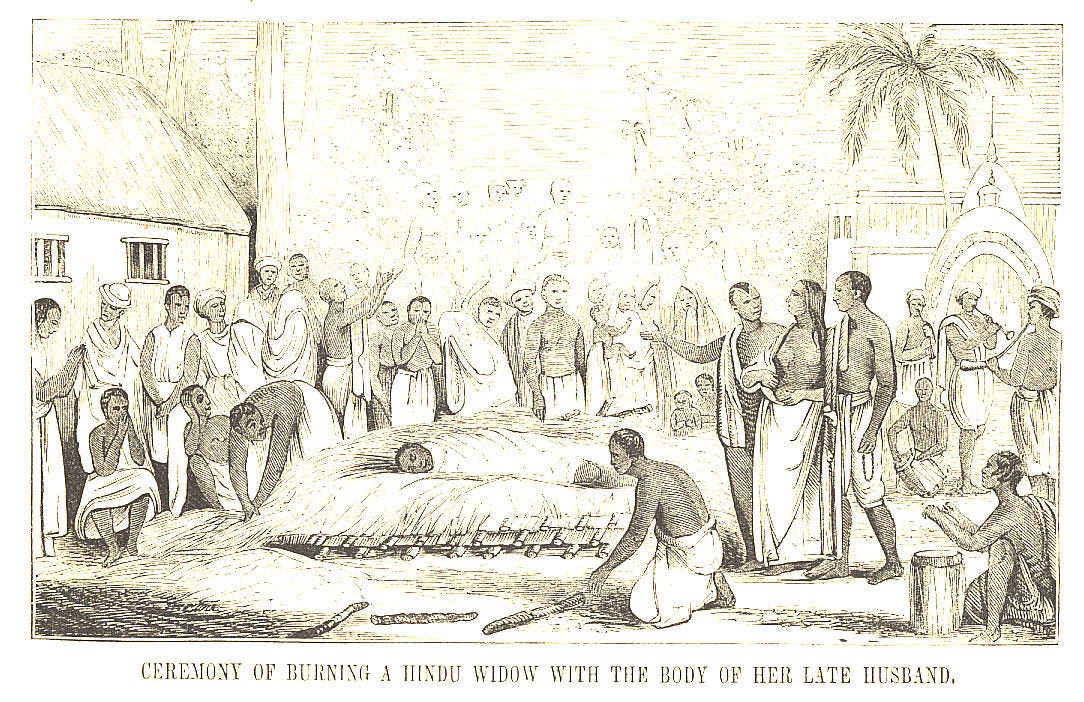
Brahmin law was particularly insistent on male authority. It was, after all, the society that valorised widows burning themselves to death on their husband’s funeral pyre.

How well members of a sex can coordinate with each other also affects social leverage. In polygynous, patrilineal, kin-group, plough-farming societies the ability of women, particularly elite women, to coordinate with each other was often very limited. Conversely, it has tended to be very easy for men in such societies to coordinate with each other, especially if male-only cults develop. Such cults are very common across human societies. Greater male coordination tends to increase male social leverage.

Increases in population density, without a commensurate increase in applied technology, tend to reduce the status of women. As population density increases, there is likely to be less male absence, discouraging the arming of women and reducing the level of women’s management of resources. There is also likely to be more pressure on social niches, encouraging more rigid delineation of sex roles. England was significantly more patriarchal in the C18th than it had been in Saxon times, around a millennium earlier.

Precisely because social leverage matters, history is not simply a pattern of upward improvement in the status of women, but of shifts back and forth.

Raiding and warfare
How raiding and warfare operates in a society also affects social leverage. If raiding and warfare is sufficiently endemic, that generates a premium on male cooperation. That tends to favour patrilineal kin systems, as related males who have grown up together are likely to be more effective in combat operations.

In small-scale societies, especially patrilineal ones where women marry away from their natal kin, endemic raiding and warfare particularly tends to generate male cults as it is important for the men to be able to coordinate planned raids and attack without women warning their relatives. Such male cults often enforce their privacy through ferocious punishments. That increases male social leverage, generating a presumption of male authority and providing a social mechanism to establish and reinforce male authority.

Endemic warfare and raiding can, however, encourage single-spouse marriage systems. Polygyny means that some men are cut out of the local marriage market. If circumstances are such that a premium is put on local social cohesion, then single-spouse marriage systems can be selected for so as to maximise the number of local males with a commitment to the local social order via having their own wife and children. (Note, this does not imply that reducing reproductive variance among men is what is being selected for.) Such pressure for single-spouse marriage for greater social cohesion can also apply to minority religious groups, such as the Alevis.

Shifting social leverage
What is hopefully clear from the above is that patriarchy is not some nefarious male plot. It is a social phenomena driven by the relative social leverage of men and women in a society. The level of patriarchy can thus vary widely between societies. It can also vary in the same society across time, if the underlying social constraints change in ways that shift the leverage between men and women.

That the Christian Church sanctified single-spouse marriage (including no concubines), insisted on the importance of legitimacy (making it very important who your mother was and whether she was married to your father), insisted on female consent being required for marriage, strongly supported female testamentary rights (and the property rights entailed therein) and, in conjunction with manorialism, broke up kin groups, meant that the status of women was significantly higher in Christian Europe than was the case in Islam, Brahmin India or Confucian East Asia. As I have noted previously, feminism was only likely to arise within Latin Christendom-cum-Western civilisation.

Technological change since the emergence of mass-prosperity societies, starting with the development of railways and steamships in the 1820s, has tended to further increase the status of women. The increase in the number of low-physical-risk jobs, the development of domestic technology (reducing the time-and-physical-skill-burden of managing a household), and the development of mass education (reducing the time-and-attention burden of raising kids), as well as shrinking family sizes, have all greatly increased the capacity of women to earn income outside the home. The fall in transport and communication costs has also made it easier for women to coordinate and organise.

The most dramatic change, however, has been the legal and technological changes that have given women unilateral control over their fertility. This has decoupled sex and marriage, a huge social shift in itself. But it also meant that women have been able to invest in higher education, greatly increasing their employment as professionals, managers and other high-status jobs. These changes have also greatly increased women’s role in the creation of culture.

Hence we now have the first societies in human history increasingly without presumptive sex roles. This is a dramatic cultural and evolutionary novelty. Needless to say, gender expectations and narratives have been in considerable flux.

These changes also mean that men and women have fairly similar levels of social leverage. As biologist Bobbi S. Low notes:
...men’s value to women is no longer solely or primarily resource value, and women’s value to men is no longer solely or primarily reproductive value.
Women still have the leverage of sex and fertility, but that is strongly age-dependent, is somewhat weakened by the relative availability of sexual outlets and the undermining of the status and value (and so the appeal) of fatherhood.

The presumption of greater maternal involvement in child-raising is a universal human cultural pattern that, while it shows variations among cultures, is substantially driven by biology. It is not a manifestation of patriarchy. Due to the biological processes of pregnancy and lactation, cultural conceptions of motherhood, while they do vary, vary much less than do cultural conceptions of fatherhood, which (unlike biological paternity) is a socially created role.

Apart from some rapidly fading cultural traces, contemporary Western societies do not face the problems of patriarchy. Instead, developed societies face the problems of dealing with a dramatic level of evolutionary novelty. Such as the dramatic fading of presumptive sex roles.

Beating the patriarchy drum may be emotionally satisfying, and have some residual propaganda value, but it is mostly just a giant, self-indulgent, distraction from working through the continuing implications of these dramatic changes and the sea of evolutionary novelty we find ourselves in.

[Cross-posted, somewhat improved, from Medium.]

Thursday, June 10, 2021

Feminism is grounded in Christian social dynamics

The Women’s movement is a product of conditions that existed in Western society but nowhere else.


Feminism was a product of North-Western Europe (and the settler Anglosphere) for very specific cultural and institutional reasons. The women’s movement had to come out of a culture which already gave women’s choices sufficient standing, where elite women could organise and deploy resources, where kin-group loyalties did not dominate and constrain, and where explicit political bargaining was already part of the institutional landscape. This combination of features occurred in no other cultures other than in the societies that descended from Medieval Latin Christendom.

As I noted in my previous post, European and Chinese settlers in the American West provided a revealing natural experiment about the difference in that status of, and possibilities for, women in a society that had sanctified single-spouse marriage and (apart from some fringe regions) eliminated kin groups (Christian Europe and its descendant societies) as against a society with polygynous marriage and powerful kin groups (China).

The Church’s sanctification of a women’s consent as necessary for marriage elevated the status of women’s choices. As did the Church’s (admittedly bequest-hungry) support for the property and testamentary rights of women. Single-spouse marriage meant that elite women habitually had access to resources and were acknowledged as public organisers of resources.

The lack of kin groups required the development of alternative mechanisms for social cooperation. It also meant that women’s fertility was not an asset of their kin group, so giving more power to their consent being required for marriage.

Women’s fertility being an asset of their kin group — and connections within the kin group being essential for social standing, risk management, income prospects, wealth protection, etc — are fundamental drivers of (dis)honour killings; fatal enforcement of the restrictions on choices for women, with family members killing their own daughters in order to protect their standing within the kin group and local community.

Open source law
That in Christian Europe law was human (i.e. was not based on revelation) meant that those cooperative mechanisms could be entrenched in law, and so could the bargains they came to. A long history of explicit political bargaining developed with associated institutional structures. Structures that were most extensively established in what became Parliamentary states.

In both Islam and Brahmin civilisation, law was based on revelation and dominated by religious scholars (ulema) or priestly castes (Brahmins). A legal system can create new precedents. It cannot create new revelations. While the varying capacity to enforce rulings on people and groups affects the evolution of revelation-based legal systems, as does having to deal with new circumstances, it is not possible within revelation-based law to get together and legally create, ratify or entrench new social bargains. This made it much harder to develop alternative social-cooperation mechanisms to kin groups.

Moreover, neither Sharia nor Brahmin law were positive for the status of women. Sharia famously weights the testimony of male and female witnesses differently. While Manusmrti, the most famous Brahmin legal source, explicitly banned women from being independent and required wives to threat their husbands as if they were gods. This is, after, the legal-religious culture that gave us suttee (aka sati).

Between kin groups treating the fertility of women as an asset, dishonour killings, polygynous marriage lowering the status of women, and law enforcing (even sanctifying) subordinate status on women, other state-society civilisations were far more patriarchal than Christian Europe and its derivatives.

In the Christian Eurosphere (Europe plus the regions where European settlers became the dominant population), the women’s movement utilised available social status, patterns and resources in new ways. It was still, however, very much a mobilising of the cultural and institutional resources that were available to be used in such a way. Hence, there is often relatively little time gap in Western societies between all men getting the vote and women getting the vote.

The emancipation sequence
The women’s movement was part of what we might call the Emancipation Sequence (banning the slave trade, banning slavery, Jewish Emancipation, Catholic Emancipation, adult male suffrage, women’s suffrage, second-wave feminism, civil rights, queer emancipation …). Two centuries of mass movements organised to expand the legal rights and social participation of previously excluded groups, utilising the structures and possibilities within societies based on Christian social dynamics.

Other civilisations produced mass movements, but they were invariably organised around religious and mystical (even occult) ideas, as other civilisations lacked well-established mechanisms for such explicit political bargaining.

The key fight of second-wave feminism in the 1960s and 1970s was over women getting unilateral control over their fertility. This put second-wave feminism in direct opposition to the Church and Christian sexual mores and teachings. This has obscured how much the women’s movement was very much a product of specifically Christian doctrines and consequent social dynamics. Hence feminism in other cultures being both derivative, and somewhat pale shadows, of its Western origins.

The retreat from moral universalism that used to be a feature of progressive politics has seen Western feminists increasingly retreat from concern for women from other cultures, using the “but that is their culture” excuse. How far would the Western women’s movement have got if their opponents could simply close down their claims with “but that is our culture”? The women’s movement may have arising in Western societies but it also did very much seek to change key aspects of Western culture. It is very odd for contemporary feminists to deny that opportunity and lever to women from other cultures.

The women’s movement was also built on the Christian roots of Western culture and social dynamics. History, it’s complicated.


[Cross-posted from Medium.]

Friday, February 5, 2021

Is toxic masculinity a bullsh*t concept?

It is far more effective at attaching a negative adjective to masculinity than in helping to understand human behaviour.

I am using bullshit in its technical philosophical sense — statements made for rhetorical effect regardless of how factually accurate they are.

About violence

To understand the problems with toxic masculinity as an analytical concept, it is useful to start with looking at something that is highly patterned by sex: violence. Especially as the patterns of violence by sex are regularly linked to toxic masculinity.

A Swedish study found that 0.1 per cent of the population made up a fifth of violent crime convictions, 1 per cent made up almost two-thirds of violent crime convictions and 4 per cent were responsible for all of them. The offenders were overwhelmingly (87 per cent) male.

So, clearly violence is correlated with being male, right?

Wrong. Yes, violence is disproportionately male, but only 7 per cent of males were in the convicted-of-violent-crime group. Something that pertains to only 7 per cent of a group is not significantly correlated with membership of that group.

Conflating being disproportionately x with being correlated with being x is done all the time. Including, of course, by a lot of feminists.

If there is any group that the violent offenders are more than 7 per cent of, especially if such a group also includes the 1 per cent of women who were violent offenders, then membership of that group is going to be more correlated, potentially far more correlated, with being violent than is being male.

As it turns out, completely unsurprisingly, certain personality traits (often aggregated into the Big Five of Openness, Conscientiousness, Agreeableness, Extraversion and Neuroticism, or OCEAN) are way more correlated with violence than is being male. Given that no personality trait is only male, and no personality trait applies to all males, this is more or less bound to be true.

Once you starting asking about personality traits and behaviour, then biological sex becomes something that may generate patterns, but is not likely to be significantly causal.

Being of a sex changes the constraints one is facing. This, on its own, is enough to generate patterned behaviour.

As a general pattern, the small gamete sex (males) is likely to be more violent than the large gamete sex (females). This is for the obvious reason that violence is usually less risky for the small gamete sex than it is for the large gamete sex. The difference in the pattern of risk produces differences in the patterns of behaviour.

If the small gamete sex is also larger and stronger than the large gamete sex, this tendency to be more violent will be strengthened further. Amongst Homo sapiens, men are, on average 7 per cent taller and 13 percent larger than women: while women, on average, have 52 per cent of the upper body strength and 66 per cent of the lower body strength of men (in part due to male spines being more rigid and providing a better lever for strength) while women generally both have, and require for health, proportionately more fat as a share of body mass than men.

Given these biological realities (even without considering the risks of pregnancy and the constraints of child-minding), of course physical violence among humans is going to be disproportionately male. Of course aggression by human males is going to manifest much more as physical aggression than will aggression by human females.

That does not mean that men are more aggressive then women: actually, the two sexes are about equally aggressive overall. It is more the patterns of aggression that differ, due to the differences in risk patterns, with male aggression tending to be more physical and more overt while female aggression tends to be both more relational and more camouflaged.

Ask someone who went to a girls’ school whether they have ever experienced or witnessed toxic female aggression.

The patterns of aggression differ by sex, but they are not entirely separate. There is physical aggression from women and relational aggression from men. It is their relative distribution and ways of manifesting that differs. Those patterns of difference can also vary, depending on social circumstances. A result of us being so much the cultural species.

Arguing that biological sex matters is not remotely the same as postulating some deeply and pervasively essential differences between men and women (apart from the small-gamete, large-gamete distinction).

About domestic violence

While all this is enough to raise large questions about the concept of toxic masculinity, including tying any pattern of negative behaviour specifically to being male, it is worth looking at the use of descriptive terms in a particular arena of violence: domestic violence. There has been a strong (feminist) push to conflate domestic violence with intimate partner violence. In response, the term family violence is being adopted as the more general category.

Treating domestic violence as if it specifically means intimate partner violence is rhetorically very useful, because what form of domestic violence does conflating it with intimate partner violence leave out? Violence against children. And why is it useful for feminists to reducing the salience of violence against children? Because it is more often perpetrated by women than men.

This is partly because women have more opportunities to commit violence against children than men do. But it is also that children are generally smaller and weaker than adult women. That there is a pattern of (some) women engaging in violence against those who are smaller and weaker than they rather gets in the way of valorising women in general and deprecating men in general. Or otherwise essentialising violence or aggression along male-versus-female lines.

Acknowledging that intimate partner violence itself has two general patterns (1) violent men and women hitting each other, and (2) intimate terrorism, where one partner terrorises the other, also gets in the way of postulating some deep causal gulf between male and female. Especially as, while the pattern of intimate terrorism is wildly disproportionately a male partner terrorising a female partner, the reverse also occurs, just much more rarely. Much of the public discussion about intimate partner violence is, however, framed as violence against women, essentially writing any violence against men out of the social script.

Toxic aggression

Both men and women, both boys and girls, can and do engage in toxic aggression. While such aggression has patterns by sex — that is, the distributions differ by sex — no form of it is purely limited to a single sex.

The questions then become, is there any useful element of the concept of toxic masculinity that (1) is not about a form of toxic aggression, (2) is reasonably specifically tied to being male or to masculinity and (3) is to any significant degree characteristic of or, or caused by, either? Or are we, at best, dealing with a small sub-group of males who, due to specific personality traits and/or beliefs, choose to manifest their masculinity in particular ways?

The rhetorical value of the term toxic masculinity is obvious. It ties a negative adjective (toxic) to masculinity, it encourages the attribution of causality to being male and/or being masculine (as if it is what happen when masculinity “goes too far”, so masculinity is to be treated as potentially toxic) and it discourages attention to any analogous female behaviour.

So, it is excellent rhetoric, and it is excellent rhetoric regardless of its analytical soundness.

Given the above considerations, toxic masculinity is looking like a bullshit concept.

One reason toxic masculinity is excellent rhetoric, is that there is male behaviour based on a sort of hyper-masculinity that we are familiar with, and which is widely (often intensely) disliked. But, of course, it is disliked by a lot of men. That general dislike of such behaviour among both men and women gives toxic masculinity much of its rhetorical power.

Cultural phenomena

An objection to the above considerations is that the notion of toxic masculinity is not about violence and aggression as such, but pertains to a cultural phenomena.

One of the perennial problems of cultural analysis is that culture, and cultural patterns, can easily be turned into analytical “silly putty” — able to redefined to fit any analytical hole. Especially as culture itself is infamously so variably defined.

The overwhelming majority of human societies have had presumptive sex roles, driven by how expensive human children are to raise. This has led to very strong patterns of activities that could be done while minding children being presumptively female and activities that could not be done while minding being presumptively male. This is usually driven much more by relative risk and level of constant attention required than by strength.

Hence, in foraging societies, women generally gather, but they will hunt small animals, such as lizards. Meanwhile, men generally hunt, but they will gather more risky-to-get things, such as honey. In hoe-farming societies, women generally farm, as that can be done while minding the kids. In plough-farming societies, men generally farm, as ploughing cannot be done while minding the kids. And so on.

This very long history of presumptive sex roles probably has something to do with why Homo sapiens are so cognitively dimorphic. A recent study found that around 70 per cent of men have a mix of personality traits that no woman has and around 70 per cent of women have a mix of personality traits that no man has. Only 18 per cent of us are in the personality-trait-bundles overlap group. (An earlier study found even higher rates of cognitive dimorphism.)

We are, in fact, as a species more cognitively dimorphic than we are physically dimorphic (apart, from the mammaries-ovaries, testes-penis, small gametes versus large gametes pattern). Different patterns of risk-management behaviour, and associated interactions, can be expected between men and women, with both continuities and variations between cultures.

Dealing more with physical risk, men are likely be more drawn to philosophies such as Stoicism, or analogous outlooks. Declaring such stoicism to be toxic masculinity is just silly.

We live in the only societies in human history largely without presumptive sex roles. Thus, any implicit or explicit pathologising of the notion of presumptive sex roles is, analytically, pretty silly.

Similarly, tying any phenomena to masculinity that also manifests among women is pretty silly. it is, for example, fairly clear that the breakthrough for queer emancipation was a major shift in attitudes among women. The strictures against homosexuality being part of a moral order that raised the social exchange value of sex.

It is, after all, generally hard for any broad cultural patterns to persist, or to change, without significant numbers of both sexes “buying into” the persistence, or into the change. Hence second-wave feminism was as successful as it was because lots of men agreed with the goal of expanding opportunities for women.

Strictures against homosexuality have a complicated relationship to masculinity and patriarchy, because in some societies, the celebration of masculinity extended to celebration of male beauty and eroticism. They could be highly patriarchal societies (e.g. Ancient Athens) or rather more gender egalitarian societies (e.g. Sparta). If we are dealing with patterns that are specific to some culture or set of cultures, toxic masculinity is clearly a misleading label.

Unless we are dealing with attitudes and patterns of behaviour that are specifically male, are specifically tied to masculinity in general and are not tied to specific cultures (and would therefore have a specifically cultural source, not a generally masculine source) toxic masculinity is a misleading term.

It would also be helpful if the concept was, at least to some degree, quantifiable. How general is the pattern? If it is very much a minority phenomena, then it will be tied to something else more strongly than it will be to masculinity.

There is also a problem of context. Something that might be functional in one context may be much less so, or even dysfunctional, in another.

Drawing causal connections between specific behaviours and cultural patterns is also notoriously difficult. Especially as manifestations of cultural patterns can vary markedly between individuals within the same culture.

So, are we dealing with a well-defined concept, that is usefully quantifiable and tied to careful causal analysis?

Not really, we are dealing with something much more motte-and-bailey like. That is, there are discussions of toxic masculinity that have all the sophisticated trappings of careful analysis (the motte version) that defenders of the term point to. And then there is the much more blunderbuss rhetorical uses of the term (the bailey plays).

Any objection to the latter will be referred to the former. But the tying of toxicity to masculinity makes the concept of toxic masculinity ideal for such rhetorical games, given that the boundaries of the concept are so unclear. Or, at least, easily shifted. Especially as masculinity itself can mean or imply (1) to do with being male or (2) to do with conceptions of masculinity.

If the concept of toxic masculinity was part of a general taxonomy of masculinity, it may be of some interest. As a stand-alone pathologising tag, not so much.

So, yes some men choose to manifest their masculinity in particular, unfortunate or destructive, ways. Certain cultural milieus may encourage or discourage that. But it is not their masculinity that is driving that.

Ultimately, the giveaway is that toxic masculinity is a stand-alone pathologising tag. Part of a more general pattern of conflating disproportion with correlation and so treating disproportion as characteristic-of or specific-to.

So, toxic masculinity: rhetorically powerful, yes; factual or analytically useful, not so much.

(Cross-posted from Medium.)

Wednesday, January 27, 2021

Trans activism and the feminist discounting of womanhood

Transactivism has taken establishment feminism setting up ovaries and mammaries as being incidental to being a woman and made it irrelevant to being a woman.

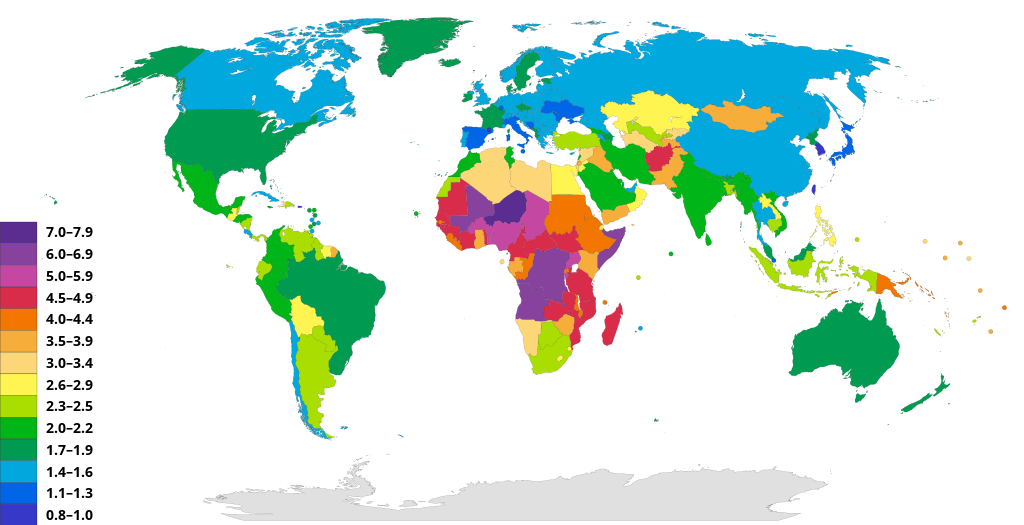
Current fertility rates (in children per woman, assuming average fertility rate for her age group without dying in childbirth before the end of her reproductive life).

It is rather startling how much of the public space is being driven by trans activism and trans issues. Trans folk are, after all, a very small proportion of the population whose individual cases are rife with various complexities.

Yet, we are being offered striking simplistic narratives that have to be adhered to if one is going to be of the morally meritorious.

In fact, trans issues in the public sphere provide an excellent example of the more general dynamics of narrative-driven sense of status based on prestige opinions.

Especially the attendant hostility to any discovery processes that might threaten said narratives and prestige opinions. This hostility to open enquiry so as to preserve the status value of the prestige opinions as unchallengeable means that comments or musings that do not conform have to be pathologised. Dissenting views even more so.

Hence the very strong tendency to misrepresent both. Having detected a failure to conform to prestige opinions and narratives, the material in question does not have to be seriously grappled with, it just has to be characterised in whatever conveniently pathologising way is at hand.

Misrepresentation becomes rife, with comments by the divergent being given implications that weren’t there, weren’t intended, or simply have minimal connection to what was actually said.

This is tied to catastrophising, whereby expressing divergent views is characterised in ways that invoke alleged catastrophe. The classic catastrophising in trans activism being “you are erasing my/our/their existence”.

This is, of course, a nonsense at so many levels. Words do not erase one’s existence. They can, however, damage a narrative and if one’s identity is tied to a particular narrative, then the “wrong” words can be very threatening.

Meanwhile, trans-activism seeks to separate the possession of a uterus, ovaries and functioning mammaries from the identity of being a woman.

Where establishment feminism went…

In this, they are pushing at a door that careerist feminism has already opened.

Lots of women do not identify as feminist. A 2015 poll by the UK’s most significant advocacy body for women, the Fawcett Society, found that only 9% of British women identified as feminist. Meanwhile, 81% of women supported equality of opportunity for women (and 86% of men did so).

Explaining the dramatic divergence between supporting equality for women and identifying as feminist is simple: feminism comes with a lot of baggage other than achieving equality. Especially as the most prominent and public version of feminism is dominated by highly-educated career women, who pursue the interests and concerns of highly-educated career women.

Such feminism has blown through seeking equality and is now after various forms of privilege. “Believe all women!” is not an equality claim, but one of privilege. That criticising men is feminism and fine, while criticising women is misogyny and not, is also not an equality claim, but one of privilege.

Careerist, establishment feminism has a clear set of concerns about motherhood. Which is (1) to maximise the ability to avoid motherhood, (2) to minimise the career costs of being a mother and otherwise (3) to mainly positively concern themselves with motherhood when it becomes a stick to beat fathers and fatherhood with.

In this view of women’s progress, the key markers of progress are all concerned to do with women’s participation in the workforce, particularly the professions. This means that women’s progress largely revolves around social markers that are explicitly separated from having a uterus and ovaries. Any attempt to make anything of this separation of women’s progress from having a uterus and ovaries is treated as an attempt to tie women to motherhood: to “force” them to be barefoot in the kitchen; to de-legitimise any other aspiration.

Trans-activism just takes this well-established pattern of separating key markers of being a woman from anything to do with having a uterus and ovaries one step further.

Uneven mobbing

Trans-activists have become notorious for their hostile mobbing of anyone who is seen to dissent or diverge from their preferred narratives. But this hostile mobbing is not evenly distributed. Women who publicly dissent are typically treated much more viciously by trans activists than men who do so. It is not hard to infer why: they envy women whose identity as a woman goes “all the way down” and so is inherent, without expensive hormones and surgery.

But this particular hostility to women who do not go along with the preferred narratives and prestige opinions also has its counterpart in establishment feminism.

It has been a regular finding of honest surveys (those that do not tie feminism to believing in equality for women) that many women do not identify as feminist. Once one realises that feminism comes with all sorts of baggage, overwhelmingly tied to it being dominated by highly-educated career women, this is not surprising.

Nevertheless, a standard feminist response to the mass failure by women to identify as feminist has been the condescending notion that such failure to so identify is a failure of cognitive understanding on the part of non-identifying women. That for a women not to see themselves as a feminist is a sign that they do not understand their own interests and are too weak-willed or ignorant to embrace their “proper” feminist identity.

So, only feminists are “cognitively complete” women, This systematically discounts women — except for those that are so blessed they have achieved the status of feminist.

The flattery of false consciousness

It is also a derivation of the concept of false consciousness in Marxism. (Similar notions to false consciousness have a long history in mystical and occult thought. It is very attractive to see oneself as a member of a knowing, enlightened elite.)

The problem with the concept of false consciousness is not the idea that social circumstances and experience can systematically mislead us. Though it is reasonable to query how much this is compatible with adaptive pressures of biological and social evolution. Patterns of cognitive error arising from evolutionary adaption are much more plausible than assuming systematic error that would get in the way of reproductive survival.

The problem comes when the corollary is added that some particular group is somehow gifted with a superior capacity to apprehend reality. This sets one off on a path that makes it so much easier to discount contrary views. Even if held by folk who one is notionally seeking to champion. Notions of false consciousness were, after all, quite enthusiastically adopted to explain how the working class was so cognitively incompetent that it could not accurately judge its own interests.

Taking other people’s views and concerns seriously is a corrective humility and requires an openness to the discovery processes involved in interrogating, without protective arrogance, why they might have those views. Conversely, adopting a process of systematically discounting divergent views and concerns is conducive to collective arrogance while blocking discovery processes.

This interacts with the notion that activism represents the highest moral good. Not only are activists cognitively superior, in that they see what others do not. They are also morally superior, in that they are working to a better future.

This gives even more grounds to systematically discount divergent views while generating a collective identity based on mutual admiration of what is in their heads. (That is, mimetic moralising — ardently copying each other’s moral views — based on mimetic arrogance — agreeing to mutually worship some common factor they have: in this case, the splendour of what’s in their heads.)

It is very easy for this mutual admiration based around convergent views to be tied to contempt and anathematisation of divergent views. Anathematisation that both recruits (to the self-identified moral elite) and intimidates (by stigmatising and punishing those who dissent).

Prestige opinions only provide prestige if divergent opinions generate negative prestige.

Needless to say, discovery processes that threaten any of the tenets of this process of convergent admiration, of mimetic moralising, are not welcome. Casting such efforts at discovery as representing hostility to the ostentatious good intentions that generate the shared identity based on prestige opinions (and thereby being of the morally meritorious), can provide an easy line of rhetorical attack on those using such discovery processes.

Fear of divergence makes those who seek to be identified as one of the morally meritorious remarkably easy to manipulate. Hence the non-player-character (or NPC) meme, as those who seek to embrace narrative and opinion convergence so as to see themselves, and be seen as, one of the morally meritorious, sign up to accept, or at least acquiescence in, all the prestige opinions and narratives that go with being of the morally meritorious.

In such circumstances, any inconsistency between various prestige opinions marking membership of the morally meritorious is a feature not a bug, as embracing inconsistency becomes a signal of one’s wish to be one of the morally meritorious. Such as the wild inconsistency between the age of sexual consent (usually 16) and the sought age of gender-transition consent.

Betraying women

Establishment feminism increasingly accepts various betrayals of women. Since, under social justice ideology dynamics, the more marginal the group, the higher their moral rating, women, being half the population, are thereby less marginal than any other group except men. So, if it is women versus Muslims, women lose. And it it is women versus trans, women lose.

It is not hard to work out why so few British women identity as feminist. For about half of British women, motherhood is their most important identity. Establishment feminist treats motherhood as an impediment on the road to matching men in all (positive) things. Establishment feminists are highly educated, often from elite institutions, and their class is obvious in their voices and language. Establishment feminists have been conspicuously missing in action when it comes to problems of predatory sexual behaviour from within Muslim communities. Establishment feminists are also conspicuously missing in action when it comes to defending women’s sports and women’s spaces from invasion by people who do not have, and will never have, ovaries and mammaries.

Motherhood, class, Muslim, trans: that’s four strikes and you’re out.

There is a wider cultural consequence. If you don’t have children, or turn them into a career embarrassment and distraction from what really matters, then passage down the generations loses its moral and social force. The connected-to-the-past future of continuing tradition is so much more easily rejected in favour of the imagined future built on worshiping the splendour of what’s in one’s head(s).

We have lots of experience of what happens to societies when they are taken over by people who worship the splendour of what’s in their heads and so claim everything will be wonderful if they control everything. The results of such mimetic zealotry are, uniformly, disastrous.

So, to recap. Establishment feminism treats women who do not identity as feminist as cognitive failures. Establishment feminism measures female progress by how few women concentrate on being mothers. That is, by how well people who happen to have ovaries and mammaries match the social patterns of those that do not. The discounting of womanhood in this has opened the door to people who have never had ovaries or mammaries being declared to be women.

Transactivism has simply taken the notion, that establishment feminism has spent decades establishing, that having ovaries and mammaries is incidental to being a woman and made having ovaries and mammaries irrelevant to being a woman.

The line about reaping as you sow comes to mind.

(Cross-posted from Medium.)