Showing posts with label genetics. Show all posts

Thursday, November 18, 2021

The Out-of Expansions

There have been four major out-of expansions by Homo sapiens.

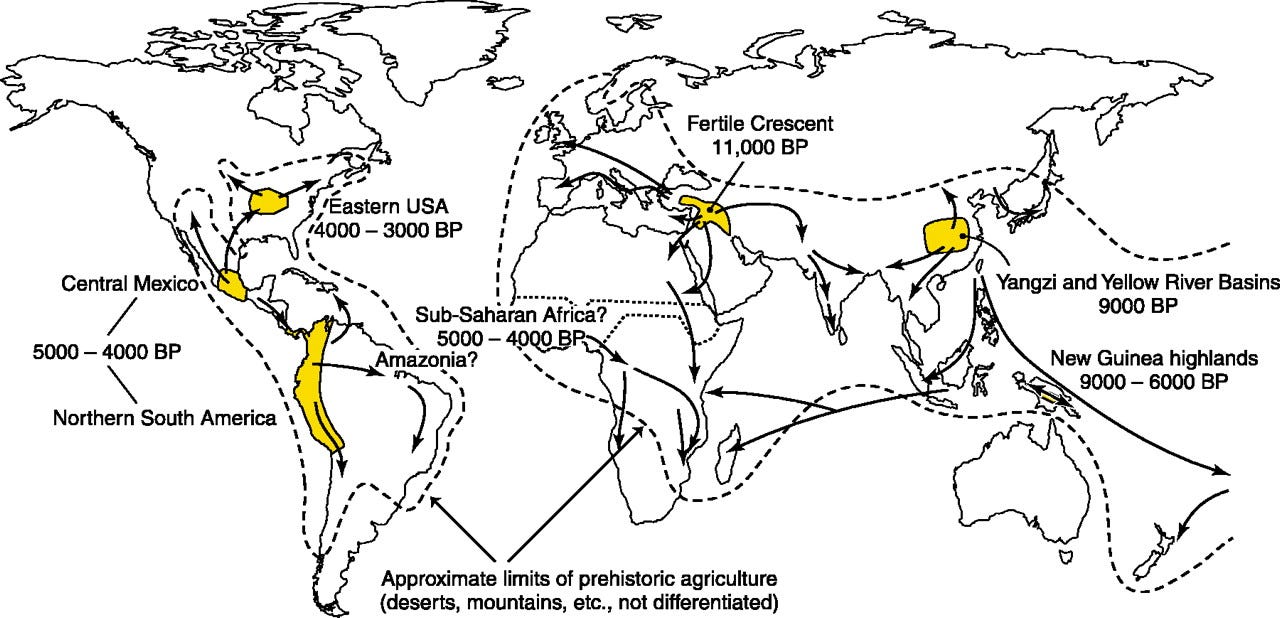
Source: Jared Diamond, Peter Bellwood, Farmers and Their Languages: The First Expansions, Science, 2003, Vol. 300, Issue 5619, pp. 597–603.

Four great out-of population expansions have widely dispersed Homo sapien populations. The out-of-Africa expansion of foragers; the out-of-the-river-valley expansion of farmers; the out-of-the-steppe expansion of pastoralists; and the out-of-Europe expansion of settler empires and states.

Out of Africa: the expansion of Homo sapiens

Whether an exit from Africa around 100,000 years ago was successful or not is still debated. From around 60-50,000 years ago, there was a sustained exit from Africa. Homo sapiens spread to occupy all continents except Antarctica, absorbing and replacing all other Homo populations. These foragers spread at a rate of about 10km a year, at least in areas without existing Homo populations.(1)

Homo sapiens are more gracile than other Homo, so likely lower in reactive aggression and thus more cooperative. Though the delay in the exit(s) from Africa, and the long period of coterminous occupation of Eurasia (maybe 20,000 years), suggest only a marginal advantage over Neanderthals, although this may have changed over time. This spreading of Homo sapien foragers concluded with the settling of southern regions of South America around 14,600 years ago.

Out of the river valleys: the expansion of farmers

Starting around 11,000 years ago, farming populations expanded across arable land, absorbing and replacing foragers. The process is still going on in Africa, Amazonia and elsewhere. In Oceania, farmers occupied islands without previous human habitation, reaching New Zealand probably around the year 1320.

The transmission from foraging to farming was a lengthy one. While not generally more productive per hour of effort than foraging, farming was able to extract many times more calories from arable land, lowered the cost of child-rearing and created an increased protection problem, encouraging the development of more coercive capacity.(2) Hence the continuing expansion, and dispersal, of farming populations.(3) Farmers and farming generally spread across arable land at a rate of around 1km a year.(4) The development of farming also had significant adverse health consequences, with deteriorations in dental health, loss of height, increased infectious disease and more signs of metabolic stress.(5)

Farmers seem to have traded-off less food-search time (food search being more difficult for child-minding) for more food-processing time (easier for child-minding) and more immediate access to energy (calories) (so quicker weaning of children) for less long-term access to nutrients. 

The flesh of plants are much more likely to be toxic to humans than is the flesh of animals while plant calories and nutrients are often significantly less bio-available than are animal calories and nutrients. Hence the increased need for processing to use plant foods. Hence also the existence of an calorie/nutrient trade-off when shifting from a more animal-based diet (as foraging diets generally have been) to the plant-based diet of farming. (Much of modern food culture has been systematically trading-off taste and calories against nutrient quality.)

With the development of farming and pastoralism, there was a dramatic narrowing in male genetic lineages. The rate of elimination of male lineages varied by region. Overall, only about 1-in-17 male lineages survived this harrowing of male lineages. (Female lineages were almost entirely unaffected.)(6) This harrowing of male lineages was a result of the expansion among agro-pastoral peoples of the (social) technology of aggression against fellow humans.

The development of pastoralism intensified the pattern of elimination of male lineages.(7) The harrowing of male lineages largely came to an end with the development of chiefdoms and states. That is, when the technology of exploitation overtook the technology of aggression — conquered males became providers of tribute and taxes, so were worth protecting. 

The biggest single thing states do after extracting surplus (taxing) is pacify: they don't want their taxpayers killing each other.

Out of the steppes: the Indo-European pastoralist expansion


Pastoralist populations from the Pontic-Caspian steppe domesticated the horse (though the Botai people further east may have domesticated horses earlier) and, from about 5,000ya, and continuing until about 3,000ya, expanded into Europe, the Iranian plateau, the Tarim Basin and Northern India. During these surges of settlement, Indo-Iranians develop the horse-drawn chariot (c.4,000ya).

The steppe-descended pastoralist population eventually expanded across all of Europe, interbreeding with the Neolithic farmers. Though not in the Basque Country and Sardinia.(8)

The original steppe pastoralist population had, like various other pastoralist populations have, developed a mutation for lactase persistence. This enabled much higher metabolic return from post-infancy consumption of milk. Different pastoralist populations in Afro-Eurasia have developed different lactase persistence mutations.(9)

Dairying broadens access to nutrients and enables the extraction of around five times as much calories from grassland as could be done via ruminant meat consumption.(10) This biological advantage likely enabled millennia of expansion, resulting in Indo-European languages, and cultural patterns ultimately derived from steppe pastoralism, covering Europe, the Iranian plateau and Northern India.

After the Indo-Europeans settlement surges had petered out, Indo-Iranian peoples also pioneered horse archers and heavy lancers (c.2,700ya). Later pastoralist peoples continued to periodically ravage, or even conquer, agrarian peoples. Only the Arab and Turkic dispersals resulted in large-scale demographic expansion beyond pastoralist heartlands. In both cases, settlement following imperial conquest.

Out of Europe: the empires-and-settlers expansion

Beginning c.1500 and petering out c.1960, European populations expanded across Siberia, the Americas and the Antipodes.

The combination of competitive jurisdictions, single-spouse marriage, the abolition of kin groups (requiring the development of replacement mechanisms of social cooperation), as well as being able to entrench social and political bargains in law (as law was not based in revelation, unlike Sharia and Brahmin law) meant that Europe had far more variety of political institutions than elsewhere. This gave the selection processes of history far more to work with, resulting in Europe developing more effective states. Christian Europe’s swift adoption of the printing press after 1450 greatly aided the dissemination and development of information and technology while reducing administrative costs.

With gunpowder, the compass, and ocean-going sail technology, Europeans spread out from Europe in a largely maritime out-of expansion. The out-of-Europe expansion included waves of settlement. (The Russian conquest and settling of Siberia did not need the maritime step, though riverine expansion was important in parts of Siberia.)

Settlement generally followed, sometimes preceded, imperial expansion. Both the Russian and American nation-building-through-settlement were also imperial projects, although animated by rather different ideas and institutions.

The Europeans acquired a portmanteau biota of supporting plant and animal species. Where their portmanteau biota became dominant, Europeans became the dominant human population, creating neo-Europes. Where the biota failed to do so, they did not.(11)

Being Eurasian, so resistant to the Eurasian disease pool, gave Europeans a disease advantage in the Americas and the Antipodes. Having much more effective states was their advantage within Afro-Eurasia and allowed them to exploit their disease advantage far more completely and speedily outside it. Their advantage in state (and other cooperative) organisation eventually (albeit temporarily) expanded their control across regions where they were systematically disease-disadvantaged (including Sub-Saharan Africa).

The Homo sapien advantage is non-kin cooperation. Medieval European Christian civilisation put non-kin cooperation “on steroids” and so Europeans equipped with compass, gunpowder, ocean-going maritime technology and the printing press created the Eurosphere across four continents plus Siberia and ended up dominating the planet — until other peoples learnt their tricks.

In general


The expansions have been getting faster: taking at least 35,000 years; 11,000 years; 2,000 years; 500 years.

The, currently underway, fifth great out-of expansion — the out-of-the-countryside movement to the cities — is a series of concentrations, rather than a dispersal.

Each of the out-of dispersals has its specific characteristics, but each represents Homo sapiens behaving like Homo sapiens. Indeed, behaving like any biological population with access to new resources, including new abilities to access resources.

[An earlier version was posted on Medium.]

Endnotes
  1. B. Llamas, L. Fehren-Schmitz, G. Valverde, J. Soubrier, S. Mallick, N. Rohland, S. Nordenfelt, C. Valdiosera, S. M. Richards, A. Rohrlach, M. I. B. Romero, I. F. Espinoza, E. T. Cagigao, L. W. Jiménez, K. Makowski, I. S. L. Reyna, J. M. Lory, J. A. B. Torrez, M. A. Rivera, R. L. Burger, M. C. Ceruti, J. Reinhard, R. S. Wells, G. Politis, C. M. Santoro, V. G. Standen, C. Smith, D. Reich, S. Y. W. Ho, A. Cooper, W. Haak, ‘Ancient mitochondrial DNA provides high-resolution time scale of the peopling of the America’s,’ Science Advances, April 2016, Vol.2, №4, e1501385, suggests that it took 1.4kya to people the length of the Americas. As this is a distance of roughly 14,000km, that is an expansion rate of around 10km a year.
  2. Samuel Bowles, ‘Cultivation of cereals by the first farmers was not more productive than foraging,’ Proceedings of the National Academy of Sciences, March 2011, 108 (12) 4760–4765.
  3. Jared Diamond, Peter Bellwood, ‘Farmers and Their Languages: The First Expansions,’ Science, 25 April 2003, Vol. 300, Issue 5619, pp. 597–603.
  4. Joaquin Fort, ‘Demic and cultural diffusion propagated the Neolithic transition across different regions of Europe,’ Journal of the Royal Society Interface, 2015, 12: 20150166.
  5. Katherine J. Latham, ‘Human Health and the Neolithic Revolution: an Overview of Impacts of the Agricultural Transition on Oral Health, Epidemiology, and the Human Body,’ Nebraska Anthropologist, 2013, 187.
  6. Tian Chen Zeng, Alan K. Aw & Marcus W. Feldman, ‘Cultural hitchhiking and competition between patrilineal kin groups explain the post-Neolithic Y-chromosome bottleneck,’ Nature Communications, 9 Article number: 2077 (2018), published 25 May 2018.
  7. Patricia Balaresque, Nicolas Poulet, Sylvain Cussat-Blanc, Patrice Gerard, Lluis Quintana-Murci, Evelyne Heyer & Mark A. Jobling, ‘Y-chromosome descent clusters and male differential reproductive success: Young lineage expansions dominate Asian pastoral nomadic populations,’ European Journal of Human Genetics, January 2015.
  8. Iosif Lazaridis, ‘The evolutionary history of human populations in Europe,’ arXiv 1805.01579, submitted on 4 May 2018.
  9. Hadi Charati, Min-Sheng Peng, Wei Chen, Xing-Yan Yang, Roghayeh Jabbari Ori, Mohsen Aghajanpour-Mir, Ali Esmailizadeh and Ya-Ping Zhang, ‘The evolutionary genetics of lactase persistence in seven ethnic groups across the Iranian plateau,’ Human Genomics, (2019) 13:7. Scholarly discussions of lactase persistence in Europe often pay remarkably little attention to the same specific lactase-persistence mutation occurring in Europe, Iran and Northern India, so must have spread by a pastoralist, not a farming, population.
  10. Latham, op cit. Morton O. Cooper and W. J. Spillman, ‘Human Food from an Acre of Staple Farm Products,’ Farmers’ Bulletin, №877, October 1917, U.S. Department of Agriculture. Gregory Cochran and Henry Harpending, The 10,000 year explosion: how civilization accelerated human evolution, Basic Books [2009] (2010) cite the Bulletin for their discussion in Chapter 6 of the Indo-European expansion, including the role of lactase persistence.
  11. Alfred W. Crosby, Ecological Imperialism: The Biological Expansion of Europe, 900–1900, Cambridge University Press, [1986] (1993).

Sunday, June 23, 2019

Clades not clusters: about the folk theory of race

A clade is a group of organisms with a common ancestors. Identifying clades in human genetics maps out the ancestry of human groups. Like most genetic analysis of human populations, it is based on identifying alleles, patterns of variation in human genes.

As far as I am aware, the most complete study currently available identifying the structure of human clades is here. Entitled: Human population history revealed by a supertree approach and compiled by two researchers from the University of South Bohemia, the 2016 study incorporates the following chart.


The geographic mapping of large clades obviously has some connection to our current folk notion of race, but is hardly a close match. While it is true that cluster analysis can get us to groupings of human populations something like the folk notion (pdf) of race, such as in this 2002 study (pdf), cluster analysis simply looks at similarities while clade analysis is based on identifiable underlying causal structure (specifically, ancestry). 

In the 2002 study, Genetic Structure of Human Populations, by biologists from a range of institutions and countries, a relatively mathematically robust grouping was found at K=5 clusters, which does match the folk notion of race quite well. But mathematically robust groupings were found at various numbers for K. As the authors conclude:
The challenge of genetic studies of human history is to use the small amount of genetic differentiation among populations to infer the history of human migrations. Because most alleles are widespread, genetic differences among human populations derive mainly from gradations in allele frequencies rather than from distinctive “diagnostic” genotypes. Indeed, it was only in the accumulation of small allele-frequency differences across many loci that population structure was iden- tified. Patterns of modern human population structure discussed here can be used to guide construction of historical models of migration and admixture that will be useful in inferential studies of human genetic history.
Which is what identifying clades does much more directly. 

So clades, not clusters. If the human biodiversity folk are intellectually serious, they should base their analysis on clades, not on whatever clustering seems otherwise convenient. While the folk notion of race is not entirely silly (self-identification matches genetic ancestry quite well [pdf]), it is nowhere near analytically robust enough to be of use to analyse well, anything, really. 

In particular, classifying people by race strips them of their cultural and civilisational legacies, which are much more important collections of causal factors than genetic clusters than match patterns of ancestry fairly poorly. As the authors of the 2016 study note:
The linguistic classification fits rather poorly on the supertree topology, supporting a view that direct coevolution between genes and languages is far from universal.
Thus, for example (links added): 
The poor fit of Macro-Altaic and the families that constitutes it (especially the Turkic) is in agreement with the fact that there is only a weak unifying genetic signal for the Turkic-speaking populations across Eurasia. The expansion of Turkic languages has probably been largely mediated by language replacements rather than demic expansion.
We are the cultural species. A basic reality that race talk both ignores and gets in the way of understanding. Even ancestry is at best a partial match with culture. 

Race talk is pretty dreadful for analysis of social patterns but remains good for one thing: racial stigmatisation (brilliantly analysed by economist Glenn Loury). Which all sorts of people have found race talk useful for, and still do, but that is not remotely a recommendation for race talk. Indeed, it remains true that implicit or explicit racial stigmatisation is by far the dominant reason for the use of race talk. Hence, the best way to understand race talk is to look for the patterns of stigmatisation that underlie it. 

So, clades not clusters and even clades don't get us all that far, analytically speaking. 


[Cross-posted at Skepticlawyer.]

Thursday, January 26, 2012

Genes do not motivate

Natural selection is one of the great breakthrough ideas in human understanding of ourselves and of our world. Particularly when added to the discovery of genes. Unfortunately, human minds are pre-programmed to see intentions: particularly when thinking about living things. So, there is this constant tendency, by folk who should know better, to talk as if genes motivate behaviour.

Take this passage from Steven Pinker:
The child sees things differently. Though an offspring has an interest in its siblings' welfare, since it shares half its genes with each full sib, it shares all of its genes with itself, so it has a disproportionate interest in its own welfare (The Better Angels of Our Nature p.431).
A child typically having greater interest in its own welfare than that of its siblings has nothing to do with its genes. It has to do with being a motivated being which experiences its own existence rather more intensely than it does other people's.

It is likely that a child will have greater empathy with its siblings than with other folk, but that is to do with long and intimate association. Nor does that always work out: siblings can end up disliking or even hating each other. Moreover, the capacity to see others as "sibs" is a moveable feast, that can be adopted by other social mechanisms. The whole notion of "brothers in arms" works on that. Similarly, it is a much-attested feature of life on a kibbutz that those raised together because quasi-siblings, if even if there are no common genes.

Yes, natural selection works to select for certain behavioural traits. Such as the capacity to develop strong, non-sexual (or even de-sexualised) attachments to others. But the genes themselves do not provide any sort of motivation: they do not drive behaviour in that sense. Hence a capacity that evolved for one reason can end up being attached to other behaviour.

The real power of natural selection is to see how order can evolve without intention. Putting intention "back in" misses the explanatory power of natural selection, not to mention committing one to false characterisations of human behaviour. Writing in such intentional terms does not display your understanding of natural selection, it displays a serious lack in such understanding.

(BTW This is not a shot at Pinker or his book: which is a great and enlightening read. He just provided an example of an all-too-common mode of thinking about natural selection.)

ADDENDA Further on, Pinker adds the caveat:
As always, teleological terms in the explanation--"wants," "interests," "for"--don't refer to literal desires in the minds of people but are shorthand for the evolutionary pressures that shaped those minds (p.431).
But the notion that framing language in intentional terms has no implications is naive at best. Shaping capacities is very different from motivating actions, as we can see from considering how the capacity for non-sexualised/de-sexualised attachment can operate for non-relatives. The language of intention is certainly easy and familiar: it is also highly misleading.

Friday, September 4, 2009

The Seven Daughters of Eve: the iceman telleth

The Seven Daughters of Eve by Bryan Sykes is a book on using DNA to chart human history by the geneticist who was the chief genetic investigator of the Iceman.

The team developed technique for identifying DNA from very old biological samples (typically teeth). The book tells the tale tracing the ancestry—and thus the apparent migration routes—of various human populations, starting with the puzzle of where Pacific Islanders had come from. In particular, tracing mother-daughter lines through mitochrondrial DNA which is passed from mother to daughter.

Sykes is good at explaining the science and recounting his own experiences. The book is highly informative on how genetics can trace human history. Sykes did an internship as a journalist and has a journalist’s eye for the engaging anecdote and the use of personal interest angles (such as controversies between scientists).

Sykes was also involved in identifying the remains of the Romanovs, which makes a great little DNA who-was-it.

The central idea of the book is the identification of seven “clan mothers” from whom the entire European population is descended—hence the title of the book. Seven chapters are devoted to invented biographies of the “clan mothers”. These are a bit twee and somewhat sanitised.

The major scientific controversy in the book is the conclusion from the study of the genetic origins of Europeans that the neolithic farmers largely intermarried with the existing paleolithic hunter-gatherers rather than supplanting them as Cavalli-Sforza argued. There has been some tendency for genetic research to discover intermarriage rather than one population supplanting another.

Apart from being an engaging story of scientific controversy—which Sykes and his team won when Cavalli-Sforza conceded that the neolithic farmers were responsible for about 26% of the genetic base of the European population—this section was of particular interest to me since the Rulers and Subjects presentation I developed incorporated Cavalli-Sforza’s claim of farmers supplanting hunter-gatherers (which certainly has been the pattern elsewhere—such as Australia). The rate of the spread of farming across Europe was still very slow, so one suspects that pressure from farmers may have driven the hunter-gatherers to take up farming in self-defence.

But that is much of the fun of the growing use of DNA to expand our understanding of our history. Before the Dawn is a more broadly informative book than Seven Daughters, not least because Sykes’ shares the contemporary academic tendency to be a bit rose-tinted about the violent bits of the early human story. Even so, Seven Daughters is a fun and informative read.

Saturday, August 29, 2009

Biological Exuberance

A journal article having the title A Note on the Apparent Lowering of Moral Standards in the Lepidoptera has a certain arresting quality. (Lepidoptera are butterflies, in case you didn’t know.) That was the title of a 1987 article published by W. J .Tennent in the Entomologist’s Record and Journal of Variation. It was about – shock, horror – male butterflies having it off with each other in the Atlas Mountains of Morocco.

Observations of same-sex activity in animals are recorded in Greek literature. That certain animals were sexually deviant was part of medieval world views – indeed, was incorporated in heraldry. Keen records the great story (pp 130-1) of a certain gentleman, granted arms by the Earl of Salisbury for valour on the field, being given a device of three partridges,
a bird of aberrant and abhorrent sexual practices with the male being known to mount the male, whence ‘to bear partridges in arms betokens the first bearer to be a great liar or sodomite’.
Over the last two centuries, scientists have observed, and documented, a wide range of animal homosexuality. Alas, scientists are not immune from the prejudices of their time, so a considerable amount of obfustication has been engaged in to ignore, explain away, deny or avoid same-sex and other non-procreative sexual activity in animals. A particularly honest biologist reported of his beloved Bighorn Rams:
I still cringe at the memory of old D-ram mount S-ram repeatedly…True to form, and incapable of absorbing this realization at one, I called these actions of the rams aggrosexual behaviour, for to state that the males had evolved a homosexual society was beyond me. To conceive of these magnificent beasts as "queers"—Oh God! I argued for two years that in [wild mountain] sheep, aggressive and sexual behaviour could not be separated…I never published that drivel and I am glad of it…Eventually, I called a spade a spade and admitted that rams lived in an essentially homosexual society.
The above is quoted in (p.107) Bruce Bagemihl’s Biological Exuberance: Animal Homosexuality and Natural Diversity. Bagemihl both amusingly details said obfustication while providing a wealth of material on the startling sexual diversity of nature. The lightness of the scholarly touch is one of the best features of the book.

And nature has it all: virgin births (parthenogenetic reproduction) by female-only lizard species who engage in lesbian sex. Same-sex parenting, either by adoption or outside fertilisation. Using tools to masturbate. Using gestures to communicate over sex. Non-procreative heterosexual activity such as oral sex, anal sex, mutual masturbation. Transvestites (animals who mimic the opposite gender but don’t necessarily engage in same-sex activity). Transsexuals (animals who change gender). Step parents. Blended families. Courting rituals specific to same-sex couples. Intersex individuals (animals who mix male and female characteristics). It’s all there, in a riot of diversity
Read More...
If one is looking to sexuality, including sexual diversity, or gender diversity as an item to differentiate homo sapiens from other species, you’re out of luck. And if you think heterosexuality has some monopoly on being natural (or even close to it), you’re out of luck too.

Bagemihl points out that, while modern science has had, at times, great difficulty in observing such ideologically-charged elements of nature accurately, many indigenous cultures were well aware of the diversity of nature, something reflected in both their myths and their understanding of human diversity. Hardly surprising, millennia of close observation probably is going to impart some knowledge. Such ‘new’ and ‘modern’ phenomena such as transgender and intersex individuals, same-sex bonding and so forth have plenty of indigenous antecedents. Even hyper-masculinity within contemporary gay culture has indigenous antecedents – some Amerindian cultures held that some ‘two-spirit’ males had an overflow of masculinity and made particularly good warriors.

Bagemihl is not pushing some gooey New Age romanticism. He just thinks looking for kernels of truth in indigenous beliefs concerning the world around them might be well worth doing (p.242). They might actually have noticed a few things about the world around them, a proposition for which he adduces much evidence.

The last two-thirds of the book is entitled A Wondrous Bestiary: Portraits of Homosexual, Bisexual and Transgendered Wildlife. In it, Bagemihl provides almost 400 pages of summaries of the data for a wide range of animals. It is for browsing and dipping.

The fun is in the first third of the book. Chapter 1 The Birds and the Bees establishes the startling diversity of nature. Chapter 2 Humanistic Animals, Animalist Humans demolishes delusions of homo sapiens’ uniqueness in this area. Animal breeders have often been much more aware of such activity than the scientific community, even developing special terminology (p.81). Chapter 3 Two Hundred Years of Looking at Homosexual Wildlife covers the long, troubled, history of scientific observation of such things (I particularly liked the studies which just assumed [p.94] that the animal on top was male and the animal on the bottom was female without checking further). Chapter 4 Explaining (Away) Animal Homosexuality looks at the attempts by scientists to pretend they weren’t seeing what they were seeing, or to reduce it to something else, to keep heterosexuality as the unchallenged norm or otherwise make the phenomena fit preconceived ideas. Chapter 5 Not for Breeding Only: Reproduction on the Periphery of Life is, in some ways, the most challenging chapter to conventional Darwinian viewpoints pointing out that a very wide variety of animal behaviour, including heterosexual behaviour, has absolutely nothing to do with reproduction, though that does not mean it does not have evolutionary benefits. Treating animals as a gene’s way of making more genes leaves out huge amounts of what goes on in nature. The issue is not what genes determine (they are a recipe not a mould) but what they permit. A wide range of behaviour, including sexual behaviour, clearly.

Chapter 6, A New Paradigm: Biological Exuberance in part takes us on a tour of indigenous beliefs about such things, concentrating on the anthropologically best-documented areas of New Guinea/Melanesia, Siberia/Artic and Amerindian cultures, demonstrating on how indigenous beliefs about sexual and gender diversity in other species do indeed often have a significant kernel of truth in them. This section I found to be heaps of fun.

Bagemihl then attempts to articulate a new way of looking at nature to incorporate this amazing diversity. Chaos theory and James Lovelock’s Gaia hypothesis get a guernsey. This is, as one might expect, the weakest bit of the book, though it has some striking quotes. I particularly liked
evolution is chaos with feedback (p.247).
Where I was more impressed was when he cited Georges Bataille’s theory of General Economy concerning excess energy needing to be discharged. Not because I have any time for Bataille, but because what of Bagemihl seems to be groping towards. The point about excess energy can be easily made more cogent.

For animals to have access to energy in excess of the needs of immediate survival is highly desirable for survival, as individuals who are constantly on the edge of starving would have very poor survival chances. Storing excess energy as fat is clearly a very limited option. Other ways to discharge such energy will be required. So species with access to energy optimal for survival will be able to support a wide range of behaviour that have nothing to do with either immediate survival or reproduction. Such behaviour can then be a ‘bank’ of displaceable energy able to be sacrificed if survival requires it. The selection pressure such behaviour will be subject to will be of a more ‘second-order’ variety due to their surplus-to-immediate-requirements nature: they already have a survival function. So a range of behaviour that is not about either immediate survival or reproduction will be supported without being genetically determined. Non-procreational sex and other forms of play would be particularly useful for this. They are pleasurable, so will be engaged in; redundant to immediate survival, so can sacrificed; and subject to motivational cut-offs, so will be sacrificed (hence hierarchy of motives as per Maslow). Being subject to ‘second-order’ selection, such behaviour is likely to tend towards considerable diversity. Hence biological exuberance way beyond simple niche-filling.

Rescuing natural selection from Malthus
Which means Bagemihl provides a compilation of striking evidence that Darwinism, as originally conceived, is false, an embarrassing truth despite (failed) attempts to prove it not so. But Bagemhil also points the way to the solution to the same. The problem for Darwinism as originally propounded (particularly in Darwin’s rhetoric) being that it is based on Malthus’s principle of population, which is false. Malthus’ principle of population is that food increases arithmetically while that population tends to increase geometrically. This is open to the elementary objection that food supplies are typically themselves populations. (This is hardly the only objection, nor a new one, but it will do.) The reverse also applies – populations are food supplies: a point not germane to Malthus’ original thesis as it only pertained to homo sapiens but very relevant if you want to extend it to other species.

Pausing here, I do not wish to deny the fact of evolution, still less the brilliant notion of natural selection. Merely that Darwin and Wallace wildly overstated the level of constraint organisms actually operate under, or need to operate under, to provide the motive power for natural selection.

All they needed was (1) inherited variance and (2) budget constraints. If individuals within species vary (as they do) and if some of the variances are heritable (as they are), then as long as there is some constraint on the resources available for sustaining life (as there is) there will be selection processes. The greater the constraint, the more intense the selection processes, but as long as there is some constraint, there will be (non-random) selection processes. Which is all you need for evolution. Particularly given the very long time-frames available. That Malthus’s principle of population is overstated does not mean that species never come up against resource limits, still less than they cannot. Darwin avoided the “arithmetic/geometric” problem by holding that all living populations can increase geometrically, it is the limitations of the natural world (sun, weather, moisture, extremes of hot and cold, seasons, etc) which generate the ultimate constraints.

Moreover, Darwin et al got their notion of constraint the wrong way around. Darwin clearly felt and, given the riotous variety of life, it was an understandable belief, that he needed some desperately powerful and restrictive motivating force to get natural selection to work. But this is not so. Consider (the admittedly controversial) notion of punctuated equilibrium. Development of new species is not necessarily a constant process. There appear to be periods when there is a sudden mass extinction followed by an explosion of new species. The best explanation is that some catastrophe occurs (a comet strike, say) which wipes out most species. That is to say, there is a sudden, catastrophic, increase in budget constraints so natural selection operates far more viciously than normal, selecting out vast array of species.

Darwin himself was arguing against a catastrophist (Noah’s flood) theory. Since he rejects the notion of past catastrophes suddenly wiping out lots of species (Noah’s flood scientised), he had evolution proceeding at a consistent, gradual, but inexorable pace varying over time only with any variance in the rate of mutation. In order to drive this inexorable change, Darwin characterised the struggle for existence as relentlessly intense.

After the major catastrophe has happened, there is an enormous loosening of the budget constraints facing species. Natural selection becomes positively indulgent and an explosion of new species occurs as all sorts of variations suddenly (in evolutionary terms) get a guernsey. Natural selection never becomes absolutely indulgent, of course. A certain basic functioning is required even in the most lush conditions. Natural selection is always operating, it just operates at different levels of intensity at different times. But far from the development of new species being favoured when natural selection is most intense, said development is favoured when natural selection is least intense.

Which, if you think about it, makes perfect sense. Who is going to be the most innovative: the person on the margin of existence, with nothing spare, or the person with a reserve to fall back on if things go wrong? The question answers itself and is regularly demonstrated in human affairs. In the modern world, which are the most innovative societies, the wealthiest or the poorest? Again, the answer is obvious. The development of species seems inherently likely to be more frequent in lush conditions as beggars can’t be choosers. If things are desperate, you choose the first mate that comes along. If things are more relaxed, more discrimination is tolerable, so population drift would appear to be more likely. Biodiversity happens most in the lushest areas, not the most arid.

In the words of Richard Dawkins
natural selection exerts a braking effect on evolution. The baseline of evolution, in the absence of natural selection, is the maximum possible rate. That is synonymous with the mutation rate
which is a bit confused (since the mutation rate surely does not always operate at its maximum possible rate, even in the most favourable conditions), but will do.

Note that even the ‘populations are food, food are populations’ notion of species inter-actively policing each other’s numbers cannot get to you ceaseless struggle for existence. It can get you to it might happen at any moment (which is true) but it certainly can’t get you to it happens at all moments (which is false). No doubt the way constant and ceaseless can be ambiguous between always can and always does accounts for much of why a patent falsity is so widely adhered to.

And the problems of Darwinism that philosopher David Stove took such witty delight in demolishing flow from Darwin having picked a mechanism of excessive intensity – Malthus’s struggle for existence. All Darwin needed was a mechanism of constraint sufficient to have selection occur. Food is not unlimited, living beings have to be sufficiently functional to eat and reproduce, things can go wrong. That will do. You certainly don’t need a ceaseless struggle for existence or, in Darwin’s own words
every single organic being around us may be said to be striving to the utmost to increase in numbers
or
owing to the high geometric powers of increase of each species, some age, season or year, a severe struggle for life, and this certainly cannot be disputed
with a
constant struggle for life among conspecifics
which is just as well, because none of this is true.

And the existence of animal play proves they’re not true. If you’re constantly struggling for existence, particularly with your fellow whatevers, you don’t stop and play with them. Nor engage in non-procreative sex. And so on. So the phenomena that Bagemihl takes such enjoyable delight in enumerating show just how punctuated the so-called struggle for existence really is. And, what’s more, by drawing attention to the excess of energy beyond immediate survival available to living organisms he makes it easier to see that energy redundancy is beneficial to survival and will generate a riot of behaviour which is not, of itself, driven by a constant struggle for life but nevertheless is explicable in terms of natural selection.

So, natural selection (inherited variance + constraint) is true, Darwinism (inherited variance + Malthus) is not and Bagemihl helps us see both the former and the latter. Even better, it indicates why the Malthusian principle becomes less and less apposite the more complex organisms, and their behaviour, become.

I originally bought Biological Exuberance because of my interest in the homosexuality-is-unnatural argument. Biological Exuberance certainly shed very revealing light on that, and more, but above all, it is simply a lot of fun to read. Talk about the wonders of nature …

Monday, August 24, 2009

Genes, Peoples and Languages

Genes, Peoples and Languages by Luigi Luca Cavalli-Sforza is an enthralling brief history of the current state of knowledge of human movement and original cultural development. Cavalli-Sforza endorses an interdisciplinary approach (genetic, anthropological, archaeological, linguistic), on the grounds that that increases the range of evidence and thus the reliability of conclusions. Apart from the flag-waving ‘racism is evil’ essay at the beginning (pp 3-8), including a comment about American racism which shows he doesn’t understand the US (p.7), a silly comment (p.177) about monarchies:
History shows that hereditary monarchies last only a short time …
(Cavalli-Sforza seems not to have noticed that of the three oldest institutions on the planet—the Papacy, the English Crown, the Japanese Throne—two are hereditary monarchies: hereditary monarchy actually has a much better track record of survival than democracy or republics) and an irritating factual lapse that puts the Ottoman failure before Vienna in the C18th rather than the C17th, he is very nicely matter of fact. His discussion of hybrid vigour is enough in itself to demolish much racist nonsense about race purity.

He is particularly good on the neolithic transition (‘revolution’ is a silly term for something that has taken millennia) from hunter-gatherer to farming existence. It is pretty clear that farming advanced by ‘demic diffusion’—i.e. from the spread of farmers. It took about 3,000 years to reach the far edge of Europe from the Middle East via Anatolia, advancing about 1 kilometre a year.

Hunter-gatherers have extremely low population growth rates – they have to carry everything, including children. Farmers on the other hand, despite living a less healthy existence (one reason why hunter-gatherers don’t immediately go ‘what a great idea!’), breed children as in-house labour force and old-age pension. Give them a chance and their population will grow rapidly. So farmers supplant hunter-gatherers (including a significant amount of intermarriage), a process that has been going on since agriculture was first developed 10,000 years ago. The European invasion of Australia was simply one of the final acts in the process. Though not the final one, as hunter-gatherers continue to be squeezed out in various rain forest areas. (So, the “neolithic transition” hasn’t yet finished.)

Agriculture itself was probably developed as a response to population pressure, since hunter-gathering requires very low population density – for most of human history, the population of farming New Guinea exceeded that of hunter-gatherer Australia.

I found the discussion of the evidence of the spread of the human species fascinating. Australia was settled by homo sapiens before Europe (homo sapiens entered Europe about 40,000 years ago, compared to 50-60,000 years ago for Australia). The original wave of Amerindians (maybe 35,000 years ago maybe 15,000 years ago) may have been as few as a dozen people. Europeans are, genetically, about one-third African and two-thirds Asian. Africa, as the original home of the species, is more genetically diverse than any other continent. The Basques are probably the remnant of the original paleolithic inhabitants of Europe.

There’s lots more, it’s a great and enlightening read.