Showing posts with label anthropology. Show all posts

Saturday, September 11, 2021

The vulnerability gap and the collapse of courtship

Much of contemporary feminism is engaged in an unfortunate game of let’s pretend.


In any sufficiently complex and mobile species that uses conjunction of gametes to reproduce, the only evolutionary stable outcome is to have one type of gametes be small and motile (self-moving) and the other type to be large and sessile (not self-moving). Reproduction then requires the conjunction of a small gamete with a large gamete.

If there are no neuters in the species, and the species is divided into two sexes, one producing small gametes (males) and the other producing large gametes (females), then the only evolutionary stable outcome is for equal numbers of each sex, as shortage of one sex would lead to it having an evolutionary advantage, leading to production of more of that sex until the chances of being a vehicle for successful genetic replication equalise.

The existence of a small-gamete (male) sex and a large-gamete (female) sex is likely to lead to courtship behaviour, as the large gamete sex incurs more risks in reproduction. So members of the small-gamete sex have to demonstrate sufficient fitness to members of the large-gamete sex to be worth the risks of reproduction.

Courtship behaviour occurs in many species. The most extreme version being the male having to offer his body for the consumption by the female in order to mate. Courtship does not occur in every species: it is not a feature of herd/harem species, for example. But it is a common pattern among species.

Homo sapien children are, in terms of required parental investment to raise children able to also achieve successful reproduction, the most biologically expensive children in the biosphere. Among contemporary foraging populations, children do not reach calorie break-even point (providing as many calories as they consume) until around age 20. They have to be fed and taught across that time and are particularly helpless infants.

This means that Homo sapien women have particularly high risks in reproduction. This includes elevated risks of dying in childbirth due to the large heads of human babies. They also have to care for particularly helpless infants, supervising and feeding dependant children, and help socialise juveniles. (Humans have a particularly long juvenile period.)

So there are lots of risks in reproduction for Homo sapien women. It is therefore hardly surprising that human societies have tended to evolve elaborate and/or lengthy courtship practices. Given that Homo sapiens evolved grandmothers (i.e. women with particularly long post-reproduction lives, so they could invest in their children’s children, having stopped having their own children) this courtship could be also, or even mostly, directed towards the parents of the potential bride.

Lots of foraging societies required the prospective groom to provide one or two years of bride service to the parents of the prospective bride. This compensated the parents for losing services of the daughter but also demonstrated ability to provide; that the prospective groom was able to perform the food provision needed to support future children.

Courtship

Courtship is therefore a product of the vulnerability gap. This vulnerability gap is not only the gap in the respective risks involved in reproduction, both child-bearing and child-rearing, it also pertains to men being about 7% taller and 13% larger, with women having on average 66% of the lower body strength of men and 52% of the upper body strength of men. (Despite the current trend towards fictional presentation of the contact-fighting capacity of men and women as equal.) In upper body lean body mass, Homo sapiens are almost as sexually dimorphic as gorillas.

Compared to other mammals and primates, Homo sapiens are relatively under-muscled for their size, with a relatively high fat content, even in healthy, lean Homo sapiens. We are the fat ape because our very expensive brains need a high base level of energy, and our higher fat stores buffer our energy-expensive brains against fluctuations in food intake. Women have higher body fat content than men at healthy weights as they also have to cope with pregnancy and lactation: i.e. feeding a second energy-hog brain while buffering both brains’s energy intake.

Compared to other primates, Homo sapiens have relatively low levels of differences between the sexes in size and strength (even if more than is often acknowledged nowadays). This suggests that human males have invested less in muscles for mating success and more in behaviour for parenting success. (A complicated interaction, if parenting effort can also aid mating success.) In contemporary foraging societies, on average, men dominate the provision of calories to the group and overwhelmingly dominate the provision of calories to children that have been weaned.

In farming and pastoralist societies, if women were not confined to women’s quarters, and otherwise largely kept out of public spaces, and the choices of women (rather than their parents and kin) had sufficient status, various mechanisms evolved for men to signal their respect for the vulnerability gap. This was particularly a feature of Christian societies, given that Church doctrine said that a woman had to consent for a marriage to be legitimate and strictly mandated only single-spouse marriages. In Western society, the socially evolved mechanisms to show respect for the vulnerability gap involved such things as opening doors for women, letting women go first, and so on.

Muslim observers in Christian Europe were often bemused by the way Christian men publicly deferred to women. For instance, in the C17th, famed traveller Evliya Çelebi reported of Vienna that:
I saw a most extraordinary thing in this country. If the emperor encounters a woman in the street, then if he is on horseback he halts his horse and lets the woman pass. If the emperor is on foot and meets a woman, then he remains standing, in a polite posture. Then the woman greets the emperor, and he takes off his hat and shows deference to the woman, and only when she has passed does he continue on his way. This is the most extraordinary spectacle. (Bernard Lewis, The Muslim Discovery of Europe, Pp287–8.)
With (1) the legalisation of the Pill and abortion, giving women unilateral control over their own fertility, (2) advances in modern medicine massively reducing the risks of childbirth, and (3) expansion in low-risk employment opportunities outside the household available to women, the vulnerability gap has dramatically shrunk.

The result has been the collapse of courtship across developed Western societies into a pale shadow of its former self. Indeed, the very notion became suspect. So did the everyday chivalric courtesies towards women. They were re-read as implying the incapacity of women, their lack of equality (viewed in terms of comparative anthropology, a rather extraordinary claim, as such deference was a function of the status of women being higher than in many societies), and had to go.

The decline of male enforcement

As women essentially demanded control over the policing of treatment of them, previous mechanisms whereby men enforced proper behaviour by other men towards women have largely fallen into abeyance. This may have led to a paradoxical situation of more public deference to women (and public repression of male assertiveness) yet a range of predatory behaviour by a relatively small number of men becoming less socially policed. It has been suggested to me that one reason for women adopting “non-binary” gender identities is that they are saying “I will not be prey”. (The evidence suggests that rape has generally become significantly less common. But rape was always a criminal matter and there are other forms of predatory behaviour well short of rape.)

The previous normative dispensation of connecting sex strongly to marriage was a fairly easy set of norms to enforce. The enforcement was somewhat random, and was not particularly effective at stopping rape, but it did operate to inhibit a range of predatory behaviour by men within social networks.

It is, however, hard to enforce norms that are in flux. It is even harder to enforce norms if one is not told, if men are left out of the information loop. The previous normative dispensation of sex and marriage being closely connected, with people living in relatively dense social networks, was rather simpler to enforce than one where sex and marriage had become decoupled and social networks have frayed.

Enforcement also varied with social circumstances. Lower down the socio-economic scale, people are more vulnerable to things going wrong and are more likely to deal with men with little to lose. So, normative enforcement tended to be more physical: taking the transgressing male out the back and giving him a belting.

One of the consequences of decades of feminism is that men have, on average, become happier than women. Given that (1) the obligation to provide for one’s family is increasingly shared between the sexes and (2) there are more acceptable sexual outlets, it is not surprising that male happiness has risen compared to female happiness. But being functionally relieved of the burden of enforcing norms against other men has probably also had an increased-male-happiness effect.

The other element in play is the fraying of social connections. This can be understood in terms of what I call the Granovetter effect, the importance of the pattern of connections (i.e. social capital or what anthropologists call relational wealth) for life prospects. The Granovetter effect is:
the less of other types of capital one has command of, the more important social capital, and particularly local social capital, is for life prospects.
The Granovetter effect is derived from sociologist Mark Granovetter’s classic paper The Strength of Weak Ties (~61,000 citations) and, even more, his follow-up paper The Strength of Weak Ties: a network theory revisited(~12,600 citations). The Granovetter effect happens to be particularly important in understanding the dynamics of forager societies, as patterns of connection are one of the two dominant forms of capital in forager society (the other being human capital, i.e. learnt skills).

Part of what social capital provides is enforcement of norms. As people become less connected, there is less bottom-up enforcement of norms. That gives more power to public signalling of norms but likely leaves women more vulnerable to a range of predatory behaviour.

Admitting, yet not admitting

While the vulnerability gap had shrunk, it has not vanished. Indeed, over time, the vulnerability gap has come to be (without direct acknowledgement of its existence) subject to waves of intense focus, in terms of risks of sexual harassment and assault.

On one hand, to admit the vulnerability gap seemed to be an assault on equality between the sexes. On the other hand, its reality has been the subject of intense public discourse in terms of sexual harassment and other forms of predatory or transgressive behaviour. Much of feminism seems to be playing a dual game of let’s pretend: let’s pretend there is no vulnerability gap but let’s also really talk up its (real and alleged) consequences.

Maybe the chivalric courtesies were overdone. But they were a workable way of dealing with something real. Including having men enforce them on other men. A contradictory game of let’s-pretend-there-is-no-vulnerabilty-gap-yet-let’s-also-really-worry-about-its-consequences is not the path to evolving a new, workable, way of dealing with the (smaller but still real) vulnerability gap. Nor is having such dealing being something women decide the rules for, while men just passively go along with without being invested in their enforcement.

Part of the problem is much of feminism is committed to a notion that there are no basic biological constraints, so we can write any social script we want to, if we apply enough harmonising social power to the problem. This is simply not true. There are basic biological constraints, the trick is to deal with them intelligently.

Yet there are clearly feminists who regard admitting that reality as somehow to compromise the promise of equality between the sexes. Despite many folk pointing out that moral equality does not require identity in characteristics. One suspects, however, that the real objection is the threat to the vision of being able to remake human society in any way one wants.

Sex is a biological reality. It is not a social construct. Sex roles, the behavioural manifestation of sex, has an element that is socially constructed, but only an element. Gender, the cultural expression of sex (i.e. narratives, framings and expectations about sex and sex roles), is even more socially constructed. Sex is binary at its base, and bimodal in its physical manifestations, but gender is neither, though it riffs off that bimodality. Nevertheless, such social construction is still an interaction between biological reality and social and other circumstances (such as technology, local ecology and the transfer of risks away from the care of children).

The basic biological constraints do not invalidate moral equality between the sexes, however large a problem they may be for over-reaching social visions seeking to achieve some transformative notion of social equality. But we will not achieve stable and effective ways of dealing with the vulnerability gap unless we acknowledge that biological constraints are real: that’s why the vulnerability gap persists.

So, the trick is to find ways to deal with its reality. Not spin around and around playing a contradictory game of pretending the vulnerability gap does not exist while being so ostentatiously concerned (from MeToo to “rape culture”) by the consequences of it existing. Especially as any effective way to deal with the reality of the vulnerability gap is going to have to be one that works for, and is enforced by, both sexes.

(An earlier version was posted on Medium.)

Tuesday, June 1, 2021

What is (and isn't) fascism?

Moving beyond political swear words (and grappling with very different life experiences).


Trying to define fascism is possibly a pointless exercise, as it has long since largely lost any specific meaning, becoming a political swearword used for denouncing those you disagree with and establishing how morally wonderful and heroic you are for being against such vile folk. It thus involves equal parts political slander and narcissistic self-promotion.

The more one is addicted to slandering those you oppose, and to narcissistic self-aggrandisement, the more freely one throws about the term fascist. In our time, given the dramatic lack of actual fascists (or Nazis), outside of the political fringe, constant use of the term fascist is an almost perfect indicator of self-serving political bad faith.

This is not remotely a new problem. George Orwell, in his 1944 essay, What is Fascism? set out the ludicrous prolixity with which the term had already been used. The problem has not got any better since.

A particularly useless contribution to the what is fascism? question is Umberto Eco’s Ur-Fascism essay, which does what so many participants do — take their preferred framing of politics and forces fascism into it. This is a common sin of political taxonomies. Robin Corey, for example, does it in his discussion of conservative thinkers. He comes from a political tradition centred around notions of equality. One opposed by conservatives. Who he therefore portrays them as motivated by concern for inequality.

This is an example of the ideologue’s syllogism:
People like me are for x.

Those people over there oppose people like me.


Therefore,

They are against x.
Which, of course does not remotely follow. It is much more likely they are for y more than they are for x. Indeed, they may simply rate y more highly than they do x. Rating y more highly than they do x does not make them against x. Indeed, they may be at least somewhat in favour of x. They are just less concerned about it, and much more concerned for something else, than are folk like you. Which may, indeed, lead them to oppose folk like you, if you rate x more highly than they do y.

For instance, conservatives typically focus on, and value, order and heritage. That leads them to rate those things more highly than equality and to significantly reduce what they are prepared to give up to achieve any specific form of equality. It does not mean they are against all forms of equality and certainly does not place questions of equality (and inequality) at the centre of their world view.

The ideologue’s syllogism also operates in reverse:
People like me are against x.

Those people over there oppose people like me.


Therefore,

They are for x.
Which also does not follow, but has become a mainstay of ostentatious anti-racism.

It is a great mistake, in trying to understand other world views or ideologies, to presume that they focus on the same issues you do, or that their framing of the world is some variation on, or derivation from, yours. Alas, folk regularly do precisely this. It means one can stay within emotionally comfortable territory, minimises the cognitive effort and so makes for easy and congenial rhetorical plays.

It is still a profoundly analytically deficient way to proceed.

The narrower the range of political opinion has become in academe, the more the ideologue’s syllogism has come to infect social science and scholarship generally. The more you deal with folk with similar viewpoints to oneself, the more alien people of different viewpoints are going to become and the more unopposed the use of the ideologue’s syllogism is going to be. If you literally never meet someone who speaks up for a particular viewpoint at conferences or in common rooms, then your understanding of such viewpoints is likely to be swallowed up by what is collectively congenial rather than what is true.

In contemporary society, this is aggravated by having a deeply Gesellschaft (dispersed networks based around formal structures) academe living quite different lives than do the far more Gemeinschaft (highly localised and personalised connections) working class.

Academics typically operate on the basic of transactional networks enmeshed within formal institutions run by folk like them that are not based on specific localities. They are David Goodhart’s Anywheres: happy to live anywhere with a congenial cafe culture, able to maintain and develop their networks irrespective of the specific locality they live in. They take this to be the natural and sensible way to live and presume all modern societies are basically formal-transactional, and so Gesellschaft.

This is simply false. Many folk live lives deeply based around their specific locality. A locality within which they have built a life-time investment in a dense network of local connections. Those connections form what anthropologists call their relational wealth, and economist call social capital (and then, alas, generally analyse in transactional terms, though Glenn Loury is a notable exception to this trend). Those connections provide a sense of place and identity, and a protective buffer against adversity. Such folk are Somewheres who live largely Gemeinschaft lives.

Anything that breaks up or otherwise degrades those local connections imposes major psychic and social costs on them. One that transaction analysis is unlikely to even notice, let alone attempt to quantify. In particular, fraying those local connections can profoundly degrade their capacity to have any control over their lives and the future of their local community.

When you can command little or no capital, social capital (or its lack) looms much larger in your life and prospects. It is, for instance, why social capital (aka relational wealth) looms so large in the lives of forager populations.

One way to undermine social capital is to set it against itself. The systematic failure to effectively police African-American urban communities means that the resulting low homicide-clearance rates (and so high rates of homicide) leads to folk, particularly young males, trying to generate the social capital of respect as a protective measure. This leads to patterns both predatory and protective (such as street gangs) that set the social capital of those communities against themselves, profoundly undermining the development possibilities within those communities.

Note, this is not a consequence of being “black” as African-Americans and Euro-Americans in rural areas have the same homicide death rates. The more urban the area, the higher the difference in homicide death rates, because the more the effective provision of policing can be racially coded and the more deleterious the effects of failing to provide sufficiently effective policing is.

The higher homicide death rates among African-Americans is, as it has always been, an artifice of American public policy. One has to understand, in Glenn Loury’s words, that relations precede transactions in order to fully grasp these dynamics and their (profound) knock-on effects.

Migration as test case
The failure to understand the importance of locality-based connections is a major reason why mainstream economic analysis of migration is almost ludicrously inadequate. It is a bunch of Gesellschaft academics and professionals applying transaction analysis in a way that pays no attention to, and so almost completely fails to value, local connections. Local connections that are most certainly degraded by mass migration.

This capacity to disrupt, degrade and replace local connections also means that mass migration is an excellent divide-and-dominate mechanism. This was true in colonial times in places such as Fiji, the West Indies, Sri Lanka and East Africa. It is no less true in London, Paris, Chicago and New York.

(NB: Despite their much higher levels of immigration than Europe, the UK or US, Australia and Canada are somewhat different cases. They have effective border control and their migrant intake is highly varied. This greatly increases the assimilative effect, because all the incoming groups are sufficiently small that absorbing the patterns of the majority becomes much more likely. Also, at least in Australia, the existing population was already unusually mobile. Even so, in Australia, opinion poll support for migration increased notably after stronger border control measures were implemented.)

Such pervasive failure to understand the realities and concerns of those living Gemeinschaft lives means that opposition to migration is therefore slotted into a congenial racism-and-xenophobia framing. That way, holders of capital, especially holders of human-and-cultural capital, get to self-righteously pursue their divide-and-dominate migration policies. Moreover, as holders of capital, they benefit from migration way more than providers of labour do. (Even if, under some highly debatable assumptions, there is a net economic gain to resident workers, it is dwarfed by the gains to the holders of capital, thereby further helping to entrench domination of politics by holders of various forms of capital.)

Self-righteous pursuit of self-serving class and status interests has generally become the defining feature of modern progressivism. With migration being the textbook example.

This why Gesellschaft academics, intellectuals and professionals are often so hopeless at understanding the national populist upsurge resulting from the political and cultural disenfranchisement of working class voters. The holders of human-and-cultural capital have essentially taken over centre-left political parties, turning mainstream party politics into a contest between various types of capital, a process well documented and analysedby French political economy Thomas Piketty. Hence, the working class has become increasingly political homeless. With, in voluntary voting jurisdictions, the falling voting participation to match.

It is not surprising that one of the better books on national populism is co-authored by an academic of working class background who still has a lot of working class friends.

This disenchantment is aggravated by workers’ quite rational angsts about mass migration, which is generally not in their interests (but generally is in the interests of holders of both commercial and human-and-cultural capital), being denied legitimate expression or outlet within “acceptable” mainstream politics. Especially as the massively expanded human-and-capital class has increasingly reached for the standard lever of social dominance of every such class in human history: control over the levers of public legitimacy.

Submit-or-be-stigmatised dominance plays
At the core of the contemporary reaching for social dominance through control of public-legitimacy is a submit-or-be-stigmatised choice. Either you submit to claims that are not true (e.g. “men have periods”) or you get set up for stigmatisation (“transphobe!”).

Trans-activism and trans-ideology is particularly useful for this social dominance strategy. It involves a set of phenomena with a great deal of complexity. It can be targeted at minors (adolescents, particularly adolescent girls, are a very suggestible group). It has a civil rights patina (and civil rights campaigns have acquired a strong presumption of moral correctness). It invokes claims about basic aspects of human existence that are nuts, but which dissent from gets treated as bigotry. (As you can be presented as opposing civil rights of an oppressed and marginalised group.)

The structure of misrepresentation and delusion starts with the term gender dysphoria, which is, as evolutionary biologist Heather Heying has noted, itself a mislabelling. Gender dysphoria is, for example, being a tomboy (you don’t conform to the expected behaviour patterns). What trans folk typically have is sex dysphoria (you are alienated from the physical sex of your body).

Trans and “gender identity” is just an example, a particularly useful-for-the-dominance-strategy example, of a much wider pattern. Various positions are set up as markers of moral correctness. The willingness to ignore contrary evidence (or contradictions between such positions) shows commitment to the collective status strategy; that you are sound, that you are “one of us”; one of the “good, smart people”. A strategy that gains power through forcing others to submit or be stigmatised. It is a strategy of dominance through collective gaslighting.

A fading mainstream media feeds the strategy by seeking attention-holding narratives that give folk a righteous illusion of being informed while making it clear who you should despise. Information-economising righteousness as an attention-grabbing strategy. By what is, or is not reported, and how, media folk who embrace the status strategy provide information management services to support the strategy. Hence the pressure that is mounted against any outlet that fails to conform.

While trans issues has become the cutting edge of the strategy of domineering gaslighting, migration has long since been established as central to the strategy. You don’t like the way mass migration is fracturing your local community? Racist! Xenophobe! You are worried about the well-documented cases of overwhelmingly Muslim gangs systematically preyingon under-age girls? Islamophobe! Etc.

A profoundly dishonest public discourse is set up, generating expanding levels of anger and resentment that are not permitted to be treated as anything other than manifestations of bigotry. For so treating dissent not only feeds the strategy, it is required for it. If it is legitimate to dissent from a claim, then that claim is not a marker of moral righteousness.

The dynamics of elite over-supply

As those credentialed in human-and-cultural capital have become massively over-supplied by a bloated higher education sector, the use of the public legitimacy lever for prestige, dominance and career purposes has become ever more frenetic. In particular, a metastasising structure of linguistic taboos has become a vicious and expanding mechanism of social dominance, used to unseat older cohorts within their own class in favour of younger graduates well-trained in proficiency in such self-aggrandising status plays. Though they are often much less well-trained in historical understanding or analytical capacity that gets in the way of such status plays.

The operative selection has been for status-efficiency, not genuine understanding of social dynamics. Being wrong about general patterns of social dynamics has much weaker feedback effects than does being well-versed in the various status-plays. Hence the latter is what is being selected for.

All this has left the working class increasingly politically and culturally disenfranchised. This is a world where, for instance, almost half of Britons do not believe that the BBC represents their values, only a third of Britons believe it does, with only 4 per cent believing it has recently come closer to their views.

This political and cultural disenfranchisement has been aggravated as the status-and-social-dominance strategy, focused on ever more complex linguistic taboos, cuts the blunt vulgarity of working class speech out of anything even remotely politically acceptable. Add in the costs and dislocations of globalisation, and working class voters have much to be disenchanted about.

And so national populism
A significant, politically disenfranchised, voting bloc is not going to remain so forever. Which is where national populism comes in. It is culturally oppositional to increasingly intolerant and self-aggrandising cultural politics coming from the “cultural commanding heights” of Western societies. National populism is also anti-immigration, because that is where there are votes to be had.

There is at least one similar political dynamic to the interwar politics that saw the rise of Italian Fascism and German Nazism. Neither Italian Fascism nor German Nazism would have become other than fringe political movements except for the rational fear of Leninism in the first case and of Stalinism in the second.

Similarly, national populism would never be able to get anywhere without the sneering, intolerant, self-righteous cultural politics that finds -ists and -phobes everywhere. That views itself as so wonderful because what it opposes is so vile. The product of an arrogant and self-aggrandising human-and-cultural capital class that avidly pushes the disenfranchising of (understandable and rational) opposition to mass migration.

The response to the rise of national populism has been to (1) denounce it as fascist and Nazi, (2) denounce it as racist and xenophobic, (3) denounce it as anti-democratic. In other words, to double down on we-are-so-wonderful-because-those-who-oppose-us-are-so-vile, sneering, self-righteous, self-aggrandising “we own morality” so ostentatiously well-intentioned, cultural politics that did so much to generate national populism in the first place.

Are the national populist movements generally illiberal and authoritarian? Yes. Does that make them anti-democratic? Not in itself no. In fact, as functionally the central point of democracy is to give the working class the vote, national populist movements are an expression of both demotic and democratic politics.

As citizenship is the only mechanism that has systematically provided the working class a serious say in politics — both in the sense of entitling them to a say and a vote and in the sense of being rooted in local connections — the systematic devaluing of citizenship by human-and-capital class politics is a more serious threat to democracy than national populism. Both because said devaluing has far more institutional and intellectual reach and because the sought control of public legitimacy explicitly degrades the right to have your say. The control-of-public-legitimacy weapon of finding speech “offensive” is a weapon against freedom of thought and speech, against democracy and against science because you cannot have any of these things (except as anodyne rituals) without offending people.

Increasingly, merely being a citizen does not give you any right to express yourself or be heard. On the contrary, acting against the burgeoning social taboos increasingly puts career, employment and livelihood at risk.

What is fascism?
If national populism is something different than fascism or Nazism, that brings us to the question of what is fascism? (And what is Nazism?)

Just as “woke progressivism” is not Leninism or Stalinism, even though there are some shared ideological roots and it increasingly does embrace a Jacobin model of politics (no restriction of the means of political action, no restriction on the ambit of political action), so national populism is not Fascism or Nazism reborn. That which national populism is opposing is different in crucial aspects from what Fascism and Nazism were opposing. This does much to make national populism different from either Fascism or Nazism in crucial respects.

There are also two large historical reasons why national populism is so different. The first is because it is not operating in the two decades after the 1914–1918 Great War and so within a time with mass living experience of the mass death and mass war experience of the trenches. The second is because it is operating after the Second World War.

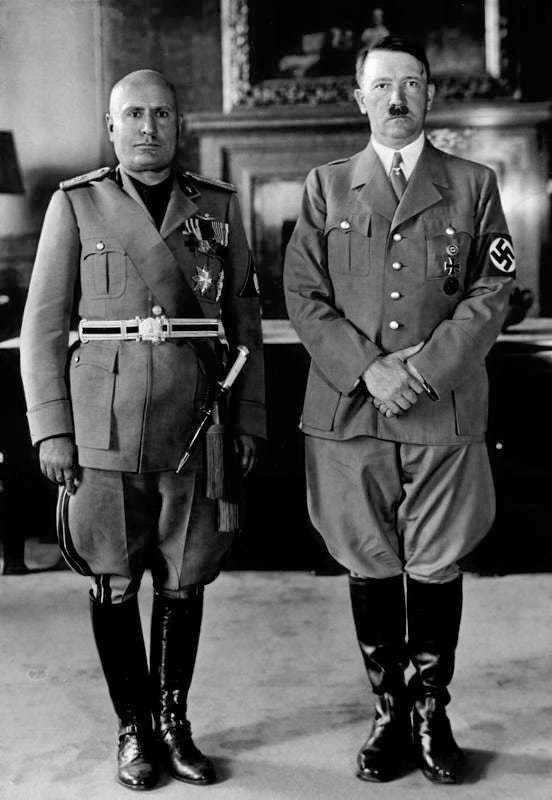
The first matters because the binding experience of fighting and surviving the trenches was crucial to the appeal of both Fascism and Nazism in general and of Mussolini and Hitler in particular. They were both war heroes and veterans of the trenches who played on, and to, that status.

We are so used to thinking of the horrors of trench warfare that we generally fail to grasp the bonding effect of surviving horror. We are such peaceful societies we often have difficulty understanding the binding exhilaration of combat. Yet that binding sense of shared agency is precisely what Fascism and Nazism focused on and appealed to. It is not remotely coincidental that both Fascism and Nazism had paramilitary forces, that Mussolini and Hitler both regularly wore uniforms, that both movements adopted military pageantry.

Fascism evoked that binding sense of shared agency in the name of the (Italian) nation, Nazism did so in the name of Aryan race. But they both evoked it, again and again and again. Not only in their rhetoric, but also in their organisational structures, and in their public pageantry and rituals. With the highly militarised nature of their politics — in organisation, pageantry, ritual and rhetoric — directly invoking the context in which so many had gained a sense of shared agency and which provided the model for the transformation of politics and society. Though the Nazi project of racial purification and imperial dominance required far more social transformation (and foreign aggrandisement) than did (the rather less coherent) Fascist project of national greatness.

Which brings us to very clear differences between national populism compared to Fascism and Nazism. No paramilitaries, no uniforms, no military pageantry and rituals, no fetishising of military action and organisation. Nor is there any systematic denunciation of democracy nor extolling of replacement of democracy. All of which means, of course, that national populism is neither Fascist nor Nazi.

Why the lack of such things? Because there is not a critical mass of veterans. Because its leaders are not war heroes. Because they are not responding to a waves of violent revolutions as occurred during and after the Great War. Because Fascism and Nazism were profoundly discredited by losing the Second World War and the crimes of Nazism.

Embracing Fascism and Nazism is now not a defence of heritage, but a denial of it.

The embracing of the military as an ideal of social action is not incidental to Fascism or Nazism. It is central to both. Without it, one does not have Fascism or Nazism. This is why essays such as Umberto Eco’s Ur Fascism fail. They impose their own ideological framings on movements that are orthogonal to them. Umberto Eco wants to take Fascism out of history and turn into a general category of authoritarian traditionalism, which both predated Fascism (e.g. Admiral Horthy’s regime in Hungary) and extends well beyond it.
Fascism: a movement that seeks to create a sense of binding agency centred on nation through pervasive military organisation, pageantry and ritual, embodied in an dictatorial leadership structure that replaces democratic politics.
Nazism: a movement that seeks to create a sense of binding agency via a socially purifying conception of race operating through pervasive military organisation, pageantry and ritual, embodied in an dictatorial leadership structure that replaces democratic politics, with the purpose of creating Lebensraum for that purified race.

So, Fascism and Nazism are movements that have some clear similarities with each other but are definitely not the same. As their very different trajectories in power demonstrated.

It is also clear that Nazism went way beyond mere racism. Hence the speciousness of using Auschwitz as the definitive icon of racism. (It is even more specious to use it as an icon of nationalism.)

By contrast, using the gulag as an icon of Marxism is rather more reasonable, as brutal labour camps have been a persistent feature of Communist regimes. As the People’s Republic of China and North Korea both continue to demonstrate.

That those who engage in waving the icon of Auschwitz about are often much less interested in the lessons of the gulag says a lot about them, rather less about Auschwitz. Even more as so much that made Nazism so horrific was enabled by institutional structures and rhetorical absolutism that were adapted from, or otherwise similar to, Leninism and Stalinism. A similarity that manifested precisely because the Nazi project of transformation was on a similar scale to the Marxist one. Even today, the People’s Republic of China is institutionally far more like Nazi Germany than either is like any Western democracy.

Nazism and Fascism are manifestations of history. They are not archetypes of evil that continue to manifest across time and space. However much it may be rhetorically convenient for some to think so.

Revealing vignette
In a recent online discussion with evolutionary biologist Bret Weinstein, academic, Muslim and person of colour Irshad Manji relayed a very revealing vignette. In 2009, she had gone on a book tour across the American heartland promoting her book calling for a reformed Islam. She kept hearing the question “why do they hate us?” Folk in the US heartland were not asking why Muslims hate them, they were asking why people (particularly highly educated people) on the East Coast of the US hated them.

If you want an example of the progressive cultural politics of hatred and contempt, The Stranger columnist Dan Savage’s 2004 essay “The Urban Archipelago” expresses it very clearly.

When Irshad Manji got back to New York, her NYU dean asked her how much Islamophobia had she had to ward off. Not whether she had experienced the same, that was simply presumed. In fact, she had experienced no Islamophobia or racism that she could discern. Her dean was operating on a malignant fantasy of heartland US, one that so much of academe and mainstream media is happy to create and relay.

That is, of course, precisely the cultural politics that generated the responses that saw Donald Trump win the Republican nomination and then the Electoral College, and so the US Presidency. Cultural politics that has continued to be double-downed on.

Trump was always likely to prove to be what he turned out to be: an unreliable champion too chaotic in his political management to be a successful President. He was also, very clearly, whatever his (many, many) flaws neither a fascist nor a nazi.

Trump was far more symptom than cause. And the cultural politics that produced him as a counter response is getting worse, rather than better. Playing the fascist! fascist! Hitler reborn! game is specious and toxic and shows how so many contemporary progressives are like the Bourbons of old: they forget nothing and they learn nothing. The pleasures of self-righteous contempt for masses of one’s fellow citizens are too great, and the demands of a toxic, but industrial-strength, status-and-dominance strategy too powerful.

They dominate the cultural commanding heights of Western societies but nothing unfortunate that happens in the culture is ever their fault. They have no wisdom, but apparently endless amounts of self-righteous narcissism. Things are going to get worse before they get better.

[Cross-posted from Medium.]

Friday, November 20, 2020

Peers and parents, past and present

Typically, the child-rearing not done by parents is done by peers.

Source.

Fatherhood, being (unlike biological paternity) a socially-constructed relationship of social identity, provision, care and attention, varies much more across (and within) cultures than does motherhood, which is far more biologically-grounded (at least until the infant is weaned). A small number of societies traditionally did not recognise the relationship of fatherhood at all, the role of male protector being taken by uncles. Even beyond such outliers, evidence from the anthropological literature is that the father’s attention is a highly variable factor in child-rearing.

The investment in attention and feeding required to raise a human child is considerable. Far more than is required to raise the young of any other species. As pregnancy and lactation ties women to the raising of infants, this leads to recurring risk-management patterns across human societies whereby activities that are compatible with breast-feeding, and other aspects of child-minding, become presumptively female roles. Those activities that are not thus compatible become presumptively male roles. The first scholarly explication of this was in a classic short analysis by anthropologist Judith K. Brown. An analysis that subsequently acquired considerable statistical and other support.

In his The Lifeways of Hunter-Gatherers: The Foraging Spectrum, archaeologist Robert L. Kelly includes a very useful summary of the anthropological evidence on child-rearing and its interaction with the acquisition of culture. (All quotes are from Lifeways, mainly Pp108–110.)

The two dominant social sources for transmitting or acquiring culture are parents and peer groups. They generate rather different patterns. Parents, particularly, mothers, are predictable and consistent providers of resources — breast milk, food, affection, attention and protection. Over time, the parents provide less and less resources until eventually the child is cut off.

It has been reasonably argued that parent-raised children learn that “resources and desirable goods are limited and hard to obtain”. They can also be expected to tend to be assertive and independent, focusing on using knowledge of terrain and technology to gain resources rather than social favours. In nomadic societies, boys tend to “de-emphasize male-male competition and focus more on manipulation of the world through technology”. Parent-raised children can be reasonably expected to show greater within-group variation in beliefs and behaviours.

Peer-rearing produces different patterns. Potentially from a young age (as early as around two years old) the child finds themselves in a group, often with older siblings, who become the focus of the child’s social interaction. A group that has less status and power differences within it than are involved in parent-child interactions. Children learn that there are “many sources of food and desirables other than their parents”. Peer-raised children learn to network (who people are, what they have, how they are disposed towards them); that resources are acquired by manipulating social relations. They learn that “resources are not scarce and can be acquired through persuasion”.

The acquisition of culture within the peer group can also be expected to generate less variation in beliefs and behaviours. (It is a long-standing pattern that any organisations seeking to impose uniformity of outlook tend to be inherently suspicious, even hostile, to family autonomy and seek to undermine the authority and independence of families.)

Shifts in the activities of parents are likely to also shift societies from having children being parent-raised to being them peer-raised. In foraging communities, the shift to sedentism leads to longer foraging trips by males and more intense food acquisition and processing by females, as consumption shifts to more-effort foods. This leads to less parental attention to children, leading to more peer-raising. A mechanism that “may account for why sociocultural change seems to occur so quickly once hunter-gatherers become sedentary”.

Peer-raising typically has quite different effects on boys and girls. Girls are typically assigned as caretakers, contributing to “girls having attitudes favoring nurturance and prosocial behaviors … [and] more restricted spatial ranges”. Fathers being away for extended periods of time “is associated with boys who have poor attitudes towards females, who are aggressive and competitive towards other males, and who, when grown, give little attention to their offspring, encouraging a continuation of peer-rearing”. A pattern we can see in contemporary societies in deprived urban communities.

In sedentary societies, adolescent male peer groups have greater importance than in mobile societies, with more violent initiations and harsher punishments. “These competitive groups define a boy’s success in life more than in mobile societies where, presumably, fathers are more often present.” Street gangs are peer groups with added income or self-protection element

Early C20th Chicago street gang

Source:

Cross-cultural surveys have found that “when men spend a lot of time with their offspring and cooperate in child rearing, there is less cultural emphasis on competition”. If men spend more time away from children, “there is a general physical separation of male and female tasks, and competition among men is encouraged”. (This could be a bit chicken-and-egg, if presumptively male tasks are such that they have to be done elsewhere.) “Partially as a response to male behavior, peer-raised girls show expression of sexual interest and assumption of sexual activity early in life, while also showing negative attitudes towards males and a poor ability to establish long term relationships with one male”.

Shifts in adult labour patterns can be “expected to have dramatic effects on enculturation and hence on cultural change”. These patterns clearly have implications well beyond foraging societies. Much of the literature on fatherlessness, for example, reads as the difference between parent-raised and peer-raised children. A sole parent clearly has less potential to counter-balance peer effects than do two parents.

In complex societies, peer groups may vary considerably. Much of the motivation to get students into “good” schools (whether public or private) is to ensure that they have a better quality peer group. Peer group effects also complicate trying tease out the specific effects of a school or teaching on education outcomes.

One of the counterpoints raised to the literature on fatherlessness is the claim, famously made in psychology Judith Rich Harris’s book The Nurture Assumption, that if one control for income/socio-economic status, the negative effects of sole-parenthood disappear. This is a classic problem of co-dependent variables. Bering a sole-parent family tends to greatly affect (i.e. lower) household income and socio-economic status. Normal regression techniques are not analytically reliable in such circumstances. One has to use techniques such as comparing single-parent with two-parent families who are in the same income range. When that is done, the dis-advantaging tendencies of being raised by sole-parent families become quite clear: as one would expect. (For those interested in pursuing this further, the footnoted citations in this essay provide a useful place to start.)

The anthropological evidence also lends support to identifying fatherlessness as a negative factor in raising children. With much of the effects of fatherlessness being due to the effects of peer groups lacking competition from family life, particularly for boys. This obviously has implications for socially-deprived urban neighbourhoods and other localities suffering from absent fathers. Elijah Anderson’s classic study Code of the Streets (a useful summary essay is here) is very much congruent with this anthropological literature. J.D.Vance’s Hillbilly Elegy also touches on these issues, as does the excellent study Trump’s Democrats.

The developing pattern in many Western societies of marriage (and fatherhood) being strong in the upper reaches of society but decaying in the lower reaches is yet another socially-polarising factor in such societies.

Cross-posted from Medium.

Tuesday, August 4, 2020

Some considerations of evolutionary theory

Nothing in biology makes sense except in the light of evolution.
Theodosius Grygorovych Dobzhansky (1900-1975)


Pair bond is not the same as sexual activity
One of the things I find somewhat frustrating is not consistently using terminology that distinguishes between pair bonding and who an organism has sex with. Clearly, there is some overlap and connection there, but they are not the same thing and it encourages sloppy thinking to use the same terminology to cover both.

Thus 'monogamy' can mean only has sex with one person or only has one spouse. This ambiguity can derail discussions and confuse analysis.


Genes play games
All that is required for game theory to operate is patterns of stimulus and response in a competitive environment. We can reasonably think of genes as playing a game, the replication game, where success is measured by replication. If you replicate, you are still in the game, so you are a winner and you remain a winner for as long as you are still being replicated.

These replication games that genes play are not only recurring, they are also probabilistic. A replication pattern will always have some failures. It is generating enough successes to stay in the game that is crucial.


Genes do not have intentions
The Selfish Gene is a very vivid and memorable metaphor. It is also an unfortunate one, as genes do not have intentions. Life is a Game Genes Play, or something similar, might have been a better title.


Parenting is altruistic behaviour
Biologists seem to have this odd notion that parenting is not altruistic behaviour, on the grounds that it is not altruistic to reproduce one’s genes. The notion that acting in a way that permits one’s genes to replicate does not show altruism is to imply that something cannot be altruistic if it conforms to the intentions that genes do not have. Or that genes are part of an organism, even when in another organism.

Parenting absolutely is altruistic behaviour. It is one organism investing in the interests of another. The tensions between the interests of the parent and the child provide a nice example of how of genetic replication is distinct from the interest of the organism. Tensions that are particularly stark in the case of neglectful, abusive or child-abandoning parents.

Parenting is the form of altruism that genes have to induce in order to replicate.

Once it is realised that parenting is altruistic, then it is much less of a leap to develop analyses of forms of altruism, in the sense of acting for the benefit of others, that do not as directly result in the replication of genes specific to the acting organism. Investing in the benefit of other organisms can absolutely be a successful gene replication pattern, at a probabilistic level. Especially if played out across a large enough number of individuals.

Confusing what altruism is—other-directed behaviour to the benefit of the other—with genetic replication patterns is an example of how natural and easy it is for us to confuse our frames of reference. Particularly if we use intentional metaphors (which are, of course, very natural to us) to apply to replication-game-playing genes that do not have intentions.


Survival strategies drive genetic selection
There is a critique of evolutionary theory that says that random mutation is not nearly enough to create the prolix orderings of life. This critique, associated particularly with mathematician and philosopher David Berlinski, is, of course, correct. Selection processes are, however, much more ordered than that.

The survival strategies of organisms create selection pressures. Organisms can only choose survival strategies compatible with their existing biological capacities. But, within those capacities, a range of survival strategies are likely to be possible.

Once enough of a species successfully selects a particular survival strategy, that sets up selection pressures, and selection pressures that are much more ordered than random mutation. (I am riffing off a 9 minute discussion of exploration by organisms by evolutionary biologist Bret Weinstein.)

A very nice example of this provided by human pastoralism. All human pastoralist populations that are large enough, and persist in their pastoralism long enough, develop lactase persistence: the ability to consume milk as adults. This allows them to generate about five times as many useful calories from a given amount of grassland as those who just raise animals for slaughter. This is a huge biological advantage.

Here’s the thing, however. Pastoralist peoples do not develop the same mutation. The lactase persistence mutation that allowed the Indo-Europeans to spread so far is not the same lactase persistence mutation as that of East African pastoralists such as the Masai.

So, which mutation develops, and how long it takes to turn up, that clearly has a random element. But the choice of survival strategy sets up selection pressures that are not random. Hence there is more order in observed biology than can be explained by random mutation, as the survival strategies of organisms inject order into selection processes.


Homo selection was for adaptability
The answer to the question of what is the human diet? is: prepared, particularly cooked, food. All human populations cook their food. Even the Inuit, who have to go to considerable extra effort to do so. We are cucinovores, food preparers, especially by cooking.

When we examine the diet of human populations, especially the pre-industrial diet, the striking thing about human diets—apart from food being actively prepared and frequently cooked—is the huge variety of human diets. Human beings can live and reproduce quite successfully on remarkably broad range of diets. (Problems with particular diet patterns usually don’t seriously kick in until after our reproductive peak.) This speaks to our adaptability as a species. An adaptability that has seen us permanently inhabit every single continent except Antarctica.

By adaptability I mean the capacity to choose and operate a variety of survival strategies (and therefore survive in a wide variety of ecological conditions). Prior to the development of farming and pastoralism, human beings were foragers, but there was considerable variety in those foraging strategies. And, of course, foraging then often led onto farming and pastoralism. Modes of living which also had considerable variety within them.

This adaptability has some manifestation across the hominin line, but is what is particularly distinctive in the genus Homo.

The combination of bipedalism and grasping hands led to tool using. This probably started with Australopithecus picking up stones to split bones and skulls from the kills of other species to get at the fat and brain. Access to such nutrient-dense food allowed us to give up gut tissue for brain tissue (the expensive tissue hypothesis).

We then moved on to making tools, increasing our adaptability. Choosing to scavenge in the middle of the day, when the major predators were resting, led to developing sweating and increased long-distance running capacity. We could then start running down animals with our expanded tool use, choosing hunting over scavenging. Giving us even more access to nutrient-dense food.

Being bipedal freed our hands for communicating by gestures. Increased use of tools moved communication to the face and mouth.

Use of fire and other food preparation both expanded the range of possible foods and further accelerated giving up gut tissue for brain tissue. At each stage, the expansion in capacities led to a greater range of possible survival strategies.

The predominant thing being selected for was that adaptability. Hence the rather prolix speciation of the Homo line. Different populations would choose different survival strategies, leading to different selection pressures. Yet, the general pattern is clear: selection for adaptability won out. Homo sapiens were the most adaptable form to appear, and relatively rapidly became the last biped primate left standing in Africa.

Our margin of superior adaptability over Homo neanderthalensis seems to have been relatively thin, as Neanderthals successfully blocked our exit from Africa for many generations. But Homo sapiens had enough of an adaptability advantage to get past the Neanderthal block in two waves, around 80,000 years ago and again around 50,000 years ago. And we Homo sapiens then became the last bipedal primate left standing anywhere by absorbing and replacing all other Homo populations.

So we became the tool-making ape, the running-and-throwing ape, the gesturing-then-talking ape, the fire-using ape, the food-preparing and cooking ape, the trading ape, the artistic ape, the ritual ape ... All manifestations of being the adaptable ape. It was that adaptability which was being selected for. As the more adaptable, the greater the range and variability of ecology and climate we could successfully reproduce in and the greater range of ecological changes (some of us) could survive.


Defence mechanisms and healthy eating
The prime defence mechanisms of animals is mobility. The prime defence mechanisms of plants, given they generally cannot move, is to wage chemical and other biological warfare against their predators. A process that can include considerable production of anti-nutrients.

Human evolution relied at various crucial stages on access to animal food, particularly saturated fats and organ meats, because they are so nutrient-dense. (There is no plant food remotely as nutrient-dense as liver.) For human nutrition, there are essential proteins, there are essential fats. There are no essential carbohydrates. With enough protein and fat, your body can produce all the glucose it needs.

We process animal foods for palatability. We process plant foods for palatability and to render them sufficiently non-toxic to consume.

So, thinking in evolutionary terms, how likely is it that saturated fats are not nutritionally sound for humans? How likely is it that plant-based foods are inherently or systematically nutritionally superior for humans than animal foods?

Markets and persuasion are also selection environments. How likely is it that selection for food-persuasion agendas is going to be for maximising extractable income? Which generates more corporate income, animal products or plant products?
So, does that raise questions about the anti-meat, pro-plant-based agendas being so assiduously pushed?


Norms economise on the effort required to sustain cooperation
When looking at human sociality, the selfish-versus-altruistic division is not very useful. Our range of interactions with others is much more varied than that.

What is striking is how much we are a normative species. Our nearest genetic relatives, the other African great apes, show some (very limited) level of normative behaviour. Enough to sustain the level of sociality they display. We Homo sapiens show far more.

Norms economise on the effort to sustain cooperation. Once a norm is established, interactions become much more predictable and therefore much more manageable. A whole lot of attention time and calculation effort is no longer required.

Attention and cognitive capacity are both scarce items. We have powerful tendencies to adopt mechanisms that allow us to economise on them. Hence the development of our normative capacity in situations where there were considerable pay-offs to cooperation. Cooperative payoffs that expanded as our normative capacities expanded.

Being so strongly the normative ape has permitted us to be much more complexly social. Which increased our adaptability. Which clearly increased the replication of our genes. A pattern of replication via cooperative sociality that we have spread to every continent, including temporary visits to Antarctica.

Norms can generate significant reciprocative behaviour. In fact, quite complex patterns of such. But they can also generate significant altruism, even amazing levels of self-sacrifice. All of which is a by-product of norms’ ability to increase and spread populations, and thus greater gene replication, through greater social cooperation by economising on the effort to sustain cooperation.


Resources affect reproductive strategies
Birds tend to pair bond, with both parents contributing to raising the chicks. This is because eggs are fragile, chicks cannot feed themselves and once the egg is hatched, neither male nor female birds have an advantage in feeding the chicks. Given a certain level of difficulty in obtaining resources, the male and female expression of genes have equivalent cards to play in the replication game, despite the females producing the eggs. They are therefore equally invested in raising the chicks, if their genes are to replicate. Hence the frequency of not only pair bonding among birds, but of the Dad strategy:  the male investing in the protection and feeding of the offspring. As distinct from the Cad strategy:  deposit one's sperm but provide no other assistance in the raising of offspring.

In certain circumstances- - for instance, if laying the egg means the female bird needs immediate nutritional replenishment- - then the replication pressure may be for the male bird to do more of the post-egg-laying care. To, in effect, equalise energy expenditure in order for successful replication to be sufficiently likely.

If, however, resources are particularly abundant, then male birds will likely revert to a harem strategy. (I.e. a mate-guarding Cad strategy.) With sufficiently abundant resources, what cards the female-expressed genes have to play in the replication game is much less of a concern for the replication of the male-expressed genes. All the male bird has to do is feed himself and keep other males away. If a completely promiscuous strategy is used (a pure Cad strategy), they might not even have to do the latter. The replication pay-off of more impregnated females being greater than any loss from the drop in investment in individual chicks. Hence it is sufficiently easy for the male-expressed genes to stay in the game such that a replication strategy other than pair bonding is used. The females are thus stuck with the eggs, and so raising the chicks, while more intense male mate selection provides some replication compensation for the lack of male investment in raising the chicks.

The general propensity of birds to pair bond is very unlike mammals, where females have mammary glands (so the food is right there when the baby mammal pops out) and hence are far more inherently invested than male mammals in raising their offspring. Female mammals provide baby-feeding resources from their own body and food consumption. Thus, in mammals, the male and female expression of genes do not have equivalent cards to play in the replication game.

Hence male mammals are very rarely significantly involved in raising their offspring. They may be pure Cads, they may be mate-guarding Cads, or even coalition Cads (a group of males sharing a group of females), but they are very rarely Dads.

Homo sapien males are a conspicuous exception. They are an extreme case of successful replication strongly favouring male investing in offspring. The Homo sapien big-brain strategy has resulted in particularly helpless babies whose brains and cognitive capacities have to develop outside the womb. Hence Homo sapien children take 15 years or more to be successfully raised to reproductive age.

In foraging societies, it is not practical to raise Homo sapien children without male contribution to provision of resources and protection. Hence Homo sapien males generating such a strong Dad strategy, contributing protection and resources to child-raising. (A few farming societies have an Uncle strategy instead - brothers contribute to raising their sister's children.)

With the dramatic expansion in mass prosperity, resource thresholds undermining the Dad strategy as described for birds has kicked in, but in a way that expresses human social complexity. At lower socio-economic levels of mass-prosperity human societies, the balance of resources compared to the cost of raising a (poorer) child has undermined the Dad strategy of investing in children. A Cad can still have children reach adulthood without bothering to contribute to their upbringing.

Conversely, women can abandon the Feeder strategy (seek to keep the guy around) in favour of a Breeder strategy (rely on their own income). Family law systems can also generate incentives, particularly if child custody is presumptively awarded to the mother, to move from a Feeder to a Breeder strategy. Especially as the state can be enlisted to extract income from fathers without that provision of income giving fathers any leverage for any role in their children's lives beyond cash-cow. They become a Shadow Dad - the financial costs without the participation, authority and status benefits of fatherhood.

All these factors encourage the rise in single motherhood, particularly among lower socio-economic levels of society.

These interactions also mostly explain the 'gender gap' in US (and other developed democracies) politics. Single mothers and divorced women have an incentive to vote for the side of politics more favourable to welfare expenditure and for family law to favour women. The latter can include, but is not limited to: establishing fatherhood (but not motherhood) as a matter of strict legal liability, giving mothers presumptive child custody, not requiring a DNA test to allocate paternal financial obligations, using the state to impose paternal financial obligations thereby (as noted above) profoundly undermining the leverage of fathers, not penalising use of false accusations as a legal tactic.

At higher socio-economic levels of human societies, the cost of raising a child is considerably greater and the value of social connections and networking considerably higher. So the Dad strategy is still going strong.

Human marriage is the ritualising of human pair bonding to support the Dad strategy. The above patterns mean that marriage is keeping on keeping on in the upper levels of Anglo and Northern European society, but decaying in the lower levels. To the advantage of the children of the upper levels of society and the disadvantage of the children of the lower.


Same-sex attraction transposes a thoroughly normal characteristicA characteristic that about half the members of a species have is a thoroughly normal characteristic of the species.

About half the human species is sexually attracted to males. A small proportion of those with this normal characteristic are themselves male.

About half the human species is sexually attracted to females. A small proportion of those with this normal characteristic are themselves female.

The same-sex attracted have a characteristic that is normal for the other sex, but not for their own.
The question is with regard to same-sex attraction is not, why does this male or female have this weird characteristic? It is, why does this male or female have a characteristic that is so common in the other sex but rare in their own?

The trait itself does not need explanation, only the transposition. Moreover, if neither the trait nor its transposition is itself significantly genetic, then the gets in the way of genetic replication, if transposed to the other sex, issue becomes moot, as there would not be specific genes, or specific gene expression, that were being selected against by that transposition. There would be no need for an explanation in terms of the chances of specific genes replicating.

Same-sex activity, even same-sex pairing, is much more common in nature than people generally realise. Which tends to weaken the expectation that same-sex attraction has a specific genetic cause rather than, say, an epigenetic or a population-dynamics cause.

Once we realise that it is the transposition that requires explanation, it then becomes more likely to be a population-level question, rather than just something that is weird in an organism because it gets in the way of replicating their genes, so should not be persistent.
Especially as it is an empirical question how much same-sex attraction does actually get in the way of gene replication. Thus, in those human societies where marriage is essentially a universal expectation, any reduction in the propensity to replicate any specific genes due to same-sex attraction may well be quite muted.

Suppose the expression of the trait in the other sex is significantly genetic and same-sex attraction is a serious block to gene replication, which it is likely to be in societies where same-sex pairing is accepted. Why would same-sex attraction persist in a population?

One proposal is the ‘gay uncle’ hypothesis—same-sex attraction increases the reproductive success of the siblings of the same-sex attracted person. In societies with very strong kin-group patterns, this has some plausibility as a ‘survive in the gene pool’ mechanism. But while most human societies do have strong kin groups, this is not a human universal across human societies.

Attitudes to same-sex attraction are strikingly varied across human societies. It seems unlikely that mechanisms that occurs in some societies but not in others, or that have varying degrees of social intensity, would have much explanatory value in explaining a recurring pattern across human societies. Especially given that same-sex activity and pairing turns up in many other species. Which brings us back to population-level analysis.

We are a significantly cognitively dimorphic species. That is, an overwhelming majority of men have a bundle of cognitive traits no woman has and an overwhelming majority of women have a bundle of cognitive traits no man has.

It seems likely that the same-sex attracted would disproportionately turn up in the cognitive-traits-bundles overlap group. This would imply that gay men would often display cognitive patterns that we more commonly associate with women and that gay women would often display cognitive patterns that we more commonly associate with men. (This in addition to having the attraction focus that we associate with the opposite sex.) Which is, of course, exactly what we do observe.

What makes us expect that the mechanism to associate cognitive traits with physical sex would operate to perfectly differentiate by physical sex? Why would it not sometimes cross-over? Same-sex attraction then becomes simply a transposition resulting from non-perfect association of cognitive phenotype with sexual phenotype.

Note that there is an interesting benefit to this pattern of overlap and transposition for us as a profoundly cultural species. Having a small, cognitively cross-matched group could assist in communication between the (cognitively dimorphic) sexes. Moreover, in a cultural species, having a small but persistent group more inclined to invest in cultural activity rather than children would also be collectively beneficial. In fact, these two features would run together.

It seems likely that the first occupation to split off, at least in part, from subsistence activities was shaman. Shaman often come from the cognitively cross-matched, displaying same-sex attraction and other cross-gender behaviour. It seems unlikely that any specific pattern of genetic replication would be generated by this role. At the very least, however, having such a persistent cognitively-cross-matched minority would assist in sustaining the advantages that we get from being a cultural species.

A cognitively complex, yet significantly cognitive dimorphic, species would generate more dimensions across which cognitive traits common in one sex might get transposed to another. It is a sign of our adaptability as a species that this too could be turned into an advantage via sustaining cultural and social connections.


These musings are part of the intellectual scaffolding for a book to be published by Connor Court looking at the social dynamics of marriage. As they are somewhat a work in progress, these musings may be subject to ongoing fiddling.

Why Gifts Are Not Exchange (and how exchange leads to money): a reconsideration of Marcel Mauss’s essay The Gift

I recently re-read Marcel Mauss’s classic 1925 essay, The Gift: The Form and Reason for Exchange in Archaic Societies, in which Mauss (a noted sociologist, influential in anthropology, who was the nephew of Emile Durkheim) argues that gifts, operating in chains of exchange based on obligations to give, receive and reciprocate, dominated public resource management in archaic societies.

I had forgotten how frustrating I had found Mauss’s essay to be. To be sure, having recently done a lot of reading into the origins of Homo sapiens and the operation of foraging societies, I can draw on a much broader information base than he could.

As an aside, if you haven’t discovered the online lectures from CARTA (the Center for Academic Research and Training into Anthropogeny), then I highly recommend them. A series of individual, or bundled, short lectures by scholars to audiences significantly of other scholars on the latest research into the evolution of Homo sapiens is an intellectual feast. An online gift to the global community of the curious.

Back to The Gift. Mauss manages to be a bit too general at times and not general enough at other times. So, there is an insufficiency of precision in his discussions — what he means in a concrete sense is often not as clear as it should be. But he also wants to make grand claims about stages of social development that do not really fit with the evidence.

For example, he writes:
The victory of rationalism and mercantilism was needed before the notions of profit and the individual, raised to the level of principles, were introduced. P.76. (Norton paperback edition)
Well, thousands of cuneiform tablets from Mesopotamia say that’s not the case.

Taking a step back, the evidence for long-term exchange among Homo sapiens is about as old as the evidence for the first Homo sapiens. We are the trading ape. So, the evidence is that Adam Smith was mostly correct when he wrote in The Wealth of Nations (Book 1, Chapter 2) that:
This division of labour, from which so many advantages are derived, is not originally the effect of any human wisdom, which foresees and intends that general opulence to which it gives occasion. It is the necessary, though very slow and gradual consequence of a certain propensity in human nature which has in view no such extensive utility; the propensity to truck, barter, and exchange one thing for another.
Smith is clearly correct on the importance of the division of labour, though not on its origins, which predate exchange. The ways in which we Homo sapiens are a dimorphic species makes sense on the basis of a division of labour between males and females that we see in all foraging societies. (Men do the riskier foraging; the hunting, and such gathering, as is not compatible with minding the kids. Women do the safer foraging; the gathering, and such hunting, as is compatible with minding the kids.) Smith is also correct in identifying among humans a “propensity to truck, barter and exchange”.

Mauss is, however, a little too impressed with gifts as acts of exchange. I want to suggest a somewhat different take.

Pooling, connection and …
The most intimate way that Homo sapiens deal with resources is pooling, whether within the family or within the hunting band. We are a group-living species who, most likely, evolved from group-living species. All our nearest relatives are group-living species (gorillas, bonobos, chimpanzees). It is extremely unlikely that our ancestors in the Homo line, and the various common ancestors with the African great apes before that, were not also group-living species.

It is striking, however, that the four surviving African great ape species have quite different mating patterns. Gorillas are a harem species where an adult male, about twice the size of adult females, dominates a group of females. Bonobos are a group-mating species based on coalitions built around an alpha female and alpha male (often the alpha female’s son). Chimpanzees are a group-mating species based on strictly male-only, female-dominating coalitions led by an alpha male.

We are a mildly polygynous pair-bonding species whose foraging cultures tend to strongly resist attempts to establish any form of dominance by any group member. Dominance only (re)emerges among humans either when food production permits storage of food or there are variation in productive assets. Dominance behaviour can get quite extreme, however, when there is both storage of food and variation in productive assets.

Homo sapien foragers engage in sharing, in pooling, behaviour for food (particularly from hunting) far more than do our African great ape relatives.

Use of fire can also be a pooling behaviour. Indeed, the answer to ‘what is the Homo sapien diet?’ is, cooked food. We are the cooking ape.

As the evidence for systematic use of fire in our evolutionary line is older than evidence for Homo sapiens, we pooled resources and managed connections before we engaged in exchange. Indeed, it is likely that it the development of those capacities that led us to becoming the trading ape.

But Homo sapiens had connections beyond the hunting band. (This is true in most foraging societies and the few it was not true of, you really didn’t want to live in.) Human foragers also might interact with people from groups that they had no connections with. With the former, the connections need to be managed. With the latter, any non-violent interaction has to be able to operate without being sustained by connections across the groups.

By connection I simply mean: repeated, mutually acknowledged, interactions that both parties presumptively mean to continue.

Across a wide variety of human societies, managing connections has commonly entailed both gifts and shared rituals. Participating in common rituals signals wider group membership, and intensifies the emotional content of the membership. Coming together for the rituals enables people to exchange information (including, even mostly, gossip), re-invigorate existing connections and possibly make new ones. What, in the modern world, we call networking.

About exchange
Exchange emerges out of creating mutual benefit from nonviolent interaction with those we lack connections with. This may also be ritualised so as to align expectations about what frame of action applies. Rituals in general get around the talk is cheap, so a very weak signal due to lack of required commitment: the cheap talk problem. But rituals can also operate when there is a lack of a common language — the no talk problem.

Gifts can be part of an exchange ritual. Or a bid to establish connection. Or both.

If you are interacting with someone with whom you do not have a connection, and are unlikely to establish a connection, there can be no expectation of ongoing reciprocation, for there is no interaction across time of a form that can be expected to involve such reciprocation.

So, the reciprocation of giving in order to receive, receiving in order to give, has to be done on the spot as a self-contained thing, hence exchange. Each participant in the bargaining process that leads to exchange swaps something they want less for something they want more. Thus occurs gains from trade. Both bargainers benefit, both are likely to want to be able to do it again, so the expectations of exchange are adhered to.

Thus, exchange is typically something done with ‘strangers’. Those you do not have a specific connection to, so do not have expectations of reciprocation that follow from, and are part of, such connection. But that simply makes exchange a specific form and tool of interaction. One, moreover, that can be scaled up, in a way that connections generally cannot (given the time and effort that connection requires), as societies get larger and more complex.

Exchange scales up as it an information-economising form of interaction. The across-time reciprocations of connection are a much more information-dense form of interaction. Hence, as societies get larger and more complex, the information-economising form of interaction of exchange becomes much more common and tends to involve larger and more complex goods (and services). That is, exchange will scale-up both in social ambit (how often, and with how many, people you do it) and scale of resources (how much resources will be transferred across a given period of time and how large individual transfers can be).

It is also worth noting that exchange is profoundly normative. The key element, as with all systems of property rights, is not “mine!”, any chest-thumping ape can do that, the key element is “yours!”. Hence exchange is bargaining over an swap of rights. I transfer to you my ownership of/rights over this in exchange for you transferring to me your ownership of/rights over that. Homo sapiens is the only species that regularly engages in one-off acts of reciprocation with strangers of the same species due to us being a normative and communicative species. We trade because we are a pervasively normative species.

About money
Money evolves out of the information-economising nature of exchange, as money economises on information even more than exchange already does. A shared medium of exchange for transactions means you do not have to know the specific menu of goods or services the person you are interacting wants in order to exchange with them. Hence the development of transaction goods — goods you hold solely for the purpose of transacting, as people will accept them as they can also use them for transacting. Once prices are typically quoted in terms of a single transaction good, then you have full-service money.

Money, as an information-economising mechanism, greatly lowers transaction costs. It makes exchange easier, so scales exchange up even further.

As money is typically used across time periods, it is an asset. A transaction good that was “used up” in the process of transacting would not be much use. Hence the standard obligation that issuers of banknotes accept to replace damaged notes or coins so as to protect their value as transaction goods. (Not having any liability or obligation other than such replacement is the great advantage of fiat currency.) But money is an asset because, as a transaction good, it is used across time periods. Being an asset is not money’s essential feature, however, it is a consequence of its essential features. We can tell this as, during periods of hyperinflation, when money is, by orders of magnitude, the worst asset to hold, people still use money, because of money’s information-economising properties. They simply unload it as quickly as possible.

I don’t much like the unit of account, medium of exchange, store of value description of money as it mystifies money unnecessarily. Defining money as a good held for the purpose of transacting that prices are quoted in (either directly or through accepted rates of exchange), and so is used across time periods, fits into ordinary commercial patterns and economic discourse rather better. The unit-of-account and store-of-value characteristics flow from money’s use as a transaction good. But money is not just a medium of exchange, as it is also used to quote prices and obligations in.

People sometimes talk of odd cases where something is only used as a unit of account. That, however, only works if there are agreed rates of exchange with things that are exchanged. Something used purely as a unit of account is not really money because it is not a transaction good, more a transaction aid. Economising on information in exchange is the crucial, transaction good, element of money, with the addition of the unit-of-account function turning it into full-service money.

The information-economising transaction-good approach to money also fits better with use of commodities as so-called ‘primitive money’. Any convergence of empirical expectations around a particular transferable commodity for what people will accept in exchange can turn that commodity into a transaction good. Hence the vast array of commodities that have been used as transaction goods. I distilled the following list from A. Hingston Quiggin’s A Survey of Primitive Money. They have all been used as ‘primitive money’ (i.e. transaction goods):
Beads (whether made of stone, shell, glass or whatever), beeswax, buffaloes, camphor, cattle, cloth (from silk to wadmal, a coarse wool fabric), coca leaves, cocoa beans, coconuts, strings of coconut discs, dye cakes, feather coils, gold dust, weighted gold, grain (notably barley and rice), human heads, logwood (mahogany), tool metals (iron, copper, tin, bronze) in various shapes, plaited palm-fibre rings, pigs, porcelain jars, balls of rubber, salt (including stamped salt cakes), seeds, shells (especially cowries), silver in lumps or shaped, animal skins, slaves, carved stone (a tool material), tea (including in bricks), teeth, tobacco.
When it comes to economising on information in exchange, it seems to be a case of, whatever works.

Notes and coins: branded moneyNotes and coins are branded money. If the branding is what gives them their transaction utility, the range and readiness of people willing to accept them as transaction goods, then they are just tokens. (The operation of supply and demand in their use as transaction goods gives them their exchange value.) If coins are branded bullion, then that opens up the possibility of a gap between their nominal, branded, value and their commodity value.

Notes can be claims on bullion, as in a silver standard or a gold standard, but that is a complexity we need not deal with here.

If the branding authority has sufficient incentives to be concerned with the branded value of coins outside their jurisdiction, they are likely to keep the commodity content of the coins stable. Indeed, if the coins establish a reputation for reliability as a bullion brand due to the stability of their bullion content, then the readiness to accept can give them a premium above their bullion value because of their ease of acceptance. That is, the brand can increase the information-economising nature of the money, and so its transaction utility, and thus its exchange value.

The less the exchange value of the branding of the coin, the more the potential incentive there is to melt the bullion content down for other uses. But any branding is likely to provide some extra transaction utility, and so increase the value of the coin above its bullion value.

The less the branding authority has reason to be concerned with the branded value of coins outside their jurisdiction, the greater the temptation to attempt to profit from creating (more of) a wedge between nominal value and commodity value. Debasement reduces the bullion content without changing the nominal branding. To the extent that the branding authority can force acceptance at the nominal value, and that there is a lag in perceiving the change in commodity value and/or circulating supply, it can profit from debasement.

Private operators can do something similar, typically by ‘clipping’ the coin, shaving off some of the bullion. Hence the ridges or milled edges on modern coins, introduced into English coins by Sir Isaac Newton when he was Warden of the Mint.

The more effort is required to assess the bullion content, the higher the threshold at which people will go with the nominal value rather then going to the effort of assessing the bullion content. So, the lower the preceding value of the metal content of the coins, the more the direct incentive to debase but the less the likely profit per coin from doing so. Turning copper coins into tokens is relatively easy, while official debasing of silver coins is more likely than gold coins.

The classic response to debasement, or at least to variable branding reliability, is Gresham’s law. This is the tendency for bad money (less bullion content) to drive out good money (more bullion content) as people economise on bullion in response to debasement by the branding authority, or debasement by others. Both official debasement and private debasements are also cases of economising on bullion.

Debasement and Gresham’s law, as forms of economising on bullion, both rely on the condition that:
there are two (or more) types of money which are of equivalent value for some purposes and of different value for others.
For ordinary users of coins, facing variable bullion content in coins of the same nominal value, there was a trade-off between economising on bullion and economising on attention and cognitive effort.

Economising on information is a pervasive element in the use and dynamics of money. Attention and cognitive capacity are both scarce items, so economising on them has value.

The point about the cognitive effort and attention threshold for worrying about nominal value versus commodity value can also apply to token money across time. There is considerable economising-on-cognitive-effort value in being able to simply use the nominal value of money in monetary calculations without any adjusting calculations. If, however, the money is changing in exchange value over time, then there is an incentive to adjust the nominal value for setting and judging prices. At some point (depending on rate of change in exchange value and the scale of exchange and the ease of doing the calculations), it is worth doing those adjustment calculations. Below that point, it is not.

Ignoring changes that are not big enough to trip the cognitive attention-and-effort threshold is called by economists ‘money illusion’. As if attention and cognitive capacity are unconstrained, so there is no cost in their use.

The notion that a rational being does not economise on attention and use of cognitive capacity, as if these are not scarce items, is a pretty remarkable concept of rationality.

Gifts
Going back to the evolution of human societies, there is no reason to presume a gifts-first, exchange-later pattern of social development. As soon as people seek to have nonviolent but beneficial interactions with people they are not connected to, exchange can be expected to develop. Exchange evolves where connections do not reach.

Gifts will, however, be very important in connection-dense societies, for the more connection-dense a society, the less need for exchange. Moreover, gifts are rather more information-dense than ordinary exchange. Indeed, a key element of a gift is acknowledgement — I see you, this is why I am giving you this specific thing appropriate to you. The more well-targeted the gift, the stronger the effect.

Gifts both rely on, and reinforce, the personalised information flows of connection. They are very much an intended statement of connection. There is more than echo of this in that, in common law, the intent to give is a necessary element for a legally recognised transfer.

The differences between gift and exchange is why I am not entirely comfortable with Mauss treating gifts as a form of exchange. I prefer to see gifts as connection-management acts of personalised acknowledgement. Hence gifts are used to create flows of resources in information-dense social environments.

Exchange does not really seem to be what is going on in such transfers in such societies. So-called gift exchange seems to be better described as networks of reciprocation. Especially as, as is set out below, gifts operate in essentially a permanent state of imbalance, avoiding the very state of completion that is central to exchange. Moreover, it is much more fruitful to think of exchange as an information-economising mechanism while gifts are embedded in information flows. With money pushing the information-economising a step further, thereby extending the operation and density of exchange. If money itself is given as a gift, there is, unlike exchange, no specific, often immediate, matching reciprocation.

But what about Mauss’s analysis of the obligations to give, to receive and to reciprocate? What about how gifts tended to dominate resource transfers in archaic societies?

Taking the resource-transfer point first, for gifts to dominate resource transfers (outside the areas of life dominated by pooling of resources) just tells us that such societies are information dense and dominated by connection. In a sufficiently information-dense social environment, gifts will “work” for the reasons Mauss notes. Indeed, a problem with his analysis is that he is so impressed with the social scale of the gifting networks he identifies, he does not think quite hard enough about the boundaries of those gifting networks and how far out those boundaries can reach and why.

This failure is striking given that Mauss does draw attention to a boundary problem that persistently turns up in myths, legends and folk tales: the boundary of the failure to invite. Which is to say, the failure to properly manage connection. This is the classic case when the cursed gift occurs. Think of the uninvited evil godmother in the Sleeping Beauty story. If you fail to include someone you should have, if you fail to acknowledge somebody you should have acknowledged, bad things will happen.

Of course they will, because your society as a whole, and your position in particular, relies on effective management of connection.

As for the obligations to give, receive and reciprocate, connections were managed by gifting networks. You give to show the connection is important to you. You give to the correct people in the correct way to show that you know your place, and your obligations in from being in that place. You are obliged to receive so that other people can manage their connections with you correctly. You are obliged to reciprocate to show that you also value the connection, that you are actively committed to it.

A description of the Japanese art of giving, ochugen, expresses this nicely:
Gift-giving is more than just buying gifts for people on birthdays and special holidays, it is a way to show gratitude to those you are indebted to and to show appreciation for those you care about and/or respect. Gifts are brought to houses that are being visited whether its just for a short visit, or if its an overseas visit. Parents will bring snacks or treats over to houses where their children would be visiting for playdates, families would bring omiyage (gifts) over to family member’s houses that they have not seen in awhile, and over to people’s houses in which they would be residing. Gift-giving serves an important function in Japanese culture as not only a way to show appreciation, but as a way to strengthen and maintain relationships, and in some cases, show closeness or fondness for another.
The more structured connections, the more empirical and normative expectations are aligned, the more stable connections will be. Moreover, the more structured connections are, the more expectations are aligned, the less of an information burden connections are. If one can rely on accepted patterns of behaviour, there is a lot less search and other information burdens involved.

One reason we can manage so many connections is that we are good at reading cues. Hence people who are bad at reading cues are disadvantaged in social interactions. But those cues are a better, less information burdensome guide, the stronger the framework of expectations is. That is, if there are agreed schemas of belief that generate agreed scripts of action.

The advantage of using structures and discourses to align expectations (both expectations of what people will do, empirical expectations, and expectations of what people expect you should do, normative expectations) generates the discourses around gifts and giving that Mauss is so impressed by. An evolving normative framework, set out and reinforced in myths, legends and gossip, helps people align their expectations. Hence the development of obligations to give, receive and reciprocate. You have to play the connections game in such societies and the structure of obligations are the “currency” within which you play it.

Connections operate across time, this is a fundamental feature of them. So, as Mauss indicates, inherently involve the notion of credit (and its converse, debt).

Yes, resources go in both directions, as having both parties benefit from the connection is required for it to continue and to be stable enough to continue. But it is better to think of gifts as a flow of resources rather than an exchange of resources. A flow of resources that both manages connections and provides much of the reason to have connections. A flow that, moreover alternates between patterns of credit and debt, so is almost always in a state of imbalance, not balance.

Mauss notes that reciprocation, being a matter of credit, can involve a notion of interest, and at quite high rates of interest. That is, as time passes, the level of expected reciprocation comes to exceed what was originally received. Such putative rates of interest can be, Mauss tells us, in the order of 30–100 per cent per annum.

If giving is an act of connection management, it entails a notion of credit. Having received, you have also show that the connection matters to you and that you are a person worthy of your status, who understands what is expected and can meet those expectations. The longer it takes you to reciprocate, the more the giver’s credit, and your debt as receiver, mounts. The effective interest rate becomes a measure of the period of imbalance in obligation and of commitment to the connection. The rolling pattern of imbalance, of shifting credit and debit, both manifests the connection and is a an expression of commitment to the connection across time.

You cannot reciprocate immediately. That stops it being a gift and turns into an exchange, an act without the information burden of connection and that robs the giver of the ability to express their commitment to the connection. But you have to reciprocate eventually, otherwise you are denying the importance of the connection. So, you acknowledge the period of imbalance and continue the binding cycle of imbalance by giving back with interest, by giving back greater than you received, thereby keeping the cycle of imbalance, and commitment to the continuation of the connection, going. Thus does each party move back and forth from credit to debt and signal their commitment to the connection. I put you in debt so you can put me in debt in return. I achieve a credit, so you can achieve a credit in turn. If we reached a state of balance, then neither of us has an outstanding resource commitment to the connection, which is thus put at risk.

Again, this does not really look like exchange, it looks like connection management via fluctuating, and deliberately alternatively unbalanced, flow of resources. A lack of balance alternating between the parties via resource flow, where the rhythm of imbalance is the key.

In acts of exchange, by contrast, the interaction is self-contained; that is the point. We both walk away from the act of exchange feeling like winners because there is no continuing connection that requires an ongoing resource commitment from the exchange. That is the, information-economising, point.

In very hierarchical societies, giving, and giving-up, can be an act of prestige, even dominance. Hence the deliberate destruction of goods in the potlatch. This is, in some ways, a manifestation of a society too driven by connection, too interconnected, and not enough open to exchange. Everyone knows too much about others, is connected too thoroughly with others, is too concerned by status embedded in connections, for exchange to operate sufficiently as a path for gaining value from resources. (Or, possibly, the lack of accepted opportunities for exchange is forcing everything into connections.)

Connection can be so dominant, that giving, and giving-up, can be an act not merely of prestige, but of dominance. Not merely of status granted by others (prestige) but an act of dominance over others. The structuring rules of connections require reciprocation, but if I am so giving-dominant that I give in a way you cannot match, then your loss of status can be so great, I can have a credit with you (that implies a debt to me) so great, that you are forced into bondage. Again, exchange is not the most useful way to think of what is happening here. Overwhelming someone with the flow of resources, so as to bankrupt their capacity to be independent, seems a better way to think of such dominance plays.

Particularly as it is very much not a gains-from-trade situation. It is much more of a winning-the-game situation.

Created within the dynamics of connection, the notion of credit and debt can be adapted to people with whom one does not have a connection, or not a sufficient connection. Thus collateral for a loan is what you do if there is no connection between creditor and debtor, or the connection is not strong enough to carry the risk involved in the loan.

Some exchanges create connections. Contracts create connections because they operate across time as the specified exchange cannot happen all at once. Contracts thus have a managing-the-connection element, especially as no contract can be fully specified to cover all circumstances. The trick is to structure the contract enough, and well enough, that connection management within the contract can handle the rest due to expectations and incentives aligning enough to do so. Hence the law sometimes treats contracts as simply exchanges that can be “paid off” with appropriate value and sometimes as a promise that has to be fulfilled. With a major factor to be considered being whether it is reasonable to force a continuing connection between parties whose interaction has broken down.

Employment contracts create particularly complex connections. A major reason why wages are “sticky” is that cutting wages obviously risks poisoning an employer’s connections with their employees. It is usually going to be much more in an employer’s interest to end a series of employment connections (i.e. sack people) rather than poison continuing connections with ongoing employees, creating a much more fraught series of connection-management problems. Especially as sackings can warn remaining employees that things are serious.

In both these cases, connections are operating across time and within, in effect, the “gaps” in exchange. Time is, of course, a key element in connection: whatever else connections are, they are things that operate across time periods. Contracts are for exchanges that require connection as they operate across time periods. Loans also create connections across time, though they can otherwise be completely self-contained.

Later in his essay, Mauss tries to discern elements of gift exchange lingering on in legal systems. The effort comes across as a bit strained, in part because his discussion is somewhat under-specified. Moreover, his attempt to connect gift exchange to solidarity in contemporary societies through state action is just sad. Modern states do not, and cannot, remotely operate according to the patterns he discerns in archaic societies. States are not personal connection devices, no matter how some attempt to romanticise them in that way. (This is not to deny that connections can be very important in understanding the operation of the state apparatus, but that is connections between individuals within state, and with outside actors, not the state itself.)

If, however, we see gifts as flows of resources expressing and manifesting the management of connections, then the later echoes in legal systems are clearer. But those later echoes rest in connections, and their management, far more than they do in the shifting balances of credit and debit, via the resource flows of gifts, in information- and connection-dense societies that Mauss memorably grapples with but does not really get to the heart of.

Marriage
Marriage provides a fascinating nexus between the resource modes of pooling, connection and exchange. The classic human pooling is men and women bringing different skills and abilities to the task of raising children via marriage. Yet marriage can often be understood as an exchange. In patrilineal kin group systems, kin groups trade out the fertility of their daughters. In matrilineal kin group systems, kin groups trade out the protect-and-provide capacities of their sons.

The protect-and-provide for sex-and-fertility exchange (plus domestic preparation services such as cooking or weaving) has generally been at the base of marriage systems, though with considerable variability in the expected level of the wife’s contribution to subsistence. The expectation of wifely contribution to subsistence was generally high in foraging and hoe-farming societies. It was usually lower, possibly much lower, in plough-farming and pastoralist societies. This typically weakened women’s social leverage in such societies. Hence plough-farming and pastoralist societies have tended to be distinctly more patriarchal than foraging and hoe-farming societies.

The exchange aspect in marriages could be very explicit in bride price (paid to bride’s family), dowry (paid to the groom), dower (paid to the bride). Bride price and dower pay for/acknowledge the fertility of the bride, dowry pays for/acknowledges the status of the groom. They all register relative scarcity.

Bride price and dowers are typical features of polygynous societies. These perennially have a shortage of prospective brides compared to grooms. For a women getting married took her, but not her husband, out of the marriage market, as he could take another wife but she could not take another husband. If the marriage is viewed as a contract, then the sense of an exchange of services could extend to notions of payment by the husband for the wife’s sexual services.

Bride wealth signals that the groom has the assets and connections to sustain the role of husband and father. For the other thing marriage does is create connections. The only feature common to all marriages across all human societies that anthropologists have been able to find is that marriage creates in-laws, it creates a kin connection. Bride price, dower and dowry all provide a way of creating a balance so as to enable the connection to be worth investing in by both families or kin groups. The value of the (continuing) benefit of the bride’s fertility (or the husband’s status) is acknowledged by the other party so that the marriage, and the connections it creates, and the pooling it is supposed to entail, can take place from a place of balance. A good match does all that.

Even though they are about allowing a connection to be established, bride price, dowry and dowers are exchanges for something rather than gifts. They are exchanges (resources for fertility or status) to create sufficient balance for the connection to be established and sustained. If the social gap between the parties is too large, then either the connection-via-marriage will not happen or the gap will be a point of continuing strain.

Although dowries are illegal in India, the continuing status of higher caste, particularly Brahmin, husbands, and the expansion, due to spreading prosperity, of the range of families who aspire to a higher caste husband for their daughters has not only meant dowries have persisted, it has led to considerable and continuing rise in the cost of dowries. Rather grimly, this seems to have led to a particular pattern of wife-beating so that the husband can extort a dowry “top up” from the bride’s family to match the rise in the price of dowries since the marriage.

In summary
Gifts take place within, or to establish, connections through a flow of imbalance. This is very different from exchange, the point of which is completion, and thus exchange typically creates a balance of satisfaction.

Indeed, the Chinese state traditionally re-characterised trade as tribute precisely to avoid an implication of balance in status. Thus the Son of Heaven would receive tribute in horses and, in return, graciously provide gifts of silk and treasure. It was absolutely not, everyone was to understand, an exchange of silk for horses, nor treasure payments for peace on the border, buying off potential raiders. The Son of Heaven was therefore absolutely not a merchant nor the equal of any steppe khan or khagan. Hence, the Son of Heaven entered into tributary arrangements, not trade ones. The status claims that such tributary-trade exchanges were wrapped in did not, however, make them not exchange, nor the alleged gifts other than purchases and pay-offs.

Gifts are typically embedded in resource flows so as to create and sustain connections. They are marked by a flow of shifting resource imbalance in an information-dense environment to make connections work. They are not information-economising acts of completion that require no ongoing connection beyond the participants, so they are not acts of exchange.

So, no, gifts are not an archaic form of exchange, nor are they exchange within archaic societies.

This essay is part of the intellectual scaffolding for a book to be published by Connor Court looking at the social dynamics of marriage. (There might also be some suggestion that economists and anthropologists should talk more.) As this essay is something of a work in progress, it is subject to ongoing fiddling.