Showing posts with label barter. Show all posts

Saturday, February 26, 2022

On acknowledged possession

Property law rests on conventions that evolved before it and that can operate without it, or even against it.
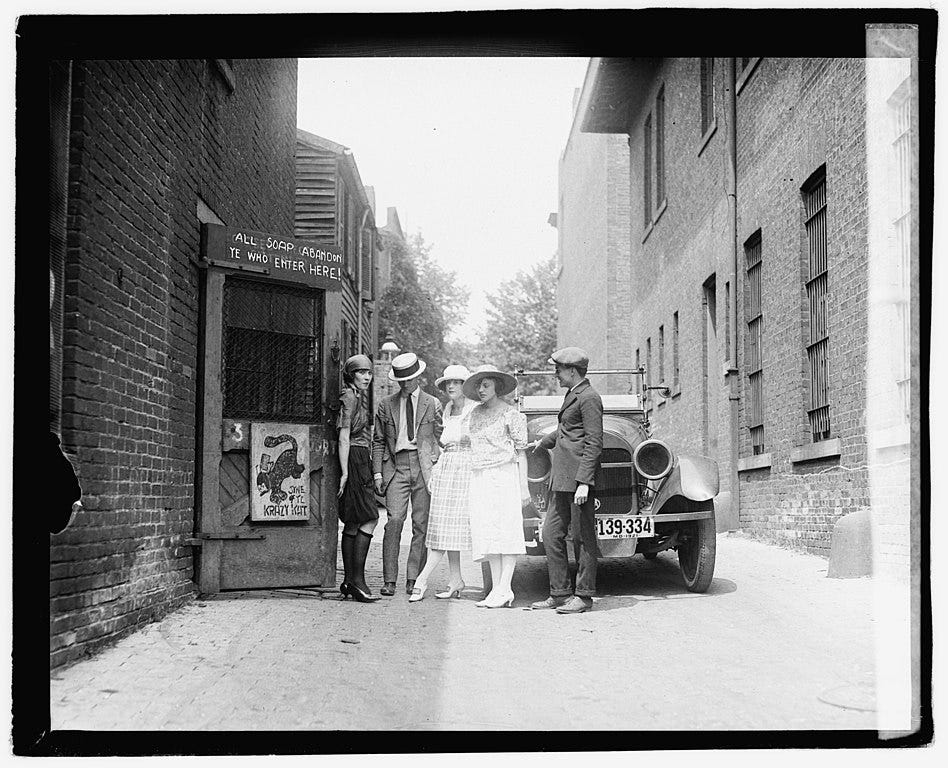
Waiting for the opening of a speakeasy in 1921 (Wikipedia commons).

Black markets, markets in illegal goods and services, demonstrate that state recognition and protection of property rights are not required for a market to operate. Black markets exist where the state bans the sale and/or purchases of specific goods and services and, as a consequence, will not protect the exchanges, goods, services or assets involved in, or derived from, such commerce.

The state does not only fail to provide recognition and protection of property rights within the banned market, or any mediation or adjudication services; it actively denies such and seeks to suppress the trades and accompanying property rights. Yet, black markets exist. They can even flourish, generating great (if insecure and often violently contested) wealth.

As various economists, such as Ronald Coase, Harold Demsetz and Yoram Barzel have explored at length, a trade, an exchange, is actually a transfer of control over some attribute or bundles of attributes. If such control is formally recognised and enforceable, then they are legal or formal property rights. But, as we have seen, trades can and do happen regularly even when formal legal ratification of such control, and their transfer, is actively denied.

How can this be? Because the functional element in property is not formal ratification by a legal system or process, but mutual acknowledgement by the contracting parties and others that they interact with. Such acknowledgment may be active, or it may be passive acquiescence. Nevertheless, such mutual acknowledgement is all that is needed for people to exercise effective control over attributes and so for economic property rights to exist. Indeed, such mutual acknowledgement is what makes any property law functional in day-to-day operation. The old saw that “possession is nine-tenths of the law” points to the fundamental role of mutual acknowledgement in any property system.

At this level, property-as-mutual-acknowledgement is a matter of convention, something you do in particular ways because others do so. (Language and fashion are classic realms of convention.) Property-as-mutual-acknowledgement generates basic conventions of resource use. If you have something in your possession, if you are exercising control over it, the information-economising presumption that simplifies human interaction is that it is, indeed, yours in the senses that matter. This mutual acknowledgement, as is normal for effective conventions, works because it works for everyone as a general presumption. People can operate on the basis of a common set of mutually-reinforcing, because mutually-beneficial and mutually-aligning, expectations.

Property everywhere and always exists via such information-economising acknowledgement, creating mutually-reinforcing expectations. The key thing in property is not “mine!”, any silverback gorilla thumping his chest can claim that. The key thing in property is “yours!”: the acknowledgement by others that the thing is yours and remains yours until you pass it to another.

A trade is just the process of transferring mutually acknowledged control over goods or services. All parties to the trade agree because they are getting something out of the transfer. Each gets the value they perceive out of having what the other previously had, or is going to provide, in exchange for what they themselves previously had, or will provide. An exchange they undergo because they value the former more than the latter. Hence, gains from trade: in cases of voluntary exchange, if both sides did not feel themselves to be better off, they would not have agreed to the trade.

Even in cases of coerced exchange (providing goods or services to avoid some violent or other penalty), the coercion works because the transfer is judged better than the alternative by both parties. In the case of the coerced, it is judged better than the alternative after coercion is put into play. In the case of the agent applying the coercion, before doing so. It is the legitimacy and consequences of the coercion that drives our judgement about such coercive exchanges. Taxes and a mugging are both coerced exchanges, but they are not generally regarded as normatively equivalent.

The power of mutual acknowledgement (and of information-economising, expectation-aligning, common presumption) is such that it permits black markets to operate even in the face of the state denying formal recognition of such acknowledgment. Indeed, even though the state is seeking to actively frustrate such mutual acknowledgement.

Black markets can only operate because the state is unable or unwilling to make its ban fully effective. But the difficulty of doing so points to, and is part a result of, the willingness of the parties to make the banned exchanges. Trades based on mutual acknowledgement using generally convenient conventions of property.

Because the parties involved seek to avoid the prohibiting efforts of the state, black market exchanges tend to gravitate towards places that are not regularly policed by the state. The level of black market activity in a locality tends to say more about the patterns in the policing efforts of the state than the inhabitants of the locality. Nevertheless, it is very easy for the inhabitants of such localities to be tarred by the association with the local black market activity. Something that can be useful to obscure the level of state responsibility for its (lack of) effective policing. And even more useful for dividing residents, citizens and workers by locality, or by features associated with locality.

In practice, even the blackest of black markets is somewhat parasitic on the formal property rights structure endorsed or provided by the state, if only to more securely enjoy the benefits of income and assets acquired from illegal exchanges. Hence the appeal of money laundering: converting what is illegal into what is legal by moving assets and income out of the realm that the state seeks to ban into the realm that the state acknowledges (i.e. ratifies) and protects. Obviously, the intent of such laundering of money and assets is to avoid the risks and costs of hostile state action but successfully doing so also gains the benefits of state property protection and adjudication services.

Thus, that black markets demonstrate that markets do not need the support and acknowledgment of the state to function does not mean that there are not major benefits in such support and acknowledgment. Including the various services the state may offer. Even if the state is purely motivated by the pacification needed to secure its taxation base, that normally entails some protection of property rights. Moreover, the pacifying state is likely to provide, or create social space for, or otherwise support, adjudication services as part of ensuring the social pacification that enables and supports its revenue extraction.

Trade or raid

Black markets are, of course, notoriously connected to violence. This flows directly from the state refusing to protect and acknowledge black market exchanges. In the absence of state protection and adjudication, assets have to be protected, and disputes adjudicated, by private action. In the end, by private force.

Moreover, black market exchanges happen through mutually acknowledged control of property. Such acknowledgement can be withheld or withdrawn.

Exchanges outside the ambit of state ratification, protection and public adjudication are in the pre-state situation of the primordial trade-or-raid choice. Does one bargain to secure desired things that another has by trade or does one simply take by raid?

Much of the point, and a very large part of the value, of state pacification is to minimise the attractiveness, and so incidence, of the raid choice. Thereby elevating the frequency and scale of the trade choice. Which can also further encourage the making of things, the third choice in acquiring something you do not already have, after take or trade. To the potential benefit of the state’s revenue.

Reducing transaction costs

Elevating the frequency and scale of trades is the core benefit of effective systems of legal property rights. Clarity of property rights, ease of adjudication and reliability of their protection all lower transaction costs, potentially dramatically. Transaction costs being costs entailed in making an exchange or other interaction. Specifically, search and information costs; bargaining and decision costs; policing and enforcement costs.

The lower transaction costs are, including the lower the risks involved in transacting and in having assets, and the greater the clarity in who has what rights, the higher the scale of transactions are likely to be and the more willing people are going to hold, and invest in, commercial assets. The state-revenue and economic growth advantages of this situation are likely to be very large.

While the advantages of the reduction of transaction costs through an effective legal system are very real, this is very different from stating or implying that such a happy situation is required for commercial activity to occur. It is perfectly clear, from history and anthropology, that such a well-functioning system of property rights and law is absolutely not necessary for commercial activity, even considerable levels of commercial activity.

As, of course, the case of black markets starkly demonstrate. More generally, as history and anthropology demonstrate quite clearly, mutual acknowledgement generating property conventions — whether or not such is formally ratified by the state and regardless of how efficiently or effectively the state does so — can still support considerable levels of commercial activity. Especially if agents within the state provide functional acknowledgment of property, even if formal ratification is lacking. Indeed, the case of post-1978 China demonstrates that such acknowledgement within the state apparatus can be sufficient even though private commerce and ownership is formally illegal. As it was in China until 2004.

China in the period 1978–2004 was not so much a matter of black markets — as the state was clearly not enforcing its bans on private property and private exchanges in anything remotely resembling a systematic way — as grey markets. Markets whose existence and exchanges were formally banned but functionally permitted. That such markets could operate at all, points to the key role of mutual acknowledgement in functioning property systems, every bit as much as black markets do.

What made such markets functional was being acknowledged by agents within the state apparatus. Indeed, often engaged in by such agents. What evolved were patterns of acknowledgement by such agents that permitted markets to emerge based on conventions of property (including of the transfer of property). Markets that were not typical black markets, with their associated violence and often socially disruptive goods and services; but nor were they ratified by the state within a formal system of property law. Though they were parasitic both on formal state property systems and the social peace imposed by the Chinese state.

The path of the People’s Republic from command economy to market economy, under the continuing regime of the Chinese Communist Party, can perhaps shed some light on a recurrent pattern in Eurasian history, where land starts as being owned by the ruler and, over time, becomes the property (with varying degrees of completeness and recognition) of intermediary social actors. Possibly all the way down to individual farmers. Versions of this pattern can be seen in Indian, European, Japanese and Imperial Chinese history. The difficulties and inefficiencies of central control, and the pervasive power of, and tendency towards, acknowledged possession, of property-as-convention, are clearly a recurring tension within state societies.

Manageable transaction costs

Economic agents can use connections to reduce uncertainty and manage risks, further strengthening the conventions that generate mutually-acknowledged possession. (A connection being repeated, mutually acknowledged, interactions that both agents presumptively intend to continue, or that one agent can force to continue.) Connections provide a wide range of possibilities that, without achieving the level of uncertainty reduction (and so risk clarification) that efficient property-rights regimes generate, can nevertheless enable considerable commercial activity.

Markets emerge when there is sufficient mutual acknowledgement of possession to generate property-as-convention in situations where transaction costs, and other risks, are manageable. We can identify three key elements based on the normal resource-creation-and-risk-management triad of structured sharing, exchange, and connection (that both structured sharing and exchange are embedded in, and interact with), plus the value of signalling your value as a social interlocutor.

First, there is the element of a functional common space. Passive acquiescence in control of what others possess-and-so-control makes it much easier for everyone to act within the common social space. If the state does nothing more than block public violence, it effectively creates a common social space within which such passive acquiescence will be naturally ubiquitous. That alone is a powerful protector of functional property rights, even if the state does not formally ratify property rights or does not provide adjudication services (whether at all, or sufficient to cover the demand for such).

Many societies have had private providers of adjudication services covering property disputes. Which folk have been willing to use for the same reason that they acquiesce in the possessing(s) of others: it eases their social interactions.

Second, there is mutual signalling. Passive acquiescence signals that one is potentially a person easier to interact with. The more complete the mutual acknowledgement, the stronger the signal. Folk have a powerful incentive to acknowledge the possessing of others so that their own possessing will be acknowledged in turn.

Such patterns of mutual signalling can also increase the willingness to use private adjudication services. By using such services, and abiding by their decisions, folk establish their reliability as social and commercial interlocutors. More generally, the broader the ambit of one’s repeated trading activity, the more value there is in a reputation for fair dealing; which includes respect for the possessing of others.

The value of Sharia, and Sharia courts, in providing a shared system of commercial law and adjudication, had much to do with the spread of Islam along trade routes, particularly in the Malay world. More recently, the provision of such services also had much to do with how the Taliban was able to maintain networks of support within rural Afghanistan, leading to its recapture of the country.

One sign of how effective the suppression of violence in public spaces is, is how much effort those willing to violate the general pattern of presumptive possession put in to hide or obscure their doing so. What makes a riot a riot is the breakdown of such presumptive hiding of violence. Just as what makes looting, looting is the breakdown of presumptive acknowledgement of possessing by others. Though, at some point, looters will want a return to the presumption of possession so they can more securely retain their gains. A revealing instance of how much the violation of the presumptive possession by others is itself parasitic on a more general pattern of acquiescence in possession that generate the conventions of property. As previously noted, the general utility of possessing is a powerful motivator for ongoing patterns of mutual acquiescence in possession and the alignment of expectations to generate the conventions of property.

Thirdly, there is the role of connections. The need to maintain and protect connections important to oneself may further encourage mutual acknowledging of possession, and an abiding by private adjudication, by raising the social costs of failing to protect and sustain a reputation as a reliable interlocutor. Especially if such connections also protect one’s own presumptive possession. The atomised individual may be more willing to violate such presumptions but is also a more likely target of such violations.

The use of (typically kin) connections to provide protection-via-retaliation, which is a method for protecting life, person and property particularly common in horticultural and pastoralist societies, can set off cycles of feuding. One of the ways that states pacify is by breaking such patterns of retaliatory feuding.

Societies with strong kin groups often use private adjudication services quite extensively, as protection of one’s standing within the kin group often helps motivate use of, and abiding by, such adjudication.

Certain connections may also protect one’s violation of the presumptive possession of others. Hence the tendency of criminal gangs to form so as to protect, organise and enable such violations (and of the assets gained therefrom). They are also a very useful protective device when engaged in black market activity and may be necessary if operation within the black market involves significant issues of scale or complexity in provision. Every bit as much as other firms do, criminal gangs wrestle with choices of whether to transact externally through markets (or, being criminal, via taking) or internally through organisation (i.e. managed connection using pooled resources organised through some mixture of hierarchy and structured sharing). Boundary choices that depend, as with other firms, on questions of transaction costs and risk-coverage. (A transaction that one can profit from is also a transaction that one can lose from; covering the risk of loss is a fundamental factor in why firms exist and how they are structured.)

The value in protecting the ability to interact through conventions of ownership based on mutual acknowledgement is so strong that injunctions against stealing (at least within the relevant in-group, the relevant normative community) are a universal feature of human societies. The conventions of property are thereby reinforced by social norms against (in-group) theft.

Norms arise out of a sense-of-should based on the benefits of aligning expectations in a highly social species with considerable cognitive capacity due to having large, and metabolically costly, brains.

Social norms are injunctions to act as expected, with sanctions also being expected to be imposed if such expectations are not fulfilled. The mechanisms to enforce anti-theft norms can include shunning, expulsion, violence, or other penalties. Whether enforced personally, by wider action within the community or by some authority. The universal evolution of normative injunctions against stealing (at least within the in-group) point to the ubiquitous value of the conventions of property.

We can see that, even if there is no pacifying state, so that there is what one might call a pure trade-or-raid choice, there are many reasons that trades can and will still happen. There are many mechanisms for making transaction costs and risks sufficiently manageable that trades happen, even in the absence of any state. Indeed, even against the efforts of the state. Mechanisms that are viable because of the ubiquity of mutual acknowledgement as a basis for functional systems of property.

The mutual convenience of the conventions of possession can establish functional property rights without any state action or formal legal acknowledgement. The conventions of property evolve naturally because we are so much a social and normative species, regularly engaging in mutual signalling and seeking to benefit from aligning our expectations.

[An earlier version was posted on Medium.]

References

Yoram Barzel, Economic Analysis of Property Rights, Cambridge University Press, [1989], 1997.

Cristina Bicchieri, The Grammar of Society: The Nature and Dynamics of Social Norms, Cambridge University Press, 2012.

Cristina Bicchieri, Norms in the Wild: How to Diagnose, Measure and Change Social Norms, Oxford University Press, 2017.

R. H. Coase, The Firm, The Market and the Law, University of Chicago Press, 1988. Includes ‘The Nature of the Firm’ (1937) and ‘The Problem of Social Cost’ (1960).

Harold Demsetz, ‘Towards a Theory of Property Rights’, American Economic Review, Volume 57, Issue 2, May 1967, 347–359.

Jordan E. Theriault, Liane Young, Lisa Feldman Barrett, ‘The sense of should: A biologically-based framework for modeling social pressure’, Physics of Life Reviews, Volume 36, March 2021, 100–136.

Chenggang Xu, ‘The Fundamental Institutions of China’s Reforms and Development’, Journal of Economic Literature, 2011, 49:4, 1076–1151.


Saturday, December 24, 2011

The Civilization of Angkor (1)

Charles Higham’s The Civilization of Angkor is very much focussed on the rise, achievement and decline of the civilisation of Angkor: of what led to the creation of the amazing constructions of Angkor. As Higham writes, the book:
sets the supreme architectural achievement of the civilization of Angkor in its historic context (p.4).
Higham precedes his narrative with a timeline interposing events from Anglo history with Khmer history from 2300BC to 1600AD—so 410, the year of the Roman abandonment of Britain, becomes “the fall of the Western Roman Empire” (Pp xiii ff).

We start with the European discovery of the ruins of Angkor, their amazement on the scale, the lack of belief that they were created by the local Khmer people and the contemporary (1296) report of the Chinese visitor Zhou Daguan (Pp1ff). Higham then provides a general description of Angkor:
Angkor is the name conventionally given to the cities and the associated monuments that lie between the Tonle Sap and the associated monuments that lie between the Tonle Sap and the Kulen Hills. The name derives from the Sanskrit nagara, meaning ‘holy city’ (p.4).
New temples were built there for seven centuries or more from about AD 700 (and included a reservoir 8km x 2.5km).

As Higham notes:
Illuminating an extinct civilization is a demanding and challenging endeavour … This is particularly the case for the Western scholar where the civilizatioin of Angkor is concerned, because the people, the religion, the environment, indeed virtually all aspects of its life and culture are alien (Pp4,6).
The sequence leading up to the establishment of Angkor Higham sets out as being Iron Age (starting 500BC), the formation of the earliest state around AD 150 in the Mekong Delta which declined “due largely to changing trade patterns” (p.6), then several rulerships competing for power AD 550-800 culminating in the establishment of the Angkor royal centre.

Rulership in context
To put this process in wider context, Higham examines three key questions:
What is a state, how does it come into being, and how is it maintained (p.6)?
Higham provides a brief summary of anthropological understanding of chiefdoms:
in which leaders dominate a social web where individuals are related by kinshipo [which]… usually involve a central settlement in which the chief resides, and one or two categories of smaller, dependent settlements. The chief is usually distinguished by symbols of status, and will often be accorded elaborate mortuary rites (p.6).
From these evolve states in which:
although kinship ties remain, people are also identified by their class within a complex social network … one comprising the ruling elite. The royal tier will usually be accorded a divine origin and the ability to communicate with the gods. There are four levels of settlement hierarchy from the capital down through provincial settlements to villages. The king will live in a palace, and play an important role in rituals. His court absorbs surplus production from a much larger sustaining area than in a chiefdom, and high-ranking members of the court are recognized by special titles, offices and symbols of status. The regulation of labour and the appropriation of surplus production is essential in the support of the administrative machinery for an enforceable legal system, an army, full-time priests and state temples (Pp6-7).
In other words, a state is a chiefdom on steroids, while a chiefdom is a proto-state. Both are about rulership and control of surplus, but a state operates on a greater scale that involves considerably greater social complexity.

To illustrate the processes by which a state can evolve from chiefdoms, Higham goes through the C18th-C19th history of the Yao people of Malawi as:
the recorded course of their development is so similar to what we think might have occurred in the Mekong Delta (p.7).
The Yao started off in villages where a group of sisters appointed their oldest living brother as village headmen. These villages rarely exceeded 50-60 people as:
this social system encouraged young aspiring leaders to leave and found their own settlement (p.7).
Contact with Arab traders seeking ivory and slaves in exchange for beads, cloth and metal wire radically changed this. As the headman traditionally managed trade and distributed its benefits, an upsurge in trade increased their standing while the demand for slaves “engendered much tension among the Yao and their neighbours”. Male slaves were sold, female slaves increased the headman’s retinue:
The transition from village headman to great chief was swift, happening in the space of half a life span. As the emerging chiefs expanded their domains and increased their power through trading for guns, so they adopted the exotic manners and customs of the Arab traders. This enhanced their prestige in the eyes of their followers. Some accepted Islam, and changed their names … They began to use Arab writing to keep their records. As towns developed from villages, it became necessary to grow more food, and irrigation was brought to their fields (p.8).
Swap Islam for Hinduism and Mahayana Buddhism, swap Arabic for Sanskrit, and this looks remarkably what happened in the Mekong Delta: including that the process was chosen by the headmen, not imposed from outside.

Prehistory
Higham examines the process of Indianisation, and the key ideas of Hinduism (Pp9-11). Followed by the role of rice (Pp11-12). As he notes:
States are fuelled by the energy supplied by agricultural surpluses (p.11).
Having summarised the key issues, Higham moves onto the prehistoric periods in South-East Asia (2300BC-AD 400) (Pp13ff).

Archaeology is beginning to greatly expand our understanding of prehistoric South-East Asia. These societies:
were vigorous and powerful. They engaged in distant maritime exchange, and their leaders organized large-scale water control measures. They maintained specialized bronze and iron workshops, and were recognized in death with rich burials, which would include gold and silver jewellery and hundreds of bronze ornaments (p.13).
Rice farmers and farming arrived in the region about 4300 years ago, setting in train the normal supplanting of foragers and foraging. As Higham notes:
The pathway to civilization required the energy provided by rice agriculture … the adaptability of this marsh grass, its nutritional value especially when it is consumed with fish, the degree to which the landscape can be modified to expand it production, and the relative ease with which it can be stored. Rice is the solid rock on which South-East Asian civilizations were founded (p.14).
Higham takes us through the interaction between human society and geography (including the importance of the monsoon), the development of the local Bronze Age (1500-500BC), helped by good local supplies of tin, and then the Iron Age:
the Iron Age ancestors of Angkor lived in large communities in which some individuals, both men and women, were interred with opulent grave goods and much ritual. Iron was employed not only to increase agricultural efficiency but to forge weapons of war. Salt processing reached an industrial scale; specialists were able to produce for their leaders outstanding ceramic vessels and ornaments of bronze, glass, gold, silver, carnelian and agate. There was increased competition and conflict, as skilled and intrepid navigators engaged in international trade. Iron Age chiefdoms were now poised for the transition to the state (p.22).
Evidence of trade between the Iron Age communities of central Thailand and India dates back to at least 380BC (p.23). Chinese sources claim South-East Asian ocean-going ships 50m in length and weighing over 600 tons by the C5th. Chinese dynastic records include a report from emissaries Kang Tai and Zhu Ying to the Wu emperor about a state they call Funan operating in the Mekong Delta in the C3rd. Archaeology at a site named Oc Eo confirmed many of the activities in the Chinese reports and a local coinage (which does not seem to have persisted). Oc Eo was linked by a canal with Angkor Borei, a walled city of about 300ha, 90km to the north. The city wall is 2.4m wide and 4.5m high, with a moat of 22m in width—so a considerable construction. There were also water reservoirs—or baray—whose function remains the subject of much scholarly debate (Pp24ff).

Rising complexity
Higham takes us through the archaeological evidence, including early Sanskrit inscriptions. He observes that no prehistoric sites have been found in the Delta, presumably because of the regular flooding. With the development of flood retreat rice farming (where water is stored and released during the dry season) it became able to support substantial populations (including urban centres). Nevertheless, the social and political structures that grew up (including significant specialisation) were clearly dependant on the benefits of maritime trade. How centralised political structures were is unclear (the large canals suggest political centralisation). The rise of Java from the C5th as the maritime connector between China and India massively undermined the Delta, leading to the shrinking and abandoning of urban centres due to loss of trade (Pp29ff).

A C13th Chinese compilation includes description of a C7th Khmer ruler of some power and magnificence. This period seems to be one of competing rulerships, where inland rulers may have achieved varying levels of dominance. Inscriptions reveal various dynasties (one of which seems to have three generations of ruling queens) with fluctuating areas of control. Inscriptions also reveal a mixture of appointed and hereditary (pon) titles with a court-centred social hierarchy. Management of temple foundations, including what appears to have been significant levels of trade (including of assets), seems to have been a path to wealth. This was a barter economy:
there was no system of coinage. Goods were valued by reference to the weight of silver, or quantity of rice or the length or quality of cloth (p.48).
This did not preclude sophisticated economic transactions:
There are records of assets being exchanged through individuals through the aegis of the temple management. On occasion, we find that land was mortgaged, as it were, to a temple in return for silver or cloth, and the product of the land was assigned as a form of interest payment (p.49).
Inheritance was indirectly matrilineal (through sister’s son), though one major dynasty shifted to patrilineal succession along with its assumption of the style of gods while another, for three generations, had direct matrilineal (mother-daughter) succession. Higham argues that direct succession better promoted intergenerational asset accumulation. Jayavarman I was the first king recorded to have divine honours in his own lifetime, an act which went with royal authority superseding those of pon in control of assets. Now the king, not temples, would be the final arbiter of assets and land use. The centralisation of authority from 720-770 coincides with a drastic reduction in the number of inscriptions, limiting our knowledge. Higham summarises the period 550-800 as one where states emerged, conflict was recurrent and a “thin veneer” of Indianisation was adopted over local patterns and worship (Pp50ff).

Empire
From about 800 to about 1000, the aforementioned patrilineal dynasty with divine honours ruled a substantial empire as universal kings. This kingdom, Kambujadesa, was a agrarian surplus rulership which controlled the Delta, the lowlands around the Great Lake and the agricultural lands to the west. It engaged in increasingly substantial temple and baray construction.

The first king of this universal rulership, Jayavarman II, established the tradition of having himself consecrated king-of-kings in an elaborate ritual:
The court was projected at the centre of the kingdom and a representation of heaven, but was sustained by the agricultural surplus. The inscriptions are filled not only with references to the elite aristocrats and their meritorious acts, but also contain details of land ownership, field boundaries and the duties of retainers. We find many references to slaves, but it would be wrong to regard this as a slave-based society. The rural populace donated part of their time and labour to maintain the local temple. Thus part of their production, be it rice, butter, honey, cloth or livestock, was directed to the capital. Our knowledge this, the first dynasty of Angkor, comes from the inscriptions, reservoirs and surviving stone or brick temples. On the one hand, we encounter a dynasty of kings who built on an increasingly massive scale and extended their power through elite aristocrats to the sustaining populace. On the other hand, we find endemic instability rooted within disputes in a dynasty that had no clear rules to govern the succession, and the constant problem of maintaining control over the provinces (Pp53-4).
The concentration of control over surpluses naturally created a target for attempted seizure.

How Jayavarman II came to power is unclear, though sites with relevant inscriptions provide indications of the extent of his power. A map (p.55) usefully charts where inscriptions associated with various rulers have been found. For details about events of Jayavarman II’s reign we are dependant on inscriptions dated about 260 or more years later. Higham takes us through the archaeology, how little is known about his son and successor Jayavarman III then the building, and unclear lineage, of his successor Indravarman I, who describes himself as a great warrior. His son and successor Yashovarman I also described himself as a great warrior and built on an even grander scale (Pp54ff).

The inscriptions of Yashovarman’s reign show royal control over the allocation of land, with a social hierarchy radiating from the king:
The key element in this great architectural achievement is the control of labour … It may be that the same people who worked on the buildings during the dry season would return to their duties in the rice fields with the rains. … The state superstructure … fundamentally relied on the agricultural surpluses, a situation that illustrates the importance given to land tenure and agricultural production (p.69).
Inscriptions from the reign of his sons and successors Harshavarman I and Ishanavarman II tells us of an official in charge of collecting the rice taxation and grants of exemptions from service.


This review will be concluded in my next post.

Wednesday, November 2, 2011

Barter

Wikipedia claims that:
Contrary to popular conception, there is no evidence of a society or economy that relied primarily on barter.[2] Instead, non-monetary societies operated largely along the principles of gift economics. When barter did in fact occur, it was usually between either complete strangers or would-be enemies.[3]
It cites the work of two anthropologists (Marcel Mauss, The Gift: The Form and Reason for Exchange in Archaic Societies and David Graeber, Toward an Anthropological Theory of Value) in justification.

The claim is misleading. There was extensive trade, across long distances, in societies without money (which, in the world before printing, essentially meant before/without coins). This was so in hunter-gatherer/forager societies: there is evidence of long distance trade in Australia before European arrival, for example. It was even more so in agrarian societies. Thus the Khmer Empire had no coinage but the testimony of Chinese ambassador/commercial attache Zhou Daguan—the only eyewitness evidence we have for the Empire—is that there were vigorous markets and a significant foreign trade community.

It is perfectly true that gift-connections and guest-host connections could be very important in pre-money societies, but these were often implicit exchanges: a form of mediated trade. The almost universal arrangement in forager societies of men hunt and women gather was precisely such an implicit exchange. (The one known exception was a society where the foragers exchanged meat for the produce of the neighbouring farming society: so both men and women hunted and then traded—i.e. bartered—what they caught.)

Similarly, when Chinese sources talk of ‘tribute’ what they are often doing is reconstruing trade relations as an acknowledgement of Chinese superiority, of China being the “Middle Realm”. Notably in the exchange of horses-for-silk that was so central to the trade networks of Eurasia for so long.

The reason why rulers could introduce coins so successfully is precisely because there were already considerable barter-trading which coins make dramatically cheaper and easier. When Adam Smith wrote of:
a certain propensity in human nature … the propensity to truck, barter, and exchange one thing for another.
he was far more accurate than what Wikipedia™ is trying to claim.

Sunday, October 23, 2011

Angkor and the Khmer Civilization (1)

Michael D. Coe’s Angkor and the Khmer Civilization is “volume one hundred and nine in the series Ancient Peoples and Places” (p.4), a numbering which nicely indicates how large Khmer civilisation does (not) loom in the Western historical consciousness. Most people would be aware of the Angkor ruins, but have only the vaguest notion of the civilisation that produced it, except as the forerunner of modern Cambodia.

Which is a bit like saying the Roman Empire was the forerunner of modern Italy. Khmer civilisation during its classic period (802-1327) was the seminal civilisation of mainland SE Asia, dominating modern Cambodia, southern Laos, the Mekong delta and central Thailand. Coe’s book is an excellent survey of the rise and decline of this civilisation.

Coe’s scholarly speciality is “the other great monsoon forest civilisation” (p.7), the Maya of Mesoamerica, a comparison that informs his treatment. He divides the trajectory of Khmer society into Early Farmers, Early Kingdoms, Classic and post-Classic (p.9) with a useful full-page timeline (p.10).

The Introduction deals with European discovery and engagement with Angkor and Khmer history (Pp11ff) concluding with a full-page explanation and potted summaries of the various periods: hunters and gatherers to c.3600-3000BC, early farming period to c.500BC, Iron Age to c.200-500AD, early kingdoms to 802AD, Classic 802-1327 and post-Classic 1327-1863 (p.20): or, to put it another way; foragers, farmers, chiefdoms, states, empire, aftermath.

The ruins of Angkor are vast: the first colour plate is a synthetic-aperture radar image of Angkor from the space shuttle Endeavour:
The entire urban complex covers about 1000 square km (386 square miles), and its core area c.200 square km (77 square miles). There is nothing else to equal it in the archaeological world (p.11).
Coe then moves on to the geographical setting (Pp21ff) – the various black-and-white illustrations throughout the book and magnificent colour plates are helpful. So, for example, the picture of the massive Khong Falls (the modern day boundary between Laos and Cambodia) makes it quite clear why they “effectively block all boat communication between the lower and upper reaches of the river” (p.21), which makes the Mekong far less of a conduit for human traffic than it might be. The great waterway of Angkor was not the Mekong but Tonle Sap (the Great Lake) on the Tonle Sap River, a tributary of the Mekong.

The setting
Like much of Asia, Khmer was and is a rice civilisation. Khmer is one of the many Asian languages where the word for ‘food’ is ‘cooked rice’ (bai). Rice and fish are the basis of the economy (p.29), Coe taking us through the varieties of rice cultivation; dry rice, bunded field, flood-retreat and “floating” rice (Pp30ff).

Then it is on to peoples and languages (Pp33ff). A map of languages (p.35) makes it clear that linguistic boundaries do not entirely coincide with modern political boundaries. There is a significant Khmer borderland in Thailand and a minority remnant in southern Vietnam.

In modern Cambodia, there are some Tai (Thai, Lao) speakers along the upper Mekong, significant areas of Mountain Mon-Khmer as well as Mountain Cham and Cham enclaves. But language boundaries have also changed over time. The Mekong delta was Khmer until the late C17th, when the Vietnamese influx began, while the Tai peoples migrated down from Southern China in the C12th and C13th (displaying some similarities in their role vis-à-vis the Khmer Empire as that of the Germanic peoples vis-à-vis the Western Roman Empire). There is also the normal history of language mixing:
It is now generally recognised that Vietnamese is a Mon-Khmer language that shows the effect of long contact with Chinese in its vocabulary, in its use of tones, and its tendency to be monosyllabic (p.36).
The animist-shamanistic Mon-Khmer mountain peoples have been traditionally despised by the Khmer and subject to slave raids. The Cham had a significant rival kingdom before being conquered by the Vietnamese in 1471: the Cham had been Hindu-Buddhist but converted to Islam from the C11th onwards (Pp36-7).

The Khmer script (the first inscription of which dates from 611) is Indic in that it is far more complex than a simple alphabet. The language itself tends to be very concrete, borrowing abstract terms from Sanskrit and, after the adoption of Theravada Buddhism, Pali (still the main source of neologisms in contemporary Khmer). We have about 1200 surviving rock inscriptions, most in Sanskrit, and religious: the surviving Khmer script, while still largely religious in context, tends to deal with more mundane administrative matters (Pp40-1).

Foragers, farmers and early kingdoms
The fourth chapter, The Khmer before history (Pp43ff), deals with foragers, farmers and chiefdoms, the latter apparently the result of the advent of iron tools and weapons and increased social differentiation:
Onto this Iron Age ‘basement culture’ was to be grafted a belief system that had its origins over two millennia ago in the plain of India’s Ganges River, laying the foundation for what was eventually to become the civilisation of Angkor (p.56).
Moving on to the early kingdoms period (Pp57ff), Coe notes that the region known as ‘Indochina’ has culturally far more that comes from India than China: the exception being ‘Tonkin’ or the Red River valley (i.e. the proto-Vietnamese), which was sinicised.

Ironically, there are almost no Indian texts on the region (apart from reference to risky-but-high-return trading opportunities) but several Chinese texts which, given the linguistic difficulties of transliterating from non-tonal polysyllabic languages (Khmer, Sanskrit) to a tonal monosyllabic language (Chinese), and Chinese disdain for ‘barbarian’ peoples, are more ethnographically revealing than historically so (p.57). Coe quotes at length from various Chinese reports on the Mekong Delta Khmer cities and societies:
They have neither rites nor propriety. Boys and girls follow their penchants without restraint (p.59)
conveys the general tone. (The relative freedom of the sexes—and so sexuality—is a recurring comment on Khmer society by outside observers.)

The picture the Chinese chronicles give of a dominant state or states (‘Funan’, ‘Zhemla’) is contradicted by contemporary Khmer inscriptions, which indicate no dominant state or rulership. Scholars relying more on the latter (i.e. contemporary) records have built up a picture of a series of Iron age chiefdoms which, as Chinese demand for luxury goods increased, coalesced in the Mekong delta into trading ports with local rulerships:
The chiefs of these palisaded settlements bore the Mon-Khmer title of pon, an office that was passed down matrilineally (passing from the deceased to sister’s son). The population of a core pon-dom formed its own lineage or clan, with its own deity whose representative was the pon himself …
There was a hierarchy of pon, probably based on wealth and political influence. As early as the fifth century AD, superior pon started claiming kingship, taking on Indian names and titles … although Khmer names linger (Pp61-62).
The earliest Khmer king whose existence is firmly historically established, Rudravarman, ruled the Delta pon in the first half of the C6th (p.62).

This was the period in which Hinduism and Buddhism became firmly established in the region, particularly amongst the Khmer. Indian traders operated from the Red Sea (linking with the Roman Empire) to the Mekong Delta (thereby linking to Chinese trade). Buddhism spread easily along trade routes, being both a congregational and proselytising religion, comfortable with trade. That Brahmanism also spread was more surprising, since it is highly agrarian in its origins and structures (p.62).

It is less surprising if one considers that what actually spread was worship of the Hindu gods, particularly Vishnu and Shiva—figures of awe, power and prestige—and Brahmin status and learning. The caste system never established itself in Khmer society (p.63), except as a vehicle for court language. To put it another way: what spread was those parts of Vedic Brahmanism that were most compatible with royal status-seeking and Buddhism, particularly Mahayana Buddhism. Even better, the Indian states and principalities were not expansionist outside India, so Khmer rulers could pick and choose which aspects of Indianisation suited them: coins, for example, never took on, the Khmer lands remaining a barter economy until the arrival of the French in the mid C19th (Pp62-3). The archaeology of the Delta has been much disrupted by the violence of its C20th history (Pp64ff).

Being a barter economy was another similarity with Pharonic Egypt and Mayan Guatemala—barter societies whose rulers produced great monumental architecture. As the Khmer lands were barter societies, they lacked mechanisms to transfer obligations across time, with (given the hot and humid climate) particularly poor ability to store produce over the longer term. One can see the appeal to Khmer rulers of great projects that soaked up surpluses in ways the kings controlled: hence the constant building by the rulers of the later Khmer empire of yet new “temple mountains”, complexes and artificial lakes.

By the early C7th, political power seems to have shifted from the maritime cities of the Delta to inland cities controlling rice surpluses. Societies became more stratified, kings became more powerful, the pon title faded away, temple foundations spread. This is the period when the first Angkor site, Angkor Borei, was established, linked to the Delta by a long canal, with considerable striking Hindu and Buddhist sculpture based on lively reinterpretation of Gupta styles. Coe takes us through the archaeology of this and other Khmer sites from the period (Pp68ff). Several page inserts take the reader through the central points of Hinduism (Pp80-4) and Buddhism (Pp85-8).

Classic Angkor
Then it is on to the classic Angkorean period of Khmer Empire. Coe lists the defining characteristics (even though some also pre-dated or post-dated the period) as being:
A universal monarch as head of an imperial state.
The capital of the empire almost always based in Angkor.
Hinduism and/or Mahayana Buddhism as the state religion.
Religious architecture primarily in stone (sandstone and laterite) rather than wood.
State and ancestral temples.
Workship of the linga.
Prasats (shrine towers) housing images of the gods, often arranged in quincunx and supported by stepped pyramids.
Massive and extensive public waterworks, including canals and vast reservoirs (barays).
A network of highways, causeways and masonry bridges.
Inscriptions in Sanskrit, as well as Khmer.
Iconography primarily Hindu, mainly derived from the epics and from the Puranas. (p.97)
With no serious geographical barriers to unity, the warring minor kingdoms eventually produced a warlord able to conquer them all. This was Jayavarman II (‘protected by victory’) known posthumously as Parameshvara (‘supreme lord’) whose crowning as universal monarch in 802 in a Brahmin rite is taken as the establishment date of the Khmer Empire (Pp97-100).

An inset explains the somewhat chaotic dynastic succession processes in Cambodia whose tendency to fratricidal conflict was somewhat balanced by a tendency to select for competence (p.100). Jayavarman II established his capital at Hariharalaya (named after the deity that unified Vishnu and Shiva). His son Jayavarman III engaged in significant building in stone in the new capital, establishing styles that persisted through the history of the Khmer Empire including the building of an ancestral temple and a state temple, the last including a representation in stone of Mount Meru, home of the gods (Pp.101-2).

After a fratricidal conflict over the succession, Yashovarman I won and, after building 100 ashrams across his empire and embellishing further his father’s capital, moved to the capital to Angkor, where it remained for the next five centuries, except for “one brief lapse”:
There were probably several compelling reasons for this move – economic, socio-political, military and probably religious (undoubtedly he was advised by Brahmin gurus where and when this should take place), but suffice it to say that the Angkor region is strategically located about halfway between the hills of Kulen and the margins of the Great Lake, on the right bank of the Siem Reap River – not only an abundant source of water for whatever hydraulic schemes the ruler might be contemplating, but also a waterway as holy to the Khmer as the Ganges still and is to Indians (p.103).
A two-page map conveys the scale of what was eventually constructed on the site (Pp104-5). There was much construction:
Each of the major chakravartin who ruled the Khmer Empire felt it necessary to build important public waterworks, an ancestral temple, and a state temple, usually in that order (p.107).
Hence, given the resources at their command, the architectural splendours that so impress to this day in Yashodharapura (‘Glory-bearing City’). One of Yashovarman’s waterworks was 7.5km (4.7m) by 1.8km (1.1m): one estimate is that it must have taken 6 million man-days to build its embankments alone (p.107). In an agrarian barter economy, labour service cannot be “held over”: it must be used each year or lost.

Kings followed kings, until Jayavarman IV (reigned c.928-41) moved the capital to Koh Ker (Chok Gargyar), 90km (56m) to the NE. Why, we do not know. As the site provided easy access to sandstone, the monumental and other statues of this interlude have produced many of the admired masterpieces gracing various collections around the globe. After a period of weak rule and disintegration, Rajendravarman II (r. 944-68) moved the capital back to Angkor and reimposed imperial rule on the breakaway rulerships. He built Banteay Srei, a Shivaite complex that gets its own two-page insert (Pp110-1). He and his son and successor Jayavarman V (r. 968-c.1000) were both pious Buddhists, but Mahayana Buddhism is a tolerant and syncretic faith (p.112).

Then followed a 9 year civil war, won by Suryavarman I (r.1011-49), who demanded of 4,000 officials an oath of loyalty (that if one broke it one would be “reborn in the thirty-second hell as long as the sun and moon shall last”) that was still being used by the Cambodian crown in C20th. Suryavarman also required it be sealed in blood.

The wealth of the Khmer Empire rested on extraction of surplus from rice-growing peasants. Goods and labour service sufficed for the needs of its monarchs: particularly as the surplus was “soaked up” in uses controlled by the monarchs—notably huge building projects. This did, of course, mean that the Khmer Empire’s history was dominated by using and fighting over that surplus—foreign invaders attempting to loot the products of that surplus or acquire surplus-generating territory, internal rebels seeking to gain control of the surplus in their region, usurpers seeking to gain control of the surplus for the entire empire.

The succession of kings continued, marked by grand building projects, revolts and wars. Rulers of such power had to be praised. One inscription tells us of Undayadityavarman II (r.1050-1066 ) that:
He excelled in seducing women to his will by his beauty, warriors by his heroism, sages by his good qualities, the people by his power, Brahmins by his charity (p.114).
The ‘cult of personality’ is a perennial feature of autocracy for, when loyalty is compulsory, how does one successfully signal loyalty? Playing the game of excessive public flattery is a form of signalling that has some costs involved, so is more reassuring. Various kings succeeded to rule of the Khmer Empire. Some were successful, some less so; some favouring Buddhism, some Shiva or Vishnu. Success and grand building projects tended to go together. So, Suryavarman II (r.1113-c1150) extended the empire, defeated the Cham enemies, invaded the Vietnamese realm based on the Red River by land and sea repeatedly (if unsuccessfully) and built Angkor Wat, which gets its own multipage insert (Pp117-121).

A Cham invasion threatened the continuity of the Empire, but Jayavarman VII (r.1181-c.1215):
arguably not only the greatest of all the Khmer kings but also the greatest personage in Cambodian history (p.122)
restored the power of the Empire, crushingly defeated and conquered the Cham, avidly promoted (Mahayana) Buddhism and engaged in the normal grand building projects: including the grandest of all, Angkor Thom (Pp122ff).

Rulers after Jayavarman VII found keeping the Cham within the Empire proved too hard (though the Cham later succumbed to the Vietnamese). At some point in the C13th, there was a massive (royal) reaction against Buddhism, since every single Buddhist sculpture in Angkor was smashed or defaced while Angkor was “re-Hinduised”: this was iconoclasm on a massive scale and a manifestation of religious intolerance previously foreign to the region. Meanwhile, chiefdoms of the Tai people migrating down from Southern China began to put pressure on the Empire’s northern frontiers. In the early C14th, the Empire rapidly declined. The last Sanskrit inscription was carved in 1327, which is taken to be the end of the Khmer Empire. But not, of course, of Khmer civilisation, which transmuted into something different. In particular, it became overwhelmingly Theravada Buddhist, the first Pali inscription being carved in 1309 (Pp128ff).

Rulerships are based on patterns of expectations, incorporating particular framings (such as religion). Stress can lead to shifts in those patterns that can encourage the adoption of new framings. Alternatively, shifts in those framings (such as religious changes) can themselves cause stress that may undermine expectations rulership relies upon. With our limited information, it is very hard to see whether the shift to Theravada Buddhism was a response to stress, a cause of stress or both.


This review will be concluded in my next post.

Monday, August 22, 2011

A History of Cambodia (2)

This is the second part of my review of David Chandler’s A History of Cambodia (2nd edition). The first part is in my previous post.


Between Thailand and Vietnam
The period when Angkor is abandoned by kings and rule shifts to Phnom Penh is very poorly documented. Likely, the rapid expansion of Chinese maritime trade under the Yuan and early Ming had something to do with the shift from an inland centre to a river port and what seems to have been a much more commercial version of kingship, particularly by the C17th. There were also regular wars between the Thai kingdom centred in Ayudha and Cambodia.

After being permitted to set up customs posts in the Mekong delta in the 1630s, the Vietnamese poured into the region, rapidly reducing the Khmer to a minority in what is now southern Vietnam, cutting Cambodia off from maritime access to the wider world. Increasingly, the pattern grew of Cambodia moving to a shifting pendulum of conflict and alliance between Thailand and Vietnam. Conflict with Thailand in particular seems to have been perennial, with the Thai capture of Lovek in 1587 being seen as a traumatic defeat for the Cambodians. This was also a period of increasing contact with Europeans, with at least one Cambodian king even promising to convert to Christianity if the Spanish would help him against the Thais. One Cambodian king converted to Islam, was defeated by the Vietnamese and carted off to Vietnam in a cage (Pp77ff).

From the late C18th to the mid C19th, Cambodia was a weak state oscillating between its more powerful neighbours Thailand and Vietnam. Succession disputes within the royal family would have aspiring would-be kings attempt to the support of one, leading to the incumbent king to seek the support of the other and successive invasions by both neighbours (Pp99ff).

This culminated in Vietnamese occupation and Cambodia’s (temporary) disappearance as a separate state. Chandler observes that:
Just as Jayavarman VII’s ideology can be compared in some ways to the ideology of Democratic Kampuchea, the first half of the nineteenth century bears some resemblance to the 1970s in terms of foreign intervention, chaos and the sufferings of the Cambodian people (p.117).
Thai and Vietnamese forces fought over Cambodia, with Vietnam essentially attempting to incorporate Cambodia from 1834 to 1847, being defeated by Thai military power and how different Cambodian society and rulership was from Vietnamese patterns. The reign of Duang (1848-1860) saw Theravada Buddhism and the Cambodian kingship restored, although a kingship subservient to the Thai monarchs Rama III and IV (Pp123ff).

Enter the French
In 1863, Cambodia became a French protectorate. Up until 1906, Cambodia was self-governing. After Sisowath’s coronation in 1906, French control intensified. In its last period, 1941-53, the French were reduced to trying to retain their position under pressure from Thais (France and Thailand fought a brief war, which went well for Thailand on land but badly in the sea and air), the Japanese and agitation for Cambodian independence (Pp 137ff).

The picture Chandler paints of French colonialism is of a colonial power that never understood the society it was administering; a colonial rule which was very much, indeed increasingly, driven by its own internal dynamics. As Chandler observes:
… the volume of reports required by residents, and consumed by their superiors in Phnom Penh, Saigon, Hanoi, and Paris, increased dramatically. Residents, more than ever, were tied down to their offices, presiding over a two-way flow of paper; they were seldom in contact, socially or professionally, with the people they were intended to protect. In automobiles, tours of inspection became speedier and more superficial, for residents and their aides were confined to passable roads. In fact, the intensification of French economic and political controls over Cambodia, noticeable throughout the 1920s and after, was accompanied, ironically, by the withdrawal of French officials from many levels of Cambodian life (p.152).
Much of the revenue seems to have gone to support a colonial bureaucracy that was mostly concerned with revenue collection (and one technique of said rule was to supply plentiful free opium to the reigning kings [p.149]). Competence in Khmer declined among French officials (p.156).

There were some rationalising campaigns such as abolishing “slavery”—a campaign pursued without much sign of understanding the role bondage played in the economy and society, nor how to replace its functions (though a cynical view would be that there was in fact a deliberate intention to disconnect the local elite and replace them with French officials: either way, it provoked a major popular revolt in 1885-6 [Pp144-5]). But there was not much concern with, for example, suppressing brigandage in outlying areas (p.155), providing any education, electricity or similar C20th intrusions (p.156). They did succeed in creating a small, French-speaking intelligentsia whose aspirations they mostly frustrated and many of whom, ominously, picked up Sorbonne/Ecole-style Marxism.

Comparing the post-colonial experience of South-East Asian countries, clearly it was much better to be subject to British colonialism (Malaya, Singapore: though Burma is a bit of a black mark), retaining independence (Thailand) or Dutch colonialism (Indonesia) than suffering French colonialism (Cambodia, Laos, Vietnam). This was not merely a matter of the direct colonial experience but also what framings your post-colonial elite imbibed. Even given the drag the Permit Raj has been on Indian economic growth, clearly it was better to have your post-colonial elite be Oxbridge/LSE-educated by such as Harold Laski than Sorbonne/Ecole-educated by Louis Althusser and his ilk. But Western intelligentsia criticisms of “colonialism” rarely consider the responsibility of folk such as themselves for post-colonial disasters.

From the 1930s, a sense of Cambodian nationalism began to arise among the small, French-educated elite. Including Saloth Sar (better known as Pol Pot) whose elder sister was one of King Monivong’s concubines (p.162). But, up until the fall of France in 1940, no doubts were offered by French officials about the permanence of French control: there were certainly no policies directed at a post-French rule future (p.164). The experience of French weakness from June 1940 to October 1945 changed everything:
By the end of 1945, Cambodian independence, impracticable and almost unthought of in 1939, had become primarily a matter of time (p.165).
In April 1941, a shy young prince, Norodom Sihanouk, became King: he was do dominate the country and its politics for most of the next half century (p.167).

The French continued their “improvement” projects, including an attempted replacement of the Khmer alphabet with roman letters; one of the first acts of Cambodian government after the Japanese pushed aside the French in March 1945 was to rescind this decree:
… as so often in Cambodian history, what the French saw as self-evident improvement in the status quo the Cambodians saw as an attack on the essential character of their civilisation, defined in part by what had been passed down from Angkorean times (p.170).
At Japanese request, King Sihanouk declared Cambodia independent. There followed a brief period (March – October 1945) when patriotic politics operated openly: along with the beginnings of anti-French guerrilla resistance. By 1946, Cambodia was once again a French protectorate, the French having control over defence, foreign affairs and finance, with the Cambodians promised the right to a constitution and to form political parties (p.172).

The re-imposition of French dominance turned out to be temporary. While Cambodia largely avoided the guerrilla warfare that convulsed Vietnam it (though the Thai government did finance anti-Japanese and anti-French guerrillas along the Thai-Cambodian frontier [p.174]), along with the rest of Indochina, became independent.

From what Chandler writes, it is clear that the model of modern statehood the French provided was little connected to the wishes or perspectives of the general populace, still less concerned with service delivery. It was marked by “rationalising” projects that arose out of the framings of the officials, not the needs, wants and perspectives of the ruled. This was an ominous model to impart.

Becoming independent
In the years prior to independence, political parties formed. Politics rapidly devolved into the Democratic and Liberal Parties, both led by Princes. The former proved to be much more electorally popular, leading it to a position to make the Constitution as it wished. Sihanouk resisted, eventually being able to achieve complete dominance over politics by effectively turning Cambodia into a one-Party state under his control, starting with his June 1952 French-assisted coup against his own government. In the lead-up to Sihanouk’s seizure of power, the Democrats faded, various right-wing groupings organised and the guerrilla movement transformed into the Cambodian Communist Party eventually led by Saloth Sar (Pp173ff).

Having achieved political dominance within Cambodia, Sihanouk then led the campaign for independence. In October 1953, the French caved, granting Cambodia control over its defence and foreign policy while the lack of fighting in Cambodia gave Sihanouk’s delegation a strong position at the Geneva peace conference. Sihanouk’s government, the French and the Vietnamese communists all agreed to freeze out the Cambodian communists (Pp184ff). As for the last:
For several thousand of them, 1954 marked the beginning of a “Long March” that that would take them to exile in Hanoi, not to return to Cambodia until the 1970s when almost all of them were killed by U.S. bombing, Lon Nol’s army or internal Communist purges at the instigation of Pol Pot, by then the leader of the Cambodian Communist party. A few hardy survivors of this group were given cabinet positions in the post-1979 government of Cambodia (p.186).
The story of Cambodia thereon is a countdown to disaster and its aftermath.

Sihanouk dominated Cambodian politics until 1970, treating the Cambodian people as his children, dissent as treachery, engaging in endless hard work, weaving a path between Americans and North Vietnamese, trying various (generally unsuccessful) economic schemes and eventually retreating more and more into making films he starred in and directed (Pp186ff).

One dynamic was that commercialisation basically meant more wealth to the Chinese and Sino-Cambodian minority: the association of “capitalism” with ethnic difference encouraged state-driven economic policies (p.201) even beyond confidence in state action being so much a dominant theme in intellectual and policy debates at the time.

After Sihanouk
In 1970, Sihanouk’s own Assembly (whose 1966 election he had failed to supervise with his normal care, giving priority to a major state visit by President de Gaulle [p.194]) voted him out of office and installed Lon Nol as Chief of State. Sihanouk retreated to exile in China and made common cause with the Cambodian Communists, who began to steadily win the civil war that now broke out in earnest. This culminated in the total victory of Pol Pot’s forces (Pp204ff).

For three-and-a-half years, Pol Pot’s surreal regime tyrannised, destroyed, slaughtered and starved: about a million Cambodians, or one in seven, of the population died. Chandler manages to tell the bizarre and horrid story in dispassionate language. Eventually, Pol Pot’s revolutionary hubris provoked a Vietnamese invasion, which rapidly subdued most of the country and installed a puppet government, to the relief of the vast majority of the population (Pp209ff). In all the appalling global record of Leninist tyranny and slaughter, Pol Pot’s regime remains the epitome of utopian madness: of the attempt to transform people and society by totally centralised control, heedless of human cost, aimed at creating the “final society”.

In the second edition, Chandler concludes with a chapter on post-Pol Pot Cambodia, up to 1991 (Pp227ff). So the edition does not include the UN intervention, the the 1993 restoration of the monarchy and a multi-party democracy. Hun Sen, one of the leaders brought to power by the Vietnamese invasion, remains PM; having been such since 1985, the longest-serving head of government in South East Asia. With Cambodia once again a monarchy, those elements of continuity in Cambodian history that are so much a part of Chandler’s narrative manifested again.

Precisely because the details of Cambodian history are so limited for so long, Chandler is forced to concentrate on patterns. Even better, he does so in a way that is clear, perceptive and revealing. Throughout the book, he keeps the reader well informed on the sources used and available. A History of Cambodia is a useful and enlightening work of history.

Saturday, August 20, 2011

A History of Cambodia (1)

I mentioned to a friend that I was interested in why Buddhism and won out over Hinduism in South-East Asia, when matters had gone the other way in India. She loaned me David Chandler’s A History of Cambodia (2nd edition) which a Quaker friend who had worked in Cambodia had told her was the best history of Cambodia.

And a fine history it is too.

The Introduction sets out several themes of Cambodian history: from the mid C18th onwards, the effect of its location between Thailand and Vietnam; the relationship of C20th Cambodia to its past; the “pervasiveness of patronage and hierarchical terminology in Cambodian thinking”; and the inertia of a largely peasant society:
Until very recently, alternatives to subsistence agriculture and incremental social improvements of any kind were rarely available to most Cambodians and were in any case rarely sought, as the outcome could be punishment or starvation. In the meantime, crops had to be harvested and families raised as they had been harvested and raised before as they had been harvested and raised before (p.2).
This social inertia encouraged a myth of “changelessness”.

Given my interests, this caught my eye:
the spread of Theravada Buddhism (and its corollary, Thai cultural influence) diminished the importance of the brahmanical advisers to the kind and broke down the influence of brahmanical families who crowded around the throne looking for preferment. In Angkorean times, these families controlled much of the land and manpower around Angkor through their connections with royally sponsored religious foundations. As these foundations were replaced by wats (Buddhist temples) the forms of social mobilization that had been in effect at Angkor diminished in importance; so did extensive irrigation. The two or three annual harvests of rice that had been reported at Angkor diminished in importance came to a halt. The elite undoubtedly grew less numerous as a result (p.3).
That brahmin power and wealth depended so much on royal patronage would clearly be very important in explaining how a series of Buddhist dynasties and kingships replacing Hindu ones would lead to religious change.

It is striking to learn that Cambodia’s population at independence was four times the size it had been when the French originally took over (p.5).

Continuity seems to be the main theme in Cambodian economic history: a peasant subsistence economy based particularly on wet rice with a persistent technology and, prior to colonisation, exports largely limited to what grew wild in the woods—notably rhinoceros horn, hides, ivory, cardamom, lacquer, and perfumed wood (Pp6-7).

Beginnings
People who knew how to make pots lived in caves in north-western Cambodia as early as 4200BC. Skulls and human bones from c1500BC suggested they looked much like modern Cambodians, given recent infusions of Chinese and Vietnamese bloodlines. Khmer is likely a very old language, dating back in its local origins thousands of years. A certain conservatism:
perhaps, is characteristic of a subsistence-oriented society, in which experimentation can lead to famine and in which techniques of getting enough to eat are passed from one generation to another (p.10).
Likely continuing elements in Cambodian life and thinking across thousands of years are:
the village games played at the lunar new year; the association of ancestor stones (nak ta) with stones, the calendar, and the soil; the belief in water-spirits or dragons; the idea that tattoos protect the wearer; and the custom of chewing betel, to name a few (p.11).
. But lots of continuity does not mean there has not also been considerable change.

Indian Asia
The first set of revolutionary changes being Indianisation; the adoption of aspects of Indian life and thinking over a thousand years of Cambodian history, likely starting around two thousand years ago. Cambodians came to dress in Indian styles, eat with fingers and spoons, carried goods on their head, wore turbans and skirts, use Indian forms and styles of musical instruments, jewellery and manuscripts—living and acting more like Indians than like their neighbours the Vietnamese. One scholar suggested it was a matter of a common “monsoon culture” converging on Indian models (Pp11-12). Up to about 500BC:
India provided Cambodia with a writing system, a pantheon, meters for poetry, a language (Sanskrit) to write it in, a vocabulary of social hierarchies (not the same thing as a caste system), Buddhism, the idea of universal kingship, and new ways of looking at politics, sociology, architecture, iconography, astronomy, and aesthetics (p.12).
Cambodia was thus very much part of “Indian Asia”.

This being a process of neither conquest nor colonisation, Cambodia’s relationship with India lacked the angst that characterised Vietnam’s response to China. It seems to have been very much a process of Cambodians adopting what worked for them; the caste system never took root in village life and its use at court seems to have been more a ritual respect for Indian traditions than anything more substantive (Pp12-13).

For the first few centuries, written sources about Cambodia are almost entirely Chinese, and so filtered through Chinese framings. Remains of a port active in C2nd and C3rd—which include Roman coins and Indian artefacts—suggest trade between and with India and China, likely including warehousing facilities. The port likely declined in the C4th and would have been a useful conduit for Cambodia exports of forest products, such as elephants, feathers, wild spices and the products listed previously. How developed or centralised a political authority underpinned this is still an open question (Pp14ff).

A crucial feature of social dynamics is that:
People, rather than land per se, are needed to cultivate wet rice. … as well as the low density of the population in the entire area (always excepting Java, Bali, and the Red River Delta in Vietnam), it is easy to see why throughout Southeast Asian history overlordship and power were so often thought of and pursued in terms of controlling people rather than land. … territory per se (mere forest in most cases) was never as important as people.
Indeed, the notion of alienable ownership of land, as distinct from land use, does not seem to have developed in traditional Cambodia. Land left fallow for three years reverted to state control. The king, theoretically at least, was the lord of all the land in the kingdom, which meant he could reward people with the right to use it. Many of the Cambodian-language inscriptions from the Angkorean period … dealt with complicated quarrels about access to land resources (Pp.16-7).
Land-controlling, land-dispensing kings whom brahmin families were dependant on, plus no caste system for brahmins to administer, left them in a much weaker position than their Indian equivalents. If the kings switched to Buddhism (particularly Theravada Buddhism), then the brahmins had little or no basis for social power.

It is likely that, in the first 8 centuries A.D., Cambodia was divided into lots of small states with a local king and elite, operating both as Indian “universal” kings and local Cambodian chieftains, their power resting on their perceived ability to provide protection, both practical and divine (Pp17-8).

In this period, Hinduism and Buddhism both flourished in Cambodia, operating similar notions of merit and reward across a chain of lives. Localized religious cults seemed to have stressed community welfare:
for without communities to perform the work, irrigated rice cannot be grown (p.19).
A concern that, at least one location (Ba Phnom) included an annual human sacrifice to a consort of Shiva at the beginning of the agricultural year, this continuing to occur as late as 1877 (Pp18-19).

If land use was granted by royal authority, and private landownership was unknown, then genealogies mattered less:
Because genealogies were not maintained in Cambodia, except among the elite, the nak ta, or ancestor people, had no family names. They became the symbolic ancestors of people in a particular place, or by dying in a place they came to patronize its soil. Nak ta in inhabited sites could be spoken to and tamed; those in the forest or in abandoned places were thought to be more powerful and more malignant (p.19).
There is much similarity with the kami of Japanese Shinto. But a similar sensibility pervades animism generally and feeds easily into polytheism. Chandler is surely correct to suggest that Hinduism was more likely to adopt and blend with such sentiment than confront it. Indeed, the nak ta could become gods during periods of high Indianisation while the gods could blend back into ancestors when such receded (Pp19-20).

The first dated Khmer-language inscription was incised in 611, the earliest Sanskrit one being carved in 613. For centuries, the two languages served different roles: Sanskrit spoke in prose and poetry to the gods, Khmer (always in prose) to the people. Sanskrit was the language of poetry, praise and merit; Khmer of the founding of temples and temple administration (such as how many slaves were attached to a particular place, inventories, duties and protective curses). Recording land grants on stone provided recognition and protection while curses sought to protect the same. Sanskrit was the language of those few “rescued from the mud” as Khmer was of those whose rice-growing labour supported all (Pp21-2).

Bondage
Chandler then tackles the vexed issue of what knjom (usually translated as “slave”) meant. Wherever land has been more plentiful than labour, bondage has been a normal social mechanism to extract a usable surplus. But how much, in Cambodian usages, we are talking of slaves—full property who were bought and sold—or some sort of bondsperson or “serf”—bound to a place, is not entirely clear from the available evidence and may have varied considerably (Pp23ff).

It is likely the region remained a welter of small principalities. Indian notions:
seem to have played a prominent role in molding and directing these societies, perhaps because ideas of this hierarchical kind were useful in legitimizing the extraction of surpluses more or less by force (p.27).
Or, at least (if one accepts a recent critique of the notion of legitimacy) providing a common framework for expectations.

Angkor
Having set out the themes of Cambodian history and its beginnings, Chapter 3 moves on to Kingship and Society at Angkor, the most architecturally dramatic period of Cambodian history. Conventionally dated by historians as 802-1431, Chandler points out that Khmer-speaking peoples had inhabited the Angkor region for centuries; that the royal city was briefly re-occupied in the 1570s; that Buddhist statuary continued to be placed there every century to the C19th; that the latest inscriptions date from 1747; and that:
When the Angkor complex was “discovered” by French missionaries and explorers in the 1850s, Angkor Wat contained a prosperous Buddhist monastery inside its walls, tended by more than a thousand hereditary slaves (p.29).
(Though ‘bondsfolk’ is likely a better translation of knjom in this instance: as for any shock to our sensibilities about Buddhism or monastic life, there were Christian monasteries in Western Europe supported by bondsfolk up until the late C18th.) Still, the dates are useful because:
they mark off Cambodia’s period of greatness. At various times in those six hundred years, and only then, Cambodia—known in its own inscriptions as Kambuja-desa—was the mightiest kingdom in Southeast Asia, drawing visitors and tribute from as far away as present-day Burma and Malaysia as well as what were later to be Thai kingdoms to the west … these periods of systematic domination were infrequent and relatively short (p.29).
One gets the distinct impression that Southeast Asian rulership was more fluid, and embedded in less dense and resilient institutional networks and connections, than was the case for Latin Christendom in the same period. There was also clearly no warrior class even vaguely equivalent to knights, samurai, azadans, mamluks, or even iqta or similar: these are not medieval societies in any useful sense of that term.

It is also worth noting that the notion of ‘tribute’ was likely often a particular way of framing trade relations (such appears to be a feature of Chinese history, for example).

Even during the Angkorean period, the historical sources are seriously limited (Pp29ff). Historical inference has to be gleaned from inscriptions, made for particular purposes and often referring to events decades or more earlier. The likely third Angkorean ruler (Indravarman r.877-889) followed what seems to have been (or became) a conventional pattern of building: irrigation works, followed by honouring of his parents and capped off by creating a temple-mountain (Pp37-8).

His son, Yasovarman (r.889-c.910) created the royal city at Angkor (Yasodharapura as it was known until the C14th) and was the first of the grandiose temple builders, bespeaking ability to command considerable labour resources (Pp39ff).

A succession of kings either rejected or (more commonly) extended the Angkor complex. Chandler examines Angkorean kingship through the prisms of the king’s relationship with Shiva, their public role as hero of Indian epic and their connection to everyday life (Pp46ff). While Cambodia stopped short of importing the Indian caste system, the vocabulary of varna provided a way of framing the radiating patterns of patronage through which kings ruled (p.48).

Manifesting the fluid religious framings, the largest Angkor complex—Angkor Wat—was dedicated to Vishnu (Pp49ff). Chandler suggests that Angkorean rulership was, in its close relationship between water management, priesthood and temple foundations, was much like that of Pharoanic Egypt and Mayan Guatemala (Pp53-4).

Jayavarman VII, who was crowned in 1181, shifted the dominant model from Hindu to Buddhist kingship. Where Hindu kingship focused on the king as the fount whose approval all sought, Buddhist kingship celebrated the king’s merit manifested in his compassion for his subjects:
Put very starkly, the difference … resembles the difference between a monologue that no one overhears and a soliloquy addressed to an audience of paid or invited guests. A “Hindu” king’s rule was an aggregation of statements—rituals, temples, poems, marriages, inscriptions and the like—and his grandeur and godliness. A Buddhist king made similar statements, but he addressed them, specifically, to an audience consisting of his people. This made the people less an ingredient of the king’s magnificence … than objects of his overwhelming compassion, an audience for his merit-making and participants in his redemption (p.58).
Jayavarman VII’s dramatic break with the past seems to have been connected to the traumatic Cham invasion of 1177 and 1178. Having defeated the Cham in battle prior to his coronation, he spent his reign of about 30 years essentially turning Cambodia from a Hindu kingship to a Buddhist society. He seems to have been a man in a hurry, imposing his personal stamp on Cambodia more than any other ruler before modern times (Pp58ff). Chandler notes some ominous parallels in:
his break with the past, his obsession with punitive expeditions, the impetuous grandeur of his building program, and his imposition of a national religion rather than his patronage of a royal cult (p.69).
The only feature of Angkorean life:
singled out for praise by Democratic Kampuchea was precisely the full-scale mobilisation of the people that Jayavarman VII, but very few other kings, managed to carry out (p.69).
He was a devotee of Mahayana Buddhism. Over the next 50 years, Mahayana Buddhism gave way to Theravada Buddhism as the dominant Cambodian religion. While we know that missionaries from the Mon-language parts of Siam, Burma and Ceylon played a role, the reasons for the shift are unclear, though the lack of inscriptions at Angkor during this period imply an interaction between political and religious upheaval (Pp68ff).

A Chinese traveller, Chou Ta-Kuan, wrote an account of his visit to Angkor in 1296-7, by far the most detailed picture of everyday life and appearance at Angkor. Brahmanism, Shaivism (whose followers Chou calls ‘Taoists”) and Theravada Buddhism co-existed. The former seem to have been largely an official class while Shaivism was clearly in decline—monastic Shaivism disappeared entirely after Angkor was abandoned, though Indian cults persisted. Chou was struck at how accessible the king was, with his twice-daily audiences (Pp71ff).


This review will conclude in my next post.