Showing posts with label ethnicity. Show all posts

Monday, July 12, 2021

Ancestry, ethnicity and the hopeless confusions of race

Yes, ancestry matters but not in the way that makes race talk sensible.

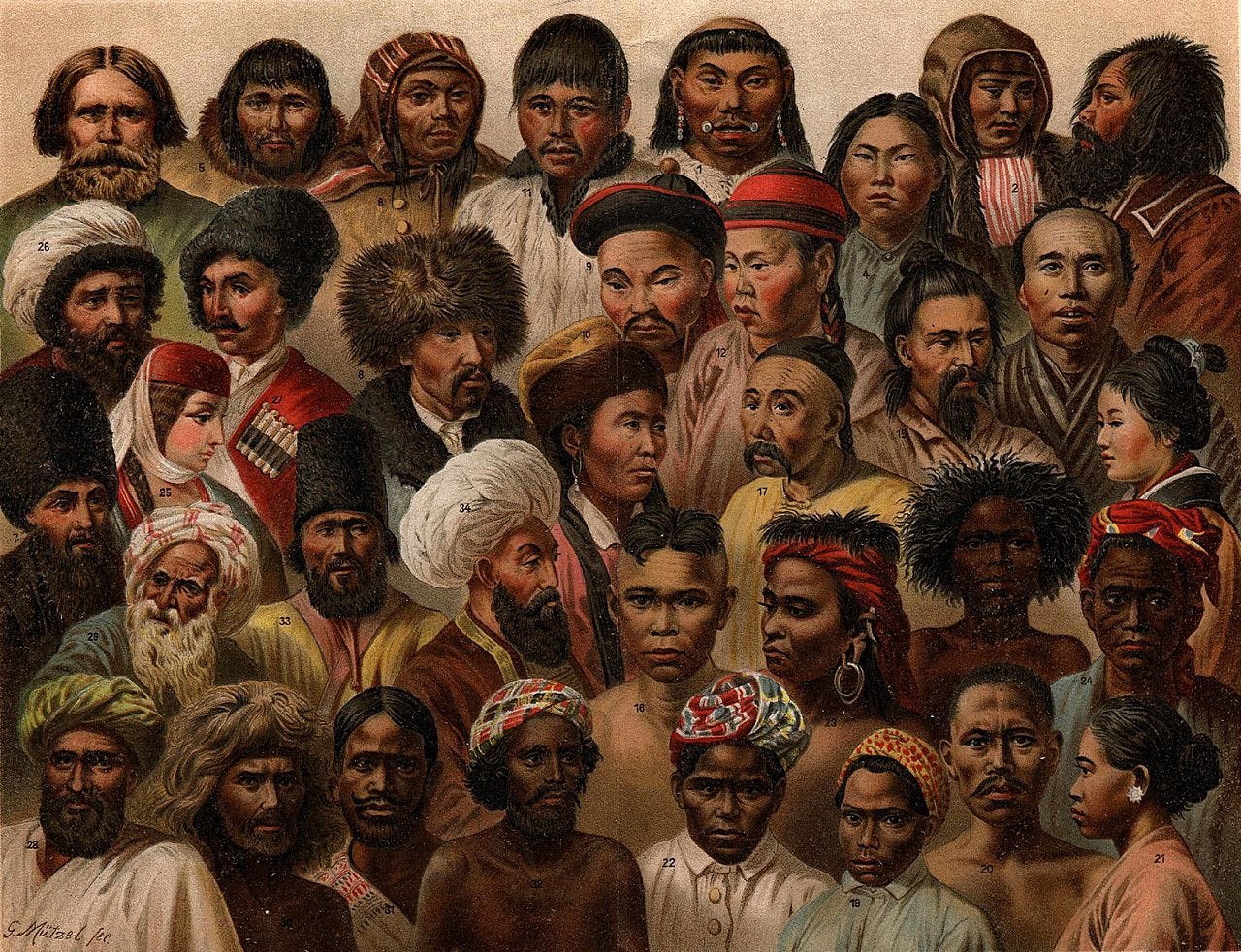
A 1904 depiction of Asian ethnicities.

The early medieval scholar Regino of Prum wrote the following:
Diversae nationes popularum interse discrepant genere moribus lingua legibus.
For those (such as myself) not up on the their Latin, that translates as:
The peoples of various nations differ by origin, customs, languages and laws.
This quote has been much cited since. Its fourfold formula was frequently used by medieval writers. For instance, Bishop Bernard of St David’s wrote to Pope Innocent II referring to:
populos nostre provincie natione, lingua, legibus et moribus, iudiciis et consuetudinibus discrepare
In English,
the peoples of our province are distinct in nation, language, laws and customs, judgements and manners
But manners are part of customs and laws entail judgements, so it is a more poetic version of the same fourfold formula.

About law
This was a region and an era where your law could be as much about which group you belonged to as where you lived. A single sovereignty could readily entail a variety of systems of law. A single system of law (e.g. Brehon law) could operate across several sovereignties. A non-resident in a city involved in a legal dispute might be asked what laws he lived under.

For much of the medieval period in Europe, particularly early in the medieval period, law was: the custom of the area. Which tended to mean: whatever we remember doing, last time this came up.

Henry II, the first Plantagenet king of England, used his Chancery and royal judges to develop what became the common law precisely because different people in different parts of England had different law (Norman, Saxon, Danish), with local variations. Royal judges would offer judgements that were both common across England and sought to synthesise the common elements between existing local laws, creating the common law of England.

Common law can be understood as evolving customary law. One of its many fine features is that it provides a structure of law without any Parliament, or other legislating authority, having to issue any specific law. A system of law with, moreover, an inherent tendency to move towards consistency. Something that is not a notable feature of statutory law.

In the modern era, law is very much a matter of state jurisdictions. So, setting law aside, that leaves us with origin (so descent or ancestry), customs and language as identifying an ethnic group. (Nation is ambiguous between state and people, but it is ethnicity that we are concerned with here.)

Ethnicity is something that develops in a mixture of separation (you overwhelmingly interact with members of the same group) and differentiation (there is one or more other groups that are identified as not being of the same group). Geographical separation means that folk can much more easily have specific customs and a specific language. (And, of course, specific laws.)

Ancestry matters because it is how customs and language are transferred across the generations. Yet the key thing is connections between people and common features that arise from the patterns of connection. A child adopted as a baby will be raised in the ethnicity of their adoptive parents and local community, regardless of their genetic ancestry. People are overwhelmingly raised by one or more biological parents, or adopted within the same group, so ancestry tracks ethnicity very strongly. But it does not drive ethnicity.

The overwhelmingly dominant connection between ancestry and the ethnicity in which folk are raised, drives some muddy thinking about ethnicity (and race). The notion that DNA tests can determine ethnicity, particularly for policing boundaries between ethnicities in intermingled communities, is deeply confused thinking. The bits of ethnicity that matter are your customs, your language, your expectations, your received framings, your patterns of connection. None of that is genetic or genetically defined.

Ethnicities can arise and fade away while genetic lineages continue. In his The Art of Not Being Governed: An Anarchist History of Upland Southeast Asia, James C. Scott notes that people and families in Southeast Asia would periodically choose new cultural identities, creating “crazy quilt” ethnic enclaves that ethnographers found perplexing. Ethnicities are nowhere near as primordial as is often pretended and ethnic identities can often be situational and strategic.

Race has come to refer to continental ancestry and the concept, and its associated social meanings, has had the most social power when folk of different continental ancestry interact. Most notoriously in the Americas where settlers from one continent (Europe) invaded another continent (North or South America, as the case may be), imported slaves from a third continent (Africa) and then received migrants from a fourth continent (Asia). That skin tone and other physical features were strong indicators of continental ancestry interacted with these very different social roles to make race talk an easy, and sadly convenient, option.

Yet continental ancestry on its own does not tell us what customs or languages you, or anyone else, has. No continental group, including Australian Aborigines, is a single ethnic or cultural group or users of a single language. Nor are they a single breeding population. Hence the speciousness of race — continental ancestry — as an analytical category, however socially convenient it has been for various folk to invest social meanings in physical markers of ancestry. Particularly as a divide-and-dominate dynamic.

Race as continental ancestry is also a long way from the C14th chronicler John of Fordun describing Scotland as a land of one nation but two races:
Mores autem Scotorum secundum diversitatem linguarum variantur ; duabus enim utuntur linguis, Scotica videlicet et Theutonica, cuius linguae gens maritimas possidet et planas regiones, Scoticae vero montanas inhabitat et insulas ulteriores. Maritima quoque domestica gens est et culta, fida, patiens et urbana, vestitu siquidem honesta, civilis atque pacifica, circa cultum divinum devota, sed et obviandis hostium iniuriis semper prona. Insulana vero sive montana, ferina gens est et indomita, rudis et immorigerata, raptu capax, otium diligens, ingenio docilis et callida, forma spectabilis, sed amictu deformis, populo quidem Anglorum et linguae, sed et propriae nationi, propter linguarum diversitatem, infesta iugiter et crudelis. Regi tamen et regno fidelis et obediens, necnon faciliter legibus subdita, si regatur.
Or, in English:
The manners of the Scots vary according to their language, for they employ two languages, Scottish [Gaelic] and Teutonic [Scots/English]. The race of Teutonic language has the sea coasts and lowlands, that of Scottish language inhabits the mountainous areas and the outer isles. The race of the sea coasts is domesticated, civilized, faithful, patient, cultivated, decently dressed, refined and peaceable, devout in church worship, yet always ready to withstand any harm done by its enemies. The island or mountain race, however, is wild, untamed, primitive, intractable, inclined to plunder, leisure-loving, quick to learn, skilful, handsome in appearance but vilely dressed, and continually fiercely opposed to the English people and language, but also to their own nation, on account of the difference of language. Nevertheless they are loyal and obedient to the king and the kingdom, and also easily subdued to the laws, if they are ruled properly.
Intermingling
DNA as a convenient sorting mechanism is only likely to be reached for if people of different ethnicities (so different ancestries) are intermingling. If everyone lives in villages of the same ethnicity, but are aware of there being villages of a different ethnicity over there, the issue does not arise. It is only if folk within the same larger community have varied ancestries (and so varied ethnicities) that it is going to seem sensible to look for some “sure” marker, such as biological ancestry or (once the technology exists) DNA testing.

The problems of maintaining separate identities in a situation of intermingling is what led to the development of the “one drop” rule in the US. If you had any element of African ancestry you were “black” (i.e. not “white”). It is a sign of how intense the stigmatising social meanings attached to being “black” were, the extension of the inherited dishonour of slavery onto their descendants, that no mulatto or mixed-race identity emerged in the US, in contrast to much of the rest of the Americas.

Ironically, this pattern was largely because electoral politics — who could vote and for whom — mattered so much more in the US. In societies with proportionately smaller settler elites, where voting was not much of an issue, it tended to be convenient to have an intermediary group as social buffer and suppliers of services. In such situations, one gets gradations of ancestry rather than sharp continental-ancestry (“race”) divisions, where elite ancestry provides the most benefits and slave or indigenous ancestry the most handicaps.

With the current attempts within the US and the wider Anglosphere to stigmatise the social meaning of “whiteness”, we are nowadays getting the same one-drop rule exclusion working in contemporary society, but going the other way so that any degree of non-European ancestry confers a presumptive moral advantage, making one “a person of colour”. But this just flips the pejorative effect while also wrestling with the problem of differentiation in intermingled societies. Situations of intermingling are much more likely to see situational or strategic use of ethnic (or racial) identities. 

It looks "racial" as the elite came from Europe and the slaves from Africa. But all elite structures have a strong element of ancestry in them (including in Leninist states). It is just that differing continental origins associated and associate different physical markers with different social/class status.

To impose simple, dividing, categories on intermingled populations requires systematically ignoring (inconvenient) ancestry. The original “one-drop” rule in the US meant ignoring any European ancestry among those with African ancestry. The new version similarly generally involves ignoring any European ancestry among “persons of colour”.

There is a long history of ignoring inconvenient ancestry. Patrilineal kin-groups generally ignored maternal ancestry, as matrilineal kin-groups generally ignored paternal ancestry. But the point in such cases was also very much to enforce differentiating boundaries.

The great advantage of DNA is that it reveals the complexities of ancestry. It does not track the complexities of culture. It does, however, point to how genetic lineages pass through, and into, cultures.

Segregation
The use of public policy to impose residential segregation in the US, to the extent of attempting to break up integrated neighbourhoods, was another way of wrestling with problems of differentiation among intermingled folk.

The enforced spread of residential segregation in the US, including attempts to segregate previously integrated neighbourhoods, is set out in Richard Rothstein’s The Color of Law. A note in the book quantifies the path of residential segregation, including its intensification under FDR’s New Deal. In the ten largest US cities:
in 1880, the neighbourhood (block) on which the typical African American lived was only 15 percent black; by 1910 it was 30 percent, and by 1930, even after the Great Migration, it was still only about 60 percent black. By 1940 the local neighborhood where the typical African American lived was 75 percent black.
Reducing intermixing by residential (and other) segregation is an obvious way to sharpen identity differentiation in a mixed society. This is typically done by giving one group a greater say than another. Whether it was such things as hostile zoning and resident activism in the US producing the aforementioned residential segregation, shuffling people off into reservations or giving one group claims over land that others cannot have.

Such segregation can indeed sharpen identity, but at the cost of giving up the benefits of interaction with the wider society. Denying folk such benefits has often been the purpose of such segregation. It is likely to be the effect of it, regardless of intention.

Marriage
As is well known, intermarriage, a very intimate form of intermingling, blurs ethnic identity. Hence groups that wish to retain their separate identity either block intermarriage or require outside spouses to convert to their group. Such marriage boundaries then provide a way to continue intense patterns of connection that differentiate the group from outsiders.

Religions have often been very much involved in setting up and policing such boundaries. As Nassim Nicholas Taleb notes, the right sort of boundary laws can turn a minority into a majority:
the spread of Islam in the Near East where Christianity was heavily entrenched (it was born there) can be attributed to two simple asymmetries. The original Islamic rulers weren’t particularly interested in converting Christians as these provided them with tax revenues — the proselytism of Islam did not address those called “people of the book”, i.e. individuals of Abrahamic faith. In fact, my ancestors who survived thirteen centuries under Muslim rule saw advantages in not being Muslim: mostly in the avoidance of military conscription.
The two asymmetric rules were are as follows. First, if a non Muslim man under the rule of Islam marries a Muslim woman, he needs to convert to Islam — and if either parents of a child happens to be Muslim, the child will be Muslim. Second, becoming Muslim is irreversible, as apostasy is the heaviest crime under the religion, sanctioned by the death penalty. 

The famous Egyptian actor Omar Sharif, born Mikhael Demetri Shalhoub, was of Lebanese Christian origins. He converted to Islam to marry a famous Egyptian actress and had to change his name to an Arabic one. He later divorced, but did not revert to the faith of his ancestors.

Under these two asymmetric rules, one can do simple simulations and see how a small Islamic group occupying Christian (Coptic) Egypt can lead, over the centuries, to the Copts becoming a tiny minority. All one needs is a small but continuing rate of interfaith marriages and little or no defection from the group folk are marrying into.

Such boundaries and group identities have often been reinforced by participation in common rituals.

Vanishing heritage
John Wood Jnr has observed that, on the Euro-American (“white”) side of his family, folk can talk about a heritage reaching back to Europe. As can Asians with Asia or recent African immigrants with Africa. On the (slave-descended) African-American side of his family, there is a striking absence of such. The descendants of American slaves have no such identifiable specific ancestral heritage(s), as slavery mixed ethnicities together while slaves had no family rights.

As sociologist Orlando Patterson has pointed out, the social death that slavery entailed, and the consequent natal alienation, separating slaves from any acknowledged line of ancestry or family rights, defined the slave far more then being property did. (Medieval serfs, for example did not suffer any such social death, any such alienation from family and heritage.) The process of Transatlantic exile of slaves, and their descendants, was a process of exile much more profound than that experienced by others arriving in the US and the rest of the Americas.

The descendants of slaves imported into the Americas have the most “American” identities, as they have had to create their identities within the Americas and within the context of European settlement. (Indigenous Americans have identities that reach back before European settlement, so are not anchored in the creation of new societies that American implies.) It is not accidental that various quintessential American cultural forms, such as Jazz and Blues, are grounded in the experience of American slaves and their descendants.

Within the US, the descendants of American slaves were an ethnic identity defined by “race”, i.e. African ancestry. They are now an identity submerged by “race”, as Afro-Caribbeans and recent African immigrants are both also “black”. (Though there is some evidence that American-born generations of such migrants may be at last somewhat socialised into attitudes of the descendants of American slaves; another instance of the effects of intermingling.)

That no descendant of American slaves has graced the Presidential nomination ticket of either major US Party is very much obscured by focusing on race rather than ethnicity. (President Obama and Vice-President Harris are both examples of migrant heritage, not US slave heritage.)

Custom
Culture is a notoriously ambiguous term, with literally hundreds of definitions being offered by social scientists. Custom also suffers from a certain ambiguity. Fortunately, philosopher Cristina Bicchieri has done the work, setting out a rigorous theory of norms that helps clarify thinking on these matters. This is done formally in The Grammar of Society and with a more practical focus in Norms in the Wild.

Using Prof. Bicchieri’s definitions:
Customs are things you regularly do because they work for you. They may generate expectations among other folk but they are not driven by such expectations.
Conventions are things you do because other people do them. They both generate, and are driven by, expectations. Language and fashion are classic convention-driven activities. Conventions allow people to coordinate with each other.
Social norms drive things you do because other people expect you to do them and are likely to sanction you if you do not.
Moral norms drive things you do because you believe it is the right thing to do regardless of the expectations of others.
The use of custom by Regino of Prum as quoted above clearly covers customs, conventions and social norms. In mixed societies, folk adopt and lose customs. They adopt and lose conventions. Both customs and conventions lose their distinctiveness, blurring identity. Similarly with social norms. So, once again, we can see the power of connection and the problems of intermingling.

Thinking in terms of custom, convention and social norms brings out the power of religion as a creator and preserver of identity. For participating in common rituals can be a great binding and a differentiating mechanism. Indeed, they are much of the social effect of ritual.

Corrosive contradictions
But thinking in terms of custom, convention and social norms also brings out how much politicising and legalising identity becomes a morass of corrosive contradictions. Such attempts to differentiate seek to draw lines in ways that social intermingling must undermine.

One ends up being at war with such intermingling — and so at war with any overarching common identity — while creating endless possibilities for strategic game-playing that is likely to be highly socially corrosive in its effects. Such identity-games can create simple categories that are appealing in their simplicity and disastrous in their lack of nuanced realism.

Ethnicities evolve. They change, emerge, weaken, strengthen, mingle and divide according to circumstances. Attempting to create a legal, moral and political order based on primordial, unmixed and fixed identities is to build a series of noxious fictions into the social order that are at war with the complexities of the human in ways that invite bad, even disastrous, outcomes.

There is no good form of identity politics. What look to be such (e.g. the various agitations for civil rights, whether for women, African-Americans, indigenous people, same-sex attracted …) have been attempts to gain the benefits of a common status, not a divided and differentiated one. To be judged by the content of one’s character, not some general, differentiated, category. That is true of every emancipation struggle, from the campaigns against slavery onwards.

Intermingling strengthens the case for a common humanity and a common citizenship. Contemporary identity politics do not represent the completion of the processes of celebrating a common humanity, and building a common citizenship, but the overturning of them. Hence contemporary identity politics replicating and adapting past methods for forcing differentiation on intermingled communities. But, then, divide-and-dominate retains its appeal to elites and forcing differentiation has always been very useful for that. As it still is.

[Cross-posted, somewhat improved, from Medium.]

Wednesday, October 2, 2019

Giving something away for free is not a sign of it having value

The progressivist push against citizenship took another big leap forward with the British Labour Party decision committing the Party to giving the vote in general elections to all UK residents. As things reveal their nature (and importance) in their history, a quick trip through citizenship's backstory helps to see what is going on.

Origins and decline
Citizenship originally dates back to the city-states of Ancient Greece. The basic idea was that if you took the risks and effort of fighting for your city, you got a say in the politics of your city-state, your polis. Political citizenship was therefore male, but legal and social citizenship extended to all members of citizen families. 

Eventually, one citizenship-polity, Rome, managed to work out how to scale-up citizenship and, coupled with a very effective military system, conquered the entire Mediterranean littoral. Civil war then culminated in replacing the Republic with the Empire. The Republic itself being conquered from within by the march of Roman imperialism.


Roman Emperors did not need people to vote for them, and had a (relatively) small professional army, so the link between taking risks for your polity and getting a say steadily weakened. The offer of Roman citizenship could entice outsiders into serving in the legions, and cities were still largely self-governing. But the trend was against any strong notion of citizenship.

Eventually, citizenship was universalised in 212 by the Constitutio Antoniniana to all freeborn folk in the Empire. This is usually written up as a noble act, but it expressed what limited value citizenship had by then. The division between honestiores (respectables) and humiliores (lessers) had already developed, indicating how citizenship itself had lost status.

Rather predictably, even citizenship's one remaining status claim within the Empire (a citizen was a free person) declined with the development of coloni, who became tied to their estates, so a type of serf. 

Revival
The revival of citizenship in medieval cities also had an implication of readiness to fight for your city, helping to create tough urban militias which were a feature of medieval and early modern Europe. The later, post-American and -French Revolutions, revival of citizenship also had some flavour of fighting for your country (hence the infamous Second Amendment). 

But citizenship became more tied to being who the state was committed to defend and to serve. The term "to protect and to serve" invokes protecting and serving a community of citizens. The ultimate expression of citizenship became having the vote. But it had already been connected to all sorts of other freedoms. Indeed, it had those connections before the vote. One could easily be "a free born Briton" but not have the vote. (This applied especially to women, of course.)

As is so often the case, the UK had somewhat particular history, in this case with the notion of a British subject, but that became trumped by citizenship.

The structure of citizenship flowed from all of this. You got it from being born in the country, because that established you had lots of links and connections and so could be reasonably presumed to have strong attachments within the society that the state was supposed to be serving. You could become a citizen, but only by long enough residence that you could be reasonably presumed to have built up such attachments. Continued residence was a strong signal of commitment. You were committing to the society that the state was supposed to be serving. Some states insisted on unitary citizenship, others permitted dual attachment.

Social bargaining
The history of the spread of the suffrage, of the right to vote, throughout Western societies is the history of the expansion of the ability to participate in social bargaining about the policy and laws of the state. That votes determined who held office at the peak of the state (apart from any monarch) made votes matter. Hence the importance of voting mechanisms and electoral systems. For these affect how much voter concerns have had to be paid attention to, that being what makes voting "real". The legitimacy element involved in the practical and expressed consent of the people is a consequence of the power it gives to participate in social bargaining in this way, it is not a driver of the significance of voting.

After all, totalitarian states hold elections. But they are mere rituals of dominance, forcing mass participation in rituals of legitimacy. It is the ability to vote in and out people who make decisions that matter that gives the vote its power. Provided, that is, there is some genuine bargaining element involved, which requires that there be genuine alternatives, both offered in the public space and adhered to by serious competitors for office. In particular, that voters have the capacity to articulate their concerns, and have them heard.

This is why the old centre-left, back in the days when they overwhelmingly represented (and their candidates and activists often came from) people of low income, assets and education, were stalwarts of democracy. The vote was by far the most important social lever that their voters had. It is also why such voters now dominate (pdf) the increasing proportion of non-voters in societies with voluntary voting: an increasing, and largely accurate sense, that the political class is indifferent, or even hostile, to their concerns.

Undermining citizenship
For things have changed profoundly for progressive politics. Modern progressivism has been mounting a multi-level attack on citizenship. This is because, as French economist Thomas Piketty has documented in his revelatory paper Brahmin Left v Merchant Right: Rising Inequality & the Changing Structure of Political Conflict (Evidence from France, Britain and the US, 1948-2017) (pdf), left-of-centre politics has become dominated by a human capital (i.e. educated) elite. And the way an educated elite turns its human capital into a position of social dominance is by controlling public language within the society; by setting the limits on who can express what, when and how, on whose concerns will be deemed legitimate or not. By controlling what is to be legitimate for any social bargaining to be about, thereby determining what social bargaining (if any) will be permitted. Eric Weinstein's Four Quadrant model provides a useful heuristic.


In other words, social dominance is achieved by controlling the Overton window and by undermining any area of social bargaining it cannot dominate and control. Piketty's use of the term Brahmin Left is inspired because being secular Brahmins, the folk imposing rules and taboos, is an excellent description of what they are increasingly about. (How Left they are is another question, hence I will refer to them as Brahmin progressives.) 

Any strong concept of citizenship gets in the way of this strategy of social dominance. Moreover, it does so comprehensively. 

For instance, the notion "I am entitled to say that, I am a citizen" has to go. Hence the enthusiastic adoption of the Stalinist concept of hate speech. "Hate speech" is a conceptual and rhetorical device used by Brahmin progressives seeking to gain control over who can say what. Thus the use of terms of reputational aggression ("racist", "homophobe", "misogynist", "islamophobe", "transphobe" etc) to police speech and destroy reputations. It sets up the mechanisms for dominating public discourse by controlling legitimacy. As does, of course, calling lots of people fascist or nazi

The ostentatious and intense moralising Brahmin (i.e. diversity) progressives engage in is ideal for this strategy of social dominance. First, because morality is trumps; to say something is moral is to say it is what you should do. So, intense and ostentatious moralising mobilises that trumping value of morality for the strategy of social dominance. Second, because it hides from themselves and others what they are about. They are, of course, not trying to impose their own social dominance, they are just being moral, they are just doing the right thing. This is a classic example of social psychologist Jonathan Haidt's point that morality blinds and binds.

It is important to understand the selection processes here. People seek to economise on information, minimise reputation risk and maximise status. A set of received opinions which denote being a good, even morally superior, person does all this. But it only works if the opinions being used as moralised markers of status generate moral prestige, and they only do that if dissent is morally retrograde. Indeed, the more morally reprehensible dissent is, the greater the moral prestige. Hence the “pile-ons”: people are protecting their investment in moral prestige.

Once these mechanisms are in play, then a structure to generate and enforce social dominance has evolved. One, moreover that both gains strength the more organisations and institutions it dominates and also fosters colonising said organisations and institutions. (Inconveniently principled believers get in the way, as they elevate some other consideration above the prestige-and-dominance game: see the current use of trans activism and the war on biology-affirming feminists.)

The power and status implied in citizen-as-voter gets in the way of this sought social dominance. So the vote becomes hemmed in by judicial power, by an expanding administrative state, by supranational authorities. All increasingly run by people like them, according to their attitudes and serving their social dominance. The Brahmin progressives are, therefore, overwhelming pro-EU because it is such an excellent vehicle for all that. (The old working class Left was always much less keen, as is still true of their remnants.)

The vicious and continuing attacks on the 52% of voters participating in the UK's 2016 referendum who voted Leave is all about Brahmin progressivism--what UK writer Ben Cobley called the system of diversity in his very useful book The Tribe: The Liberal-Left and the System of Diversity--seeking to re-establish their control over the public discourse and keep the UK tied to supranationalism, hemming in the power of voting and the status of citizenship. No revolts are allowed. Especially not revolts that celebrate and elevate citizenship. 

Considering citizenship in terms of the history of its role and functions is the only way to understand the implications of undermining or eliminating it. That way, any trade-offs with various moral principles can be understood in context. If, however, one simply ignores the purpose, and consequent structure, of citizenship then those trade-off considerations are eliminated, so any infringement of some declared moral principle becomes a simple infringement of morality or consistency, and so illegitimate. It becomes easy to make "knock down" criticisms of citizenship (as is done, for example, here [pdf]).

But, of course, for Brahmin progressivism, it is precisely those purpose and functions which are the problems. Even more, that their moral lessers (those xenophobic, race-cursed, heteronormative, insufficiently educated modern humiliores) become people who politics should be about and the state should be in service of. For, whatever else Brahmin progressivism, or diversity progressivism is, it is urgently concerned with elevating the status of the Brahmin progressives, with boosting their sense of moral prestige against, and their social dominance over, their fellow citizens.

That term
The attempt to control the public space by controlling what is deemed legitimate to discuss, and how it is deemed legitimate to discuss it, brings us to that fraught term political correctness. In particular the two uses that essayist William Deresiewicz discusses in his essay, “On Political Correctness: Power, class, and the new campus religion”.

There is political correctness-as-verbal-civility:
the expectation of adherence to the norms of basic decency, like refraining from derogatory epithets.
This is the cover usage, the one that those who wish to dismiss any concern over political correctness invoke. What Deresiewicz is concerned with is:
the persistent attempt to suppress the expression of unwelcome beliefs and ideas.
The longstanding campaign to undermine any use of the term political correctness is all about hiding that attempt to suppress behind a fog of morality. Though, more recently, with the term free speech itself becoming an object of criticism, of diminution, held to be a block to progressivism, even treated with punitive derision, there is rather less hiding, and even more puffed up moralising.

Deresiewicz is well aware of, and invokes, the history of the term political correctness:
The term political correctness, which originated in the 1970s as a form of self-mockery among progressive college students, was a deliberately ironic invocation of Stalinism. By now we’ve lost the irony but kept the Stalinism—and it was a feature of Stalinism that you could be convicted for an act that was not a crime at the time you committed it. So you were always already guilty, or could be made to be guilty, and therefore were always controllable.
People suddenly finding they are catastrophically on the wrong side of a norm that they did not know existed, or did not know would be applied in that way, has become almost commonplace. The world of Young Adult fiction has recently provided several examples, but they are just instances of a much wider trend.

Cultural Stalinism
Brahmin, or diversity, progressivism, can be reasonably described as operating as cultural Stalinism. Not because it is inherently Marxist, though there are certainly some Marxist antecedents. The term cultural Marxism is way over used, given that most folk involved are not Marxists, are not aware of how much of the ideas they are using or actively or passively endorsing have Marxist origins and that genuine Marxists are often quite hostile to contemporary diversity politics. Not surprising, as actual Marxists are Enlightenment universalists, and identity politics/diversity progressivism's creation of a series of sanctified, versus various tainted or demonised, identities based on what are often innate characteristics involves a clear rejection of Enlightenment universalism.

The point is not that Stalinism was a manifestation of Marxism, but that it was a strategy of political action and dominance. In particular, it was the attempt to apply Leninthink to operating in liberal democratic societies. Consider the characteristics that Brahmin/diversity progressivism and Stalinism have in common.

(1) Endorsing and using the concept hate speech. As noted above, it is a Stalinist concept used to arrogate to Brahmin progressives the right to decide who can speak, how and about what.

(2) Use of the terms fascist and nazi as a standard term of rhetorical abuse. Fascism was an early C20th ideology characterised by expect rejection of democracy, belief in the purifying effect of violence, extolling of military virtues and organisation that sought to attain and impose complete national unity of purpose. With a few exceptions, such as the Golden Dawn in Greece, fascism is nothing but a reviled fringe in Western politics. Which is why movements that have fascist antecedents have had to work to shed them. (Even the Golden Dawn denies being fascist, though it fairly clearly is.)

The use of fascist and nazi as standardised terms of rhetorical abuse against people who simply are not fascists, or versions of fascists, shrieks of the ambition to control public discourse, to determine who is, and who is not, a legitimate participant in the public space. It is also a classic characteristic of Stalinism (for, of course, the same reason).

(3) Internationalist. The denigration of ethno-cultural identities, the contempt for nationalism, the sense of belonging to a transnational elite practising transnational politics, is bog-standard Brahmin/diversity progressivism, hence the use of the term globalist by opponents. Also a classic characteristic of Stalinism.

(4) Know, and are working with, the proper direction of history. An obvious feature of Brahmin/diversity progressivism; all that talk of where the arc of history bends and being on the right side of history and how their opponents are against modernity. Also a classic characteristic of Stalinism.

(5) Dogmatic. The Brahmin/diversity progressives are a highly opinion conformist group. The dogmas may keep shifting, but that Brahmin/diversity progressivism is dogmatic, at times viciously so, is an obvious feature of it. Also a classic characteristic of Stalinism, including there being precipitous shifts in dogma.

(6) Unlimited in social ambit. There is no part of one's life that the strictures of Brahmin/diversity progressivism do not reach, because they want to impose their norms and taboos on all language everywhere. There is no such thing as exempt private speech or exempt social action. Again, a classic characteristic of Stalinism.

(7) Unlimited in action. Any level of destruction of people's lives--sacking, destroying their business, career, livelihood--will be engaged in. Maximising reputational risk is a great way to enforce conformity. 

The major existing limit at the moment is actual violence, except that Antifa is breaking down that limit. But, again, this is replicating Stalinism in the West, which also had limitations on its ability to use violence. Except that Brahmin/diversity progressivism has penetrated Western institutions far more thoroughly than Stalinism ever did, so can range much more widely in the destruction of people's careers, reputations, public standing ...

(8) The inconvenience of principled believers. Even the split with serious Marxists replicates Stalinism, because as Gary Saul Morson points out in his Leninthink essay, serious believers in Marxist ideology were targeted under Stalinism, as they might hold the leadership to account according to Marxist principles. Contemporary Marxists who think that concern for the working class is a bedrock of being on the Left are definitely not what is wanted within Brahmin progressivism. Sneering at, and lauding over, the citizen working class is so much of the point of Brahmin progressivism, whose politics reek of contempt for their fellow citizens. Which is epitomised by stripping of them of status of citizens, and giving them no status markers that sets them over the romanticised newcomers, newcomers treated as economic saviours with lots of desirable traits (e.g. initiative) and no taint of the oh-so-awful Western past.

A salient example of this "true believers not wanted" phenomena is the anathematising of biology-affirming feminists such as Germaine Greer and various radical feminists (the infamous TERFs). The whole trans madness being Brahmin progressivism displaying its social dominance. It both selects for reliability (who breaks ranks?) and expresses dominance (how much can we force people to acquiesce in things they do not believe?).

There is so much overlap between Stalinism in the West and Brahmin/diversity progressivism (far more than there is between fascism and almost anyone currently being accused of it) that Brahmin/diversity progressives are clearly practising what can be reasonably described as cultural Stalinism.

Nor is this overlap surprising. Both Brahmin/diversity progressivism and Stalinism are about a human capital elite striving for social dominance in mass communications and mass politics societies. It is hardly surprising that the new wave of such would adopt the most apposite available strategy they can pick up. Even more so, as similar aims and constraints lead to similar selection pressures.

The convergences between Stalinism and Brahmin/diversity progressivism really are no accident. A process of both adoption of available strategies and of convergent evolution is in play.

Divide and rule
The level of institutional penetration is such that we can reasonably talk of a diversity imperium, and any imperium knows the importance of divide-and-rule. Which brings us to multiculturalism. Or, as political scientist Eric Kaufman nicely expresses it, asymmetric multiculturalism, which elevates (and, indeed, romanticises) the cultures of newcomers while ignoring or denigrating the culture of the heritage citizens. Thus, a Muslim, Buddhist, Sikh or Hindu festival is "multicultural". A Christian event is not. One cannot say that London is no longer an English city, because there is no English identity except living in England.

In his excellent The Road to Somewhere, David Goodhart makes the observation concerning multiculturalism that:
But by cordoning off minorities in their own districts with their own leaders and social centres and often making their progress dependent on white advocacy, white liberals were merely continuing the colonial heritage with a smiley face pasted on. (P.167)
Indeed. Citing Goodhart's previous book, The British Dream, Ben Cobley, in The Tribe, notes that:
The figure of the colonial administrator, presiding over, accepting representations from and giving favours to various different groups under his purview, has a lot in common with contemporary administration of multiculturalism and diversity. For a start it is an elite role; it oversees and directs its politics through group or tribal leaders, giving them access to higher power. It also stands apart, not interfering with the representatives’ relationships to their group members, thereby outsourcing power over what is good and bad within those groups and conferring political power on to the representatives it favours. As the first waves of mass immigration came in from former Empire countries, colonial-style multiculturalism effectively allowed Britain’s governing elites to pick up where they had left off in the Empire—slipping into old ways that were familiar to both administrators and many of the immigrants themselves. Goodhart says that ‘in the 1960s this translated easily into the cosmopolitan manners of a new liberal elite too—allegiance was now to tolerance and openness instead of the monarch, to England’s “genius” for multiculturalism.’ He adds: ‘The core members of this new elite, according to [the sociologist] Geoff Dench, were “policy-makers and the public servants responsible for carrying out social policy but it extends widely into the educational establishment and liberal professions… and their role is to stand impartially above and integrate different elements of the population.” This is what both imperial and multicultural elites do. (Loc 1087.)
Quite so. Imperial systems are naturally multicultural: it maximises the number of their subjects while dividing them from each other. One certainly can't have some strong notion of citizenship bringing them together.

Importing people of a different cultural background to improve the local economy was a standard device of colonialism. Academics have had no trouble identifying it as a divide-and-rule technique. Except, of course, when it is people like them doing so to serve an imperial cause they support.

Resentment and condescension 
It is not as if the general public, the general citizenry, have not noticed. When asked in polls, huge numbers define pc as a problem. Across all ages and races. Of course they do, attacking their ability to express themselves about matters social and political assaults the bedrock of their citizenship quite directly. 

Citizenship defends the status of the somewheres (those rooted in a sense of place and community) against the endless vote-trumping social imperialism of the Brahmin progressives, acting as the vanguard of the anywheres (those not so rooted). Citizenship, and its implications, gets in the way of the mobility and status claims of the anywheres. 

And they are typically mightily offended by any notion of serving their moral lessers. In his The Road To Somewhere, David Goodhart cites some revealing conversations:
The first conversation took place at an Oxford college dinner in Spring 2011. When I said to my neighbour—Gus O’Donnell, then in his last few months as Cabinet Secretary, the most senior civil servant in the land—that I was writing a book about immigration, he replied, ‘When I was at the Treasury I argued for the most open door possible to immigration … I think it’s my job to maximise global welfare not national welfare.’ I was surprised to hear this from the head of such a national institution and asked the man sitting next to the civil servant, Mark Thompson—then Director-General of the BBC—whether he believed global welfare should be put before national welfare, if the two should conflict. He defended O’Donnell and said he too believed global welfare was paramount. (Pp14-15)
The global welfare they see themselves as serving being what looks like global welfare to people like them. Which, strangely, will tend to reflect the perspectives of people like them. Global welfare is grand enough for such moral paragons, while serving their fellow British citizens is clearly not. Even better, taking such a lofty view also releases them from any constraints the concerns or actions of said citizens involve that they deem incompatible with said global welfare.  

In their combination of moral arrogance and feckless irresponsibility, the above-quoted sentiments are perfect Brahmin progressivism. The globe does not give feedback, but the voters do. But that feedback can always be ignored in the name of the greater global good. They are both morally ennobled, and freed from burdensome responsibility, all at once.

Brahmin/diversity progressives just know the direction of history. They own morality. They collectively possess the power to punish any public dissent. Even what the migrants, those romanticised outsiders they are so solicitous of, might want does not matter. Just ask Israel Folau. So, there is "nothing to see here" when it comes to migrant attitudes and outlooks. Besides, those migrants can be expected to (mostly) vote the correct way.

The Brahmin/diversity progressives replacement for citizenship, for voting that matters, for the social bargaining that is the very stuff of democratic politics, is their own moral dominion; their right to decide what people are permitted to say and what concerns they are permitted to express and how. So, it does not matter how socially conservative the romanticised newcomers are or may be, the Brahmin diversity dominion, the diversity moral imperium, will control all.

No matter how many newcomers turn up. Even if one has created a massive extra incentive to just turn up:  as if enough of you do, you get to dominate the political system. An effect that obviously depends on what level of filter there is for simply arriving: open borders says none at all, except the willingness and ability to travel.

As economist George Borjas says:
Our immigration policy—any immigration policy—is ultimately not just a statement about how much we care about immigrants, but how much we care about one particular group of natives over another.
Yes, and the statement is being made loud and clear.

Devaluing their inferiors
It is entirely appropriate that the decision of the British Labour Party to hand out the right to vote as a reward for getting off the plane was matched by a commitment to open borders. Migration is a key element in the future direction of any society, and Brahmin progressivism has been fighting a long battle to remove migration from the ambit of social bargaining. An open and complete commitment to open borders (any opposition to which is, of course, "racist" and "xenophobic") just cements that removal.

After all, our new Brahmins are far too morally lofty to be dictated to by mere shudras. Citizenship implies that politics is about serving their moral inferiors. Clearly, it has to go. And for it to go is clearly the plan. The British Labour Party conference has told us so.

Handing out the vote merely because you have arrived while putting no barriers to arrival does not represent the peak of democracy, it represents the trumping of it. It does not represent the apotheosis of broad social bargaining, but its effective elimination, its reduction to whatever minimal ritual form suits Brahmin/diversity progressives. The British Labour Party wants to bury citizenship, to empty it of status and content, and in so doing bury any chance of the citizen working class having a serious say in its future. 

Whatever that is, it doesn't look very Left. Not in any sense that Keir Hardie, the first Labour Leader, and those who built the Labour movement, might recognise. 

Friday, October 2, 2015

Immigration and social order

The entire debate over immigration, particularly illegal immigration, turns on the issue of social order -- specifically, its value and cohesiveness. Those who think there is simply no issue -- that no people who make the effort to go to another country to live can be a threat to the social order they are entering, no matter what their numbers or characteristics -- thus see immigration (legal or otherwise) as a very simple moral issue. People have a right to live where they wish and societies should willingly accept anyone who wants to live there. The worse the conditions or dangers they are fleeing, the more that is so.

Of course, it never occurs to some that there could possibly be a social order issue. If confronted with such concerns, they are either uncomprehending, dismissive or hostile. They posit -- without apparently noticing that they are doing so -- that the receiving societies are unproblematically adaptable to any particular influx, no matter what the scale.

Not accepting concern about any effect on social order as valid, it is then easy to "read" raising such concerns as oppressive (racist, xenophobic, etc). This is the three languages of politics issue, where progressives see blocking migrants as oppressive, while libertarians see it as coercive.

Conservatives, by contrast, have social order concerns at the centre of their political worldview. So they tend to read tolerance for illegal immigration in particular as either deliberately subversive or stupidly naive.

(And there is a line of thought which takes the view that any harm done to the host societies is well-deserved; what is rather nicely labelled ethno-masochism. As the new arrivals would likely also be negatively affected by such increased dysfunction, it is an attitude based on deep despite, not genuine concern for others.)

De-legitimising debate
Given that journalists and academics and related professions are strongly progressivist in their ideological outlook, and (based on US evidence) remarkably homogeneously so, there is a serious problem if even raising concerns about immigration is regarded as illegitimate. If wanting less immigration, or wanting to discuss selection criteria for migrants, is "anti-migrant", "xenophobic", "racist" etc, then it is not possible to have a free and open debate about immigration.

Which, of course, may be the point of the exercise -- the notion that "our moral project is so important that dissent is wicked" is a view that is clearly alive and well: that this "error has no rights" view is one of the key premises of totalitarianism either does not strike such folk or they don't care.

A comment on the Via Meadia blog expresses the use of terminology to try and close down debate nicely:
Take "anti-immigrant," for example. We hear that a lot. What, exactly, does it mean? As far as I can tell, its popular political meaning is this: anyone who suggests fewer immigrants be let into one's country, no matter what reason they give, is automatically "anti-immigrant." So the "debate" never even gets started because there can be no debating someone who is "anti-immigrant," right? Another is xenophobia. This is a favorite because it has overtones of erudition, being a Greek word and all. So if one is concerned about hundred of thousands, millions or tens of millions of immigrants from vastly different cultures entering one's country, one therefore fears strangers?
Such de-legitimising also means cutting out of the debate anyone with such concerns or views. The narrowing of debate has become increasingly pervasive. Thus, I could not post the picture opposite on Facebook(tm): apparently any negative reflection on refugees is verboten.

As being concerned about, sceptical of, etc to immigration turns out to be large proportions of electorates, such pressure to narrow debate becomes a serious problem for the health of democracy. And if mainstream politics will not address the concerns of significant numbers of voters, then that provides an opportunity for less (or non-) mainstream politics to do so. What I called in my previous post the "angry voter" effect.

Immigration policy provides an opportunity for a large-scale use of the Curley effect, whereby one seeks to bring in migrants expected to vote for you -- it has been suggested that the former British Labour Government had such a strategy. An effect which is increased if one also drives out people not expected to vote for you. (The effect is named after a Mayor of Boston who encouraged rich Protestants to leave while mobilising poor Irish Catholics.) Leaving aside the moral issues, the operational trouble with any such policy on a national scale is that migrants take a while to become voters, so there is the danger of driving up the "angry vote" quicker than you increase your own.

The frustrated popular sentiments being captured by the Bernie Sanders and Donald Trump surges in US Presidential politics are nicely expressed by conservative intellectual Yuval Lugan:
But in their different ways, they are actually pointing to some shared frustrations: Both Trump and Sanders are calling attention to those political debates in which the inherent cosmopolitanism of modern capitalism is most deeply in tension with the inherent populism of modern democracy—especially, but by no means exclusively, immigration and trade.
The Trump insurgence in particular is expressing a populist frustration which is also manifesting in such things as the surge in the National Front in France, the Sweden Democrats in Sweden, the UKIP in the UK and so on. All tapping into notions among voters that their government is supposed to be on their side, looking out for their interests.

Especially as the net benefits of immigration tend to be correlated with how much capital (including human capital) one has -- that is, the benefits tend to be positively correlated with how much capital one is backed by, the costs negatively correlated (i.e. high capital folk tend to get most of the benefits, low capital folk most of the costs). [For example, a recent paper (pdf) found that the sudden arrival of largely unskilled immigrants from Cuba in 1980 seriously depressed the wages of those in Miami who had not completed high school for years afterwards.]

Thus the costs of immigration vary considerably among social groups. It is therefore not surprising that, in the UK, polling suggests that Labour voters are quite hostile to immigration. The fear that immigration can overstep popular tolerance is a perfectly reasonable one. Especially as the scale and rate of inflows matter. When, for example long time renters start getting evicted to make way for refugees (and that in a country with relatively strongly responsive housing supply), it is not likely to help social acceptance.

But modern progressivists typically don't socialise with those who disproportionately bear the costs of migration. As talking about such costs -- let alone considering the possibility they may vary with different migrant groups -- becomes BadThink, the interests of those citizens who disproportionately bear the costs become themselves de-legitimatised. Instead, we see a tendency to sneer at such concerns from considerable social, and self-defined moral, distance. (Social distance that has been increasing over time, at least in the US.)

Virtue signalling
Any highly moralised perspective that is dismissive of dissent is made for Virtue signalling. Virtue signalling itself gets a great deal more power from maximising the wickedness of those who dissent -- who are then bullied with systematic attacks on their motives and moral character (something social media is made for). Such Virtue-signalling leads to the sort of mindset which is happy to negotiate with (or, at least consider the alleged grievances of) terrorists, but not with sinner fellow citizens sceptical about, or hostile to, the Virtue signal of endorsing the obvious and overwhelming urgency of letting refugees in. Besides, if much of the point of the exercise is to signal Virtue, then alienating lots of voters becomes a good thing -- it gives so many more folk to signal Virtue against. Thereby applying a basic principle of modern progressivist politics: I am superior to you because I am more committed to equality than you.

Though being outraged at the notion that public debate should be wide enough to encompass the concerns of large numbers of fellow citizens does show a deep not getting of what this democracy thing actually means. The EU is currently demonstrating the difficulties of systematically excluding widely held concerns from normal democratic political bargaining.

The entire point of the flows of people into Western societies is precisely that Western societies are very successful societies; that is why folk want to live there. But valuing Western success is not a noticeable feature of the Virtuous mindset.

The ostentatiously Virtuous typically have no idea how narrow their moral vision is (nor how narrowly self-serving it is), blinded as they typically are by their own moral self-satisfaction and their (often deeply hypocritical) burblings about tolerance and diversity (which typically do not extend to tolerance and diversity about divergent opinions or inconvenient concerns). It is one thing to argue the costs of large-scale migration are worth bearing -- it is quite another to treat any discussion of such costs as illegitimate.

Much of Virtue signalling is based on ignoring or downplaying inconvenient facts. Which becomes even more of a problem if such cognitive blinkers seep into reporting, analysis and commentating because of high levels of moral conformity -- particularly Virtue-signalling conformity -- among journalists, academics and similar professions (thereby pushing reports of problems into more rambunctious media). It is precisely such blinkering, and consequent intensifying of narrowness in perspective, which makes cognitive conformity so dangerous for decision-making.

Gains from trade and other economies
Economists of an open borders bent point to the overall improvement in human welfare from migration, given that the income of people moving to the better organised (i.e. more productive) societies will be raised--which is, of course, a major motivation for moving to such countries. Libertarian economist Bryan Caplan provides a representative example of such enthusiasm for open borders.

The economist-libertarian argument about welfare gains due to moving to countries with higher productivity provides an example of gliding over social order concerns. Which is particularly easy for libertarians, who tend to take the view that social outcomes are state+private transactions, hence there is no problem from any level of migration because the state will continue to operate as before and there will be more gains-from-trade private transactions.

If, by contrast, one takes a broader view of the importance of social capital, and of possible impacts on (pdf) the operation of the existing state, then the libertarian argument becomes rather less impressive. It is both funny and sad to read an open-borders enthusiast wrestling with the idea that a billion entrants might change the US political system. The notion that entrants who have done nothing to show any commitment to the society they are resident in will follow the expectations and rules of their new society is hardly something to be just assumed. Especially if no pressure is put on them to do so.

Democracy and rule of law -- particularly accepting different-but-equal and not nepotistically colonising institutions, to take two examples whose lack explains much about the contemporary Middle East -- are ideas and patterns of behaviour that folk have to be socialised into. (After all, helicopter-dropping democracy into Iraq, without dividing it into its constituent communities; that worked so well.) Such socialising requires a slow enough rate of immigration for it to occur; and the more divergent the patterns of behaviour and belief the originating societies are from the outlooks and behaviours that democracy and rule of law are based on, the slower the rate of immigration needs to be.

One of the remarkable features of the Virtuous mindset is that it holds that Western societies are seething with hateful thoughts and beliefs that desperately require laws against "hate speech", academic speech codes and institutional codes of conduct; all to block, repress and transform said hateful thoughts and beliefs. Yet to suggest that there might be problematic patterns of belief and behaviour among actual or potential migrant groups is wicked BadThink.

But the point of Virtue signalling is to elevate one's status against one's fellow citizens and one's own society; neither of which Virtue signalling is served -- indeed both are undermined -- by critical examination of non-Western patterns of belief and behaviour. So, non-Westerners become moral mascots, to use Thomas Sowell's language, or sacred victims, to use Jonathan Haidt's, and thus morally protected groups; critical consideration not allowed.

As Haidt points out, sacredness involves abandoning trade-offs. The sacred victims are not placed with other mere mortals within a web of trade-offs between moral principles, but elevated to a special moral purity such that critical examination itself becomes a sin against Virtue.

Fiscal costs and policy adjustments
There is an argument about the cost of immigration for welfare systems. In the US, poor immigrants seem to access welfare at a lower rate than the locally born poor. But this is a pattern which will depend on national rules about eligibility and the make-up of immigrants. It becomes a potential issue if the increase in welfare expenditure from immigration is greater than the increase in revenue from increased economic activity from immigration: which does not seem to be a significant problem anywhere. But that is a fiscal cost argument which has no particular connection to social order concerns and which, in libertarian hands, is more likely to be an argument for scaling back welfare provision.

The libertarian case for open borders is typically also bound up in arguing for the necessary policy adjustments -- that labour markets be liberalised to encompass the new entrants, that land use regulation be liberalised to provide housing at reasonable prices and so on. The evidence is that such things are not likely to occur. Indeed, one of the sectional advantages of immigration can be to drive up the value of existing houses in supply-constricted markets. Such immigration can also make it easier to restrict the supply of housing for land, because a larger proportion of housing market entrants become new arrivals -- so non-voters -- skewing the electoral math even more towards market restriction and so creating "insiders" and "outsiders" (with migrants being "outsiders"). Nor is there any reason such a "more market entrants are non-voters so blocking market entry becomes electorally easier" dynamic could not operate in other markets.

Indeed, one sign that the Virtuous posturing on immigration is just that is that they can be relied on to oppose and denounce any of the market liberalisations which would have to be enacted to enable reasonable economic participation by large numbers of new migrants. Just as they would oppose and denounce any attempt to have education systems encourage loyalty to the new country or anything resembling open and critical debate about what might or might not work well in the new social settings compared to what folk are fleeing from. [Yet acknowledging such an over-arching identity and focus of loyalty also provides paths to integration for migrants.]

If the path to signally moral Virtue is taking a critical stance towards one's own society, not only does that mean ignoring its strengths but it also undermines any real incentive to minimise social dysfunction that does not directly affect folk like oneself, because such social dysfunction then provides more things to signal Virtue against. The pose among the Virtuous about being "subversive" is at least in part about preserving their sense of moral purity by not taking responsibility for anything unfortunate. Econblogger Noah Smith has coined the nice term of "Haan history":
Injustice anywhere, under Haan thinking, invalidates justice everywhere else. ...
What matters is not just the flow of current injustice, but the stock of past injustices.
Haan presents a vision of stasis that is different from the Malthusian version. By focusing on the accumulated weight of history instead of the current situation, and by focusing on the injustices and atrocities and negative aspects of history, it asserts that the modern age, for all its comforts and liberties and sensitivity, is inherently wrong.
A view which suits Virtue signalling, as it maximises sensitivity to moral imperfection to better signal one's own superior Virtue.`

Population variance
Given their heightened sense of the fragility of social order, conservatives tend to think it obvious that large-scale migration is potentially degrading or destabilising of a social order built up on developed social habits, framings and perspectives that incoming migrants do not share and have not participated in. (Including comparisons with the collapse of the Western Roman Empire.) Historian Michael Burleigh articulates that sort of concern, that mass, uncontrolled migration:
... raises questions whether one can simply uproot people from entirely different cultural universes and expect them to thrive in societies that may subscribe to other values, with radically different expectations of their citizens.
Illegal immigration is particularly disliked, since it inherently involves breaking the laws of the country being entered.

If, as libertarians and progressives tend to hold, there are no legitimate or substantive social order problems with immigration (legal or otherwise), it then becomes a reasonable question to ask what is different from that and simple armed invasion? To which the answer would be that armed invasion involves the application of coercion and the clear intent to impose a new social, or at least political, order.

An answer that does not take us nearly as far as it might appear. The obvious case is Israel and the alleged Palestinian "right of return". It is blindingly obvious that if Israel stopped being a majority Jewish state, then the safety of Jews in Israel would be greatly degraded. (If it was not obvious before--though it was, for those with eyes to see--the present state of mutual massacre in the Middle East has made it so.)  While it is a refreshing change to see Israel's amazing record of taking in refugees lauded, it is also a useful to remember they were specifically Jewish refugees, overwhelmingly likely to be committed to the Jewish state, strongly motivated to its success and embraced by those already there as contributors to state-building in hostile environment.

Human groups can have seriously varying values, framings and perspectives. [Thus they can vary dramatically in levels of pro- or anti-social behaviour, extending to cooperation personality types (pdf) and such factors as levels of patience.]

And in reactions to the same: there is a lot more popular scepticism about Muslims than Jews in Europe. Scepticism that is hardly empty of things to be concerned about. The Front National (FN) in France is picking up considerable gay and Jewish support in polling precisely because both groups feel (not unreasonably) somewhat threatened by the dominant migrant group in France. A milder manifestation of the same issue is that the security guards one sees at synagogues and Jewish schools in Australia are not there because of concerns with the Anglo-Celtic majority, nor any postwar European migrants, nor more recent East Asian migration, but due to a specific set of migrants.

Honour cultures, diversity and crime
Social orders are not independent of the people who constitute them (though living in particular social orders can affect how people see social possibilities). Thus, evidence suggests that, while migrants in general tend to have significantly lower crime rates than locally-born residents, importing significant number of migrants from honour culture societies is likely to raise one's crime rate; something that European history makes very plausible (pdf). Muslim countries are honour culture societies.

Moreover, as increased ethnic diversity reduces trust, and reduced social trust tends to increase crime, importing large numbers of migrants can increase crime in localities (pdf) even if the migrants are less likely to commit crimes than the locally born; more so if they are.

All migrant groups are not the same. Moreover, if patterns of behaviour, thought and belief are not conducive to embracing the social success of the countries they are coming to, then assuming that everything about their cultures of origin is just fine, and nothing needs to change, actually inhibits participation in said social success. It is very plausible, for example, that a persistent honour ethics has much to do with the elevated African-American homicide rates (6 times the US average) and why they are so similar to Afro-Carribbean and West African rates. More hopefully, divergent embrace of such ethics may help explain the wide variance in homicide rates within the two latter groups of countries (i.e. different propensities to adopt dignity, rather than honour, ethics). Evidence suggests that among the current wave of would-be migrants to Europe, some are bringing their conflicts with them:
But insults, threats, discrimination and blackmail against Christian asylum-seekers in particular are a regular occurrence, according to the Munich-based Central Council for Oriental Christians (ZOCD).
"I've heard so many reports from Christian refugees who were attacked by conservative Muslims," said Simon Jacob, of the Central Council for Oriental Christians (ZOCD).
But that's only the tip of the iceberg, the ZOCD board member told DW: "The number of unreported cases is much higher."
Not a good start for entry into historically Christian countries.

The notion that social orders are infinitely adaptable to any level of voluntary migration from any source is deeply implausible. The more dysfunctional the social order folk are coming from, the more implausible that is. Especially if there are, for example, religious reasons which may lead to clinging to causes for said dysfunction. No country is under any obligation to import social dysfunction.

Variant framings
Even without such concerns, deeply variant framings and perspectives can make operating a common political order more difficult. Muslim countries dominate the top origin countries for asylum seekers in the UK, for example. But Muslims are also the only potential migrant group where the mainstream position of the civilisation they come from has been that there is no moral order beyond revelation, a result of the defeat of Aristotelianism within mainstream Islam and the triumph of al-Ghazali's approach.

That is a very different framing than that the social orders of Western societies have been built on; or the social orders of any other group of potential migrants. Which is not an argument against Muslim migration per se (especially as some groups, such as the Ismailis, do not buy into the problematic patterns): but it is very definitely an argument that the scale of Muslim migration matters.

For Muslim men (note, not Muslim women: gender dynamics are a key part of the issue) are a unique migrant group -- they are the only migrant group who tend to become less integrated with their host societies over time. The key difficulty being that the position of mainstream Islam is that God ordains that male believers should be at the apex of the social order. Which, of course, Muslim men (particularly young Muslim men) in Western societies are clearly not, nor likely to be. Which just sets things up for them becoming disproportionately alienated from their host society -- and the more so in particular if societies regulate their labour markets to protect insiders against outsiders (as is very much the normal pattern in Continental Europe, particularly France) and the larger Muslim-dominated enclaves become. The former increases alienation, the latter intensifies cognitive-conformity effects.

Thus there is reason to believe that it makes a difference what proportion of the population is Muslim, and that raising the proportion amplifies problems rather than solving them [and also]. Australia has a strikingly successful migration policy, but the one notably problematic migrant group has been Muslim Lebanese in Sydney -- partly because Sydney is Australia's most socially dysfunctional major metropolis (including highly restrictive land use regulation) and because Muslim Lebanese were imported in a rather large "lump", by-passing the normal filters and safeguards. (The Christian Lebanese, by contrast, have been no trouble -- they adapted the existing Catholic networks and do not share the above framing problems.)

At one level, the fuss over foreign fighters for ISIS:
Nor have there been any more satisfying explanations of what draws the 20,000 foreign fighters who have joined the movement. ... in truth, these new foreign fighters seemed to sprout from every conceivable political or economic system.
shows a lack of historical perspective -- they are just ghazis with aeroplane tickets. The real question is, why is Islam still producing ghazis? Because those aspects of the belief system that has generated ghazis for 1300 years still have power.

In other words, the most problematic migration flow in the modern world is large numbers of single Muslim men, particularly young Muslim men. But if your moral perspective not only does not permit distinguishing between possible migrant groups, but even discussing the possibility is illegitimate, then this all becomes one long exercise in BadThink and the Virtue-signalling shrieking begins. For part of Virtue-signalling is chocolate box multiculturalism -- where only Westerners can have wicked, dangerous or problematic beliefs.

It is particularly inappropriate for Australians to urge Europe to accept large numbers of refugees, given that doing so in current circumstances will involve utilising none of the features which have made Australian migration policies successful. On the contrary, it will be overwhelmingly a very large case of the least successful example of said policies and in societies much less set up for migration and with much less successful records in dealing with it.

Context and perspectives
Meanwhile, the Czech Republic, Slovakia and Poland are only accepting Christian refugees from Syria. Given that they are not settler societies, are not set up for large-scale immigration, and have very definite ethno-linguistic identities, an understandable decision. The Gulf States are not accepting their fellow Arabs as refugees because they are worried about upsetting the social balance of their societies. (The Middle East is the leading region for the trend towards border fences.)

People from Anglosphere countries particularly should not sneer at the concerns of people from small  European countries. The US (pop. 321.6m, area 9.2m km2), Canada (pop. 35.7m, area 10m km2), Australia (pop. 23.9m, area 7.7m km2) are settler societies insulated by large oceans and, along with New Zealand (pop. 4.6m, area 268,000 km2) and UK (pop. 64.5m, area 242,000 km2) make up an ocean-insulated, deeply culturally compatible Anglosphere of 450.3m people inhabiting 27.3m km2. (The entire EU is 508.2m people inhabiting 4.3m km2.)

Hungarians (pop. 9.9m, area 93,000 km2) do not have another Hungary to play with. Slovaks (pop. 5.4m, area 49,000 km2) do not have another Slovak Republic to play with. Czechs (pop. 10.5m, area 79,000 km2) do not have another Czech Republic to play with. And so on.

Migration is not part of the national identity of such European countries, they are not set up to be settler societies; becoming multicultural would not change as much as, in a real sense, abolish their national identity. Moreover, German Chancellor Angela Merkel publicly stated that the multiculturalist approach had failed in Germany. British PM David Cameron has also been harsh in his criticism of "state multiculturalism". Multiculturalism does not come close to being widely supported policy even in large European countries.

The issue of Muslim migration in particular has particularly unfortunate cultural baggage for Hungarians, given a great national tragedy was their defeat at Mohacs (1527) and the conquest of most of Hungary by the Ottoman Empire under Sultan and Caliph Suleiman the Magnificent; not remotely a pleasant historical memory [which Hungary's Prime Minister has specifically invoked].

This is the sort of context that Megan McArdle misses in her "but think of what they will contribute" upbeat reporting on refugees. (In her case, reflecting her libertarian inclinations.) While the answer to the question is what is different about walls keeping people out compared to walls keeping people in is just a bigger version of why people are allowed to fence their properties in the first place -- to preserve what they are entitled to preserve.

It is moral imperialism to insist that small European countries issue what is effectively a blank cheque for entry of people who they share nothing with; not even the experience of migration. (Not, at least, in remotely useful historical memory -- the Volkerwanderung was a long time ago now.) But none of this is likely to register as anything other than BadThink among folk whose moral certainty exceeds their social understanding.

Mass migrations of the C19th
Libertarians are likely to invoke as evidence for their confidence in open borders the halcyon days of the mass migrations of the C19th, particularly to the US. But that example is much less straightforward than might appear. First, the difficulty of travel in the C19th provided something of an inherent filter. Both in selecting for initiative and encouraging commitment to their new home once folk arrived in their new home. As transport costs have trended down, the implied filter weakens (across both dimensions). 

Second, such immigration was a great deal more contested than is often remembered. Considerable efforts were made to block tropical labour flows from going to the temperate zone settler societies. Much of the tension in the pre-Civil War US was fuelled by the politics of immigration and the downward pressure on the living standards of existing residents the massive flows of migrants provided, fuelling strong nativist sentiments that the new Republican Party finessed by redirecting resentment to "the slave power". And we know where that led. (Which is not saying that immigration caused the American Civil War, slavery was far more important; merely that pressures from mass immigration were definitely part of the explosive mix.)

Disrupting order
In his recent Daily Mail article, historian Michael Burleigh points particularly to political alienation among voters as a threat from mass migration:
... [that] could splinter the Continent, fostering xenophobic nationalism, as immigration swamps individual countries. ...
The inability of governments to get a grip on the problem is benefiting parties on the populist Right which exploit immigration.
And it’s not just Ukip’s huge tally of votes at the last British General Election; recent elections in Denmark, where the Right-wing Danish People’s Party won the biggest share of the vote in its 20-year history, and Finland, where the nationalist Finns Party is now part of the coalition government, are also cases in point. ...
As we have witnessed in various European countries, the anger this engenders quickly assumes political forms, with the rise of neo-Nazi parties. What on earth do Europe’s leaders imagine is driving this angry populism, including that of established legal immigrants? The common fisheries policy?
Burleigh specifically points to the danger to the welfare state:
Uncontrolled migration impacts unfairly on benefits, education, housing and public transport in ways that destroy any notion of the contributory element that lies at the heart of European welfare states.
This is not a concern over fiscal costs as such, but a concern over a welfare state as a common enterprise. This is a historically valid fear; it is very clear that a sense that one group is continually (as in, over decades) subsidising another can be deeply corrosive of a sense of commonality. The rise of the Lega Nord in Italy, and of Flemish nationalism in Belgium, substantially come from such corrosion.

As Burleigh notes, the costs of large-scale migration are not evenly distributed. In particular, the costs tend to fall most heavily on those least connected into Virtue signalling processes.

Refugee floods
We live in an age of record levels of refugees: a high proportion of which are fleeing the consequences of political Islam. The only significant return of refugees in recent years was the flow of Afghan refugees back to Afghanistan after the NATO invasion: but political Islam, in the form of the Taliban, then generated another refugee exodus.

More recently, Afghan refugees in Pakistan have come under strong pressure (to put it politely) to return to Afghanistan. Meanwhile, ISIS appears to be recruiting among refugees, both in Turkey and in Europe.

If you open the doors, they will keep coming; not as a one-off wave but as a continuing movement. Opening the doors does not solve the refugee flow, it just encourages it. The UN currently sees no end in sight to the flow towards Europe.

These refugee flows are very different from the post WWII refugee flows in Europe. That was a response to a specific (if enormous) disruptive event and was mostly a matter of people moving to countries of people they shared an ethnic identity with or abandoning Europe for settler societies dominated by European-descent populations. (Neo-Europes, in historian Alfred Crosby's useful term.) The current refugees are fleeing more endemic dysfunction to places they have no shared identities, historical continuities or experiences with.

And they will keep coming in leaky, over-crowded boats with tragic but predictable consequences. Adopting on the way through whatever ever claimed identities will get them in. Australian experience is quite clear on this -- the only way to stop the drownings at sea is to close the doors for those coming by boat. If there is no [functional] supply (of entry via boat) then there is no [expressed] demand for such boat travel.

It is also obvious that a certain amount of target selection is going on, as in reports of "asylum seekers" who find that Finland is not to their taste. But, then that was also part of the Australian experience, as "asylum seekers" bypassed many jurisdictions and a large section of the globe to get to their preferred destination. Smaller (and poorer) European nations in the path of the mass migration are attempting to play "pass the parcel", with mixed success.

In 1950, the population of the Middle East was 18% of Europe's: it is now 65% and is expected to surpass Europe's population in the next 20[30] years. In 1950, the population of Sub-Saharan Africa was 33% that of Europe's: it is now 130% of Europe's and is likely to be twice that of Europe's by 2040[2035]. In the light of the dramatic change in relative populations, an open door policy is a policy of Europe becoming an extension of the Middle East and Sub-Saharan Africa. Not an outcome likely to be embraced by the voters of Europe.

Sovereign entitlement
Sovereignty is fundamental to democracy, because if a state cannot choose to act, then the votes of its citizens have no power. [Asking ordinary voters to be comfortable with large-scale illegal -- i.e. unchosen by democratic processes -- immigration is asking them to be comfortable with having their powerlessness publicly flaunted.] Moreover, as Peter Hitchens notes, no country is under any obligation to import social dysfunction. Either via people who bring social dysfunction with them, or whose presence generates it, or whose unwanted entry stresses the receiving political system.

It is perfectly reasonable for Jewish or queer citizens to be deeply sceptical about importing large numbers of migrants who are disproportionately likely to make their lives in their own societies worse. It is perfectly reasonable for people to be adverse to running genuine risks of increased crime. Or downward pressure on their incomes. Or upward pressure on the costs of housing. Or undermining a sense of common loyalty and shared, compatible realm of political bargaining. It is not evil to have these concerns, and it is not moral to dismiss them with contempt.

Around 70% of the incoming migrants are men (13% women, 18% children) and around 80% of incoming migrants are Muslim. EU countries have not done very good jobs of integrating their Muslim residents and citizens. Thus Germany is beginning to experience "problem zones" for police and emergency service personnel, like France and Sweden before it. (I am avoiding the "no-go zone" terminology, as that generates diverting semantic controversy from what is a real and growing problem; the issue is not religious blocks on civilian entry but problem areas for the movement and operation of police and other emergency services.)

Remembering that Middle Eastern Muslims in particular come from a tradition of distrust of state authority, bring their own system of law which -- as the law of the Sovereign of the Universe -- trumps mere human law, engage in high levels of cousin marriage because lineage provides many of the protective and coordinating services Western tradition gives to the state and other formal bodies, and have a history of non-kin religious organisations also providing coercive services -- to the extent of either founding their own states or helping others to do so.

Contesting the operation of infidel states in their own territories has a range of ready-to-use social mechanisms. So it is quite plausible that increases in the Muslim population share can see significant shifts in behaviour patterns [and also].

Importing large numbers of single Muslim males -- the most problematic migrant group in the most problematic form -- is simply not a good idea. Refugee families from the oppressed minorities of the Middle East are, by contrast, much better prospects for integration.

(And the moral posturing of the Virtuous can be dismissed, given that they would bitterly oppose and denounce any attempt to move EU countries towards a policy mix that might actually have some chance of dealing successfully which such an influx.)

More broadly, a migration policy that, given the underlying demographic patterns, if continued with, means an effective abolition of one's current national identity is also not a policy any country is under any moral obligation to embrace.


[Cross-posted at Skepticlawyer.]