Showing posts with label pomo. Show all posts

Thursday, October 15, 2020

Transgender authenicity as a case study of Theory destroying sense


Source

We Homo sapiens are a much more dimorphic species than people may realise. Men are, on average, only 7% taller than women, and 13% heavier. Women’s bodies have a higher minimum level of fat content than men’s do. So women are generally smaller and have proportionately less muscle.

But women only have on average 66% of the lower body strength, and 52% of the upper body strength, of men. The difference in muscle mass does not account on its own for this striking disparity in strength. Male spines are more rigid than female spines. That makes male spines much better anchors for physical effort. So, it is the combination of more muscle tissue plus a more rigid frame to lever off that makes men so distinctly stronger, on average, than women.

It is also why there are barriers for who can play women’s sports. Men’s sports do not need those barriers. If women attempt to play in men’s sports at an elite or professional level they will lose and probably get hurt.

The point of the restrictions on who can play in women’s sports is to keep male spines out of women’s sports, because those with male spines will win and those with female spines will, if it is a contact support, be much more likely to get hurt.

There is no such thing as sex-change surgery. No surgical procedures give functioning testes to transmen or functioning ovaries to transwomen. There is gender reassignment surgery, which changes the outward physical characteristics to that of the other sex. But the surgery does not provide functioning gonads and certainly does not give transwomen female spines. Nor does any amount of hormone treatment significantly change the rigidity of the spine, though increased oestrogen will tend to effect the operations of muscles in ways that reduce strength.

At this point, it should be obvious that, generally, it is unwise for transmen to play serious men’s contact sports, for their own safety. and that usually (outliers occur) they will not be competitive at professional or elite levels in men’s sport.

It should also be obvious that is unreasonable for transwomen to play in women’s sport. Even after the full operation and hormone treatment, they still have male-pattern spines. The striking success of transwoman athletes in women’s competitions is not an accident and is, of course, what drives the controversy.

But that is not the approved prestige opinion. (A prestige opinion is an opinion, the public affirmation of which makes one a member of the morally worthy while denial of the same makes one a member of the morally unworthy. Prestige opinions become part of a social dominance strategy if those with contradictory opinions are therefore deemed to be subject to legitimate stigmatisation and attendant sanctions.)

In fact, suggesting there are enduring biological differences between women and transwomen, and that these matter, is deemed to be so morally outrageous that it is transphobic.

There are no contrary biological facts when it comes to the rights of the marginalised.

So, how do we get to such self-righteous, dissent-blocking, reality-denial?

Ideas having consequences

Blame Martin Heidegger.

No, seriously. The claims above can be straightforwardly expressed in Heideggerian language as that the Dasein of a transwoman encompasses all that there is in, and to, being a woman.

What is Dasein you may ask? Literally, it is being-there, though it is usually understood as being-in-the-world. Heidegger introduces the concept in the Introduction to his magnum opus Being and Time thus:

This entity which each of us is himself and which includes inquiring as one of the possibilities of its Being, we shall denote by the term “Dasein”.

Hope that is clear. Heidegger makes the centrality of Dasein to, well, everything, very clear. In the first chapter of Being and Time he tells us that:

The existential analytic of Dasein comes before any psychology or anthropology, and certainly before any biology.

When Philosophy first began, philosophers’ status-task (or symbolic boundary task) was to assert themselves against priests, the bearers of revelation and purveyors of other-worldly knowledge. Philosophers presented themselves as providing much surer paths to the knowledge of reality than anything priests could come up with. Indeed, they often made very large claims about the transformational nature of the knowledge they could impart.

Since Galileo, Newton, Darwin and Einstein, the status-task (or symbolic boundary task) of philosophers has to been to assert themselves against scientists. Either in explaining why science is so successful, working out the limitations of science, working out the implications of science, some combination of the preceding, or in finding a more profound path of understanding than science can offer.

Heidegger is clearly in the last category. As are all those who have drunk of his well. Which includes Sartre, Foucault, Derrida and Baudrillard: the existentialists, postmodernists, post-structuralists and other purveyors of French theory.

Outside France, it also includes Richard Rorty, the postmodern Pragmatist, and Alexander Dugin, he of the fourth political theory. But we can leave them, and their particular complications, aside.

Heidegger also makes a great deal about the concept of authenticity and inauthenticity, noting that (also in Chapter One):

And because Dasein is in each case essentially its own possibility, it can, in its very Being, ‘choose’ itself and win itself. But only in so far as it is essentially something which can be authentic — that is, something of its own — can it have lost itself and not yet won itself. As modes of Being, authenticity and inauthenticity (these expressions have been chosen terminologically in a strict sense) are both grounded in the fact that any Dasein whatsoever is characterised by mineness.

Clear? If you are wondering where Derrida and co., and those derivative in various ways of them, derived their annoying prolix unclarity of language, that is another legacy of Heidegger.

So, if you intellectually front-and-centre Being and authenticity, and claim that your form of inquiry is much more basic in its delving into the nature of reality than biology, then it is not very many steps at all to transwomen being fully, and indubitably, women. That being a woman is the authentic expression of their Being.

Heidegger treats truth as uncovering. He divides logos into discourse (Rede: a fundamental existential phenomenon, the main purpose of which is to ensure a basic understanding of the world) and language (Sprache: a way in which discourse communicates or articulates itself). If discourse is collapsed into language, then it loses its ability to uncover, to reliably find or express the truth. (A useful discussion of Heidegger’s approach to language, from which I took the above two definitions, is here.)

There are some intermediate steps for derivations of what Heidegger published in 1927 popping up in biology-denying identity-affirmation nine decades later. I have gone through some of these steps before, but we will do a quick revisit for those not familiar. Various ideas have been adapted from French theorists into the constellation of ideas that are feeding into current prestige opinions. These French thinkers were themselves responding to Heidegger, in the context of the failure of political Marxism. Key adaptations are:

  • From Jean Baudrillard: we are trapped in our social bubble, the map is the territory, and you might not be able to get out of our social bubble.
  • From Jacques Derrida: words are only defined in terms of other words.
  • From Paul-Michel Foucault: arguments are about jockeying for power, which is the fundamental constituent dynamic of society.

The question is not whether the above are accurate and nuanced adoptions of the thought of these French thinkers, but rather that these adapted takeaways from these thinkers have emerged in the constellation of ideas that feed into the increasingly dominant prestige opinions.

Knowing, not so much

To understand the implications of these ideas, it helps to understand that there are four modes of knowledge: propositional, procedural, perspectival and participatory — knowledge that, knowledge how, knowledge of and knowledge in. They each have their own marker of reality: truth, power, presence and something like attunement. (Psychologist John Vervaeke discusses these ideas in considerably more detail in various online lectures and discussions.)

If propositions are deemed to be entirely self-referential, they only refer to other propositions, then truth is thereby eliminated as a marker of reality. That makes power the dominant marker of reality. So speech becomes acts of power and expression of power struggles. Thus, stigmatising and sanctioning people over their speech becomes a righteous act when done in the service of the correct form of social validation.

Human society becomes a structure of power. Experience and participation become self-validating, as they cannot be interrogated by truth. Which makes power, acting in the world, the only social validation of perspective and experience. In the evolved system pushing out prestige opinions, that validation comes from the experience and perspective of oppression.

So, enquiry into Being is more fundamental than biology, biology does not provide us with reality markers and people can act in the world to achieve their authentic Being, grounded in their perspective and experience. For instance, as being “truly a woman”. Moreover, being of a marginalised group, trans perspective and experience has validation that no one who is less marginalised, less validated by oppression, can match.

See how easy it is? How easy to get to identification as being authentically-a-woman trumping any amount of mere biology. Biology, moreover, that if cited against their claims is thereby used in service of oppression by denying transwomen their authentic experience of themselves. The whole thing makes perfect sense.

Well, not really. It is a serviceable simulacra of making sense, but it doesn’t actually. Propositions are not entirely self-referential, propositional knowledge is knowledge, truth is a marker of reality and biology does tell us about reality and it is outrageous for people with male-pattern spines to compete in women’s sports.

So problematic

The notion of social validation of perspective and experience via the lens of oppression has so many problems it is hard to know where to start.

The first problem is this: except when the comparison is with all men, women always lose once this validation-by-oppression calculus is in play. They lose because women are half the population, so any other group (apart from all men) will always be more marginal. So, if it is Muslims versus women, women lose. If it is trans versus women, women lose.

The second problem is that a moment’s thought shows that this validation-by-oppression can easily be reversed. As, in Heidegger’s own politics, it notoriously was. One just claims that authenticity comes from acting more effectively in the world, so the more effectively one acts, the more authentic and validated one is. And who acts more effectively in the world than a master-race? Or indeed, a master-belief-system.
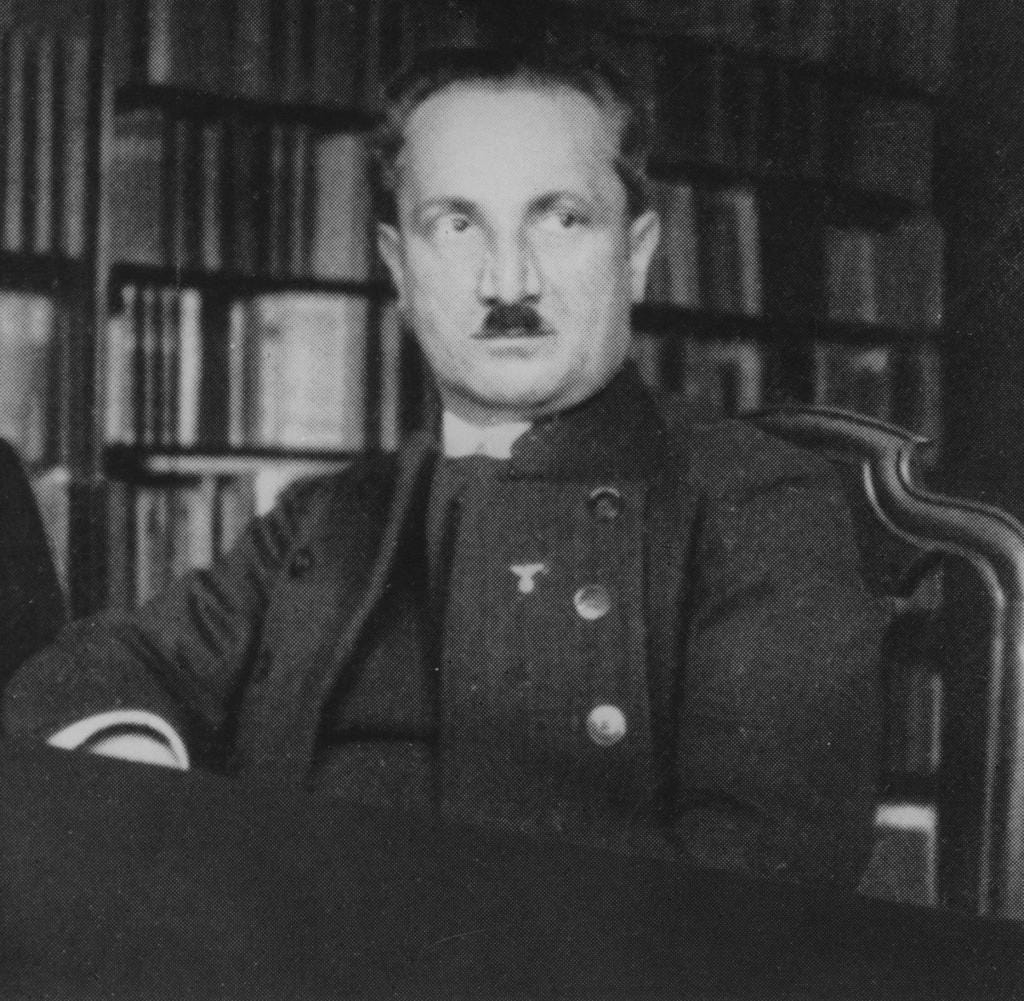
Martin Heidegger

The politics that flow from validation-by-marginalisation are not anti-Nazi politics or anti-Fascist politics, but reverse-Nazi politics and reverse-Fascist politics. Politics with the same obsessions (race, identity, gender, etc) but with reverse polarities. Instead of the problems of the world or society coming out of blackness or Jewishness, they come from whiteness.

It helps to understand the difference between reversal and opposites to remind ourselves that love and hate are just the reverse of each other. The genuine opposite of both is indifference. If you hate your ex, you are not over them. It is only when you can reach indifference, or some similar state of minimal emotion, that you are truly over them.

Thus, keeping with the social centrality of race talk but turning the threat from blackness to whiteness is classic reversing of the polarities while keeping the same obsessions.

Hence Antifa are not anti-Fascists, they are reverse fascists — using paramilitary violence to push racially obsessed politics, but racially obsessed politics with a reversed polarity (whiteness down rather than whiteness up).

The opposite of Nazism (or Fascism) is in not having the same obsessions while just reversing the moral and political polarities. The opposite of Nazism or Fascism is abandoning those obsessions altogether. Such as abandoning race talk.

The third problem comes directly from having a decapitated epistemology, a decapitated understanding of knowledge. Making propositional knowledge impotent by making propositions entirely self-referential, taking out truth as a marker of reality, also hugely increases the possibilities for self-deception. Restricting the capacity to interrogate one’s own experience and perspective, except in terms of whatever type of social-validation-through-the-perspective-of-power one accedes to, impoverishes one’s self-awareness. Worse, it makes it much easier to bullshit yourself through the manipulation of salience, particularly moral salience.

This is excellent for a social dominance strategy based on prestige opinions. It is truly awful for genuine understanding of yourself, the world and others.

As we look around, we can see huge amounts of self-deception. Such as all those folk thinking they are being morally brave and “subversive” in taking stances that are absolutely conventional in their social milieu. The entertainment industry has become rife with it, leading to lots of very annoyed fans as their treasured heroes and franchises are reworked according to the same narrow, increasingly predictable, range of cookie-cutter identity-politics based on the same narrow range of prestige opinions. The combination of smug condescension and relentless conventionality involved in these oh-so-conventional reworkings are exercises in pervasive self-deception. (Or, even worse, very self-aware status-play manipulations.)

Technological trans

Returning to the trans demand that folk with male-pattern spines continue to make a mockery of women’s sport in the cause of expressing their authentic Being, this systematic denial of the facts of the case is clearly not a way to run an advanced technological society.

Ironically, this trans politics of self-validated-authenticity is only possible in an advanced technological society. Plenty of societies have had trans identities. It is clearly a human thing. But in no previous society was it seen as other than a trans identity, a thing in itself.

Until the rise of mass prosperity societies form the 1820s onwards (with the development of steamships and railways), the overwhelming majority of people lived subsistence lives. Who could, or could not, get pregnant was a key, even foundational, social fact. Trans people were not members of the other sex, they had an identity across normal gender boundaries. An identity that was, indeed, trans. The notion that a transwoman was a woman made no sense, because they could not give birth.

It is only with the cushion of mass prosperity, separating actions from consequences, that the notion that transwomen are authentically women in every sense that counts can even pretend to make sense.

But it is a self-deceiving pretence of sense in the service of strategies of social dominance based on prestige opinions. It only gets anywhere because people either buy into the social dominance strategy or are too afraid of the stigmatisation costs to stand up to it. Trashing women’s sports is only a small part of the costs of this noxious combination.

A great writer has an answer to this social dilemma. Let an evolutionary biologist read to you words of genuine perception and understanding. Because what we get when we trash truth is not some higher understanding, but the multiplication of lies acquiescing in bullshit.

Cross-posted from Medium. My essays on Medium are often works in progress and are updated there.

Wednesday, October 14, 2020

The problem with epistemology: science, deconstruction, wisdom and ritual


What might be called sense-data epistemology always niggled at me. It seemed to be that our apprehension of reality was more interactive and immersive than the sense-data framing implied. It was not, however, until I came across the online lectures of psychologist John Vervaeke that I became aware of a framework that gave my niggle substance. The answer turned out to be, as should not have been surprising, not more philosophy, but more cognitive science.

A problem with how epistemology, the philosophy of knowledge, has been predominantly practised in Western philosophy is that episteme — which referred originally to a specific type of knowing: knowing that or propositional knowledge — is only one form of knowledge, yet it is the form of knowledge that mainstream philosophy, especially in the analytic tradition, has overwhelmingly concentrated on. There is also techne, procedural knowledge, knowing how; noesis, perspectival knowledge, knowing of; and gnosis, participatory knowledge, knowing in. Our knowledge of reality is, like our cognition, not only propositional, it is embodied and extended.

So, no analysis of episteme, of propositional knowledge, can remotely provide an adequate theory of knowledge. Experience is not a proposition, yet we definitely have knowledge of our experience. I think therefore I am is a proposition. The experience of thinking is not, but is part of our knowledge.

Moreover, as psychologist John Vervaeke puts eloquently, each form of knowing has a different mark of connection with reality. With episteme it is truth, with techne it is power, with noesis it is presence and gnosis it is something like attunement.

A theory of knowledge that is some variety of justified true belief is not going to be a satisfactorily complete theory of knowledge, given that truth is a feature of propositions, so is neither a comprehensive measure of connection to reality for knowledge nor a feature of all knowledge. Unless we are going to claim that things which are not propositions can be true. Which is a usage that does occur, but is better understood as meaning reality-connected. Conceiving of belief as entirely propositional is not a good basis for a comprehensive theory of knowledge.

(Thinking of knowledge as much more than just propositional knowledge may cast some light on why it has been so hard to teach robots to walk. Walking is not only a propositional matter, so is not a straightforward computational problem.)

Deconstruction

The failure of epistemology made postmodernism possible, and the failure of socialism made postmodernism necessary.
Stephen Hicks

What happens if we isolate propositions from truth? If we deny that propositions can have any reliable connection to reality and so cannot have their specific measure of reality connection (truth)?

We continue to act in the world. We still have techne, noesis and gnosis. What will happen is the other forms of information, of knowing, will become both more salient and less tested.

If discourse is entirely self-referential, if it is not reality-connecting, then we are left with power. If discourse cannot be about truth, then it must be about acting in the world. Words become acts of power. Society becomes interactions of power, structures of power relations. Human social action, if it is not about expressing experience and feeling, becomes about power without purpose except power: having it, acquiring it, rearranging it.

We still have our perspectives, but without episteme we cannot interrogate or connect our perspectives except in terms of power. Every perspective becomes validated within itself. Their social validation is a matter of acts of power, not of truth seeking or truth judgement.

We still have our experience of being us, but we have the same problem. Without episteme, we cannot interrogate or connect our experiences, except in terms of power. Every person’s experience becomes validated within itself. To the extent there is any social validation, it will be via acts of power, not of truth seeking or truth judgement.

In other words, if we isolate propositions from truth, we are left with standpoint epistemology. With epistemology without episteme.

Conceiving knowledge as just episteme cripples our understanding of knowledge. It renders knowledge thin and bodiless, without experiential depth.

Conceiving of knowledge without episteme also cripples our understanding of knowledge. Indeed, it cripples our understanding generally.

Both separations are crippling because both approaches cut us off from the full range of knowledge. The first makes knowledge bodiless computation, the second decapitates it from interrogated understanding.

The foundation documents of the Enlightenment were Francis Bacon’s Novum Organum (1620) and Rene Descartes’ Meditations (1641). These were about propositional knowledge, about episteme. The pervasive critique, indeed rejection, of Enlightenment ideas that was such a feature of French theorists such as Foucault, Derrida and Baudrillard, was very much about deconstructing, not only any meta-narrative, but the reign of episteme. The adaptations from their thought that have fed into the constellation of thinking around critical social theory have continued to dethrone episteme. Hence, its adherents enthrone experience, feelings and power and embrace identity romanticism.

It also leads to the generating of amazing amounts of bullshit: in the technical sense of statements made for persuasive effect without regard to their truth. The persuasive effect typically coming from manipulation of salience. Decapitating knowledge from episteme dethrones truth, but salience remains. Hence creating amazing amounts of bullshit. (Often highly profitable bullshit, however, having persuasive salience.)

Science and mathematics are very much episteme, so they are also in the firing line. Discussing whether 2+2=4 is open to debate is the epitome of dethroning episteme, of decapitating our apprehension of reality. A metaphorical guillotining of our cognitive order.

It also creates a great capacity for self-deception. As John Vervaeke points out, you cannot lie to yourself — you cannot make yourself believe what you don’t believe — but you can bullshit yourself. You can accept things for their congenial or otherwise reinforced salience, rather than their truth. This can involve systematically ignoring awkward facts, possibly to the extent of putting any attempt to raise such facts outside the realm of the morally acceptable. Thus, raising inconvenient facts can cast one as a member of some unacceptable out-group.

Relying on episteme alone will not permit the self-awareness required for wisdom. But, without the capacity to interrogate our beliefs and actions via episteme, the self-awareness necessary for wisdom is also unattainable.

Ritual

To return to the observance of the rites through overcoming the self constitutes benevolence. …
When employing the services of the common people behave as though you were officiating at an important sacrifice. …
When those above love the rites, none of the common people will dare be irreverent …
The gentleman has morality as his basic stuff and by observing the rites puts it into practise …
Kong Qiu, Analects, XII:1, XII:2, XIII:4, XV:18.

Thinking of knowledge as having a much wider range than propositions, than knowledge that, also casts light on the ubiquity of ritual in human affairs. If we look at life as a computational problem, as a set of propositions to solve, then ritual looks very odd. What propositional purpose or function does ritual serve? Little or none.

Now, think of ritual as acts utilising all the modes of knowledge. You experience ritual, ritual generates a perspective, ritual requires technique, ritual affirms propositions. Ritual engages all our ways of knowing and does it as a common experience. That makes ritual an act of social alignment. It is the seeking or signalling social alignment that generates the ubiquity of ritual.

The more controlled the social alignment that is sought, the grander, the more encompassing, the more ubiquitous, ritual is likely to be. Hence, highly hierarchical institutions, which are, by their nature, very much about control, such as armies and prisons, tend to have many ritualised interactions. Such as saluting. Totalitarian regimes, which are thoroughly about control, about creating an unavoidable, an inescapable, social alignment, engage in mass rituals for the same reasons. Up to, and including, reducing elections to rituals.

That Kong Qiu (Kong Fuzi or Confucius, 551–479BC) put so much emphasis on ritual as a basis of civilised existence is highly congruent with him being very much the philosopher of social alignment. One, moreover, doing so in a highly hierarchical society.

A philosopher concerned with ritual implies a wide understanding of our apprehension of reality. Not something that will make much sense to those who see our apprehension of reality as a computational problem.

Cross-posted from Medium.

Saturday, September 26, 2020

The PoMo Tango: Partial Adaptation Is Not Complete Adoption

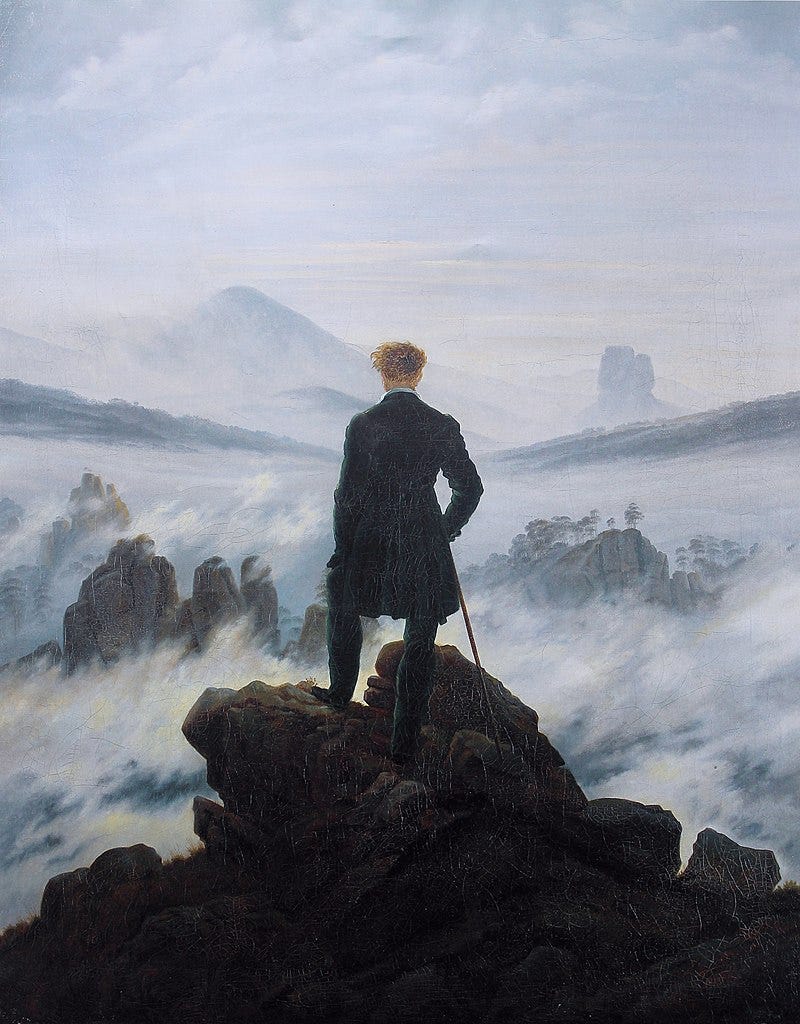
Image for post


Rationality is a tool that you better have if you want to achieve anything. You may as well have some grasp of what the real world is like. If you give up on that you can be an easy victim for any outside force.
Noam Chomsky

Vox commentator Matt Yglesias came up with a great term for the profound shift in attitudes that has been sweeping through American cultural institutions and, to varying and generally decreasing degrees, cultural institutions in the Anglosphere and the Eurosphere more widely. He called it The Great Awokening, a play off the Great Awakenings, the various waves of religious revivals in US history.

The term Great Awokening is apt at many levels. First, is it clearly about intensification of beliefs reacting to a sinful society. Second, we are dealing with what can reasonably be called a faith system. Critics are fond of treating “wokeness”, and critical social theory which underpins it, as a cult and it does act somewhat as a religion-substitute, though without the supernatural claims we associate with religion. Third, like the previous religious revivals, it has been particularly intense in the Atlantic Northeast of the US: i.e. what we might call Greater New England or Greater Yankeedom. (Yes, the US West Coast is also an epicentre, but the West Coast, particularly the Pacific Northwest, is to a significant degree an outgrowth of the Greater New England.) Fourth, it is ultimately an American phenomenon, driven by American obsessions and coming out of American theorising. It also has a specifically US history. Both the Social Gospel movement, which is a clear precursor to modern social justice ideology, and what political scientist Eric Kaufmann calls Left Modernism, largely came out of the Atlantic/Great Lakes Northeast of the US.

So, why do folk who criticise wokeness and critical social theory tend to go on about Postmodernism and various French thinkers? Why bring up a bunch of French theorists?

Good question. The fact that we are dealing with an overwhelmingly US-centred phenomena — not only that, significantly regional-US phenomena — does surely raise questions about Blaming The French. Really, it is not hard to see a secularised Yankee Puritanism underlying a lot of wokeness. And if French theorists are such an issue, why has not wokeness and critical social theory swept France? Why do all the key figures in critical social theory itself appear to be US residents or citizens? Why do very American obsessions with race seem to loom so large?

There is a whole stream of commentary which argues that those folk pointing their fingers are Postmodernism and French Theory do not properly understand either Postmodernism or French theory. A good example of this line of commentary is found here.

If the argument is that wokeness and critical social theory do not represent accurate or complete adoptions of the ideas of various French theorists — notably Jean Baudrillard (1929–2007), Jacques Derrida (1930–2004) and Paul-Michel Foucault (1926–1984) — then surely the claim is correct. Neither wokeness nor critical social theory is remotely built on a sophisticated or accurate adoption of the corpus of these French thinkers. Apart from anything else, the principle enunciated by intellectual historian Etienne Gilson is in play: the conclusions of the master are the premises of the disciples. Nor is there any reason why what is adapted from those thinkers has to be accurate and fully nuanced adoptions thereof.

Have, however, various American theorists adapted ideas or themes they have taken from such thinkers into their own theorising? Yes. It is those adaptations that are in play, rather than nuanced, full-range, incorporations. To critique those adaptations is not going to be, or require, a full grappling with the thought of Baudrillard, Derrida or Foucault. It is generally much more to the point to criticise the key (US) contributors to critical social theory, as philosopher Martha Nussbaum did so memorably with queer theorist Judith Butler, than to tango with various French thinkers.

The discussion between YouTuber Benjamin Boyce and Twitter commentator Wokal Distance is a good entry point to those adaptations and what has been done with them. Key adaptations from these thinkers include:
Jean Baudrillard: we are trapped in our social bubble, the map is the territory, and you might not be able to get out of our social bubble.
Jacques Derrida: words are only defined in terms of other words.
Paul-Michel Foucault: arguments are about jockeying for power, which is the fundamental constituent dynamic of society.

The question is not whether the above are accurate and nuanced adoptions of the ideas of these French thinkers, but rather whether these are the adapted takeaways from these thinkers that operate within critical social theory.

Which is not to say there is no point in considering the thought of these thinkers. Something that strikes me, even when reading or listening to sympathetic renditions of the ideas of Baudrillard, Derrida and Foucault, is that their thinking is very much pre-Darwinian.

Noam Chomsky has noted about French thinkers that the French Communist Party (which had an entire associated intellectual culture) was and remained Stalinist, with those who rejected Stalinism often adopting Maoism, while French biology had largely failed to adopt Darwinian evolutionary thinking. So, French thinkers tend to be pre-Darwinian in the sense of not incorporating the insights of evolutionary theory. But that is a more general failing.

Baudrillard, Derrida and Foucault were all born in the period 1926–1930. They grew up in the 1930s Depression and in wartime France, during the most destructive war in history. They were in their late 20s when the East German uprising, the Hungarian Revolt and Khruschev’s secret speech occurred. The 1950s and 1960s were age of mass prosperity and low unemployment. Western empires were in retreat and Europe was dominated by an extra-European power (the US) and a peripheral European power (the Soviet Union). Solzhenitsyn’s The Gulag Archipelago hit the persistent Stalinism and Maoism of French intellectual life like a thunderbolt, made all the more resonant by the horrors of Cambodia’s Year Zero, which had been unleashed by folk who had had French educations.

History was not following the Marxist script. Scepticism about meta-narratives, and the claims they are based upon, is not surprising in such circumstances.

On the pre-Darwinian nature of their theorising, consider a simple question: why did we evolve the capacity for language? Yes, being able to persuade our fellow Homo sapiens was likely crucial, but persuade them to do what in what context? We had to evolve a voice box able to create a very wide range of fairly precisely controlled sounds. That took persistent, adaptive feedback from the world around us to successfully evolve such a capacity. Does that make either the idea that (1) language is self-contained or (2) our perceptual apparatus does not give high quality feedback about the world around us, in any way plausible?

Consider the notion that society is made up of power relations. Now, to be fair to Foucault, his concept of power seems to have been something more like human action. But society as being constituted by power relations is the notion that has been incorporated into critical social theory.

Well, power relations to do what? When foragers got together, were they forming hunting bands as exercises in power relations? Or was the point to successfully interact with the world so as to eat, live and raise children? Do we not consistently act in the world to do things? To be purposeful? Are those feedbacks from physical reality not real and significant?


Source.

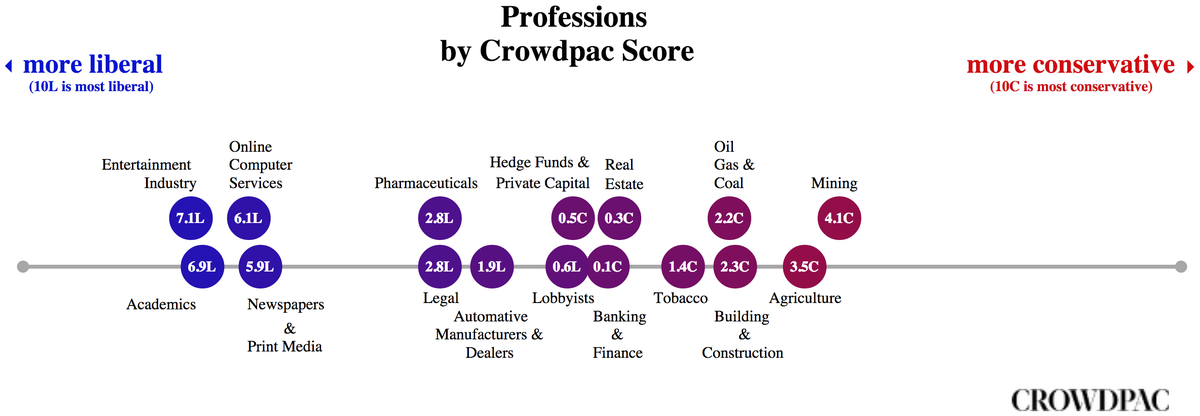
It is rather conspicuous that the more people make a living from dealing with brute physical reality, the more their industry/occupation leans towards conservatism. Conversely, the more abstract and imaginative the profession, the more progressive (and now woke) they tend to be. Raising questions about feedback and functionality does not encourage embracing critical social theory.

One of my analytical principles is that political ideologies often ask very good questions. The answers they give are often much less useful, but the questions are typically good ones. The effective elimination of conservative voices from large parts of academe, education, IT and media means the conservative questions of how do we achieve social order?, what do we seek social order for?, what can we learn from past achievements and failures? what constraints did they face? do not get asked. The lack is increasingly obvious and pervades critical social theory.

Evolutionary theory forces one to consider the functionality of things, in a very broad sense, and what feedbacks are operating. Critical social theory rests on a whole host of narrowings that make no sense from an evolutionary perspective. But those perverse narrowings are things they did adopt from French theory, albeit without a full nuance transplant. French theory was a source for such, because Baudrillard, Derrida and Foucault are, in a real sense, all pre-Darwinian thinkers.

Historians often make much of the impact of Charles Darwin and evolutionary thinking on modern thought and social history. But considering French Theory, and critical social theory, it is obvious that the myth or icon of Darwin has had much more impact than has evolutionary thinking itself. To a startling degree, human sciences (such as, for example, medicine, dentistry and nutrition) still do not incorporate the evolutionary lens. The further one gets away from the sciences, the more that is true.

The pre-Darwinian nature of such French theorising makes them rather unfortunate places from which to adopt the building blocks of a world view.

But to hold them, or even their ideas, responsible for the intersection between various partial takeaways of their thought with rather specifically American cultural and intellectual patterns is to misdiagnose what has been going on. Ideas have to resonate in order to replicate, and critical social theory, and wokeness, are very much ideas resonating, and replicating, first and foremost in American, and then Anglo, contexts.

Once the pre-Darwinian nature of the sources of critical social theory, and that critical social theory is also pre-Darwinian, has been spotted, there is not a lot of further benefit to be had in dancing with French theorists, or simulacra of them, in the Pomo Tango.

Cross-posted from Medium.

Tuesday, May 28, 2019

Whiteness is not property: deconstructing critical race theory

This is a long post, in part because I do not have time to write a short one. It is a response to a 1993 Harvard Law Review essay by Cheryl L. Harris arguing for the notion of whiteness as property. I not only critique that claim, doing so gives me an opportunity to demonstrate the problems with the treatment of "race" by the critical race theory/intersectionalism/identity/diversity streams of thought that the essay is an example of.

Normally, when I discover a Law Review article on a matter I am concerned with, I am pleased. Law Review articles tend to be thorough, strongly evidence-based, with careful interrogation of key concepts, being thus very useful. The Columbia Law Review article “Polygamy, Prostitution and the Federalization of Immigration Law” (pdf) on immigration bars on Chinese entry, for example, epitomises these virtues.

Thursday, May 10, 2018

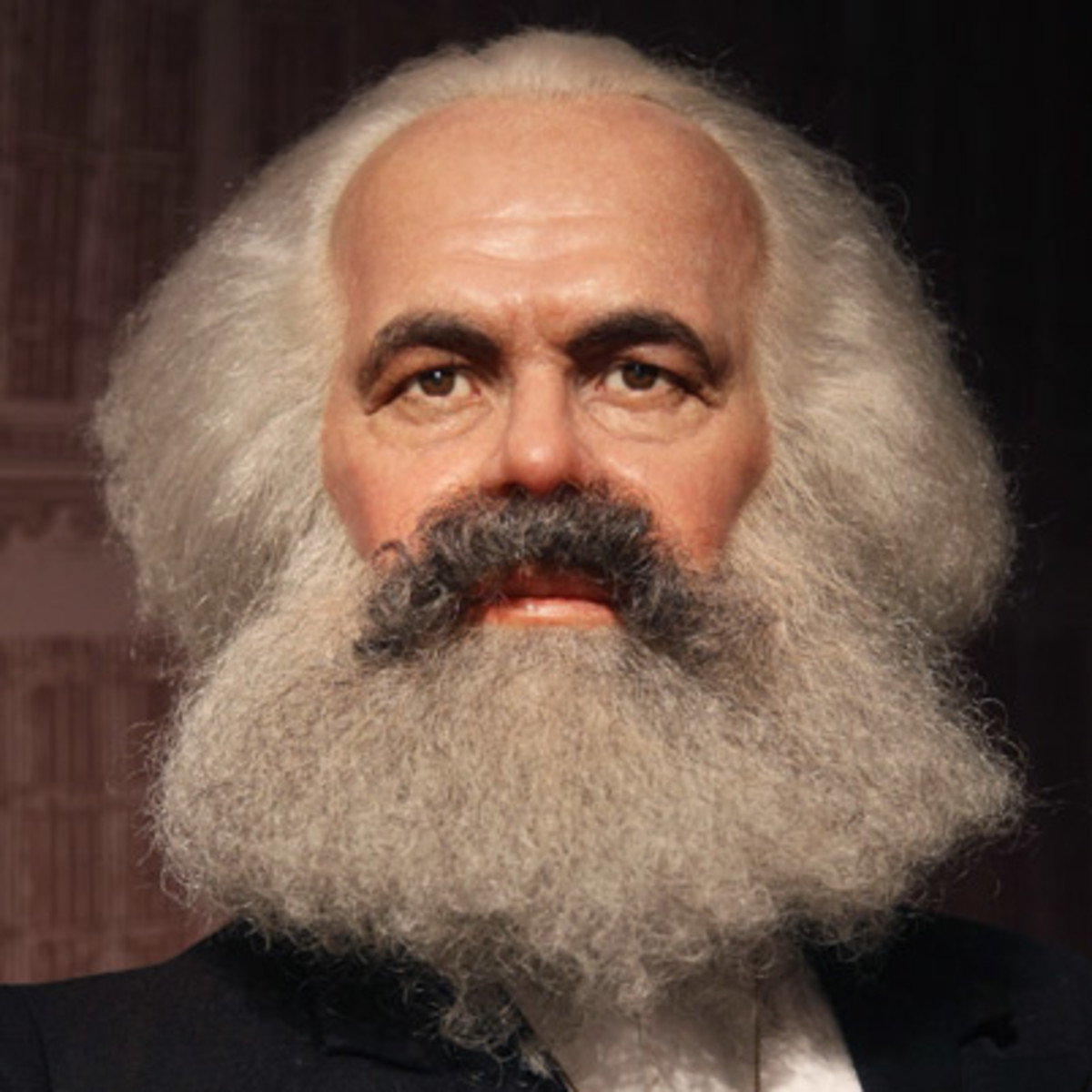
Marx at 200 and Robespierre at 260

This year is the 200th Anniversary of the birth of Karl Marx (1818-1883). A recent biography of Marx (reviewed here) places him very much as a man of his time. It is a sign of the success of Marx that his legacy is still so debated; it is a sign of his failure that defending Marx involves separating him, and his ideas, from the record of mass murder and tyranny of regimes calling themselves Marxist.

The latter line of apologia has a major problem: the prescient predictions of various of his contemporaries about where his ideas (and his praxis) would lead. If perceptive contemporaries could perceive the potential for disaster in his ideas in advance, it seems a bit otiose to deny the connection in retrospect.

Conclusions becoming premises
Part of the problem is that Marx was not ideologically consistent. His ideas of proper social goals become somewhat more grandiose and totalising over time. So, one can cite earlier writings as a defence against the implications and influence of the later writings. Which leads into the “good intentions” defence—if we cite Marx’s morally engaging statements, we can then claim that clearly he has nothing to do with what was done in his name (see here). Marx, after all, did famously state that he was not a Marxist.

But neither was Freud a Freudian, or Kuhn a Kuhnian and so on. This is the progression pointed out by Etienne Gilson (1884-1978)—the conclusions of the master are the premises of the disciple. Which is a very old pattern. When Philo of Alexandria used Greek natural law theory to effectively re-write the tale of Sodom and Gomorrah (Genesis 19), rejecting the rabbinical oral tradition and proposing a claim that sits poorly with the actual text, one can see both old and new interpretations in his own writing (in On Abraham XXVI-XXIX). Those that followed just took his natural law imposition on the text and dropped the complexities. As can be seen in St John Chrysostom’s homilies on Romans. So, what had been a story about God destroying societies which were anti-moral, which actively punished good behaviour, became a story about how people of the same sex having sex was treason against the purposes of the Creator (hence worthy of death). Which Philo himself, in his polemical war with Greek religious and sexual culture, was clearly just fine with (see Special Laws III: VII).

So, conclusions have consequences. Hence Bakunin (1814-1876) and other contemporaries picking accurately where Marx’s ideas would lead. It is misleading and dangerous to put so much weight on stated intentions, especially moral intentions as it is precisely the making-trumps element of morality which makes it so potentially oppressive. How things are framed (especially how other people are characterised), the means extolled, scale of the purposes embraced: these all matter at least as much, and often rather more, than intentions, however morally engaging they might be. But we live in an age where many people are deeply invested in moral entitlement status games based on their ostentatious moral intentions.

The Left that was
From 1789 to 1991, across the long C19th (1789-1914) and the short C20th (1914-1991), the term Left in politics had broadly consistent referents. The term started off with who sat where in the French National Assembly. The 1789-1991 Left was, in all its forms, a product of the Enlightenment and largely framed its moral and social analysis in terms of class. It was divided between the Radical Enlightenment; those who believed that applied human reason could transform man, that human nature was plastic to applied social action: and the Sceptical Enlightenment; those who believed that human reason could improve human social conditions but nevertheless had to deal with humanity as it was and had been.

This division, and associated (albeit often implicit) claims about human nature, went at least as far back as the Grandee-Leveller Putney Debates (1647) during the English Civil Wars with Henry Ireton (1611-1651) leading the Grandees, and Thomas Rainsborough (1610-1648), leading the Levellers. The antinomian aspirations and totalitarian tendencies of the Radical Enlightenment Left went even further back, to the radical heresy movements so brilliantly analysed by historian Norman Cohn in The Pursuit of the Millennium.

But that the Left did not erupt ex nihilo does not invalidate that there was a coherent Left in European and European-derived politics across the two centuries from 1789 to 1991—a product of the Enlightenment among whom various class-framings of politics and moral action were dominant. That Left has remarkably little in common with contemporary progressivism, as it has abandoned class framings and embraced Post-Enlightenment ideas (often, somewhat over-narrowly, labelled postmodernism). If one resurrected Karl Marx—or, for that matter Lenin (1870-1924) or Keir Hardie (1856-1915)—they would find familiar and congenial remarkably few of the concerns and obsessions of contemporary progressivism.

Conversely, if one resurrected Adolf Hitler (1889-1945), he would absolutely find familiar the concerns of contemporary progressivism. He would, of course, have a somewhat different take (apart from blame-the-Jews and a functional preference for Islam and Muslims over Christianity and Christians) but the concerns of contemporary progressivism (sex, the stories we tell about sex aka gender, sexuality, race, ethnicity, population movements, environmentalism and the valorisation of nature, identity, subjectivity and emotion over reason) were absolutely his concerns. Nor is this some sort of weird outcome; it flows naturally from the reality that the Post-Enlightenment, with its concern for emotion, experience and subjectivity, is the Counter-Enlightenment rebooted and Hitler was the embodiment of the Counter-Enlightenment as a political project.

The Jacobin curse
While I do not agree with anything close to an absolute separation of Marx’s ideas from the history of the attempt to operationalise them, it is still an error to put all the blame on Marx. For there was another figure whose influence on politics across those two centuries, and beyond, has been more disastrous.

That was Maximilien Robespierre (1758-1794) who, along with his political associates, such as Louis Saint-Just (1767-1794), created, not merely as conception but as practice, the Jacobin model of politics. The Jacobin model of politics is politics unlimited in means and unlimited in scope. That, is, politics willing to engage in any level of killing and repression, and willing to expand into any aspect of society and social interaction, to achieve its ends. A model of politics which relies on its sense of profound moral purpose to justify its refusal to accept limits in means and scope and, somewhat more implicitly, relies on its sense of profound social understanding to give the required confidence that what it does will lead where it intends.

That Marx’s ideas were profoundly congenial for the Jacobin model of politics is obvious. They bring together both the sense of profound, trumping moral purpose and the sense of profound understanding of human social dynamics. Lenin very explicitly saw himself as applying Jacobin politics to Marx’s ideas as the necessary way to operationalise them. A bringing together that successfully established the first enduring explicitly Marxist regime and led to, at its height, a third of humanity being ruled by such regimes. A bringing together, furthermore, that many, many intellectuals who regarded themselves as followers of Marx implicitly or explicitly endorsed.

Not all, of course; Rosa Luxemburg (1871-1919) famously demurred. But her murder amidst the failure of the Spartacus uprising both silenced her voice and associated her ideas with failure. And those political Parties which were officially Marxist, but remained committed to democratic praxis, came to abandon Marx’s ideas. Something of a hint there, methinks.

The reality is, Marx’s ideas were ideally suited for the Jacobin temptation and it has been only by acceding to that path that they have come anywhere near implementation. Of course, the conjunction turned out to be nothing like any form of human liberation: a warning in itself. It is, moreover, a general problem: what looks like Morality’s Empire so easily and recurrently becomes Moral Tyranny and then simply Tyranny. Marx’s ideas had particularly weak barriers to that progression. On the contrary, they slid down it oh, so easily.

But the poisonous influence of the Jacobin model extends well beyond the history of Leninism and its offshoots. Italian Fascism and German Nazism both represented the application of the Jacobin model to political projects: in the case of Fascism, to the project of Italian nationalism. In the case of Nazism, to the project of Aryan racial supremacy. If Lenin was Marx+Robespierre, Mussolini was Mazzini+Robespierre and and Hitler was Houston Stewart Chamberlain+Robespierre.

Of the three meldings of the Jacobin model of politics to political projects, Italian Fascism was by far the least morally and humanly disastrous. That was because Giuseppe Mazzini (1805-1872) was by far the most liberal thinker, compared to Marx or Chamberlain (1855-1927), and Italian nationalism was by far the most limited political project of the three.

Hiding from oneself
One of the purposes in the promiscuous use of the term Fascist!, even to claiming that German Nazism (whose victims number in the millions and whose ambitions ignited a world war) and Italian Fascism (whose domestic victims numbered in the hundreds and whose ambitions led to minor wars of opportunistic conquest) were just instances of the same phenomena, morally indistinguishable from each other, is to obscure the fact that, without Nazism, no modern political movement had remotely the record of tyranny and mass murder of various forms of Leninist regimes. It is deeply embarrassing to leave intensive manifestations of the Left as the peak of mass murderous tyranny, hence the endless invocations of Fascism! and of racism as the worst sin ever.

It is even more embarrassing to note that what made Nazism so horrible was not how different it was from the radical Left, but how similar it was. The grandeur of its ambitions for social transformation, the intensity of its mobilisation of society, the depth of its organised penetration of social institutions, all these were far more like the radical Left than any part of the broad non-Left (aka Right).

Nazi Germany institutionally resembled the Soviet Union far more than it did any of the Western democracies. Even now, as the People’s Republic of China retreats from command economics, it increasingly institutionally resembles Nazi Germany, without the Jew-hatred and Lebensraum ambitions (whatever its South China Sea ambitions, barely anyone actually lives there). Though the overseas Chinese communities provide some potential for irredentist politics.

So, it is very expedient for progressivists to shout “Fascism!” a lot and treat racism as the worst-thing-ever; to talk about Marx’s intentions and ignore the prescience of his contemporary critics. And do it even louder so as to obscure the abandonment of the concerns of the Enlightenment Left and the adoption of those of the Counter-Enlightenment, politically personified in Adolf Hitler. With Paul de Man (1919-1983), Heidegger (1889-1976) and Carl Schmitt (1888-1985), not to mention environmentalism, even providing ideological bridges.

A lot of the moral outrage and moral tub-thumping of contemporary progressivism is about hiding unfortunate political resonances and commonalities: above all, from themselves. But they are people obsessed with their sense of moral status and entitlement burbling endlessly on about equality; so there is a lot of cognitive dissonance to be hidden: above all, from themselves.

Is-people versus Ought-people
The history of the Jacobin model, of grand moral intentions and social understandings, gives us plenty of insights and warnings. But that is so only if you are an is-person who thinks that history is what has happened; that human nature is fairly consistent, so history is a source of warning and insight. If you are an ought-person, who elevates moral intentions as the measure of all things, for whom is history is about the glorious imagined and intentioned future, not limited by the constraints of human nature, then this is just a catalogue of past sins with which the well-intentioned need not concern themselves. And so they don’t, except to distance themselves from it.

Which also makes then not the people you want in charge of anything serious, given how many facts and historical lessons they are hiding from; so it is worrying how much they are now in charge of the culturally significant. In their informative and fun How Women Got Their Curves, the authors observe that:
the Second Law of Thermodynamics, which states that entropy or disorder increases in natural systems unless energy is available to counteract this process, applies to organisms no less than to nonliving, physical systems.
And also applies to social systems created by organisms. The assiduous efforts, in the name of morality's empire, to exclude people and concerns from social life, the war on inconvenient facts, the pervasive attack on the wellsprings of culture: folk pursuing such are an increasingly pervasive force for social entropy, and not in any good way.

A certain sense of impending slow disaster seems appropriate, this 200th anniversary of Karl Marx’s birth, 260th anniversary of Robespierre’s birth and 231st anniversary of Robespierre’s election to the Estates-General of the Kingdom of France.

ADDENDA: Branko Milanovic reminds us that, without Engels Marx might have passed into obscurity and without Lenin Marx would have nowhere near the global significance his thought achieved.

[Cross-posted at Skepticlawyer.]

Wednesday, December 20, 2017

Islam as Philosophical Dead End

Classical (622 to c.940) and early medieval Islam was a civilisation and period with a rich philosophical tradition. Yet Islam became a philosophical dead end, an example of how societies, indeed, an entire civilisation, can stop supporting philosophy as a significant autonomous realm of enquiry. Islam is a civilisation where religion swallowed philosophy, with consequences we are still living with.

That Islam as a civilisation developed a rich philosophical tradition is obvious and well-documented. Thinkers writing in Arabic were particularly important in reconciling Aristotelianism with monotheism. Ibn Rushd (Averroes) (1126-1198) in particular was very influential in Latin Christendom. So much so that St Thomas Aquinas (1225-1274), in his writings, would refer to Aristotle (384-322 BC) as The Philosopher and Ibn Rushd (Averroes) as The Commentator.

Yet that rich philosophical tradition dwindled away to vanishing point. It did so as the result of interaction between ideas and social change.

The social dwindling

The social change was the dwindling away of any basis for supporting scholarship and learning outside explicitly Islamic religious schools. The movement to a fief-based military administration reduced administrative bureaucracies, by far the most significant basis for non-religious intellectual life within Islamic societies, while dominance by Turkish-speaking warlords, from the time of the Seljuqs (1037-1153) onwards, led to a surge in ostentatious support for religion by rulers making up for their non-Arabness via ostentatious religious adherence and patronage.

The shock and devastation of the Mongol invasion (much larger and far more traumatic than Crusader seizure of narrow coastal strips), including the sack of Baghdad (1258), the only time the capital of a living Caliph had fallen to non-Muslims, aggravated these trends. The Mongol invasion and conquests, particularly the violent ending of the Abbasid Caliphate, apart from a sad shadow-line in Cairo, both disrupted what non-religious scholarly networks remained and encouraged a retreat into an intensified Islamic identity. These processes are well set out in Lost Enlightenment: Central Asia's Golden Age from the Arab Conquest to Tamerlane by S. Frederick Starr.

The religious trumping
The two philosophy-swallowing ideas developed from the Ash'ari Islamic school, being given their civilisation-winning form by al-Ghazali (c.1058-1111). The moral claim was that revelation was the only ground for ethical judgement. This effectively eliminates moral arguments as the West understands them (indeed, as all the origin civilisations for philosophy—the Hellenic world, northern India and China — understood them). It is why Islamic states are the only ones who have seen fit to issue an adjusted form of the UN's Universal Declaration of Human Rights, the Cairo Declaration on Human Rights in Islam, because all ethical arguments and claims have to be grounded in revelation.

The metaphysical claim is that Allah is the source of all non-human causation. Not merely the ground of causation in the Aristotelian sense, but literally the immediate cause of everything that happens. Allah remakes the world at every moment; what we see as causal patterns are merely the habits of Allah, which Allah can change at any moment.

Unsurprisingly, the dwindling away of philosophy also saw the dwindling away of science within Islam, as intellectual effort was directed back into religion. Especially as law was part of religion and religious scholarship, apart from elements (qanun) allowed to operate in the silences of Sharia.

In this way, Islam pre-eliminates competition to itself from within Islamic society. It does so by eliminating the category of moral arguments beyond itself and allocating all non-human causation to Allah. So the levers to replace religious grounding of social and physical understanding which led to the Western Enlightenment are absent within mainstream Islam, as they have no resting points. Especially as the Quran is held to be the literal word of God, a manifested miracle, written in a single language and, according to mainstream Sunni thought, outside time, so far more insulated from critical scholarship than the Christian scriptures.

Adoption aborted
The expansion of the non-religious intelligentsia from the early C19th onwards that the (much delayed) spread of the printing press and efforts of modernising rulers created in the Middle East appeared to give the basis for Islam as a civilisation to “catch up” with the West. A modernising intelligentsia did develop, but largely as a by-product and support for modernising regimes and states.

This centrally-organised, copycat modernisation largely failed to put down deep roots in Islamic societies. Worse, it became tied to success of those states and regimes. (In some ways, a repeat of what happened to the original wave of reason-based modernisers, the Mu'tazila of Classical Islam: Islam is a civilisation of strong recurring patterns.)

Islamic Enlightenment: the Struggle between Faith and Reason, 1798 to Modern Times by Christopher de Bellaigue provides a history of this modern abortive Enlightenment: an informative and perceptive review is here.

The Islamic world became dominated by fascist-analogue regimes. But defeat in the Dictators’ War (1939-1945) had rather discredited Fascism and the Soviet bloc was willing to supply arms and support to friendly regimes, so socialism became the dominant rhetorical flavour of non-monarchical regimes in the Islamic world. (Note that I mean socialism in its command economy sense rather than its “free-floating good intentions insulated from any failures” sense.)

But Arab socialism fared no better than its alternatives elsewhere; though, being less actually socialist, rather less catastrophically so. In the West, the failure of socialism led to postmodernism and its close associates, such as Critical Theory. In Islam, the failure of socialism led to political Islam (Islamiyya) and to a search for a purified Islam (notably the Salafi and Deobandi movements).

This was somewhat less of a difference than it might appear, as al-Ghazali’s causal analysis was grounded in essentially the same epistemologically sceptical argument about what we can know from observation later developed by Hume (1711-1776), which so influenced Kant (1724-1804) and from there led to postmodernism.

Moreover, Critical Theory permits no moral argument beyond itself, as the purpose of all “proper” intellectual endeavour is to support the struggle against oppression and any critique of that goal is, by definition, illegitimate defence of exploitation and oppression. An attitude which has seeped into the wider society (particularly the "cultural commanding height" industries of media, education, entertainment and IT) to the extent that start-up entrepreneur Sam Altman can report that it is easier to discuss heretical ideas in China (under a Leninist regime) than in Silicon Valley in California.

Monarchy, mosque and military
So both mainstream Islam and PoMo progressivism pre-eliminate competition. In Islam, outside the monarchical societies, the weakness of civil society leaves politics suspended between mosque and military. (The monarchies tend to have richer civil societies precisely because the monarchies both incorporate and balance between mosque and military and failed to wage quite the war on traditional society that the modernising military regimes did.)

The revival of the headscarf both speaks to the power of Islam and the revival of political Islam. (Trying to spin it as some sort of manifestation of female power is pathetic, even given that reveiling has largely been driven by [pdf] expanded education and employment opportunities for women, as it is a response responding to the power of Islamic belief.) That the Islamic world still has significant patches of relatively low literacy rates (especially for women), and (in the case of the Arab world) a strikingly low rate of translation of non-Arabic books, does not help the develop of non-religious thinking and ideas within Islamic civilisation.

What intellectual life there is within Islam remains trapped within the concerns of the early Western Enlightenment—how to replace and overcome religious grounding of social and physical understandings versus how to insulate religion from the pressures of modernity—and remains without the levers that the Western Enlightenment relied on. While there is some dim possibility of a moderate modernising approach developing, Islam is not likely to stop being mostly a philosophical dead-end civilisation any time soon.

[Cross-posted at Skepticlawyer.]

Sunday, October 22, 2017

Sex and gender

This is based on a comment I made here.

If you think the bodies are sexed (clearly true) and psyches are sexed (a bit murkier, but broadly true) then it is easy to get more than two genders.

Male (male in body and psyche)
Female (female in body and psyche)
Third (body and psyche don't match).

Plenty of human societies have worked on that basis.

You can even work on a simple matrix and get four genders (male-male, female-female, male-female, female-male). But third gender classification (really "other") is more common.

And some societies, without going all the way to third gender, have operated on sub-genders (e.g. males held to belong to a separate category because, hey, not sexually interested in girls). Western notions of sexuality are a way of modifying gender identity.

Sexuality or gender?
Back in the C19th, with the intersection between growing anthropological awareness of other societies' takes on gender with a critical mass of urbanisation, secularisation and communication making gender/sexual minorities more able to begin to organise, there was an argument in Western circles about whether queer folk should be treated as third gender. The notion of "homosexual" (and its derivatives, heterosexual and bisexual) won out, as it seemed more scientific and less of a shift of basic presumptions.

What we are seeing is a revisiting of that debate. Unfortunately, it is turning up on the wrong side of postmodernism, so rather than being grounded in ethnography and empiricism, it is all about feelz and discourses. Hence the ludicrous explosion of "genders".

Bio-error
What has not helped is that feminism has tended to talk so much about the penis & vagina, which actually do not mark the differences between males and females nearly as much as people think, as they both perform the same functions (bring gametes together, provide sexual pleasure). One's an innie (so receives) and the other's an outie (so penetrates), but they otherwise perform the same functions. If you take that as the key distinguishing feature between male and female, then, if one surgically turns one into the other, you have changed sex.

Except, of course, you haven't. People have just been surgically adjusted to better support a change of gender identity. Which, if we had a three gender system, would be fine--it would then get rid of those tedious and fruitless debates about who is a "real woman".

What really distinguishes male from female are testes, ovaries and mammaries. And no trans surgery actually provides those, just the external form of them. Hence trans surgery does not actually change one's sex, just physical form to support a change of gender identity. Something that there is a long history of via castration, such as eunuch priests and hijras.

All about the mammaries
Rather than the penis and vagina, the key for understanding the statistical patterns of cognitive differences between men and women is, in fact, the mammaries. (Mammaries are on the sex that gives birth, so that they are right there when the baby emerges.)

We are the cultural species, that is the secret of our success. To be the cultural species, we need big brains. So big, that they have to keep developing outside the womb.

Which requires extended childhoods, which leads to the oddness of the human mammaries--they are unusually large and prominent, they don't change shape all that much when lactating, and they can keep operating for years at a time to support those long childhoods. Hence female homo sapiens are the childminding sex. But we are the cultural species, which means we are the public space species. If one sex is the [what is compatible with] childminding sex, then the other will be the "everything you can't do while minding kids" sex, which makes it (the males) disproportionately the public space [i.e. outside household and immediate surrounds] sex.

In subsistence societies, producing the next generation requires a lot of available resources and attention. So, until the dramatic changes in production and reproduction technology over the last two centuries, the allocations of roles by sex in human societies has radiated out from [what was compatible with] childminding.

We have been the cultural species for many, many generations. Thousands of generations. Easily enough time to select for variated cognitive patterns. And even more than our long pregnancies, our long childhoods has driven that (hence mammaries being the most biologically important driver of cognitive differences).

So, irony of ironies, the biology required to be a species which can socially construct so much means that cognitive differences between men and women cannot be entirely socially constructed. Even more ironically, in societies of mass prosperity, the statistical cognitive patterns of men and women are becoming more divergent (pdf), not less, just as the notion of presumptive sex roles is being abandoned.

But these are very complex mechanisms, with a lot of overlap, and nature is always "throwing" the "genetic dice". Moreover, genes are not molds, they are recipes. So the "epigenetic dice" is also being "thrown". And all before we get into social and environmental influences. Hence psyches not lining up with biological sex in neatly differentiated ways. Nor, for that matter, does physical sex always line up in neatly differentiated ways.

Hence needing some language to talk of the people who do not fit. Having a third gender category does solve a lot of problems, which is why so many societies developed it. But that does not excuse the multiplying genders nonsense.


[Cross-posted at Skepticlawyer.]