Showing posts with label economics. Show all posts

Saturday, April 15, 2023

Yes, I have a Substack

Christine Roy, Unsplash.

My poor blog, how I have neglected you.

I have abandoned you for my Substack, which is Lorenzo from Oz. It is here.

I have written there on lots of things.

In July 2022, I wrote on matters Trans. (https://lorenzofromoz.substack.com/p/people-were-a-weird-mob)

I also wrote on information dispersal and disorientation with regard to the Russian invasion of Ukraine.
(https://lorenzofromoz.substack.com/p/disorientation-and-information-dispersal)

Then I wrote on Elon Musk’s bid to buy Twitter.
(https://lorenzofromoz.substack.com/p/whats-a-bot-or-few-million-between)

In August 2022, I returned to the Russo-Ukrainian War, in particular talking about why Russian autocracies have been one-trick regimes and keep pushing a strategy that keeps failing.
(https://lorenzofromoz.substack.com/p/the-latest-iteration-of-continuing)

I also wrote on why ritual is such a pervasive feature of human societies, including the ritual elections of totalitarian regimes.
(https://lorenzofromoz.substack.com/p/why-ritual)

In September 2022, I wrote about the death of Queen Elizabeth II, and the power and value of monarchy.
(https://lorenzofromoz.substack.com/p/a-monarch-and-a-monarchy)

In November 2022, I presaged the Worshipping the Future series of essays by me that are being published on Helen Dale’s Substack.
(https://lorenzofromoz.substack.com/p/introducing-worshipping-the-future)

I also wrote about the economics (as distinct from the Economics) of migration.
(https://lorenzofromoz.substack.com/p/the-migration-scam)

In December 2022, I wrote about the Worshipping the Future series starting.
(https://lorenzofromoz.substack.com/p/the-worshipping-the-future-series)

I also wrote about Social Justice as a social strategy: specifically a status-through-norm-dominance strategy.
(https://lorenzofromoz.substack.com/p/social-justice-as-social-strategy)

In January 2023, I wrote about Marxism as prophecy and a model for political action.
(https://lorenzofromoz.substack.com/p/prophecy-and-political-action)

I also wrote about how relationship to means of production is a dreadful basis for defining class.
(https://lorenzofromoz.substack.com/p/priests-and-warriors)

I wrote about that remarkable polymath, Ibn Khaldun.
(https://lorenzofromoz.substack.com/p/who-was-ibn-khaldun)

I discussed humans as the niche-creating species.
(https://lorenzofromoz.substack.com/p/the-niche-creating-species)

I discussed why the future is not what it used to be.
(https://lorenzofromoz.substack.com/p/the-future-by-default)

In February 2023, I wrote about how it is a mistake to over-rate the role of Marxism in current trends in Post-Enlightenment Progressivism (aka “wokery”).
(https://lorenzofromoz.substack.com/p/overdoing-marxism)

I also wrote about the problems of the US mainstream media, the collapse of the previous business model, and how it is creates a “go broke, go woke” tendency.
(https://lorenzofromoz.substack.com/p/go-broke-go-woke)

I wrote about the connections between Zen thought and the flow states discussed by modern psychology.
(https://lorenzofromoz.substack.com/p/zen-and-the-art-of-flow)

I wrote about self-deception and various socially corrosive factors.
(https://lorenzofromoz.substack.com/p/self-deception-and-social-corrosion)

In March 2023, I wrote about basic patterns of human societies.
(https://lorenzofromoz.substack.com/p/basic-patterns-of-human-societies)

I also critiqued the concept of race, advanced the fiscal-sink hypothesis (that governments tend to under-police localities that are net revenue drains) and pointed out adverse incentives in “racial” matters.
(https://lorenzofromoz.substack.com/p/race-and-other-annoyances)

I discussed the need and difficulty of integrating evidence across disciplines.
(https://lorenzofromoz.substack.com/p/wrestling-with-ideas)

So far in April 2023, I have written a two-part essay, applying the evolutionary lens to economics. The first part is here:
(https://lorenzofromoz.substack.com/p/humans-as-information-economisers)
The second part is here:
(https://lorenzofromoz.substack.com/p/humans-as-information-economisers-cae)

Why have I neglected you, my blog? Well, this is free labour, but I earn money from Substack.

I have not sworn off you, my blog. But you may become just a portico to my Substack.

Thursday, November 24, 2022

Migration and destabilising politics

The destructive non-electoral politics of institutional capture.


Have done two new posts on Substack.

On Helen Dale’s Substack, I have posted on how the rate of social change does not de-stabilise conventional centre-right politics, it is change (or the threat of change) that by-passes electoral politics that does so.

The post includes a discussion of how patterns of migration that supress the Baumol effect thereby suppress wages. (The Baumol effect is the way the high productivity/high wage end of the economy drags up wages generally, hence a hair cut in 2022 costs way more than a haircut in 1960 despite being the same service.)

On my Substack, I have extended that point into an analysis of how easy it is to use migration against the local working class.

Not only via suppressing the Baumol effect, but also via the Fogel effect (migration intensifying competition for positional goods), the Borjas effect (migration increasing returns to capital more than labour) and the Granovetter effect (migration supplanting local connections, so breaking up people’s local social capital).

The latter piece concludes with a discussion of why (mainstream Sunni) Middle Eastern Muslim migration generates rather specific problems.

Friday, November 4, 2022

Introducing ‘Worshipping the Future’


Source: Nathan Dumlao on Unsplash.

Blogging has been very light here. Mainly because I have been doing a lot of researching and writing for various major projects.

Also, I now have a Substack

What began as a critique of Marxism grew into a series of essays, now under the title of Worshipping the Future. I briefly explain how they grew into an essay series covering way more than just Marxism on my Substack

The essay series will be published on Helen Dale’s Substack

An essay introducing the series, Human nature, liberalism, and the politics of transformation,
 has now been published on Helen’s Substack. Enjoy.

Tuesday, July 5, 2022

Alienation, Commodification and Other Distractions

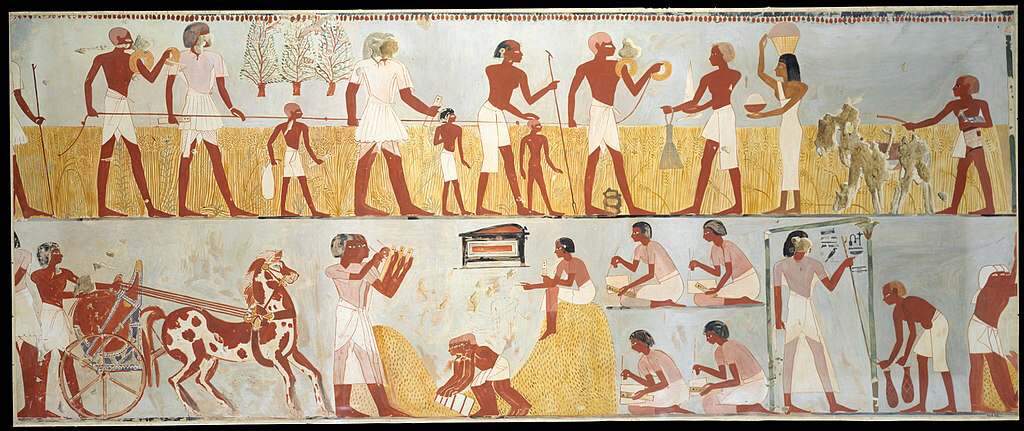
Ever since their inception, states have dominated the extraction of surplus.

Tomb of Menna, Wikipedia commons.

Two concepts that, in their anti-commerce forms, get in the way of understanding social dynamics are commodification and alienation.

Regarding commodification (turning things into objects of exchange) we have been exchanging goods outside our immediate groups for perhaps as long as we have been Homo sapiens. Given that the only ways to get hold of something that you do not already have are to make it, take it or trade for it and that (1) we have not been generally able to individually make everything we need since we adopted a cooperative subsistence strategy (something which helped make us human) and (2) we probably want to discourage too much of the take option, that leaves trade. It is not remotely a coincidence that our material prosperity, capacity to engage in social life, personal freedom and autonomy, have all expanded as our trading has.

There are certainly questions about what should or should not be traded, and in what circumstances. But everything useful has boundaries, albeit often fuzzy ones, beyond which it stops being beneficial. That comes from living in a universe where constraints are built into the structure of reality. Constraints that we navigate by engaging in various trade-offs.

As for alienation, given that we have been trading for possibly our entire history as a species, it can reasonably be said to be incorporated within our evolved capacities, rather than being some psychic maiming. More specifically, the notion that there is something specifically bad about profit because it represents the extraction of surplus, of income that the providers of labour are otherwise entitled to, is a ludicrously simpleminded notion of profit.

We direct our labour towards what we value, but there is always the risk of consuming (or otherwise using) more value than we produce. As commercial activity thus runs the risk of loss, covering said risk of loss is a commercially necessary function that folk generally are not going to do for free.

Mistaking that labour is directed towards what we value for labour being the determinant of value obscures the central role of risk in structuring commercial activity. Those covering the risk have the greatest incentive to organise production so as to maximise the creation of value (and so minimise the risk of loss). This is why ownership of commercial enterprises by those covering the risk of loss has evolved in every commercially active society. Indeed, what exchanges are, or are not, going to be covered in that way by a particular firm is a question that helps set the boundaries of firms.

Surplus through limiting subsistence

It is also a mistake to regard such normal commercial activity as the prime method of generating surplus (i.e., production in excess of subsistence) in human societies. Ever since their inception, states have overwhelmingly dominated the actual extraction of surplus, and still do. In every developed society, the tax share of GDP is far larger than the profit share.

It is a myth that farming, the shift from taking food from the environment to making it by growing plants or raising animals, generates significant surplus on its own. What farming generates is a greater population: i.e., more babies. Hence farming’s ability to overwhelm and replace foraging across arable lands as farming populations swamped foraging populations.

In order for farming, for food production, to generate significant surplus, said surplus has to appropriated before it goes to supporting more babies. In all state societies, the overwhelmingly dominant mechanism for extracting surplus has been taxation: that is, appropriation by the state. How can we look at the Pyramids of Giza, the Great Wall of China, Angkor Wat etc, etc, etc and not realise that states dominate the creation and extraction of surplus?

Someone deriving their income from taxes gains it by a far more pure “extraction of surplus” than does anyone in business. Unless the business uses coerced labour. But labour bondage is, in effect, private taxation: using coercion to extract the scarcity premium of labour.

Businesses can leach off the surplus-extracting capacity of the state. This is known as crony capitalism. Crony capitalism harnesses the exploitative possibilities of the state through collusion between actors within business and within the state for the benefit of both, and the detriment of the wider society. Such colluding application, into the private sector, of the exploitative possibilities of the state is another manifestation of state dominance of the extraction of surplus.

The existence of states do create incentives to privatise profits and socialise losses. But through the surplus-extracting nature of the state.

Alienation and commodification may be useful mechanisms to generate an ennobling narrative of oneself as a fighter against metaphysical evils, and to de-legitimise rival (commercial) elites. In their anti-commerce forms, they are, however, not helpful for understanding social dynamics.

References

Yoram Barzel, Economic Analysis of Property Rights, Cambridge University Press, [1989], 1997.

Jared Diamond, Peter Bellwood, ‘Farmers and Their Languages: The First Expansions’, Science, 25 April 2003, Vol. 300, Issue 5619, pp. 597–603.

N. Blegen, ‘The earliest long-distance obsidian transport: Evidence from the ∼200 ka Middle Stone Age Sibilo School Road Site, Baringo, Kenya’, Journal of Human Evolution, 103 (2017) 1e19.

Amory Gethin, Clara Martínez-Toledano, Thomas Piketty, ‘Brahmin Left versus Merchant Right: Changing Political Cleavages in 21 Western Democracies, 1948–2020’, World Inequality Lab Working Paper N° 2021/15, May 2021.

Joram Mayshar, Omer Moav, & Zvika Neman, ‘Geography, Transparency, and Institutions’, American Political Science Review, 2017, 111(3), 622–636.

Saturday, February 26, 2022

On acknowledged possession

Property law rests on conventions that evolved before it and that can operate without it, or even against it.
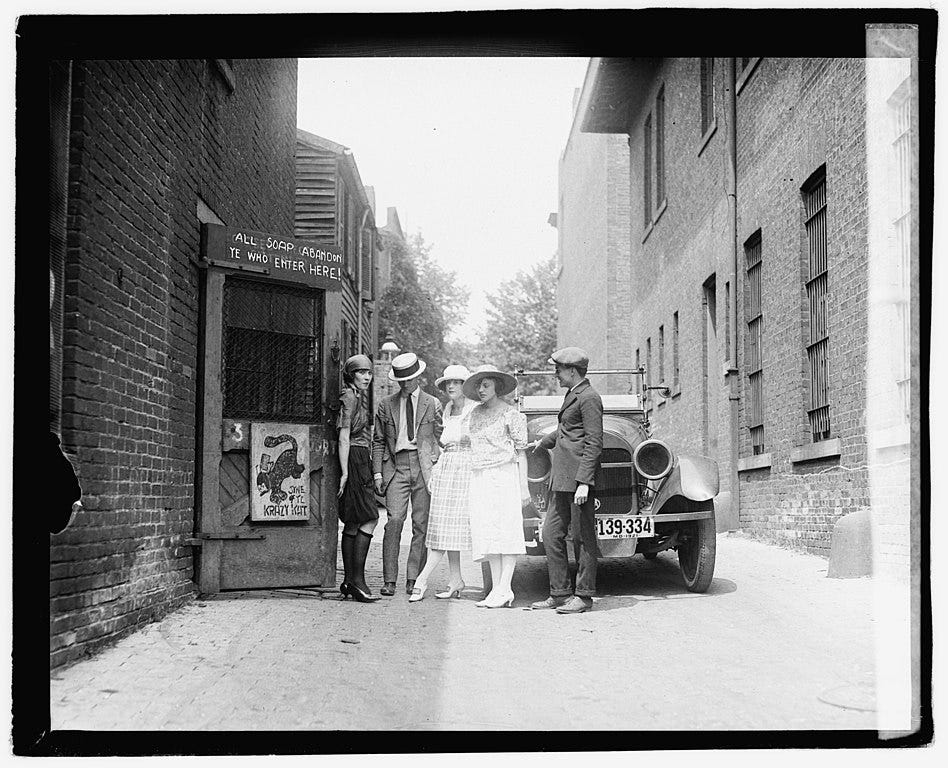
Waiting for the opening of a speakeasy in 1921 (Wikipedia commons).

Black markets, markets in illegal goods and services, demonstrate that state recognition and protection of property rights are not required for a market to operate. Black markets exist where the state bans the sale and/or purchases of specific goods and services and, as a consequence, will not protect the exchanges, goods, services or assets involved in, or derived from, such commerce.

The state does not only fail to provide recognition and protection of property rights within the banned market, or any mediation or adjudication services; it actively denies such and seeks to suppress the trades and accompanying property rights. Yet, black markets exist. They can even flourish, generating great (if insecure and often violently contested) wealth.

As various economists, such as Ronald Coase, Harold Demsetz and Yoram Barzel have explored at length, a trade, an exchange, is actually a transfer of control over some attribute or bundles of attributes. If such control is formally recognised and enforceable, then they are legal or formal property rights. But, as we have seen, trades can and do happen regularly even when formal legal ratification of such control, and their transfer, is actively denied.

How can this be? Because the functional element in property is not formal ratification by a legal system or process, but mutual acknowledgement by the contracting parties and others that they interact with. Such acknowledgment may be active, or it may be passive acquiescence. Nevertheless, such mutual acknowledgement is all that is needed for people to exercise effective control over attributes and so for economic property rights to exist. Indeed, such mutual acknowledgement is what makes any property law functional in day-to-day operation. The old saw that “possession is nine-tenths of the law” points to the fundamental role of mutual acknowledgement in any property system.

At this level, property-as-mutual-acknowledgement is a matter of convention, something you do in particular ways because others do so. (Language and fashion are classic realms of convention.) Property-as-mutual-acknowledgement generates basic conventions of resource use. If you have something in your possession, if you are exercising control over it, the information-economising presumption that simplifies human interaction is that it is, indeed, yours in the senses that matter. This mutual acknowledgement, as is normal for effective conventions, works because it works for everyone as a general presumption. People can operate on the basis of a common set of mutually-reinforcing, because mutually-beneficial and mutually-aligning, expectations.

Property everywhere and always exists via such information-economising acknowledgement, creating mutually-reinforcing expectations. The key thing in property is not “mine!”, any silverback gorilla thumping his chest can claim that. The key thing in property is “yours!”: the acknowledgement by others that the thing is yours and remains yours until you pass it to another.

A trade is just the process of transferring mutually acknowledged control over goods or services. All parties to the trade agree because they are getting something out of the transfer. Each gets the value they perceive out of having what the other previously had, or is going to provide, in exchange for what they themselves previously had, or will provide. An exchange they undergo because they value the former more than the latter. Hence, gains from trade: in cases of voluntary exchange, if both sides did not feel themselves to be better off, they would not have agreed to the trade.

Even in cases of coerced exchange (providing goods or services to avoid some violent or other penalty), the coercion works because the transfer is judged better than the alternative by both parties. In the case of the coerced, it is judged better than the alternative after coercion is put into play. In the case of the agent applying the coercion, before doing so. It is the legitimacy and consequences of the coercion that drives our judgement about such coercive exchanges. Taxes and a mugging are both coerced exchanges, but they are not generally regarded as normatively equivalent.

The power of mutual acknowledgement (and of information-economising, expectation-aligning, common presumption) is such that it permits black markets to operate even in the face of the state denying formal recognition of such acknowledgment. Indeed, even though the state is seeking to actively frustrate such mutual acknowledgement.

Black markets can only operate because the state is unable or unwilling to make its ban fully effective. But the difficulty of doing so points to, and is part a result of, the willingness of the parties to make the banned exchanges. Trades based on mutual acknowledgement using generally convenient conventions of property.

Because the parties involved seek to avoid the prohibiting efforts of the state, black market exchanges tend to gravitate towards places that are not regularly policed by the state. The level of black market activity in a locality tends to say more about the patterns in the policing efforts of the state than the inhabitants of the locality. Nevertheless, it is very easy for the inhabitants of such localities to be tarred by the association with the local black market activity. Something that can be useful to obscure the level of state responsibility for its (lack of) effective policing. And even more useful for dividing residents, citizens and workers by locality, or by features associated with locality.

In practice, even the blackest of black markets is somewhat parasitic on the formal property rights structure endorsed or provided by the state, if only to more securely enjoy the benefits of income and assets acquired from illegal exchanges. Hence the appeal of money laundering: converting what is illegal into what is legal by moving assets and income out of the realm that the state seeks to ban into the realm that the state acknowledges (i.e. ratifies) and protects. Obviously, the intent of such laundering of money and assets is to avoid the risks and costs of hostile state action but successfully doing so also gains the benefits of state property protection and adjudication services.

Thus, that black markets demonstrate that markets do not need the support and acknowledgment of the state to function does not mean that there are not major benefits in such support and acknowledgment. Including the various services the state may offer. Even if the state is purely motivated by the pacification needed to secure its taxation base, that normally entails some protection of property rights. Moreover, the pacifying state is likely to provide, or create social space for, or otherwise support, adjudication services as part of ensuring the social pacification that enables and supports its revenue extraction.

Trade or raid

Black markets are, of course, notoriously connected to violence. This flows directly from the state refusing to protect and acknowledge black market exchanges. In the absence of state protection and adjudication, assets have to be protected, and disputes adjudicated, by private action. In the end, by private force.

Moreover, black market exchanges happen through mutually acknowledged control of property. Such acknowledgement can be withheld or withdrawn.

Exchanges outside the ambit of state ratification, protection and public adjudication are in the pre-state situation of the primordial trade-or-raid choice. Does one bargain to secure desired things that another has by trade or does one simply take by raid?

Much of the point, and a very large part of the value, of state pacification is to minimise the attractiveness, and so incidence, of the raid choice. Thereby elevating the frequency and scale of the trade choice. Which can also further encourage the making of things, the third choice in acquiring something you do not already have, after take or trade. To the potential benefit of the state’s revenue.

Reducing transaction costs

Elevating the frequency and scale of trades is the core benefit of effective systems of legal property rights. Clarity of property rights, ease of adjudication and reliability of their protection all lower transaction costs, potentially dramatically. Transaction costs being costs entailed in making an exchange or other interaction. Specifically, search and information costs; bargaining and decision costs; policing and enforcement costs.

The lower transaction costs are, including the lower the risks involved in transacting and in having assets, and the greater the clarity in who has what rights, the higher the scale of transactions are likely to be and the more willing people are going to hold, and invest in, commercial assets. The state-revenue and economic growth advantages of this situation are likely to be very large.

While the advantages of the reduction of transaction costs through an effective legal system are very real, this is very different from stating or implying that such a happy situation is required for commercial activity to occur. It is perfectly clear, from history and anthropology, that such a well-functioning system of property rights and law is absolutely not necessary for commercial activity, even considerable levels of commercial activity.

As, of course, the case of black markets starkly demonstrate. More generally, as history and anthropology demonstrate quite clearly, mutual acknowledgement generating property conventions — whether or not such is formally ratified by the state and regardless of how efficiently or effectively the state does so — can still support considerable levels of commercial activity. Especially if agents within the state provide functional acknowledgment of property, even if formal ratification is lacking. Indeed, the case of post-1978 China demonstrates that such acknowledgement within the state apparatus can be sufficient even though private commerce and ownership is formally illegal. As it was in China until 2004.

China in the period 1978–2004 was not so much a matter of black markets — as the state was clearly not enforcing its bans on private property and private exchanges in anything remotely resembling a systematic way — as grey markets. Markets whose existence and exchanges were formally banned but functionally permitted. That such markets could operate at all, points to the key role of mutual acknowledgement in functioning property systems, every bit as much as black markets do.

What made such markets functional was being acknowledged by agents within the state apparatus. Indeed, often engaged in by such agents. What evolved were patterns of acknowledgement by such agents that permitted markets to emerge based on conventions of property (including of the transfer of property). Markets that were not typical black markets, with their associated violence and often socially disruptive goods and services; but nor were they ratified by the state within a formal system of property law. Though they were parasitic both on formal state property systems and the social peace imposed by the Chinese state.

The path of the People’s Republic from command economy to market economy, under the continuing regime of the Chinese Communist Party, can perhaps shed some light on a recurrent pattern in Eurasian history, where land starts as being owned by the ruler and, over time, becomes the property (with varying degrees of completeness and recognition) of intermediary social actors. Possibly all the way down to individual farmers. Versions of this pattern can be seen in Indian, European, Japanese and Imperial Chinese history. The difficulties and inefficiencies of central control, and the pervasive power of, and tendency towards, acknowledged possession, of property-as-convention, are clearly a recurring tension within state societies.

Manageable transaction costs

Economic agents can use connections to reduce uncertainty and manage risks, further strengthening the conventions that generate mutually-acknowledged possession. (A connection being repeated, mutually acknowledged, interactions that both agents presumptively intend to continue, or that one agent can force to continue.) Connections provide a wide range of possibilities that, without achieving the level of uncertainty reduction (and so risk clarification) that efficient property-rights regimes generate, can nevertheless enable considerable commercial activity.

Markets emerge when there is sufficient mutual acknowledgement of possession to generate property-as-convention in situations where transaction costs, and other risks, are manageable. We can identify three key elements based on the normal resource-creation-and-risk-management triad of structured sharing, exchange, and connection (that both structured sharing and exchange are embedded in, and interact with), plus the value of signalling your value as a social interlocutor.

First, there is the element of a functional common space. Passive acquiescence in control of what others possess-and-so-control makes it much easier for everyone to act within the common social space. If the state does nothing more than block public violence, it effectively creates a common social space within which such passive acquiescence will be naturally ubiquitous. That alone is a powerful protector of functional property rights, even if the state does not formally ratify property rights or does not provide adjudication services (whether at all, or sufficient to cover the demand for such).

Many societies have had private providers of adjudication services covering property disputes. Which folk have been willing to use for the same reason that they acquiesce in the possessing(s) of others: it eases their social interactions.

Second, there is mutual signalling. Passive acquiescence signals that one is potentially a person easier to interact with. The more complete the mutual acknowledgement, the stronger the signal. Folk have a powerful incentive to acknowledge the possessing of others so that their own possessing will be acknowledged in turn.

Such patterns of mutual signalling can also increase the willingness to use private adjudication services. By using such services, and abiding by their decisions, folk establish their reliability as social and commercial interlocutors. More generally, the broader the ambit of one’s repeated trading activity, the more value there is in a reputation for fair dealing; which includes respect for the possessing of others.

The value of Sharia, and Sharia courts, in providing a shared system of commercial law and adjudication, had much to do with the spread of Islam along trade routes, particularly in the Malay world. More recently, the provision of such services also had much to do with how the Taliban was able to maintain networks of support within rural Afghanistan, leading to its recapture of the country.

One sign of how effective the suppression of violence in public spaces is, is how much effort those willing to violate the general pattern of presumptive possession put in to hide or obscure their doing so. What makes a riot a riot is the breakdown of such presumptive hiding of violence. Just as what makes looting, looting is the breakdown of presumptive acknowledgement of possessing by others. Though, at some point, looters will want a return to the presumption of possession so they can more securely retain their gains. A revealing instance of how much the violation of the presumptive possession by others is itself parasitic on a more general pattern of acquiescence in possession that generate the conventions of property. As previously noted, the general utility of possessing is a powerful motivator for ongoing patterns of mutual acquiescence in possession and the alignment of expectations to generate the conventions of property.

Thirdly, there is the role of connections. The need to maintain and protect connections important to oneself may further encourage mutual acknowledging of possession, and an abiding by private adjudication, by raising the social costs of failing to protect and sustain a reputation as a reliable interlocutor. Especially if such connections also protect one’s own presumptive possession. The atomised individual may be more willing to violate such presumptions but is also a more likely target of such violations.

The use of (typically kin) connections to provide protection-via-retaliation, which is a method for protecting life, person and property particularly common in horticultural and pastoralist societies, can set off cycles of feuding. One of the ways that states pacify is by breaking such patterns of retaliatory feuding.

Societies with strong kin groups often use private adjudication services quite extensively, as protection of one’s standing within the kin group often helps motivate use of, and abiding by, such adjudication.

Certain connections may also protect one’s violation of the presumptive possession of others. Hence the tendency of criminal gangs to form so as to protect, organise and enable such violations (and of the assets gained therefrom). They are also a very useful protective device when engaged in black market activity and may be necessary if operation within the black market involves significant issues of scale or complexity in provision. Every bit as much as other firms do, criminal gangs wrestle with choices of whether to transact externally through markets (or, being criminal, via taking) or internally through organisation (i.e. managed connection using pooled resources organised through some mixture of hierarchy and structured sharing). Boundary choices that depend, as with other firms, on questions of transaction costs and risk-coverage. (A transaction that one can profit from is also a transaction that one can lose from; covering the risk of loss is a fundamental factor in why firms exist and how they are structured.)

The value in protecting the ability to interact through conventions of ownership based on mutual acknowledgement is so strong that injunctions against stealing (at least within the relevant in-group, the relevant normative community) are a universal feature of human societies. The conventions of property are thereby reinforced by social norms against (in-group) theft.

Norms arise out of a sense-of-should based on the benefits of aligning expectations in a highly social species with considerable cognitive capacity due to having large, and metabolically costly, brains.

Social norms are injunctions to act as expected, with sanctions also being expected to be imposed if such expectations are not fulfilled. The mechanisms to enforce anti-theft norms can include shunning, expulsion, violence, or other penalties. Whether enforced personally, by wider action within the community or by some authority. The universal evolution of normative injunctions against stealing (at least within the in-group) point to the ubiquitous value of the conventions of property.

We can see that, even if there is no pacifying state, so that there is what one might call a pure trade-or-raid choice, there are many reasons that trades can and will still happen. There are many mechanisms for making transaction costs and risks sufficiently manageable that trades happen, even in the absence of any state. Indeed, even against the efforts of the state. Mechanisms that are viable because of the ubiquity of mutual acknowledgement as a basis for functional systems of property.

The mutual convenience of the conventions of possession can establish functional property rights without any state action or formal legal acknowledgement. The conventions of property evolve naturally because we are so much a social and normative species, regularly engaging in mutual signalling and seeking to benefit from aligning our expectations.

[An earlier version was posted on Medium.]

References

Yoram Barzel, Economic Analysis of Property Rights, Cambridge University Press, [1989], 1997.

Cristina Bicchieri, The Grammar of Society: The Nature and Dynamics of Social Norms, Cambridge University Press, 2012.

Cristina Bicchieri, Norms in the Wild: How to Diagnose, Measure and Change Social Norms, Oxford University Press, 2017.

R. H. Coase, The Firm, The Market and the Law, University of Chicago Press, 1988. Includes ‘The Nature of the Firm’ (1937) and ‘The Problem of Social Cost’ (1960).

Harold Demsetz, ‘Towards a Theory of Property Rights’, American Economic Review, Volume 57, Issue 2, May 1967, 347–359.

Jordan E. Theriault, Liane Young, Lisa Feldman Barrett, ‘The sense of should: A biologically-based framework for modeling social pressure’, Physics of Life Reviews, Volume 36, March 2021, 100–136.

Chenggang Xu, ‘The Fundamental Institutions of China’s Reforms and Development’, Journal of Economic Literature, 2011, 49:4, 1076–1151.

Saturday, November 27, 2021

The niche-creating species

We are the cultural species par excellence, and so the species that creates its own niches.

Beaver dam, Hesse, Germany.

The ecologist Paul Colinvaux, author of the classic text Why Big Fierce Animals Are Rare, made an observation in his deeply flawed book The Fates of Nations that is very useful for modelling human social dynamics:
Unlike other animals, we can change our social habits to fit ourselves for new niches … P.42
A niche being:
… all the things the things about a kind of animal the let it live: its way of feeding, what it does to avoid enemies, how it is fitted to the place it must dwell. P.19
How, as he says elsewhere in the book, a species fits into the web of life.

For instance, any theory of elite over-production is a niche theory, being based on the social dynamics of more people seriously aspiring to occupy an elite niche in a society than there are such niches to be filled.

Within the biosphere, species typically have a specific niche that they fill. Even if they are a differentiated species, such as ants and termites, their form still dictates, along with interaction with other species and the world around them, the niche they occupy in the web of life.

That interaction with other organisms and the environment can involve a certain amount of niche construction through impacts their actions have on the environment around them and on other species. Such niche construction can leave an ecological inheritance to their descendants. It can potentially increase the number of niches available for the species, or reduce the variability (and so increase the predictability) of the niche. Such niche construction provides, as part of the purposive (i.e. goal-directed) behaviour of living organisms, an ordering principle within the biosphere.

The population of a species is set by the number of available niches for that species. (Hence, big, fierce animals are indeed rare.) The contest within species is to occupy one of those niches and reproduce more future occupants of those niches. Genetic lineages that successfully do so get to continue and those that don’t disappear. Different species (i.e. different sets of genetic lineages) compete to occupy and sustain niches within the nutrition and reproductive possibilities of the eco-system around them.

All currently existing genetic lineages have genetic ancestries that are much older than their current species. A genetic lineage, in the process of evolution and replication, can pass through existing as, and within, many different species.

Processes of adaptation can be expected to have some sort of search process inherent in them (as evolutionary biologist Bret Weinstein has suggested) for ability to search out survival and replication possibilities increases the chances of continuing genetic replication. Replication being the game that genes play. One played via selection for or against traits within subsistence and reproduction strategies. (All one needs for a game, in an analytical sense, is feedback and response in the context of limited resources where some outcome, in this case staying in the game, is a "win": intent is not necessary.)

Such search processes for successful replication possibilities, which includes niche construction, enables the biosphere to have the level of order it does. For random mutation is nowhere near enough to explain the observed level of order in the biosphere, even within geologic time frames. This is especially so given the periodic mass extinction events and the explosions in new species that follow them. It is natural selection acting on strategies, particularly with the genetic recombinations of sexual reproduction, that provide much more opportunities for search-and-discovery of new opportunities. 

A nice example of the interaction between search, niche, niche construction and genetic evolution is provided by the development of lactase persistence in humans. If pastoralists can evolve the capacity to continue to consume milk after weaning, that greatly increases (by around fivefold) the calories they can harvest from a given area of grasslands, dramatically increasing the number of sustainable pastoralist niches. This has happened more than once in human history, with at least four separate versions of such genetic mutation occurring in different pastoralist populations and subsequently rapidly spreading through such populations.

The most widespread such mutation being that which developed among Proto-(or at least every early) Indo-Europeans. Indeed, their particular mutation provides an excellent genetic marker of their pastoralism and the extent of their spread. A spread which, in the case of the Indo-European pastoralists, was almost certainly sustained over such as a breadth of time and space precisely because lactase persistence gave them a biological advantage over other populations that could only be gained by other populations through interbreeding with the Indo-Europeans.

Trade-offs rule

A niche always involves a series of trade-offs. Trade-offs both from pursuing the internal competition for available niches and for sustaining niches. The trade-offs a particular niche involves develop interactively with the energy-and-nutrient possibilities, and threat profiles, the niche occupant has to deal with to sustain itself and reproduce.

What makes Homo sapiens so ecologically distinctive is the extent of our ability to choose new trade-offs, to shift across trade-offs, and so to adapt to, and create, new niches. An ability intimately interwoven with us being the technological ape, the toolmaking ape.

There is no single human niche. There is, for instance, no single forager niche. As can be seen by comparing, say, the Inuit with the Hadza. The human capacity to change interactions with the surrounding environment (and each other) so as to create new niches, even within the nomadic foraging pattern, is how we became the global ape.

Our varied human niches are created and sustained by our cognitive capacity for learning and discovery and our cultural transmission of information and skills. Our niche construction is a manifestation of us being so much the cultural species. Human technologies are sustained via our cultures which in turn are profoundly affected by our technologies.

We Homo sapiens are the niche-creating, indeed niche-multiplying, species. We can adapt to, and create, new niches. Doing so either in addition to, or replacing by, existing niches. Indeed, we can create and occupy multiple niches across and within human societies.

Hence we have not only spread across the planet, becoming the global ape, but have also increased hugely in population. If you can create new niches, you can create new ecological spaces to occupy, with new resources to use.

The human nomadic-forager niche was already more varied than the niches of any other species. Taking up sedentism added a new level of variation. Taking up farming and pastoralism extended that variation even further. As did creating chiefdoms and states. Industrialisation — the Great Enrichment — then increased the number and variety of human niches by further orders of magnitude. It also increased the fluidity of human niches, something information technology has ratcheted up further.

Human niches

Malthusian models, models developed from the population-dynamics insights of the Rev. Thomas Malthus (1766–1834), are models of the limits to population given available resources, including available technology. Niches are the analytical mechanism connecting population size to available resources. Malthusian models should therefore incorporate the insight of ecology that it is available niches that set the limit to a population. Hence Malthusian models should be based on niches.

If this is not done, if people, rather than niches, are the unit of Malthusian models, it becomes much more difficult to deal with trade-offs within niches. Indeed, it becomes easy to operate such models in ways that are blind to such trade-offs.

Conversely, switching to an ecological analysis, making niches the basic unit of the model, makes it possible to consider trade-offs within niches. For there will clearly be a range of trade-offs that are possible within niches that can yet remain viable such that occupants are able to reproduce. For instance, trading off more ready access to energy (calories) for lower long-term access to nutrients.

This ability to shift trade-offs is not only compatible with Homo sapiens having the most biologically expensive children in the biosphere, it is a product of the cooperative cognitive complexity that those long childhoods evolve to sustain.

Quality versus quantity

One of the possible trade-offs within human niches is between quantity of offspring and quality of offspring. The more skills are needed to successfully occupy the targeted niche, the more likely parents are to shift towards quality of offspring over quantity. Conversely, the less skills and learning are needed, the more likely parents are to shift towards quantity of offspring over quality.

Farming is a lower-skill niche than foraging, given that it greatly reduces search costs and concentrates on a very small number of species. Conversely, the productivity of foragers typically peaks around 45 years of age and foraging children typically don’t break even on calorie collection and consumption until they are almost 20. This is why mixed foraging-planting niches could be sustained by sedentary foragers, as they were, for millennia: there was very limited extra skill burden involved in planting some edible plant for later harvesting.

The lower skill burden is also part of how farming lowered the cost of children. Farming (and plant and animal domestication generally) required less time training children, who could become more productive earlier, while sedentary living meant that children were more able to look after each other. The easy (after processing the harvested plants) access to calories from domesticated plants also permitted earlier weaning of infants and so increased fertility, enabling the quantity/quality trade-off to be made. (The energy/nutrient trade-off involved, resulting in worse health outcomes, emphasises that this was a quality/quantity trade-off.)

Connection, pooling and exchange

As intensely social beings, whose survival and reproductive success depends fundamentally on cooperation, humans manage and sustain their niches through processes of pooling (sharing), connection and exchange. With pooling being: the use of common resources and connection being: a continuing series of mutually acknowledged interactions.

We are the only species that regularly displays the behaviour of engaging in “truck, barter, and exchange one thing for another”. While whether Adam Smith was right to call this a propensity or not can be disputed, it is certainly a distinctive, and recurring, human pattern.

A pattern that occurs because we are so much the normative species, a crucial element in us being the cultural species par excellence. It is not that there is no culture at all in other species, nor anything that might reasonably be called normative behaviour. It is just that we display both at a rate orders of magnitude greater than other species. Just as, and not coincidentally, our tool making and use is orders of magnitude greater.

Exchange involves the exchange of property: what was yours becomes mine, what is mine becomes yours. The crucial idea in property not being mine!, any silverback gorilla with a harem can do that, but yours!, the acknowledgment of possession by others and associated rules of rightful transfer from one owner to another. Which is normative.

The need to defend our social space, plus the information associations an owned thing can have, generates an endowment effect (valuing something we own over an identical thing that we do not). The effect on exchange behaviour tends to diminish with market experience in trading such things, as distinct from merely being an experienced trader, for the more the owned thing then becomes something to be traded (i.e., transferred) rather than distinctively ours.

A chimpanzee in a behavioural lab confirms more strongly to the predictions of game theory — i.e. conforms more to the predictions of Homo economicus — than humans do because we Homo sapiens are far more normative than are Pan troglodytes. That far greater normative capacity is part of us being the cultural species and fairly clearly arose out of our highly cooperative subsistence and reproduction strategies.

Being so much cultural species, including being able to marshal exchange as part of socially and technologically constructing new niches, is what has made us the global ape. The discoveries of the anthropogenic sciences undermine both the cultural hegemony model used by many sociologists and anthropologists and the rational self-interest model used by economists and political scientists.

Human history is one of the social and technological construction of niches via the mechanisms of pooling, connection and exchange. For instance, shifting from nomadic foraging to sedentary foraging, and especially to sedentary farming, changes the dominant structure for pooling production and consumption from the multi-family band of shifting membership to (a typically) single-family household with much more stable membership.

Social exchanges are exchanges in the context of connection; so in the context of a continuing series of mutually acknowledged interactions. Commercial exchanges are exchanges that, if they continue across time, include managing connection(s), but are otherwise discrete events involving transfers of resources via goods or services.

Social exchanges are therefore dominated by the norms and expectations of connection. It would be an insult to offer to pay a friend or relative for a meal they have cooked for you.

As commercial exchanges are exchanges where any connection arises from within the context of exchange, they are dominated by the norms and expectations of trading and commerce. It would be theft or fraud to not pay for a commercially-provided meal. (There is a useful discussion of the difference between social and market exchanges in Chapter 4 of Dan Ariely’s book Predictably Irrational.)

Any pooling in the case of social exchanges is based on the pre-existing (or sought) connections. Pooling in the case of commercial exchange results from the exchange itself.

As social exchanges are based on the norms of connection, the level of mutual regard inherent in the social context of the path of interaction typically involve considerable density of information. Commercial exchanges are based on commercial norms that typically involve much lower levels of information, outside the exchange itself and associated patterns of exchange. This allows commercial exchanges to scale up much more than can relying on connection and local pooling. Hence such exchange can expand the size and number of human niches.

Economising on information is much of the advantage of commercial exchange. Sufficiently dense patterns of exchange result in the development of exchange goods: goods held so as to be able to participate in future exchanges. At some point, a medium of account (i.e. full money) may develop, due to its value in economising on information: notably search, negotiation and accounting costs. (A medium of account being something used to both quantify and discharge obligations.) Increasing the scaling-up effect on the size and number of human niches of commercial exchange.

Gifts and favours are investments in connection. An appropriate gift can express the strength of a connection by demonstrating how accurately the giver of the gift “sees” the other person and how important their connection is to the giver. A public gift makes a public display of these things.

In societies with very little exchange, but very dense webs of connection, failure to be able to sustain the pattern of gifting that maintains connections can drive individuals into “gift bankruptcy” and so a form of debt-bondage. Just as with commercial bankruptcy, it represents a terminal inability to meet one's obligations.

Niche size and well-being

Malthusian models for pre-industrial societies that use people as the unit of analysis imply, due to using the person as the unit being modelled rather than the niche, that human well-being will tend to return to a recurring steady-state, as increased resources are eventually matched by increased population. This makes it difficult for Malthusian models using people as the unit of analysis to conform to the strong evidence that farming was less healthy than foraging. But, if the models focus on niche-size instead of human well-being, then different internal trade-offs within niches can be incorporated within the model, even if niche size tends to return to a recurring steady-state for a given level of technology.

As mentioned above, a possible such trade-off is to have more readily available energy but less nutrients, resulting in smaller stature and worse health. As long as the trade-off does not get in the way of successful reproduction, it can be a socially viable trade-off. Indeed, if accepting the trade-off results in increased capacity to generate such niches for your descendants to occupy, it will become a successful, even dominant, trade-off.

Trade-offs between niche size (so niche quality) and niche number (niche quantity) can occur in various forms. Where you are in the spectrum of control of resources determines the consequences of different decisions in intergenerational transfer of assets. Thus, single-heir systems, such as primogeniture, are structured to maintain a certain niche size. Single-heir systems typically involve accepting that one’s other children end up with smaller social niches.

Elite over-production can be de-stabilising for societies precisely because more people are seeking (and having the resources to) compete for elite niches than there are elite niches to sustain them. Such competition, if of sufficient intensity, can be highly destructive to the normative order of a society.

Elite over-production by polygynous hereditary elites is likely to have been a major cause of the transience of steppe empires, for example. Given that the herding productivity of grasslands was an enduring constraint on the number of pastoralist niches.

Some niches need more resources to be sustained and/or are sustained at a higher level of health. Sufficient increase in resources, such as the great enrichment that began with the application of steam-power to transport by the development of railways and steamships, can lead to increases in both quantity and quality of niches and, if the cost of children rises sufficiently, to lower fertility.*

As farming, due to its elimination of most search costs and concentration on a far narrower range of food species, required less skill than foraging, so could be contributed to more with a lower level of skill (i.e. children were more productive earlier in life), there was no pressure to increase the quality of children, but there were likely benefits to having more children. Including more capacity to create kin connections through marriage and more of a buffer against ageing.

The first constraint in the construction of human niches is time. There are only certain amount of hours in a day. The second constraint is sustenance, the need for a certain amount of energy and nutrients to sustain oneself. Energy is more immediately urgent than nutrients, so it is possible to make a choice that provides sufficient energy but involves some deficiency in nutrients. This will have future health implications, but, as noted above, this may not block the continuation and replication of the niche.

If the niche is going to be replicated in the next generation, then time and sustenance has to allocated to reproduction and training. At the core of Homo sapiens being the cultural species is direct or indirect investment in the training of offspring.

Hence the potential trade-off here between quality of offspring and quantity of offspring. As we have seen, it is entirely possible to have a niche that reduces the cost of children, for instance making it easier to feed them and making it less likely to lose them in early infancy, yet also means that their long-term health is poorer. Ironically, a higher rate of infant mortality in a situation of restricted fecundity (due to long weaning periods, for example) may make for more investment in the quality of children. Particularly if there is more nutrient-rich food available to feed them.

One of the changes industrialisation created was to markedly increase the returns to education while reducing the ability of children to contribute to household production. Improved sanitation and increased medical knowledge also markedly reduced infant mortality. This resulted in a dramatic shift away from quantity of children towards quality of children, with large falls in fertility rates.

Thus, the foraging-to-farming shift from quality to quantity of children has been more than reversed. But at, of course, hugely higher population levels.**

Niche-creating species
Humans are members of a species that technologically creates a variety of niches by intensely social and cultural processes. Models of human populations need to be able to incorporate the reality of the creation of varied niches. Assuming a single human niche certainly hugely simplifies modelling, but the analytical accuracy cost in usefully analysing human social dynamics by doing so can become very high, very quickly. Similarly with attempting to model human population dynamics without being able to incorporate the varying trade-offs of human niches.

Thinking of humans as the niche-creating species, and as niches as involving various trade-offs, clarifies human social dynamics.

[An earlier version was posted on Medium.]

End Notes

*Education of women tends to lower fertility because it increases the opportunity cost of children to women and raises the education cost of children. This is especially so in circumstances, such as high returns to human capital, where investing in quality of children is a more successful inter-generational strategy than investing in quantity of children. The higher-returns-to-human-capital effect is also a specific instance of investing in more concentrated asset inheritance by offspring can favour single-spouse marriage over polygyny, if the number of offspring and/or spouses affects the level or persistence of asset concentration. The human capital effect, which was very intense for Brahmins (given the enormous levels of memorisation required to function as Brahmin), probably encouraged their tendency to single-spouse marriages. This investment in maximising household production through in-group marriage is likely the reason for the development of the jati (caste) system, as a way of both maximising household production and generating protective connections. A system whose longevity shows up very clearly in the genetic patterns of South Asia.

**See economist Robin Hanson’s ongoing discussion of contemporary society as a struggle between farmer and forager patterns and ethics.

Monday, June 14, 2021

The One-Stop Explanation of Why Marxism is Toxic Crap

The human disasters of actually existing Marxism flow directly from Marx’s theories.

Two toxic theorists and three mass murdering tyrants.

The most obvious feature of Marxism is that it has been the ruling ideology of a series of tyrannies, some of which murdered millions of their own citizens and all of which performed worse, typically disastrously worse, than their “capitalist” equivalents in promoting human well-being. The last point has been established by a series of clear natural experiments (North and South Korea, East and West Germany, China and Taiwan) but it also obvious if one just compares outcomes between reasonably similar states.

Communism (i.e. revolutionary Marxism) was strategically the best thing that ever happened for the US because it hobbled the two states most able to rival it, Russia and China. Both states have significantly fewer people, less wealth and lower standards of living, than they would have if neither had ever become Marxist.

Despite this disastrous history being the most obvious feature of Marxism, there are plenty of people who still call themselves Marxists. They give this appalling history a series of hand-waving evasions that they would not, for a moment, grant to “capitalism”. Apparently, around a 100 million deaths in purges, persecutions and terror famines (i.e. from deliberate policies of Marxist regimes) and an unbroken series of tyrannies is not enough evidence that there might be something a bit wrong with the original theory.

The justification will be something like “they did Marxism wrong”. This is just a hand-waving evasion. If you get the same basic pattern every time, then the outcome is inherent in the ideology.

Marxism is based on two (interacting) fables that go back at least to Adam Smith (1723–1790). One is the labour theory of value whereby any return from production that does not go to the workers is return on labour that labour does not get. The other is the theory of class that emerges from the labour theory of value.

Getting class completely wrong
Marx’s theory of class is that it is based on the extraction of surplus (the return from labour that labour does not get) by landlords and capitalists. The state is the instrument or manifestation of the underlying class structure of society. This is a version of an historical fable that, even today, most social scientists accept some version of and has long dominated scholarly thinking about the state.

This historical fable is that when humans developed farming, farming created surplus and social hierarchy from which the state arose. The state can therefore be understood as essentially an extrusion of the society that creates it. Marx’s famous statement that in capitalist societies [t]he executive of the modern state is but a committee for managing the common affairs of the whole bourgeoisie belongs firmly within this standard historical fairytale tale, one promulgated by Adam Smith and his intellectual heirs (which includes Karl Marx).

Almost every element of this fable is incorrect. First, farming does not, by itself, create a surplus (that is, production in excess of subsistence). Farming does greatly increase food production, increasing the ability to extract useable calories from the arable landscape by up to a hundredfold, but that just leads to more people.

For most of human history, extra food mainly meant extra babies. That is, more humans, more human biomass. This was a far stronger result from farming than any creation of more resources per person. Especially as it generally did not result in any such increase.

Farming created more human niches rather than noticeably larger human niches. Indeed, it tended to create smaller human niches (in the sense of health and nutrition quality) than foraging, just (a lot) more such niches. The health of people living in farming societies was persistently worse than that of foragers. 

The metabolic health costs of farming were worth it adaptively because they lowered the cost of individual children, so enabling people to have more children. In the genetic replication game that is evolution, farming was definitely a big winner over foraging.

Human societies thus remained within the social dynamics originally analysed by the Rev. Thomas Malthus (1766–1834) of population tending to increase to consume the food available. For farming to create a continuing and substantial surplus, food had to be intercepted and diverted before it led to more babies. (Technological and commercial surges in available resources provide complications that need not detain us.)

Direct expropriation of food on any scale was only practical if there was significant stored food. This is why most farming societies did not create states. States arose in only a relatively small minority of farming (and no foraging) societies. Though all societies, including all farming, pastoralist and foraging societies, eventually had states imposed upon them.

Farming generally results in significant amounts of stored food only if one is harvesting seasonal crops, notably grains. (Also potatoes, as potatoes are a seasonal, temperate crop that is relatively non-perishable, so function like a grain.)

If one grows crops that can be harvested all year around, there is normally no significant storage, so no significant amounts of food to be systematically, and recurrently, seized before it supports more babies. New Guinea, in all its thousands of years of farming, trade and conflict, never produced anything resembling a state, or even a chiefdom, because it is a land of crops harvested all year round, with minimal storage of food. It lacked the taxable resource-base for chiefdoms and states to arise.

Moreover, if one is living off seasonal crops, it becomes vital to ensure that (1) the stored food is available between harvests and (2) the stored seed-grain is available to sow next year’s harvest. Seasonal crops thus create a particularly intense protection problem. Even more so if there were other groups, especially pastoralist nomads, within raiding range. That protection problem encouraged the rise of specialist protectors (or organisers of protection), thereby providing a basis for the development of coercive power across generations: the basis for creating chiefdoms and states.

The benefits of coordinating protection opened up the possibility for the systematic and recurrent appropriation of stored food sufficient to create and sustain chiefdoms and then states. Societies did not easily nor simply go from farming villages to states. There had to be some build-up of the capacity to defend, to coordinate and to appropriate. Hence chiefdoms preceded states (but not all chiefdoms created states).

So, the farming-leads-to-surplus-leads-to-states fable about the origin and nature of states falls over at the start. The story about hierarchy is not much better. Most farming societies did not create much in the way of social hierarchies. Stored food was the dominant source of social inequality and hierarchy. Though inequality and hierarchy was also a feature of controllable resources generally (such as salmon runs). But only some farming leads to stored food and only some stored food comes from farming. To generate enough surplus to support a state requires systematic and recurrent generation of enough stored food that the state can then appropriate sufficient food to reliably support itself.

Sedentary foraging societies with stored food (e.g. salted fish) could and did generate social hierarchy, chiefdoms, slavery and warfare. It was stored crops, particularly grains, that usually generated the scale of resources required to generate states. (Sub-Saharan Africa, with its mixture of seasonal and non-seasonal crops, generated trade-and-slavery states, but trade also generates a storable goods protection problem.)

States and class
Once the state evolved in (or was imposed on) any society, it dominated the generation of surplus in that society. In a real sense, each state had to remake its originating society so as to sustain itself (and then impose the same remaking on any areas it conquered).

The state was almost invariably not some “extrusion” of a society, it was the dominant structuring element in its society. If it could not structure society so as to sustain itself, it would either not arise in the first place or, if it could not sustain the required structuring of society, it would collapse. Even cooperative-bargaining (i.e. non-autocratic) states remade their societies. An example being the abolition of lineage-based tribes within both Athens and Rome and their replacement by territorial designations depending on where in the city one lived. (Judging by the disappearance of kin terms differentiating male- and female-line kin from classical Greek, such replacement of lineage-based kin groups seems to have been a general pattern in Mediterranean city-states.)

The first, and arguably the greatest of historical sociologists, Ibn Khaldun(1332–1406) discussed states structuring their societies, using the Aristotelian language of form for structure rather than the more economistic language that we are, post-Marx, used to. Thus he writes:
… dynasty and royal authority have the same relationship to civilization as form has to matter. (The form) is the shape that preserves the existence of (matter) through the kind of (phenomenon) it represents. It has been established in philosophy that one cannot be separated from the other. One cannot imagine a dynasty without civilization, while a civilization without dynasty and royal authority is impossible, because human beings must by nature co-operate, and that calls for a restraining influence. Political leadership, based on either religious or royal authority, is inevitable. This is what is meant by dynasty. Since the two cannot be separated, the disintegration of one of them must influence the other, just as its nonexistence would entail the nonexistence of the other.
(Ibn Khaldun, Muqaddimah, Chapter 4, Section 1.)
In other words, the state structures society. It cannot be assumed to be the extruded product of a society.

Perhaps the most extreme example of such structuring is provided by Egypt, which generated the quickest, and most thorough, transition from seasonal-crop farming to highly centralised state. Yet, from the flight of pharaoh Nectanebo II in 343BC to the officers’ revolt which overthrew the Albanian Alawwite dynasty in 1953, Egypt was ruled by foreign empires or foreign dynasties. For almost 23 centuries, there was a state in Egypt, but there was not an Egyptian state. Even if each iteration of the state in Egypt adopted the techniques for exploiting Nile valley farmers developed by the pharaohs, whatever state ruled Egypt was not an extrusion or product of the society it ruled. It imposed structures on that society congenial for its continued rule and reflective of its (external) origins.

States are typically not creations of class structures. Typically, they have been the dominant creators of class structures. States have dominated the creation of class structures as they have dominated the extraction of surplus and, typically in alliance with priesthoods and clerics or (in the case of China) secular clerisies, dominated the socialisation of function: what status various social groups had; what access to surplus they had and on what basis; what were their rights and obligations. Surplus + socialisation of function => class structure.

So, states themselves are, historically, the dominant extractors of surplus and the dominant creators of class structures. The former is still true, by the way. Look at the size of the tax take in any Western democracy. It is way larger than the profit share of GDP. (Though, in the sense of income above subsistence, technology and economic structures dominate the creation of surplus, with the state taking far more of that surplus than do company profits.)

But the most dramatic example of states as the dominant creators of class structures is provided by every revolutionary Marxist state. In each case, the ruling regime seized the state, atomised society and restructured society to serve its own power and purposes, thereby creating the class structure of its society. Marx’s theory of class proved to be self-refuting by Marxism.

Marx’s theory of value claimed that surplus came from exploitation of labour by landlords and capitalists. So, if you abolished such exploitation, you abolished class. Marxist regimes abolished such designated exploitation by concentrating all social power in the hands of the ruling regime via the state: the actual historically dominant extractor of surplus and creator of class structures. So, of course Marxism-in-power created murderous tyrannies run by elites who extracted the surplus from society for their own ends.

Stalin was able to extract far more surplus for his own purposes from a smaller-in-territory-and-population Soviet Union than Tsar Nicholas II had from the larger-in-territory-and-population Russian Empire. Stalin created one of the largest slave systems in history. He (re)imposed serfdom, as people were not allowed to leave a workplace without the workplace’s permission. The Kim regime in Korea is, in effect, a recreation of the dynastic God-kings of early states, with more advanced technology.

This pattern of tyrannical regimes extracting surplus for their own ends was not some weird, recurring accident. It was a direct result of Marx getting class fundamentally wrong.

Getting value wrong
So, why did Marx get class so completely wrong? Because he got value profoundly wrong.

On this point, as elsewhere, there is not much point in engaging in some forensic analysis of what Marx actually wrote. While he was a rhetorically powerful reasoner (and asked some good questions), he was also a persistently dishonest one. That is, when he makes some claim that might be critiqued he adds in some fudging protection, so that he can always point to the protective fudge to evade critique. As he put it in a letter to Engels, one just uses a bit of dialectic to get out of any difficulty in analysis.

So, consider Marx’s basic characterisation of profit: the return on labour that labour does not receive. Why do people engage in labour? Why did our original foraging ancestors engage in effort? To gain something they wanted. Why did they want it? Because it has some feature of characteristic they needed (nutrition) or otherwise valued (it tasted good, it was fun, it made getting food easier, and so on).

So, the labour was directed to what people valued. That is the basic connection between labour and value: labour is typically directed to what people value. If the labour is successful, the value is gained. If the labour is not successful, then the value is not gained. Since success is not measured by the labour, labour is not the source of value. It “creates” value only in specific circumstances.

So, labour is the “source” of value only if one completely ignores the discovery process involved in applying labour, in putting in effort, to successfully achieve value. Human history is fundamentally a history of discovery. The way labour is applied always relies on some previous process of discovery. Indeed, all of evolution is fundamentally a process of discovery: discovering what can be successfully replicated.

What increases the value that labour, successfully applied via discovery processes, provides? Well, land for one. Foragers engaged in a lot of search activity to find that which they valued. What was available to be discovered made a big difference in how they went about that (how they applied their labour) and what they were likely to discover (what was the outcome of doing so).

Foraging, especially hunting, is a skilled activity. People had to learn skills to be effective foragers. In contemporary foraging societies, the productivity of foragers peaks at about 45 years of age. As humans increasingly adopted skill-based foraging techniques, that meant that older males could be desirable mates. The older the male, the longer the telomeres of their offspring tend to be, so the longer such offspring tended to live. This resulted in more human females living past menopause, which enabled them to finishing raising the children they had when they were about 40 and to invest in the children of their children (as they stopped having children of their own).

The learned skills that meant productivity of the provisioning human males peaked at an older age were the cognitively incorporated — indeed embodied, including via muscle memory — results of discovery processes. Labour is always effort + (past or present) discovery. Skilled labour simply incorporates a higher level of (past) discovery.

What’s another thing that increases the value that labour, successfully applied via discovery processes provides? Tools. Which are a form of capital, the produced means of production. Humans became tool makers because that made their labour more productive. As skills are learnt, they are also a produced means of production, so human capital.

So, the more (useful) land, the more capital (including human capital) and the better the discovery processes, the more value the application of labour is likely to provide. Workers in developed economies have much higher wages than folk generally do elsewhere, or in the past, because they are supported by a great deal of productive land, capital and accumulated discovery processes.

How does one get folk to look after the land, provide capital and engage in discovery? Make sure they gain benefit from doing these things. Why does every society ever known generate returns to land, capital and discovery? Because these things magnify the value that labour can achieve.

Together, they create value in the sense of providing things people value. But the value comes from people’s reaction to the things provided. Economic activity “creates” value in that sense, and that sense alone. It “creates” value if it is successfully directed towards providing things people value and does not “create” value if it is not, regardless of how much labour and other resources might have been applied to such activity.

There is another feature of economic activity not yet covered in the above. That is risk. The notion of discovery implies the possibility of not discovering. Or even of disastrous discovery (e.g. that thing that tasted OK was actually poisonous). Search involves risk. Effort involves risk. Not doing anything involves risk. Risk has to be managed. Good risk management is a very useful thing. It makes creating value, particularly doing so recurrently, from the application of a given amount of resources much more likely.

Human foraging is cooperative. In contemporary foraging societies, individuals vary in their social connections, what anthropologists call relational wealth and economists social capital. Such connections function as information (i.e. discovery) networks and risk management networks, as they are constructed by exchanges of favours. Management of risk has always been part of human activity and social organisation. So has land, so has capital.

The analytical advantage of starting with foragers is:
  • that is where we came from, and
  • we can see basic economic patterns without exchange being a major factor. (Though evidence for exchange dates back to our emergence as a species.)
If exchanging something we produced or acquired for something that someone else produced or acquired has been going on for our entire history of a species, a mere 200,000 years or so, then we are probably adapted to engaging in exchange. Producing things for sale, for exchange, is not, in any useful sense, inherently alienating.

Though it is not exchange itself that is allegedly alienating. Rather, if labour creates (all) value, then any value from productive effort that does not go to labour is return from labour they did not receive. That is allegedly the source of alienation.

Those familiar with Marx’s writings, or Marxist theory, will notice I have ignored the use-value/exchange-value distinction. (Mainstream economics calls the first utility, and the second price, where cost is what you pay or imposed, which may or may not be priced.) This is because:
  1. exchange-value is driven by use-value, including use in exchange, as all exchange is driven by variation in valuations: we exchange what we value more for what we value less; and
  2. it is perfectly possible to make key points by considering foraging economies where exchange is not a major factor — they are instead dominated by connection and pooling. It makes it easier to see that that use-value/exchange-value distinction does not get you where Marx wants to go with it.
So, moving to an exchange economy, you put land, labour and capital together in the hope of creating more value than was consumed. Suppose you fail. That is, you make a loss. Who covers the loss? Who is in the best position to cover the loss?

Generally speaking, not the workers. They generally lack the resources to do so. More importantly, they lack the control to do so. Forcing folk to cover losses from processes that they do not control is a very bad incentive structure. So, the person who covers the loss better have sufficient control over the processes of production to affect the pattern of risk. Why would they cover the loss? Because of some hope of gain.

You could pay them to cover the risk of loss. That is how one gets an insurance industry. Or, you could have them not only cover the losses, but also gain the profits. That provides them with an incentive to cover losses and to organise production so that profits are more likely.

Hence the structure whereby business are owned by the people who put up the capital to cover the risk of loss and, in return, receive the profits. Does this remotely look like “the return from labour that labour does not gain?” Or does it look like the return from taking on the risks, from engaging in discovery, from organising land, labour and capital to be productive?

Would labour be as productive without those things? Does doing those things make the labour more valuable? Does doing those things increase the return to labour? No, yes, and yes. Hence firms and workers can contract for mutual gain.

The labour theory of value “works” by assuming success. By assuming that production of value is successfully achieved when labour is applied to production. So you don’t have to worry about discovery, risk, consuming more value than you produce, etc. But that just assumes away a whole set of hard questions.

If all the value of production is returned to the workers in an enterprise, how do you pay for upkeep of land, acquiring and maintaining capital, managing risk, discovery processes? No enterprise can operate for any length of time by returning all the value it produces to labour. So, burbling on about “return to labour that labour does not receive” is nonsense on stilts. Especially given how much all these things affect the success of the application of labour. Firms generally don’t happen by workers congregating together and assembling the processes for creating value, as there is a lot more involved than labour.

Marxist states were appallingly bad at looking after the land and at maintaining buildings and equipment, were not good at providing capital for anything beyond the convenience of the regime. Nor were they good at discovery processes (apart from stealing other folk’s discoveries). Why? Because they were command economies and based on Marx’s labour theory of value, with the latter tending to exacerbate the problems of the former. All value was deemed to be created by labour: not by land, capital or discovery. Folk owning land or capital was inherently exploitive because they extract a “return from labour” that labour does not receive. The consequences of this fundamental misreading of the processes of creating value were predictable, and predicted.

Pretending that payment for use of land, for creating and maintaining capital, managing risk, and discovery processes is not payment for value received is just another hand-waving evasion. As is pretending that it is payment for labour. Value is what labour (and use of land, and use of capital, and discovery processes, and risk management) is directed towards. Value is only produced by any of these things, including labour, if it is successfully so directed and is much more likely to be achieved if all these things are successfully so directed.

Property as incentive structure
The notion of private property emerges very early in human history, though it does not become a major feature of human societies until the development of sedentism, farming and pastoralism. The basic idea of property is not mine! — any silverback gorilla male with a harem can do that — but yours!

Exchange is a fundamentally normative activity: it makes what was yours, mine and what was mine, yours. We humans engage in exchange so readily because we are a far more normative species than are our primate near relatives. Our normative and cooperative capacities have made us the global ape.

Chimpanzees conform much more to the predictions of game theory in strategic games than do humans because they are less normative than are humans. A Pan troglodytes in a lab is distinctly more homo economicus than are Homo sapiens.

As a group-living species that also pair-bonded, some notion of yours! had to develop to permit pair-bonding to happen. That is, both the males and the females in the group had to acknowledge some sense of the pairing being off limits to others.

In contemporary foraging societies, young folk do not “break even” in their calorie contribution to the group until about age 20. On average, in such societies, males dominate the provision of protein to the group, provide a majority of calories to the group and overwhelmingly dominate the provision of protein and calories to children, once they are weaned. There was no evolutionary stable alternative than investment in children that they could be reasonably confident were theirs to getting males to provide for children at the consistency and level needed to raise such remarkably helpless human infants into adults, a process taking about 20 years.

(Investing in one’s sister’s children — i.e., substituting unclehood for fatherhood — is a possible alternative, but it operates as the main mechanism of male provision for children in a very small number of societies. Given that nephews and nieces are more genetically distant from oneself than are sons and daughters, it is an inferior gene replication strategy. One typically adopted in circumstances of high uncertainty about the paternity of individual children.)

Once you have farming and pastoralism, then property rights develop in earnest. Having someone gain the benefits from controlling some thing (or some attribute of the thing) is often the only stable way to get around free rider problems and tragedy of the commons. It motivates better use (and maintenance) of the owned thing. This is why property rights are such a pervasive feature of human societies. Indeed, substituting control of attributes by their agents for more widely distributed property rights is often done by the powerful so as to make it easier for them to appropriate the labour, or products of the labour, of others. This was as true in Pharaonic Egypt as in Stalin’s Russia, Mao’s China or Kim Dynasty Korea.

When regulation in modern societies goes wrong, it often does so by poorly aligning effective control over an attribute with the incentives to productively use said attribute. This is particularly likely to be true when discretionary power is given to an official. Especially as corruption is essentially the market for official discretion: the more official discretions there are, the more extensive such corruption is likely to become.*

Regulation, especially if it involves considerable official discretions, can often be a considerable source of commercial risk. This tends to favour larger enterprises, as they can better manage such risks. Being larger provides them with more capacity to influence, even manipulate, regulatory processes. This perverse interaction between regulation, risk and response can be seen in any jurisdictions that engage in extensive land management via official discretions.

The coercive basis of the state, and its consequent ability to operate with, even benefit from, poorly aligned incentives makes it a much less reliable mechanism for encouraging human flourishing than is often assumed. Especially as you functionally pay an organisation to do what makes its income go up. Thus, government health systems get more income if the metabolic health of the citizenry gets worse, not better. Government health systems colonise the ill-health of the population, so have pervasive institutional interest in metabolic health getting worse, as it has. Hence crap official nutrition guidelines that are not based on sound science but are generating obesity even in the US armed forces.

When Western states gave up their territorial colonies, they switched from colonising other people’s societies to colonising their own. (We call this process of internal colonisation “the welfare state”.) Much of that has involved colonising social pathologies, with the income streams received by state organisations tending to increase as the social pathologies that they are tasked with “solving” increase.

Perhaps the best protection for state action is being judged by the publicly declared intent of policies. (Which is, of course, much easier to do than ferreting out actual effects, especially as they often require consideration of counterfactuals.) Marxism has very grand intentions. So do Marxist states. As they will tell you. At great length.

Command economies become increasingly corrupt over time because they are so pervaded by official discretions. Informal “grey” market or illegal “black” ones emerged to try and keep the command economies working. They were both necessary to get around the pathologies of the system and a result of those pathologies. Command economies are also bad at managing and maintaining assets as those in control of such assets do not get sufficient (sometimes any) return from better management.**

When Austrian school economists von Mises and Hayek criticised command economics on the basis of the inability to calculate value, they under-estimated the resilience of actually existing socialism because people adapted to the pathologies of the system. The informal and illegal markets, and other adaptations, were not enough over the long run. But they kept the command economies functioning longer and better than they otherwise would have. (Especially as it turned out that the planners were surreptitiously putting market information from the West into their plans.)

As all human societies have to grapple with free rider problems and the tragedy of the commons they have evolved a range of responses to deal with them. Which can include local resource management regimes. How arrogant do you have to be to think that abolishing all the mechanisms that evolved to deal with such problems was remotely a clever thing to do? Marxist-level arrogant.

Though, with critical social justice and its associated forms of critical constructivism, we are getting a new wave of such arrogance, one concentrated more on cultural rather than economic revolution. Then again, critical constructivism is, like Marxism, also a form of transformative, golden-future progressivism. One that traces much of its intellectual lineage back to Marxism and, like Marxism, represents the worship of the golden-transformative-future splendour in progressive heads.

Not only crap, but toxic crap
Marxism has disastrous outcomes because it is a crap theory of class based on a crap theory of value. Marxist historians can only make their analytical framework work by either ignoring whatever parts of history don’t fit or by ignoring the framework whenever it gets in the way of doing good historical scholarship. But Marxism does give its adherents a reassuring, though false, sense of understanding how societies work, how history works and the direction that history is going in.

Marxism is a manifestation of progressivism: of belief in a transformative golden future that is taken to inherently ennoble its adherents. It encourages mutual worship of the splendour in their heads. It provides a heroic narrative that adherents can write themselves into. All based on disastrous falsehoods.

With enough mutual worship of the splendour in progressive heads, any amount of tyranny, mass murder and mass death is possible. As we have seen again and again.***

This is what makes Marxism not only crap, but toxic crap. Marx’s “From each according to his ability, to each according to his needs” (Jeder nach seinen Fähigkeiten, jedem nach seinen Bedürfnissen), a vision of a society without alienation — a vision of a splendid future so golden that any sacrifice for it is worthwhile — is combined with a disastrously wrong conception of value and economic processes and, as a consequence, a disastrously wrong conception of class and, as further consequence, a disastrously wrong conception of the role and dangers of the state.

The awful human cost of Marxism in power is not a result of some perversion of Marx’s thought. It is a direct consequence of his theories. It is a result of Marxism’s disastrous pretensions to, but profound failures of, understanding combined with justifying moral grandeur.

Tens of millions of dead in an unbroken series of tyrannies testify to how much Marxism is toxic crap. It represents neither understanding nor moral grandeur. Just delusions of understanding lost in self-flattering heroic narratives that shield those adherents from self-understanding. Or asking the right questions to gain understanding. Marxism is toxic crap at so many levels.

Yet Marxism remains profoundly influential, including via critical theory and its offshoots. Not due to its analytical value, still less its moral value, but because of its rhetorical power and its ability to generate self-flattering, but profoundly mistaken, senses of moral and social understanding.

We are a group-living species. So we are a status-concerned and status-driven species. Between the heroic narrative, the sense of moral grandeur, the mastery of arcane terminology, the sense of purpose, meaning, and understanding, Marxism--like golden, transformative future progressivism generally--is the basis of an industrial-strength collective status strategy. It turns out it does not need to be accurate about the world, it just has to provide the right motivation, the right sort of appeal, to enough folk who are happy to derive their sense of status and identity from what is in their heads. Apparently, no amount of tyranny and mass murder can trump that.

ADDENDA

*Corruption need not be financial. There can also be moral and intellectual corruption whereby officials substitute status strategies, that is personal social or cognitive benefits (including ideological self-satisfaction), for genuinely public-interest-focused performance of their duties.

**It is a misnomer to think of command economies as abolishing property rights. They confiscate private property and allocate legal property rights to the state. But economic property rights, control of things and attributes of things, are distributed across the apparatus of the state because such control has to be distributed for production and resource management to function. Distributing economic property rights across the state apparatus does so in ways that tends to suppress key information feedbacks, misaligns incentives, undermines quality control and encourages waste. Command economies are, in no sense, “solutions” to any alleged problem of property rights. They magnify such problems in ways fundamentally antithetical to human flourishing.

***There is also the problem of such regimes selecting for pathological personalities. The notion that commitment to the transformative golden future is ennobling provides cover for Dark Triad personalities while the creation of a single hierarchy of power in revolutionary command economies provides them with a single target to aim at. Their narcissism makes them self-focused on personal advancement, their Machievallianism makes them effective players of the self-advancement game and their psychopathy minimises any self-constraint on their actions, making them more ruthless players of the self-advancement game. Needless to say, selecting for pathological personalities, and handing them great power over others, is not good for promoting human flourishing.

[Cross-posted from Medium.]