Showing posts with label narcissism. Show all posts

Saturday, September 26, 2020

Licenses to self deceive: How much of the Dark Triad can be packed into a single ideology?


Psychologists identify the Dark Triad as being made up of Narcissism, Machiavellianism and Psychopathy.

Psychologist John Vervaeke has a nice discussion of narcissism as being an inner emptiness that requires the light of attention to be shown towards the narcissist, otherwise they are left with the dark emptiness inside.

Machiavellianism is manipulative behaviour towards others displaying a high level of callousness and indifference to norms, particularly moral norms.

Psychopathy is a somewhat contested concept, but involves high social assertiveness (boldness), poor impulse control with a demand for instant gratification (disinhibition) and a lack of empathy, use of cruelty to gain empowerment, exploitative tendencies, and defiance of authority (meanness).

About ideology

Ideology can be reasonably understood as a framing for understanding the world. Political ideologies often ask good questions, but their answers tend to be rather less valuable. Indeed, an inherent problem with an ideology is precisely that it tends to pre-commit to some particular sets of answers.

In providing a set of presumptive answers as a framing for understanding the world, an ideology can encourage emotional reactions towards things in the world and other people. In doing so, an ideology can definitely encourage a collective narcissism; creating or amplifying the demand for positive attention while its intellectual and emotional thinness generates an inner emptiness. An ideology can encourage a manipulative attitudes to others, especially if its normative structure encourages discounting the concerns, including the moral concerns, of others. An ideology can, especially via dramatic claims about social transformation and/or pervasive evil, encourage high assertiveness, undermine contrary impulses, justify use of cruelty to gain empowerment, be a vehicle for exploitation and for defiance of (contrary) authority.

So, the answer to how question of how much of the Dark Triad can be packed into an ideology is: close to all of it. Particularly any ideology that adopts the Jacobin model of political action. This a secular model of political action first developed by Robespierre (1758–1794) and his supporters during the French Revolution (1789–1799).

By the Jacobin model I mean politics unlimited in means and unlimited in scope. That, is, politics that does not rule out any means (including killing and repression) to achieve it ends, and is willing to expand into any and every aspect of society and social interaction. A model of politics that relies on its sense of profound moral purpose, of moral grandeur, to justify its refusal to accept limits in its means or its scope. The Jacobin model also tends to rely on a sense of profound social understanding to give the required confidence that what it does will lead where it intends.

The Jacobin model can be applied to a wide range of political projects. Lenin very self-consciously applied the Jacobin model to Marxism. So, Leninism (or Communism as it named itself) is Marx + Robespierre. Mussolini, the former revolutionary socialist, applied the Jacobin model to Italian nationalism. So, Fascism was Mazzini (1805–1872) + Robespierre. Hitler applied the Jacobin model to Aryan racism. So Nazism was Houston Stewart Chamberlain (1855–1927) + Robespierre.

As one can see by how they operated, and the human wreckage they left in their wake, these were all ideologies that incorporated a great deal of the Dark Triad into their workings. They mainly did so by adopting the Jacobin model of politics.

The scale of the project also matters. Italian Fascism created orders of magnitude less human wreckage than did Communism or Nazism because the project of Italian nationalism was far less in scale than either the elimination of capitalism to create a society without alienation or creating continental-scale Lebensraum for those designated to be Aryans.

Communism did far more damage than Nazism but in the service of a goal far more encompassing in its alleged beneficiaries. This helps account for why Nazism is more systematically reviled. That, and that without the example of Nazism, the “progressive” Communist regimes would be more starkly distinctive in their tyrannical murderousness. Hence “progressive” education tends to dwell on Nazi crimes far more than Communist ones. The adoption of the Jacobin model of politics, making their political projects more effective and more destructive, is the point of commonality between Nazism and Communism.

Rationality and self-deception

In order to understand the dynamics whereby moral grandeur leads to great human suffering and oppression, we need to understand the human capacity for self-deception. Psychologist John Vervaeke argues that you cannot lie to oneself, as it is impossible to make yourself believe what you don’t believe. But you can bullshit oneself, you can adopt beliefs without regard to their truth because they are in some other way congenial.

Often, these beliefs will be true but not accurate. That is, they will have some element of truth that it is congenial to focus on but not be an accurate description of social reality. In this way, particularly if motivated by a shared sense of moral grandeur, mountains of bullshit can be built out of molehills of truth.

The trumping (i.e. prescriptively dominant) nature of moral claims encourages persuasion and rhetoric to be cast in moral terms. Sublimation of self-interest behind a shield of morality, including as a shield from self-awareness, can make someone a more persuasive and effective advocate. Aggression and competition (such as over status and resources) can be sublimated by expressing moral concern; itself a play for higher status. (My ever-expanding essay on structural equilibria examines the wider dynamics of status and norms.)

We can differentiate between logic, the structure of inference; reason, the ability to purposefully infer; and rationality, the ability to coherently manage inference and action. Vervaeke argues that rationality increases as self-deception decreases.

A certain level of self-deception can be a successful strategy, as it allows the more complete and effective use of prescriptively dominant moral claims within a status-seeking and resource-acquiring strategy. Especially if it enables stigmatisation of contrary concerns. Thus, embracing a level of irrationality — for example, adopting standpoint epistemology, privileging particular experience over inconvenient facts or social nuance and complexity — can be an effective dominance strategy, if it is seen to invalidate contrary concerns or evidence. Of course, it will not look irrational from within, however much it may do so to outsiders. It is the licensing of self-deception, via moral grandeur, to discount contrary concerns and evidence that both expresses and hides the irrationality.


Dark Triad dynamics

The embrace of whatever morally urgent project the Jacobin model is applied to sets in train adoption of the Dark Triad characteristics. Validation by external social aim requires the light of outward moral purpose to be constantly shining to cover up inner emptiness, hence the collective narcissism.

The justifying moral purpose is so morally and socially grand, that it requires systematic strategic manipulation of people and events, without regard to contrary norms or concerns, hence the Machiavellianism.

The aim is so morally and socially grand, that it must reject any contrary authority. It also empowers through deemed moral intensity and purposiveness of action, thereby justifying cruelty. That it is a social dominance strategy, as any contrary concerns or limits have no legitimacy in the face of utterly morally urgent aim, creates great capacity for exploitation of others. That provides the psychopathy.

All aspects of the Dark Triad are thus achieved.

All of this generates politics unlimited in means (justifying any action that works towards the grand moral goal) and unlimited in scope (seeking to intrude into every aspect of social to achieve the grand moral goal). Or, to be put it another way, collectively narcissistic, Machiavellian, psychopathic politics. Which, of course, entirely accords with the history of Communism and Nazism.

Self-deception is a crucial part of the dynamics. The movements became successful precisely because they used the prescriptively trumping rhetoric of grand moral urgency or common purpose to create a mirage of common moral grandeur that permit adherents to bullshit themselves into adopting Dark Triad politics.

In some ways, it is politics being unlimited in scope which shows the Dark Triad pattern most clearly. Having politics unlimited in scope means that it does not matter what sphere of social action is involved, whether football, knitting, young adult fiction or whatever, it will be subject to political action and political censure. This is fairly obviously a social dominance strategy. But the insistence that one’s political purpose is so grand that all must defer to it in every social space is narcissism. The expansive intrusion of political strategy everywhere, regardless of ancillary costs, is Machiavellian. The uninhibited imposition of your political concerns at often great costs to others is psychopathic. The Dark Triad in operation.

Status is at the heart of this; taking the prestige of moral grandeur and transmuting it into a social dominance strategy. Prestige is the currency of social cooperation. Add in the benefits and pleasures of dominance, and moral grandeur can become a deeply destructive social force.

If enough collective impetus can be generated, “everyone who disagrees is evil” is a powerful mechanism for social dominance, as it both stigmatises opposition and energises self-deceiving commitment. For instance, the destruction, actual or attempted, of reputations, careers and businesses is social cruelty justified by moral purpose.

All political action involves, or implies, explicit or implicit imposition on the will of others. Moral grandeur both justifies and expands this.

A principle that Nassim Nicholas Taleb identities — that it is easier to macro bullshit than to micro bullshit — has particular force. It is a problem of feedback. Precisely because one is making grand social claims about society as a whole, the elements of factual feedback are much weaker than if you are trying to do some practical bit of physical work.

Thus any highly status-driven environment with weak factual feedback is likely to be highly conducive to the social selection for ideas which promote Dark Triad status-and-resource strategies. Circumstance that can be found in the less scientific parts of academe and in administrative bureaucracies. Somewhat less intense version of such circumstance can also be found in highly abstract or imaginative occupational fields such as entertainment, online IT, media and education generally.

The abandonment of the normative constraints of liberal politics makes adoption of the Jacobin model that much easier.


So, does this seem to be describing anything we can see around us? Do see Dark Triad politics acting destructively while claiming great moral urgency? Do we see cruelty and destruction being justified or downplayed on grand moral grounds? Do we see resource grabs underway in the guise of morally urgent social transformation?

Of course we do. With great amounts of self-deception involved. Great amounts of producing bullshit while consuming it themselves.

Critical social theory, the latest oh-so-urgent grand moral project using the Jacobin model of politics, is a series of exercises in creating mountains of bullshit out of molehills of truth.

History tells us that the Dark Triad politics of self-deception, wrapped in suitable moral grandeur, can be both incredibly effective and incredibly destructive. Each time the claim goes out, this time is different. Again and again, it turns out that, no, the basic underlying dynamics are the same. Dark Triad politics never, ever leads to good social and human places. How can it?

We are in the middle of a struggle between social action and historical awareness. Highly motivated self-delusion could prove, once again, to be an effective social dominance strategy. Or the awareness that we can collectively learn from history may actually break through, and not generate a new form of recurring disaster.

It is fascinating to watch this struggle play out, scary to live through.

Cross-posted from Medium.

Thursday, February 25, 2016

Post-Enlightenment is just the Counter-Enlightenment rebooted

There is a clear difference between the modernist Left and the postmodern progressivism. The modernist Left was an Enlightenment project, and proud to be so. This is the stream of political analysis and commentary represented in our time by such figures as the late Christopher Hitchens and Norman Geras, by Terry Eagleton's jeremiads against post-modernism and by the Euston Manifesto. They are the anti-fascist Left; as they will not have a bar of the Counter-Enlightenment in any form. (And can get their heads around the complicated idea that there could be brown-skinned fascists and non-Western movements which are analogues of fascism.)

Conversely, postmodern progressivism is Post-Enlightenment and proud to be so. The trouble is, the Post-Enlightenment just turns out to be the Counter-Enlightenment rebooted--whether engaging in the romanticisation of nature, emphasising emotion (particularly "compassion"), deprecating reason (especially reasoned debate) or using hierarchical identity politics (heterosexual white male has become an accusation as much as a description). All of which reboots classic features of Counter-Enlightenment thought and movements.

Thus, what economist Thomas Sowell calls moral mascots and social psychologist Jonathan Haidt labels sacred victims are all about developing a moral caste system of status-ranked identities. While the habit of coining ever more "boo words" (racism, homophobia, Islamophobia, etc) as conversation-and-thought stoppers is classic elevation of emotion and deprecation of reason.

Dipping from a poisonous well
A friend, in conversation, called Hitler "the first postmodern dictator": on the grounds that he was all about Will (and so Intent) trumping everything. I then came across this piece by one Aeman Ansari about minorities needing "safe" (i.e. no-whites-allowed) spaces, which is all about racial/ethnic identity being morally trumping, and I was once again struck by how much current culture wars involved postmodern progressivism dipping into the Counter-Enlightenment well. Especially when thinkers such as HeideggerPaul de Man and even Carl Schmitt, fed ideas into the postwar Left.

For losing a Big War, even a Very Big War, does not mean that your conceptions vanish--does contemporary China, for example, conform more to Mao's vision or Chiang Kai-shek's? Clearly the latter. (And the history of Nazism does tell us about the consequences of ideas, so using Godwin's Law to block discussion actually makes it easier for noxious ideas to spring back in new forms.)

The context is sadly clear enough. The Dictator's War (aka WWII) can be understood as a three-way Western civil war, where the liberal democracies, led by Anglo-America, represented the Sceptical Enlightenment (which applies reason to history, based on the notion that human nature is largely fixed, so lessons translate across history and societies); the Soviet Union represented the Radical Enlightenment (which apples reason to society and history but holds human nature to be transformable) and Nazi Germany represented the Counter Enlightenment (which rejects reason in favour of intent, will, emotion, passion and authenticity).

A classic Sceptical Enlightenment moment is James Madison running a failure analysis on republics throughout history before drafting the US Constitution. A classic Radical Enlightenment moment is Lenin holding that over two millennia of struggling with how to restrain political power could be completely ignored, for the Bolshevik Party had the transformative Key to History. A classic Counter Enlightenment invocation of emotion is Triumph of the Will.

The Dictator's War started with the Radical Enlightenment Soviets allied with the Counter Enlightenment Nazis dividing Eastern Europe between them (the Molotov-Ribbentrop Pact) against the Sceptical Enlightenment Anglo-French and ended with the destruction of the Counter Enlightenment Nazi empire, and the Sceptical Enlightenment and Radical Enlightenment Powers dividing Europe between them (the Yalta/Potsdam Agreements). Leading to the Cold War, a global struggle between the the Sceptical Enlightenment (the Western alliance) and the Radical Enlightenment (the Soviet bloc).

Which famously ended in the victory of the Sceptical Enlightenment West, with the 1989-91 collapse of the Soviet empire. Long before that, however, it had become obvious that Leninism and the Soviet Union (or, for that matter, Leninist offshoots such as Maoist China) were not the transformative social vehicles they had claimed to be. Hence the rise of post-modernism; a way of achieving triumphs of the mind as a substitute and consolation for the failures of social transformation--a rise so incisively analysed by philosopher Stephen Hicks.

Triumphs which are only in the mind. A strong contemporary pattern is: the contemporary Western "Left" (i.e. postmodern progressives) functionally allies with the Muslim "Right" (political Islam): notably by accepting strong religious identity claims for all folk of Muslim heritage while seeking to disallow any serious critique of Islam. The other side of the pattern is that the Western "Right" (conservatives and libertarians) prefers the Muslim Left (humanists, secularists, feminists, etc of Muslim heritage: folk who are still modernist, Enlightenment folk in their thinking and so can still be treated as Left) while postmodern progressives ignore or belittle them. The cross-over pattern occurs because Western conservatives and libertarians like those who want what the West has while Western postmodern progressives prefer those who reject the West, because that is more "subversive" and morally "authentic".

But it is also the consequence of postmodern progressivism rejecting Enlightenment values--such that, for example, feminism and queer rights are not for export; universalism being rejected in favour of "authenticity". (Which includes criticism and ideological abuse of folk from non-Western backgrounds who speak for Enlightenment universalism.) Moreover, postmodern progressives can hardly seriously call out political Islam for its Othering on the basis of belief, given that is precisely what contemporary progressivism does so avidly. Even more so, given that postmodern progressivism and political Islam have overlapping targets for their respective Otherings.

Group identity sets moral rating
For the first and most obvious way that rejecting Enlightenment values leads to rebooting the Counter Enlightenment via the culture wars is the notion that group identity is morally trumping. Yes, it is true that progressivist ratings reverse those the former Counter-Enlightenment endorsed (or, for that matter, early C20th Progressivism)--whites on bottom instead of on top. But to merely reverse the framing is to continue the framing.

The Aeman Ansar piece cited above is dreadfully bad history; she claims that:
Segregation was imposed on people of colour by people of privilege ...
I.e. all whites got together and imposed segregation on all blacks.  At this point, one wants a little more Marxism--i.e. a little more sense of varied interests in social causation. Yes, lower income whites were most certainly an audience for segregation--they were sold higher status. But Jim Crow was more complicated than that. Yes, excluding black voters increased the value of white votes: it was about creating privilege. But it was also about depressing black economic competition, including restricting their choices, to make them easer to exploit. It was not simply something "whites" collectively did to blacks--there were always whites who opposed it.

Races simply are not causal units. One becomes somewhat nostalgic for the Marxist Left--for, however crude class analysis can be, it is way better than race analysis as a causal explanation.

At all times in the Emancipation Sequence (Jewish, Catholic, Female, Black, Queer), crucial to the series of breakthroughs in political participation and social standing were that increasing numbers of people saw common humanity rather than dividing categories. Reverting back to such categories as morally trumping is not a moral advance. Thomas Sowell's comment of some years back:
If you have always believed that everyone should play by the same rules and be judged by the same standards, that would have gotten you labeled a radical 60 years ago, a liberal 30 years ago and a racist today.
Has, sadly, acquired even more force. A product of Virtue signalling, and its spiralling upward dynamics of exclusion, it may be. But it is also a win for the Counter Enlightenment in the culture wars. 

As is a certain form of multiculturalism, which SF writer Sarah Hoyt goes to town on here (and notices the win-for-Hitler--i.e. the Counter-Enlightenment--aspect of it): 
I saw it in my kids homework, when they were requested to write about “your culture” but got the essay sent back when they wrote about SF/F geekdom because they wanted “your ancestral culture.”
In my kids particular case the situation quickly became tragic or funny depending on how you look at it, because I descended on them like the wrath of Sarah, demanding they explain themselves.
The explanation went something like this “Language and costumes are tied to your race. Trying to get an immigrant to learn a new language/integrate in the culture he immigrated to is aggression, since you’re supposed to keep your culture, because it’s part of your race. To want you to change is racist.”
(Note to those in SF/F this is much, much worse than the position staked out by VD, the banished one, which if I understand him correctly is that SOME characteristics are inherited and make you more/less competent for industrial civilization. Note also that I don’t even agree with his position, much less the more extreme one. Note also that for his position he is condemned as racist, but the other position makes you enlightened and possibly beautiful and full of the meanings.)
This is the point at which I broke out my broom and flew in circles around their office, pointing out their position was something Hitler would have been proud to embrace. What they are claiming in fact is that there is some ur-mythical-quality to races (and races in this case are defined in the European sense, like my dad blathering on about the “Portuguese race”) which imbues them with their own language and culture. If wanting to change that is racist, and if some of these “races” are better at life than others (understood in the whole system of Marxist reward and punishment) then what will prevent them from in the future deciding to eugenically improve the breed by eliminating the less competent? Or just, as they’re doing now, handicapping them by never teaching them the lingua franca of the age and the technological culture needed to survive?
As she points out, the entire history of human betterment is a standing case for contamination, to use the felicitous phrase of Anglo-Ghanian philosopher Kwane Anthony Appiah. To see us as being our cultural/ethnic/racial category (and even more, to see that as fixed) is not only morally retrograde, it is dreadfully bad history--and in exactly the same sense that Hitler's sense of history was appallingly flawed: making simply false causal claims about racial groups.

Category mistaking
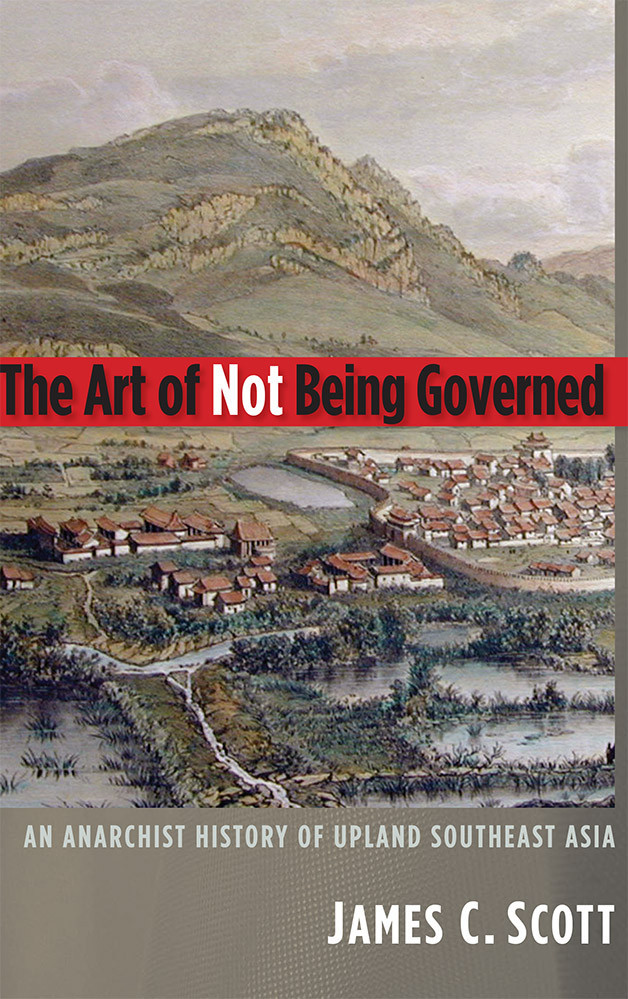
The reality is that cultural identity in particular can be startlingly fluid. As James C. Scott points out in his splendid The Art of Not Being Governed: An Anarchist History of Upland South East Asia, cultural identities can be chosen to fit in with ways of life (specifically: river valley farming, slash-and-burn horticulture, foraging) that can also be chosen (in the cases he considers, including to get away from rule by the river-valley agrarian states). There is no ur-identity here. Chosen identities are not an invention of modern Western sub-cultures.

For instance, in living memory, the Palestinian identity has been created. There is a line of Zionist argument which holds that Palestinian claims are illegitimate as there was no Palestinian identity before the waves of Jewish settlement. The historical claim is correct, but has no moral implications, because there certainly is a Palestinian identity now: created, as such identities so often are, in opposition (in this case, to the Zionist project).

Though there are some similarities to the dynamics of the Jim Crow American South, in that the no-compromise strain in Palestinian identity was originally an unholy alliance between clerics acting as gatekeepers of righteousness and those landlords who resented the undermining of existing structures of social control and exploitation based particularly in debt-bondage. An undermining they--perfectly correctly--blamed on the Jews, as the rise in wages was a result of the influx of Jews, and especially their accompanying capital (which raised wages), while the influx of those attracted from elsewhere in the Middle East by the increased economic activity also undermined existing social hierarchies and patterns of control.

A further similarity with the Jim Crow South is that it seems that the only consensus position among Palestinians is that, unless they get to be the equivalent of Jim Crow Southern whites, no peace agreement with Israel is acceptable.

Nor was there historically some sort of ur-racism. Not only are racial, ethnic and cultural categories more fluid than is commonly realised, but the normative weight put on them is also remarkably fluid over time. Asians have become functionally "white" in the contemporary US while medieval Christendom had little or no skin-colour racism to speak of (though it had plenty of other negative categorisations); as was also true of the Greek and Roman Classical Mediterranean.

Putting negative moral weight on (black) skin colour first arose under the Christian Roman Empire but then, rather more fully, in Muslim North Africa. In both cases, it was about justifying slavery within a universalising moral perspective (Christianity or Islam respectively). In the Muslim case, to justify the mass enslaving, rather than conversion (which would block said enslaving) of Sub-Saharan Africans. The use of mass slavery in the Christian-ruled Americas led to similar derogatory rationalisations, which got another oomph with the adoption of Enlightenment universalism. (Of course, so did opposition to slavery.)

Racism was far more of a post hoc rationalisation of oppression and exploitation than an originating cause thereof. Though, like all moral exclusions, it retains the appeal of effortless virtue, an effortless sense of superiority. (The rise of "biological" conceptions of ethnicity and race from the C18th onwards was an attempt to locate a sense of identity, for a culture of increasingly mass literacy, that wasn't religious or dynastic yet seemed scientific.)

Even more confusingly, by far the worst manifestation of racism in world history was Europeans systematically massacring other Europeans. Given that there is non-white racism, and that the victims of the worse manifestation of racism were also white, the race-as-(inevitably hierarchical)-moral-category approach really does not work--except as a new way of selling effortless virtue. Which is precisely what the framing does, in both Hitler's form and its "progressive" reversal. In either form, it is an ideology in Vaclav Havel's sense:
Ideology is a specious way of relating to the world. It offers human beings the illusion of an identity, of dignity, and of morality while making it easier for them to part with them. As the repository of something suprapersonal and objective, it enables people to deceive their conscience and conceal their true position and their inglorious modus vivendi, both from the world and from themselves.
An ideology that is simply rebutted through grasping, indeed celebrating, our common humanity.

Islam is better
In his private conversation, Hitler was not very keen on Christianity. As he says in his Table Talk,
The heaviest blow ever struck humanity was the coming of Christianity. Bolshevism is Christianity's illtegitimate child. Both are inventions of the Jew. The deliberate lie in the matter of religion was introduced into the world by Christianity. Bolshevism practises a lie of the same nature, when it claims to bring liberty to men, whereas in reality it seeks only to enslave them. In the ancient world, the relations between men and gods were founded on instinctive respect. It was a world enlightened by the idea of tolerance. Christianity was the first creed in the world to exterminate its adversaries in the name of love. Its key-note was intolerance.
Without Christianity, we should not have had Islam. The Roman Empire, under Germanic influence, would have developed in the direction of world-domination, and humanity would not have extinguished fifteen centuries of civilisation in a single stroke.
Let it not be said that Christianity brought man the life of the soul, for that evolution was in the nature of things. (11/12th July 1941).
Nor was this a one-off comment, the Table Talk is littered with derogatory comments about Christianity and the Church. By contrast, Islam was distinctively preferable:
Had Charles Martel not been victorious at Poitiers--already, you see, the world had already fallen into the hands of the Jews, so gutless a thing Christianity!--then we should in all probability have been converted to Mohammedanism [Islam], that cult which glorifies heroism and which opens up the seventh Heaven to the bold warrior alone. Then the Germanic races would have conquered the world. Christianity alone prevented them from doing so. (28 August 1942).
When Hitler mentions Islam, it is typically to note ways in which it was preferable to Christianity. After the Nazi defeat, there was something of a trail of ex-Nazis to the Middle East--after all, they got to help fight Jews. And the elevation of Israel to the status of the state that Western progressivists and political Islam can bond over by hating has been an excellent conduit for moving from the Radical Enlightenment modernist Left to Counter-Enlightenment postmodern progressivism. Just as it has been an excellent conduit for the, now endemic, habit in so much of the mainstream media of preferring Virtue over veracity.

Maximum virtue, minimum effort
As a friend noted in conversation (and Stephen Hicks develops with clarity and intellectual depth), the explicit ideologies arising out of the Radical Enlightenment fail; so moving to a set of "compassion authentic" positions with accompanying justifying rhetoric (the latter created as necessary) works much better. Hence the rebooting of the Counter-Enlightenment--as that elevates intent, passion, sentiment, authenticity.

All of which are excellent bases for effortless, or very low cost, Virtue. Which is the other advantage of the Counter Enlightenment rebooted; it provides endless ways of signalling membership of the tribe of the Truly Virtuous. (A claim and process that postmodern progressivism and political Islam also have in common.)

Particularly if you adopt what econblogger Noah Smith calls Haan history; a vision of history very different from the hopes and aspirations of both the Sceptical and Radical Enlightenments:
... what's clear is the anti-Whig perspective. Progress does not fix things. The fact that Jim Crow was less horrible than slavery, and that redlining was less horrible than Jim Crow, and that today's housing policy is less horrible than redlining, does not mean that things are getting better. What matters is not just the flow of current injustice, but the stock of past injustices.
Haan presents a vision of stasis that is different from the Malthusian version. By focusing on the accumulated weight of history instead of the current situation, and by focusing on the injustices and atrocities and negative aspects of history, it asserts that the modern age, for all its comforts and liberties and sensitivity, is inherently wrong.
Western civilisation becomes defined by the weight of past sins (and ludicrous over-weighting of current ones). Other civilisations are not so defined (particularly not Islam). In internal Western status games, Haan history gives the Virtuous instant moral superiority over any of their fellow citizens who express any attachment to the society in which they were born; the society whose success and stability is the crucible for the hopes and aspirations for them and their families. Such instant moral superiority is, of course, the point of the exercise.

For the moral posturing involved is precisely that--moral posturing. The purpose is to buttress the collective normative narcissism of Tribe Virtue. Hence the patent inconsistencies in moral concern, including the endless excuse-making why Western sins (and especially Western "white" sins) get so much weight, and anyone else's so little. It produces remarkably closed minds and, even better, easily transmittable techniques for closing minds.

Analytical insight
Kiwi political scientist Xavier Marquez's analysis of personalities cults, and his criticism of the use of the notion of legitimacy as an empirical criteria, are both useful analytical tools for understanding what has been going on.

Regarding the former: in a situation where moralism is compulsory, how do you signal your membership of the Truly Virtuous? By embracing any required level of inconsistency--which facts count, which don't; what sins count, which don't; what critiques are acceptable, which aren't. The Counter-Enlightenment's trumping of identity and emotion are made for that; while its deprecation of reason (and especially reasoned debate) are necessary for the specific Virtue signalling strategy's success.

To take a current salient example of embracing inconsistency to signal Virtue; any critique of Western society as "rape culture", and Western men (such as college students) as willing, even eager, participants in said "rape culture", is Virtuous. Conversely, any critique of Islamic societies as "rape culture", or cases of Muslim men as active rapists (from Rotherham to Cologne to ...), is to be denied, belittled, emptied of significance. Even if such critique is done by people of Muslim heritage (with formulations such as "native informant", essentialist or orientalist being used to discount what they say). So, that the sources of Islam canonically endorsed the right of believing men to have sex with (i.e. rape) their non-believer captives, including their married captives, is a reference to be ignored, belittled, denied significance; while Western history and culture can be happily ransacked for evidence of violent misogyny.

Muslims make excellent moral mascots or sacred victims not despite the queer-hatred, Jew-hatred, misogyny, and abusive Othering which is so pervasive in Islamic cultures (flowing directly from the doctrines and long term effects of Islam on moral sensibility) but because of all that. One has to embrace so much inconsistency in embracing Muslims as moral mascots of sacred victims, that doing so becomes a perfect mechanism for signalling Virtue.

To take an extreme, but revealing, example of highly selective concern for facts, and the dominance of rhetorical convenience and Virtue signalling over logical consistency, a "white trash" young guy kills 9 African-Americans in a church in Charleston and the progressivist concern is all about the shooter, and anyone who might look in any way like the shooter, or might think in any way like the shooter, or might be attached to a flag that the shooter might or might also be attached to.

A jihadi couple gun down 14 people in San Bernardino, seriously injuring another 23, and amongst progressives, it is all about not talking about the shooters, absolutely not about anyone who might look or think in any way like the shooters, or might be attached to any doctrines espoused by the shooters. In fact, any number of folk can kill any number of people while shouting "Allah akbar!" and it is never about the shooters. Except, possibly, in a "root causes" way, but the "root causes" of white racism are never considered in any way similar to the alleged "root causes" of jihadism.

Similarly, the chances of an American being killed by a terrorist are, as progressives love reminding folk, pretty remote. Probably about as remote as of an African-American being killed by a white racist. But the first observation is Virtuous, the second very much not.

Then there is the recurring attempts to create moral panics over anti-Muslim sentiment which, on the statistics of actual attacks, is a relatively minor problem. Conversely, the statistically rather more significant problem of attacks by Muslims on Jews is largely ignored. The more factual selectivity and logical inconsistency you are prepared to embrace, the more clearly you signal your Virtue, your membership of Tribe Virtue.

Marquez's critique of legitimacy argues that signalling, and how free or blocked are information flows, are the key issues in analysing social dynamics (not cognitive commitment, which is often largely invisible). For Tribe Virtue, signalling provides coordination: and modern information technology (and particularly social media) provide excellent coordination mechanisms. Markers of Virtue can then operate to coordinate large group of people. Again, elevating "authenticity", emotions, identity all simplify and magnify signalling effects.

Turkish-American economist Timur Kuran's analysis of preference falsification is also useful to understand what is going on--especially the mechanisms for the creation of public acquiescence. The Virtue Game weaponises morality--it imposes genuine costs on those who fail to publicly acquiescence; especially reputation costs (pdf). Particularly given that, since adherence to the various claims signals Virtue, contradicting or criticising them signals Viciousness. The dialectically false, but rhetorically extremely powerful, syllogism of:
X is done/advocated to stop Y
You are against/criticising X
Therefore
You are for/insufficiently against Y
Is accepted and applied to denigrate and shout down dissent and to enforce conformity. As priests and clerics have found down the ages, the ability to define Virtue is a powerful mechanism for enforcing social compliance: one always defined and applied as "true" morality. A nice contemporary example of how it works is economist Robert Frank's experience of the resulting social pressure from using University granting athletic scholarships, and the (false) reputation of athletes as less intelligent than average, to provoke more comprehensive discussion of affirmative action.

As people's sense of moral identity (and moral superiority) is at stake, a significant proportion of those seeking the status of being members of Tribe Virtue in good standing are willing to impose social costs on those who dissent.  Especially given their reasonable confidence that they will be backed up.

Codes of conduct (notably "speech codes) become an excellent way of entrenching and institutionalising both markers of Virtue and punishment of dissent. Violation of elementary principles of natural justice and due process (such as hidden accusers) demonstrate how much of a power play it all ultimately is.

Self-righteousness, status seeking and power plays are combined together in a noxious package. Hence the (ironic) title of Social Justice Warriors for those for whom trashing civility, freedoms and rights is paraded as some sort of moral advance, rather than the deeply self-serving, narcissistic power grab, wielding weaponised morality, it is.

There is a perennial tendency for organisations to be taken over by those who are able to mobilise and wield reputational effects, to impose reputational costs, most thoroughly. For decades, that has been the modernist Left, who have been even more successfully followed by postmodernist progressivism. Hence historian Robert Conquest's observation that:
Any organization not explicitly right-wing sooner or later becomes left-wing.
The modernist Left and postmodern progressivism are both deeply controlling when they get any serious amount of power precisely because they are so normatively driven--hence profoundly inclined to adopt the deeply totalitarian principle that error has no rights. They more or less automatically commit the just-add-morality error.

They also tend to be remarkably poor at actually running organisations and institutions (as distinct from taking control of them) because they are so inclined to block information (and to heretic-hunt) while substituting normative display for practical effectiveness. Creating, for example, education systems not terribly good at imparting knowledge and skills (particularly given the resources consumed) but truly excellent at stripping people of their deeper cultural heritage.

The massive sense of moral entitlement involved--displayed currently by claiming the right to determine what people can say, how they can say it, what they can wear, what they can enjoy, what concerns are legitimate--fuels this march-through-the-institutions power grab.

The collective narcissism tango
The package parades (above all, to themselves) as being the epitome of morality. Which is precisely what it is not: neither in the overturning of elementary civility and any reasonable sense of moral proportion; nor in the weaponising of morality against both masses of fellow citizens and one's own society; nor in the pervasive contempt for human achievement which underpins the entire outlook.

The achievements of Western civilisation are far more distinctive than its sins, and far greater. We in the West live in prosperous and profoundly decent societies, where an ordinary citizen of today lives better than a billionaire did a century ago: only a pathological moral outlook would treat confidence in, and respect for, those achievements as something contemptible. A moral outlook all the more pathological for being so ultimately self-serving: which, of course, is where it gets so much of its emotional power--the combination of sneering superiority and self-righteous moralism is very powerful. But that makes it no less contemptible.

The collapse of the Soviet Union brought to an end the Left-Right divide that had operated since the French Revolution. As philosopher Stephen Hicks has laid out, post modernism was a way to rescue a sense of moral purpose and superiority from the serial failures of the entire post-capitalism project. Let loose from any commitment to actual social achievement, the substitution of attitude rooted in nothing more than a profoundly tribal sense of the collective moral narcissism provides a profound sense of emotional self-worth, and moral superiority, without the tedious business of actually building anything worthwhile.

Rebooting the Counter-Enlightenment is not a sign of moral sense and perception, but of a commitment to nothing more than towering edifices of presumption and contempt. For nothing actually existing is, or could ever be, worthy of Tribe Virtue's soaring sense of moral superiority. Collective narcissism parading as moral commitment--this is what the progressivist movement has become out of the ashes of socialism.


[Cross-posted at Skepticlawyer.]

Monday, August 10, 2015

Frustrated status and bigotry

Bigotry (in the sense of prejudice-by-category) is a form of moral exclusion--one excludes some group from the moral consideration and standing given to other people. As I have noted before, bigotry is always and everywhere a moral claim--a claim about some category of people's moral status or standing. A claim not based on specific individual actions against others, but on either some alleged essential flaw they all share or some shared transgression against a conception of social order or human nature. (A classic formulation of such bigotry is Carl Schmitt's aphorism that not everything with a human face is human.)

Motivators
There are three basic motivators for such moral exclusion.  One is social cartels--blocking the excluded group from social participation available to others; typically so as to stop the excluded group from competing for social goods or so as to derive some other (typically exploitive) benefit from said exclusion. The "cleanliness of the blood" laws of Christian Iberia blocking Jewish converts to Christianity from holding various positions or receiving various benefits were a classic example of the former. Jim Crow laws in Southern US States provided both the former and the latter, as it increased the ability to extract income from disenfranchised African-Americans.

Certifying not being of Jewish descent for the requisite number of generations.
Slavery is a particularly invidious form of social cartel, allowing the extraction of labour surplus from an entire category of people. Its effect on bigotry is more complex, depending somewhat on whether it is an "open" or a "closed" slavery system. In an "open" slave system, there are relatively high levels of manumission, with ex-slaves being integrated into the wider society as full citizens and economic participants; Ancient Rome ran an "open" slave system. There was some prejudice against freedmen (ex-slaves) but not their children. In a "closed" slave system there is very little manumission and ex-slaves were not integrated into the wider society: the Antebellum South ran a particularly intensely "closed" slave system. This both manifested and reinforced that slavery across a colour line is a powerful generator of bigotry.

The second motivator for moral exclusion is creating and maintaining the authority to exclude--what I call being "gatekeepers of righteousness". Priests and clerics are classic examples of such, though secular clerisies are hardly immune from either the temptation or the role.

Righteousness in this sense is a normative claim to override basic moral considerations. Deuteronomy 13 6:11 is a classic text of such righteousness:
If your very own brother, or your son or daughter, or the wife you love, or your closest friend secretly entices you, saying, “Let us go and worship other gods” (gods that neither you nor your ancestors have known,  gods of the peoples around you, whether near or far, from one end of the land to the other), do not yield to them or listen to them. Show them no pity. Do not spare them or shield them. You must certainly put them to death. Your hand must be the first in putting them to death, and then the hands of all the people. Stone them to death, because they tried to turn you away from the Lord your God, who brought you out of Egypt, out of the land of slavery. Then all Israel will hear and be afraid, and no one among you will do such an evil thing again.
Frustrated status
The third motivator for moral exclusion is social status; a sense of superior status both generating, and generated by, said exclusion and so accruing to the non-excluded with little or no effort on their part. Thus slavery across a colour line is a powerful generator of bigotry precisely because it separates physically distinct people into such starkly distinct categories--"real" people and property. The more stark the felt status gap, the more the "insult of equality" potentially arises: that people can feel actively insulted in being treated as the equals of the excluded group, in being subject to the same rules and treatment as the despicable, or at least "obviously" lesser, them.

I have previously suggested that low status people are particularly drawn to the effortless virtue (which is effortless status) of bigotry. A better formulation would be frustrated status--that is, people whose functional status in their society is significantly lower than the status they believe they should have; the disjunct being a source of negative emotions, with the level of emotional intensity generated being the key factor.

After all, it is eminently possible for people to be of low status without investing in effortless virtue. Conversely, people of some (or even considerable) status in society can well experience intense status frustration if they believe such status is nevertheless significantly lower than the status due to them.

Note this is not a point about some status merely aspired to, but status that one feels one is, in some sense, entitled to. The effortless virtue, the effortless status, of bigotry can provide a substitute sense of status. Although, ironically, if those regarded as morally excluded are nevertheless socially successfully, that can set off, and intensify, a further spiral of negative emotions as the morally excluded group's success becomes even more of an insult to an aggrieved sense of status.

A question and answer on Razib Khan's gene expression blog is pertinent to the power of frustrated status. A commenter asked, regarding a documentary on escaping ISIS slaves:
…concerning ISIS, I just don’t get what makes people who have grown up in Western democracies join a movement whose members openly brag about having re-introduced slavery.
Razib Khan replied:
they’re in the country, but not of it. they feel marginalized. islamism provides a cultural exit strategy to being members of a society that can’t/won’t/isn’t able to absorb them or the way they insist on being (the second is key, because there are plenty of people of muslim background who are assimilating into european norms). a lot of the radicals of the late 19th century were from jewish backgrounds. they were outsiders, and millenarian political radicalism offered a way to make an end around the system.
Yes, quite. Particularly the way they insist on being point. One of the striking feature of the Islamic world, particularly of Middle Eastern Islam, particularly Arab Islam, is the continuing strength of various moral exclusions--Jew-hatred, misogyny, xenophobia of various forms, even anti-black racism. The last being (yet another) example of the poisonous legacy of slavery. Within the West, Muslim communities are epicentres of the upsurge in Jew-hatred.

While forming social cartels (reserving various social goods for male believers, for example) is something of a factor, most of the excluded groups are already so marginal that there is not much gain to be specifically had from such social cartelisation. Apart, that is, from gender-exclusion; but that perhaps says more to how systematic misogyny tends to be, rather that its comparative emotional power.

The authority to exclude is a much more lively factor. Islam is such a part of the public life in Muslim countries and communities, that Muslim clerics are both in a position to act as effective gatekeepers of righteousness and to have their social authority enhanced by doing so.

But it is frustrated status which has the real kick. Islam is easily read as saying that male believers are not merely entitled to be at the top of the human social pyramid, but mandated by God to so be; moreover, not merely mandated locally, but globally.

Clearly, they are not. Hence frustrated status. Which Islamic clerics can both generate and exploit. The problem with living in a global village is that some may decide (and clearly have) that they have a divine mandate to take over that global village--Allah being the sovereign of the universe and Sharia being His law, so applicable everywhere and to everyone. A status of local and global dominance that beckons, but is so patently not how things currently are.

Indeed, I would put frustrated status at the centre of understanding the violent pathologies within Islam, particularly within Middle Eastern Islam. Thus, the success of Israel--the Jewish state--becomes a cosmic insult, rubbing the noses of believers (particularly male believers) in how much they are not the top of the human social pyramid in their own region of the world. But so much of our globalised world conveys such a message about the contemporary world as a whole.

Much of the complaints about "Islamophobia" are in fact claims for a protected, indeed superior status, for Islam. Hence, as historian Bernard Lewis points out in his classic 1990 essay The Roots of Muslim Rage, many Muslims:
... demand for Islam a degree of legal protection which those countries no longer give to Christianity and have never given to Judaism. Nor, of course, did the governments of the countries of origin of these Muslim spokesmen ever accord such protection to religions other than their own. In their perception, there is no contradiction in these attitudes. The true faith, based on God's final revelation, must be protected from insult and abuse; other faiths, being either false or incomplete, have no right to any such protection.
As for the patterns of violence and massacre within the Middle East (and elsewhere), lashing out violently not merely assuages rage, it expresses on-the-spot dominance in the most visceral fashion. In the case of the revival of slavery, the appeal of slavery to such status-mongering is obvious. That is so even without the social cartel of slavery allowing for exploiting those stripped of most basic legal standing; and so stripped on righteousness grounds.

The current cycles of massacre are part of a larger pattern going back to the Hamidian massacres of the 1890s and directly connected to an ongoing sense of insult that non-believers could be considered legal, social and moral equals of believers; especially within Dar al-Islam.

Women signalling religious piety by wearing restrictive clothing that goes well beyond anything specifically mandated in Quran or hadiths appeals to, and reinforces, the sense of proper social order being the dominance of male believers.

The use of violence to police public space--and to do so globally, from the Charlie Hedbo killings to hacking to death Bangladeshi bloggers--is also a statement of "proper" dominance.

This is likely why the conveyer belt model of jihadi recruitment works at best weakly as a description of the path to jihadi recruitment. [Or not at all, really.] There are too many direct paths to the energising and viscerally dominating violence of jihadism; extending to its role as a pathway to eternal superior status in Paradise.

A civilisational trap
Islam has an interlocking series of problems. The medieval defeat of Aristotelianism within Islam, with the triumph of al Ghazali's critique, meant that mainstream Islam came to hold that revelation defines the ambit of the good, that there is no realm of morality beyond revelation. Hence the Islamic states being the only collection of states who felt compelled to issue their own version of the 1948 Universal Declaration of Human Rights, the 1990 Cairo Declaration of Human Rights in Islam.

It is that much harder to argue for a secular public space if the very notion of moral principles not anchored in revelation is deemed to be against Islam; indeed, an offence against Islam--as in the case of the targeted Bangladeshi bloggers but extending to intellectuals, journalists and cartoonists through out Islam and beyond. As Bernard Lewis notes in The Roots of Muslim Rage:
The war against secularism is conscious and explicit, and there is by now a whole literature denouncing secularism as an evil neo-pagan force in the modern world and attributing it variously to the Jews, the West, and the United States.
The medieval defeat of Aristotelianism also meant that mainstream Islam accepted the view that there was no inherent causal structure to the universe, that everything we see is just the habits of God. When Muslims say "if God wills it" (or some similar formula) it is not merely a pious formula, it has an embedded metaphysical claim. In Wikipedia's useful summary of al-Ghazali's formulation, that:
There is no independent necessitation of change and becoming, other than what God has ordained. To posit an independent causality outside of God's knowledge and action is to deprive Him of true agency, and diminish his attribute of power. In his famous example, when fire and cotton are placed in contact, the cotton is burned not because of the heat of the fire, but through God's direct intervention
It is that much harder to sustain a notion of science, of secular knowledge, if all action in the universe is understood in such a theological fashion. Ideas have consequences.

As noted in my previous post, the state history of Islam militates against well developed habits and patterns of institutionalised bargaining: so Islamic politics has tended to fail to provide countervailing patterns. On the contrary, scapegoating "enemies of Islam" (most obviously, the "Zionist entity") has tended to be used to pander to, and reinforce, such patterns.

All of which leads to a pervasive sense of frustrated status--a sense of not having proper (even divinely mandated) social dominance--fuelling the politics of hate and violence. Egged on by Muslim clerics all too eager to claim the role of gatekeepers of righteousness. Such preaching extends, at worse, to the implicit or explicit condoning of violence but, even without that, rejects inclusive and egalitarian values which itself narrows the possibilities for social bargaining.

The dominant issues and patterns here are not Western policy, globalisation, the existence of Israel; it is the history and internal patterns of Islam. It there that the explanations of the continuing power of moral exclusions within Islam lie. As Bernard Lewis notes in The Roots of Muslim Rage:
The Muslim has suffered successive stages of defeat. The first was his loss of domination in the world, to the advancing power of Russia and the West. The second was the undermining of his authority in his own country, through an invasion of foreign ideas and laws and ways of life and sometimes even foreign rulers or settlers, and the enfranchisement of native non-Muslim elements. The third—the last straw—was the challenge to his mastery in his own house, from emancipated women and rebellious children. It was too much to endure, and the outbreak of rage against these alien, infidel, and incomprehensible forces that had subverted his dominance, disrupted his society, and finally violated the sanctuary of his home was inevitable. It was also natural that this rage should be directed primarily against the millennial enemy and should draw its strength from ancient beliefs and loyalties.
Gender dynamics are so much at the heart of current patterns within Islam, that feminists of Muslim heritage--writers such as Karima Bennoune (Your Fatwa Does Not Apply Here) and Azar Nafisi (Reading Lolita in Teheran)--are indispensable to understanding what is going on within Islam; both in Muslim countries and in Muslim communities.

Patterns specific to Islam
Regions outside Islam experienced Western colonialism, live in a predominantly capitalist global economy, have migrant communities within Western states; they do not manifest the specific homicidal pathologies that emerge out of Islam (including among converts to Islam). The narcissistic sense of divine entitlement that Islam is prone to generate; the sense of frustrated status such gives rise to; and the embrace of being highly differentiating gatekeepers of righteousness that so many Islamic clerics are so keen on, are key factors.*

Islam's history of states weakly integrated with the societies they rule, with very limited histories and institutions of social bargaining, has led to states which often fail to provide compensating social mechanisms while readily adopting modern techniques of social control and repression--repressive security states as modern substitute for the slave warrior states of the past.

Emerging from this fraught history neither has been, nor will be, an easy process: for Islam or the rest of us, their global neighbours. But pretending that the fundamental dynamics arise from anywhere other than within the religion and civilisation of Islam does not, to put it mildly, help.


* Palestine provides a microcosm of all this; particularly the ludicrous "right of return" whereby Palestinians--alone of all the myriad displaced peoples of the C20th--get to be hereditary refugees with claim to reside in the territory of someone else's sovereign state that somehow should be (in that one and only case) taken seriously. While Palestinians cling to this delusion (itself driven by a sense of entitled status) Israel can quite reasonably infer that no serious peace is possible, so it may as well continue to, slowly but steadily, grab what it can.


[Cross-posted at Skepticlawyer.]

Tuesday, July 12, 2011

The Science of Evil

Psychologist Simon Baron-Cohen’s The Science of Evil: On Empathy and the Origins of Cruelty is a fascinating, clear, short excursion into the current science of empathy, autism and their implications. (And if the name seems vaguely familiar, yes, he is Borat’s cousin.)

The book starts with a discussion of human evil and cruelty, using some salient examples, suggesting that while ‘evil’ as a concept has little explanatory value, and is not amenable to scientific study, empathy has both. That human evil and cruelty are the result of a lack, or erosion of, empathy. Empathy being defined as:
our ability to identify what someone else is thinking or feeling and to respond to their thoughts and feelings with an appropriate emotion (p.16).
Using the word ‘appropriate’ in a definition is troublesome unless you “cash it out” later, but we get the point. If someone lacks empathy entirely, then they are “trapped in their single focus” on themselves (p.18): such people being the subject of the book.

About empathy
Before we get there, Baron-Cohen covers how empathy can be measured, and how people (permanently or temporarily) vary in empathy according to, as is so common in human traits, a Bell-curve distribution (Pp19ff). Even though empathy is a continuous dimension, as a useful heuristic, he divides people into various levels of empathy from level 0 (none) to level 6 (very high levels) according to their EQ (Emotional Quotient), a scale he and his fellow researchers devised based on questionnaires (Pp23ff).

Baron-Cohen notes the problems of self-reporting but argues these “occasional inaccuracies” are cancelled out in sufficiently large samples (p.22). His discussion covers current findings in neuroscience about relevant areas of the brain to empathy (Pp27ff). One of the things that impresses me about the book is that Baron-Cohen is careful not to over-claim, either in his discussion of the neuroscience or his later discussion of genetic connections. He does not fall foul of this critique of connecting neuroscience to psychology: his point is the more basic one of establishing that there is a biological basis for the psychology he is outlining.

When it is all about them
We then move to discussing Zero-Negative empathy; that is, people with zero empathy who behave in ways dangerous to others. Throughout the book, he uses revealing examples: in this section, of people with Borderline, Psychopathic and Narcissistic personality disorders (Type B, Type P and Type N). A weakness in this use of examples is that Baron-Cohen naturally uses particularly intense examples: one needs to pay careful attention to the discussion of general characteristics and not take his examples as templates.

It is nasty to be around a borderline, but it is not good to be one either: they are about 2% of the population but about 15% of those who turn up for counselling or psychiatric help, about 33% of those who commit suicide, and may be as many of half of those seeking clinical help for eating disorders, alcoholism and/or eating disorders; with a high propensity to commit, attempt or threaten suicide (p.55). Borderlines:
rage at those they love. … Despite all this rage, they describe themselves as “empty” inside (p.56).
An emptiness they attempt to fill with impulsive behaviour and which leaves them with a lack of core identity. Marilyn Monroe was a borderline personality (Pp57ff).

So, what causes it? There is a great deal of evidence that childhood deprivation affects brain development and helps generate personality disorders. The causal connection is complicated: 80% of those who suffer childhood sexual abuse do not grow up to be borderline personalities, but 40-70% of borderline personalities report childhood sexual abuse, 60-80% report a history of physical abuse, early separation through divorce, emotional neglect, indifference, deprivation and rejection (p.62). So childhood abuse and neglect creates a strong propensity to being borderline, but is not of itself determinative. Borderline brains show distinctive patterns that include abnormalities in the brain’s “empathy circuit” (Pp62-4).

Next are the psychopaths, or Type P. These are the classic “evil individuals”. They also lack empathy, but are willing to do whatever will satisfy their desires (p.64). About 3 percent of males and 1 percent of females have antisocial personality disorder (which includes psychopaths), but about half of all male prison inmates and a quarter of female prison inmates have antisocial personality disorder (p.67). The classic identified symptoms of psychopaths are:
superficial charm
lack of anxiety or guilt
undependability and dishonesty
egocentricity
inability to form lasting intimate relationships
failure to learn from punishment
poverty of emotions
lack of insight into the impact of their behaviour
failure to plan ahead (p.68).
Economics predicts that criminals will tend to be people with short time horizons, which fits. Baron-Cohen is more specifically interested in the lack of empathy involved in so many of the above symptoms. Part of the danger of the psychopaths is that they may not be physically aggressive, but can be more subtly so. Baron-Cohen accepts that the cliché “snakes in suits” is an apt description of how they can be camouflaged.

Psychopaths respond to parental rejection with rage. Blocked from being expressed towards their parents, the rage builds up, to be vented later in life, unchecked by any empathy (Pp69ff).

Baron-Cohen briefly sets out child psychiatrist John Bowlby’s attachment theory, which generates predictions that are supported by considerable evidence. The theory holds that an infant uses the primary care-giver as a “secure base” from which to explore the world:
By giving praise, reassurance, and a feeling of safety, the caregiver’s affections helps the child manage his or her anxiety, develop self-confidence, and trust in the security of their relationship (p.71).
Baron-Cohen paraphrases this as successful parenting gives a child an “internal pot of gold” that fills the child up with positive emotions. Psychopaths typically have a higher rate of what Bowlby (who developed his theory from work with juvenile delinquents) called “insecure attachment” (Pp 71ff).

Psychologist Jeffrey Gray developed the theory that psychopaths have an under-active “Behavioural Inhibition System” (BIS), the structure that allows learning about the emotional consequences of actions, while anxious people have an over-active BIS. Hence psychopaths do not learn to fear punishment: with clear consequences. Psychopaths also show brain abnormalities in their “empathy circuit” (Pp79ff).

Then it is on to narcissists (Type N), the least studied of the three main types of personality disorders. They lack empathy or humility, think themself much better than other people, typically tending to monologues rather than conversations; though narcissists can vary greatly in their mode of social interaction from outgoing to shy and withdraw. A massive sense of entitlement is a common feature, however. It is speculated that excessive parental admiration, praise or indulgence is a factor in the creation of narcissists. They are about 1 percent of the population but about 16% of those attending clinics for mental health issues while a half to three-quarters are male (Pp88ff).

Baron-Cohen discusses how empathy can be temporarily or permanently depressed (Pp 93-4). This is of particular interest to me, because I have come to the conclusion that bigotry works by exempting people from being objects of empathy. Putting them outside the ambit of empathy.

Clearly, emptiness, rage and entitlement can occur in response to seriously unbalanced parenting and yet not create borderlines, psychopaths or narcissists. The essence of Baron-Cohen’s theory is that it is those things plus zero-empathy which makes Type B, P or N personality disorders.

All about patterns
Then it is on to an even more enlightening discussion of how zero empathy can be positive, in the case of people in the autism spectrum (particularly Aspergers). For empathy is not the sole route to developing a moral code (p.95). These people can be Zero-Positive for two reasons:
First, in their case their empathy difficulties are associated with having a brain that processes information in a way that can lead to talent. Second, their the way their brain processes information paradoxically leads them to be supermoral rather than immoral (p.96).
People in the autism spectrum show underactivity in the empathy circuit (Pp100ff).

What distinguishes these people from the Zero-Negatives is that they systemise to a remarkable degree. The social world lacks rules they can grasp, but the physical world is full of them:
People with Asperger Syndrome have brains that are exquisitely tuned to notice patterns (p.104).
Patterns are basic to acting, to predicting, to making things work, to find new ways to make things work. By identifying patterns we can see what is the case and what can be made to be the case. In a sense, seeing patterns allows us to step outside time because we can identify enduring realities. We can systemise by observing patterns, or by observing and operating on them: we can then create new ways of doing things (Pp105ff).

Calling those parts of the brain that can perceive patterns in changing information the “Systemising Mechanism”, Baron-Cohen points out that these are also distributed in a Bell curve, from people with very low systemising ability to those with very high systemising ability. The problem for the hyper-systemisers, is that all they see are patterns, so any unexpected change is toxic. They seek complete control so everything is completely ordered, with any disruption threatening collapse. The upside is that they see patterns no one else has discovered. Such people live in a black-and-white world of things being true or false, never shades of grey. For them truth is precision. And the emotional world does not “fit”. Their systemising mechanism is set so high, there is no place for empathy. But there can be great intellectual and other creativity, as they spot and use patterns no one has previously noticed (Pp112ff).

Classic autism, in Baron-Cohen’s analysis, is this to the max. Autistics have no sense of empathy at all, no sense of other people except as objects. But everything needs to be systematic, patterned or else it becomes toxic change they cannot deal with, that they have no place to “put” it. But without the obsessive systemisers, Baron-Cohen argues, humans would have achieved far less (Pp118ff).

What makes the hyper-systemisers' zero-empathy profoundly different from the Zero-Negative borderlines, antisocials (including psychopaths) and narcissists is that the hyper-systemisers come to morality, not through empathy, but through a very strong sense that behaviour should be governed by rules. They can, indeed, be super-moral because they are so strongly tuned to fairness as a basic principle. So, they are Zero-Positive both in the sense of being often highly creative and in being moral, even hyper-moral, without empathy (Pp 121ff).

Wrestling with cause
All of which is fascinating and enlightening, but still leads to the question of causes. Yes, parental abuse and neglect or otherwise seriously unbalanced upbringing can lead to destruction of empathy coupled with emptiness, rage or entitlement but most people with abusive or otherwise seriously unbalanced upbringings do not develop into borderlines, psychopaths or narcissists. Conversely, some people develop in to Zero-Negatives without suffering such neglect or abuse. If environment is not sufficient explanation, then interaction with genetics (and Baron-Cohen stresses interaction and that genes are just mechanisms for coding proteins) has to be considered (Pp125ff).

But any genetic tendencies to low empathy that manifests in the Zero-Negatives are going to be different genes from the Zero-Positives, given that the latter go down the empathy distribution as they go up the systemising distribution (p.127).

Which brings us, inevitably, to twin studies and which traits are common in identical twins and different in non-identical twins. Baron-Cohen discusses (in a very accessible way) the evidence on genes for aggression, emotional recognition and genes associated with EQ and autistic traits. Baron-Cohen then reminds us that causes are very mixed: genes are not determinative (Pp128ff).

If empathy is in part genetic, there should be evidence for empathy in animals. Which there is, some of it unexpected (in rats, for example)(Pp143ff). Nevertheless:
whatever glimmerings of empathy we can discern (or imagine we discern) in other species, the level of empathy that humans show is qualitatively different from that seen in any other species (p.145).
As are our systemising abilities.

The final chapter is Reflections on Human Cruelty, where Baron-Cohen returns to making what people call evil amenable to scientific analysis. (He carefully makes it clear he is not buying into any Dawksian anti-religion agenda.) He summarises the ten new ideas he hopes to introduce into the debate:
we all lie somewhere on the empathy spectrum;
at one end is zero empathy;
the empathy circuit in the brain will be abnormal in such cases;
treatment of zero empathy should target the empathy circuit;
John Bowlby’s notion of early secure attachment can be usefully characterised as an internal pot of gold able to be drawn upon;
there are genes for empathy;
while most forms of zero empathy are negative, one is positive;
Zero-Positive comes from a mind striving to “step out of time” to see the repeating patterns in nature;
the Zero-Positive mind finds change toxic;
empathy is the most valuable resource (Pp147ff).
I was particularly struck by the comment that:
Calling the brain types personality disorders leads to debates about whether personality can be changed, especially if personality is defined as a fixed set of traits. Calling them Zero-Negative opens up new avenues for intervention (p.150).
Some of his tentative suggestions for treatment echo what Albert J. Bernstein in Emotional Vampires suggests for narcissists.

Baron-Cohen identifies various outstanding puzzles and suggests psychiatry needs to give much more attention to empathy. He considers the alleged “banality of evil”, what an underactive empathy circuit means and the potential for change. Finally, he considers the possibility of super-empathy and empathy as an under-utilised resource (Pp153ff). The book includes an Appendix incorporating questionnaires for measuring EQ in adults and in children (Pp187ff) and a second Appendix listing characteristics of Type B, P and N Zero-Negatives (Pp197ff), a very useful summary.

I found The Science of Evil a very enlightening book. I would particularly recommend it for anyone who is on the autism spectrum or has to deal with someone on the autism spectrum.