Showing posts with label China. Show all posts

Saturday, February 26, 2022

On acknowledged possession

Property law rests on conventions that evolved before it and that can operate without it, or even against it.
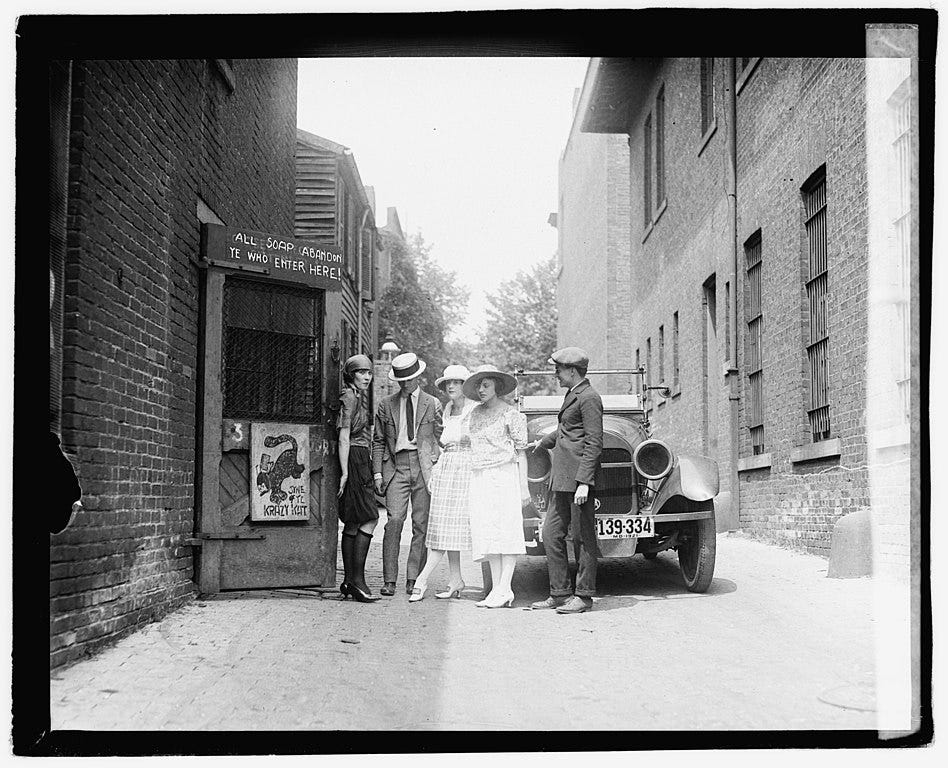
Waiting for the opening of a speakeasy in 1921 (Wikipedia commons).

Black markets, markets in illegal goods and services, demonstrate that state recognition and protection of property rights are not required for a market to operate. Black markets exist where the state bans the sale and/or purchases of specific goods and services and, as a consequence, will not protect the exchanges, goods, services or assets involved in, or derived from, such commerce.

The state does not only fail to provide recognition and protection of property rights within the banned market, or any mediation or adjudication services; it actively denies such and seeks to suppress the trades and accompanying property rights. Yet, black markets exist. They can even flourish, generating great (if insecure and often violently contested) wealth.

As various economists, such as Ronald Coase, Harold Demsetz and Yoram Barzel have explored at length, a trade, an exchange, is actually a transfer of control over some attribute or bundles of attributes. If such control is formally recognised and enforceable, then they are legal or formal property rights. But, as we have seen, trades can and do happen regularly even when formal legal ratification of such control, and their transfer, is actively denied.

How can this be? Because the functional element in property is not formal ratification by a legal system or process, but mutual acknowledgement by the contracting parties and others that they interact with. Such acknowledgment may be active, or it may be passive acquiescence. Nevertheless, such mutual acknowledgement is all that is needed for people to exercise effective control over attributes and so for economic property rights to exist. Indeed, such mutual acknowledgement is what makes any property law functional in day-to-day operation. The old saw that “possession is nine-tenths of the law” points to the fundamental role of mutual acknowledgement in any property system.

At this level, property-as-mutual-acknowledgement is a matter of convention, something you do in particular ways because others do so. (Language and fashion are classic realms of convention.) Property-as-mutual-acknowledgement generates basic conventions of resource use. If you have something in your possession, if you are exercising control over it, the information-economising presumption that simplifies human interaction is that it is, indeed, yours in the senses that matter. This mutual acknowledgement, as is normal for effective conventions, works because it works for everyone as a general presumption. People can operate on the basis of a common set of mutually-reinforcing, because mutually-beneficial and mutually-aligning, expectations.

Property everywhere and always exists via such information-economising acknowledgement, creating mutually-reinforcing expectations. The key thing in property is not “mine!”, any silverback gorilla thumping his chest can claim that. The key thing in property is “yours!”: the acknowledgement by others that the thing is yours and remains yours until you pass it to another.

A trade is just the process of transferring mutually acknowledged control over goods or services. All parties to the trade agree because they are getting something out of the transfer. Each gets the value they perceive out of having what the other previously had, or is going to provide, in exchange for what they themselves previously had, or will provide. An exchange they undergo because they value the former more than the latter. Hence, gains from trade: in cases of voluntary exchange, if both sides did not feel themselves to be better off, they would not have agreed to the trade.

Even in cases of coerced exchange (providing goods or services to avoid some violent or other penalty), the coercion works because the transfer is judged better than the alternative by both parties. In the case of the coerced, it is judged better than the alternative after coercion is put into play. In the case of the agent applying the coercion, before doing so. It is the legitimacy and consequences of the coercion that drives our judgement about such coercive exchanges. Taxes and a mugging are both coerced exchanges, but they are not generally regarded as normatively equivalent.

The power of mutual acknowledgement (and of information-economising, expectation-aligning, common presumption) is such that it permits black markets to operate even in the face of the state denying formal recognition of such acknowledgment. Indeed, even though the state is seeking to actively frustrate such mutual acknowledgement.

Black markets can only operate because the state is unable or unwilling to make its ban fully effective. But the difficulty of doing so points to, and is part a result of, the willingness of the parties to make the banned exchanges. Trades based on mutual acknowledgement using generally convenient conventions of property.

Because the parties involved seek to avoid the prohibiting efforts of the state, black market exchanges tend to gravitate towards places that are not regularly policed by the state. The level of black market activity in a locality tends to say more about the patterns in the policing efforts of the state than the inhabitants of the locality. Nevertheless, it is very easy for the inhabitants of such localities to be tarred by the association with the local black market activity. Something that can be useful to obscure the level of state responsibility for its (lack of) effective policing. And even more useful for dividing residents, citizens and workers by locality, or by features associated with locality.

In practice, even the blackest of black markets is somewhat parasitic on the formal property rights structure endorsed or provided by the state, if only to more securely enjoy the benefits of income and assets acquired from illegal exchanges. Hence the appeal of money laundering: converting what is illegal into what is legal by moving assets and income out of the realm that the state seeks to ban into the realm that the state acknowledges (i.e. ratifies) and protects. Obviously, the intent of such laundering of money and assets is to avoid the risks and costs of hostile state action but successfully doing so also gains the benefits of state property protection and adjudication services.

Thus, that black markets demonstrate that markets do not need the support and acknowledgment of the state to function does not mean that there are not major benefits in such support and acknowledgment. Including the various services the state may offer. Even if the state is purely motivated by the pacification needed to secure its taxation base, that normally entails some protection of property rights. Moreover, the pacifying state is likely to provide, or create social space for, or otherwise support, adjudication services as part of ensuring the social pacification that enables and supports its revenue extraction.

Trade or raid

Black markets are, of course, notoriously connected to violence. This flows directly from the state refusing to protect and acknowledge black market exchanges. In the absence of state protection and adjudication, assets have to be protected, and disputes adjudicated, by private action. In the end, by private force.

Moreover, black market exchanges happen through mutually acknowledged control of property. Such acknowledgement can be withheld or withdrawn.

Exchanges outside the ambit of state ratification, protection and public adjudication are in the pre-state situation of the primordial trade-or-raid choice. Does one bargain to secure desired things that another has by trade or does one simply take by raid?

Much of the point, and a very large part of the value, of state pacification is to minimise the attractiveness, and so incidence, of the raid choice. Thereby elevating the frequency and scale of the trade choice. Which can also further encourage the making of things, the third choice in acquiring something you do not already have, after take or trade. To the potential benefit of the state’s revenue.

Reducing transaction costs

Elevating the frequency and scale of trades is the core benefit of effective systems of legal property rights. Clarity of property rights, ease of adjudication and reliability of their protection all lower transaction costs, potentially dramatically. Transaction costs being costs entailed in making an exchange or other interaction. Specifically, search and information costs; bargaining and decision costs; policing and enforcement costs.

The lower transaction costs are, including the lower the risks involved in transacting and in having assets, and the greater the clarity in who has what rights, the higher the scale of transactions are likely to be and the more willing people are going to hold, and invest in, commercial assets. The state-revenue and economic growth advantages of this situation are likely to be very large.

While the advantages of the reduction of transaction costs through an effective legal system are very real, this is very different from stating or implying that such a happy situation is required for commercial activity to occur. It is perfectly clear, from history and anthropology, that such a well-functioning system of property rights and law is absolutely not necessary for commercial activity, even considerable levels of commercial activity.

As, of course, the case of black markets starkly demonstrate. More generally, as history and anthropology demonstrate quite clearly, mutual acknowledgement generating property conventions — whether or not such is formally ratified by the state and regardless of how efficiently or effectively the state does so — can still support considerable levels of commercial activity. Especially if agents within the state provide functional acknowledgment of property, even if formal ratification is lacking. Indeed, the case of post-1978 China demonstrates that such acknowledgement within the state apparatus can be sufficient even though private commerce and ownership is formally illegal. As it was in China until 2004.

China in the period 1978–2004 was not so much a matter of black markets — as the state was clearly not enforcing its bans on private property and private exchanges in anything remotely resembling a systematic way — as grey markets. Markets whose existence and exchanges were formally banned but functionally permitted. That such markets could operate at all, points to the key role of mutual acknowledgement in functioning property systems, every bit as much as black markets do.

What made such markets functional was being acknowledged by agents within the state apparatus. Indeed, often engaged in by such agents. What evolved were patterns of acknowledgement by such agents that permitted markets to emerge based on conventions of property (including of the transfer of property). Markets that were not typical black markets, with their associated violence and often socially disruptive goods and services; but nor were they ratified by the state within a formal system of property law. Though they were parasitic both on formal state property systems and the social peace imposed by the Chinese state.

The path of the People’s Republic from command economy to market economy, under the continuing regime of the Chinese Communist Party, can perhaps shed some light on a recurrent pattern in Eurasian history, where land starts as being owned by the ruler and, over time, becomes the property (with varying degrees of completeness and recognition) of intermediary social actors. Possibly all the way down to individual farmers. Versions of this pattern can be seen in Indian, European, Japanese and Imperial Chinese history. The difficulties and inefficiencies of central control, and the pervasive power of, and tendency towards, acknowledged possession, of property-as-convention, are clearly a recurring tension within state societies.

Manageable transaction costs

Economic agents can use connections to reduce uncertainty and manage risks, further strengthening the conventions that generate mutually-acknowledged possession. (A connection being repeated, mutually acknowledged, interactions that both agents presumptively intend to continue, or that one agent can force to continue.) Connections provide a wide range of possibilities that, without achieving the level of uncertainty reduction (and so risk clarification) that efficient property-rights regimes generate, can nevertheless enable considerable commercial activity.

Markets emerge when there is sufficient mutual acknowledgement of possession to generate property-as-convention in situations where transaction costs, and other risks, are manageable. We can identify three key elements based on the normal resource-creation-and-risk-management triad of structured sharing, exchange, and connection (that both structured sharing and exchange are embedded in, and interact with), plus the value of signalling your value as a social interlocutor.

First, there is the element of a functional common space. Passive acquiescence in control of what others possess-and-so-control makes it much easier for everyone to act within the common social space. If the state does nothing more than block public violence, it effectively creates a common social space within which such passive acquiescence will be naturally ubiquitous. That alone is a powerful protector of functional property rights, even if the state does not formally ratify property rights or does not provide adjudication services (whether at all, or sufficient to cover the demand for such).

Many societies have had private providers of adjudication services covering property disputes. Which folk have been willing to use for the same reason that they acquiesce in the possessing(s) of others: it eases their social interactions.

Second, there is mutual signalling. Passive acquiescence signals that one is potentially a person easier to interact with. The more complete the mutual acknowledgement, the stronger the signal. Folk have a powerful incentive to acknowledge the possessing of others so that their own possessing will be acknowledged in turn.

Such patterns of mutual signalling can also increase the willingness to use private adjudication services. By using such services, and abiding by their decisions, folk establish their reliability as social and commercial interlocutors. More generally, the broader the ambit of one’s repeated trading activity, the more value there is in a reputation for fair dealing; which includes respect for the possessing of others.

The value of Sharia, and Sharia courts, in providing a shared system of commercial law and adjudication, had much to do with the spread of Islam along trade routes, particularly in the Malay world. More recently, the provision of such services also had much to do with how the Taliban was able to maintain networks of support within rural Afghanistan, leading to its recapture of the country.

One sign of how effective the suppression of violence in public spaces is, is how much effort those willing to violate the general pattern of presumptive possession put in to hide or obscure their doing so. What makes a riot a riot is the breakdown of such presumptive hiding of violence. Just as what makes looting, looting is the breakdown of presumptive acknowledgement of possessing by others. Though, at some point, looters will want a return to the presumption of possession so they can more securely retain their gains. A revealing instance of how much the violation of the presumptive possession by others is itself parasitic on a more general pattern of acquiescence in possession that generate the conventions of property. As previously noted, the general utility of possessing is a powerful motivator for ongoing patterns of mutual acquiescence in possession and the alignment of expectations to generate the conventions of property.

Thirdly, there is the role of connections. The need to maintain and protect connections important to oneself may further encourage mutual acknowledging of possession, and an abiding by private adjudication, by raising the social costs of failing to protect and sustain a reputation as a reliable interlocutor. Especially if such connections also protect one’s own presumptive possession. The atomised individual may be more willing to violate such presumptions but is also a more likely target of such violations.

The use of (typically kin) connections to provide protection-via-retaliation, which is a method for protecting life, person and property particularly common in horticultural and pastoralist societies, can set off cycles of feuding. One of the ways that states pacify is by breaking such patterns of retaliatory feuding.

Societies with strong kin groups often use private adjudication services quite extensively, as protection of one’s standing within the kin group often helps motivate use of, and abiding by, such adjudication.

Certain connections may also protect one’s violation of the presumptive possession of others. Hence the tendency of criminal gangs to form so as to protect, organise and enable such violations (and of the assets gained therefrom). They are also a very useful protective device when engaged in black market activity and may be necessary if operation within the black market involves significant issues of scale or complexity in provision. Every bit as much as other firms do, criminal gangs wrestle with choices of whether to transact externally through markets (or, being criminal, via taking) or internally through organisation (i.e. managed connection using pooled resources organised through some mixture of hierarchy and structured sharing). Boundary choices that depend, as with other firms, on questions of transaction costs and risk-coverage. (A transaction that one can profit from is also a transaction that one can lose from; covering the risk of loss is a fundamental factor in why firms exist and how they are structured.)

The value in protecting the ability to interact through conventions of ownership based on mutual acknowledgement is so strong that injunctions against stealing (at least within the relevant in-group, the relevant normative community) are a universal feature of human societies. The conventions of property are thereby reinforced by social norms against (in-group) theft.

Norms arise out of a sense-of-should based on the benefits of aligning expectations in a highly social species with considerable cognitive capacity due to having large, and metabolically costly, brains.

Social norms are injunctions to act as expected, with sanctions also being expected to be imposed if such expectations are not fulfilled. The mechanisms to enforce anti-theft norms can include shunning, expulsion, violence, or other penalties. Whether enforced personally, by wider action within the community or by some authority. The universal evolution of normative injunctions against stealing (at least within the in-group) point to the ubiquitous value of the conventions of property.

We can see that, even if there is no pacifying state, so that there is what one might call a pure trade-or-raid choice, there are many reasons that trades can and will still happen. There are many mechanisms for making transaction costs and risks sufficiently manageable that trades happen, even in the absence of any state. Indeed, even against the efforts of the state. Mechanisms that are viable because of the ubiquity of mutual acknowledgement as a basis for functional systems of property.

The mutual convenience of the conventions of possession can establish functional property rights without any state action or formal legal acknowledgement. The conventions of property evolve naturally because we are so much a social and normative species, regularly engaging in mutual signalling and seeking to benefit from aligning our expectations.

[An earlier version was posted on Medium.]

References

Yoram Barzel, Economic Analysis of Property Rights, Cambridge University Press, [1989], 1997.

Cristina Bicchieri, The Grammar of Society: The Nature and Dynamics of Social Norms, Cambridge University Press, 2012.

Cristina Bicchieri, Norms in the Wild: How to Diagnose, Measure and Change Social Norms, Oxford University Press, 2017.

R. H. Coase, The Firm, The Market and the Law, University of Chicago Press, 1988. Includes ‘The Nature of the Firm’ (1937) and ‘The Problem of Social Cost’ (1960).

Harold Demsetz, ‘Towards a Theory of Property Rights’, American Economic Review, Volume 57, Issue 2, May 1967, 347–359.

Jordan E. Theriault, Liane Young, Lisa Feldman Barrett, ‘The sense of should: A biologically-based framework for modeling social pressure’, Physics of Life Reviews, Volume 36, March 2021, 100–136.

Chenggang Xu, ‘The Fundamental Institutions of China’s Reforms and Development’, Journal of Economic Literature, 2011, 49:4, 1076–1151.

Monday, December 18, 2017

Origins of philosophy

This very short post by philosopher Stephen Hicks states that:
*Metaphysically*, philosophy was born with Thales and the Milesians. *Epistemologically*, it was born with Parmenides and the Eleatics.
The Milesian school began around 600 BCE on the coast of Asia minor. The Eleatic school began around 500 BCE about 1100 kilometers west in the southern Italian peninsula.
He also has a nice post on what distinguishes philosophy from pre-philosophic thought.

There are three original cultures with serious philosophical traditions -- Greece, northern India and China. Their philosophical traditions all started in periods of small, competing polities sharing a common language and culture: the Archaic Period in Greece (776-480 BC), the Srmana Period in northern India (700s-332BC ) and the Spring and Autumn Period in China (771-456BC).

The contiguous time periods are very noticeable. One can see why German philosopher Karl Jaspers came up with the notion of an Axial Age. As for what they have in common, one is that they all had contact with the militarised pastoralist societies which developed as a result of the invention of the composite recurve bow and effective deployment of mounted archers. They were periods of increased urbanisation (particularly noticeable in India but also in the Hellenic world.) They were all places that developed coinage but that was after philosophy and is a natural response by urbanised trading polities to intense inter-polity competition.

In the case of China, the focus was on competing autocracies developing out of a vassalage-and-honour ("feudal") system. So Chinese philosophy focused on how to live and what to serve (Confucianism), how to rule (Legalism) and how to navigate serenely a world of flux (Taoism).

India had a range of types of polities, including deliberative assembly republics. The Vedic order was collapsing and being challenged by new ideas, notably Buddhism and Jainism, followed by the Brahmin response, which led to what is known as Hinduism or better understood as the Hindu synthesis. This clash of ideas, ways of thought, ways of being governed, led to the very rich Indian philosophical tradition, ranging from mathematics to ethics to metaphysics but with a strong tendency to an otherworldly focus.

The Hellenic world (which ranged from Spain to Crimea) also had a wide range of types of polities, but much less religious flux, resulting in a very rich philosophical tradition ranging from mathematics, to ethics to metaphysics but with a stronger element of epistemology than elsewhere and a more this-world focus leading to proto-science and (if physicist and historian of science Lucio Russo is correct) a full-blown Scientific Revolution in the Hellenistic Period.

Philosophy starting in culturally linked competing jurisdictions makes sense because:
(1) thinkers could move from less friendly to more friendly locales;
(2) diversity of polities led to more chances of "positive mutations" (i.e. mixtures of circumstances and institutions provoking, or friendly to, more intense and broader reasoning);
(3) common language facilitated far more connections between thinkers and ideas.

India and the Hellenic world had a far richer range of polities than China, leading to a much broader range of experience and examples for reasoning about social and political matters. The effect was much stronger in the Hellenic world, which had few significant monarchies and which was in contact with a much broader range of societies and geographies than northern India and far more so than China. In particular, the sheer number of polities with deliberative assemblies made the politics of persuasion a much stronger factor. This encourages thinking about rhetoric but also public reasoning in general.

So, it is not surprising that the Hellenic world had a somewhat broader ambit of philosophy than India and that both had much broader than China. Nor is it surprising that philosophy, as with other forms of human creativity, tends to operate more strongly in periods of polity diversity and competition.


[Cross-posted at Skepticlawyer.]

Friday, August 21, 2015

Open and closed state systems: the geography of regional unification

Recurring periods of unification were a notable feature of the history of China; notably the Qin-Han (221BC-220), Sui-Tang (589-907), and Yuan-Ming-Qing (1271-1912) periods of unification. (The Northern Song [959-1126] arguably do not count as a full unification, since they never controlled the northern regions, which was under the control of the Liao dynasty [907-1125].) Indeed, of all the major civilisation centres, China was unified more frequently than any other.

Conversely, Europe was never unified and the Mediterranean basin was unified only once--under the Roman Empire. So, why was China repeatedly unified, while the Roman Empire was a one-off?

Unification propensities
The first thing to note, is that we are looking at different propensities to be unified. There were centuries-long periods of Chinese history when it was not united: nevertheless, compared to other civilisation centres, it showed a relatively high propensity for unification. Conversely, the Mediterranean basin had a low propensity to being unified (it was unified once) and Europe as a whole effectively no propensity to being unified (as it never was).

Size of largest and second largest empire.
Note also that propensity to unification is not the same as any more general propensity to large states or mega empires. The former is about the propensity for a specific region to be ruled by a single state, not mere state size or capacity. (Though, of course, state capacity matters in the sense that the region has to be within the possible ambit of control by a single state, given the level of organisational capacity achieved by states in a particular time period.)

Both historical demographer Peter Turchin (here) and historian T. Greer (here) have posted on the contrast between China and Europe. Both of the them reject what Greer calls the fractured land hypothesis, which Greer describes thus:
... they suggest that China's political unity and Europe's perpetual disunity are reflections of the unbroken terrain of the first and the disparate geography of the second. Two prominent examples can be found in Paul Kennedy's Rise and Fall of the Great Powers: Economic Powers and Military Change, 1500-2000 and Jared Diamond's Guns, Germs, and Steel: The Fate of Human Society.
Turchin and Greer both argue that the geography of China is more similar to Europe's than the hypothesis requires.

I completely agree with them, the fractured land hypothesis is not at all a satisfactory explanation of the different propensities to unification. Greer concludes his post with:
A close examination of the geography of East Asia suggests that there is no geographic feature capable of explaining the divergent paths of European powers like Germany, France, and the Netherlands that cannot be found in China. Chinese unity did not come because of its geography. It came in spite of it.
While completely agreeing with the unsatisfactory nature of the fractured land hypothesis, I completely disagree with Greer's wider conclusion. China's geography does explain why it had a relatively high propensity to unification--provided we look at in terms of the interaction between geography and state systems.

State systems: how bounded?
In using the concept of a state system, I am adopting the terminology and definition of historical sociologist Charles Tilly in his seminal Coercion, Capital and European States: AD 990-1992:
States form a system to the extent that they interact with each other regularly, and to the degree that their interaction affects the behaviour of each state (p.162).  
To explain varying propensities to unification, we have to examined how open or closed, how bounded, a particular state system is. A state system is completely open if it has no borders without effective states (or power projection by states). The contemporary global state system is completely open, it has no such geographical borders. But we have not always had a global state system: in fact, far from it.

A state system is completely closed if it is bounded on all sides by borders without effective states (or power projection by states). Apart from some early periods of state formation in various regions, this has essentially never been the case. A state system can be relatively closed, however. If, for example, all but one border is without effective states (or power projection by states).

The closed and controllable state systems of China
Which is precisely the situation that China was in for most of its history. Until the C19th, no state projected significant state power across its coasts. With the exception of the relatively brief Tibetan Empire (618-842)*, no state projected significant state power into China across a South-to-West-to-North arc from the Vietnam border to the steppes. For most of its history, the only open border for the projection of state power into China was the steppes border.

The interaction between the people of the plough (the Chinese) and the people of the bow (the pastoralist nomads) has been central to Chinese history. But it has been central to Chinese history precisely because, for the overwhelming majority of Chinese history, it has been the only open border across which external state power was projected into the farming lands of China. And that was most emphatically been a product of the geography of China. That its agrarian heartland is a series of river valleys bordered by coasts, jungles, mountains and deserts across which state power was not seriously projected from outside (with the above noted relatively brief Tibetan exception) and by the steppes, across which it was. 

Why does that matter for the propensity to be unified? Because the area that is so bounded was able to be controlled (given the transport and communication technology available) by a single state. So, in a period of disunity, if and when one state gained a military advantage over the others, the geography of China meant that the period it needed to sustain that military advantage to roll up the other states in the bounded state space was relatively short. Short enough to generate China's relatively high propensity to be unified. And, since there was effectively only one border across which rival state power could be projected, there were considerable economies of scale in military effort to be reaped once unification was achieved.

As we are looking at the interactive dynamics of state systems--that is, their movement through time--both military and administrative technology matter. In particular, what level of resource mobilisation states in the relevant state space have the organisational capacity to do, matters. It may take considerable time before one participant develops the organisational capacity to overwhelm the other states in the relevant state space. Hence centuries of disunity even in the case of China. Since we are looking at varying propensities, while geography remains essentially a fixed constraint, only explanation in terms of dynamics--specifically, state system dynamics, given that we are looking at the propensity for the state system to evolve into a single state--has any chance of explaining the pattern.

The Roman exception
If we look at propensity to unification in terms of characteristics (and the dynamic possibilities and patterns therefrom) of state systems, we can see why Europe had effectively no propensity to unification. Once state formation had spread beyond the Mediterranean littoral, it was never a closed state system in the above sense. There were too many borders across which state power could be (and was) projected into too large an area for establishing and maintaining unified control. Which meant too many directions from which unity could be blocked and (especially) military dominance blocked (as a series of would-be hegemons found).

The centuries earlier Mediterranean world that the Roman Republic confronted was quite different. There were no states beyond the Mediterranean littoral, except in the East. The forests of Europe, the deserts of the Sahara, were either empty of states or too much of a barrier for effective projection of state power. Only eastwards--in particular, the Iranian plateau--were there state(s) able to project state power into the Mediterranean littoral. Which was not enough to block Mediterranean littoral unity if one state had enough of a military advantage for long enough. 

The Mediterranean littoral was a large area, even given the utility of the Mediterranean itself for transport and communication. So, a state had to sustain a significant military advantage for a significant period of time to roll up all the other states and unify the Mediterranean littoral. But, if a state did, then the only border confronting significant state power was with the Iranian plateau. A geographical pattern which could generate significant economies of scale in military effort, if and when unification was achieved.

Which it was, because the Roman Republic did sustain such a military advantage for a long period of time, winning every external war for about three centuries. Long enough, indeed, to roll up every other Mediterranean littoral state and unify the entire Mediterranean littoral under one state.

Success that blocked replication
But the very success of Rome ensured that such a unification was a one-off, as the example of Rome spread the techniques of state formation beyond the Mediterranean littoral, which never again became a closed state system.  The Umayyad Caliphate and the Ottoman Empire made notable attempts at unifying the Mediterranean littoral, but it was precisely the Sahara-flanked region of the Mediterranean littoral--not that bordering the now too-deep European state system--which they united with the Middle East. Though neither controlled the entire African coast of the Mediterranean for as long as the Romans did.

So, I agree, the fractured land hypothesis does not explain the relatively high propensity for unification of China and the effectively zero propensity for unification of Europe; or why the Roman Empire was a one-off. But the interaction between geography and its effect on the dynamics of state systems does very definitely explain those patterns.

Geography matters in history; particularly before the Growth Revolution (to use T. Greer's nice phrase) from the 1820s onwards: for geography provided powerful, continuing constraints on human affairs. Only with steamship and railroads, from the 1820s onwards, (along with the development of telegraph systems from the late 1830s onwards) did humans develop any significant technological capacity to overcome the constraints of geography. It is not surprising that a recent study found that, prior to said Growth Revolution, geography appears to have dominated institutions in explaining the average long-run incomes of regions.

China was a relatively closed state system, with blocking boundaries, so had a high propensity to unification. The Mediterranean basin stopped being a relatively closed state system, so never repeated the Roman unification. While, once there was a European state system, it was never sufficiently bounded to be unified. All the results of the interaction of state system dynamics with geography.


[Cross-posted at Skepticlawyer.]

* The period of the Tibetan Empire coincided with the Sui-Tang unification, so China was already unified.

Thursday, July 9, 2015

French Revolution as Chinese dynastic crisis

This is an essay on the interaction between states and social orders, using China as a prism to examine European patterns, rather than the other way around. According to Japanese historian Naito "Konan" Torajiro, the history of modern China began in the Song dynasty (960-1279), making China the first modern society; an analysis known as the Naito Hypothesis. Given that Song dynasty China had paper money, meritocratic bureaucratised autocracy, tax-paid soldiers, public rituals but private religion, scholar-gentry replacing vanishing landed aristocracy--even the offering of prizes for better crossbow designs--I find Naito's proposition to be very plausible.

I see no reason to presume that modernity began in Europe. Especially given the way various Enlightenment folk thought Chinese government more advanced in its forms of management than European states. Britain, for example, did not introduce civil service examinations until the mid C19th, over twelve hundred years after China had pioneered them and about nine centuries after they had become the only path to officialdom.

I am, however, uncomfortable with calling the previous period in Chinese history "medieval", as Naito often did. I prefer the term he also used of middle antiquity (chuko in Japanese), though I would call it China's late antiquity. And yes, that means I hold that China did not have a medieval period as such; it went straight from its late antiquity to the early modern.


It is remarkable how much fine scholarship is available at one's fingertips thanks to the Information Technology revolution. Many scholars and researchers make their papers available for free download. An even vaster array of papers are available for purchase. Due to the prevalence of the "working paper" model, and various public institutions (notably central banks), economics papers tend to be particularly prone to being available for free.

China's dynastic cycle
In particular, there are some very revealing economic history papers available on the historical political economy of China. One of particular interest (pdf), part of a dissertation by T.H. Sng, examines Chinese dynastic cycles as a principal-agent problem. A related paper by Debin Ma looks at incentive and information issues (pdf) across Chinese imperial history, including some revealing comparisons of the income available to various central governments, notably that of the Qing dynasty (1644-1911) and the UK, from the C17th to C19th. Both papers concentrate on the period from the Song dynasty (960-1279) onwards, when the bureaucratic form of Chinese imperial government crystallised.
Song emperor hosts banquet for scholar-officials.

The Song dynasty made civil service examinations the only path to appointment as an official, creating a meritorious bureaucracy with the Emperor as the only hereditary element in government, leading to the eclipse of the landowning aristocracy. The three-tax system on individuals, households and land levied as silver and grain taxes plus labour service was replaced by the two-tax system on individuals or households and land levied as silver and grain taxes. (There were also various commercial taxes but these were not a significant source of revenue.) As land was now taxed without any connection to labour service (either military or civilian), the imperial government lost interest in land redistribution, something which had been a facet of imperial government in previous imperial dynasties.

The history of the Chinese imperial state demonstrates particularly clearly the principle that the state creates social orders at least as much as any social order creates a state. The more dominant the state, the more it creates the social order. (The history of revolutionary Marxism demonstrates this very clearly, as Leninist states created the social orders according to the convenience of the Leninist state an its agents.) If we look at the origins of states as a process of experimentation to find how to sustain the relevant level of specialisation in control, the process seems to be at least as much moulding the social order to sustain the state as adjusting the state to fit in with the local social order.

In the case of imperial China, the imperial state was clearly the dominant factor driving the form of the social order. Even the gentry were simply those with status from the civil service examinations who had not done well enough to get an appointment, but well enough to gain various legal exemptions and privileges.
First emperor.

The more acquainted with Chinese history one becomes, the more that Mao's comment that he hadn't changed China, merely a few places around Beijing, makes sense. He really does seem to have been the First Emperor with a Marxist gloss rather than a Legalist one. Said Marxist gloss proving to be highly dispensable under his successors. Post 1979, the Beijing regime even looks like the Han (206BC-220AD) trying not to repeat the mistakes of the Qin (221BC-206BC). Ironically, contemporary China is far more like the vision of Mao's great rival Chiang Kai Shek than Mao's; Chiang certainly seems to have had a clearer idea of what really would constitute changing China.

The key element in T.H. Sng's analysis is that the Emperors had severe limitations in monitoring their agents, the imperial officials. Said officials numbered (depending on the period) from 10,000 to 20,000, with the lowest level being the magistrate who ran a county. His main duties were tax collection and running the local court. Under the "law of avoidance" he could not have been born or raised in his county. Local clerks, runners and other staff assisted him. Every three and a half years or so, he would be moved to another position. He would be subject to oversight by higher officials and the imperial Censorate; too little tax collection or too big a court case backlog could see him punished. The local gentry were those most likely and able to be the source of adverse reports. Both the magistrate and his local staff could increase their income via corruption, which would fall most heavily on the peasantry (who were not in a good position to complain) rather than the gentry (who were and enjoyed various legal exemptions).
Shang Yang, founder of Legalism,
looking suitably severe.

It was very difficult for the Emperor to get accurate information on the performance of his officials; a problem that worsened the further away from the capital they were. Especially as subjects had a range of techniques to hide information. Expanding the number of officials just magnified the information-and-control problem. Indeed, a somewhat perverse pattern developed whereby Emperors would send out special monitoring agents who would become absorbed into the formal bureaucracy leading to a new layer of special monitory agents who would also be absorbed; thereby expanding the layers of the bureaucracy, so worsening the Emperor's monitoring problem. Sng notes that there were more counties when China was disunited than when it was united, implying a scale limit on monitoring.

It being difficult to tell who were honest and who were dishonest officials (or the gradations in between) magnified the monitoring problem, as punishing honest officials created perverse incentives and sent very bad signals to the suffering peasantry. With the disappearance of the landowning aristocracy, there was a much lower risk to emperors of usurpation by elite conspiracy. The primary dangers facing the emperors were nomad invasions and peasant revolt, both being classic ways dynasties fell.

The nomads were dealt with by a mixture of military effort, investment in very long walls, trade and bribery. The Ming dynasty (1368-1644) famously went for "the" Great Wall. Though under increasing military pressure from the Manchus from the early C17th, the dynasty was actually brought down by internal revolt. The new Qing dynasty, being of nomad extraction itself, managed the nomad problem by territorial expansion and genocide.

Note that an expanding population (including official and gentry class), with declining agrarian surplus after a peak and expanding official responsibilities (the population per county increased dramatically) can produce the same effect (pdf) without presuming only extensive growth or falling peasant incomes until late in the cycle.
Qing army defeating nomads (1755).

Which left peasant revolt as the great danger. The establishment of a stable order under a new dynasty lead to expanding population and economic activity. According to Sng's model, as the population expanded faster than the economy--economic growth being extensive (more inputs) rather than intensive (better skills and technology)--this led to declining peasant incomes, though there is no strong evidence in a drop in average living standards until the mid C19th: this was, however, compatible with falling living standards at the margin. (The Rev. Thomas Malthus very much had China in mind when he did his famous analysis.) The expansion in population and economic activity increased the opportunities for corruption. But said corruption was regressive, so the burden of corruption increased over time (more corruption + falling peasant incomes). The only lever the imperial government reliably had to relieve the pressure on the peasantry was to freeze or reduce taxes.
Gone but not forgotten.

Which led to the perverse pattern of an expanding Chinese economy leading to falling central government income ( both relative to demands and then absolutely) and increased risk of peasant revolt. At some point, the central government's income fell below a level able to maintain itself, leading to collapse. Borrowing was not an option because the autocrat was too unconstrained: there was no mechanism by which the autocrat could credibly commit to paying loans back. (And revealing one's wealth so explicitly opened up the risk of unwelcome official attention, up to and including simple expropriation.) Building up silver reserves was the central administration's only reliable financial cushion. The Qing government built up silver reserves equal to about two years' revenue from the final consolidation of its rule in the 1680s until the reserve was largely expended suppressing the White Lotus rebellion (1794-1804). The Qing finances then never recovered.

Hence the dynastic cycle. The issue was not having "good" emperors followed by "bad" emperors. It was that the constraints emperors faced got worse over time, while their levers of power became more and more ineffective. The similar duration of the bureaucratised dynasties--the Song dynasty lasted 319 years (and spent much of that time ruling over only part of China), the Ming dynasty 276 years and the Qing dynasty 267 years--does look like a strong pattern.

The Yuan dynasty (1271-1368) only lasted 97 years but it had significantly different ruling structures--being far more troubled by usurpations and powerful local warlords--imposed much more onerous taxes and suffered the Black Death, so is rather a separate case.

Under the Ming and Qing dynasties, the central governments were able to extract probably less than 3% of GDP in revenues, but corruption (i.e. the extralegal income of officials) likely reached around a fifth of total agricultural production. One can see why stability might be a higher imperial priority than promoting economic development. One also wonders whether President Li's anti-corruption drive might have something to do with analysis of the patterns of Chinese history.

(Claims that Chinese government was particularly cheap compared to (pdf) that of, say, Tokugawa Japan, have to be regarded as dubious or, at least, overstated. Japan's political system suffered far less from peasant revolts. It also turned out to be far more effective at dealing with the Western challenge.)

Meanwhile, in Britain
An obvious role for representative institutions (such as the English-cum-British Parliament) is as checks on executive (i.e. kingly) power. But that is not why rulers such as Alfonso IX of Leon (r.1188-1230) or Edward I of England (r.1272-1307) decided to expand the use of representative institutions. Representative assemblies were techniques for kingly management. They were forums for negotiation. The king found out what was bothering the folk who mattered--including acting as information sources about the performance of his officials--and lowered his enforcement costs through getting consent for taxes. In other words, representative assemblies operated to lessen the king's information and other agency issues.

By allowing tax-public good trade-offs to be more efficiently managed, such representative institutions permitted taxation levels to be higher than otherwise, with less corruption costs. To put it another way, there was both top-down and bottom-up monitoring of the performance of officials. The commercial-representative polities of the Serene Republic of Venice, the Dutch Republic and the United Kingdom were the highest taxing polities of their time. They also delivered the most effective level of public goods. (Even today, the Scandinavian countries--with their small size and cultural homogeneity--have had the highest tax-expenditure trade-offs because they have the least information, management and monitoring issues.)

In each of these polities, the state got more "bucks" and the political nation got more "bangs" for their "bucks". In the case of the Serene Republic, the Dutch Republic and the United Kingdom of Great Britain (after the Glorious Revolution of 1688 entrenched the trade-off of Parliamentarianism), they were the polities least troubled by popular revolts. The main exception being the restive Highlands of Scotland but the mixture of religious difference, geographical distance and lack of connection between the clan and Parliamentary systems explains that--i.e. they were only minimally part of the trade-off, monitoring and information system centred in Parliament and shire government.

It was surely no coincidence that the biggest failure of C18th British politics--the American Revolt--was precisely by folk not connected into the Parliamentary system. "No taxation without representation" may have been a brilliant political slogan but it also pithily expressed the coordination failure at the heart of the American Revolution. The British political class learnt from that mistake and, in the absence of overseas representation in Parliament (probably not all that practical due to transport and communication costs), it subsequently minimised demands on settler colonies.

A feature of the Serene Republic, the Dutch Republic and the United Kingdom was that all three polities gained extra military capacity through their ability to borrow because of the greater credibility to potential creditors their representational systems imparted. The Serene Republic invented bonds, the prestiti, in 1177. When Dutch Billy (r.1689-1702) became King of England, due to the last successful invasion of England (which apparently doesn't count as an invasion because he was invited), Dutch financial institutions were introduced to England, culminating in the Bank of England (1694) and consolidated public bonds, the famous consols (1751).

The United Kingdom was able to spend as much on warfare as its rival France--even though France was much bigger in population and land area--and do so without anywhere near the continental distractions of its rival. Hence its record of military success against its French rival. By 1815, the British public debt was 200% or more (pdf) of GDP (or 20 times or more the annual revenue of the British central government), the joke being it has acquired half of the debt pushing the Bourbons off the throne of France and the other half putting them back on. (The current US public debt of about 100%of GDP--or about five times the annual revenue of the US Federal Government--is not nearly as scary.)

Because the UK had much greater taxation capacity, much better capacity to monitor officials and economic development expanded the financial strength of the British state, by the first half of the C19th, the annual revenue of the British central government was four times (pdf) that of the Qing central government measured by silver value (6,156 tons of silver to 1,367 tons), its per capita revenue was close to fifty times that of the Qing central government by silver value (334 grams of silver to 7); even by wage value, it was over nine times that of the Qing central government (19 days of urban unskilled wages to 2). So, in the first Opium War (1839-1842), the Qing Empire was taking on a state with four times its annual income (plus the capacity to debt-finance) and better military technology while lacking significant silver reserves. It wasn't going to end well for the Qing Empire.
We have the Bank of England, the British Parliament,
steam engines and bigger guns and they have not.

Given that, during the C18th and early C19th, wages in Qing China were a third or less of English wages (in purchasing power terms) and interest rates were four or five times higher in Qing China than the UK, the combination of much more expensive labour and much cheaper capital no doubt helps explain why the UK pioneered what became transformative patterns of sustained intensive growth and China didn't. Of course, the higher wages and cheaper capital were a product of much more plentiful capital, which itself was a product of institutions much friendlier to private accumulation because the would-be accumulators had a say in the political system and the state gained higher revenues from increased economic activity while the United Kingdom was big enough to gain benefits from economies of scale and scope (particularly in innovation). That between the mid C18th and mid C19th the British state greatly reduced the ambit of official discretions, further massively reducing corruption, just magnified the effects. (It is instructive to compare the reputations of British politicians c.1750 with their reputations c.1850.)

Using the measure of tons of silver, the revenues of the English-cum-British central administration increased forty-fold (pdf) from the mid C16th to the end of the C18th. Per capita revenues, measured in grams of silver, increased twenty-fold in that time. Measured in days of average wages, per capita revenues increased fourfold. While the C17th was a period of civil war and Revolution, the UK had a very successful C18th, winning the Second Hundred Years War (1689-1815), and setting it up for an even more successful C19th (despite all that debt).

The other path to the modern state
The C16th and C17th in France were also periods of turmoil and civil war, with the French Wars of Religion (1562-1598), the Huguenot Rebellions (1620-1628) and the Fronde (1648-1653). The outcome was not a Parliamentary system, but an absolute monarchy with additions; provincial estates in the outer provinces plus semi-autonomous Parlements--courts that could refuse to register and enforce royal edicts that conflicted with custom. There was also considerable tax-farming, sale of offices, and granting of pensions as favours.

The upper offices, notably the Parlements, were dominated by the noblesse de robe and had become increasingly hereditary. Under them were around 50,000 royal officials (pdf), who had mostly purchased their offices. Hence the reliance on tax-farming--it was a way of dealing with purchased and often hereditary officeholding. France may have been an absolute monarchy but it was very far from an absolute autocracy.

The revenues of the French central administration measured in tons of silver increased increased twelve-fold from the mid C16th to the end of the C18th. Measured by grams of silver, per capita revenues increased seven-fold. The French state shared in the general increase in revenues of European states, just not as dramatically as its British rival. For there were two paths (pdf) to the development of the modern state in Europe--the parliamentary path discussed above and the autocratic path exemplified by the Hohenzollern Kingdom of Prussia and Romanov Russian Empire.
C18th Prussian infantry.

The latter path worked particularly well in highly rural societies. The autocrat wanted reliable extraction of income and soldiers, the landlords wanted official positions and control over the peasantry and no other group was sufficiently organised to matter but valued internal and external security. The Prussian and Russian crowns backed the landlord cartel (aka en-serfing the peasantry) and the landlord class provided the officers and cavalry for their armies. When it looked like the Polish-Lithuanian Commonwealth might, after a prolonged period of paralysis, get its act together, the neighbouring Prussian, Austrian and Russian autocracies cooperated to partition this potentially disturbing Parliamentary example into non-existence.

The Parliamentary path worked best in urbanised, geographically small polities (so lower communication costs) with geographical advantages (sitting on islands in the middle of a lagoon, being an archipelago, having dykes, being an isolated peninsula, having protective mountains) lessening the need for a powerful standing army (a classic basis for autocratic rule and subjects accepting the permanent royal taxes-for-security trade-off). Good sea access also helped, so commercial interests would favour military effort to secure and protect trade income.

France as betwixt and between
France was neither one nor the other. It had a landlord class that wanted dominion over the peasantry and access to official positions. But it also had an extensive free peasantry that was an important source of tax revenue. It was large, militating against Parliamentarianism. (The Polish-Lithuanian Commonwealth managed to be a large Parliamentary state, but even before the Partitions, it had become a less than inspiring example.) The urban-commercial sector was significant, but not large enough to collectively force its way into government and its political aspirations were diverted into purchase of offices. Expenditure on overseas military effort diverted resources from the territorial expansion which was a more reliable source of royal income. Focus on continental expansion undermined overseas military effort, reducing the relative importance of trade income and lowering the growth path of the urban-commercial sector. France was too rural-territorial to be Parliamentary and too urban-commercial to be fully autocratic.
The Parlement of Paris: really not a Parliament.

Hence the autocracy-with-checks that evolved. But the checks (notably the Parlements) provided constraints on the autocracy without being effective forums for negotiating trade-offs. They manifested France being caught between the two paths, they were no solution to the problem. The French state found it difficult to either mould the social order to its needs or to adapt to the social order as it was evolving. Such persistent discontinuity between state and social order was not likely to end well.

The fiscal crisis of the Bourbon monarchy
The difficulties manifested, as they often do, as a fiscal problem. France failed to develop a central bank on the English model--John Law's disasters during the Duc d'Orleans regency (1715-1723) tainted the entire idea. The French crown could borrow, but on less favourable terms than the British crown. Where the British state would finance war by borrowing and then tax to service and pay down debt in peacetime, the French crown found that its ability to service its debt tended to get worse over time, with both taxes and expenditures being relatively inflexible.
John Law, the paper notes man:

more of a good thing is not always better.

The result was recurring defaults. The swapping out of debt for John Law's paper notes wiped away a considerable amount of debt in the subsequent inflationary collapse. This was followed by converting debt into perpetuals and life annuities with considerably less capital value followed by an interest rate cut being imposed in 1726: a combination of actions that reduced the debt service ratio to tax revenues from 80% to 30%. A second episode involved another conversion of debt into perpetuals and life annuities in 1759, along with halting of scheduled reimbursements on fixed-term loans.

In 1770, the French crown resorted to a partial bankruptcy, defaulting on a significant proportion of its debts. Upon coming to the throne in 1774, the 20 year old king Louis XVI (r.1774-1792) promised that such defaults would not be resorted to again (a promise he kept). Slow, grinding effort by various Ministers of Finance enabled some periods of recovery. Not helped by the American War of Independence (1776-1783), the one stage of the Second Hundred Years War Britain actually lost--France was able to put together an anti-British coalition without continental distractions. France's minimal territorial gains hardly matched the huge financial expense, however.

French officials were well aware of the strategic advantage the United Kingdom and Dutch Republic's greater ability to borrow provided. In an unpublished manuscript, a senior finance official wrote in the 1770s (pdf):
Great Britain finances by taxation neither all nor part of the costs of war, it finances them by loans and increases the annual tax burden only by the amount necessary to face the interest and redemption of the loan. That is the regime that France must adopt, and will adopt sooner or later because its value is only too obvious, and our mistakes will force us to return to this policy. In wartime it is our habit to increase taxes, at a time when perhaps they should be decreased. Indeed in wartime the country suffers enough from the labor withdrawn from agriculture and manufactures to be sent into the army, the navy, and into the production activities necessitated by war.
They were also well aware of the source of the French disadvantage. The aforementioned official also wrote:
Which European states now enjoy the soundest credit? Those where the authority of a single man is less prominent, and we cannot disguise the fact that Holland and England have a great advantage over France by their constitution. ... If we faced the sad alternative of sacrificing the [French] constitution to finances or finances to the constitution, we should not hesitate to choose the former.
In 1784, Jacques Necker, French Finance Minister (1777-81, 1788-89) wrote:
The absolute power of a monarch and full public trust are two notions which need intermediaries to be perfectly conciliated. This authority is in France subject to certain restraints when it comes to an increase in the sovereign's revenues, since the laws which levy new taxes must be registered in the Parlements, and these courts can then enlighten the monarch's justice by their remarks; but a simple arret du Counseil [Order in Council] or a ministerial order authorized by the sovereign are enough to suspend reimbursements or impose a reduction in interest. ... Therefore one can rekindle or sustain public trust only by giving reassurances on the sovereign's intentions, and by proving that no motive can incite him to fail in his obligations.
Necker also observed that:
... suspension of payments is a much less a cause than a result of the lack of trust.
Necker had a very clear grasp of what is known in modern terms as credible policy. Then again, a compare-and-contrast across or along the Channel provided all the "natural experiment" one needed.

Faced with the enormous debt burden left by Louis XIV's (r.1643-1715) wars, the Regent had considered recalling the Estates-General, but had been warned the consequences would not be controllable. Three default episodes and 74 years later, Louis XVI and his ministers decided that a forum able to negotiate new tax-expenditure trade-offs was the only way forward and the Estates-General was recalled, for the first time since 1614.

The results proved to be every bit as uncontrollable as feared; particularly coming during a period of famine/rising food prices that the monarchy lacked the fiscal resources or policy flexibility to deal with effectively. (A typical late-in-dynastic-cycle Chinese experience, even if pulling the Parliamentary lever was not a Chinese response.) Reading a history such as David Andress's The Terror: the Merciless War for Freedom in Revolutionary France, it is striking how poorly schooled in political negotiation the participants were. The nobles (led by Louis's brothers) would not compromise, the members of the third estate increasingly framed their demands in absolutist terms (which, I would argue, was by far the most important influence of the French Enlightenment on the Revolution: reading their speeches, the contrast between the rhetoric of the American Revolutionaries and that of the French is striking) and Louis and his wife Marie Antoinette could never be trusted to stick with any deal. (Something that Louis shared with Charles I and Nicholas II; which does much to explain the other thing they also share.)

But the participants also had no experience in such politics-by-negotiation (unless they had participated in the provincial estates, which did not exist across most of France). After all, the British only learned how to do it after executing one king, deposing another, a prolonged period of civil war and a Revolution or two. The crown had the examples of Charles I (r.1624-1649) and James II (r.1685-1688) as warnings. The political nation had the death, disruption and chaos of the Civil Wars, the oppressions of the Major-Generals and uncertainties of the Glorious Revolution as warnings. All parties were well aware that there were much worse consequences than a bit of compromise and deal-making.

Back in France, as the immediate outcome of the Revolution was to make the fiscal position much worse (folk stopped paying taxes) and merely having a Parliamentary body--even executing the King and Queen, lots of nobles, then quite a few revolutionaries--did not mean that state and social order automatically cohered, the Revolution fluctuated through various political and monetary regimes, uprisings, massive inflation, bankruptcy and war.
Here comes the man on horseback
to impose order and sound finances.

The outcome of the Revolutionary decade--Napoleon's rule (1799-1815)--was a classic "Chinese" solution. A successful warlord unencumbered by previous obligations, with tried and tested supporters and appealing to a desire for order and stability, seizes power and imposes a vigorous new autocracy. Napoleon's meritocratic, bureaucratised, rationalising (i.e. simplifying functionalist) autocratic rule was very like the Chinese imperial model. He even introduced civil service examinations. Particularly as he eschewed borrowing and stayed on a bimetallism (i.e. specie) standard. A policy choice that was rational for an unconstrained autocrat offering stability after an intense inflationary period. Meanwhile, the UK--having the benefit of much greater policy credibility--could suspend gold convertibility and operate with paper money from 1797 to 1821.

Unfortunately for Napoleon, the European state system proved to be stronger than he; a problem that did not confront a dynasty-founding Son of Heaven--rulers of the centre of the universe with an established, if intermittent, history of unity.

Autocracy as management problem
In 1750 (pdf), Qing China had one civilian official per 11,250 people; Tsarist Russia had one per 10,000 people. Fifty years earlier, Louis XIV had one official per 7,700 people just for France's direct tax system and, already by the C16th, England had one official per 4,000 people. Given the limitations in transport and communications technology at the time, the more autocratic the system, and bigger the territory ruled, the greater the difficulty for the ruler in monitoring his or her agents and the less the penetration of officialdom into society.

In the case of the Tsardom of Russia; as well as providing income for the throne's officer and cavalry class, binding the peasantry to the nobility and gentry may have also been attractive as a way of lessening the management burden of the state. Conversely, the improved communications and transport technology of the C19th increased the administrative reach of the state which, along with rising revenue, made the bondage solution increasingly less attractive, culminating in the Emancipation of 1861.

There is considerable evidence that autocracy and corruption are intimately connected. Contemporary China, for example, can be usefully analysed as a kleptocracy while command economies become, as the initial revolutionary enthusiasm wears off, notoriously corrupt.

This is hardly surprising. Corruption is the market for official discretions. Other things being equal, the greater the official discretion, the greater the likely level of corruption. If monitoring is only from above, that in itself will increase the effective ambit of official discretion and so the likely level of corruption.
Genghis Khan with a telephone: master race version.

Those inclined to extol the virtues of autocracy tend to assume that officials are simply extensions of the autocrat's will. As we have seen, that is not so. They are agents of the autocrat, which means that the autocrat has a serious agent-monitoring problem.

A recurring criticism of Hitler's autocracy was his habit of creating overlapping responsibilities. This was deeply rational on his part--it meant that his subordinates reported on each other and had to come to him as final arbiter. Stalin used the triad of government (civilian and military), party and secret police to provide multiple lines of communication and responsibilities. The danger was that local government, party and secret police officials might start colluding. The solution to that was regular purges. Mancur Olson was correct; purges were not some homicidal dysfunction, they were a rational (and highly effective) means to entrench Stalin's control. Mao used the same technique as part of the Cultural Revolution.
Genghis Khan with a telephone:
revolutionary vanguard version

The autocrat has to juggle revenue raising, corruption costs and risks of revolt--both popular revolt and elite conspiracy. (Hosni Mubarak of Egypt, for example, was overthrown by a combination of the two.) From the Song dynasty onwards, the Chinese imperial state minimised the risks of elite conspiracy (at least until the Qing dynasty was forced to give provinces more autonomy to deal with the Taiping Rebellion of 1850-1864) via hereditary emperors (increasing the ruler's credibility across time), making the civil service examinations the only route to official office (eliminating the landowning aristocracy) and rotating officials regularly (breaking up local loyalties).

The combination of monitoring difficulties, corruption costs and risks of popular revolt created the Dynastic cycle (pdf) whereby stable rule leads to rising population and economic activity increasing corruption possibilities but also creating falling peasant incomes at the margin (as population increases faster than economic activity) leading to downward pressure on government revenue (to avoid revolt) and, eventually, fiscal failure and dynastic collapse (either due to domestic revolt or foreign invasion or some combination of the two).

The state and social order
The French Revolution, at least in its origins, was a manifestation, within a European context, of a similar fiscal crisis of autocracy arising out of the difficulties in monitoring agents of the autocracy, the costs of corruption (or, to put it more neutrally, the gap between income extracted from the society and income received by the central government) and the lack of means for adaptive negotiation of new tax-expenditure trade-offs. The ancien regime of the Bourbons fell because it fell between two stools, France being insufficiently urbanised and commercial to adopt the Parliamentary systems of the Dutch Republic and the United Kingdom but too urbanised and commercial to run the fully autocratic systems of Prussia and Russia. A problem that continued until the advent of the Third Republic, when a republic had become the form of government "that divided them least".

The ancien regime lacked the will, and likely the capacity, to change the social order of France to fit its needs but also failed to adapt itself to fit in with France's evolving social order. Hence its collapse and France's subsequent cycling through of various forms of government (two Empires, three monarchies, various republics) as its successive rulers and political classes tried to find a state structure that could manage both sufficient domestic tranquility and external military effectiveness to survive. (It is currently on Republic number five, the Third Republic having failed the latter test and the Fourth a combination of the two.)

The paradox of politics--the desirability of a state as protection against social predators, yet states are the most dangerous social predators--can be managed more or less badly, but never solved. The difficulties in matching state with social order and social order with state are just another manifestation of that paradox.


[A previous version was posted at Skepticlawyer.]