The post includes a discussion of how patterns of migration that supress the Baumol effect thereby suppress wages. (The Baumol effect is the way the high productivity/high wage end of the economy drags up wages generally, hence a hair cut in 2022 costs way more than a haircut in 1960 despite being the same service.)
Not only via suppressing the Baumol effect, but also via the Fogel effect (migration intensifying competition for positional goods), the Borjas effect (migration increasing returns to capital more than labour) and the Granovetter effect (migration supplanting local connections, so breaking up people’s local social capital).
The latter piece concludes with a discussion of why (mainstream Sunni) Middle Eastern Muslim migration generates rather specific problems.
What began as a critique of Marxism grew into a series of essays, now under the title of Worshipping the Future. I briefly explain how they grew into an essay series covering way more than just Marxism on my Substack.
Official health has a persistent pattern of presenting as science-based things that are not.
Source. Taken from here, original research and data from here.
Despite the efforts of the wilder shores of critical theory and its critical constructivist derivatives (such as critical race theory) to present science as white, patriarchal, heteronormative and similar morally-disabling things, science retains a great deal of authority in Western societies. Particularly in areas of policy concern that clearly should be based on good science. Hence public policy, and policy advocacy, regularly presents itself as being based on sound science.
Thus uses of terms and phrases such as trust the science, scientific consensus and, as terms of de-legitimisation, science denialism.
The evolution test
In areas such as health, nutrition, medicine, dentistry there is, in fact, a pretty reasonable rule-of-thumb to apply about how well science is being applied: the evolutionary lens. Ask yourself: does this claim make sense in the light of human evolutionary history? If the answer is no, there is a good chance that it is wrong. If the answer is yes, there is a much higher chance of it being correct.
So, if humans have been eating something for thousands of generations (meat, fish, saturated fat, salt, tubers) then there is a good chance that it is fine in your diet. (Nutritional-value or health-risk claims against them typically have very poor evidentiary bases.) Though differences in how they are cooked or when, including how often, they are eaten provides a complicating factor.
If humans have been eating something for only a few decades (seed oils, ultra-processed food), then there is an good chance that it is not good for you.
A similar point applies to eating patterns. If an eating pattern has been common for thousands of generations (one, two, maybe three, meals a day, little or no snacking), it is probably good for you. If an eating pattern is much, much more recent (eating several times a day due to regular snacking), then it is probably not good for you.
Modern Westerners have about the same daily energy expenditure as hunter-gatherers, so levels of physical activity are less of a factor in explaining rising obesity than one might expect. Which strongly suggests that changes in diet and eating habits has been the main factor in rising obesity.
It is frightening how much of the nutrition advice from official health sources does not pass the test of the evolutionary lens. Then again, a fair bit of medicine and dentistry also fails the test of the evolutionary lens. (For instance, the silly claim that it makes evolutionary sense that we grow redundant teeth, especially as foraging populations are generally known for their wide jaws and healthy teeth.)
The mask of science (nutrition)
Much of the nutrition advice from official health (i.e. government health departments and regulatory bodies) wields the mask of science. It presents itself as being based on the science, when it is not. Or, at least, is not based on good science.
The problem is, it is hard to do nutrition science well, because of nutrition’s inherent complexity. That means it is easy to do nutrition science badly, and even easier to do it to an agenda.
As the food industry (using the term ‘food’ somewhat loosely) is huge, there are enormous revenues at stake. So the capacity to fund, present and cherry-pick poor or misleading science is great. And, indeed, frequently done.
Unfortunately, official health also has perverse incentives. Not only are there the pressures of very well-funded influence-peddling but there are the inherently perverse incentives due to the tax-funding of health departments.
We pay organisations to do what makes their income go up, because that will have by far the strongest reinforcing incentives and feedbacks on what they do. If the metabolic health of the population gets worse, then health expenditure, including tax-funded health expenditure, goes up.
So, official health gets more revenue if they give us metabolically counter-productive advice and they get less revenue if they give us metabolically sound advice.
This is what economists call perverse incentives. Evolutionary biologists would call it adverse selection.
Unfortunately, welfare states are full of perverse incentives and processes of adverse selection. We can define the welfare state as:
a structure whereby taxes are spent to reduce or ameliorate social harms via various tax-funded bureaucracies that receive more revenue if the social pathologies tend to increase and less if they tend to decrease.
If we want to define the welfare state in terms of the state apparatus itself, then the welfare state represents:
a process whereby the state apparatus colonises (i.e., expands into, and receives increased revenue from) its own society rather than other societies.
Government health departments, in effect, colonise our collective ill-health. It is perhaps not a shock that the metabolic health of Western populations has been getting worse, and has been getting worse faster since governments started promulgating official nutrition guidelines in 1980.
If you are wondering what specific mechanisms have led to the official nutrition guidelines making our collective metabolic health worse, they can be summarised as:
Encouraging us to eat more frequently, leading to our bodies being chronically flooded with insulin, driving up rates of insulin resistance.
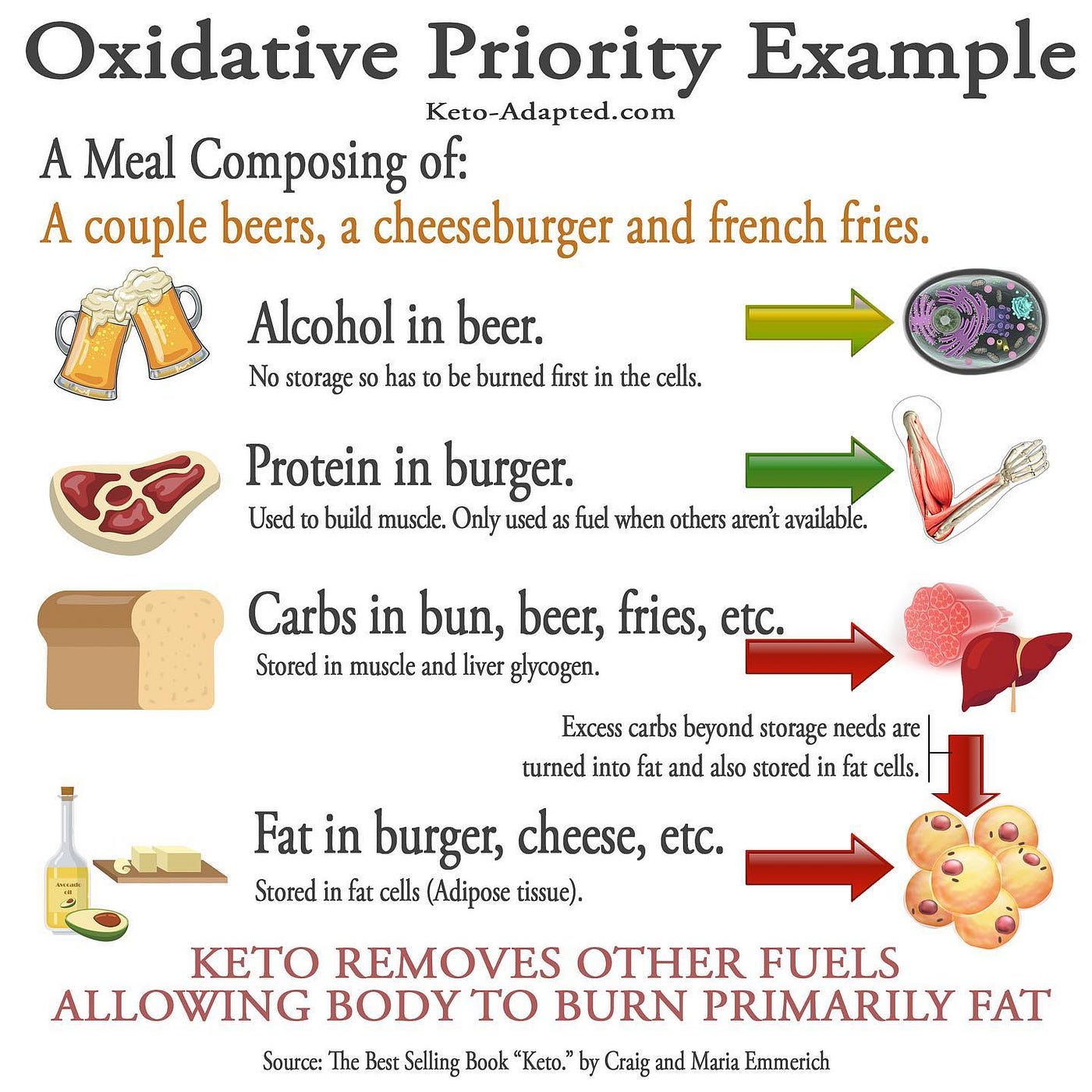
Encouraging more consumption of carbohydrates, leading to more fat storage (as set out in the chart at the top of this post).
Demonising saturated fat on the basis of no good scientific evidence. (And eating less fat means eating more carbohydrates.)
The official nutrition guidelines have been structured, by feedback and selection processes, to generate deteriorating metabolic health in a way that permits the use of the mask of science to cover nutrition guidelines that no one concerned for their health, or the health of their family, should actually follow. US defence forces, for example, are suffering adverse health consequences, likely due to following the official nutrition guidelines.
Indeed, without the mask of science, more folk would be come aware of what a diabolically bad job the nutrition guidelines have done, if improving the health of the population was the goal.
Of course, if the aim is to increase government health expenditure, then they have been excellently effective. Which appears to be precisely how the selection pressures have operated.
As we contemplate the deteriorating metabolic health of Western populations, Thomas Jefferson proved to be prophetic in his 1787 Notes on the State of Virginia:
Was the government to prescribe to us our medicine and diet, our bodies would be in such keeping as our souls are now.
The mask of science (Covid 19)
We can also see the mask of science being use to cover policies not grounded in good science in the official responses to the Covid-19 pandemic.
Covid-19 is a respiratory (so seasonal) illness of metabolic distress. That is likely why children and adolescents have been largely immune: their metabolisms are generally sufficiently healthy that they are far less vulnerable.
One of the things that became clear relatively early is that outdoor transmission is not a significant vector for spreading the virus. Conversely, Vitamin D deficiency is a vector for increasing the likelihood of suffering badly from the virus. (Likely a major factor in why darker-skinned folk in northern latitudes had higher rates of illness and death.) Also, social interaction is well known to reduce stress and so increase capacity to resist disease.
So, we should not have been telling people to stay out of the sun and the fresh air, or to wear masks outdoors, as airborne transmission risk is about effective volume of air. Yet, using the mask of science, this is precisely what has been done in many jurisdictions. The case for lockdowns is also much weaker than is often recognised. (See also here.)
Masks do, however, operate as a strong social signal. A signal that gets its power from use of the mask of science.
A tale of two (US) States
Florida and California are both large population US states, (21m to 40m people) at similar latitudes (so similar seasonal patterns). Florida has a higher population density, though California’s population is slightly more urbanised (95% to Florida’s 91.2%). Florida has an older population (median age of 42.5 to 37) as you would expect from a well-known retirement destination.
So, other things being equal, you would expect Florida to have a higher pandemic death rate than California. California has a death rate of 1,595 per million people. Florida has a death rate of 1,721 per million people. So, higher, as one would expect. But not very much higher: 126 more deaths per million or 8% higher. Rather less of a difference than one might expect, given that Florida’s median age is 15% higher than California’s.
Yet the measures in California to combat the pandemic have been way more intrusive and expensive than what has been done in Florida. Moreover, California’s death rate has been closing on Florida’s, as California’s second (seasonal) wave was much worse than its first.
Florida not discouraging people to go outside and enjoy the sun, and not requiring masking outside, does not seem to have had significantly adverse effects. As, one would expect, if one was following the actual science rather than those wielding the mask of science.
The systematic attempts to suppress any public consideration of the lab leak hypothesis was another, particularly egregious, case of the use of the mask of science against actual science. Also egregious has been the suppression of discussion of a potentially viable treatment for Covid-19, Ivermectin (longer discussion here). I have no idea about whether Ivermectin is effective, or in what circumstances. But suppression the discussion is nonsense and not in any way "doing science".
Advice not given
It was clear relatively early on in the pandemic that Covid-19 was a respiratory (thus seasonal) disease of metabolic distress, with poor metabolic health greatly increasing your risk factors. By changing your eating habits, you can improve some markers of metabolic health in a few days, some in a few weeks, the rest within a few months.
These changes needn’t be all that expensive. Indeed, simply eating less frequently (aka time-restricted eating or intermittent fasting) to give your body a rest from being flooded with insulin can be very effective.
As far as I am aware, at no stage did official health tell us that. Either they didn’t know the above or they didn’t want to admit what crap their official nutrition guidelines are.
Either way, the selection processes operating on official health did not favour optimising the policy response to the pandemic. But they certainly did involve much use of the mask of science. Rather less use of actual science.
Stop and consider how many unnecessary deaths there may have been from the Covid-19 pandemic because official health has perverse/adverse incentives.
They are a mere fraction of the premature deaths every year from using the mask of science to push bureaucratically (and corporately) convenient nutrition guidelines rather than providing nutrition advice well-grounded in our evolutionary history, so in actual science.
The history of the US has generated persistent racial derangement. It has been far more of a case of structures generating racism than of racism generating structures.
People have a pretty good understanding of their own continental ancestry. People are also relatively accurate at picking out other people’s continental ancestry.
This is not surprising. There was not much mixing of lineages across continents until relatively recently, at least outside continental border regions. This was due to the limitations of technology: specifically very limited transport capacitie. Moreover, thousands of years of separate genetic lineages, with genetic bottlenecks creating relatively small founder populations for various continents, meant that there are fuzzy-boundary, but relatively clear, patterns of physical markers of continental ancestry.
So, a folk concept of race based on continental ancestry has some, relatively straightforward, patterns of physical-markers to work off. Hence the history of skin-tone descriptors of race. With race becoming to be understood as being continental, or some significant sub-continental region, ancestry. (Medieval Europeans had a rather different concept of race, one much more language based — so it made sense for a C14th commentator to talk of Scotland being one nation with two races: highlanders and lowlanders as thy spoke different languages.)
The US in particular has a long history of obsessing over race because continental origin coincided with fundamentally different roles in colonial society (the settlers, the dispossessed and the enslaved). Different roles that persisted into the country created by the American Revolution.
Slavery, settlement and racism
As continents produce neither single cultures per continent nor single breeding populations per continent, analytically, remarkably little follows from physical markers of continental ancestry being relatively clear. But as physical markers of continental ancestry are collectively visually relatively clear, they can, very easily, have social meanings attached to them. Which, of course, has happened repeatedly. Especially when one region has systematically enslaved people from region(s) with different general patterns of physical markers. Or when folk from one continent have populated another. We can call these the slavery effect and the settlement effect.
Both have proved to be powerful generators of racism: attaching normative ranking to continental (or region thereof) origin. That is, positive social meaning to one’s own group and (especially) pejorative social meaning to those with a different continental origin (and so a different social role).
A third generator of racism has been imperialism: domination of a state created by one continental origin group over folk with differing continental origins. This has been a rather stronger generator of elite or theoretical racism than more general racism, as imperialism is mostly an elite activity. (A 2018 study found that the UK and Portugal, the two surveyed countries with the longest histories of colonialism, had generally the lowest levels of racism among the surveyed European countries.) Though all racism, and race talk, starts off as an elite discourse.
The fourth generator of racism has been ethnicised religion. The classic version of this being racialised Jew-hatred.
None of these factors are sufficient in themselves to generate racism. The Romans were mass-enslaving imperialists who settled new areas and tended to dislike Jews. Racism was not a feature of their culture.
For the Romans were not a xenophobic culture regarding descent. Folk of any origin could become Roman citizens, including ex-slaves. Their slaves could be of any origin. Their society and their thought did not structurally differentiate by continental origin.
Moreover, Romans traditionally were not moral universalists. So, they did not have to generate some generalised story about why some folk were slaves. Slaves were simply losers and if they were freed, and became Roman citizens, then they became winners. Folk would put that they were freedmen (i.e., ex-slaves) on their tombstones, as that showed how much of a winner they had become.
Islam and racism
The first significant discourse grading people as cognitively deficient, based on physical markers of continental origin, came out of Islam. Islam being an imperial, evangelising monotheist (so morally universalist) religious civilisation that systematically enslaved people to their north (including Europeans, notably Slavs) and people to their south (Sub-Saharan Africans).
Folk of such origins were repeatedly characterised by Islamic writers as being cognitively deficient. Often either due to too little sun (Northern Europeans) or too much sun (Sub-Saharan Africans). So, in Chapter Three of his Tabaqāt al-ʼUmam (Categories of Nations), geographer Sa’id al-Andalusi (1029–1070) wrote:
The rest of this category, which showed no interest in science, resembles animals more than human beings. Those among them who live in the extreme North, between the last of the seven regions and the end of the populated world to the north, suffered from being too far from the sun; their air is cold and their skies are cloudy. As a result, their temperament is cool and their behaviour is rude. Consequently, their bodies become enormous, their colour turned white, and their hair drooped down. They have lost keenness of understanding and sharpness of perception. They were overcome by ignorance, and laziness, and infested by fatigue and stupidity. Such are the Slavonians, Bulgarians and neighbouring peoples.
The patterns of castrating male slaves, and of incorporating the children of Muslim fathers into the umma, the Muslim community, meant that centuries of mass slavery failed to generate an ex-slave underclass within Islamic lands. But there are still linguistic traces of these centuries of mass slaving: abd in Arabic can both refer to slave (as in Abdullah, slave of Allah) and to Sub-Saharan African.
Christianity and racism
The Americas were subject to imperialism and mass settlement from Christian Europe. Added to this imperialism and settlement, millions of slaves were imported from Africa. This made continental origins socially salient in the Americas and did so from within a morally universalising religious perspective Christianity). This was a situation made for racism to develop. Which it duly did.
Hence the confused interaction between Christianity and racism. On one hand, the Gospel of Love applies to everyone. Indeed, from the earliest days of Christian European settlement of the Americas, there were devout Christians who spoke and agitated on behalf of the moral status of the inhabitants of the Americas as children of God.
An early, and important, manifestation of this was the 1537 Papal Encyclical Sublimus Deideclaring that the inhabitants of the discovered lands, even if they did not know Christ, were children of God with natural rights and could not be enslaved. In the words of Pope Paul III:
… the said Indians and all other people who may later be discovered by Christians, are by no means to be deprived of their liberty or the possession of their property, even though they be outside the faith of Jesus Christ; and that they may and should, freely and legitimately, enjoy their liberty and the possession of their property; nor should they be in any way enslaved; should the contrary happen, it shall be null and have no effect.
This did not bar owning slaves someone else had enslaved. As African rulers were more than happy to take care of that stage of the process, Sublimus Dei had little effect on the Atlantic slave trade.
The moral claims and reasoning of the Papal Encyclical were, however, in rather direct contrast with Sharia, which is entirely fine with enslaving non-Muslims who have not submitted to rule by Sharia (i.e. by Muslims), including sexually exploiting captured women. The last being endorsed no less than 15 times in the Quran and by the example (sira) and the acts and sayings (hadith) of the Prophet. A principle of Sharia is that the marriage of any woman captured by a Muslim man is automatically annulled by the act of capture.
The Anglosphere abolitionist movement in the C18th and C19th had strong Christian roots. As did the US civil rights movement of the mid C20th.
On the other hand, Christianity is a morally universalist religion. Like Islam, it required some justifying story about why you were systematically enslaving the children of God from Africa. It required some justifying story about why you were dispossessing the children of God in the Americas.
Christian moral universalism later also required some justifying story why you were systematically denying the descendants of slaves political and other civil rights. These were never going to be good stories about the dispossessed, the enslaved, and the excluded. There were plenty of people who were racist, not despite being Christian, but because they were Christian.
Enlightenment thought, which was also morally universalising, had much the same confused interaction with race and racism as Christianity. On one hand, the scientific impulse to categorise could be, and was, mobilised to propagate racist ideas. On the other hand, seeing the world as a shared globe inhabited by a single human species, along with a sense of expanding human capacities, made slavery morally problematic on a scale never seen before. Hence the rise of the abolitionist movements.
As for the settlement effect, so long as the Amerindians were being dispossessed (and feared) by the settlers from Europe, the structural reasons to be racist against them remained strong. After they were subjugated and shoved into reserves, the underlying structural motives to be racist against them lost strength. The effortless virtue, and pleasures of contempt, that bigotry provides may linger, but the general social retreat from, and anathematising, of racism has further weakened what was already a form of racism in structural retreat. As the eminent political career of Herbert Hoover’s Amerindian Vice President, Charles Curtis, demonstrated.
The intensities of slavery
Slavery and its aftermath proved to be a different matter to self-justifying antipathy to Amerindians, who always had a certain warrior vigour going for them. As sociologist Orlando Paterson has brilliantly analysed, slavery does much more then reduce people to property, it imposes on the slave a form of social death. They have no social standing, no family standing nor heritage to be acknowledged. Slavery is profoundly stigmatising and dishonouring, as it deprives the slave of the capacity to have honour or any status that casts doubt on being a slave.
The slave States of the US operated one of the most closed slave systems in history. It became legally hard to manumit a slave and the stigmatising dishonour of slavery was not excised by freedom. A process of stigmatisation greatly helped by the slaves being of a different continental origin than the settlers. The generalised theories that justified slavery could not allow space for some moral transformation from not being a slave anymore.
Roman slavery, not having that justificatory burden, and not being divided by continental ancestry, was far more open. Hence ex-slaves could become citizens and would even boast of how far they had come from their former slave status.
In much of the Americas, an intermediary mulatto or mixed race (i.e. mixed continental origins) identity grew up. Such folk served useful intermediary roles between a small settler elite and large slave or indigenous population. This did not happen in the slave South of the US, as the political importance of voting, and the scale of European settlement, worked against a mixed-race identity emerging.
There was no particularly useful social role that a mixed-race group could fulfil that was not already being filled by folk of European ancestry. Moreover, if ex-slaves and their descendants began voting in any numbers, they could begin to wield political power. Which was both politically threatening and an affront to the justifications for slavery. The result was the “one-drop” rule, whereby any African ancestry identified your slave origins, with all the associated stigmas and exclusions.
These structures served the divide-and-dominate politics of the plantation elite. Before the Civil War, the plantation elite used a range of mechanisms to repress poor “whites”, the masterless men, who had no stake in the slave system but who traded and socialised with the slaves. After the Civil War, and the failure of Reconstruction, the plantation elite used the same range of mechanisms to repress the ex-slaves and their descendants. They simply racialised the operation of exactly the same repressive mechanisms that had operated against the masterless men before the Civil War into what became known as Jim Crow. The former masterless men were now on the “right” side of the exclusions, and were thereby incorporated into the Southern system.
As African-Americans migrated to the industrialising cities, a version of such divide-and-dominate strategies turned out to be congenial to, and adaptable by, urban elites. Public policy was wielded to generate increasing residential segregation, as such segregation makes divide-and-dominate tactics far more effective.
A note in Richard Rothstein’s revelatory The Color of Law, sets out the path of residential segregation. Residential segregation that was driven by public policy. Including intensifying under FDR’s New Deal. In the ten largest US cities:
…in 1880, the neighborhood (block) on which the typical African-American lived was only 15 percent black; by 1910 it was 30 percent, and by 1930, even after the Great Migration, it was still only about 60 percent black. By 1940 the local neighborhood where the typical African-American lived was 75 percent black.
At all stages, such divide-and-dominate politics only worked because people bought into the political framings and discourses that legitimated them. Far more of our thinking and decision-making is unconscious than we realise. Social selection processes work on information and feedback: but not necessarily fully conscious, or sufficiently critically examined, information and feedback. Weakening racism
The experience of the Second World War, both the mass mobilisation for a common purpose and the horrors of Nazi imperialism and racism, as well as the pressures of the Cold War, increased, both domestically and internationally, the embarrassment that American racism generated. At the same time, the continuing fail in transport and communication costs made it easier for marginal groups to organise, as did increased urbanisation and suburbanisation.
So, the structural supports for divide-and-dominate racism weakened. The civil rights movement, and particularly Martin Luther King, brilliantly played up the moral embarrassment of racial exclusion. Both the Christian moral embarrassment and the American-ideals moral embarrassment. With mass communications making it easier to reach people for persuasive effect.
Hence the successes of the civil rights movement and the retreat of racism from being pervasive within American society to being a moral shame. Though, as Glenn Loury makes clear in The Anatomy of Racial Inequality, complex patterns of stigma have been rather more stubbornly persistent.
From this history, we can see that structural racism (or analogues such as systemic racism) is generally not a useful term. For it has been far more the case that structures generate and mobilise racism than that racism generates structures. Nor are such structures a necessary part of the social system. They are more about bending the social system in a particular direction.
After the civil rights movement
Which brings us to the graph at the top of this post and its odd pattern whereby “white” (i.e. Euro-American) Democrats were very much more likely to say that they knew someone who was racist in 2015 than in 2006, but “black” (African-American) and Hispanic Democrats were apparently somewhat less likely to say they knew someone who was racist in 2015 than in 2006.
If someone knows more people they regard as racist than someone else, that can be because (1) they are more likely to meet racists; (2) they are better at identifying racism; (3) they are more expansive in their characterising of racism; or (4) some combination thereof.
So, taking the 2006 results in the graph above, it could be that Euro-American Democrats were more likely to meet racists than Hispanic Democrats or Euro-American Republicans. Or that they are better at identifying them than Hispanic Democrats and Euro-American Republicans. Or that they have a more expansive definition of racism than do Hispanic Democrats and Euro-American Republicans. Or some combination of the above.
If we move to the 2015 results, Euro-American Democrats were far more likely to believe they knew a racist than were African-American Democrats, Hispanic Democrats or Euro-American Republicans. They were also the only group who increased their likelihood of knowing a racist since 2006, and did so dramatically. By contrast, both African-American Democrats and Hispanic Democrats became, if anything, less likely to believe they knew a racist. (The shifts were not statistically significant but do accord with long term patterns of declining racism.)
The most plausible read of this data is that racism has declined somewhat in the US (in accordance with long-term trends) but Euro-American Democrats have acquired dramatically more expansive definition(s) of racism. (Unless they are registering dramatically increased anti-white racism — we can reasonably give that low probability.)
So, by 2015, Euro-American Democrats apparently lived in a US of significantly more racists among the people they interacted with, while African-American Democrats and Hispanic Democrats did not.
If fluctuations in racism are largely driven by changes in structural factors, as history strongly suggests, that suggests a change in structural factors that is particularly affecting Euro-American Democrats, but not other folk. Something that is making race much more salient to them.
An obvious factor is the massive increase, since around 2010, in the use of racial terms by US elite media. As Democrats have far more confidence in elite media than do Republicans (a long-term tendency that increased dramatically from 2015), the dramatic upsurge in the media’s use of racial terms could be accounting for much of the “more people know a racist” effect.
Especially as there clearly has been an expansion of what counts, within elite race talk, as racism. Partly because our concept of a phenomena tends to expand as the prevalence of that phenomena shrinks. There has been, for example, a creeping expansion of what is labelled as harm in Psychology. But there has also been an expansion of the concept of racism due to the expanding influence of intersectionality and critical race theory. Especially in the education of increasing numbers of younger journalists.
Is there a structural reason for this increased focus on race? One is fairly obvious: the value of anti-racism as a status play. The more intense one’s opposition to racism, the greater the moral prestige in being ostentatiously anti-racist and, conversely, the greater the moral shame from failing to appropriately oppose racism. So, a status-play purity spiral gets set up. One that can be used to lever folk out of jobs. The bottom-up (but still elite) prestige play then becomes a dominance play. In a situation of elite over-production, such status-plays are a very useful weapon in struggles over opportunities and resources.
Ostentatious anti-racism can make one reluctant to admit that racism has declined or to give credence to other factors in explaining social dynamics. One becomes invested in continuing to ascribe social meanings to race. The surge in hate crime hoaxes fits in with this.
Function does not require intent
Unconscious psychological processes outstrip conscious reasoning, both in time and in scope, which makes many psychological phenomena possible…
Andrew M. Lobaczewski, Political Ponerolology: A Science on the Nature of Evil Adjusted for Political Purposes, p.163.
The other reason for increased focus on race is less obvious, but has a longer historical pedigree. Overt racism might have become embarrassing, but the advantages to urban elites of divide-and-dominate politics has never gone away, so social selection pressures will continue to favour such politics. The more divided residents, workers and citizens are on racial grounds, the less elites have to deal with competing (against them) claims on resources. Symbolic race-identity politics are way cheaper for elites than politics that delivers good government. That is as true today in urban US as it was in the Antebellum or Jim Crow South. Hence racially-divided US cities are (by developed democracy standards) comparatively ill-governed, just as the Antebellum and Jim Crow South were in their time.
If anti-racism can be turned into a racialised divide-and-dominate strategy, as clearly it can, then all the better for opportunity-hoarding elites. Especially for elites facing intensified internal competition for resources and opportunities.
Intersectionality and critical race theory are very much elite products, coming out of places such as Harvard Law School. Nor do they have to be originally developed as divide-and-dominate mechanisms for social selection pressures to adapt them into divide-and-dominate mechanisms.
Moral concern easily becomes status plays. Status plays are naturally divisive. Moral dominion easily becomes social dominion. Such feedback loops provide much for social selection processes to work on.
Such outlooks and patterns of action do not have appear to their active proponents to be divide-and-dominate politics in order to function as such. Remembering that such framings and discourses work much better if folk can be convinced to go along with them, while social selection processes do not have to be entirely conscious. Especially as the prime mechanisms for self-deception are by manipulating salience. Particularly moral salience.
One cannot force oneself to believe what one doesn’t believe. We can, however, use focus on, for example, image-self-protection, to block paying attention to awkward facts or considerations. This is especially easy to do with highly moralised concerns and self-images. Both because of their emotional power and because it is inherent in moral claims that they be normative trumps. That one has an ostentatious image of oneself as being not-oppressive does not guarantee that one is not buying into politics that are, in fact, oppressive or self-serving.
Coverage by elite media of deaths in police custody, or at the hands of police, is particularly revealing. There is a general problem of police training and accountability in the US. One that varies far more by jurisdiction than it does by race (whether of police or civilian protagonist). If media had reported these things accurately, then a broad coalition could have been built up to improve police training and accountability.
Instead, by intensely and selectively racialising their coverage, the “racist cops” narrative was firmly established by elite media. Turning this into a specifically African-American-and-police problem rather than a general accountability-to-the-citizenry problem and allowing those propagating, and those accepting, the narrative to thereby parade their ostentatious anti-racism. A way easier, and more immediate, social and cognitive reward than doing the hard work of increasing police training and accountability. Hence “defund the police”: a simplistic but convenient symbolic politics that was way easier to pander to than improved police training and accountability.
Revitalising divide-and-dominate
Even better, one of the key mechanisms for divide-and-dominate has been to fail to provide effective policing in African-American urban communities (as measured by homicide clearance rates), thereby generating much higher homicide rates in those communities. (In rural US, Euro-Americans and African-Americans have identical homicide rates.) These differential levels of violence do more to racially divide US cities than any other factor.
The “racist cops” media narrative, and activism, so congenial to moralised self-image, and their associated status plays, has increased the level of violence in those localities and so increased the most racially divisive element in US cities. If one was seeking to revitalise divide-and-dominate politics, it would be hard to do better.
A recent study found that the more educated you were, the more politically progressive you were, and the more you trusted the media, the less well informed you were on police shootings. (But the more conveniently you believed, as far as divide-and-dominate politics went.)
Social intent does not entail social function. Social function does not entail social intent.
Elite race talk is always a divide-and-dominate mechanism. Elite race talk has, historically, been racist. Indeed, racist discourses have always started off as elite theories. But anti-racist race talk works just as well as a divide-and-dominate mechanism, provided one continues to ascribe social meanings to race and do so in pejorative ways. Which, of course, is what all the talk about whiteness, white supremacy, white racism, etc. does.
It is still a case of structures generating the assigning of divisive social meanings to race, far more than the reverse, seeking to bend the social system to their benefit. Even doing so within ostentatiously anti-racist rhetoric and moral framings.
What is that French saying? plus ça change, plus c’est la même chose: The more it changes, the more it’s the same thing …
Moving beyond political swear words (and grappling with very different life experiences).
Trying to define fascism is possibly a pointless exercise, as it has long since largely lost any specific meaning, becoming a political swearword used for denouncing those you disagree with and establishing how morally wonderful and heroic you are for being against such vile folk. It thus involves equal parts political slander and narcissistic self-promotion.
The more one is addicted to slandering those you oppose, and to narcissistic self-aggrandisement, the more freely one throws about the term fascist. In our time, given the dramatic lack of actual fascists (or Nazis), outside of the political fringe, constant use of the term fascist is an almost perfect indicator of self-serving political bad faith.
This is not remotely a new problem. George Orwell, in his 1944 essay, What is Fascism? set out the ludicrous prolixity with which the term had already been used. The problem has not got any better since.
A particularly useless contribution to the what is fascism? question is Umberto Eco’s Ur-Fascism essay, which does what so many participants do — take their preferred framing of politics and forces fascism into it. This is a common sin of political taxonomies. Robin Corey, for example, does it in his discussion of conservative thinkers. He comes from a political tradition centred around notions of equality. One opposed by conservatives. Who he therefore portrays them as motivated by concern for inequality.
This is an example of the ideologue’s syllogism:
People like me are for x.
Those people over there oppose people like me.
Therefore,
They are against x.
Which, of course does not remotely follow. It is much more likely they are for y more than they are for x. Indeed, they may simply rate y more highly than they do x. Rating y more highly than they do x does not make them against x. Indeed, they may be at least somewhat in favour of x. They are just less concerned about it, and much more concerned for something else, than are folk like you. Which may, indeed, lead them to oppose folk like you, if you rate x more highly than they do y.
For instance, conservatives typically focus on, and value, order and heritage. That leads them to rate those things more highly than equality and to significantly reduce what they are prepared to give up to achieve any specific form of equality. It does not mean they are against all forms of equality and certainly does not place questions of equality (and inequality) at the centre of their world view.
The ideologue’s syllogism also operates in reverse:
People like me are against x.
Those people over there oppose people like me.
Therefore,
They are for x.
Which also does not follow, but has become a mainstay of ostentatious anti-racism.
It is a great mistake, in trying to understand other world views or ideologies, to presume that they focus on the same issues you do, or that their framing of the world is some variation on, or derivation from, yours. Alas, folk regularly do precisely this. It means one can stay within emotionally comfortable territory, minimises the cognitive effort and so makes for easy and congenial rhetorical plays.
It is still a profoundly analytically deficient way to proceed.
The narrower the range of political opinion has become in academe, the more the ideologue’s syllogism has come to infect social science and scholarship generally. The more you deal with folk with similar viewpoints to oneself, the more alien people of different viewpoints are going to become and the more unopposed the use of the ideologue’s syllogism is going to be. If you literally never meet someone who speaks up for a particular viewpoint at conferences or in common rooms, then your understanding of such viewpoints is likely to be swallowed up by what is collectively congenial rather than what is true.
In contemporary society, this is aggravated by having a deeply Gesellschaft (dispersed networks based around formal structures) academe living quite different lives than do the far more Gemeinschaft (highly localised and personalised connections) working class.
Academics typically operate on the basic of transactional networks enmeshed within formal institutions run by folk like them that are not based on specific localities. They are David Goodhart’s Anywheres: happy to live anywhere with a congenial cafe culture, able to maintain and develop their networks irrespective of the specific locality they live in. They take this to be the natural and sensible way to live and presume all modern societies are basically formal-transactional, and so Gesellschaft.
This is simply false. Many folk live lives deeply based around their specific locality. A locality within which they have built a life-time investment in a dense network of local connections. Those connections form what anthropologists call their relational wealth, and economist call social capital(and then, alas, generally analyse in transactional terms, though Glenn Loury is a notable exception to this trend). Those connections provide a sense of place and identity, and a protective buffer against adversity. Such folk are Somewheres who live largely Gemeinschaft lives.
Anything that breaks up or otherwise degrades those local connections imposes major psychic and social costs on them. One that transaction analysis is unlikely to even notice, let alone attempt to quantify. In particular, fraying those local connections can profoundly degrade their capacity to have any control over their lives and the future of their local community.
When you can command little or no capital, social capital (or its lack) looms much larger in your life and prospects. It is, for instance, why social capital (aka relational wealth) looms so large in the lives of forager populations.
One way to undermine social capital is to set it against itself. The systematic failure to effectively police African-American urban communities means that the resulting low homicide-clearance rates (and so high rates of homicide) leads to folk, particularly young males, trying to generate the social capital of respect as a protective measure. This leads to patterns both predatory and protective (such as street gangs) that set the social capital of those communities against themselves, profoundly undermining the development possibilities within those communities.
Note, this is not a consequence of being “black” as African-Americans and Euro-Americans in rural areas have the same homicide death rates. The more urban the area, the higher the difference in homicide death rates, because the more the effective provision of policing can be racially coded and the more deleterious the effects of failing to provide sufficiently effective policing is.
The higher homicide death rates among African-Americans is, as it has always been, an artifice of American public policy. One has to understand, in Glenn Loury’s words, that relations precede transactions in order to fully grasp these dynamics and their (profound) knock-on effects.
Migration as test case The failure to understand the importance of locality-based connections is a major reason why mainstream economic analysis of migration is almost ludicrously inadequate. It is a bunch of Gesellschaft academics and professionals applying transaction analysis in a way that pays no attention to, and so almost completely fails to value, local connections. Local connections that are most certainly degraded by mass migration.
This capacity to disrupt, degrade and replace local connections also means that mass migration is an excellent divide-and-dominate mechanism. This was true in colonial times in places such as Fiji, the West Indies, Sri Lanka and East Africa. It is no less true in London, Paris, Chicago and New York.
(NB: Despite their much higher levels of immigration than Europe, the UK or US, Australia and Canada are somewhat different cases. They have effective border control and their migrant intake is highly varied. This greatly increases the assimilative effect, because all the incoming groups are sufficiently small that absorbing the patterns of the majority becomes much more likely. Also, at least in Australia, the existing population was already unusually mobile. Even so, in Australia, opinion poll support for migration increased notably after stronger border control measures were implemented.)
Such pervasive failure to understand the realities and concerns of those living Gemeinschaft lives means that opposition to migration is therefore slotted into a congenial racism-and-xenophobia framing. That way, holders of capital, especially holders of human-and-cultural capital, get to self-righteously pursue their divide-and-dominate migration policies. Moreover, as holders of capital, they benefit from migration way more than providers of labour do. (Even if, under some highly debatable assumptions, there is a net economic gain to resident workers, it is dwarfed by the gains to the holders of capital, thereby further helping to entrench domination of politics by holders of various forms of capital.)
Self-righteous pursuit of self-serving class and status interests has generally become the defining feature of modern progressivism. With migration being the textbook example.
This why Gesellschaft academics, intellectuals and professionals are often so hopeless at understanding the national populist upsurge resulting from the political and cultural disenfranchisement of working class voters. The holders of human-and-cultural capital have essentially taken over centre-left political parties, turning mainstream party politics into a contest between various types of capital, a process well documented and analysedby French political economy Thomas Piketty. Hence, the working class has become increasingly political homeless. With, in voluntary voting jurisdictions, the falling voting participation to match.
It is not surprising that one of the better books on national populism is co-authored by an academic of working class background who still has a lot of working class friends.
This disenchantment is aggravated by workers’ quite rational angsts about mass migration, which is generally not in their interests (but generally is in the interests of holders of both commercial and human-and-cultural capital), being denied legitimate expression or outlet within “acceptable” mainstream politics. Especially as the massively expanded human-and-capital class has increasingly reached for the standard lever of social dominance of every such class in human history: control over the levers of public legitimacy.
Submit-or-be-stigmatised dominance plays At the core of the contemporary reaching for social dominance through control of public-legitimacy is a submit-or-be-stigmatised choice. Either you submit to claims that are not true (e.g. “men have periods”) or you get set up for stigmatisation (“transphobe!”).
Trans-activism and trans-ideology is particularly useful for this social dominance strategy. It involves a set of phenomena with a great deal of complexity. It can be targeted at minors (adolescents, particularly adolescent girls, are a very suggestible group). It has a civil rights patina (and civil rights campaigns have acquired a strong presumption of moral correctness). It invokes claims about basic aspects of human existence that are nuts, but which dissent from gets treated as bigotry. (As you can be presented as opposing civil rights of an oppressed and marginalised group.)
The structure of misrepresentation and delusion starts with the term gender dysphoria, which is, as evolutionary biologist Heather Heying has noted, itself a mislabelling. Gender dysphoria is, for example, being a tomboy (you don’t conform to the expected behaviour patterns). What trans folk typically have is sex dysphoria (you are alienated from the physical sex of your body).
Trans and “gender identity” is just an example, a particularly useful-for-the-dominance-strategy example, of a much wider pattern. Various positions are set up as markers of moral correctness. The willingness to ignore contrary evidence (or contradictions between such positions) shows commitment to the collective status strategy; that you are sound, that you are “one of us”; one of the “good, smart people”. A strategy that gains power through forcing others to submit or be stigmatised. It is a strategy of dominance through collective gaslighting.
A fading mainstream media feeds the strategy by seeking attention-holding narratives that give folk a righteous illusion of being informed while making it clear who you should despise. Information-economising righteousness as an attention-grabbing strategy. By what is, or is not reported, and how, media folk who embrace the status strategy provide information management services to support the strategy. Hence the pressure that is mounted against any outlet that fails to conform.
While trans issues has become the cutting edge of the strategy of domineering gaslighting, migration has long since been established as central to the strategy. You don’t like the way mass migration is fracturing your local community? Racist! Xenophobe! You are worried about the well-documented cases of overwhelmingly Muslim gangs systematically preyingon under-age girls? Islamophobe! Etc.
A profoundly dishonest public discourse is set up, generating expanding levels of anger and resentment that are not permitted to be treated as anything other than manifestations of bigotry. For so treating dissent not only feeds the strategy, it is required for it. If it is legitimate to dissent from a claim, then that claim is not a marker of moral righteousness. The dynamics of elite over-supply As those credentialed in human-and-cultural capital have become massively over-supplied by a bloated higher education sector, the use of the public legitimacy lever for prestige, dominance and career purposes has become ever more frenetic. In particular, a metastasising structure of linguistic taboos has become a vicious and expanding mechanism of social dominance, used to unseat older cohorts within their own class in favour of younger graduates well-trained in proficiency in such self-aggrandising status plays. Though they are often much less well-trained in historical understanding or analytical capacity that gets in the way of such status plays.
The operative selection has been for status-efficiency, not genuine understanding of social dynamics. Being wrong about general patterns of social dynamics has much weaker feedback effects than does being well-versed in the various status-plays. Hence the latter is what is being selected for.
All this has left the working class increasingly politically and culturally disenfranchised. This is a world where, for instance, almost half of Britons do not believe that the BBC represents their values, only a third of Britons believe it does, with only 4 per cent believing it has recently come closer to their views.
This political and cultural disenfranchisement has been aggravated as the status-and-social-dominance strategy, focused on ever more complex linguistic taboos, cuts the blunt vulgarity of working class speech out of anything even remotely politically acceptable. Add in the costs and dislocations of globalisation, and working class voters have much to be disenchanted about.
And so national populism A significant, politically disenfranchised, voting bloc is not going to remain so forever. Which is where national populism comes in. It is culturally oppositional to increasingly intolerant and self-aggrandising cultural politics coming from the “cultural commanding heights” of Western societies. National populism is also anti-immigration, because that is where there are votes to be had.
There is at least one similar political dynamic to the interwar politics that saw the rise of Italian Fascism and German Nazism. Neither Italian Fascism nor German Nazism would have become other than fringe political movements except for the rational fear of Leninism in the first case and of Stalinism in the second.
Similarly, national populism would never be able to get anywhere without the sneering, intolerant, self-righteous cultural politics that finds -ists and -phobes everywhere. That views itself as so wonderful because what it opposes is so vile. The product of an arrogant and self-aggrandising human-and-cultural capital class that avidly pushes the disenfranchising of (understandable and rational) opposition to mass migration.
The response to the rise of national populism has been to (1) denounce it as fascist and Nazi, (2) denounce it as racist and xenophobic, (3) denounce it as anti-democratic. In other words, to double down on we-are-so-wonderful-because-those-who-oppose-us-are-so-vile, sneering, self-righteous, self-aggrandising “we own morality” so ostentatiously well-intentioned, cultural politics that did so much to generate national populism in the first place.
Are the national populist movements generally illiberal and authoritarian? Yes. Does that make them anti-democratic? Not in itself no. In fact, as functionally the central point of democracy is to give the working class the vote, national populist movements are an expression of both demotic and democratic politics.
As citizenship is the only mechanism that has systematically provided the working class a serious say in politics — both in the sense of entitling them to a say and a vote and in the sense of being rooted in local connections — the systematic devaluing of citizenship by human-and-capital class politics is a more serious threat to democracy than national populism. Both because said devaluing has far more institutional and intellectual reach and because the sought control of public legitimacy explicitly degrades the right to have your say. The control-of-public-legitimacy weapon of finding speech “offensive” is a weapon against freedom of thought and speech, against democracy and against science because you cannot have any of these things (except as anodyne rituals) without offending people.
Increasingly, merely being a citizen does not give you any right to express yourself or be heard. On the contrary, acting against the burgeoning social taboos increasingly puts career, employment and livelihood at risk.
What is fascism? If national populism is something different than fascism or Nazism, that brings us to the question of what is fascism? (And what is Nazism?)
Just as “woke progressivism” is not Leninism or Stalinism, even though there are some shared ideological roots and it increasingly does embrace a Jacobin model of politics (no restriction of the means of political action, no restriction on the ambit of political action), so national populism is not Fascism or Nazism reborn. That which national populism is opposing is different in crucial aspects from what Fascism and Nazism were opposing. This does much to make national populism different from either Fascism or Nazism in crucial respects.
There are also two large historical reasons why national populism is so different. The first is because it is not operating in the two decades after the 1914–1918 Great War and so within a time with mass living experience of the mass death and mass war experience of the trenches. The second is because it is operating after the Second World War.
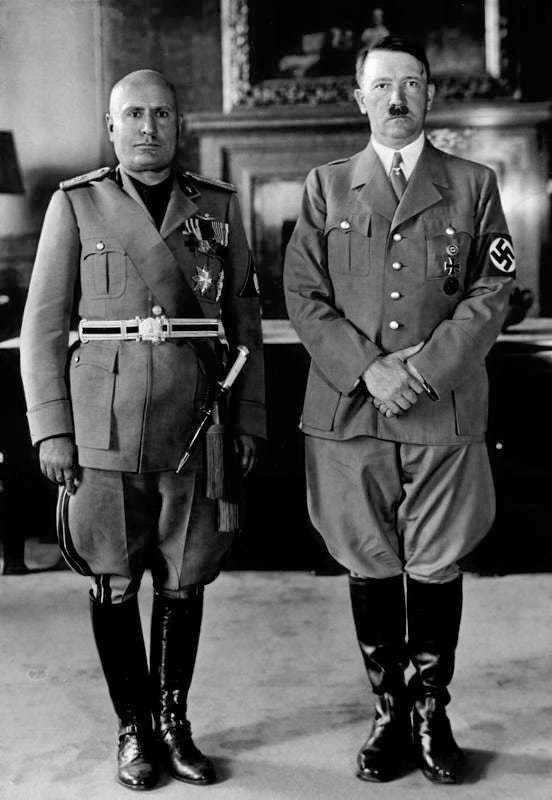
The first matters because the binding experience of fighting and surviving the trenches was crucial to the appeal of both Fascism and Nazism in general and of Mussolini and Hitler in particular. They were both war heroes and veterans of the trenches who played on, and to, that status.
We are so used to thinking of the horrors of trench warfare that we generally fail to grasp the bonding effect of surviving horror. We are such peaceful societies we often have difficulty understanding the binding exhilaration of combat. Yet that binding sense of shared agency is precisely what Fascism and Nazism focused on and appealed to. It is not remotely coincidental that both Fascism and Nazism had paramilitary forces, that Mussolini and Hitler both regularly wore uniforms, that both movements adopted military pageantry.
Fascism evoked that binding sense of shared agency in the name of the (Italian) nation, Nazism did so in the name of Aryan race. But they both evoked it, again and again and again. Not only in their rhetoric, but also in their organisational structures, and in their public pageantry and rituals. With the highly militarised nature of their politics — in organisation, pageantry, ritual and rhetoric — directly invoking the context in which so many had gained a sense of shared agency and which provided the model for the transformation of politics and society. Though the Nazi project of racial purification and imperial dominance required far more social transformation (and foreign aggrandisement) than did (the rather less coherent) Fascist project of national greatness.
Which brings us to very clear differences between national populism compared to Fascism and Nazism. No paramilitaries, no uniforms, no military pageantry and rituals, no fetishising of military action and organisation. Nor is there any systematic denunciation of democracy nor extolling of replacement of democracy. All of which means, of course, that national populism is neither Fascist nor Nazi.
Why the lack of such things? Because there is not a critical mass of veterans. Because its leaders are not war heroes. Because they are not responding to a waves of violent revolutions as occurred during and after the Great War. Because Fascism and Nazism were profoundly discredited by losing the Second World War and the crimes of Nazism.
Embracing Fascism and Nazism is now not a defence of heritage, but a denial of it.
The embracing of the military as an ideal of social action is not incidental to Fascism or Nazism. It is central to both. Without it, one does not have Fascism or Nazism. This is why essays such as Umberto Eco’s Ur Fascism fail. They impose their own ideological framings on movements that are orthogonal to them. Umberto Eco wants to take Fascism out of history and turn into a general category of authoritarian traditionalism, which both predated Fascism (e.g. Admiral Horthy’s regime in Hungary) and extends well beyond it.
Fascism: a movement that seeks to create a sense of binding agency centred on nation through pervasive military organisation, pageantry and ritual, embodied in an dictatorial leadership structure that replaces democratic politics.
Nazism: a movement that seeks to create a sense of binding agency via a socially purifying conception of race operating through pervasive military organisation, pageantry and ritual, embodied in an dictatorial leadership structure that replaces democratic politics, with the purpose of creating Lebensraum for that purified race.
So, Fascism and Nazism are movements that have some clear similarities with each other but are definitely not the same. As their very different trajectories in power demonstrated.
It is also clear that Nazism went way beyond mere racism. Hence the speciousness of using Auschwitz as the definitive icon of racism. (It is even more specious to use it as an icon of nationalism.)
By contrast, using the gulag as an icon of Marxism is rather more reasonable, as brutal labour camps have been a persistent feature of Communist regimes. As the People’s Republic of China and North Korea both continue to demonstrate.
That those who engage in waving the icon of Auschwitz about are often much less interested in the lessons of the gulag says a lot about them, rather less about Auschwitz. Even more as so much that made Nazism so horrific was enabled by institutional structures and rhetorical absolutism that were adapted from, or otherwise similar to, Leninism and Stalinism. A similarity that manifested precisely because the Nazi project of transformation was on a similar scale to the Marxist one. Even today, the People’s Republic of China is institutionally far more like Nazi Germany than either is like any Western democracy.
Nazism and Fascism are manifestations of history. They are not archetypes of evil that continue to manifest across time and space. However much it may be rhetorically convenient for some to think so.
Revealing vignette In a recent online discussion with evolutionary biologist Bret Weinstein, academic, Muslim and person of colour Irshad Manji relayed a very revealing vignette. In 2009, she had gone on a book tour across the American heartland promoting her book calling for a reformed Islam. She kept hearing the question “why do they hate us?” Folk in the US heartland were not asking why Muslims hate them, they were asking why people (particularly highly educated people) on the East Coast of the US hated them.
If you want an example of the progressive cultural politics of hatred and contempt, The Stranger columnist Dan Savage’s 2004 essay “The Urban Archipelago” expresses it very clearly.
When Irshad Manji got back to New York, her NYU dean asked her how much Islamophobia had she had to ward off. Not whether she had experienced the same, that was simply presumed. In fact, she had experienced no Islamophobia or racism that she could discern. Her dean was operating on a malignant fantasy of heartland US, one that so much of academe and mainstream media is happy to create and relay.
That is, of course, precisely the cultural politics that generated the responses that saw Donald Trump win the Republican nomination and then the Electoral College, and so the US Presidency. Cultural politics that has continued to be double-downed on.
Trump was always likely to prove to be what he turned out to be: an unreliable champion too chaotic in his political management to be a successful President. He was also, very clearly, whatever his (many, many) flaws neither a fascist nor a nazi.
Trump was far more symptom than cause. And the cultural politics that produced him as a counter response is getting worse, rather than better. Playing the fascist! fascist! Hitler reborn! game is specious and toxic and shows how so many contemporary progressives are like the Bourbons of old: they forget nothing and they learn nothing. The pleasures of self-righteous contempt for masses of one’s fellow citizens are too great, and the demands of a toxic, but industrial-strength, status-and-dominance strategy too powerful.
They dominate the cultural commanding heights of Western societies but nothing unfortunate that happens in the culture is ever their fault. They have no wisdom, but apparently endless amounts of self-righteous narcissism. Things are going to get worse before they get better.
The pervasive attack on citizenship is part of a divide-and-dominate strategy.
Citizens of contemporary developed democracies live within an imperial order, but not in the way folk often claim.
There is an historical fable about the history of Western states that goes like this: once upon a time, Western states colonised the rest of the world, but then they morally advanced and retreated from imperialism, becoming welfare states instead.
I would put it slightly differently. Western states colonised the rest of the world because they could. Imperialism is what states do when they can, as more power and revenue is always preferable to less. But territorial imperialism became increasingly costly and the normative support for it collapsed. So, now Western states colonise their own societies (as more power and revenue remains preferable to less): we call this self-colonisation the welfare state.
Within the welfare state, it is useful to distinguish between the income-transfer state and the government-services-and-regulation state. The existence of complex societies generate unearned — I would say emergent — benefits that are wildly unevenly distributed.
It is reasonable for governments to tax those emergent benefits and distribute them more evenly. There are obviously questions about what taxes to levy and what transfers to make, but the underlying reasonableness of some level of income transfer is clear. Universal basic income (UBI) proposals simply seek to do such re-distribution of society’s emergent benefits systematically and comprehensively.
Problems of accountability
The government-services-and-regulation state is a rather different matter to such income transfers. That governments are generally not efficient regulators is clear: they have a general tendency to over-regulate and to poorly regulate.
The bureaucratic imperative is for more authority and ambit of activity, because that justifies bigger budgets, expanded career paths and higher status. (More revenue and authority is preferable to less.) Added to this is the tendency for regulatory activity to favour organised interests over the general interest, as organised interests can target the regulatory process more effectively. Hence the general tendency towards over-regulation and skewed-regulation. (For an amusing analysis of perverse regulation politics, see Bootleggers and Baptists.)
Part of the problem is one of scale. The more government does, the more whatever effective accountability mechanisms are in play are stretched. It is clearly easy for the regulatory state to expand beyond the level of effective accountability. (And the weaker the accountability mechanisms, the more dysfunctional government’s regulatory efforts are likely to be — the history of Latin America in a nutshell.) There is, after all, no automatic feedback from the effects of the regulation back to the regulatory process. Indeed, the tendency to judge regulations by their stated intentions (as that is easy and rhetorically convenient) often impede enquiry into their actual effects.
The same points apply to government services. Clearly, they can also easily expand beyond the effectiveness of accountability mechanisms. The bureaucratic push for more authority and greater ambit of activity is the same as for regulation, with extra incentive to increase revenue (i.e. expenditure). It is important to remember that what is government expenditure to the general public is revenue to the spending organisation. Nevertheless, the tendency to favour organised interests over the general interest applies as it does for regulation.
There is also the general bureaucratic incentive to favour concern for process over concern for effectiveness or efficiency. Process is easy to follow and easy to measure. The ease and regularity involved in rendering social action via regularised processes is why bureaucracy tends to be so ubiquitous. Accountability for efficiency and effectiveness of bureaucratic action is much harder to institutionalise and to measure. Bureaucracies will always tend to favour the ease of process over the awkwardness of accurately and systematically ascertaining effect.
Accountability mechanisms also tend to be centralised, so subject to information bottle-necks. Chinese dynasties tried for centuries to develop procedural mechanisms to achieve systematic accountability for government bureaucrats. They failed.
As economist Douglas Allen explains in his splendid study The Institutional Revolution (his analysis of the incentive structure of the Royal Navy in particular is well worth reading), systematic accountability mechanisms were achieved in early modern England. They were primarily a mixture of feedback from Parliament, hostage social capital (expensive mansions in out-of-the-way places that were investments in wasteful loneliness if no one visited), and duelling (a way of testing for unobserved social capital). Mechanisms that made patronage appointments and purchase of position generally work in the wider interest of the political nation due to the pressure for normative commitment and tests of character operating on office-holders.
Duelling meant that people were prepared to defend their reputation at the risk of their life: it was a test of character and commitment. Building expensive mansions in out-of-the-way places surrounded by unproductive display parks was a sunk cost demonstrating commitment to the norms that generated a good reputation — if no one visited, those mansions and display parks were very expensive investments in loneliness and social isolation.
But these character-and-commitment mechanisms operated for relatively small bureaucracies embedded in extensive social networks with powerful reputation effects and a strong sense of common culture (so a strong framework of norms and expectations). This is not the situation that contemporary developed democracies find themselves in.
Mass production (so standardised products) and greatly expanded measurement capacity resulted in a shift to meritocracy. But, in the absence of pervasive mechanisms to test character and commitment, with serious problems of measuring effectiveness and efficiency, and the centralisation of accountability mechanisms (with resulting information bottle-necks problems), it is clear that the government-services-and-regulatory-state has expanded beyond the point where accountability mechanisms are reliably effective.
It is not good enough to wave the democratic wand and claim that of course government bureaucracies work in the public interest. There is no of course about and it is pure institutional romanticism to suggest that they automatically do so.(Though, very convenient institutional romanticism for the bureaucracies themselves and for favoured interest groups.)
Indeed, we live in the first period in Western history when there are no systematic tests for character and commitment involved in selecting officials, whether elected or unelected. Apart from the minimal test of having sufficient persistence to acquire credentials.
Selecting for the ability to gain credentials is selecting for a very narrow sense of merit that, apart from the aforementioned credential-scoring persistence, does not select for character or commitment. It is hardly surprising that we end up either with spineless officials who capitulate at the first hint they might be called bad words or conformist adherents to the dominant mode of mimetic moralising. Or both. Hence we are increasingly governed by an unfortunate mixture of mimetic zealots and spineless weathercocks, leavened by the odd bombastic demagogue.
Mimetic zealots being folk who copy moral positions off each other, converging on whatever prestige opinions are deemed to make one a member of the morally meritorious. Such mimetic zealotry is typically engaged in by people whose prime (sometimes only) achievement is to collectively worship the splendour of what is in their heads; the splendour of their ostentatious good intentions. A pattern of moralised status-seeking oneupmanship that naturally generates increasingly bizarre and toxic purity spirals.
So, disabusing ourselves of the presumption of government policy and services acting systematically in the public interest, let us take a more clear-eyed view of the way migration, and migration policy, operates. After a slight detour into the social dynamics of democracy and citizenship.
The social dynamics of democracy
Socially and historically, there is, outside frontier societies, only one reason to have a democratic political system: to give the working class a say in the political process. That was true back in Ancient Greece, when democracies were states that gave the demos, the free poor, the vote. (Typically, because they needed them to row the war galleys.) It is true today. There is no deep association between any ideological tendency and democracy that is more powerful than seeking working-class votes.
In the C19th, frontier societies tended to be more democratic because they wanted more settlers and because they needed to be able to mobilise willing upholders of the peace. Needing people to fight, to settle, to work, are all powerful reasons to give them the vote. (Not so much for indigenous folk, of course, as they were the ones being supplanted.)
Concerning citizenship
Deeply tied in with democracy as a vehicle for incorporating the working class into politics is the notion of the citizen. As a general (though not universal) rule, citizenship has generally been strongly associated with political participation: and often armed political participation.
Democracy tied the status of citizen to all adults (well, all adult males originally) and political participation to citizenship. Being a citizen was tied to the right to participate, to speak, to articulate one’s concerns, to vote. To participate in the full range of political bargaining. You were the citizen of a specific polity, tying yourself to its history, its heritage, its institutions, its conventions and social norms.
Bringing new people into a citizenship polity is a fraught business. They potentially dilute the votes of the existing citizens and they may have loyalties and normative attachments that are at cross-purposes with their new place of residence. (The newcomers in the settler societies of the Americas and the Antipodes had very different allegiances and normative attachments than did the indigenous inhabitants.) For instance, if migrants move to a country with a different religious majority, it has tended to increase, rather than decrease, their identification with their heritage religion, at least among pioneer migrants, though patterns can vary among later waves of migrants. The dramatic falls in transport and communication costs also make it easier for migrants to maintain connections back to their communities of origin.
Hence, some period of residence is usually required before one can become a citizen. It is also why public oaths of allegiance — a ritual of adopting a new identity and loyalty — are required of new citizens.
An extra complication is the issue of attachments within a polity. As migrants tend to concentrate in particular localities, notably large metropolises, significant levels of movement of people into a society can affect the political balance within that society. It is very obvious that mass migration into the US, France and the UK is sharpening (and partly creating) a metropolitan-provincial split in those societies, with seriously polarising effects. Not only does it mean people have very different experiences of migration, but it can set up a fear-and-arrogance dynamic where one part of a polity thinks it can ignore the concerns of another part because the numbers are increasingly on its side. Conversely, the side that is facing demographic eclipse may get increasingly desperate.
This is not a theoretical scenario, it is precisely the dynamic that led to the American Civil War, as economic historian (and Nobel Memorial Laureate) Paul Fogel explains in his very revealing Without Consent or Contract. However shameful and abhorrent slavery was, the reality was the American republic coped fine with being partly slave and partly free for decades. It was the flood of new migrants, after the development of steamships and railways enormously reduced transport costs, that set up political dynamic that led to the creation of the Republican Party and the secession of the Southern states. A secession due to the plantation elite staring demographic (and so political) eclipse in the face.
It was not merely that the Republican Party was anti-slavery. There had been anti-slavery Presidents prior to Abraham Lincoln’s election. It was the Republican Party platform of also offering land to landless citizens and improving labour income that was potentially highly attractive to poor Southern “whites”. This threatened a potential alliance between freed slaves and poor “whites”. An alliance that the divide-and-dominate strategies of the Southern plantation elite was structured to frustrate. Indeed, that the politics of Democrat-dominated US cities are still structured to frustrate. (The book that makes the dynamics of Southern secession very clear is Kerri Leigh Meritt’s Masterless Men.)
There is another social divide that overlays the metropolitan/provincial divide, one that is picked up nicely in social analyst David Goodhart’s The Road to Somewhere. That is between networked elites (David Goodhart’s Anywheres: folk who are happy living anywhere there is a decent cafe culture) and those anchored in dense local connections (David Goodhart’s Somewheres). It is the difference between the transactional Gesellschaft world and the relational Gemeinschaft world.
One of the ongoing problems in social dynamics and political polarisation in contemporary developed democracies is that the highly transactional Anywheres include academics and social scientists. They use transactional techniques of social analysis that are often very bad at noticing dense local connections or their significance. The Anywhere academics in particular, often have very little sense of how Somewheres live, how they view the world and why. Anywhere academics often have startlingly little sense, despite their social science credentials. of what they do not know, do not see and do not ask about.
There really are only two mechanisms for working-class social power. One is unionism and the other is the vote. These mechanisms only have any chance of working in the interests of the working class if they rest on strong local patterns of connection. Without strong patterns of local connections, their unions and their political parties are likely to become dominated by university graduates; by members of the human-and-cultural capital class (aka professional and managerial class).
You can only vote according to choices offered to you, and without those strong local connections, working-class folk are likely to have very little say in what is offered. As political economist Thomas Piketty has pointed out, democratic politics has become dominated by the division between human-and-cultural capital (who he labels the Brahmin Left) and commercial capital (the Merchant Right), with working class concerns and perspectives being largely shut out. “Defund the police” may represent a resurgence of the anarchist strain in radical politics but it also represents members of the human-and-cultural capital class attacking the last bastion of working class authority — police forces.
Networks of local connections also provide information and resilience mechanisms. Without such connections, genuinely local community action and control is next to impossible. (So-called community organisers are typically university graduates, working for purposes they find congenial: they are far more local servants of the human-and-cultural-capital class than anything resembling working-class action.)
In two classic studies, (‘The Strength of Weak Ties’, 1973, and ‘The Strength of Weak Ties: A Network Theory Revisited’, 1983) sociologist Mark Granvotteer outlined very clearly the importance of these local connections, particularly if locals are to have any effective say over their community. These patterns of local connections provide what economists call social capital and anthropologists call relational wealth. Any social processes that break up these local connections will very much work against the interests of the resident working class. Which brings us to the matter of migration.
Mass migration
Australia and Canada have had a very different experience of mass migration than the US, UK or France. That is because (1) Australia and Canada are highly urbanised societies, without much of a metropolitan/provincial split. (Or, more precisely, the major urban centres are so demographically dominant, that provincial discontent is swamped.) And (2), due to their geography, Australia and Canada can control their borders relatively easily and have no neighbouring source of migrants, so can (and do) very deliberately seek to have a very diverse range of migrants.
In the case of Australia, despite migrants being about 25% of the population (a much bigger share than the 13% or so of the US), the Anglo-Celtic core has remained by far the dominant group, with migrants divided among many groups of highly diverse origins. This means that Anglo-Celtic norms are much more readily picked up by incoming migrants, as none of them have achieved that critical mass that makes it easier to sustain a resistant mass identity. There are attempts to do so within the Muslim community, but as members of that community clearly keep alerting the security forces to would-be jihadis, it is only having limited success. (This is also true in the US and Canada.) Would-be jihadis have much greater success operating within the much larger Muslim communities of the UK and Europe, where resistant identities are clearly flourishing.
The original mass migration policy was one of assimilation. Assimilation as a social ideal is based on democracy, citizenship and attending to the interests of the working class. It prioritises encouraging attachment by migrants to their new home and their integration into a common political culture. It also implicitly promises the working class that there would be minimal threat to their local connections; to the connections that made their communities work as communities and provided them with effective political levers.
The rejection of assimilation and the switch to multiculturalism (now diversity) was a switch to a very different migration policy. It was a switch from a democracy-and-citizenship to a socially imperial migration policy. Any implicit or explicit promise that migration would attend to the interests of the working class was withdrawn. On the contrary, migration policy would now not only be happy to break up the grounded-in-locality social capital/relational wealth of working-class residents, it would also denigrate them for complaining about it. Any attempt to defend local communities, and the connections that sustain them, can expect to be castigated as xenophobic and racist.
Given that the resident working class was overwhelmingly of Northern and Western European origin, even in the Anglo-settler societies, ANY newcomers were likely to be of a different skin colour. Thus it was easy to shut down any attempt to defend working-class communities, and the social capital/relational wealth embedded in them, as “racist! xenophobic!”.
This is an imperial migration policy. Both in the sense of manifesting the social imperialism of the holders of capital and the state apparatus and in the sense of replicating policies of imperial powers. When European empires imported en masse new people into one of their colonies, due to their economic skills or commercial utility, scholars have had no problem analysing such policies as divide-and-dominate policies. Domestic multiculturalism (pursued in the interests of the scholars’ own class) does not get such critical examination. Yet importing people of a different culture or cultures en masse is a divide-and-dominate strategy, whether it is done in Fiji, East Africa, Sri Lanka, the West Indies or in London, Birmingham, Paris or New York. The colonial authorities would even use the same arguments as modern multiculturalists — the newcomers have initiative, they have skills, they work hard, they increase commerce. Often true, just as it was also true that the newcomers made and make excellent vehicles for divide-and-dominate strategies.
Locality-based identities are grounded in lifetime investments in local connections. Thus, importing lots of people who have no prior connection to a locality or its people, lack common experience, lack common norms and expectations and may well have language differences inevitably frays the dense networks of local connections working-class people typically rely on for effective social action. The newcomers are not part of their local pattern of connections: on the contrary, they will fray, undermine and replace them.
Swamping communities with a mass of incoming migrants who are actively encouraged to continue to identify with their existing cultures, with existing residents being expected to make whatever adjustments required for that, systematically undermines the social capital/relational wealth of the existing residents. It makes it easier for members of the human-and-cultural capital class, working through unions, NGOs, government bureaucracies and corporations, to ensure that their perspectives and networks become dominant.
What the shift from assimilation to multiculturalism-cum-diversity has done is to marry the social imperialism of the human-and-cultural-capital class to the bureaucratic imperialism of the government-services-and-regulation state. With a whole lot of knock-on effects.
For example, official support for the existing heritage and culture is increasingly withdrawn, on the grounds it is not the heritage and culture of the newcomers. Meanwhile, the newcomer’s heritages and cultures do get explicit official support, in what political scientist Eric Kaufmann nicely calls asymmetrical multiculturalism.
But the social imperialism of the human-and-cultural-capital class increasingly goes beyond that to, in true imperial style, condemning the heritage of the local working class as being a benighted one. So benighted that their cultural superiors will rescue us all from it and, again in true imperial style, sneer at the locals for being attached to their reactionary heritage. Thereby replicating recurring imperial attitudes to “native” cultures and heritages.
Every imperial order deems itself to be normatively superior to those it rules over. In this case, we can observe a social and cultural imperialism that is justified by the splendour of what’s in their heads: their prestige opinions and ostentatious good intentions that mark them off as the morally meritorious. An internal imperialism that manifests a sense of not only being a cognitive meritocracy, but being the morally meritorious as well. Of being profoundly justified, indeed morally entitled, due to the perfection of their shared visions of the future that, of course, is so much morally grander than the cultural inheritances of a benighted past.
Hence their collective, massive sense of moral entitlement, where everyone must respect and defer to their moral perspectives while they regularly display their contempt for the moral perspectives of anyone who thinks inconveniently differently for their prestige plays (though rather more conveniently so, because of said contempt, for their dominance plays).
The most vivid way one shows oneself to be a member of the morally meritorious is via contempt for those who think differently. Displaying such contempt is also the easiest way to show commitment. A pattern that encourages convergence to avoid censure but also profoundly devalues the status of citizen.
Claiming to speak for, or on the behalf of, designated marginalised groups is easily used to undermine the existing cultural and institutional order. This form of cultural politics has become very obvious in comic franchises and increasingly obvious in movie franchises.
Imperial orders love multiculturalism/diversity: it means more subjects, and more divided subjects, easier to dominate. A unified citizenry, with common norms and expectations activated through dense networks of local connections, is a much harder (and more demanding) to deal with than a populace divided into different identity groups that the imperial bureaucracy and imperial cultural class will arbitrate between.
This was the strategy of the plantation elite of the Antebellum South. It was the strategy of the Southern elite during Jim Crow. It is the strategy of urban elites in contemporary US cities. It is becoming the strategy in “cosmopolitan” London.
The various versions have used very different rhetorics, but the underlying patterns remain remarkably similar. Telling the Euro-American (“white”) working class that you will “defend” them from the violent “black barbarians” is every bit a divide-and-dominate strategy as telling migrants and those of African descent that you will defend them from “white racists” and “white supremacy”.
Race is very, very useful for divide-and-dominate strategies.
As an analytical category, race makes no sense, as it identifies neither breeding populations nor cultural groups. Political scientist Adolph Reed Jr. is quite correct to tell his students “when you hear the word ‘race’ think unicorn, because it is the same thing”. But the physical markers of race are obvious, so it makes it an easy way to divide people.
The recent British Home Office report on group-based child sexual exploitation is a case in point. Sexual exploitation of minors has absolutely nothing to do with race, but by introducing race as a analytical category, inconvenient associations with valorised minorities can be buried, even though we have the testimony from victims of (overwhelmingly Muslim) gangs that their abusers cited religious justifications. But the report is not compiled by servants of the British citizenry, but by officials of the imperial state attempting to minimise discontent among the “natives”.
The Home Office would find identifying a specifically Muslim problem very awkward from a policy perspective and for officials’ membership of the morally meritorious. There is a very clear elite preference to deny any notion of their being a specifically Muslim problem. In such circumstances, as is so often the case nowadays, the analytically useless concept of race can be a very useful distractor.
As David Goodhart outlines in The British Dream, and Ben Cobley discusses in The Tribe, British administrators moved easily from the colonial model of administering multicultural societies to a domestic version of the same, where they do not identify with any group but arbitrate above and between them.
Divide-and-dominate strategies often actively prefer newcomers or minority groups, as they are more disruptive of the capacity to resist domination, and less threatening to the strategy of domination. In the past, that has often elevated the status of market-minorities, sometimes warrior-minorities. Nowadays, it is a range of welfare-, low-wage- and skilled-minorities that are so treated.
Islam is a very convenient weapon to undermine existing heritage, given that heritage is Christian in its origins. (The concerns of Christian migrants, for example, do not get anywhere near such tender attention from progressive possessors of human-and-cultural capital as do Muslim sensibilities.)
As part of the discounting of working-class concerns, it is sometimes claimed that there is nothing specific to migrants demand on welfare services, so complaints about migrants using welfare services are actually cover for complaining about migrants. The reality is rather more complex than that. The argument that migrants, in themselves, make no significant difference to demand presumes that there is no welfare or government services infrastructure, or that such infrastructure responds smoothly to population surges. This is incorrect. There is welfare and government services infrastructure and such infrastructure notoriously does not respond smoothly to population surges. Moreover, different language, norms and expectations increase transaction costs in using welfare systems, putting further stress on them.
The argument also relies on the notion that there are no positional goods in welfare provision and that is simply not so. Social capital/relational wealth is riddled with connections to positional goods.
So, there is a legitimate basis for complaining about migrant pressure on welfare and government services. Particularly in the case of public housing, where need-based criteria often result in family and other connections in a locality being broken up.
The lack of attention to, or concern for, locality or connection creates societies that easier to dominate, but are also less resilient as it frays social bonds and creates mass disaffection.
A pervasive attach on citizenship
In service of this divide-and-dominate strategy, a pervasive attack on citizenship has developed. Partly this is a product of the development of internet technology. As the major tech platforms have come to dominate access to information, a series of private platforms have largely swallowed the public space. One does not interact or use these platforms as citizens but as users. Being private platforms, they are largely outside the protections that have developed to protect the ability of citizens to express themselves in the public space.
In the online world, we are not citizens, we are all just internet users.
But the use of the status as private providers to attempt to “prune” online opinion would not have got anywhere near as far if there was not a much broader attack on the status of citizenship underway.
The imperial nature of this attack shows up in odd places. Such as contempt for the small (e.g. florists, bakers, etc. who fail to conform to the designated prestige opinions and whose services are easily replaced) and worship of the powerful (the tech giants “proper” management of online opinion and whose services are much less replaceable).
More broadly, the previous notion of civil liberties bodies — that even Nazis are citizens too — has been replaced by the pervasive attack on the status of citizenship based on valorised groups and stigmatised opinions. “Punch a Nazi” is a very different approach. One that normalises (political) violence against anyone deemed beyond the moral pale, regardless of their citizenship status. The attempt to drive declared racists, transphobes, etc out of workplaces, business and the public sphere says expressing the correct opinions is much more important than your status as a citizen.
The problem with the concept of citizenship is that has too much status and specific heritage to it, too much cultural depth. The prestige opinions that grant status as being of the morally meritorious are much thinner gruel. Especially given the religion-shaped-hole in contemporary developed democracies. Religion has historically provided a web of rituals, norms, expectations and social connections that tie societies together, ground common norms and expectations, provide frameworks of meaning and purpose. The retreat of religion provides space for something new to fill that space, as the convergent self-worship of a shared sense of moral merit is evolving to do so.
The consequence of the rejection of the cultural depth of our received heritage is that it easily leaves people with a thin, insecure, even paranoid, sense of self. A form of collective narcissism is natural to such a thin sense of self. Words become expressions of, and threats to, this thin, emotional, affirmative-display self. So threatening, that we get the concomitant demands for social purity in any social milieu that those participating in the new faith system of convergent self-worship are in or associate with.
Sticks and stones may break my bones but names can never hurt me is a mantra of a robust citizenship culture with robust discovery mechanisms. The constant invoking of being offended, and (highly selectively) avoiding offence, has rather different implications.
From this convergent collective narcissism based on worship of the splendour of what’s in their heads develops mimetic zealotry and purity spirals. With the selective attention and self-serving narratives that are so much a part of narcissism. And the associated hostility to discovery processes. No narcissist wants to be constrained or wounded by the stings of truth.
Inconvenient science is rejected because science requires doubt and the risk of not supporting the narratives of moral merit, of moral purity. Inconvenient speech and intellectual inquiry is rejected for the same reason. As is inconvenient voting.
Protecting conformity to the markers of moral merit is the point. Hence the aforementioned hostility to discovery processes. The mimetic moralisers, in the apt comments of YouTuber Benjamin Boyce, have intentions that are so good that they cannot doubt themselves.
Migration fits in so well with all of this; if done “properly”, which is to say imperially.
To defend assimilation as a policy is to cast oneself outside the realm of moral merit. But imperial orders always hate the idea that the divided-and-dominated might cohere in ways that demand attention to their interests and concerns.
The logic of divide-and-dominate is not a democratic logic. Nor is a logic for good public policy or resilient societies. But it is excellent for those who so dominate the cultural commanding heights.
Opportunity Party on when you’re a child
-
The Opportunity Party policy is or was that any criminal offender aged
under 25 should be sent to the Youth Court for a family group conference,
rather tha...
How One Battle Could Change the Medieval World
-
Discover why medieval battles could have enormous consequences, toppling
rulers, reshaping kingdoms and changing the course of European history.
Michael Rabin memorial conference
-
Friend-of-the-blog (well, mainly just friend) Adi Akavia has asked me to
publicize that she’s helping to organize an exciting CS conference called
Mind-IL ...
Things you cannot buy in America?
-
3. Exterior roller shutters (Rollladen) In much of Europe, homes feature
heavy shutters integrated into the exterior of the window, enabling total
blacko...
Government Failure in Africa, Part II
-
When writing about economic policy of African nations, I’m usually worried,
sometimes mixed, and occasionally hopeful. Overall, however, the continent
is a...
Islam and Nazism still solidly linked
-
Dr. Andrew Bostom, author of five major scholarly and well referenced books
on Islam in general, but more recently his focus on Islamic antisemitism,
tough...
Biggest cheating/fraud scandals of our time
-
A starter list from the last quarter-century: Some questions: The initial
list of scandals is open-ended, as is the list of questions.
Tab Clearing...
-
- China's getting extra frisky with Taiwan and the Philippines, and
meanwhile we're stripping our last carrier out of the Pacific to go plug
...
for criminal transphobia
-
Reduxx reports:
A veteran University worker in Brazil has been sentenced to 1 year in
prison for “misgendering” a trans-identified male student. Luís Adr...
This Mighty Scourge of War
-
The Most Terrifyingly Honest Sentence Written by a U.S. President BILL
ASTORE AUG 13, 2026 Abraham Lincoln’s Second Inaugural Address, often
described as a...
US novelist Joyce Carol Oates on X
-
“A friend who is a literary agent told me that he cannot even get editors
to read first novels by young white male writers, no matter how good; they
are...
Thoughts Composed At Camp
-
Every day is a miracle. It’ll happen with or without you. It’s up to you to
notice. I’m typing on a portable device at a picnic table. I’m camping and
ever...
Trump’s “Aesthetics” Go Beyond Gold Doodads
-
It’s one thing to redecorate the Oval Office with garish gold doodads
superglued to the walls and fireplace surround. It’s another to build a
ballroom to r...
Sunday morning music
-
I'd never heard of Greg Kihn until last week Zendo Deb, who blogs at 357
Magnum, embedded a video of one of his songs. I liked it, and did a bit
more...
Precognition Purchase
-
Finding that past me had bought an item and squirreled it away, that is now
hard to find and triple the price is pretty much my win of the summer. Go,
me!
A tarantella for Edward Villella
-
Edward Villella used to be the most famous male dancer in the US. He
slightly predated Nureyev’s defection and Baryshnikov’s later arrival, and
they ecli...
Say Hello to My Warty Friend
-
This little dude was on the doorstep of my garage around 4am (i.e., when
the dog told me she really really had to go pee). That’s not a great place
for a s...
No-New-Physics Consciousness
-
There is a vast literature near the topic of this post, much of which has
developed specialized vocabularies and concepts.
Free the Brain
-
You’re a writer. The stories are locked into your head. What is standing
between you and your words? For the last couple of weeks I’ve been focused
on indo...
Ozempic is not just a weight-loss story anymore
-
Just last month, I marked my 25th year as a professional journalist, which
I guess means my journalistic career is old enough to rent a car, no
questions a...
In the News (#1663)
-
Body-worn cameras are…used…to present the police to the public in the most
favorable way possible. – Christopher Schneider Shame, Shame (#1455) I’ve
been...
Heaven Bears the Prize Away
-
No words, however beautiful, can do justice to the sheer wonder of Our
Lady’s being taken up into heaven to join her heavenly Son in His Kingdom.
Taking advantage of loss aversion in education
-
Many years ago (I forget exactly when), I introduced extra credit into my
ECON110 class (which is what is now ECONS102). The idea was to provide an
incen...
Hell Hath No Fury Like a Rogue AI Agent Scorned
-
*I anticipated these developments earlier this year when I wrote a short
story entitled "The Peculiar Death of Mr. Garcia."*
*That the latest rogue AI age...
Rest in Peace, Jason Arday
-
Jason Arday resigned from Cambridge on 5 August, writing that he had
"reached the limits of what any person should reasonably be expected to
endure." Nine ...
Hockey Is For Everyone
-
Entering an era of super-teams and diva stars who insist on winning now and
getting maximally paid, the NHL is more and more reminiscent of the NBA at
its...
Who Kidnapped Najam Sethi? And Who Didn’t?
-
Originally published at the History News Network, March 15, 2004. The
letters section of The New York Review of Books for February 12, 2004
contains a heat...
The DSA Can Abolish Bills—It Can’t Abolish Costs
-
It’s a mistake to imagine that eliminating prices and profit across a swath
of industries leaves incentives unchanged. This is the central
contradiction in...
Better Bounds
-
I swear this isn’t turning into an AI blog. But did you see the one about
the Riemann hypothesis? Someone at Anthropic did something I’m sure they’re
all t...
Replicating MOND In A Spin-Foam Model
-
Spin-foam is a quantum gravity approach that quantizes space-time, rather
than treating gravity as a separate force with a carrier boson comparable
to a ph...
David Charles (1947-2026)
-
David Charles, professor emeritus of philosophy at Yale University, has
died. Professor Charles was well-known for his work in ancient philosophy,
and es...
Anthropogenic swindle in full swing
-
“Where are all those climate sceptics now?” asks Hugo Rifkind, doubtless
celebrating the 10th anniversary since I last read one of his articles.
Realising ...
Global Energy Stressors: Can Anybody Help?
-
Are there any countries that might be able to ease the global energy
stress? Saudi Arabia might be able to ramp up output, but Houthi attacks
could take ...
Weekend Knowledge Dump- August 14, 2026
-
Knowledge to make your life better. If you have some free time, check out
some of these links this weekend. Criminal Clues: Tips to Avoid Appearing
Like...
Knotty Math Comes Undone
-
[image: Blue 7 1 Knot or (2,7) Torus Knot by Jim.belk on Wikimedia Commons
- https://commons.wikimedia.org/wiki/File:Blue_7_1_Knot.png]
Knots hold a speci...
Dump Trucks, AI, and Unemployment
-
In the good old days, dump trucks came in one discrete unit. Nowadays, they
pull trailers with as much cubic space as themselves. Once upon a time,
buses...
Abortion Bans May Have Changed How People Have Sex
-
[image: Abortion Bans May Have Changed How People Have Sex ]
In new research, James Flynn, David Munro, and Caitlin Myers document how
sexual behavior has ...
Meandering…
-
It is funny how I am constantly doing nothing but at the same time it seems
like there isn’t any space to add to my day for the things that I need to
do. I...
Abortion and partisan politics
-
This week, Massachusetts’ Democratic governor Maura Healey signed a law
removing existing restrictions on late-term abortion, thereby legalizing it
to th...
AI and Consciousness
-
*AI and Consciousness,* hot off the press at Cambridge University Press and
free online until Aug 26! Summary: Our most advanced AI systems might soon
– wi...
Can structural reforms unleash private investment?
-
Christos Mavrogiannis, Nico Zorell and Christoph Zwick in this new ECB
paper discusses the impact of structural reforms on the private
investments: This pa...
Talk Like a Neanderthal Day
-
47.5 – 45.0 thousand years ago Like “Talk Like a Pirate Day,” but more
scientific! Human language is probably more than One Weird Trick. It’s
multiple weir...
Review: Camera Obscura
-
[image: Camera Obscura (The Bookman Histories)]Camera Obscura by Lavie
Tidhar
My rating: 5 of 5 stars
This was a fascinating, creative, genre bending story...
Brief Note on Military Applications of Big Data
-
One of my students brought up the military uses of big data. Here's my
response.
Warning: major oversimplifications ahead!
In the mid-2000s, the Army to...
The Book is a Book, not Disembodied Information
-
Believing that the book is just abstract information that can be merely
held on a stick is an error we will call dimension overtrucation.
*Definition: *D...
On plagiarism
-
It seems like we’ve been going through an epidemic of plagiarism scandals
for the last couple of decades. (This is a topic I’ve written about a lot.)
You s...
NOT MY FAULT, NOT MY JOB…
-
I swept gravel this morning. I live at the top of a four-way-stop. And
there are several new builds happening in my neighborhood right now. So,
very often...
For better or worse
-
A few years ago, I said that beliefs about changes in crime rates were
affected both by actual conditions and partisanship, but that the effect of
parti...
Sapiens, Ch. 4: "Don't believe tree-huggers"
-
My endeavor to review *Sapiens: A Brief History of Humankind *by Yuval Noah
Harari one page at a time is now advancing one chapter at a time.
This one's...
Enough with all the world-historic milestones
-
Whatever you’ve been writing to me to ask if I’m aware of: yeah, I’m aware
of it. In particular: Anyway, about the AI stuff. I don’t know whether this
is l...
Their ABC’s Utter defeat
-
TONY THOMAS AUG 07 2026SaveDownload PDF At 9pm on Wednesday night I
submitted to Quadrant Online my outline of the ABC vs Gina Rinehart, which
you can read...
Western Europe Is Richer Than the US
-
Originally published at People’s Policy Project By Matt Bruenig There has
been a weird debate over the last few months about whether the United
States is...
Real talk about the exchange rate
-
(This post reproduces a thread I wrote on Twitter/X on July 29.) A lot of
the discussion about the depreciation of/undervaluation of China’s real
effective...
Welcome to Dubai: Kinahan Cartel’s Visas Revealed
-
This article is the result of a collaboration with The Sunday Times. You
can find their corresponding piece here. A key leader of the Kinahan cartel
who ...
PSEC 601 Syllabus: Introduction to Psychosecurity
-
The heart is deceitful above all things, and desperately wicked. Who can
know it? – Jeremiah 17:9 I. Introduction Traditional cybersecurity has the
goal of...
I Wrote This on Ólafr's Day, or the Saint in Runes
-
Door from Rauland church with runic inscription on the upper iron fitting.
Photo J. Jesch 2023.
Today is the feast day of the holy King Ólafr Haraldsson, wh...
PPN Snake calendar marker
-
About (one of two) earliest animal calendar markers for the grain harvest
season: snake, depicted here on the pillar 22 from enclosure D, found in
PPN si...
InCognito (All Content Moved)
-
It is a bit late (almost 2 years), but now is a better time than never to
share that I have moved my blogging to InCognito.
Some Notes from My Back Pages
-
While looking for something else recently, I came across a long and
interesting interview with Patrick Hayes, a former Provisional IRA
terrorist who was ja...
The G25 Proto-Indo-European master sheet
-
I'm putting together a G25 Proto-Indo-European master sheet that I'll be
using in a future blog post about the Indo-European, or, if you wish,
Indo-Anatoli...
The Cognitive Barrier to Teaching
-
When people want to mock ed schools and the low IQ of the students within
them, they often go straight to the coursework. Millions of pages mocking
absurd ...
They’re Not Rape Gangs…
-
Of course there was a cover-up. Of course it continues—witness the
deafening silence of the legacy media in response to Rupert Lowe’s
crowdfunded Rape Gang...
Syria, Revolt and War in the Digital Age
-
World War I saw the emergence of the soldier's camera; the American side of
the Vietnam conflict marked the first televised war; the Kuwait War
inaugurated...
Unserious People
-
Next week I’m turning sixty. And people are lining up, out the door and
around the block, to find out what sort of lessons I’ve been learning in
all that t...
MEDICINE IS NOT AN ADVANCED SCIENCE
-
After hundreds of years of advances, medicine is good at fixing simple
problems-- cuts, bone breaks, infections, some diseases-- but unreliable in
th...
Lessons We Learn from Donald Trump
-
As I compose this sentence, Donald Trump appears beleaguered: thrashing
about trying to escape being labeled Loser of the Iran War, facing
basement-level a...
My (Mostly Contrarian) Thoughts on AI
-
I am not an expert in AI, but I have seen a lot of waves software-based
productivity innovations in my lifetime, and have developed some intuition
as to ho...
Service Notice
-
Although it may look, at this point, as if I’ve pretty much abandoned the
blog, I want to assure those who still stop by that I haven’t – it’s just
been a ...
-
Just What we DON’T Need: A New Predatory Journal in Archaeology
I just got a notice about a new predatory journal, “Archaeological Studies,”
publishe...
Climate Etc. is now an archive
-
Climate Etc. closed in June 2026 and this site is preserved as a read-only
archive. This feed will not update again -- visit the homepage for where to
find...
The Archbishop of Canterbury in the Holy Land
-
I am not yet confirmed, but I have come to think of myself again – after a
55 year break – as a member of the Church of England. As far as my local
church ...
Mysterianism: Broadened
-
Mysterianism. Mysterianism (or: the new mysterianism) is an idea that has
been kicking around philosophy of mind circles at least since 1989, the
year Coli...
Fred’s Utterly Necessary New Books
-
A tale of woe, though not very woeful, but I believe in straining for an
effect: After decades of inciting insurrection, sedition, and the
corruption of y...
Fred’s Utterly Necessary New Books
-
A tale of woe, though not very woeful, but I believe in straining for an
effect: After decades of inciting insurrection, sedition, and the
corruption of y...
Podcast interview scam
-
Podcast interview scam padraig Tue, 05/26/2026 - 09:49
Dear readers and authors
Several authors have made the Little Atoms team aware of emails, claiming ...
Maybe Europe is winning after all?
-
Today when I should have been enjoying the non-monetary benefits of
Wimbledon Common I was instead getting depressed by The Economist, which I
listen to as...
Regression to the mean
-
Sports fans in particular mis-use the idea of "regression to the mean,"
speaking of it, as though it were some causal power, impacting real,
physical eve...
Moving to Qatar: The Hidden Guide
-
There are many online guides about moving to Qatar and settling in.
Employers also often provide instructions and assessments. This is not a
replacement fo...
-
-
Here is a photo of my family. I love them more than anything.
Images have power, I hope. Normally we try to be pretty private, but in
this case I am shar...
China and the Future of Science
-
*THE CHINESE* socio-political system differs from our own. From the
perspective of the topic of this conference, here is the most salient
distinction: the ...
Rabbit Season (UPDATED)
-
Well, last night’s Super Bowl made me nostalgic for my youth because it
reminded me of every bad game from the ’80s. I had better things to do than
watch t...
Green Door Post- Draft 6/24/25
-
“We liberated Europe from fascism, but they will never forgive us for it”
is often attributed to Georgy Zhukov, the great Soviet general during the
Great P...
Against the Strawman God
-
Stellan Skarsgård, the famous Swedish actor, reportedly declared that the
question of G-d’s existence is “absurd and completely uninteresting”
because if a...
Collected Posts on NSSF SHOT Show
-
I have only been to the National Shooting Sports Foundation (NSSF) SHOT
Show (Shooting, Hunting, and Outdoor Trade Show) once. I am attending the
show, hel...
4 Simple Steps to Change Your Life
-
If you want to change your life—like really, seriously, no bullshit,
actually change your life—do this:
Step 1: Write down everything you care about.
Ste...
Disraeli Left Me Tariffs?
-
In a recent piece for National Review (“Why I Will Never Be A Free Trader“)
writer Michael Brendan Dougherty builds the core of his argument around the
o...
GDP Marches On!
-
A discussion has been had over on X about how GDP sucks, and is also
better than measures of happiness.
I was moved to song. To the tune of “Battle Hymn...
Interview – Bart Ehrman on Jesus Mythicism
-
My very special guest today is Professor Bart Ehrman. Bart will need no
introduction for most people, but in case you aren’t aware: he is the James
A. Gr...
OPERA, ELITISM AND THE WORKING CLASS
-
This is the opening to my essay on the forgotten relationship between opera
and the working class, published in the Observer on 12 October 2025. You
can re...
A Nobel for Innovation: Mokyr, Aghion, Howitt
-
This site is currently inactive; however, an A Fine Theorem post about the
2025 Nobel can be found on my personal site at
https://kevinbryanecon.com/mokyra...
Meet the new Prawfs, same as the old Prawfs
-
After twenty years at Typepad, we have completed our move to WordPress and
to PrawfsBlawg.com. We have exported all our posts (thanks to Typepad and
the IP...
The crisis of UK democracy
-
Conventional UK politics is in crisis. By this I don't mean merely that
things are bad. I mean that destabilizing forces have strengthened and
stabilizing ...
Footprints in the Firmament is on sale now!
-
Fresh boxes of both softcovers and hardcovers arrived today. If you’d like
a signed, personalized copy of my new short fiction treasury, Footprints in
the
...
Obiter dictum
-
There is a peculiar form of human idiocy, unusually common on the political
Left but not, alas, unheard of in any segment of society: the assumption
that i...
I’ll say it: I told you so
-
(Transplanting a post from DeviantArt) So British and EU censorship laws
have dropped, and especially on X, people are hitting the roof as every
adult flag...
Incredible Lessons I’ve Learned About
-
Auto Diagnostics: The Key to Understanding Your Vehicle’s Health In today’s
fast-paced automotive world, understanding the health of your vehicle is
more c...
The ideas of Liberal liberals
-
Nearly 30 years ago now I dropped out of a PhD exploring the communitarian
critique of liberalism. My interest in liberalism continued through
articles, ch...
My Blog Has Moved to Substack
-
As I wrote at the beginning of 2025, the previous year turned out to be
quite a challenge. It took me a while to recover and, then, to deal with
the “stuff...
-
I did not consent to have my blog stored in the wayback machine - see the
following link for a list of URLs currently captured on your site - and as
copy...
Never let facts stand in the way of a good story
-
“South Africa’s most decorated combat soldier, Colonel Jan Breytenbach, has
died in his homeland at 91” So, proclaimed Mr. John Elsegood in an article
on O...
The End
-
I started this blog back in 2008. What a ride it's been! Thanks to all who
took the time to interact with me -- I profited greatly from the
experience. And...
New location and new horizons
-
*The Travelling Companions*, 1862, Augustus Egg (1816-1863)
I'm now blogging at *Peter Frost's Newsletter.* Please drop by and offer
your comments:
...
General Preparedness Discussion–9MAR2025
-
It’s been said that most American households only have enough food on hand
for 2-3 days worth of meals. We tend to see this as factual, because of the
run ...
Algeria
-
The Algerians were mostly pirates at first. They preyed on European
commerce and enslaved tens of thousands of Europeans. They ransomed what
they could and...
Deepseek gets F+ in Econ
-
LLMs have trouble with this pretty-basic economics question:
Prompt: “*Is this factually accurate?*
*Positively correlated price-quantity pairs reveal th...
The Revitalization of the Cherokee Language
-
The Cherokee language is a key part of the rich and diverse history of the
Cherokee people. This unique language, with its syllabary alphabet created
by ...
The Humanoids by Jack Willamson
-
I had my hopes up for this one. After all, “With Folded Hands” is a bona
fide super-classic short story. Yeah, sure. Isaac Asimov was onto something
when h...
Joy!
-
Genuine, heartfelt joy, REAL joy, that is. Look close, Kumala, so’s you’ll
always know it when you see it from now on. ‘This Is What Victory Feels
Like!’ M...
To be young, perchance to dream
-
*He got to the river quay, or more exactly to the sidewalk on the other
side of the paved road running along the river, in the late morning. Too
many ...
Merry Christmas
-
And there were in the same country shepherds abiding in the field, keeping
watch over their flock by night.
And, lo, the angel of the Lord came upon them...
Institutional Economics on Bluesky
-
I have a Bluesky account you may wish to follow. Also a reminder to
subscribe to my Substack newsletter if you have not already done so. The
back-end of th...
Ribbonfarm is Retiring
-
After several years of keeping it going in semi-retired, keep-the-lights-on
(KTLO) mode, I’ve decided to officially fully retire this blog. The
ribbonfarm....
Podcast Review of “Avoidant”
-
I’ve been trying out AI assistance in marketing. This is an excellent
example of what you can do, and it’s amazingly good at bringing out the
value of th...
(WATCH) NATO
-
The US is one of 32 nations belonging to the North Atlantic Treaty
Organization or NATO. The alliance is 75 years old this year. Because of
the Russia-Uk...
China has much to teach us. John Roberts does not.
-
So, I don’t really write here any more. I write at drafts.interfluidity.com
instead. Please follow that feed or subscribe by e-mail. I do still offer
perio...
A long strange trip
-
For readers who don’t already know this, my new blog is over at Substack:
scottsumner.substack.com This will be my final Money Illusion post. The
blog bega...
Dear Friends
-
Dear Friends: Ten years after I started this blog, circumstances are making
it impossible for me to continue with it. So I am going to suspend it, at
lea...
Sanity Fair
-
*"Antifascist" demonstration Portland, Oregon. August 17, 2019. *
The two sides squared off across a field, defined by police cordons at each
end, like dis...
The Deep-State Strikes Back
-
Biden is out. Kamala is in. Democracy and laws be damned. Biden through
Saturday night was insisting he would stay in the presidential race to the
end su...
A Better Stablecoin on a Perp DEX
-
Creating a stablecoin position on a perp exchange is hard, but it should
be easy. It not only caters to demand, but it also adds liquidity to perp
marke...
Sitzkrieg?
-
Several People have inquired why I have not written a column for TR in some
time. Let me assure them I am in good health and face no lack of material
as o...
Speaking trip this April
-
I'm speaking at Libertycon in Tbilisi on April 20th, will probably either
go or come via London. Anyone interested in a talk? I'll probably be in
Europe ...
Recent work
-
The New Labor Antitrust, SSRN The Trump Indictment and America’s Political
Order, Project Syndicate, June 14, 2023 The Revised Merger Guidelines Will
Resto...
ASHTON PARKS’ DIRTY “SNACKS” ADDICTION
-
Snacks, aka “Bread” or “The Louisiana Succubus”, is infamous within the
sector.…
The post ASHTON PARKS’ DIRTY “SNACKS” ADDICTION appeared first on
TheRa...
New Yorkers are Getting What They Deserve
-
They are paying the just tax for willful self-enstupidation. Vote Democrat,
get more crime. The morally decent should leave NYC, and indeed every
Democrat-...
"Realist Jurisprudence: Selected Essays"
-
A Spanish translation by Dr. Francisco M. Mora-Sifuentes of eight of my
essays on realist jurisprudence and related topics (with a new preface by
me and an...
A pyramid scheme of misery
-
Róisín Michaux at The Critic on the mothers who affirm their children's
trans identities: I’ve spent the last couple of years lurking on their
online fora....
Thatcherism is dead: Thatcherism lives
-
Thatcherism is dead. It has ceased to be. It has expired and gone to meet
its maker. It has kicked the bucket, shuffled off this mortal coil and
joined the...
U.S. Openly Militarizes Space
-
The media have noticed that the new USSF Doctrine is more focused on
aligning space activity with the twelve principles of warfare as a whole
The post U....
Rochester gets burned over
-
Fenster writes: The burned over district: The term “burned-over district”
refers to the western and central regions of New York State in the early
19th cen...
Russia: Defend Boris Kagarlitsky!
-
News of Kagarlitsky's arrest has sparked anger and empathy among a wide
range of activists. People may perish, but ideas do not, and Kagarlitsky
has done...
Draco Layer Four: The Anagogic or Mystical Sense
-
Here be dragons. And doves.
Human beings long for transcendence. Such longing is, for the world, always
out of fashion because, of course, it is not a long...
UN Special Rapporteur Releases Guantánamo Report
-
On June 26, United Nations Special Rapporteur on Human Rights and
Counter-Terrorism Fionnuala Ní Aoláin released her report following a technical
visit ...
Conversations With Cabbies
-
Many a foreign correspondent, sent to an obscure country of which he knows
nothing but which has suddenly drawn the world’s attention to itself by a
terrib...
Moving to Substack
-
Hi all, this is a pointer to direct you over to Substack. I’m moving the
Econ Growth Blog over there, with the hopes of creating a little more
interactio...
A Few Quick Announcements
-
By James As I wrote a couple of years ago, I don’t post here anymore. I
just have a couple of updates for people who subscribe and may be
interested in my ...
Breaking my Flag
-
For those who missed the previous announcements, please read the previous
posts for the details, but after 18 2/3 years here, I will no longer be
posti...
Understanding the Rise of Transgender Identities
-
The social dynamics of girls’ and women’s friendship groups, including a
desire to fit in and avoid conflict, may make them more susceptible to
social cont...
AI Will Kill Literature, and AI Will Resurrect It
-
The literary novel, as far as genres go, is not old: novels have existed in
our culture for about three hundred years. If you had a time machine, you
could...
Subscribe to my Substack
-
For most intents and purposes, this blog is dead. Comments are still
permitted and errors will be corrected if pointed out. Nevertheless, all
new writing w...
Blog Migration!
-
Birds migrate, butterflies migrate, whales migrate, and this blog is
migrating! It's being moved over from Blogger to Substack. The URL is
currently http...
Have the Baby Boomers Ruined Society?
-
Introduction.The author is a young energetic historian who has entertaining
and insightful ideas. His exuberance on occasion leads him astray, he can
be to...
As Good As A Rest, They Said
-
Or, The Cause Of All The Banging And Salty Epithets. After close to sixteen
years, this blog has a new home. Come see. Bring cake.
Another one bites the dust.
-
I don’t usually cover the events of the day, because one loses track of the
big picture. The events of the day only reveal their meaning when viewed
months...
10 Predictions for the next 5 to 10 years
-
A friend asked what the big trends in American society over the next five
to ten years would be. This is a fun time frame to think about, because you
don’t...
Getting Down To Basics with
-
Bar Mitzvah Food Catering – Tips For Budget-Conscious Caterers For lots of,
bar mitzvah food catering is a high-ticket item. […]
The post Getting Down To...
Good and bad ways to learn
-
Learning a new skill is hard. Part of what’s so hard about it is, by
definition, you don’t know the skill and so you also don’t know the best
way to go abo...
Who Cares About Diversity?
-
All across the Academy, schools are requiring “Diversity Statements” as a
condition for new hires. Everyone has to submit a statement explaining how
they a...
Moving to Substack . . .
-
The times, they are a changin'. Going forward, I will primarily be blogging
on Substack: https://stevewinkler.substack.com.
Bryan Caplan, who else, convin...
My Final Post
-
For various reasons, I have decided to quit blogging. For one thing, my
numbers are down to a level that it doesn’t seem worth it to continue,
though let m...
AdSense became unusable
-
For several months, I have been getting direct censorship requests from
Google AdSense. In recent days, the frequency increased to "several
articles to be ...
RIP, Amy's Blog: 1997 to 2021
-
I have two intense books I'm completing, and I've been increasingly unable
to put the effort into blogging that I have done for years...
Filtering For Truth In The Age Of Google
-
Over the years, I’ve met several individuals of immense capacity for
logical deduction, genuinely impressive education, and sky-high IQ (we’re
talking well...
The shameful silence on the Waukesha massacre
-
Is silence still violence? If it is, then a whole lot of people, from the
Hollywood set to the virtue-signalling left, are guilty of some serious
violenc...
Customer Agent Rendering
-
A customer representative or perhaps buyer broker is the strategy of a
brokerage or property broker symbolizing a client in an financial
commitment transac...
The blog has moved
-
It is now on substack (In My Tribe). There is still no charge to read it. I
am trying to maintain the feel of this blog, including the daily scheduled
post...
Good Chart Checklist
-
Note: this was prepared for my ECON 3403 students, and is a list of all of
the mistakes I commonly see in student charts. Please add your suggestions
for t...
Hotel Bar Sessions, Ep 31: Whose History?
-
The HBS hosts sit down with Dr. Charles McKinney, Jr. to talk about whose
history is (and isn't) being taught.
Following on the heels of a recent and ...
Thank You
-
[image: 11032021Thanks1]
Thank you for supporting my work. As you know, my work is vital,
difficult, and sometimes – well, in wars, dangerous.
There ...
Thank You
-
[image: 11032021Thanks1]
Thank you for supporting my work. As you know, my work is vital,
difficult, and sometimes – well, in wars, dangerous.
There ...
What does Lisa Birnbach say about preppy cars?
-
I happen to have a copy of The Official Preppy Handbook, and it seems that
preppy cars barely changed at all since the book was written in 1980.
That’s 41 ...
18 Theses on Poetry
-
The principal purpose of poetry is to lay bare the hidden powers of the
language in which it is written. These powers are found both at the level
of the ph...
Dr. John McAdams
-
*October 26th, 1945 - April 15th, 2021*
Dr. John Charles McAdams passed away on Thursday, April 15th, 2021, at the
age of 75. He was a devoted husband, ...
health care
-
These two graphs really say it all:
A few years ago I got a freak knee infection that landed me in the
hospital. The experience was so smooth, non-st...
A new legend
-
Unauthorized is very, very pleased to announce that MADE BY JIMBOB has
joined the intellectual outlaws of the Internet. Look for his videos on the
Made b...
A handy guide to getting pinged
-
The NHS App could be expanded to help us make ‘informed decisions’ in all
kinds of everyday scenarios. AI algorithms would replace the flawed notion
of ‘wo...
The Sad, Discordant Ballad of Husham al-Hashimi
-
The man who pulled the trigger on Husham al-Hashimi—by first misfiring an
assault rifle and then pulling out his pistol to shoot the victim at
point-blank ...
IEA World Congress 2021
-
A few words on the International Economics’ Association online World
Congress, July 2-6, on the theme “Equity, Sustainability and Prosperity in
a Fractured...
Money “Front & Center”
-
This is a note to my long time readers that I have earlier this year moved
my blogging to Substack. At Substack, posts are called newsletters, and so
no on...
the future
-
Hey gang, I’m excited to say that Substack approached me recently and made
an attractive financial offer for me to blog over there. Given that I’ve
been ou...
Finito Sic Semper Tyrannis
-
We are done here. turcopolier.com is working now. I have cancelled all
guest author ships here. RSS is enabled on the new blog. Comments will no
longer be ...
‘Feel Our Pain,’ Politicians Demand
-
Congress is increasingly not a place where the average member partakes in
what’s generally understood as legislative activity, but rather engages in
a va...
Introducing Astral Codex Ten
-
Thanks for bearing with me the past few months. My new blog is at
https://astralcodexten.substack.com/. I’ll try to have a less unwieldy
domain name workin...
We lost. Now what?
-
I was preparing this post, anticipating that nothing would happen on
January 6, that the certification of Biden would go forward with minor
bluster and maj...
‘Test & Trace’ is a mirage
-
Lockdown II thoughts: Day 1 Opposition politicians have been banging on
about the need for a ‘working’ Test & Trace system even more loudly than
the govern...
Review of Rod Dreher’s “Live Not By Lies”
-
Two years ago, when reviewing “The Benedict Option”, I wrote, “Almost all
Dreher’s critics accuse him of crying wolf or being a Chicken Little at
best … Me...
A Letter to TAI’s Subscribers and Readers
-
Dear TAI readers,Due primarily to financing difficulties, The American
Interest is taking a hiatus from publishing new material.We are glad that
there is...
Biotin for hair: what can this vitamin do to hair?
-
What is this vitamin? How does it act on the wires? Does it make hair grow
faster? For more insights jump to: best biotin shampoo
We know that our hair l...
Humanity’s second “cradle” in Southeast Asia
-
Pleistocene Sundaland
This week on The Insight (Apple Podcasts, Spotify, Stitcher, and Google
Podcasts) Razib and Spencer talk about a topic which they hav...
The spin on the spin
-
There's been something of a triumph of spin on the EU's MFF share-out. Oh I
don't mean the headlines, which we summarised last week, but the rationale.
Spa...
Migrating the blog
-
It should be back soon. If you really want it find something right now,
it’s all still there, just hiding at a slightly different (temporary)
address: http...
The End
-
Back in 2011, a group of academic philosophers started a blog called
“Bleeding Heart Libertarians.” The idea behind that blog was simple, but
also somewh...
A good run: Overlawyered, 1999-2020
-
I published the first Overlawyered post on July 1, 1999, and I expect this
post on May 31, 2020 will be the last. As someone in the entertainment
world o...
Cold War 2 Propaganda
-
So it seems that hostility to China is now official American policy.
Redgov, i.e. the Military Industrial Complex has been pushing it for quite
a while, ...
Recent writing
-
I haven’t written recently on this blog. I wrote for a year at The American
Conservative. All the pieces are available here. I also wrote a piece
Covid-19 ...
One flu over the cuckold’s nest
-
There have been a few articles like this doing the rounds: What It’s Like
to Isolate With Your Girlfriend and Her Other Boyfriend Humiliating and
degrading...
The real problem is also nominal
-
The real problem is also nominal
March 15, 2020
*Confidence level (?): thinking out loud*
If I closed my eyes and completely wiped from my mind the fac...
Outbreak: Anatomy of a Plague
-
[ by Charles Cameron — scientific [precision meets human error in cases of
outbreak — with links to a terrific science thread by Palli Thordarson
@PalliTho...
Coronavirus, the Great Reality Check
-
I’ve been watching the situation in China for nearly a month now, and I
don’t think there are really words for how bad things are over there. I
really am...
Podcast on Maritime Policy
-
I recently recorded an episode of The Economics Detective podcast with
Garrett Petersen. The subject of the podcast is my paper, “U.S. Maritime
Policy and ...
Book Review: Not Born Yesterday by Hugo Mercier
-
There are two core arguments put forward in *Not Born Yesterday*, the
latest book by cognitive scientist Hugo Mercier. The first argument, one
which I be...
Steno Majesty
-
This beautiful lady, known as the White Rose, was Queen Consort Geraldine
of Albania in the 1930s. Don’t look closely into her politics – she and her
husba...
Mike Bloomberg and is “Stop and Frisk” Racist?
-
With the entry of former New York Mayor Mike Bloomberg into the race to be
the Democratic Party presidential nominee, we have the inevitable. The
other r...
An Alternative Proposal for the BBC
-
by Douglas Carter I want to pay more money for product from the BBC.
That’s not an intentionally incendiary sentiment. In terms, it’s exactly
the correct ...
Free College: Not So Extreme
-
I’ve complained that for the most part, self-identified centrists and
moderates prefer not to engage in direct arguments about their policy
preferences in ...
Trashed Hotel rooms and horny groupies
-
Hey y'all, starting on April first, I am hitting the virtual road on my
first blog tour to support Feral Creatures. Over 14 days, we will be making
twenty...
Coronavirus - radical thoughts.
-
On January 25th, Neil Ferguson said that it was sensible to plan for the
eventuality that containment efforts will not succeed:
I think the evidence now s...
Forgiveness is only appropriate after repentance
-
The people who tried to thwart the implementation of a vote they lost must
not be forgiven until they repent. People like Jolyon Maugham QC could have
push...
New Book: ESCAPING PATERNALISM
-
by Mario J. Rizzo and Glen Whitman Book description The burgeoning field of
behavioral economics has produced a new set of justifications for
paternalism. ...
Message heard.
-
I’ve been deeply moved and humbled by the overwhelming response to my post
announcing that I planned on shutting down the blog. I’ve reconsidered and
deci...
Is evolutionary psychology impossible?
-
p.caption { font-size: 0.7em; } Subrena Smith recently argued that
“evolutionary psychology, as it is currently understood, is…impossible”
(Smith 2019). I ...
I now blog on the Volokh Conspiracy
-
For the past few months, I have blogged at the Volokh Conspiracy, hosted by
Reason. I had hoped to give to give this blog, which I founded in September
200...
The midrise obesity crisis in North America
-
Well, it's been a long while since my last post. A combination of a busy
life, a feeling that I had said most of what I felt comfortable saying and
a des...
Gender is not just a Social Construct
-
As the decade ends, I’m still pondering gender. Everything was so different
in 2010. No intersectionality. No rape culture. No toxic masculinity. No
incels...
On the nature of forgiveness
-
Forgiveness is not an emotion or a single action. It is rather a change in
your ontological* orientation towards the forgiven person, removing
them fro...
Refuge Seeking in Relative Safety
-
There is a common misconception among Christians in particular that I’ve
been mulling over these past weeks. As usual, my thoughts have been
straying to Aa...
2019: The year revolt went global
-
Revolt as Consumer Backlash Beyond Washington DC, Donald Trump, and
impeachment, there lies a great big world – and that world, at the moment,
is being con...
“Goodnight, and Good Luck”
-
My February 2016 valedictory editorial note on the home page of Al Jazeera
America the day we closed down. Still proud of the work we did, and the way
we c...
Dictators
-
In my corner of Twitter, I recently became obliquely aware of a kerfuffle
about Michael Bloomberg saying that “Xi Jinping is not a dictator”.
(Twitter is f...
Links 1-30 November 2019
-
Tab dump.
-
Moral Leadership and the Lebanese Military | Carnegie
-
Reforming Tunisia’s military courts | Brookings
-
Ira...
Announcing New Books from Jerry Pournelle
-
Jerry’s son Alex has asked that we let you know of exciting book news for
fans of Dr. Jerry Pournelle’s fiction. The “Best of Jerry Pournelle” is
available...
Some Nice Praise in the Midst of Curses
-
I am well used to getting trashed on the internet. It comes with the job.
And truth be told, I […]
The post Some Nice Praise in the Midst of Curses appea...
Nature Author's Oddball Piece on Bioethics
-
The journal Nature has published a lengthy Commentary piece by a UK based
sociologist on Bioethics (the field, not the journal). It's part of a
series of...
From lesbian and gay liberation to equality
-
Ruth Hunt, for her hundred thousand a year pieces of silver, has sold out
lesbians and gay men out to girl dick and corporate cock.
The post From lesbia...
Allan Meltzer's Life Work
-
The Hoover Press and the Mercatus Center have just released a new book on
Allan Meltzer's contributions to economics. The book is comprised of papers
th...
MESA 2019–Medieval and Early Modern Panels
-
The Middle East Studies Association (MESA) is holding its annual
conference, one of the largest gatherings of scholars working on the
history of the greate...
THE DEFENSE OF FORT DAVIS, Chapter 4
-
Chapter 4 Six miles west of Fort Davis, Fall 1881 Chief Victorio blew into
his clenched hands, rubbed them together and held them toward the flames.
Even w...
Why Trump Is a Potential Tyrant: A Comparative Look
-
The question is not about whether Trump will be a tyrant, but that he wants
to. Trump wants to be a tyrant, his behavior shows he's behaving like other
tyr...
The CTRL ALT Revolt Controversy
-
The Original Blog Post and some Thoughts on the Crisis of Where We Find
Ourselves As the current culture war escalates into a series of
asymmetrical engage...
CNN Debate Math
-
The Democratic debates on July 30 and 31 were a little less than 3 hours
long each. A conservative estimate would be 150 minutes.
150 minutes /10 candidat...
Important: Nintil.com is moving!
-
IMPORTANT NOTICE: I’ve been making changes to the way the blog looks like,
making it load faster, and adding it a much needed feature, browsing by
category...
A Glimpse of Hell
-
Via Religion News: HOT SPRINGS, N.C. (RNS) — For years, liberals — even
liberal people of faith — have been wary of fusions of faith and politics,
careful ...
Crypto-Current (064)
-
§5.8612 — Decentralization of the ledger requires massive multiplication,
and thus an effective method of compression. Only in this way does it
become trac...
Blog moving to Spandrell.com
-
***This blog is moving to Spandrell.com ***Please update your bookmarks/RSS
readers. Spandrell.com, two ls. First they banned Youtubers, but I didn’t
say a...
The Rebel Sell at 15
-
A funny thing about the book that Andrew and I wrote, *The Rebel Sell*, is
that it was a bestseller in Spain. We recently did an interview with Manuel
Ma...
The Economic Contribution of Recent Immigrants
-
(This essay was published in Hong Kong Economic Journal on 24 April 2019.)
Expanding the youthful population through immigration is incredibly
important fo...
Socialist Monetary Policy
-
Consider a command economy that doesn't fully dispense with money but
rather pays wages to the workers in all of the nationalized industries and
charges th...
Version 1.3.2 now uploaded
-
Version 1.3.2 now uploaded A new version of the NIQ dataset was completed
yesterday and uploaded today. It now includes 669 samples with a total of
617,581...
Boston Marathon Training Update, new podcasts
-
The last time I updated my marathon training, things were going great. I
had steadily increased my mileage, and by the end of January did my first
half-mar...
The Institutional Foundations of Antisemitism
-
Antisemitism has returned to mainstream politics in Europe and America. One
fundamental misconception about antisemitism is that it is simply another
for...
Physicists, sex differences, and a new inquisition
-
When a book entitled 100 authors against Einstein came out in Germany in
1931, Einstein allegedly exclaimed: “If I were wrong, then one [author]
would have...
Momentum needs to talk to its members about Israel
-
On Thursday afternoon, the left-wing activist group Momentum released a
video designed to educate its members about anti-Semitism. It's the kind of
init...
Seumas Milne and the Stasi
-
Spectator Few noticed in 2015 when Seumas Milne excused the tyranny that
held East Germany in its power from the Soviet Invasion in 1945 until the
fall of ...
Diversity’s Dilemma
-
There’s a sort of prisoner’s dilemma now facing a federal judge in the
ongoing Harvard race discrimination court battle. As you know, the
prisoner’s dilemm...
Weekend update: Tedx restored to youtube
-
Apparently the original posting of this (staggeringly brief) talk suffered
from imperfect audio (I never listened to it, so I can't say first-hand
whethe...
European Court’s Anti-Muslim Ruling
-
In a decision made this October, the European Court of Human Rights (ECHR)
has neglected the basic principle of freedom of speech to uphold the “right
of o...
The Authoritarian Power Base
-
As I’ve written, political power is, in essence, the capacity for violence
and the will to use it. The power of a leader comes from his authority
over, his...
Saudi Arabia Lightens Up on Women – A Little
-
Saudi Arabia is about to become slightly less like a Taliban state.
Hardline Sunni Wahhabis have long enforced strict gender segregation and
the veiling ...
Waking Up to Issues in the Atheist Scene
-
Not long ago, similar emails to the one I'll share below were only sent to
me by Muslims questioning their faith, scripture and double standards, etc.
I s...
Dragon Ball series teaches valuable life lessons
-
Watching the Dragon Ball series life lesson nostalgia. Every episode hints
at hidden esoteric gems. Allow me to provide a high-level overview of
what’s r...
The era of ‘soft’ central planning
-
More than a decade ago, The Economist (at the time still a classical
liberal publication – how times change…) published an excellent article on
‘soft pater...
Calling for Violent Jihad in Australia
-
This Blog Post has been moved – click HERE to read it.
* Subscribe to markdurie.com blog by email. This text may be reposted or
forwarded so long as it is ...
What is the meaning of an accusation of racism?
-
Guy comes up to you on the street and says: “I know who you are. You may
look like a human, but I know that’s a disguise. You have taken over the
body of a...
The Power of Positive Persistence
-
Strategies to flip negative attacks by Republicans into positive progress
for Americans Like some foreign dictator, the Republican in the White House
will ...
Review of "Weep For Day" by Indrapramit Das (2012)
-
*Introduction: *Being well aware that this story was probably put at the
head of the *Best New SF 26* anthology to highlight some sort of
committment to "...
A living fossil, back to GNXP.COM
-
Just a note. I am moving back to the original Gene Expression domain. If
you consume my content through my Twitter auto feed (not my main Twitter
account) ...
The Stormtrooper Marksmanship Myth
-
[Jonathan Jeckell is a regenerated U.S. Army officer striving find unique
ways to remain useful to his country.] Stormtroopers have been the butt of
jokes ...
Ideas Generation and Behavioural Insights
-
Here is the ideas grid I use when working with local authorities to
co-produce ways of using behavioural insights. Each effect has a ‘how can
we use it?’ c...
CHAPTER 34. Glasgow and the Exhibition
-
I tried to get permission for the ladies to accompany me, but that was not
given and when I got into the yards I saw how utterly impossible it would
be for...
New Immigration Blog
-
Long time no see! Just popping in to point toward a new immigration blog
fresh on the ‘blogosphere’ (is that still a thing?). It’s infrequent, maybe
a post...
Labour relations & textiles: addenda
-
This post contains related topics and disjointed observations as addenda to
“Labour repression & the Indo-Japanese divergence” in cotton textiles.
(Lack of...
Innovation in Economics Pedagogy and Publishing
-
Well, it's Labor Day weekend, which means that Barnard and Columbia
students are back on campus and classes are about to begin. This semester
I'm teaching...
The Morality of Faith Schools
-
On Wednesday July 19 I appeared on BBC Radio 4’s Moral Maze to discuss the
Al-Hijrah school controversy. A long-running legal battle between Ofsted
and the...
Moderate rebels and augmented reality
-
A common characteristic of the multiple regime change interventions in the
Middle East is the financial, military, and moral support given by Western
gov...
This blog is now closed...
-
...and I'm now blogging at http://www.ecosophia.net. All of the posts that
appeared here during the eleven-year run of *The Archdruid Report* will be
issu...
The Sovereign Myth
-
States have never had full control over their outcomes — a fact we tend to
ignore only while things are going well.
The post The Sovereign Myth appeared ...
On the Importance of Voting
-
On this Thursday, 8th of June 2017, millions of people will be going to
polling stations throughout the United Kingdom in order to cast their vote
in t...
How the Democrats can Rebuild
-
Appearing in:
Orange County Register
Numerous commentaries from both the political left and right have expounded
the parlous state of the Democratic Part...
Military Power in an Age of Raiding
-
I was lucky enough to be invited to speak as part of the Ministry of
Defence’s new ‘Force Exploration’ Cadre. Here it is. I’m so grateful and
honoured to b...
Africa and the cold beauty of Maths
-
[image: Africa TIMMS equipercentile]
Things move fast. A published paper comes to the attention of Steve Sailer
and suddenly a section of a puzzle get...
Moving house
-
People connected to me have justifiably asked that I move my blog to a more
anonymous platform. Although I’ve made an effort to remove my name from
this bl...
“The Intel On This Wasn’t 100 Percent”
-
Gee. Ya think? Mr. Welch, the father of two daughters, said he woke up
Sunday morning and told his family he had some things to do. He left
“Smallsbury,” a...
Europe is collapsing
-
A mini Brexit is happening in Italy and socialist policies are slowly going
down, one by...
The post Europe is collapsing appeared first on The Gorka Bri...
Anarchism
-
Anarchisms are highly diverse in their visions of the society to replace
both the State and other forms of social life which they judge undesirable,
inclu...
501 Treasures of Byzantium: No. 41-50.
-
No.41: Troyes casket with emperors and hunters, 10th century, Catherdral of
Troyes, France. This surprising treasure resides in the Cathedral of
Troyes, in...
Heroic Age Papers!
-
Merovingians and Their Neighbors
Sponsor: *The Heroic Age*
Session Organizer: Deanna Forsman
Contact: Deanna Forsman North Hennepin Community College 7411 ...
Teen Wolf – Ranking the Seasons
-
MTV’s hit show Teen Wolf returns this fall for it’s final season. It’s an
emotional time for its fans. So I decided to take a look back at the
seasons and ...
THINGS ARE MOVING - AGAIN
-
The WSJ’s Peggy Noonan checks US election numbers: The polls are tightening
and no one is sure why. A Reuters/Ipsos poll through…
The Redistribution of Humiliation
-
The recent EU referendum in the UK has drawn a great deal of attention to
voters who had previously been ignored. Communities left behind by the 21st
Centu...
Posiitive progress for Venezuelan Socialism
-
“We have been impressed by the great effort that your government has taken
to improve the living standards of the majority of Venezuelans. … what
Venezuela...
Fiscal Policy and the ZLB
-
I have been doing some reading for my undergraduate thesis, which looks at
the role of credit-supply shocks in the Spain during its housing boom and
bust, ...
Every day should be International Women’s Day
-
Every day should be International Women’s Day Bread and Roses TV with
Maryam Namazie and Fariborz Pooya 8 March 2016 Interview with Bangladeshi
Author and ...
Samurai Gifts
-
The book's third chapter examines the role of gift exchange and other
ritual performances in the politics of warrior relations in the late
sixteenth and ...
Where are the “devaluationists”?
-
A Resolution Foundation report on UK monetary policy reminds me of
the near absence of discussion about devaluation. The report has a section
on policy op...
Treasure and mystery in Byzantine Cappadocia.
-
Before the Romans, other ancient civilisations, notably the Achaemenid
Empire, once inhabited the mountainous region of central Anatolia called
Cappadocia....
Salvaging the Tatters of the Obama Doctrine
-
When president Obama told George Stephanopoulos only hours before the Paris
attack that his administration had “contained ISIS” he may have been wrong
but ...
The Sumner Also Rises (to the task)
-
We again interrupt our blogging hiatus, to acknowledge some fine work by
Bentley University economist Scott Sumner (who is also the Ralph G. Hawtrey
Chair ...
We've Moved
-
The Mischiefs of Faction is now located at mischiefsoffaction.com. Here's
how to follow us:
All our posts will appear on our new homepage, here.
You can...
A Koku of Rice
-
Lately, I’ve been fascinated by the concept of a koku (石) of rice: I find
it pretty neat. A koku was a Japanese unit of volume (of rice) in use
especially ...
Book Review: Intelligence (2015) by Stuart Ritchie
-
An Uphill Battle It’s no easy task to explain why intelligence is so
important. The reason for this is oddly enough that many highly intelligent
people i...
A CryptoFiction
-
Here’s a micro-story I started with the Access Crypto Summit flash fiction
prompt in mind, left half done, and then belatedly finished off anyway,
because ...
Getting Medieval on George R. R. Martin
-
As my fellow medievalists around the world will attest, telling people that
you specialize in the Middle Ages (roughly dated from 500 to 1500 CE) is a
de...
Canada Day, 2015. Mahsie, Nika Illahie.
-
Further to my Canada Day column Finding the Right Words for Canada’s
History I thought I’d put this up. It’s from Rain Language, a long poem in
translation...
Why Mothers Are So Special
-
Mothers hold a privileged status within the human experience. I address
some of the foundational evolutionary principles that explain the
mother-child bond...
The Years Of Writing Dangerously
-
Thirteen years ago, as I was starting to experiment with this blogging
thing, I wrote the following: [T]he speed with which an idea in your head
reaches th...
Obama’s comments on the Great Barrier Reef
-
In the last few days I’ve carefully read comments emanating from the
Coalition government that suggested an undue intervention in Australian
politics by Pr...
Our first virtual Screenwriting Workshop!
-
T woke up on Monday with the idea,
bubbling with notions, and I think it's
a fabulous way to explore the new
media potentials for a virtual classroom.
We c...
Taxation vs. Expropriation
-
What’s the difference between a 50% marginal tax rate on income vs. 50%
expropriation by a kleptocratic ruler or corrupt officials? Some models
might sug...
18c – a win for Sally Sensitive
-
Sadly, it looks like 18c is not going to be done away with in a hurry. It’s
a shame, because making a crime out of causing offence to someone is an
utte...
By: Anonymous
-
Great article, however, I don't see yet a study explaining the effects of
Cannabis being freed completely overnight, lifting all restrictions and
allowing ...
Governance, aesthetics and architecture
-
I have been meaning to write up a few thoughts that came out of a
beer-fueled conversation with a friend some weeks ago. We both lived in
Austin, TX for so...
Norman Geras: 1943-2013
-
I am very sad to announce that Norm died in Addenbrooke's hospital in
Cambridge in the early hours of this morning. Writing this blog, and
communicating wi...
OxcOOd1199 Error
-
Windows Media Player is a great way to view your favorite movie content.
However, with the program comes the risk of the occasional OxcOOd1199 error
occuri...
Jide Who Played Jesus to be Ordained
-
*MEDIA *INFORMATION
*NEWS FROM THE EAST HAM TEAM*
For Immediate Use
11 June 2013
*Jide who played Jesus to be ordained*
The man who played Jesus in the N...
Skill Scores: Re: Nick Rowe
-
But if both forecasters are imperfect, how do we use the data to tell us
which forecaster was better? Or how good each one is on a scale with pure
gue...
An Independent Wild Hunt
-
We at the Patheos Pagan channel bid The Wild Hunt much luck in its new
phase as an independent website. To catch the latest from TWH, please check
out wild...
“Three panics and a nonevent”
-
While exploring Blogs yesterday I came across this one from John Cochran at
The Circle Bastiat: In a comment at Coordination Problem, “Is This How the
Myth...
Actually, maybe it is the NGDP after all
-
I’ve gotten a lot of really smart pushback on my claims about the UK
economy, and I think I have significantly underestimated what I already
believed to be...
Moving to FTB!
-
Today I am freezing my Blogger account and moving my blog to Freethought
Blogs, a prominent all-atheist venture. This move will help me earn an
income doin...
Sharia law, universal rights and secularism
-
See my speech and the ensuing discussion at a meeting organised by the
Danish Atheist Association in Copenhagen, Denmark on 27 September 2011.
There was a ...
The tax forum as a platform for a grand bargain?
-
In his Challenges of Federation speech we referred to in a previous article,
Prime Minister’s Department Secretary Terry Moran said:
*There are business l...
The satisfaction of learning a new skill
-
Today I learned how to do short row shaping in knitting. It's a technique
that is easy to do, and hard to explain. I've tried several times in the
past. so...
The Rand Paul reality for gays
-
Some Republicans are trying to brush it off as the kind of debate you have
in you freshman dorm at 2 a.m. Not so for us gays. The objection raised by
Rand ...
-
EVEN THE LIBERAL NEW REPUBLIC... (PART II): The cover of the current issue
of the New Republic blares, The Battle for Tora Bora: The Untold Story.
It's a g...