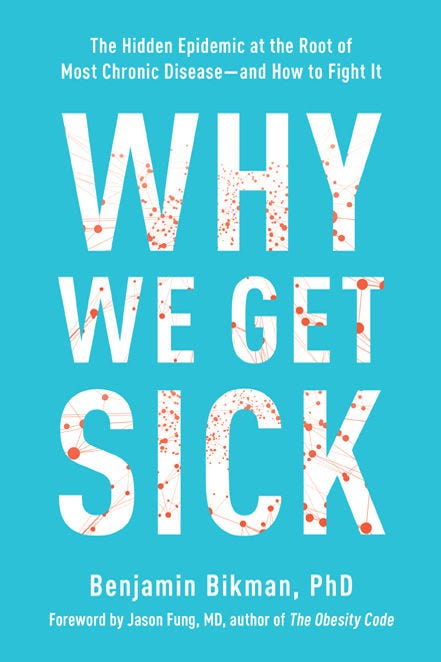
If you only read one book on health and nutrition, make it Why We Get Sick by Dr Benjamin Bikman.
Dr Bikman is a research scientist whose work concentrates on insulin. He also teaches. Why We Get Sick: The Hidden Epidemic at the Root of Most Chronic Disease — and How to Fight It has the comprehensiveness of a working scientist and the clarity of a good teacher. Dr Bikman also has various lectures available on YouTube which are well worth watching.
Why We Get Sick is organised into three parts — The Problem (8 chapters), Causes (5 chapters), The Solution (5 chapters) — with regular insert boxes to expound on salient points. The book is essentially about the nature and causes of insulin resistance and how to (re)achieve insulin sensitivity. That is, make your cells properly responsive to insulin rather than improperly resistant to it.
The “calories in, calories out” theory of obesity is simplistic and profoundly misleading, as what we eat, and how often, affects how much we eat and how much energy we expend. In other words, what we eat, and how often, affects the hormonal balance of the body which then affects whether we store fat in our bodies or use it up. The prime way mechanism determining which way our body goes is through our insulin response. Insulin is a hormone with a range of effects but it is primarily about managing our glucose levels.
Eating frequently drives up insulin levels. Eating carbohydrates drives up insulin levels. Fat does not generate a significant insulin spike. Protein with fat only generates a small insulin spike. Carbohydrates drives up insulin. Protein with carbohydrates drives up insulin.
A diet of fat and protein has minimal insulin effect. There are essential fats, there are essential proteins, there are no essential carbohydrates. Fat (if not seed oils or trans fat) is your friend, carbohydrates are not. For most people, a metabolically healthy diet is mostly (good) fat. The sugar you consume is far more likely to be turned into body fat than is the fat you eat.
So, if you follow the standard official nutrition guidelines and eat 4–6 regular meals and snacks a day of mostly carbohydrates, you are setting yourself up for developing insulin resistance.
What are some of the consequences of developing insulin resistance? Obesity, hypertension, heart disease, cancer, neurological conditions including Alzheimer’s, kidney disease, accelerated ageing and infertility. In other words, all the chronic diseases that increasingly plague our species can be largely traced back to insulin resistance. They are all conditions largely generated by metabolic ill-health.
Susceptibility to insulin resistance is partly genetic, partly some stress and environmental factors, but predominantly diet.
In Part I: The Problem: What is Insulin Resistance and Why Does It Matter? Dr Bikman takes us through what insulin resistance is (Chapter 1) and then, chapter by chapter, various health consequences.
Insulin resistance is the cells of the body becoming insulin resistant: that is, less and less responsive to insulin levels, which have to get higher and higher to have their required effect of regulating glucose levels in the body, especially the bloodstream. The more insulin there is flooding your system, the more food is turned into fat. This can be subcutaneous fat (under the skin) or visceral fat (in the thorax, especially around organs such as the liver).
Visceral fat is much worse than subcutaneous fat in its harmful health effects. It is also much less visible. Dr Bikman has a nice passage where he explains that fat you can jiggle is better than fat you cannot.
In Part II: Causes: What Makes Us Insulin Resistant in the First Place? Dr Bikman takes us through the causes of insulin resistance. The influence of age and genetics (Chapter 9), the causal role of hormones (Chapter 10), the interaction between obesity and insulin resistance (Chapter 11), the role of inflammation and oxidative stress (Chapter 12), and lifestyle factors (Chapter 13). Yes, you should get regular sleep (depending on you, 5–7 hours a night). Yes, you should exercise regularly.
Having laid out the full disaster, in Part III: The Solution: How Can We Fight Insulin Resistance? Dr Bikman takes us through the eminently practical (and inexpensive) things we can do to get back to good metabolic health. Eat less carbohydrates and fast regularly. In other words, do what you can to give your body a rest from being flooded with insulin.
As someone who has lost 39kgs (85lbs), and is no longer pre-diabetic, through doing precisely that, I am a believer.
Dr Bikman explains that a low-carb diet does mean you need to eat more salt. Often, when you are hungry, it means your body actually wants water or it wants salt. Having too little salt is more dangerous to your health than too much.
A tip not in the book: salted black coffee. Salt cuts bitterness, so salted black coffee can be a no-calorie, no-insulin affect, flavour-hit that blunts hunger cravings.
Dr Bikman has a nice explanation of the difference between fasting (not eating) and starvation (consuming your own muscles). If you have visible fat, and have no unusual health conditions, you can fast safely, though you may have to keep your salt intake up. He mentions the famous case of the seriously obese Scot who, under medical supervision, fasted for 382 days, consuming only water and minerals. Fat is stored energy, so body fat is what you consume when you fast.
Humans are designed to fast: that is why we are the fat ape. (Ever seen a picture of a chimpanzee with no fur? They are a bundle of muscle.) Breakfast is a hugely overrated meal, and often made up of foods bad for our metabolic health.
So, exercise regularly, eat whole foods, avoid processed foods (and seed oils), cut the carbs and adopt a mild fasting regime. The (inexpensive) path to metabolic health. Why We Get Sick concludes with a clear guide on how to do this.
And no, don’t drink fruit juice, that is flooding your body with sugar (and a particularly metabolically unfortunate sugar, fructose) generating an insulin spike. In fact, generally avoid drinking your calories.
Clear, informative, practical, based on good science: if you only read one book on health and nutrition, make it Why We Get Sick.
Good versus evil is not a universal religious or moral framing
I have a wide range of interests, many of them historical. One of the YouYube channels I have watched regularly is Dr Jackson Crawford’s channel on old Norse culture: serious scholarship delivered congenially in (generally) bite-sized pieces.
I have also listened to several of Tom Rowsell’s offerings from his Survive the Jive channel. He is mainly interested in matters Indo-European, but he ranges more widely, and some of his videos can be charming, such as this one on Hinduism in Bali. His material seems to be accurate (I have not spotted a significant error yet) and is engagingly presented.
Which brings me to Arith Harger’s channel. I listened to his video on What is the Left Hand Path? My interest in these matters is entirely historical and intellectual, but he gets SO much wrong in this video. Rather than give a detailed critique, I will cover the same ground based on available scholarship.
The first section of the video is actually quite a good discussion of the difference between Right-Hand Path and Left-Hand Path. He is correct in arguing that it does not neatly line up with good and evil. Even though, for Star Wars fans, the Right-Hand Path seems a bit Jedi-like and the Left-Hand Path rather Sith-like. It is when Harger tries to put the matter in a larger context that he goes seriously wrong.
The original source of the Left-Hand Path/Right-Hand Path distinction is from India. Specifically, from Yogic and Tantric traditions.
There is an excellent introduction to this distinction, and its likely cultural and historical origins, in Thomas McEvilley’s classic essay The Archaeology of Yoga. This is available on Jstor here and on Scribd here. The essay is, in part, a precursor to McEvilley’s masterpiece The Shape of Ancient Thought in which he examines the history of Greek and Indian philosophy and their interactions.
McEvilley argues that the Left-Hand Path/Right-Hand Path distinction is driven by the interaction between the patrilineal (and patricentric) culture of the invading Indo-European pastoralists and that of the matrilineal (and matricentric) culture of the resident farming population. To use slightly old-fashioned scholarly language, Aryans versus Dravidians.
Whether the culture was patrilineal or matrilineal matters because, in a patrilineal culture, a child without a father lacked a crucial element of social identity. Patrilineal cultures tend to be particularly restrictive of female sexuality for that reason. Conversely, in a culture where a child gets their social identity from their mother, not having a designated father is likely to be less of an issue. Especially if uncles can readily substitute as protective male relatives.
So, mystical and occult traditions in patrilineal cultures are likely to be sex-restrictive, to be ascetic. Conversely, mystical and occult traditions in matrilineal cultures are more likely to be sex-permissive. The former naturally inclines towards the development of spirit-focused disciplines, where ascetic denial of indulgence and the body is the seen as the path to self-development. The latter naturally inclines to the development of self-capacity-and-bodily-focused disciplines.
There is no direct connection in this to any good-versus-evil dichotomy. But, outside the monotheistic traditions, good-versus-evil is not the normal religious dichotomy. In religions in the animist-polytheist spectrum, the more normal distinction is order-versus-chaos. This is particularly true in agrarian societies, where a bad harvest presages disease, death and, if there is a sequence of such harvests, disaster. This concern for order can be seen in the ancient Egyptian concept of maat. How to construct and maintain social order is a central concern of Chinese philosophy while to seek the Tao (or Dao) is seek to be in accordance with the natural order of the universe.
Ascetic, sex-restrictive disciplines tend to be more orderly than than more sex-permissive disciplines. Especially if, as is the case in various forms of Left-Hand-Path, the deliberate breaking of conventions and restrictions is seen as a technique to develop one’s capacities. The highly patrilineal Indian elite would clearly tend to see the mother-right vestiges of Dravidian mysticism and occult practices as very much other. So, the Left-Hand-Path would be seen as more chaotic (because it was) and therefore negatively.
Arith Harger does not seem to be aware of any of this background. Of course, admitting the Left-Hand Path/Right-Hand Path distinction is originally Indian does rather get in the way of presenting it as Old Pagan Wisdom. Though somewhat similar, though less developed, patterns of patrilineal pastoralist Indo-European overlay interacting with matrilineal farming-religion survivals can also be traced in European cultures and their pre-Christian religious and occult traditions.
Where Harger gets particularly confused is over the good-versus-evil distinction. This is not remotely an originally European idea. The pre-Christian religious traditions of Europe fairly clearly follow the normal order-versus-chaos division. Thus, in Norse mythology, various monsters of chaos threaten the order upheld by the Aesir in a pattern that recurs across mythologies.
The good-versus-evil distinction is essentially (as far as we can tell) an invention of Zarathustra (aka Zoroaster). It fits nicely in with monotheism — with a Creator God who creates both the material and the moral order. Opposition to such a God is not merely chaotic and disorderly, it is anti-moral and destructive.
Hence the original Jewish understanding of the sin of Sodom and Gomorrah was that they were cities that were systematically anti-moral, preying on the weak and vulnerable and refusing to respect others. (Which makes way more sense than the later interpretation of the key sin of the cities of the plain being unnatural sex: see Chapter Four of Michael Carden’s Sodomy: A History of a Christian Biblical Myth.)
Norman Cohn’s book Cosmos, Chaos and the World to Come is a good introduction to the hugely important shift in moral perspectives from order-versus-chaos to good-versus-evil. A shift in moral perspectives that explains much of the antipathy between the Romans (who were mostly definitely all about order, including in ways that seem wildly immoral, or even evil, to us) and the Jews and later the Christians. If one is going to truly embrace a pagan perspective, good-versus-evil has to go.
So, the Right-Hand Path/Left-Hand Path distinction does not map to good-versus-evil. As it originally arose in the intermixing of cultures on the animist-polytheist spectrum, that is not surprising.
The Right-Hand Path/Left-Hand Path is originally an Indian distinction, but as patrilineal pastoralist Indo-European overlay over the culture and religious perspectives of resident matrilineal agrarians we see in India also occurred in Europe, the distinction has a relatively easy path into European pagan traditions, even revived ones.
But surely it is better to get the history correct, rather than hopelessly confused.
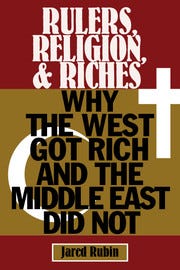
Jared Rubin’s Rulers, Religion, and Riches: Why the West Got Rich and the Middle East Did Not is a perceptive and informative attempt to answer the question of: why did Europe, particularly Northwest Europe, become so much richer than the Middle East? Especially given that Islam, in its early centuries, was comprehensively ahead of Latin Christendom in sophistication and level of commercial activity and in scientific enquiry.
As this shift was a case of a mutual reversal of fortunes — one started behind, but ended up ahead — the answer has to be an historical one. It has to be about unfolding processes over time, rather than some innate characteristic or difference operating in an undifferentiated away across the centuries.
Rubin states that the answer is not to be found in the doctrines of Islam, but in developing institutional dynamics, where one has to pay attention to what happened, and what did not happen. The latter points I strongly agree with, the first is less convincing. Rubin himself is advancing a set of propositions which he claims matter because they allow us to make sense of the world. Claiming that the doctrinal propositions of Islam do not matter, especially if they affect how institutions evolve, seems somewhat discordant.
Rubin’s basic argument is that rulers rely on propagating agents, agents in society who propagate their rule. Rule is propagated by some balance of coercion and legitimation. The more one can rely on legitimation to propagate one’s rule, the less coercion is required. Religious elites can potentially provide cheap (i.e., low cost to the ruler) legitimacy.
Rubin argues that Islamic religious elites provided cheaper and more effective legitimation to Islamic rulers than the Christian Church did to Christian rulers. Over time, that led Christian rulers to rely more on economic elites as propagating agents, so economic elites had more bargaining power, so they were able to push for more friendly-to-commerce rules, including more secure property rights, that promoted economic growth in Europe — particularly, post the Reformation, Protestant Europe. Conversely, the strength of religious elites, and the weakness of economic elites, in Spain and the Ottoman Empire led to commercial and economic stagnation.
Rubin has a nice definition of elites as: anyone who can influence how people whom they do not know act (p.29). I would add: who can recurrently influence, but I otherwise agree. More generally, I agree with his answer but not his analysis. Yes, I agree that the capacity for economic elites to bargain seriously with rulers was indeed crucial to the development of Northwestern Europe. This is a case that John Powellson makes powerfully in his 1994 Centuries of Economic Endeavour: Parallel Paths in Japan and Europe and Their Contrast with the Third World. Yes, the role of religious elites was very significant in Catholic Spain and the Muslim Middle East in explaining their commercial and economic stagnation. Yet, I disagree with Rubin’s structure of analysis.
Social bargaining
My disagreement centres on Rubin’s notion of propagating agents. Agents has a double meaning in economics. Economics is the study of purposeful action by agents in conditions of scarcity. Individuals and firms are all economic agents. But an agent can also be someone acting on behalf of an other, as in principal-agent problems.
Economic and religious elites are not really agents of the ruler, unless they hold some official position within the apparatus of the state. Dividing support for the rule of the ruler into coercive and legitimating agents (p.33) obliterates an important distinction between those outside the state apparatus that a ruler bargains with and those who, at least notionally, are under the ruler’s administrative direction.
As a medievalist, the striking absence from Rubin’s analysis is landholders. An analysis that covers priests (the Church), merchants (economic elite) and the king (ruler) but leaves out the landholding warlord class (knights and barons) is a little odd, to say the least. They are not economic elites, in the sense that merchants are, or religious elites and they are not accurately described as coercive agents, they had too much scope for independent action.
When one examines how merchants were typically incorporated in political deliberations (i.e., in overt political bargaining), it was by adding merchant representatives to the assemblies of nobles and Church hierarchy (bishops and abbots) that already existed. Analogous assemblies that did not exist in Islam. Which might be regarded as a bit of a clue.
Yes, there was a tradition of shura or consultation within Islam, but it was consultation with officials and dignitaries, who were included because of their personal standing, rather than their institutional connection. Occasionally, guild or trade representatives were included, but the entire process was far too occasional, limited and advisory to be comparable to the bargaining assemblies of Christendom.
It is easy to miss the continuity involved in the addition of merchant representatives to consultative assemblies within Christendom, as adding merchant representatives established the representative principle, which clearly would come to have great significance. But paying too much attention to the beginnings of the representative principle misses the continuity of bargaining assemblies.
Indeed, if one was looking for something that both Northwestern Europe and Japan had that Islam did not, it was a landholding warrior class with a clear corporate identity that regularly engaged in political bargaining with rulers. It is demonstrably much easier to add economic elites into political bargaining processes that already exist than to create such processes ex nihilo. Something that adversely affected China’s ability to cope with the challenge of the Eurosphere Powers. Japan which, unlike China, had a long and rich tradition of political bargaining did much better. The Japan-China comparison is a useful test of any general thesis about Islam/Middle East and Christendom/Europe.
As is comparison with Brahmin India, the other civilisation, apart from Islam, where law was dominated by a religious elite. (Hindu is a term I do not much like, as it covers a very eclectic set of religious traditions and obscures the remaking of the Vedic religion in the face of the challenge of Buddhism.)
Both Islam and Brahmin India generated fluid autocracies: autocratic states that came and went but generally left remarkably little enduring effect on the institutional landscape of their civilisations. The reason being that, in both cases, law was based on revelation and overwhelmingly in the hands of the religious elite. While this did not mean law was rigid, it did reduce its flexibility. One can make new precedents, or decree new rules. One cannot make new revelations with remotely the same facility.
Moreover, what can’t be entrenched in law is not likely to have enduring institutional power and it is very hard to entrench new things in law if it is based on revelation, on connection to the eternal. Especially new things that are to operate in one place but not another. The strength of local custom varied within Islam, but that was more about the circumstances of how Islam reached an area, and the strength of the local ulema, the religious scholars, rather than a more explicit process of legal adjustment.
Nor is political bargaining, certainly not explicit political bargaining, likely to be a prominent part of the political and institutional landscape, if political bargains cannot be entrenched in law. Political bargains that cannot be entrenched in law are not likely to be worth the effort and risks to engage in, or agitate for. In Christendom and Japan, political bargaining did not require any overturning or by-passing of the institutional structure of law. In Islam and in Brahmin India, it did.
States such as Wessex->England-> United Kingdom, France, Denmark and Japan have far longer institutional histories than any Islamic (or Brahmin) state. Apart from Denmark, they have longer institutional histories than Islam itself. The first historically attested tenno of Japan being Kinmei (r. 539–571, though he is counted the 29th Emperor), the first ruler of Wessex being Cedric (r.519–534) and of a united France being Clovis (r.509–511). Denmark only claims as far back as Gorm the Old (r.936–958).
It is important to note the difference between bargaining and resistance. The ability to resist the imposition of rules can generate a process of implicit bargaining. As economic historian Timur Kuran has so informatively laid out, there was plenty of implicit social bargaining involved in the evolution of Sharia. Notably in the evolution of the zakat, the Islamic charity tax. Chinese Emperors similarly engaged in implicit social bargaining with the gentry and merchant elites. Such implicit social bargaining has been a normal part of rulership down the ages.
Getting active agreement to new rules requires explicit bargaining. That has been less common. It was not a feature of Islam or of Brahmin India, due to religious elites dominating law, and the provision of mediating services, precisely because law was based on revelation. Nor was explicit social bargaining a feature of China, where the political model was autocracy administered by a meritocratic bureaucracy. The only explicitly hereditary element was the Emperor, the landed aristocracy having been euthanised out of existence during the Song Dynasty (960–1279). Conversely, explicit social bargaining was a pervasive feature of samurai Japan and of medieval Latin Christendom.
This was due to two inter-related factors. The first was that law in Christendom and Japan was explicitly human made. Even the canon law of the Christian Church, though it took revelation as a key source, was explicitly a human thing and possessed no inherent primacy over secular law. Christianity, Buddhism and Shinto are not legislating religions in the way that Islam, Judaism and Brahminism are. This is a doctrinal difference that generates major institutional differences.
The second was that the military elite was a landholding elite. Yes, both Japan and medieval Christendom developed the notion of land as being held in return for service. Over time, however, the landholding became more entrenched, with other levers being used to create a quid pro quo for military service. A landholding elite is an elite worth bargaining with: both because they are in a strong position to resist rules and because their active endorsement has value. Moreover, a landholding elite that is interested in increasing its income from its estates has reason to support effective property rights.
Islam did not develop such a landholding military elite due to the Sharia inheritance laws, which required property to be shared among all a father’s legal children. Yes, sons got more than daughters and older siblings got more than younger siblings. But inheritances still had to be divided. This made creating a landholding warrior elite impractical, given how expensive supporting a mounted armoured warrior was, because a landholding large enough to support such a warrior would not last beyond a single generation. Instead, Islam developed tax fiefs (iqta, timar and similar). A mounted armoured warrior would collect taxes from their land grant as payment for military service.
You don’t bargain with your tax agents in remotely the same way that you might bargain with warrior landholders with castles and military retainers. Nor do tax agents, who might be moved at any time, have anywhere near the interest in property rights that landholders who want their estates to be productive, and to be inherited by their son, do. Which is why Islam did not have the assemblies of nobles and bishops that Latin Christendom had, and could then add representatives of the merchants to. The institutionalisation of the doctrines of Islam had powerful effects on the social evolution of Islamic societies.
It is notable that the most successful Islamic State, the Ottoman Empire, the longest lasting major Islamic state, was a revealingly partial exception from these patterns. That is because the Ottoman dynasty developed the practise of re-issuing the kanun, the decrees, of previous Sultans, at the start of the reign of each new Sultan. This created an enduring body of administrative law that gave the Ottoman state considerably more institutional resilience than other Islamic states.
Muslim rulers were able to issue decrees in the silences of Sharia: mainly matters of state administration. As Rubin and others have pointed out, Ottoman rulers were able to use their ability to appoint and dismiss judges, and otherwise provide favours to the religious elite, to push the boundaries of kanun rather further than other Islamic rulers. But this was a difference at the margin, it did not change the fundamental dynamics. At least, not until late in the history of the Empire, when there were some (largely abortive) experiments with Parliamentarianism.
As what states were expected to do expanded in the C19th, so did the role of administrative law. This gave Muslim rulers a wedge against religious law in the face of the widening, and increasingly obvious, gaps between the capacities of the Muslim world and those of the Eurosphere states.
Sharia inheritance laws not only blocked the development of a landholding warrior elite, they also undermined the development of any merchant elite capable of long-term political bargaining. The wealth of successful merchants also had to divided among all their children. And as successful Muslims tended to have multiple wives, that often meant lots of children. If wealth is constantly being divided, that strongly militates against the development of the merchant dynasties that were such a prominent feature of Latin Christendom. This generated coordination and time-horizon difficulties that reduced the potential value of merchant elites as political bargaining partners. Even if those bargains could have readily been entrenched in law, which they generally could not be.
Sharia has only narrow restrictions against incest — that Muhammad’s first cousin and first convert, Ali, had married Muhammad’s daughter Fatima, rather militated against expansive incest rules, given that the life and example of Muhammad is a fundamental source of Sharia. The consequence of narrow conceptions of incest, and law being based on revelation, was that kin groups were very strong in Middle Eastern Islam, as alternative social cooperative mechanisms were weak or hard to construct. Once the Abbasid Revolution of 748–50 had overthrown the Arab tribal confederacy of the Umayyad and Rashidun caliphate, Islamic rulers faced the problem that locally-sourced troops would be colonised by local kin groups. They therefore turned to slave soldiers, as slaves are separated from any kin connection. This created military elites further separated from the local populace.
By contrast, the Christian Church, particularly the Latin Church, had extremely expansive bars on incest. That, along with other features of Christian doctrine, militated strongly against kin groups. The effect was particularly intense wherever manorialism was adopted, as holders of manors (the Church, princes and the landholding elite) had an interest in not having kin groups interfering with their management of their manors. Both Church and rulers also had a strong interest in not having their organisations colonised by kin groups. The result was that kin groups disappeared from Christendom, except in the Celtic and Balkan fringe. A rich structure of alternative mechanisms of social cooperation developed, mechanisms that could be readily entrenched in law.
This meant that a much richer variety of institutional arrangements developed in medieval Europe, given that bargaining is a path-dependent process, so produced varying institutional patterns in different places. So the selection processes of history had much more to work with in Latin Christendom than they did in Islam. (Or, indeed, any other civilisation.) Social and political bargaining was more entrenched in the society, there were more potential bargaining partners, and more reasons to bargain. With the difference between Christian and Islamic doctrine, and their institutional expression, being a key factor.
The circle of justice
The concept of the circle of justice that Islamic thought adopted from pre-Islamic civilisations — one well known form claimed to be from a letter by Aristotle to his pupil Alexander, another version claim to be a statement by shahanshah Khosrow Anushirvan (r.531–579) — expressed a notion of just order that implies protection and regularity by the ruler, but not political bargaining. In his Muqaddimah (An Introduction to History), pioneer historical sociologist ibn Khaldun (1332–1406) reports the alleged words of Aristotle as:
The world is a garden the fence of which is the dynasty, The dynasty is an authority through which life is given to proper behaviour, Proper behaviour is a policy directed by the ruler, The ruler is an institution supported by the soldiers, The soldiers are helpers who are maintained by money, Money is sustenance brought together by the subjects, The subjects are servants who are protected by justice, Justice is something harmonious*, and by it the world persists, The world is a garden . .
(*Franz Rosenthal translates this, ma’luf, as familiar, but notes it may mean harmonious, which works better in context.)
One does not bargain with servants. (Other renditions of Aristotle’s alleged words use the term slaves.) The version ibn Khaldun cites as coming from shahanshah Khosrow is even more direct:
Royal authority exists through the army, the army through money, money through taxes, taxes through cultivation, cultivation through justice, justice from the improvement of officials, the improvement of officials through the forthrightness of wazirs, and the whole thing in the first place through the ruler’s personal supervision of his subjects’ condition and his ability to educate them, so that he may rule them, and not they him.
Of ibn Khaldun’s three stated versions of the circle of justice, the first he quotes is the alleged words of a Mobedhan, a Zoroastrian priest, to Bahram b. Bahram (either shahanshah Bahram II, r.274–293, or Bahram III, r.293):
O King, the might of royal authority materializes only through the religious law, obedience towards God, and compliance with His commands and prohibitions. The religious law persists only through royal authority. Mighty royal authority is accomplished only through men. Men persist only with the help of property. The only way to property is through cultivation. The only way to cultivation is through justice. Justice is a balance set up among mankind. The Lord set it up and appointed an overseer for it, and that overseer is the ruler.
Unsurprisingly, the version put in the mouth of a priest explicitly endorses religious law, and God as the source of authority, but does not explicitly mention the military.
The notion that the ruler sustains his own authority by sustaining rightful order, while long predating Islam, received extra power in a civilisation where law was dominated by the religious elite and predominantly based on revelation.
Ibn Khaldun saw royal authority as the key force giving structure to society, including being the greatest source of demand for goods and services. He wrote that:
Mutual aggression of people in cities and towns is thus averted by the authorities and by the government, which hold back the masses under their control from attacks and aggression against each other. They are thus prevented by the influence of force and governmental authority from mutual injustice, save such injustice as comes from the ruler himself.
For ibn Khaldun, the creation, sustaining, and breakdown of social order was very much about the rise, persistence and decay of dynasties, of royal authority. The fluid autocracies of the Islamic world were very well captured by his analysis.
Islamic dynasties show, over the longer-term, very different patterns than do the dynasties of Christendom, who ruled over much more institutionally persistent states. From 800–1500, the reigns of Christian rulers in Western Europe generally tended to lengthen over time and, with some bumps, tended to have declining chances of being deposed. The duration of their reigns also show no particular pattern within dynasties. Over the same period, the reigns of Islamic rulers generally tended to decline, have a generally increasing chance of being deposed, with their reigns tending to shorten towards the end of dynasties. (The trends in reign length, chance of being deposed and patterns within dynasties is from here.) The difference between rulers whose bargaining could be entrenched in law (i.e., institutionalised), and rulers whose power was more salient (i.e. more apparently dominant), but with much less capacity to make, and institutionalise, supporting social bargains.
Legitimacy
The other feature of having law not dominated by the religious elite, is that law can develop secular discourses of legitimacy. Indeed, as James Franklin points out in his excellent The Science of Conjecture: Evidence and Probability before Pascal, legal reasoning can be the basis of a wide range of intellectual spin-offs. Especially if it is not constrained by constant referring back to revelation.
Rubin treats legitimacy as a support for rule. Legitimacy is, however, a somewhat fraught concept. As political scientist Xavier Marquez has pointed out, it can be a bit of a catch-all filler as a concept. How do we know X was legitimate? People supported X. How do we know X lost legitimacy? People stopped supporting X. Legitimacy becomes rather like phlogiston: a postulated theoretical entity without independent evidentiary support.
Legitimacy has two senses. The first is doctrinal legitimacy: follows the accepted rules, procedures and other precepts of some normative system. The second is public legitimacy: is within the political (or other) system’s operative rules of deference and authority, it’s public normative structure. Public rituals, public speech, public acts, private and public sanctions, are all means to establish those public norms of legitimacy. Rituals of submission, for example, publicly display that people submit. Failures to follow doctrinal legitimacy becomes socially significant if and when it affects people’s behaviour. That is, if it is an operative social norm, which normally includes effective sanctions. Being able to grant or withhold legitimacy, in a way that affects people’s behaviour, thus becomes a powerful social lever.
It is a social lever based on normative mechanisms. Norms are very much a social phenomena, as Cristina Bicchieri has carefully analysed; notably in The Grammar of Society and Norms in the Wild. Are economic elites purveyors of normative mechanisms? Not remotely in the sense that religious elites are. This is another distinction that the concept of propagating agents flattens.
The question of rival normative mechanisms to those of religious elites does, however, point back to the role of law in establishing norms of legitimacy. But also the processes of bargaining. Parliaments, Cortes, Estates-General, Diets, etc., could be legitimating mechanisms. One that religious elites were represented in, but were far from dominant in.
As previously noted, the incorporation of economic elites in political bargaining within Latin Christendom was not a self-contained dramatic institutional shift. It was an inclusion within, and extension of, bargaining structures that already existed.
If we go back to the break-up of kin groups and the Catholic marriage system (no concubines, no divorce, one wife, strong sanctions against bastardy), the full effect only came about where the secular elites went along with it. Which, anywhere manorialism extended to, they had a strong interest in doing. The Celtic fringe lacked manorialism, and so the Church was never strong enough to impose its marriage system on the Celtic fringe until the English-cum-British state smashed the power of the clan chiefs (Wales, Ireland) or bought them off (Scotland).
Which again takes us back to what the landholding warrior class was doing. The class that did not really exist in Islam, or in China, but did in Europe and Japan. A class that rulers definitely did bargain with, where it existed.
So, I agree with Rubin’s answer concerning the centrality of social bargaining and sources of legitimacy, but not his structure of analysis.
There is, however, much to recommend Rulers, Religion and Riches. Rubin is a very clear writer. He has intelligently and perceptively absorbed a great deal of material. He has thought seriously about the normative power of religious elites. Though incorporation of Cristina Biccheiri’s work on social norms, especially in The Grammar of Society and Norms in the Wild, would have been very beneficial to his analysis.
Rubin is also very good on the telling detail. His discussion of why the Ottoman rulers came to rely more on local notables I found particularly informative and insightful, for instance. Rulers, Religion, and Riches is a very worthy addition to the growing literature of comparative institutional analysis.
I am writing a book on marriage for Connor Court. It would be very helpful to have some "beta readers" to run a critical eye over drafts of the chapters (and appendices) of the book.
So, if you are interested in being such a reader, say so in the comments.
The chapter plan is set out below. Feel free to nominate sections you may be particularly interested in.
Prologue: A society without marriage
Introduction: The problem of marriage
Part 1: The patterns of marriage
Chapter 1: What is marriage and where did it come from?
Appendix 1.1: Rationality and utility
Chapter 2: Of cousins, cults and clans
Chapter 3: Paths to patriarchy
Chapter 4: Caste and other household matters
Chapter 5: Why the state
Appendix 5.1: China, Rome and cycles of empire.
Chapter 6: Polygyny and social aggression
Appendix 6.1: Migration and social aggression
Part 2: Marriage and Western Dominance
Chapter 7: Classical monogamy and political diversity
Appendix 7.1: Republics outside the classical world
Appendix 7.2: Empire as a territorial equilibrium
Chapter 8: Christian monogamy and supercharging cooperation
Appendix 8.1: Patterns of political bargaining
Chapter 9: The triumph of monogamy and the end of a civilisational cycle
Appendix 9.1: Sacredness and structure
Part 3: The Present and Prospects of Marriage
Chapter 10: Marriage at the margin
Chapter 11: Violence and victims
Chapter 12: Biology and culture
Appendix 12.1 Same sex attraction
Chapter 13: Conclusion
Afterword: Catastrophising and cultural flux
Appendix 1: Abstraction and Uncertainty
Appendix 2: Connection and Information
(Will update this post if and when chapter plan changes.)
I am a great admirer of work of the C14th Muslim intellectual Abū Zayd ‘Abd ar-Raḥmān ibn Muḥammad ibn Khaldūn al-Ḥaḍramī (1332-1406), known as Ibn Khaldun. I gave a paper on his thought to the University of Melbourne Medieval Roundtable in April 2016, I will be giving another examining the course of the Ottoman Empire in the light of his analysis in August 2017. Widening the circle of those acquainted with his thought is laudable.
Overstating the case, however, is not. Such as claiming that he is the real originator of economic thinking: particularly via his Muqaddimah (1377) (sometimes also called his Prolegomena). Now, apart from the piece being an instance of the unlovely contemporary habit where people cannot be just factually wrong, or have made some analytical error, they must be morally delinquent, the claim is misconceived.
That Ibn Khaldun was a serious and perceptive economic thinker is clearly true, as is discussed in this 1988 contribution explicitly suggesting he was "the father of economics". But a key characteristic of any sort of father, metaphorical or otherwise, is that they have intellectual progeny, as is pointed out here. In this case, intellectual progeny specifically in the field of economic analysis. Within the Muslim world, Ibn Khaldun failed to do so.
It is not that Muslim intellectuals were not aware of his work. In The Muslim Discovery of Europe, Bernard Lewis instances Ottoman officials attempting to analyse European states via use of Ibn Khaldun's model of the path of states. It is simply that they failed to follow in his intellectual footsteps.
What makes Adam Smith (1723-1790) the father of economics, and originator of modern economic thinking, is not Adam Smith or even The Wealth of Nations (1775), it is Thomas Malthus (1766-1834), Jean-Baptiste Say (1767-1832), David Ricardo (1772-1823), Jean Charles Léonard de Sismondi (1773-1842) and all those who followed on after. It was that Adam Smith had intellectual progeny, and, in the matter of economic analysis, Ibn Khaldun didn't.
It is worth noting that one reason that The Wealth of Nations had such an impact (apart from a book in the world of printing having a profound advantage over a book in the world of scribes) was that Great Britain was a parliamentary state, with the government by discussion that involves, and Smith's ideas rapidly became part of the political and policy debate. Conversely, Finnish priest and politician Anders Chydenius's (1729-1803) pamphlet The National Gain (1765), which preceded The Wealth of Nations and apparently advocated very similar ideas, was likely hampered in having an effect by Sweden being a more peripheral state, that Chydenius himself was a controversial political figure and Gustav III's coup of 1772, which abolished Parliamentary rule until it was restored in 1809.
If it turned out that Ibn Khaldun's ideas influenced Adam Smith, that might make him the Grandfather of Economics (vaguely possible, but not terribly likely; especially as the first complete scholarly edition of the Muqaddimah in Europe was not until 1858, part of the long-term scholarly impact of Napoleon's invasion of Egypt in 1798), but the temporal distance to intellectual progeny would still preclude him from being, in any useful sense, the Father of Economics or the originator of modern economic thinking.
It is also refreshingly free of cant and jargon. It is clearly written for a lay audience, but that the author came late to academe (she got her Ph.D. at 49) after what could only be described as a broad range of life experiences--three marriages, six children, surviving breast cancer, and what she describes as:
a varied resume that included stints as a nurse in Idaho, an administrator in a convalescent hospital in southern California, an English-language teacher in Bolivia and Spain, and a failed cattle rancher in South America (p.xii)
likely helped the easy-to-read and practical tone of the work.
The book wears its scholarship lightly but pervasively. There are boxes (ranging in size from half a page to three pages) providing background on matters touched on in the main narrative and the text is extensively footnoted and referenced.
The rhythms, discomforts and joys of archaeological endeavour are nicely brought to life. Much of her archaeology was in the former Soviet Union, concentrating on various kurgans or burial mounds, and the "joys" of dealing with Soviet agencies and suspicion of outsiders are woven into the narrative. Though it turns out that the contemporary People's Republic of China is worse, with Chinese officials going as far as to insert a (headless) museum exhibit mummy into a dig site as part of the official disapproval of interest in the Caucasian features of said mummies (p.140).
Davis-Kimball also interweaves current observation of steppe nomads with the archaeology, partly in the hope that the lives of the former might shed light on some of the finds of the latter (which, on at least one case, it did). Indeed, the observations about the life of steppe nomads are of interest in themselves. The book is something of a treasure trove of information on the archaeology, ethnology and history of the steppe nomads and is worth reading for that alone.
The warrior women of the title are only one of several themes in the book. The most striking passage on warrior women is early in the book, when the characteristics of the 194 adult skeletons found in the Povkrovka kurgans are listed. 94% of the men were buried with weapons, 3% with a clay pot or two, 3% with a child (though none of the women were). Roughly 15% of the women were buried with weapons, 7% with artefacts that suggested they were priestesses, (3% fell into both categories), 3% with chalk whorls too fragile to be of practical use and 75% were buried as hearth women (Pp46-7). The percentage of women buried with weapons is within the range of Scythian, Saka, Sarmatian burials more generally.
Davis-Kimball's book is full of striking details, though at times I would have liked a bit more interweaving with general patterns. Low population densities societies tend to teach women to fight (the men might be away) and (as Davis-Kimball notes, p.62) the horse archery of the nomads made imbalances in upper body strength and physical size less of a problem than other styles of fighting. Since it took a lot of grass to support animals, and a lot of animals to support people, and pasture is effectively a given, there would also be less pressure on women to give birth early, allowing a warrior stage of life in one's teenage years among early nomad peoples (most of the women warriors found died in their teens, p.60). There is not much evidence of women actually fighting with armies among later nomad peoples (and limited evidence for the early nomads, p.65), though more intense competition for pasture (and trade) may have shifted the balance against incorporating women in armies, rather than as last-ditch home guard. Even with these early nomads, Davis-Kimball suggests that women warriors may have been largely auxiliary or home defence forces (p.65).
Davis-Kimball is interested in all of the roles of women in these societies. Their apparent domination of religious activities is striking. Those men who seem to be of religious or shamanistic significance seemed to have cross-dressed (Pp180ff), part of the wider pattern associating queer folk with shamanistic roles. A considerable part of the text examines the role of women in spirituality and religion, religious rituals and belief in goddesses, particular a Mother Goddess.
A 12th century sheela na gig on the church at Kilpeck, Herefordshire, England.
The two chapter segue into the myths and archaeology of Ireland towards the end of the book at first seems to be just about being an archaeological memoir but she relates both back to the archaeology and history of the steppes. (Davis-Kimball clearly favours the steppes as the origins of Indo-European languages and culture.) That the genealogy of Irish heroes is always traced through the female line suggests a matrilineal past (p.210). She also points out that these were oral traditions until written down by Irish monks seems to have affected their transmission, with the role of women becoming more dependant and more morally perverse the later the transcription (Pp196ff). (She actually uses the term patriarchy correctly, as authority being centred in certain males, which is good to see.) There is also a discussion of those oddities, the sheela na gig's (Pp205ff).
The role of women in Norse (Viking) society is also discussed, including how archaeology supports Ibn Fadlan's claims about the rich adornment of their women: indeed, the archaeology suggests that women might have had more role in commerce than the men (Pp216ff). There is also a nice discussion of the series of powerful women in Mongol history--that the Mongol elite was highly polygynous did not seem to stop wives being regents in the interregnum between the death of one khan and the election of the next (Pp220ff). The contrast with Islamic history on this matter is striking, likely reflecting steppe women being taught to fight and the absence of religious-based relegation of women.
The final (short) chapter provides a summary of what has been traversed in the book, noting the historical downward shift in the standing of women when patriarchal priesthood-kingship models were adopted but ending, where she began, with the sheer fun of archaeological discovery.
Jeannine Davis-Kimball's Warrior Women is both an informative journey and a fun read. A good starting point or way station to understanding the varying gender dynamics of human societies in history.
Some works of history are excellent introductions to the history of a period, region, people. Others are much better read only if you already had some background knowledge -- either because they assume such knowledge, or because the author has such a pronounced point of view that background knowledge is desirable to balance out what is being written, or not written.
Which is not to say that I did not find it a useful and informative work of history. It gives an excellent overview of Turkish history, informatively covering the centuries before the Seljuks conquered much of the Middle East. The difficulty comes with the coverage of the Ottoman Empire (Chapters 7 - 10).
A European State
The author is at pains to point out that the Ottoman Empire was, from very early on, a European state. The Ottomans first took territory in Europe in 1354. The movement of its capital from Bursa to Edirne (formerly Adrianople) in 1363 meant that its capital was in Europe for the rest of its history, until the abolition of the Ottoman Sultanate in 1922 and the Ottoman Caliphate in 1923. With Selim I's conquest and abolition of the shadow Abbasid Caliphate in Cairo, this location history meant that the Sunni Caliphate was resident in Europe for over 400 years, though the Ottomans put much more emphasis on the title once they started losing Muslim-inhabited lands to European states, particularly Russia.
Ottoman Empire at its greatest extent -- being positively Roman in its use of client states.
At its height, the Ottoman Empire controlled about 20% of the land area of Europe (p.7). It was clearly a part of the European state system. Even the phrase used of its latter years, the sick man of Europe, acknowledged that. So, yes the Ottomans were a European state, indeed a European Great Power an acknowledged (though not original) member of the Concert of Europe. So it is easy to have fun with various historians and commentators who talk of the Ottomans as being somehow exterior to Europe and to being European; and Ball does have such fun.
The trouble is that Ball is so concerned to score points in current controversies--former French President Giscard d'Estaing's comments about Turkey not being part of Europe are clearly a particular annoyance--that his text systematically minimises differences, and emphasises similarities, between the Ottoman state and European states. In doing so, Ball does make several useful corrective points. But he also pushes his book into the realm of polemic.
Ottoman astronomers, C16th.
The notion of a clash of civilisations based on Team Christian versus Team Islam is easily demolished. Not least because there was often such vicious hostility between Catholics and Orthodox on one side, and Sunni and Shia on the other. Selim the Grim's expansion of the Ottoman Empire by 70% with, among other things, the conquest of Mamluk Egypt, completely (if temporarily) shifting the axis of advance of the Empire from conquest of Christian lands to conquest of Muslim lands, was largely motivated (or at least justified as being) to block the advances of the rabidly Shia Safavid dynasty which had conquered Iran and brutally converted it to being Shia.
And the Ottomans were ever opportunistic, making alliances with Christian states when it suited them, incorporating Christian forces into their armies, having Christian vassal states. The border lands between civilisations are noted for such patterns. But that does not mean they are not border lands between civilisations.
But a civilisational divide
To talk of the Ottomans not being a European Power is geographic nonsense. But to talk of them being of a different civilisation than the Christian states is not. The advance of the Ottomans into Europe was the advance of a civilisation from outside Europe into Europe. As the Ottomans imperium lost ground after 1683, so that was the retreat of a civilisation from Europe.
Skull tower at Nis, Serbia, erected by the Ottoman commander to contain skulls of defeated Serbian rebels, 1809.
That there were non-Muslim minorities in Muslim lands did not mean that Muslim-majority countries were not lands of Islam as a civilisation. Just as the leaving of Muslim minorities in Christian-majority countries did not stop those being lands of a different civilisation. Nor was being a majority required for a civilisational divide, who controlled the state in a territory was sufficient. The border of the Ottoman Empire was a civilisational divide, one that not only represented a different established religion, but different marriage systems, understanding of law, basic institutions and metaphysical presumptions.
Jihad as system
When Ball writes "the perceived Holy War symbolised by Kossovo--was simply not an issue to the early Ottomans" (p.98) he is being less than accurate. The Ottomans turned jihad into a system. A system operated for their benefit, but a system nonetheless. (Indeed, creating systems to expand and buttress their rule was the Ottoman genius.) All the first nine rulers of the Ottoman state called themselvesghazis (holy warriors).
Serbian historian Srdja Trifkovic, in his The Krajina Chronicles: A History of the Serbs in Croatia, Slavonia and Dalmatia (which I review here) provides a useful summary of how the Ottomans used jihad, (and his work is a useful corrective to Ball's Ottoman spruiking more generally). Raiders devastated border regions, promoting flight and reducing economic activity (and thus long-term ability to resist) while the spoils of raids (already sanctioned by Islamic jurisprudence) motivated and maintained the raiders. Larger armies periodically probed the borders. Eventually, conquest of a new region would be accomplished, the surviving inhabitants would be subject to the jizya poll tax on non-believers, Muslim warriors were settled as “tax-farmers” in the newly-conquered region and the process would roll on from the new (expanded) borders.
Mehmet II triumphal entry into Constantinople (painting by Benjamin Constant).
The Ottomans could be very pragmatic in how they interpreted non-believer submission to their rule. Hence their extensive use of Christian vassal states and Christian warriors. But that same pragmatism used jihad quite ruthlessly as a means and justification for imperial expansion. The Ottomans were never a jihadi state, but they were certainly a state that used jihad, and did so quite systematically. They saw themselves as expanding dar al-Islam; as, indeed, they were. During the long imperial retreat, they were defending dar al-Islam.
An Islamic Empire
As Ball points out, it was only after the Russo-Turkish War of 1877-8 that Muslims became a majority of the Empire's subjects (p.158). The balance of pragmatic consideration then moved to harsher treatment of what were now clearly non-Muslim minorities. This culminated in Hamidian Massacres of the 1890s and the Armenian, Assyrian and Pontic-Greek genocides followed during the Dynasts War. While admitting to the slaughters, Ball is at pains to blame European factors--the rise of nationalism (p.156), the push of the Christian Powers to protect Christian nationalities within the Empire (p.158). This represents a sadly typical "I will now signal I am a good and sophisticated person" move of allocating the "real" agency for anything bad to those bad "white" people. Ball having systematically glided over awkward bits in his Ottoman narrative makes it easier to do.
A photograph, taken by the American W. L. Sachtleben, depicting the victims of a massacre of Armenians in Erzerum on October 30, 1895, being gathered for burial at the town's Armenian cemetery.
The reality is that the Ottoman Empire was always ultimately an Islamic state. The Ottoman dynasty prided itself on being a defender of Sunni Orthodoxy and Sharia, albeit with typical Ottoman systematic finessing, was the dominant law of the Empire. (In accordance with Sharia, the various millets each operated their own law, but only as subordinate to Sharia.) With a majority of their subjects being non-Muslims, of course the Ottomans were pragmatic in their treatment of non-Muslims. But Muslim supremacy was always the bedrock the state was built on.
The balance of tolerance and oppression
There is a recurring pattern in history of states with established and legitimating religions being pragmatic when the dominant group is a minority and then becoming increasingly oppressive as the dominant group's proportion of the population shifts to being a majority, with that intolerant oppressiveness worsening as their dominant group's proportion of the population increases further. We can see this pattern in Norman Sicily, where the treatment of Jews and Muslims was relatively tolerant when the Christians were a minority, tending to worsen as the Christians became a majority and culminating in the expulsion of the remaining Muslims (and later the Jews). We can also see the pattern in Spain and Portugal during and after the Reconquista, culminating in the expulsion of the Jews and later of the Moriscoes.
Similarly, the treatment of Jews in Christian Europe was often worse than in Islamic Europe because Jews were typically the only significant religious minority in Christian states, and a relatively small one at that, while Jews were part of a wider mosaic of religious groups in Islamic realms. (Not that Jews did not also suffer massacres and pogroms in Islamic lands.)
Selim III receiving foreign dignitaries, 1789.
But the wider pattern also occurs in Islamic lands. Indeed, is continuing to this day, with the flight of the Jews after 1948 and the current steady erosion of Christian populations in the Middle East. The Ottoman massacres and genocides were a particularly vile manifestation of the wider historical pattern. (The Habsburg Monarchy also had ethnic minorities of dubious loyalty in a time of rising nationalism, with Russia posing as protectors of Orthodox groups: but the Habsburg state did not resort to massacres and death-marches as a response, not even under the stress of the Great War.)
So, there are some serious weaknesses in Ball's treatment of the Ottoman Empire. But there is also plenty of useful and striking information. And even folk being polemical can make useful points. The discussion of the Ottoman attempt to incorporate the Roman heritage, for example, is enlightening.
The real strength of the book is in its treatment of the wider Turkish history, which extends centuries before the Seljuk and Ottoman Empires. The Turks are no longer the folk who suddenly appear out of the steppes as conquerors in the C11th, but as a people with a rich and complex history before that. So, a useful book, but not one to be read as a stand-alone, particularly not regarding Ottoman history.
The history of (long distance) trade can be divided into 4 eras, one of which is regional and transitional:
Continental-coastal: outside local areas, trade was limited to thin networks of high value items with some (highly fluctuating) upward tendency in the extent of such networks, but no significant link between Afro-Eurasian trade systems and American trade systems.
Oceanic-global: Europeans link the globe via exploitation of routes their explorations opened up, with silver the dominant trade item and non-local trade still limited to thin (though expanding) networks of high value items.
Atlantic-transition: Huge increases in the level of shipping (including through greatly expanded canal networks) creates an Atlantic economy on the cusp of mass trade, a matter of quantity having a quality all of its own.
Globalised: From the 1820s onwards, steam (via steamships and railways) sets off an era of mass trade, which means Rogowski factor income (pdf) dynamics come to dominate the political economy of trade.
With mass trade (without which there is not globalisation worth the name), trade seriously impacts the income of general factors of production (land, labour, capital). Outside the Atlantic economy, there is no globalisation worth the name until the 1820s (pdf) because the technology did not support the required level of mass trade. According to Angus Maddison's calculations (pdf), in 1800, merchandise exports were about 1% of world GDP: by 1913 they were 8%.
One can tell that the Atlantic economy (particularly Britain) was on the cusp of mass trade as wheat prices converged (pdf)--wheat prices within the Atlantic economy (expressed in silver) narrowed from a range of 6.66:1 around 1400 to a range of 1.88:1 around 1750--and, in Britain particularly, free trade v protectionism starts becoming a political issue.
Before that, the political economy of trade was about fighting over the rents from thin trade networks of high value items because trade was not "mass enough" to affect general factor incomes. Though such trade was disproportionately important for state revenues. Trade was overwhelming non-competing items, because transport costs were so high, it was very unlikely traded items could compete with local production.
(As an aside, I have suggested that the change to mass trade and cheap communication matters for the history of monetary theory: in particular why the price-specie flow mechanism made sense to David Hume but rather less so later.)
Once transport technology advances enough for mass trade, then scarce factors of production want trade protection to protect their scarcity premium from foreign competition. If an economy is importing a factor of production (or its products), then that factor of production is scarce in the local economy. So, importing food implies land is scarce, importing capital implies capital is scarce, importing labour implies labour is scarce (in the local economy).
Plentiful factors of production want free trade to get access to wider markets, increasing their income (by increasing their sales and by reducing their costs through not having to pay local scarcity premiums). If an economy is exporting a factor of production (or its products) then it is plentiful in the local economy. So exporting food implies land is plentiful, exporting capital implies capital is plentiful, exporting labour implies labour is plentiful (in the local economy).
In an era of mass politics, two out of three factors of production wins (domestic) political economy fights. Hence the broad patterns of the political economy of trade in the first globalisation era from the 1820s until the Great War. Britain exported capital and labour and imported food. Capital and labour were plentiful and imposed free trade against the wishes of (locally scarce) land. Germany imported food and capital and exported labour. Capital and land were (locally) scarce and imposed protection against the wishes of (plentiful) labour.
The Anglo settler societies (Canada, US, Australia, New Zealand) exported food (and minerals) and imported capital and labour. Capital and labour were (locally) scarce and imposed protection against the wishes of (plentiful) land. Latin America had weak states, which relied on (easily imposed and collected) tariffs for revenue but also imported labour and capital, so moved to protection whenever powerful land interests could be overcome.
Very few countries exported capital in the period before 1913, and as the combination of having both plentiful land and plentiful labour is (to say the least) odd, the general tendency was towards protection among countries able to set their own trade policies. (Which European colonies, and various countries subject to European power, generally were not.)
There was retreat from, and stagnation of, globalisation in the 1914 to 1945 period, largely due to the huge shocks to the global trade system of the two World Wars and the Great Depression. There was also some interruption to the pattern of declining sea transport costs (though vastly increased uncertainty may have been a factor in that also by affecting research and investment decisions).
Over the long term, the 1914-1945 globalisation-retreat interlude turned out to be an interruption in the process of globalisation; though a major interruption, it took until the 1970s for world trade to recover to the level it would have reached if the pre 1913 trends had continued. (The latter observation is taken, as is much of the information in this post, from an excellent history of trade over the last millennium, Power and Plenty: Trade, War and the World Economy in the Second Millennium by economic historians Ronald Findlay and Kevin O'Rourke.)
Globalisation continued to be driven by falling transport (mainly in air transport) and communication costs.* Which, along with other aspects of technology, began to have some unexpected effects on the patterns of mass trade. (Paul Krugman's Nobel memorial lecture is an excellent summary of that.) As factors of production became more internally differentiated, this tended to favour free trade interests by breaking up pro-protection coalitions.
As the breakdown in international trade was strongly associated with the disasters of the 1914-1945 period, this generated increased public policy commitment among the developed democracies to liberalising trade as part of a commitment to a more stable international order. (Capital-importing countries outside the developed world generally continued to tend towards protectionism.) Just as the dominant naval power of the 1815-1913 period, Britain, supported a liberal trading order, so, after 1945 did the succeeding dominant naval power of the US.
Also, if your income is not directly affected by trade, you will tend to favour freer trade as it broadens choices and tends to lower prices. So, electorates with large public sectors and more welfare-dependent or retired folk are likely to tend to be more favourable to freer trade.
As information technology (IT) develops, and communication costs become tiny, we start getting not merely wholesaling of films and TV but retailing of films and TV as well as huge growth in computer games. Intellectual property (IP) becomes a big deal as new forms of rents from trade become available. In the words of the post by econblogger Scott Summer that inspired this post:
Because the US is the dominant producer of intellectual property, the US government (both liberal and conservative administrations) will argue for low overseas taxes on multinational earnings, weak anti-trust laws to preserve the profits of US companies with patents, copyrights and/or large network externalities, and strong intellectual property rights, to extract money from non-American consumers of stuff developed in California.
You might wonder why even liberal American politicians would defend the robber barons of California. The answer is simple; these firms produce lots of tax revenue for the US, and for California. They don’t want to kill the goose that lays the golden eggs. Nor do they want to share eggs with Europe and Asia. It doesn’t matter if our firms exploit consumers in Asia or taxpayers in Europe, as long as they share 30% of the loot with public employees in the US.
And these industries are a very big deal, particularly for the US. Computer games are a multi-billion dollar industry, apparently overtaking films for export income. It is plausible to argue that it is precisely because we have global markets, that protection of IP by states in return for taxing the income therefrom has become a feature of international politics.
On the horizon, we can see the rise of artificial intelligence (AI) and 3D printing. This seems likely to make the IP issues more salient, not less; both in their use and as the two technologies may well undermine mass trade in goods and services.
Globalisation has been fundamentally driven by technology: in particular, falling transport and communication costs. Public policy certainly can affect (profoundly) how specific countries have interacted with the pressures and consequences of said falling transport and communication costs. Major breakdowns of the international political and economic order can even more so.
Nevertheless, those falling costs created pressures and expanding opportunities that public policy responded to.
If technology now starts to strongly favour localisation, then that pressure will be reversed as technology will no longer be encouraging global connections in production and distribution of goods and services. If that is so, at least in terms of mass trade in goods and services, we may be approaching peak globalisation.
* As air transport has increasingly bled off high value items (including people), this has tended to limit shifts in real sea transport rates, as technological improvement in sea transport is being applied to cheaper and cheaper (in aggregate) products.
ADDENDA. A dramatic effect of the European created Oceanic-global trade era was the Columbian Exchange; but that was, in the spreading across the globe of crops and animals, more a matter of changing local production patterns than trade as such.
One of the high value items tending towards mass trade in the Atlantic economy was the Atlantic slave trade, in itself partly a result of the population collapse in the Americas due to the importing of the Eurasian disease pool to the Americas as part of the Columbian exchange. The Atlantic slave trade manage to move across the Atlantic likely similar magnitudes of African slaves as the Saharan slave trade had across the Sahara (with likely similar death rates, particularly when the death rates from creating eunuchs are included) but in just over three centuries rather than twelve.
Their own march
-
More on the Stella Creasy conundrum, aka the tension between wanting to
appear to have some respect for the rights of women and girls and wanting
to pret...
The mystery at the heart of Trump’s trade war
-
This story appeared in Today, Explained, a daily newsletter that helps you
understand the most compelling news and stories of the day. Subscribe here.
I sp...
Christopher Caldwell On The AfD
-
You’ve probably heard that the Alternative for Germany party (AfD) won
bigly in last weekend’s election in the German state of Saxony-Anhalt, and
is now po...
AI Pause Regs Look Risky
-
People dislike AI for many reasons, but one extreme fear is that AIs will
escape control from those who make, buy, or rent them, and then hurt others.
Donald Trump’s Historical Illiteracy
-
I’ve written several times (here, here, here, here, here, and here) about
Trump’s economic illiteracy. Five of those columns were about Trump’s blind
spot ...
Social Media Is Pointless Slag
-
*The irony here is we're being "consumed" by the process of "consuming"
social media. *
*If we want to understand why a system generates unfavorable outpu...
A Heart Warming Math Story
-
A 92 year old retired math professor (a woman), and a 15 year old girl, who
both live in the same neighborhood in Manhattan, solve an important
unsolved ...
HMG responds to genocide in Nigeria
-
Make no mistake about it: the genocide of Christians in Nigeria is a
gruesome reality. According to Nigerian Catholic Bishop Wilfred Chikpa
Anagbe, “The to...
Another day, another fraud
-
Selling green cards. Hey, why not?: The Department of Justice (DOJ) has
announced charges against a former government employee and his alleged
accomplice...
Arse Dribble
-
Only in the Guardian could such blatant misrepresentation take place. I
leave this with no other comment as the sheer stupidity and
misrepresentation speak...
New Medieval Books: The Fifth Crusade
-
The Fifth Crusade is often overlooked, even by those who study the
Crusades. This book shows why its story deserves greater attention,
offering valuable in...
Monsters of Ohio Starred Review in Library Journal
-
This actually happened, like, a week ago, but I’ve been busy traveling all
over the place, so I’m noting it here now: Hey! Monsters of Ohio got an
other st...
Tuesday assorted links
-
1. The Carob Prize, for scholars who tell the truth (WSJ). 2. Observations
from watching Iranian social media. 3. The Emma McAleavy feminist vision.
4. I...
Sportsball Man Melts Brain
-
Apparently Steelers wide receiver DK Metcalf has spent too much time around
QB Aaron Rodgers and managed to sandblast his brain smooth in the process.
Metc...
What about Lindsay Clancy?
-
By now most of you know about the Lindsay Clancy case, but I’ll briefly
reiterate it. Clancy, then 32 years old, says she was afflicted with
postpartum psy...
Placement & AOS
-
Which areas of specialization have been correlated with higher placement
into “permanent” (typically tenure-track or tenured) positions over the
past few...
Ukraine Is Shooting Fish in a Barrel
-
Ukraine has created a system to determine which ships belong to the shadow
fleet and which belong to major companies. By sourcing ship identities,
transp...
While Memory Remains
-
Nearly a third of today’s Americans were born after 9/11. To grow up in the
shadow of an epochal event is not unusual. There were generations of
American...
Summing up economic history in one para
-
Prof Luis Garicano sums up all the economic history brilliantly in one
para: “Adam Smith said a bunch of stuff that was mostly right. Marx said a
bunch of...
The Collective
-
Guys, for those of you out there who aren’t female, women, people of
vaginitude I bring you strange and wild news: We’re not a collective. We
don’t share a...
Tuesday Talk*: Free Range Or Child Abuse?
-
My older sister walked me to Washington Elementary School, about a mile
from my home, when I was in kindergarten. Then again, she was in fifth
grade and at...
“I’m Not Productive Enough!”
-
Says who? Where is the Big Writer Referee who determines if you are
producing sufficient numbers of sellable words? So you’re not SuperWriter.
Relax. Breat...
Diary #845
-
This is the time of year when the pigs, guided by their amazingly acute
sense of smell, start spending a lot of time under the apple trees,
feasting on dro...
The Evil of Anger
-
Gloria Steinem's life was marked by an implacable self-hatred hiding behind
the horrific movement used to validate murdering her own baby.
Five Hemingway short stories
-
Ernest Hemingway wrote some 70 short stories. The situation is slightly
tangled. During his lifetime he published three short story collections –
In Our Ti...
Reader’s Links for Sept. 8th, 2026
-
Each day at just after midnight Eastern, a post like this one is created
for contributors and readers of this site to upload news links and video
links on ...
What Leo Strauss Gets Right
-
One of the things that Leo Strauss does quite well, as a writer, which I
never really noticed before, is that when he rehearses the arguments of
others—wha...
Shaking the olive tree
-
Mosaic of Farming Activities from Julia Caesarea, Algeria. Agriculture was
paramount to the Numido-Romans.
Numidia was successful in becoming a main prov...
Livin’ La Vida Loca
-
A lachrymose plea for sympathy from a popular MAGA influencer who’s
sometimes quoted at me online. He recently moved to Shelby County,
Tennessee from Alaba...
The Latent Benefits of Work
-
Each year, the White House Council of Economic Advisers publishes the
Economic Report of the President. The CEA is led by politically appointed
academics...
Two Contemporary Training Issues to Ponder
-
I just read the article linked below. It discusses some heat casualties at
a high school following a bomb threat evacuation. Please take two minutes
to re...
Can Israel Connect to Syria’s New Oil Routes?
-
BESA Geo-Energy Insights No. 11, September 7, 2026
*EXECUTIVE SUMMARY:*
*Syria is reviving plans for major oil pipelines linking Iraq and other
Gulf oil...
Remembering King Harald
-
[image: Remembering King Harald]
Lyonel Perabo on the legacy of Harald V, King of Norway, who passed away on
August 28th.
Continue reading Remembering Kin...
Men: How to cure yourself of women
-
St. Benedict (500s), according to St. Gregory: “Benedict fought valiantly
to forget the woman ‘the memory of whom the wicked spirit put into his
mind, and ...
A Modern Moral Question
-
A Londoner objects to unlabelled meat from non-stunned slaughter served
widely, though UK law allows this exception only for Jewish and Muslim
consumers. H...
Types and Conditions of Moral Order
-
Is the world morally ordered? Do good things come to those who act well and
bad things to those who act badly? Do the virtuous thrive and the wicked
suffer...
“The Late Great John McCain”
-
Democrats Should Stop Praising Republican Warmongers BILL ASTORE SEP 03,
2026 I know: this is old news. But I was going through my notes from
September of ...
The Billboards of Silicon Valley
-
YOUR AI AGENT NEEDS A WORKFLOW ENGINE. The billboard stands by a
nondescript stretch of highway somewhere between Redwood City and Mountain
View. A boom, ...
Review: The Poet
-
[image: The Poet (Jack McEvoy, #1; Harry Bosch Universe, #5)]The Poet by Michael
Connelly
My rating: 5 of 5 stars
Jack McEvoy and Rachel Walling both show ...
Paying the Truthseekers
-
Academics and journalists have a lot in common, at least in principle.
Whether you’re a reporter or a professor, your job is to go out into the
world and f...
Have You Appreciated This Summer?
-
Forgive me for this post… Increasingly, I avoid politics. Where I once
participated, now I disengage. The madness is too much. I’ll get stupid on
my shoes....
LLMs and self-referentiality
-
I woke up yesterday with the following thoughts, which are probably either
obvious or dumb. A central thesis that many readers, including me, took
from Dou...
LLMs and self-referentiality
-
I woke up yesterday with the following thoughts, which are probably either
obvious or dumb. A central thesis that many readers, including me, took
from Dou...
First signs
-
17.3 – 16.4 thousand years ago In July and August, this blog covered one of
the great revolutions in information transmission, the evolution of
language. ...
LEFT RIGHT LEFT…
-
All I asked Chat GPT to render was a picture of national socialists. That’s
all. I said no names and asked for no times in history. The picture above
is w...
Memo For File CCXXIII
-
I found this incredibly discouraging: Lindsay Clancy verdict watch: Jury
ends second day without verdict, will return Monday By Peter Yankowski,
Lisa Backu...
Just war doctrine and Congress’s war powers
-
As I have argued since it began, President Trump’s war on Iran fails to
meet several of the conditions of traditional just war doctrine. Not the
least o...
The plague years
-
I'd heard about a decline of self-reported happiness in recent years, but
I hadn't looked at the numbers until I saw a post by Noah Smith a few days
ago...
Fried rice for dinner
-
… Tonight’s dinner: fried rice I had a bunch of leftover stuff sort of
floating around in the freezer. Lap Cheong. A couple of shrimp. Some peas
and carrot...
Answer To Euthyphro
-
In the Euthyphro Plato has Socrates ask whether things are good because God
wills them, or that God wills them because they are good. The former is
rejecte...
What Became of The Army Strategy?
-
“Slow is smooth, and smooth is fast.” Most anyone who has
served in combat arms as a tactical level leader in the Army is familiar
with this ...
Hamas Plays for Time in Gaza
-
Spectator, 19/8: The current, troubled and glacial diplomatic process
between Israel, the US/‘Board of Peace’ and the de facto Hamas authority in
Gaza is a...
The Race to Serfdom
-
20 years ago, it was common to hear people say something like “I love
Hayek, but The Road to Serfdom is a bit embarrassing. Clearly not every
intervention ...
Precognition Purchase
-
Finding that past me had bought an item and squirreled it away, that is now
hard to find and triple the price is pretty much my win of the summer. Go,
me!
Brief Note on Military Applications of Big Data
-
One of my students brought up the military uses of big data. Here's my
response.
Warning: major oversimplifications ahead!
In the mid-2000s, the Army to...
The Book is a Book, not Disembodied Information
-
Believing that the book is just abstract information that can be merely
held on a stick is an error we will call dimension overtrucation.
*Definition: *D...
Western Europe Is Richer Than the US
-
Originally published at People’s Policy Project By Matt Bruenig There has
been a weird debate over the last few months about whether the United
States is...
Real talk about the exchange rate
-
(This post reproduces a thread I wrote on Twitter/X on July 29.) A lot of
the discussion about the depreciation of/undervaluation of China’s real
effective...
I Wrote This on Ólafr's Day, or the Saint in Runes
-
Door from Rauland church with runic inscription on the upper iron fitting.
Photo J. Jesch 2023.
Today is the feast day of the holy King Ólafr Haraldsson, wh...
InCognito (All Content Moved)
-
It is a bit late (almost 2 years), but now is a better time than never to
share that I have moved my blogging to InCognito.
The G25 Proto-Indo-European master sheet
-
I'm putting together a G25 Proto-Indo-European master sheet that I'll be
using in a future blog post about the Indo-European, or, if you wish,
Indo-Anatoli...
The Cognitive Barrier to Teaching
-
When people want to mock ed schools and the low IQ of the students within
them, they often go straight to the coursework. Millions of pages mocking
absurd ...
They’re Not Rape Gangs…
-
Of course there was a cover-up. Of course it continues—witness the
deafening silence of the legacy media in response to Rupert Lowe’s
crowdfunded Rape Gang...
Syria, Revolt and War in the Digital Age
-
World War I saw the emergence of the soldier's camera; the American side of
the Vietnam conflict marked the first televised war; the Kuwait War
inaugurated...
Lessons We Learn from Donald Trump
-
As I compose this sentence, Donald Trump appears beleaguered: thrashing
about trying to escape being labeled Loser of the Iran War, facing
basement-level a...
My (Mostly Contrarian) Thoughts on AI
-
I am not an expert in AI, but I have seen a lot of waves software-based
productivity innovations in my lifetime, and have developed some intuition
as to ho...
-
Just What we DON’T Need: A New Predatory Journal in Archaeology
I just got a notice about a new predatory journal, “Archaeological Studies,”
publishe...
Climate Etc. is now an archive
-
Climate Etc. closed in June 2026 and this site is preserved as a read-only
archive. This feed will not update again -- visit the homepage for where to
find...
Mysterianism: Broadened
-
Mysterianism. Mysterianism (or: the new mysterianism) is an idea that has
been kicking around philosophy of mind circles at least since 1989, the
year Coli...
Fred’s Utterly Necessary New Books
-
A tale of woe, though not very woeful, but I believe in straining for an
effect: After decades of inciting insurrection, sedition, and the
corruption of y...
Fred’s Utterly Necessary New Books
-
A tale of woe, though not very woeful, but I believe in straining for an
effect: After decades of inciting insurrection, sedition, and the
corruption of y...
Podcast interview scam
-
Podcast interview scam padraig Tue, 05/26/2026 - 09:49
Dear readers and authors
Several authors have made the Little Atoms team aware of emails, claiming ...
Maybe Europe is winning after all?
-
Today when I should have been enjoying the non-monetary benefits of
Wimbledon Common I was instead getting depressed by The Economist, which I
listen to as...
Regression to the mean
-
Sports fans in particular mis-use the idea of "regression to the mean,"
speaking of it, as though it were some causal power, impacting real,
physical eve...
Moving to Qatar: The Hidden Guide
-
There are many online guides about moving to Qatar and settling in.
Employers also often provide instructions and assessments. This is not a
replacement fo...
-
-
Here is a photo of my family. I love them more than anything.
Images have power, I hope. Normally we try to be pretty private, but in
this case I am shar...
China and the Future of Science
-
*THE CHINESE* socio-political system differs from our own. From the
perspective of the topic of this conference, here is the most salient
distinction: the ...
Rabbit Season (UPDATED)
-
Well, last night’s Super Bowl made me nostalgic for my youth because it
reminded me of every bad game from the ’80s. I had better things to do than
watch t...
Green Door Post- Draft 6/24/25
-
“We liberated Europe from fascism, but they will never forgive us for it”
is often attributed to Georgy Zhukov, the great Soviet general during the
Great P...
Against the Strawman God
-
Stellan Skarsgård, the famous Swedish actor, reportedly declared that the
question of G-d’s existence is “absurd and completely uninteresting”
because if a...
Collected Posts on NSSF SHOT Show
-
I have only been to the National Shooting Sports Foundation (NSSF) SHOT
Show (Shooting, Hunting, and Outdoor Trade Show) once. I am attending the
show, hel...
4 Simple Steps to Change Your Life
-
If you want to change your life—like really, seriously, no bullshit,
actually change your life—do this:
Step 1: Write down everything you care about.
Ste...
Disraeli Left Me Tariffs?
-
In a recent piece for National Review (“Why I Will Never Be A Free Trader“)
writer Michael Brendan Dougherty builds the core of his argument around the
o...
GDP Marches On!
-
A discussion has been had over on X about how GDP sucks, and is also
better than measures of happiness.
I was moved to song. To the tune of “Battle Hymn...
Interview – Bart Ehrman on Jesus Mythicism
-
My very special guest today is Professor Bart Ehrman. Bart will need no
introduction for most people, but in case you aren’t aware: he is the James
A. Gr...
OPERA, ELITISM AND THE WORKING CLASS
-
This is the opening to my essay on the forgotten relationship between opera
and the working class, published in the Observer on 12 October 2025. You
can re...
A Nobel for Innovation: Mokyr, Aghion, Howitt
-
This site is currently inactive; however, an A Fine Theorem post about the
2025 Nobel can be found on my personal site at
https://kevinbryanecon.com/mokyra...
Meet the new Prawfs, same as the old Prawfs
-
After twenty years at Typepad, we have completed our move to WordPress and
to PrawfsBlawg.com. We have exported all our posts (thanks to Typepad and
the IP...
The crisis of UK democracy
-
Conventional UK politics is in crisis. By this I don't mean merely that
things are bad. I mean that destabilizing forces have strengthened and
stabilizing ...
Footprints in the Firmament is on sale now!
-
Fresh boxes of both softcovers and hardcovers arrived today. If you’d like
a signed, personalized copy of my new short fiction treasury, Footprints in
the
...
Obiter dictum
-
There is a peculiar form of human idiocy, unusually common on the political
Left but not, alas, unheard of in any segment of society: the assumption
that i...
I’ll say it: I told you so
-
(Transplanting a post from DeviantArt) So British and EU censorship laws
have dropped, and especially on X, people are hitting the roof as every
adult flag...
Incredible Lessons I’ve Learned About
-
Auto Diagnostics: The Key to Understanding Your Vehicle’s Health In today’s
fast-paced automotive world, understanding the health of your vehicle is
more c...
The ideas of Liberal liberals
-
Nearly 30 years ago now I dropped out of a PhD exploring the communitarian
critique of liberalism. My interest in liberalism continued through
articles, ch...
My Blog Has Moved to Substack
-
As I wrote at the beginning of 2025, the previous year turned out to be
quite a challenge. It took me a while to recover and, then, to deal with
the “stuff...
-
I did not consent to have my blog stored in the wayback machine - see the
following link for a list of URLs currently captured on your site - and as
copy...
Never let facts stand in the way of a good story
-
“South Africa’s most decorated combat soldier, Colonel Jan Breytenbach, has
died in his homeland at 91” So, proclaimed Mr. John Elsegood in an article
on O...
The End
-
I started this blog back in 2008. What a ride it's been! Thanks to all who
took the time to interact with me -- I profited greatly from the
experience. And...
New location and new horizons
-
*The Travelling Companions*, 1862, Augustus Egg (1816-1863)
I'm now blogging at *Peter Frost's Newsletter.* Please drop by and offer
your comments:
...
General Preparedness Discussion–9MAR2025
-
It’s been said that most American households only have enough food on hand
for 2-3 days worth of meals. We tend to see this as factual, because of the
run ...
Algeria
-
The Algerians were mostly pirates at first. They preyed on European
commerce and enslaved tens of thousands of Europeans. They ransomed what
they could and...
Deepseek gets F+ in Econ
-
LLMs have trouble with this pretty-basic economics question:
Prompt: “*Is this factually accurate?*
*Positively correlated price-quantity pairs reveal th...
The Revitalization of the Cherokee Language
-
The Cherokee language is a key part of the rich and diverse history of the
Cherokee people. This unique language, with its syllabary alphabet created
by ...
The Humanoids by Jack Willamson
-
I had my hopes up for this one. After all, “With Folded Hands” is a bona
fide super-classic short story. Yeah, sure. Isaac Asimov was onto something
when h...
Joy!
-
Genuine, heartfelt joy, REAL joy, that is. Look close, Kumala, so’s you’ll
always know it when you see it from now on. ‘This Is What Victory Feels
Like!’ M...
To be young, perchance to dream
-
*He got to the river quay, or more exactly to the sidewalk on the other
side of the paved road running along the river, in the late morning. Too
many ...
Merry Christmas
-
And there were in the same country shepherds abiding in the field, keeping
watch over their flock by night.
And, lo, the angel of the Lord came upon them...
Institutional Economics on Bluesky
-
I have a Bluesky account you may wish to follow. Also a reminder to
subscribe to my Substack newsletter if you have not already done so. The
back-end of th...
Ribbonfarm is Retiring
-
After several years of keeping it going in semi-retired, keep-the-lights-on
(KTLO) mode, I’ve decided to officially fully retire this blog. The
ribbonfarm....
Podcast Review of “Avoidant”
-
I’ve been trying out AI assistance in marketing. This is an excellent
example of what you can do, and it’s amazingly good at bringing out the
value of th...
(WATCH) NATO
-
The US is one of 32 nations belonging to the North Atlantic Treaty
Organization or NATO. The alliance is 75 years old this year. Because of
the Russia-Uk...
China has much to teach us. John Roberts does not.
-
So, I don’t really write here any more. I write at drafts.interfluidity.com
instead. Please follow that feed or subscribe by e-mail. I do still offer
perio...
A long strange trip
-
For readers who don’t already know this, my new blog is over at Substack:
scottsumner.substack.com This will be my final Money Illusion post. The
blog bega...
Dear Friends
-
Dear Friends: Ten years after I started this blog, circumstances are making
it impossible for me to continue with it. So I am going to suspend it, at
lea...
Sanity Fair
-
*"Antifascist" demonstration Portland, Oregon. August 17, 2019. *
The two sides squared off across a field, defined by police cordons at each
end, like dis...
The Deep-State Strikes Back
-
Biden is out. Kamala is in. Democracy and laws be damned. Biden through
Saturday night was insisting he would stay in the presidential race to the
end su...
A Better Stablecoin on a Perp DEX
-
Creating a stablecoin position on a perp exchange is hard, but it should
be easy. It not only caters to demand, but it also adds liquidity to perp
marke...
Sitzkrieg?
-
Several People have inquired why I have not written a column for TR in some
time. Let me assure them I am in good health and face no lack of material
as o...
Speaking trip this April
-
I'm speaking at Libertycon in Tbilisi on April 20th, will probably either
go or come via London. Anyone interested in a talk? I'll probably be in
Europe ...
Recent work
-
The New Labor Antitrust, SSRN The Trump Indictment and America’s Political
Order, Project Syndicate, June 14, 2023 The Revised Merger Guidelines Will
Resto...
ASHTON PARKS’ DIRTY “SNACKS” ADDICTION
-
Snacks, aka “Bread” or “The Louisiana Succubus”, is infamous within the
sector.…
The post ASHTON PARKS’ DIRTY “SNACKS” ADDICTION appeared first on
TheRa...
New Yorkers are Getting What They Deserve
-
They are paying the just tax for willful self-enstupidation. Vote Democrat,
get more crime. The morally decent should leave NYC, and indeed every
Democrat-...
"Realist Jurisprudence: Selected Essays"
-
A Spanish translation by Dr. Francisco M. Mora-Sifuentes of eight of my
essays on realist jurisprudence and related topics (with a new preface by
me and an...
A pyramid scheme of misery
-
Róisín Michaux at The Critic on the mothers who affirm their children's
trans identities: I’ve spent the last couple of years lurking on their
online fora....
Thatcherism is dead: Thatcherism lives
-
Thatcherism is dead. It has ceased to be. It has expired and gone to meet
its maker. It has kicked the bucket, shuffled off this mortal coil and
joined the...
U.S. Openly Militarizes Space
-
The media have noticed that the new USSF Doctrine is more focused on
aligning space activity with the twelve principles of warfare as a whole
The post U....
Rochester gets burned over
-
Fenster writes: The burned over district: The term “burned-over district”
refers to the western and central regions of New York State in the early
19th cen...
Russia: Defend Boris Kagarlitsky!
-
News of Kagarlitsky's arrest has sparked anger and empathy among a wide
range of activists. People may perish, but ideas do not, and Kagarlitsky
has done...
Draco Layer Four: The Anagogic or Mystical Sense
-
Here be dragons. And doves.
Human beings long for transcendence. Such longing is, for the world, always
out of fashion because, of course, it is not a long...
UN Special Rapporteur Releases Guantánamo Report
-
On June 26, United Nations Special Rapporteur on Human Rights and
Counter-Terrorism Fionnuala Ní Aoláin released her report following a technical
visit ...
Conversations With Cabbies
-
Many a foreign correspondent, sent to an obscure country of which he knows
nothing but which has suddenly drawn the world’s attention to itself by a
terrib...
Moving to Substack
-
Hi all, this is a pointer to direct you over to Substack. I’m moving the
Econ Growth Blog over there, with the hopes of creating a little more
interactio...
A Few Quick Announcements
-
By James As I wrote a couple of years ago, I don’t post here anymore. I
just have a couple of updates for people who subscribe and may be
interested in my ...
Breaking my Flag
-
For those who missed the previous announcements, please read the previous
posts for the details, but after 18 2/3 years here, I will no longer be
posti...
Understanding the Rise of Transgender Identities
-
The social dynamics of girls’ and women’s friendship groups, including a
desire to fit in and avoid conflict, may make them more susceptible to
social cont...
AI Will Kill Literature, and AI Will Resurrect It
-
The literary novel, as far as genres go, is not old: novels have existed in
our culture for about three hundred years. If you had a time machine, you
could...
Subscribe to my Substack
-
For most intents and purposes, this blog is dead. Comments are still
permitted and errors will be corrected if pointed out. Nevertheless, all
new writing w...
Blog Migration!
-
Birds migrate, butterflies migrate, whales migrate, and this blog is
migrating! It's being moved over from Blogger to Substack. The URL is
currently http...
Have the Baby Boomers Ruined Society?
-
Introduction.The author is a young energetic historian who has entertaining
and insightful ideas. His exuberance on occasion leads him astray, he can
be to...
As Good As A Rest, They Said
-
Or, The Cause Of All The Banging And Salty Epithets. After close to sixteen
years, this blog has a new home. Come see. Bring cake.
Another one bites the dust.
-
I don’t usually cover the events of the day, because one loses track of the
big picture. The events of the day only reveal their meaning when viewed
months...
10 Predictions for the next 5 to 10 years
-
A friend asked what the big trends in American society over the next five
to ten years would be. This is a fun time frame to think about, because you
don’t...
Getting Down To Basics with
-
Bar Mitzvah Food Catering – Tips For Budget-Conscious Caterers For lots of,
bar mitzvah food catering is a high-ticket item. […]
The post Getting Down To...
Good and bad ways to learn
-
Learning a new skill is hard. Part of what’s so hard about it is, by
definition, you don’t know the skill and so you also don’t know the best
way to go abo...
Who Cares About Diversity?
-
All across the Academy, schools are requiring “Diversity Statements” as a
condition for new hires. Everyone has to submit a statement explaining how
they a...
Moving to Substack . . .
-
The times, they are a changin'. Going forward, I will primarily be blogging
on Substack: https://stevewinkler.substack.com.
Bryan Caplan, who else, convin...
My Final Post
-
For various reasons, I have decided to quit blogging. For one thing, my
numbers are down to a level that it doesn’t seem worth it to continue,
though let m...
AdSense became unusable
-
For several months, I have been getting direct censorship requests from
Google AdSense. In recent days, the frequency increased to "several
articles to be ...
RIP, Amy's Blog: 1997 to 2021
-
I have two intense books I'm completing, and I've been increasingly unable
to put the effort into blogging that I have done for years...
Filtering For Truth In The Age Of Google
-
Over the years, I’ve met several individuals of immense capacity for
logical deduction, genuinely impressive education, and sky-high IQ (we’re
talking well...
The shameful silence on the Waukesha massacre
-
Is silence still violence? If it is, then a whole lot of people, from the
Hollywood set to the virtue-signalling left, are guilty of some serious
violenc...
Customer Agent Rendering
-
A customer representative or perhaps buyer broker is the strategy of a
brokerage or property broker symbolizing a client in an financial
commitment transac...
The blog has moved
-
It is now on substack (In My Tribe). There is still no charge to read it. I
am trying to maintain the feel of this blog, including the daily scheduled
post...
Good Chart Checklist
-
Note: this was prepared for my ECON 3403 students, and is a list of all of
the mistakes I commonly see in student charts. Please add your suggestions
for t...
Hotel Bar Sessions, Ep 31: Whose History?
-
The HBS hosts sit down with Dr. Charles McKinney, Jr. to talk about whose
history is (and isn't) being taught.
Following on the heels of a recent and ...
Thank You
-
[image: 11032021Thanks1]
Thank you for supporting my work. As you know, my work is vital,
difficult, and sometimes – well, in wars, dangerous.
There ...
Thank You
-
[image: 11032021Thanks1]
Thank you for supporting my work. As you know, my work is vital,
difficult, and sometimes – well, in wars, dangerous.
There ...
What does Lisa Birnbach say about preppy cars?
-
I happen to have a copy of The Official Preppy Handbook, and it seems that
preppy cars barely changed at all since the book was written in 1980.
That’s 41 ...
18 Theses on Poetry
-
The principal purpose of poetry is to lay bare the hidden powers of the
language in which it is written. These powers are found both at the level
of the ph...
Dr. John McAdams
-
*October 26th, 1945 - April 15th, 2021*
Dr. John Charles McAdams passed away on Thursday, April 15th, 2021, at the
age of 75. He was a devoted husband, ...
health care
-
These two graphs really say it all:
A few years ago I got a freak knee infection that landed me in the
hospital. The experience was so smooth, non-st...
A new legend
-
Unauthorized is very, very pleased to announce that MADE BY JIMBOB has
joined the intellectual outlaws of the Internet. Look for his videos on the
Made b...
A handy guide to getting pinged
-
The NHS App could be expanded to help us make ‘informed decisions’ in all
kinds of everyday scenarios. AI algorithms would replace the flawed notion
of ‘wo...
The Sad, Discordant Ballad of Husham al-Hashimi
-
The man who pulled the trigger on Husham al-Hashimi—by first misfiring an
assault rifle and then pulling out his pistol to shoot the victim at
point-blank ...
IEA World Congress 2021
-
A few words on the International Economics’ Association online World
Congress, July 2-6, on the theme “Equity, Sustainability and Prosperity in
a Fractured...
Money “Front & Center”
-
This is a note to my long time readers that I have earlier this year moved
my blogging to Substack. At Substack, posts are called newsletters, and so
no on...
the future
-
Hey gang, I’m excited to say that Substack approached me recently and made
an attractive financial offer for me to blog over there. Given that I’ve
been ou...
Finito Sic Semper Tyrannis
-
We are done here. turcopolier.com is working now. I have cancelled all
guest author ships here. RSS is enabled on the new blog. Comments will no
longer be ...
‘Feel Our Pain,’ Politicians Demand
-
Congress is increasingly not a place where the average member partakes in
what’s generally understood as legislative activity, but rather engages in
a va...
Introducing Astral Codex Ten
-
Thanks for bearing with me the past few months. My new blog is at
https://astralcodexten.substack.com/. I’ll try to have a less unwieldy
domain name workin...
We lost. Now what?
-
I was preparing this post, anticipating that nothing would happen on
January 6, that the certification of Biden would go forward with minor
bluster and maj...
‘Test & Trace’ is a mirage
-
Lockdown II thoughts: Day 1 Opposition politicians have been banging on
about the need for a ‘working’ Test & Trace system even more loudly than
the govern...
Review of Rod Dreher’s “Live Not By Lies”
-
Two years ago, when reviewing “The Benedict Option”, I wrote, “Almost all
Dreher’s critics accuse him of crying wolf or being a Chicken Little at
best … Me...
A Letter to TAI’s Subscribers and Readers
-
Dear TAI readers,Due primarily to financing difficulties, The American
Interest is taking a hiatus from publishing new material.We are glad that
there is...
Biotin for hair: what can this vitamin do to hair?
-
What is this vitamin? How does it act on the wires? Does it make hair grow
faster? For more insights jump to: best biotin shampoo
We know that our hair l...
Humanity’s second “cradle” in Southeast Asia
-
Pleistocene Sundaland
This week on The Insight (Apple Podcasts, Spotify, Stitcher, and Google
Podcasts) Razib and Spencer talk about a topic which they hav...
The spin on the spin
-
There's been something of a triumph of spin on the EU's MFF share-out. Oh I
don't mean the headlines, which we summarised last week, but the rationale.
Spa...
Migrating the blog
-
It should be back soon. If you really want it find something right now,
it’s all still there, just hiding at a slightly different (temporary)
address: http...
The End
-
Back in 2011, a group of academic philosophers started a blog called
“Bleeding Heart Libertarians.” The idea behind that blog was simple, but
also somewh...
A good run: Overlawyered, 1999-2020
-
I published the first Overlawyered post on July 1, 1999, and I expect this
post on May 31, 2020 will be the last. As someone in the entertainment
world o...
Cold War 2 Propaganda
-
So it seems that hostility to China is now official American policy.
Redgov, i.e. the Military Industrial Complex has been pushing it for quite
a while, ...
Recent writing
-
I haven’t written recently on this blog. I wrote for a year at The American
Conservative. All the pieces are available here. I also wrote a piece
Covid-19 ...
One flu over the cuckold’s nest
-
There have been a few articles like this doing the rounds: What It’s Like
to Isolate With Your Girlfriend and Her Other Boyfriend Humiliating and
degrading...
The real problem is also nominal
-
The real problem is also nominal
March 15, 2020
*Confidence level (?): thinking out loud*
If I closed my eyes and completely wiped from my mind the fac...
Outbreak: Anatomy of a Plague
-
[ by Charles Cameron — scientific [precision meets human error in cases of
outbreak — with links to a terrific science thread by Palli Thordarson
@PalliTho...
Coronavirus, the Great Reality Check
-
I’ve been watching the situation in China for nearly a month now, and I
don’t think there are really words for how bad things are over there. I
really am...
Podcast on Maritime Policy
-
I recently recorded an episode of The Economics Detective podcast with
Garrett Petersen. The subject of the podcast is my paper, “U.S. Maritime
Policy and ...
Book Review: Not Born Yesterday by Hugo Mercier
-
There are two core arguments put forward in *Not Born Yesterday*, the
latest book by cognitive scientist Hugo Mercier. The first argument, one
which I be...
Steno Majesty
-
This beautiful lady, known as the White Rose, was Queen Consort Geraldine
of Albania in the 1930s. Don’t look closely into her politics – she and her
husba...
Mike Bloomberg and is “Stop and Frisk” Racist?
-
With the entry of former New York Mayor Mike Bloomberg into the race to be
the Democratic Party presidential nominee, we have the inevitable. The
other r...
An Alternative Proposal for the BBC
-
by Douglas Carter I want to pay more money for product from the BBC.
That’s not an intentionally incendiary sentiment. In terms, it’s exactly
the correct ...
Free College: Not So Extreme
-
I’ve complained that for the most part, self-identified centrists and
moderates prefer not to engage in direct arguments about their policy
preferences in ...
Trashed Hotel rooms and horny groupies
-
Hey y'all, starting on April first, I am hitting the virtual road on my
first blog tour to support Feral Creatures. Over 14 days, we will be making
twenty...
Coronavirus - radical thoughts.
-
On January 25th, Neil Ferguson said that it was sensible to plan for the
eventuality that containment efforts will not succeed:
I think the evidence now s...
Forgiveness is only appropriate after repentance
-
The people who tried to thwart the implementation of a vote they lost must
not be forgiven until they repent. People like Jolyon Maugham QC could have
push...
New Book: ESCAPING PATERNALISM
-
by Mario J. Rizzo and Glen Whitman Book description The burgeoning field of
behavioral economics has produced a new set of justifications for
paternalism. ...
Message heard.
-
I’ve been deeply moved and humbled by the overwhelming response to my post
announcing that I planned on shutting down the blog. I’ve reconsidered and
deci...
Is evolutionary psychology impossible?
-
p.caption { font-size: 0.7em; } Subrena Smith recently argued that
“evolutionary psychology, as it is currently understood, is…impossible”
(Smith 2019). I ...
I now blog on the Volokh Conspiracy
-
For the past few months, I have blogged at the Volokh Conspiracy, hosted by
Reason. I had hoped to give to give this blog, which I founded in September
200...
The midrise obesity crisis in North America
-
Well, it's been a long while since my last post. A combination of a busy
life, a feeling that I had said most of what I felt comfortable saying and
a des...
Gender is not just a Social Construct
-
As the decade ends, I’m still pondering gender. Everything was so different
in 2010. No intersectionality. No rape culture. No toxic masculinity. No
incels...
On the nature of forgiveness
-
Forgiveness is not an emotion or a single action. It is rather a change in
your ontological* orientation towards the forgiven person, removing
them fro...
Refuge Seeking in Relative Safety
-
There is a common misconception among Christians in particular that I’ve
been mulling over these past weeks. As usual, my thoughts have been
straying to Aa...
2019: The year revolt went global
-
Revolt as Consumer Backlash Beyond Washington DC, Donald Trump, and
impeachment, there lies a great big world – and that world, at the moment,
is being con...
“Goodnight, and Good Luck”
-
My February 2016 valedictory editorial note on the home page of Al Jazeera
America the day we closed down. Still proud of the work we did, and the way
we c...
Dictators
-
In my corner of Twitter, I recently became obliquely aware of a kerfuffle
about Michael Bloomberg saying that “Xi Jinping is not a dictator”.
(Twitter is f...
Links 1-30 November 2019
-
Tab dump.
-
Moral Leadership and the Lebanese Military | Carnegie
-
Reforming Tunisia’s military courts | Brookings
-
Ira...
Announcing New Books from Jerry Pournelle
-
Jerry’s son Alex has asked that we let you know of exciting book news for
fans of Dr. Jerry Pournelle’s fiction. The “Best of Jerry Pournelle” is
available...
Some Nice Praise in the Midst of Curses
-
I am well used to getting trashed on the internet. It comes with the job.
And truth be told, I […]
The post Some Nice Praise in the Midst of Curses appea...
Nature Author's Oddball Piece on Bioethics
-
The journal Nature has published a lengthy Commentary piece by a UK based
sociologist on Bioethics (the field, not the journal). It's part of a
series of...
From lesbian and gay liberation to equality
-
Ruth Hunt, for her hundred thousand a year pieces of silver, has sold out
lesbians and gay men out to girl dick and corporate cock.
The post From lesbia...
Allan Meltzer's Life Work
-
The Hoover Press and the Mercatus Center have just released a new book on
Allan Meltzer's contributions to economics. The book is comprised of papers
th...
MESA 2019–Medieval and Early Modern Panels
-
The Middle East Studies Association (MESA) is holding its annual
conference, one of the largest gatherings of scholars working on the
history of the greate...
THE DEFENSE OF FORT DAVIS, Chapter 4
-
Chapter 4 Six miles west of Fort Davis, Fall 1881 Chief Victorio blew into
his clenched hands, rubbed them together and held them toward the flames.
Even w...
Why Trump Is a Potential Tyrant: A Comparative Look
-
The question is not about whether Trump will be a tyrant, but that he wants
to. Trump wants to be a tyrant, his behavior shows he's behaving like other
tyr...
The CTRL ALT Revolt Controversy
-
The Original Blog Post and some Thoughts on the Crisis of Where We Find
Ourselves As the current culture war escalates into a series of
asymmetrical engage...
CNN Debate Math
-
The Democratic debates on July 30 and 31 were a little less than 3 hours
long each. A conservative estimate would be 150 minutes.
150 minutes /10 candidat...
Important: Nintil.com is moving!
-
IMPORTANT NOTICE: I’ve been making changes to the way the blog looks like,
making it load faster, and adding it a much needed feature, browsing by
category...
A Glimpse of Hell
-
Via Religion News: HOT SPRINGS, N.C. (RNS) — For years, liberals — even
liberal people of faith — have been wary of fusions of faith and politics,
careful ...
Crypto-Current (064)
-
§5.8612 — Decentralization of the ledger requires massive multiplication,
and thus an effective method of compression. Only in this way does it
become trac...
Blog moving to Spandrell.com
-
***This blog is moving to Spandrell.com ***Please update your bookmarks/RSS
readers. Spandrell.com, two ls. First they banned Youtubers, but I didn’t
say a...
The Rebel Sell at 15
-
A funny thing about the book that Andrew and I wrote, *The Rebel Sell*, is
that it was a bestseller in Spain. We recently did an interview with Manuel
Ma...
The Economic Contribution of Recent Immigrants
-
(This essay was published in Hong Kong Economic Journal on 24 April 2019.)
Expanding the youthful population through immigration is incredibly
important fo...
Socialist Monetary Policy
-
Consider a command economy that doesn't fully dispense with money but
rather pays wages to the workers in all of the nationalized industries and
charges th...
Version 1.3.2 now uploaded
-
Version 1.3.2 now uploaded A new version of the NIQ dataset was completed
yesterday and uploaded today. It now includes 669 samples with a total of
617,581...
Boston Marathon Training Update, new podcasts
-
The last time I updated my marathon training, things were going great. I
had steadily increased my mileage, and by the end of January did my first
half-mar...
The Institutional Foundations of Antisemitism
-
Antisemitism has returned to mainstream politics in Europe and America. One
fundamental misconception about antisemitism is that it is simply another
for...
Physicists, sex differences, and a new inquisition
-
When a book entitled 100 authors against Einstein came out in Germany in
1931, Einstein allegedly exclaimed: “If I were wrong, then one [author]
would have...
Momentum needs to talk to its members about Israel
-
On Thursday afternoon, the left-wing activist group Momentum released a
video designed to educate its members about anti-Semitism. It's the kind of
init...
Seumas Milne and the Stasi
-
Spectator Few noticed in 2015 when Seumas Milne excused the tyranny that
held East Germany in its power from the Soviet Invasion in 1945 until the
fall of ...
Diversity’s Dilemma
-
There’s a sort of prisoner’s dilemma now facing a federal judge in the
ongoing Harvard race discrimination court battle. As you know, the
prisoner’s dilemm...
Weekend update: Tedx restored to youtube
-
Apparently the original posting of this (staggeringly brief) talk suffered
from imperfect audio (I never listened to it, so I can't say first-hand
whethe...
European Court’s Anti-Muslim Ruling
-
In a decision made this October, the European Court of Human Rights (ECHR)
has neglected the basic principle of freedom of speech to uphold the “right
of o...
The Authoritarian Power Base
-
As I’ve written, political power is, in essence, the capacity for violence
and the will to use it. The power of a leader comes from his authority
over, his...
Saudi Arabia Lightens Up on Women – A Little
-
Saudi Arabia is about to become slightly less like a Taliban state.
Hardline Sunni Wahhabis have long enforced strict gender segregation and
the veiling ...
Waking Up to Issues in the Atheist Scene
-
Not long ago, similar emails to the one I'll share below were only sent to
me by Muslims questioning their faith, scripture and double standards, etc.
I s...
Dragon Ball series teaches valuable life lessons
-
Watching the Dragon Ball series life lesson nostalgia. Every episode hints
at hidden esoteric gems. Allow me to provide a high-level overview of
what’s r...
The era of ‘soft’ central planning
-
More than a decade ago, The Economist (at the time still a classical
liberal publication – how times change…) published an excellent article on
‘soft pater...
Calling for Violent Jihad in Australia
-
This Blog Post has been moved – click HERE to read it.
* Subscribe to markdurie.com blog by email. This text may be reposted or
forwarded so long as it is ...
What is the meaning of an accusation of racism?
-
Guy comes up to you on the street and says: “I know who you are. You may
look like a human, but I know that’s a disguise. You have taken over the
body of a...
The Power of Positive Persistence
-
Strategies to flip negative attacks by Republicans into positive progress
for Americans Like some foreign dictator, the Republican in the White House
will ...
Review of "Weep For Day" by Indrapramit Das (2012)
-
*Introduction: *Being well aware that this story was probably put at the
head of the *Best New SF 26* anthology to highlight some sort of
committment to "...
A living fossil, back to GNXP.COM
-
Just a note. I am moving back to the original Gene Expression domain. If
you consume my content through my Twitter auto feed (not my main Twitter
account) ...
The Stormtrooper Marksmanship Myth
-
[Jonathan Jeckell is a regenerated U.S. Army officer striving find unique
ways to remain useful to his country.] Stormtroopers have been the butt of
jokes ...
Ideas Generation and Behavioural Insights
-
Here is the ideas grid I use when working with local authorities to
co-produce ways of using behavioural insights. Each effect has a ‘how can
we use it?’ c...
CHAPTER 34. Glasgow and the Exhibition
-
I tried to get permission for the ladies to accompany me, but that was not
given and when I got into the yards I saw how utterly impossible it would
be for...
New Immigration Blog
-
Long time no see! Just popping in to point toward a new immigration blog
fresh on the ‘blogosphere’ (is that still a thing?). It’s infrequent, maybe
a post...
Labour relations & textiles: addenda
-
This post contains related topics and disjointed observations as addenda to
“Labour repression & the Indo-Japanese divergence” in cotton textiles.
(Lack of...
Innovation in Economics Pedagogy and Publishing
-
Well, it's Labor Day weekend, which means that Barnard and Columbia
students are back on campus and classes are about to begin. This semester
I'm teaching...
The Morality of Faith Schools
-
On Wednesday July 19 I appeared on BBC Radio 4’s Moral Maze to discuss the
Al-Hijrah school controversy. A long-running legal battle between Ofsted
and the...
Moderate rebels and augmented reality
-
A common characteristic of the multiple regime change interventions in the
Middle East is the financial, military, and moral support given by Western
gov...
This blog is now closed...
-
...and I'm now blogging at http://www.ecosophia.net. All of the posts that
appeared here during the eleven-year run of *The Archdruid Report* will be
issu...
The Sovereign Myth
-
States have never had full control over their outcomes — a fact we tend to
ignore only while things are going well.
The post The Sovereign Myth appeared ...
On the Importance of Voting
-
On this Thursday, 8th of June 2017, millions of people will be going to
polling stations throughout the United Kingdom in order to cast their vote
in t...
How the Democrats can Rebuild
-
Appearing in:
Orange County Register
Numerous commentaries from both the political left and right have expounded
the parlous state of the Democratic Part...
Military Power in an Age of Raiding
-
I was lucky enough to be invited to speak as part of the Ministry of
Defence’s new ‘Force Exploration’ Cadre. Here it is. I’m so grateful and
honoured to b...
Africa and the cold beauty of Maths
-
[image: Africa TIMMS equipercentile]
Things move fast. A published paper comes to the attention of Steve Sailer
and suddenly a section of a puzzle get...
Moving house
-
People connected to me have justifiably asked that I move my blog to a more
anonymous platform. Although I’ve made an effort to remove my name from
this bl...
“The Intel On This Wasn’t 100 Percent”
-
Gee. Ya think? Mr. Welch, the father of two daughters, said he woke up
Sunday morning and told his family he had some things to do. He left
“Smallsbury,” a...
Europe is collapsing
-
A mini Brexit is happening in Italy and socialist policies are slowly going
down, one by...
The post Europe is collapsing appeared first on The Gorka Bri...
Anarchism
-
Anarchisms are highly diverse in their visions of the society to replace
both the State and other forms of social life which they judge undesirable,
inclu...
501 Treasures of Byzantium: No. 41-50.
-
No.41: Troyes casket with emperors and hunters, 10th century, Catherdral of
Troyes, France. This surprising treasure resides in the Cathedral of
Troyes, in...
Heroic Age Papers!
-
Merovingians and Their Neighbors
Sponsor: *The Heroic Age*
Session Organizer: Deanna Forsman
Contact: Deanna Forsman North Hennepin Community College 7411 ...
Teen Wolf – Ranking the Seasons
-
MTV’s hit show Teen Wolf returns this fall for it’s final season. It’s an
emotional time for its fans. So I decided to take a look back at the
seasons and ...
THINGS ARE MOVING - AGAIN
-
The WSJ’s Peggy Noonan checks US election numbers: The polls are tightening
and no one is sure why. A Reuters/Ipsos poll through…
The Redistribution of Humiliation
-
The recent EU referendum in the UK has drawn a great deal of attention to
voters who had previously been ignored. Communities left behind by the 21st
Centu...
Posiitive progress for Venezuelan Socialism
-
“We have been impressed by the great effort that your government has taken
to improve the living standards of the majority of Venezuelans. … what
Venezuela...
Fiscal Policy and the ZLB
-
I have been doing some reading for my undergraduate thesis, which looks at
the role of credit-supply shocks in the Spain during its housing boom and
bust, ...
Every day should be International Women’s Day
-
Every day should be International Women’s Day Bread and Roses TV with
Maryam Namazie and Fariborz Pooya 8 March 2016 Interview with Bangladeshi
Author and ...
Samurai Gifts
-
The book's third chapter examines the role of gift exchange and other
ritual performances in the politics of warrior relations in the late
sixteenth and ...
Where are the “devaluationists”?
-
A Resolution Foundation report on UK monetary policy reminds me of
the near absence of discussion about devaluation. The report has a section
on policy op...
Treasure and mystery in Byzantine Cappadocia.
-
Before the Romans, other ancient civilisations, notably the Achaemenid
Empire, once inhabited the mountainous region of central Anatolia called
Cappadocia....
Salvaging the Tatters of the Obama Doctrine
-
When president Obama told George Stephanopoulos only hours before the Paris
attack that his administration had “contained ISIS” he may have been wrong
but ...
The Sumner Also Rises (to the task)
-
We again interrupt our blogging hiatus, to acknowledge some fine work by
Bentley University economist Scott Sumner (who is also the Ralph G. Hawtrey
Chair ...
We've Moved
-
The Mischiefs of Faction is now located at mischiefsoffaction.com. Here's
how to follow us:
All our posts will appear on our new homepage, here.
You can...
A Koku of Rice
-
Lately, I’ve been fascinated by the concept of a koku (石) of rice: I find
it pretty neat. A koku was a Japanese unit of volume (of rice) in use
especially ...
Book Review: Intelligence (2015) by Stuart Ritchie
-
An Uphill Battle It’s no easy task to explain why intelligence is so
important. The reason for this is oddly enough that many highly intelligent
people i...
A CryptoFiction
-
Here’s a micro-story I started with the Access Crypto Summit flash fiction
prompt in mind, left half done, and then belatedly finished off anyway,
because ...
Getting Medieval on George R. R. Martin
-
As my fellow medievalists around the world will attest, telling people that
you specialize in the Middle Ages (roughly dated from 500 to 1500 CE) is a
de...
Canada Day, 2015. Mahsie, Nika Illahie.
-
Further to my Canada Day column Finding the Right Words for Canada’s
History I thought I’d put this up. It’s from Rain Language, a long poem in
translation...
Why Mothers Are So Special
-
Mothers hold a privileged status within the human experience. I address
some of the foundational evolutionary principles that explain the
mother-child bond...
The Years Of Writing Dangerously
-
Thirteen years ago, as I was starting to experiment with this blogging
thing, I wrote the following: [T]he speed with which an idea in your head
reaches th...
Obama’s comments on the Great Barrier Reef
-
In the last few days I’ve carefully read comments emanating from the
Coalition government that suggested an undue intervention in Australian
politics by Pr...
Our first virtual Screenwriting Workshop!
-
T woke up on Monday with the idea,
bubbling with notions, and I think it's
a fabulous way to explore the new
media potentials for a virtual classroom.
We c...
Taxation vs. Expropriation
-
What’s the difference between a 50% marginal tax rate on income vs. 50%
expropriation by a kleptocratic ruler or corrupt officials? Some models
might sug...
18c – a win for Sally Sensitive
-
Sadly, it looks like 18c is not going to be done away with in a hurry. It’s
a shame, because making a crime out of causing offence to someone is an
utte...
By: Anonymous
-
Great article, however, I don't see yet a study explaining the effects of
Cannabis being freed completely overnight, lifting all restrictions and
allowing ...
Governance, aesthetics and architecture
-
I have been meaning to write up a few thoughts that came out of a
beer-fueled conversation with a friend some weeks ago. We both lived in
Austin, TX for so...
Norman Geras: 1943-2013
-
I am very sad to announce that Norm died in Addenbrooke's hospital in
Cambridge in the early hours of this morning. Writing this blog, and
communicating wi...
OxcOOd1199 Error
-
Windows Media Player is a great way to view your favorite movie content.
However, with the program comes the risk of the occasional OxcOOd1199 error
occuri...
Jide Who Played Jesus to be Ordained
-
*MEDIA *INFORMATION
*NEWS FROM THE EAST HAM TEAM*
For Immediate Use
11 June 2013
*Jide who played Jesus to be ordained*
The man who played Jesus in the N...
Skill Scores: Re: Nick Rowe
-
But if both forecasters are imperfect, how do we use the data to tell us
which forecaster was better? Or how good each one is on a scale with pure
gue...
An Independent Wild Hunt
-
We at the Patheos Pagan channel bid The Wild Hunt much luck in its new
phase as an independent website. To catch the latest from TWH, please check
out wild...
“Three panics and a nonevent”
-
While exploring Blogs yesterday I came across this one from John Cochran at
The Circle Bastiat: In a comment at Coordination Problem, “Is This How the
Myth...
Actually, maybe it is the NGDP after all
-
I’ve gotten a lot of really smart pushback on my claims about the UK
economy, and I think I have significantly underestimated what I already
believed to be...
Moving to FTB!
-
Today I am freezing my Blogger account and moving my blog to Freethought
Blogs, a prominent all-atheist venture. This move will help me earn an
income doin...
Sharia law, universal rights and secularism
-
See my speech and the ensuing discussion at a meeting organised by the
Danish Atheist Association in Copenhagen, Denmark on 27 September 2011.
There was a ...
The tax forum as a platform for a grand bargain?
-
In his Challenges of Federation speech we referred to in a previous article,
Prime Minister’s Department Secretary Terry Moran said:
*There are business l...
The satisfaction of learning a new skill
-
Today I learned how to do short row shaping in knitting. It's a technique
that is easy to do, and hard to explain. I've tried several times in the
past. so...
The Rand Paul reality for gays
-
Some Republicans are trying to brush it off as the kind of debate you have
in you freshman dorm at 2 a.m. Not so for us gays. The objection raised by
Rand ...
-
EVEN THE LIBERAL NEW REPUBLIC... (PART II): The cover of the current issue
of the New Republic blares, The Battle for Tora Bora: The Untold Story.
It's a g...