Showing posts with label antipodes. Show all posts

Monday, May 30, 2016

The rhetorical appeal of The Donald

The Donald is a demagogue and central to demagoguery is wish fulfilment politics. Demagoguery is not about believing in things, but in saying whatever the audience wants to hear. (The real trick is saying what they want to hear but haven’t articulated themselves yet.) Say it well enough and almost any amount of contradiction will work, as the wanting-to-believe audience will grab what they want to hear and discount what they don't.

The fascist error
If we are to understand The Donald, we have to keep focused on the dynamics of demagoguery. The Donald is not Hitler redux, he is not Mussolini redux, he is not a fascist. He is not fascist in so many ways--no overt rejection of democracy, no paramilitary movement, no organised street violence (except by opponents), not in favour of a belligerent foreign policy, no fetishising of violence. (Indeed, a persistent theme in comments supporting voting for The Donald, is that The Donald is the less belligerent choice.) He does engage in Jacksonian rhetoric, but the notion that violence is the way the deep nobility of man manifests (a deeply fascist idea) is not what he is selling.

Moreover, fascism has an ideology (albeit somewhat protean one) and if you think The Donald has an ideology, you haven't been paying attention. Looking at the list in Umberto Eco's 1995 New York Review of Books piece on Ur Fascism (pdf) certainly shows The Donald's rhetoric has some echoes of Italian Fascism, but rhetorical echoes are not enough. The Donald simply lacks the notion of purifying and ennobling violence which is so central to fascism in its various forms.

If you want an Italian model for The Donald, it is media billionaire turned recurring Prime Minister Silvio Berlusconi, who was not good for Italy.  (Though his scandals had a certain entertainment value.) Italian-American economist Luis Zingales previously (2011) pointed out the Trump-Berlusconi similarities, and has sensible and informed things to say about Italy's in his conversation with economist and uberblogger Tyler Cowan. But the career of Berlusconi cannot be usefully analysed using the "fascist" metric.

The "Trump is a fascist!" rhetoric does appeal to those addicted to the rhetoric of denunciation. With the added appeal that no further thought is needed. (The Donald is Just Bad and Bad people support him.) Which is, of course, much of the appeal of the rhetoric of denunciation ("racist!", "homophobe!", "Islamophobe!", "transphobia!" etc). But what if addiction to the rhetoric of denunciation is part of the problem?

Expressing appeal
So, what do The Donald's supporters see in him? Start with academic, philosopher and blogger Keith Burgess-Jackson:
My support for Donald Trump is easy to understand. I am sick to death of Republicans standing idly by while Democrats destroy them. Think back to the way John McCain and Mitt Romney campaigned in 2008 and 2012 (respectively). Neither defended himself against the vicious attacks from the Left; both lost (and deservedly so). I saw early on in the 2016 presidential campaign that Donald Trump is a street fighter. To put it in the vernacular, he doesn't take shit from anyone. He will smash the Clintons in their faces, as they so richly deserve. This tit-for-tat response is long overdue, and it is discombobulating not only the Clintons in particular but the Left in general. George Neumayr touches on this issue in his latest column. What excites me is that Trump hasn't even begun to hit Hillary. By November, she will be staggering, if not knocked out. Get right with Donald.
This is echoed by academic refugee, philosopher, author and blogger John Pepple:
This post by Keith Burgess-Jackson pretty much sums up why I will vote for Trump, even though he is not my ideal candidate. Trump will fight against the Democrats as hard as he can. Trump also seems to have more control over the media than the other Republicans, though I’m sure that is not what the media intended. They intended to show how ridiculously un-PC he was, but it didn’t work. Their attention just drew more voters for him, and then they couldn’t stop because it would mean lower ratings. I remember a liberal expressing the hope last summer, as Trump began gearing up, that the Republicans would nominate him because I’m sure he thought of Trump as unelectable. I have the feeling he is having second thoughts about it now.
So, The Donald is good because he is rhetorically effective, which is certainly easier to be if you are also rhetorically shameless (see demagoguery).

Then there is retired US diplomat and now active blogger W. Lewis Amselem:
My reason for voting Trump is probably very similar to that of millions of other Americans. I will explain why I think so many of us vote for Trump--let me know if I have it wrong. As the military say, however, "bottom line upfront" (BLUF.) After all the verbiage I will spew, it comes down to one thing: I am tired, sick and tired, of seeing my country, our country, our laws, our history, our values, and our very civilization spat upon, kicked around, and degraded by hordes of low-information, pampered cretins allied with malevolent criminal thugs both at home and abroad. ...
If one seeks to defend the values of America and the West, one gets labelled a racist, a xenophobe, a supremacist, a patriarch (see here, for example). The assault on dissent, on diversity of opinion, on individual freedom is unrelenting. The truth must remain unspoken.
So, The Donald is good because his rhetoric celebrates America (and he drives those who don't wild).

Here is retired academic, philosopher and blogger Bill Vallicella:
Whatever you say about Donald Trump he did us all a great service by dispatching low-energy Jeb! early on. Jeb Bush and the rest of his family are decent people. His brother and father are gentlemen. No one could confuse Trump with a gentleman.
Unfortunately, in this age of post-consensus politics we need fighters not gentlemen. We need people who will use the Left's Alinskyite tactics against them. Civility is for the civil, not for destructive leftists who will employ any means to their end of a "fundamental transformation of America." For 'fundamental transformation' read: destruction.
It's a war, and no war is civil, especially not a civil war. To prosecute a war you need warriors. Trump is all we have. Time to face reality, you so-called conservatives. Time to man up, come clean, and get behind the 'presumptive nominee.'
Don't write another article telling us what a sorry specimen he is. We already know that. We are a nation in decline and our choices are lousy ones. Hillary is worse, far worse.
Consider just three issues: The Supreme Court, gun rights, and the southern border. We know where Hillary stands. We also know where Trump stands. Suppose he accomplishes only one thing: he nominates conservatives for SCOTUS. (You are aware, of course, that he has gone to the trouble of compiling a list of conservative candidates. That is a good indication that he is serious.) The appointment of even one conservative would retroactively justify your support for him over the destructive and crooked Hillary.
Jonah Goldberg recently made the point that his vote doesn't matter. True. Each of our individual votes is vanishingly insignificant. But that is not the issue. The issue is whether conservatives as a group should support Trump. The answer is obvious: of course.
The alternative is to aid and abet Hillary.
Are you a conservative or a quisling?
So, Hillary is identifiably worse and The Donald is rhetorically effective against the progressivists. (Nowadays, I am not keen on the use of the term "the Left"because the fading modernist Left is a rather different thing from increasingly dominant postmodern progressivism.)

Here is well-known, and mildly prolific, SF author Jerry Pournelle:
It’s official. Trump has enough delegates to win a majority on the first ballot, so barring an assassination – not an impossible event – he will be the Republican nominee. The Republican Establishment got both houses of Congress and a majority of Governors, but was a miserable failure at opposition. The deficit rose and rose, the budget grew and grew, the size of government went up and up, government workers got more and more pay, and meanwhile the Depression continued. Unemployment officially went down to manageable levels, but only because definitions were changed, so that those who just gave up and stopped looking for employment were no longer “unemployed” and were not counted in figuring the unemployment rate.
So we don’t have long lines of people looking for work; instead they sullenly stay home, or a few joyfully take the dole, food stamps, and all the other entitlements. Most Americans don’t like doing that. They want jobs. But the jobs are gone, sent overseas along with the equipment they worked with, and the economy settled into one of opening containers of goods from China, and “paying” for these cheap goods by borrowing the money from China to give it to the not-unemployed people who used to have jobs but don’t any more. And the deficit grows, the economy stagnates, people get more angry, and many of the Republican establishment long for the old days when nobody expected them to WIN for heaven’s sake. They were the permanent opposition, always employed with great benefits and retirement, and no ambition to be much more. They ran the only man Bill Clinton could beat in 1996, after which the defeated candidate made Viagra adds.
It may be that Mr. Trump can’t put America first, but he says he wants to. No one else even thinks it is a good idea. At which point I conclude that what the Republicans want to conserve is their jobs as opposition leaders who don’t have to govern. Maybe I’m just bitter. Of course for a while they did govern. They invaded the only real opposition Iran faced, hanged the former leader, disbanded his army, set an oppressed majority up to govern after disarming their former master, were shocked when the Shia began to oppress the Sunni – shocked, I tell you. But it was done democratically, wasn’t it?
Any business run the way the government conducts its business wouldn’t be in business long; fortunately they have an infinite capacity for borrowing money. Each of us owes north of $50,000 so far. You say that’s not that bad, and I point out that each means just that: a family of man, wife, and two children owes more than $200,000, each baby born owes $50,000. Sand that’s this year. Four years from now it will be well over $60,000 each. And the debt goes ever upward.
Salve, Sclave.
Mr. Trump is not an ideal candidate; but when we did run what looked like good candidates, they grew in office, and the budget went up, the deficit went up, the Depression continued, we entered wars in which our interest was not easily discerned and certainly was not served. I guess I had better get me a Trump hat. (Emphasis added.)
So, we tried conventional Republicans, which did remarkably little good, both at home or abroad, with the White House or without it. At least The Donald has positive-about-America rhetoric.

Jerry Pournelle's endorsement is rather less fulsome than the previously cited, but does cite the rhetorical appeal. It also picks up a strong recurring secondary theme in support for The Donald that is even clearer in this post by academic and blogger Gene Callahan:
Our foreign policy over the last couple of decades has wrecked the lives of millions and millions of people in the Middle East. It has reduced country after country to anarchy in the bad sense: starvation, lawlessness, civil war. And surprise: all of this chaos enriches American corporations that sell weapons and "security" to foreign governments.
There are many important issues dividing the American electorate: SSM, gun control, abortion law, etc., etc. I don't wish to downplay the significance of the debates on these topics, except to note that every one of them, on a global scale, pales in significance to the moral necessity that we stopdestroying the lives of millions and millions of people in the Middle East.
And it is clear to me that Hillary Clinton will eagerly continue to pursue the policies that create this destruction: indeed, she was the prime architect of some of the past destruction.
Donald Trump is not my ideal candidate for president: I would like to resurrect Dwight Eisenhower and vote for him, if I could. I agree that Trump is a wildcard, and we don't really know what he will do once in office. But we do know that Clinton is the bought candidate of the merchants of death, and gambling that Trump is not so beholden to them is not really much of a gamble at all.
Let us put aside our differences on who is entitled to poop in what bathroom, and defeat the military-industrial complex's attempt to profit off of creating continual chaos in other countries!
So, the The Donald is less about interfering militarily in other countries, because his opponent has a proven track record and all we have to go on (shameless rhetoric) suggests he will not be. (Though, to be fair, so does The Donald's set piece foreign policy speech.)

Now, whether anything can be inferred about what President Trump would do from what The Donald says is a very good question (because, hey, demagogue) but the claim that he is the less belligerent candidate than Hillary is far from self-evidently false. If The Donald was actually a fascist, even a “fascist for the C21st”, it would be.

Notice, these are all intelligent, informed men of accomplishment (though it is also possible to find women who support The Donald). One may, of course, quibble about, for example, some of the economics. But they are not knuckle-dragging grunts. What they have in common is a profound sense of cultural alienation.

Cultural alienation
Reading posts and online pieces of the “I will vote for Trump because …” variety, the overwhelmingly dominant theme is cultural alienation. What they are culturally alienated by is fairly clear: relentless and ever-expanding moral bullying; rhetorics of denunciation pretending to be politics of compassion; a civilisation portrayed as if it was without achievements only crimes, a culture as if it was without virtues only sins; bearing lots of blame yet having little power; being the only folk with cross-generational guilt, and so on. With the abusive syllogism of:
we do X in order to achieve Y,
you are objecting to us doing X,
therefore you are against Y
being constantly deployed against anyone who arcs up. The rhetoric of denunciation so relentlessly employed is fundamentally based on both assuming, and attempting to impose on the public sphere, the illegitimacy of disagreement. It is the weaponising of morality and of (pretend) civility.

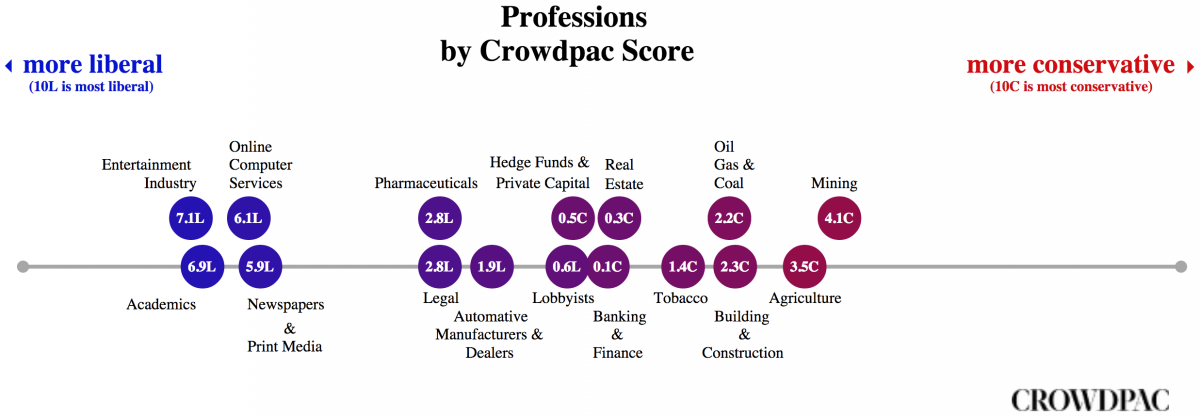
Nor is the cultural alienation surprising, as the information industries (media, entertainment, academe, IT) are overwhelmingly dominated by a narrow ideological range, increasingly disfigured by the pathologies that ideological echo chambers create.


And I mean the weaponising of morality and civility. The ludicrous lie that political correctness is about civility expresses either the deep duplicity or the deep self-blindness of its adherents. There is nothing "civil" about point-and-shriek (as Sir Tim Hunt and comet scientist Matt Taylor found) or the rhetoric of pc denunciation.

The concluding sentence of a Crooked Timber post against Jonathan Chait's mild critique of political correctness--"Seriously, fuck right the fuck off, Chait"--expresses the actual dynamics of pc splendidly. As this piece expresses particularly clearly the deep, pervasive disregard, indeed blindness, to achievement involved. (Boris Johnson gets the point.) But, then, landing a probe on a comet is hard; inciting and joining an online/public space moral sneering mob is easy: even inviting, as it drowns status from achievement with status from collective moral sneering. (And those who delight in attacking other people's motives are typically outraged when someone questions their's.) This plus crybullies blocking speech, no platforming, disinviting and all the other deeply uncivil abusive nonsense.

This is weaponised morality, weaponised civility, which extends all the way down, via "codes of conduct"*, to your local workplace. In other words, not civility at all. Instead, what is being run via the moral bullying, rhetoric of denunciation is a moral caste system, where you are allowed to hold someone's race against them--if they are white. You are allowed to hold someone's gender against them--if they are male. You are allowed to hold someone's sexuality against them--if they are heterosexual. You are allowed to hold someone's religion against them--if they are Christian. (And you are allowed to hold the existence of another country against them--if they are Jewish.) Treating Western civilisation as if it is not one of achievement and emancipations, but of crimes and oppression, and Western cultures as if they were without virtues, only sins. All the while bleating about heteronormative white male supremacy and being shockedshocked, when those whose civilisation, culture, country and identities are under serial attack arc up.

The notion that only "good people" would play identity politics was always a remarkably silly one.

Of course, when they do arc up, it gives you millions of fellow citizens to sneer at and feel superior to. No wonder, as historian Niall Ferguson points out, there is something of a turn to populism across the West; in cultural politics alone there is so much for them to work with.

Destroying civility
It turns out that, if civility and morality are weaponised, that removes important constraints within the body politic which — surprise! — has unfortunate implications. And those implications are likely to keep turning up as long as the underlying causes continue to operate.

And all this without considering the Alt Right, who are also obviously a product of cultural alienation and the toxic public culture of weaponised morality and civility. (Though prominent Alt Righter Vox Day's blog commentary turned out to be much more accurate about The Donald's Republican primary prospects than almost any mainstream media commentary.)

Online supporters of The Donald support him because of his rhetoric, his refusal to bow to the moral bullies that have so poisoned the public sphere. The shouts of "racism! racism!" and "fascism! fascism!" in response to The Donald's rhetoric are using the rhetoric of denunciation against someone whose success is fundamentally predicated on a revolt against the very same rhetoric of denunciation. That is not likely to be a successful strategy.

But nor is copying populists the way to undermine them -- that just legitimates what they say. The trick is to steal the underlying issue(s) in a way which leaves the populists with a lot of associated negatives. None of The Donald's Republican opponents were clever enough to do that -- partly because they did not take him sufficiently seriously until too late and partly because they were conventional politicians who did not understand the nature and level of angst in significant sections of the electorate and, when it did dawn, did too much implicit or explicit agreeing with The Donald, rather than stealing the underlying concerns his rhetoric played to.

Then Australian Prime Minister John Winston Howard provided a classic example of how to steal while undermining. In response to the populism of Pauline Hanson and One Nation he did not steal any of their policies or their specific rhetoric; he captured the underlying issue of control, of having a say, with the brilliant line of "But we will decide who comes to this country and the circumstances in which they come".  All while running a high immigration policy, and the least Eurocentric migration policy Australia had ever run.

Yes, he may win
I am, however, not convinced that Hillary is clever enough politician to adapt to a situation where past rhetorics are the problem not the solution ("vast right wing conspiracy" really isn't going to work).

So, those who don't want President Trump are going to have to hope he alienates enough of the electorate by his rhetoric to get Hillary over the line. But The Donald is a shameless rhetorician, a demagogue, that the media cannot look away from because he is such good copy/viewership.

The Donald is also, as Dilbert author Scott Adams has been explaining for months, a very effective rhetorician. And Hillary is such a good target for a shameless rhetorician.

In a fight between the two most disliked candidates in US Presidential politics for decades, fighting over a public sphere poisoned by the rhetorics of denunciation and the weaponising of morality and (even more problematically) basic civility, the media-savvy shameless rhetorician who represents a revolt against the dominant culture of denunciation has a much better chance than those who have no clue about the politics of cultural alienation, or why it has such power, are likely to realise. In which case, we better hope that this is not just a puff piece and there is someone of substance under the shameless rhetoric.


* How can one object to codes of conduct? When they create ideological sins not remotely subject to precise definition empowering the politics of denunciation; especially when accompanied by dubious complaint procedures. They are, as suggested here, easy weapons for budding little totalitarians.

[Cross-posted at Skepticlawyer.]

Saturday, March 22, 2014

The virtue of a pragmatic central bank

Based on a comment I made on a post by Scott Sumner on the Fed's narrow view of inflation targeting:

The RBA understands that inflation has to cycle around the target if unemployment is to be minimised. Since other central banks don't really seem to, I am led to the conclusion that the difference is ultimately Australian pragmatism at work.

Australia has what appears to be the most utilitarian political culture on the planet, going back to the early days of European settlement but particularly through the influence of Chartism. Even the great policy shift away from the Deakinite Settlement (pdf) (White Australia, Trade Protection, State Paternalism, Wage Arbitration, Imperial Benevolence) was about what worked for risk management. We are a predominantly Anglo-Celtic enclave clinging to the coasts of a water-short, drought, fire and flood prone island-continent at the end of Asia: hence practical risk management and state-as-giant-utility being at the centre of public policy.

We also tend to be good at bureaucracy. (Perhaps a little too good.) But good at bureaucracy in this instance means good at policy clarity and transparency--a definite advantage for monetary policy expectations management.

Hence a pragmatic central bank that takes a broad, utilitarian risk-management view. The US is a bit more inclined to grand ideas and creating fetishes of order. Inflation targeting is a clear fetish; the clearer the narrower it is.

New Zealand does not quite make it to Australian monetary policy pragmatism, because it is a (much) smaller country, so a bit more inclined to become swept up in the latest ideas. Especially since it is a unicameral non-federal state.  That Australia is a federation with a powerful Senate also encourages more persuasion and broadening-the-goodies compromise. More utilitarian pragmatism.

Sunday, November 11, 2012

Time enough for success


Skepticlawyer's excellent post on the GFC examines the financial crisis. The post below is concerned with the time period for monetary policy. While, as I note below, the collapse in total spending clearly worsened the GFC, this post is more about how to avoid or minimise recessions and, particularly, events such as the Great Recession.

The remarkable success of the Australian economy in avoiding a recession (defined as two consecutive quarters of negative economic growth) for 21 years and counting has been remarkably ignored by economists and policy-makers across developed countries.

It is true that the robust growth of the Chinese economy has been good for Australian commodity exports (the usual reason for dismissing Australia's recent economic success). However, it is also true that the high $A has been less happy for other sectors of the Australian economy -- such as tourism, education and manufacturing exports. Moreover, commodity prices dropped dramatically during the height of the Great Recession -- Australia had a higher (proportional) drop in exports than did the US.

The Australian success in avoiding recessions also predates the recent surge in its terms of trade. (Graphs in this post taken from here.)


Like other market monetarists, I attribute the Australian success in avoiding those transaction crashes we call "recessions" to the Reserve Bank of Australia's (RBA) monetary policy.  This is not to deny that decades of reform have made the Australian economy much more flexible, and so responsive to changes in economic conditions. Or that the concern of fiscal authorities to make life easier for the RBA has not been helpful (at the very least, in keeping down debt liabilities of taxpayers).

Furthermore, as Jim Belshaw points out, the ability of the $A exchange rate to respond rapidly to an economic shock was very beneficial to the Oz economy during the GFC -- but that was also true during previous economic shocks, such as the 1997 Asian crisis.

All these things have made it easier for the RBA to run monetary policy smoothly. But it is that policy itself which is at the core of the avoiding of transaction crashes.

The business cycle itself has not been abolished -- this is particularly obvious if one looks at per capita GDP data.  It has, however, been greatly, and beneficially, ameliorated.

At the core of market monetarism is the view that monetary policy is not a mechanical manipulation of monetary aggregates or base interest rates but an exercise in managing expectations through policy signaling. (A useful, quick, lay-friendly summary is here; I would also add in debt as the ultimate "sticky price".)

Within the boundaries set by the level of credibility of the central bank -- credibility that may require commitment to action to maintain --  the same policy instruments may have quite different signaling, and so expectation management, effects depending on the policy framing in which they are embedded.

Balanced credibility
As I have argued elsewhere, the advantage the RBA has is that, unlike central banks who only have credibility on inflation targeting, the RBA also has credibility on total spending (and so income) in the economy. Its credibility is balanced (inflation and spending) not unbalanced (inflation only). Which means that its interest rate shifts positively manage both inflation and spending expectations.

Confidence that spending (and so income) will remain relatively stable means that Australia has not experienced the transaction crashes we call "recessions".

How does the RBA achieve this balanced credibility? It is explicitly an inflation targeting central bank and it uses base interest rate as its policy instrument; its policy signaling device. In this, it is like other central banks.

The key difference is the time period of said inflation target -- it is an average over the business cycle. In the words of the RBA website:
The Governor and the Treasurer have agreed that the appropriate target for monetary policy in Australia is to achieve an inflation rate of 2–3 per cent, on average, over the cycle. This is a rate of inflation sufficiently low that it does not materially distort economic decisions in the community. Seeking to achieve this rate, on average, provides discipline for monetary policy decision-making, and serves as an anchor for private-sector inflation expectations.
As I have also argued before, this means that its policy time-horizon is based on economic conditions, not on some time period imposed over the top of economic conditions. To put it another way, there is no time period constraint operating on the RBA (and its policy signaling) independent of economic conditions.

Since the policy time-horizon is directly connected to economic conditions, this greatly helps signaling (and so expectations management). There is no concern that some arbitrary (time) constraint unconnected to economic conditions will affect RBA policy. A time-horizon based on economic conditions does not impose an arbitrary -- and so potentially dysfunctional -- constraint on policy.

Moreover, because it specifically invokes the business cycle, the RBA's monetary target actively assists maintaining balanced credibility. If the inflation target is an average over the business cycle (as it has to be to be responsive to economic conditions), that clearly implies more strongly than a simple inflation target that monetary policy will be easier if economic activity weakens and tighter if economic activity strengthens; not merely to "keep" the inflation target but in order to "lean against" the direction of economic activity so as to stabilise spending. For, being an average, it clearly implies the inflation target constraint will be (temporarily) traded-off to keep economic activity (or, more accurately, since central banks only directly control matters nominal -- that is in money terms -- spending) up if economic conditions worsen, thereby creating both inflation and spending (and so income) credibility, i.e. balanced credibility, for the RBA. So its interest rates shifts provide credible and positive signals for both inflation and spending.

Supply shocks, money demand and looking forward
This also makes the RBA somewhat more broadly forward-looking than other central banks. Since the target is a band over the business cycle, how inflation has been is considered in terms of expected economic conditions, particularly if economic conditions are weakening. Scott Sumner nicely highlights an example of this.

To put the difference between simple inflation targeting and (implicit or explicit) spending targeting another way, as Scott Sumner points out in his recent (very clear) paper on NGDP targeting (pdf: nominal GDP = GDP in money terms = total spending on/income from output of goods and services), simple inflation targeting responds quite differently to supply shocks than NGDP targeting or some implicit spending targeting. Inflation targeting would lead to tightening monetary policy in response to a negative supply shock, such as a surge in the price of oil (a perverse response to expected conditions making a transaction crash much more likely), while NGDP targeting would lead to easing monetary policy (the correct response if a serious transaction crash is to be avoided).

Supply shocks show up how the RBA monetary policy time-horizon makes inflation-targeting operate like NGDP targeting, for the average-over-the-business-cycle-goal does not sacrifice the overall level of spending to the inflation target if economic conditions weaken due to a supply shock. A similar point operates when there is an increase in demand to hold money (driven, say, by a financial crisis). An inflation-targeting central bank is likely to be limited in its monetary response, as any effect on inflation from an increase in the demand to hold money is likely to be downward. A NGDP-targeting central bank would ease, since money being held is not being spent and so would have a serious downward effect on spending.

Given the US$ is the premier global reserve currency, this makes it more important, not less, that the US Federal Reserve target NGDP (or else, like the RBA, has an explicit average-over-the-business-cycle target) since monetary-demand-shocks (for the premier global reserve currency) are more likely and the consequences of a US transaction crash are more serious. The "passive tightening" of the US Federal Reserve during the surge in demand for $US helped make the GFC such a financial crisis (as spending, therefore income, expectations weakened dramatically, worsening fears over debt and leading to a flight to cash) and, through the consequent transactions crash, the Great Recession "Great".
Regarding the time-horizon for policy, there is also an issue with what is known as level-targeting, whether of the price level or of NGDP.

Level targeting anchors longer-term expectations by forcing central bank to, if it follows the target, to adjust to past outcomes or be increasingly exposed as failing to meet its target. It does generate a possible short-run problem if reaction to past outcomes is held to create perverse responses to expected conditions. This is much more a problem for price-level targeting than NGDP-level targeting because the former lacks spending (and so income) credibility and the latter does not.

Repeatable success
So, the central bank having a policy time-horizon which is based on economic conditions allows much better policy signaling and expectations management. Having policy targets whose time periods impose arbitrary constraints unconnected to economic conditions on monetary policy is unfortunate. Having credibility on inflation but not spending makes serious transaction crashes not merely likely but as inevitable as anything can be in economic policy.

The success of a monetary policy target whose time-horizon is based on economic conditions and which has credibility for both inflation and spending is not some happy accident. It is a repeatable success open to any central bank which can bear to learn from antipodean achievement.

POSTSCRIPT: It is sometimes suggested that the RBA has been lucky in that it has not had to confront the problem of the "zero bound" (when base interest rates are 0%pa and so cannot be cut any further: the various quantitative easings [QEs] are attempts to get around that constraint). Australia has persistently run slightly higher inflation than, for example, the US.  Given the long history of Australian labour market rigidity (i.e. strongly "sticky" wages), this seems to be fairly clearly deliberate policy, fortuitously or deliberately making it much less likely Australia would confront the problem of the "zero bound".

Thursday, July 19, 2012

Debt and Boom


The slogan for this post is: don't think debt, think safe assets.

(This post is partly provoked by this post by Paul Krugman responded to by Scott Sumner and by Marcus Nunes.)

In my Debt, Doom and Despair post I noted that a hugely debt-burdened post-Napoleonic Wars UK (where the national public debt was probably about 250% of GDP or about 25 times the revenue of the British government) went on to an amazing surge in population and mass prosperity.  (In fact, by far the most remarkable in all of human history up to that time.)

What if it was not a coincidence? What if the debt burden actually encouraged said surge?  After all, WWII left the British, Australian and US governments all highly indebted (at about 240%, 150% and 120% of GDP respectively) yet all experienced amazing postwar surges in population and prosperity. All surges marked by high rates of productivity increases from expanding technology and global trade.

One's persons debt is another person's asset.What were the British, US and Australian governments doing in running up such huge debts? They were creating a huge level of safe assets, given that none of these three governments have defaulted on their bonds, ever.  One reason why Britain went back on gold in 1925 at the pre-war (over-valued) parity was to "keep faith" with its bondholders.

So, those high levels of public debt were also creating high levels of income from safe assets. If you are, for example, 1815 Britain, and debt is 250% of GDP, then a significant amount of income, compared to total production, is flowing from said safe assets.

Expropriating risk managers
There are two basic things states do: they expropriate and they manage risk. The latter is necessary for the former and goes back to the origins of rulership--dead farmers cannot pay taxes.  In ibn Kaldun's definition, cited and admired by Ernest Gellner, government is:
an institution which prevents injustice other than such as it commits itself.
This the paradox of politics or the paradox of rulership--we need the state to protect us from social predators but the state itself is the most potentially dangerous of social predators. It is a paradox that can never be fixed, only managed more or less well.

One of the tricks of rulership, refined by medieval rulers such as Alfonso IX of Leon, and Edward I of England, is that, if you get consent for your taxation, you can do a higher level of taxation because it lowers the "resistance cost". Democratic welfare states have taken the consent-benefit trade-off up to record levels (for any non-patrimonial or totalitarian polities; i.e. for societies with any free element). Welfarism is the domestic aggrandisement of the expropriating state as imperialism is its external aggrandisement. (One of the ways we can tell that welfarism is, at least in part, an excuse for state aggrandisement is how weakly expenditure is tested against effectiveness in improving social outcomes; conversely if there is less inherent nobility in welfarism than appears, there were also positives in imperialism, albeit at wildly varying levels.)

But the public goods, and latterly welfare, provided by the state in return for implicit or explicit consent for its expropriations are overwhelmingly about risk-management. And risk management is a genuine service. Consider protection of life, person and property; or mitigating the risks of unemployment, sickness, disability, old age.

Balancing risks
For any given level of risk aversion by potential investors, creating a safe income stream raises the risk threshold for further investment. People will be more willing to tolerate higher levels of risk in their other investments.

Such as in highly uncertain investment in new technology. True, that leaves one open to asset booms and busts (pdf). Nevertheless, net economic outcome is likely to be a long term acceleration in productivity (pdf). And the surge in population and prosperity such involves.


[Read the rest at Skepticlawyer or at Critical Thinking Applied.]

Monday, July 16, 2012

Debt, doom and despair


It is a matter of some comment that the public debt burden of the United States has recently increased somewhat.
Upward, ever upward
And that this surge in debt has come from increased spending
A more elevated state
More than from falling revenues.
Buy now, pay later
(The "negative deficits" in Truman's and Clinton's second terms meant the US federal government was running a budgetary surplus.)

Fiscal surge
This surge in the federal budget deficit and federal public debt was in the service of fiscal stimulus (and keeping State and Local government spending up in the face of falling revenues). Various Keynesians have argued that the fiscal stimulus was not nearly large enough or, at least, could have been usefully larger.

My take on this is that (1) if the US Congress could spend so much for so little stimulus effect, then fiscal stimulus is--as a matter of practical politics--an amazingly wasteful way of getting economic stimulus. And (2) since the fundamental problem was contractionary monetary policies, and the monetary authorities "move last", then fiscal stimulus becomes even more problematic. (As Scott Sumner points out, the fiscal multiplier is a measure of central bank incompetence.)

Your debt, my asset
But what I want to focus on here is the level of US debt. The first thing to remember, is one person's debt is another person's asset. So, a measure of US public debt is also a measure of financial assets held by whomever. It is a perfectly reasonable question whether the US state can manage its level of debt, and whether its public finances might have become somewhat debt-addicted, but let us not get the idea that debt is all just negative. Lots of folk, including lots of American citizens (indeed, mostly American citizens), are getting nice incomes out of that debt. As long as US debt/bonds are regarded as "safe assets", they will be saleable. (The less safe they are rated, the more expensive they will be to sell, but there are no signs of that.)


[Read the rest at Skepticlawyer or at Critical Thinking Applied.]

Thursday, June 7, 2012

Easy Guide to Monetary Policy


What money is
We use money to transact and the money we use is fiat money, money backed only by government decree. In economic terms, money is a transaction good and all that fiat money is, is a transaction good; the only point in holding such money is to be able to engage in transactions—its expected swap value(s) in exchange is its only value.

The use of money as a transaction good is driven by expectations. People take your money because they expect to use it in future transactions. You offer money in transactions because of that expectation. (Since there is no information from the future, we can only ever act on the basis of expectations; expectations that are derived from existing information.)

Anything that is used in a transaction for its swap value is being used as a medium of exchange. That does not, however, make it money. It is only money if it is also embodies the unit of account. Something that is used as a medium of exchange and embodies the unit of account is a medium of account and so money; something used to both quantify and pay exchange obligations.

(Money is also a store of value, but that is the least distinctive thing about it; many things are stores of value. Money’s role as a store of value comes from its swap value, which takes us back to it being a medium of account. Yes, we use it because of expectations about its future ability to operate as a medium of account, but that is what is distinctive about it, not being a store of value.)

In modern economies, the central bank—the Reserve Bank of Australia (RBA); the Bank of England (BoE); the US Federal Reserve (the Fed); in the Eurozone, the European Central Bank (ECB); the Bank of Japan (BoJ)—is the monopoly provider of local money, the money issued and used in your country. (Or, in the case of the Fed, the monopoly provider of the global reserve money which is also US local money.) The RBA, like the Fed, has a "dual mandate" of keeping inflation down and employment up. Such a mandate is, in effect, a legal obligation imposed on the central bank to neither flood the economy with excess money (causing inflation) nor to starve it of money (causing a fall in transactions from people maintaining their preferred level of money holdings by cutting back on spending and thus transacting). Since—for a given level of prices—the level of transactions determines the level of spending, and thus income (everyone's money income is someone else's spending), the latter matters; serious transaction "crashes" are known as recessions and depressions.

Unbalanced credibility
The ECB has price stability as its primary objective, with other objectives being subordinated to it. The BoE has a growth and employment objective, but it is subordinate to price stability. The BoJ just has a price stability objective. The problem with such inflation targeting by the central bank is that the central bank then explicitly promises (or is strongly expected) not to provide excess money but has no such explicit or implicit commitment to provide sufficient money to keep the level of transactions up. The central bank then acquires unbalanced credibility—people believe that their money will retain value but have much less basis for confidence in the future direction of income; unlike expectations about future prices (and so the future value of money), the future direction of income lacks any policy anchor. So, if people increase their holdings of money, and the central bank fails to adjust for this, people then cut back on spending, transactions fall so income falls, so people cut back on spending to maintain their preferred holdings of money, and the downward spiral is on. People (quite rationally) have lowered expectations of income and so engage in less spending, which confirms (and magnifies) the lowered expectations of income.

The level of money provision (and associated expectations) being required to stop actual deflation (which the central bank is expected to do to maintain an inflation target) being less than the level of money provision (and associated expectations) required to have transactions recover (which the inflation targeting central bank is not expected to do), an economy can remain "stuck" in output being well below capacity—the most obvious manifestation of which is unemployment, where labour use is well below labour supply—for a considerable period. (Or, in a milder version, stuck with much lower levels of capacity increase than would have been otherwise possible—Japan has been a manifestation of this as the Bank of Japan has regularly clamped down to maintain its, very low, inflation target; thereby offsetting any stimulatory effect from the amazing run of government budget deficits that have driven Japan’s public debt to the highest in the developed world.)

If an economy has high debt levels, then the level of economic stress from any significant fall in transactions (and so income) is even higher, as people struggle to pay back debts with lowered income. (For an example, see the Eurozone.) If the stress is sufficiently great, the potential for debt defaults—and so significant destruction of financial assets (one agent’s debt being another’s asset)—and consequent threat of major damage to, or even the collapse of, the financial system then further encourages a flight to "safe assets" and away from spending. (Again, see the Eurozone.)

In such a situation, the central bank (as the monopoly provider of local money and so dominant generator of expectations about same) is doing what monopoly providers normally do—it is under-providing its product (in this case, expectations coverage rather than actual currency) to maximise return (in this case, its credibility as an inflation targetter). Once an economy is in this situation, it can be hard for the central bank to change course, because that would have serious reputational effects on the officials running the bank, as it would be an implicit (or explicit) admission that their failure had caused the transaction crash and consequent economic misery in the first place. (For an example, see the Fed.)

As Danske Bank economist Lars Christensen has pointed out in his excellent Market Monetarist blog, failure by the Fed and the ECB to respond to increased demand for dollars and euros in the second half of 2008 is what caused the Great Recession to be The Great Recession—the largest peacetime crash in US money income (i.e. transactions) since 1938 and the largest crash in overall OECD money income since the organisation was founded.

Failed accountability
Both the Fed and the ECB have since behaved as monopoly providers, under-providing (expectations about) money to maximise their credibility as inflation targeters and, in refusing to shift policy, minimising reputation damage from their failure to react to changes in demand for money. The failure of the bulk of the economics profession to call them on it (a constant frustration for Scott Sumner) means that the reputation effect continues to militate against policy change.

[Read the rest at Skepticlawyer. Cross-posted at Critical Thinking Applied.]

Sunday, May 6, 2012

Don't mention the A-word

The Eurozone, the US, Japan and the UK are all suffering prolonged economic stagnation. [You can see how serious it is in the US here.] It is sensible to suggest that they are doing something (or perhaps many things) wrong and need to change policy. 

What is not sensible is ignoring a developed world economy that has conspicuously not suffered any of the economic stagnation problems that have hit the major developed economies. Indeed, has not had a recession (in the sense of two quarters of economic contraction) since 1991. That sailed through the Great Recession and Global Financial Crisis (aka GFC) with barely a ripple. Whose current problems are not of economic stagnation but of maintaining economic balance when one part of the economy is doing much better than another.

That country is Australia. Yes, it is true that the surge in commodity demand (centred on China) has been a boon to the Australian economy (well, to the commodity exporting States; the resultant surge in the value of the $A has been a problem for the tourism-and-goods exporting States—the commodity boom has been a distinctly mixed blessing). But Australia had also managed to avoid recession even when its terms of trade (the ratio of the price of what it sells to the price of what it buys) were in long-term decline and when commodity prices dropped dramatically at the onset of the Great Recession. Indeed, the fall in Australia’s exports as a % of GDP was worse than the US’s.

Yet the Australian success gets mostly ignored. A classic example is Raghuram Rajan’s recent piece in Foreign Affairs. (Non-gated version here [pdf].) Much of what he has to say about the desirability for supply-side reforms is sensible. Indeed, much of what he advocates Australia has already done; which makes the failure to mention what should be the poster-polity for what he is advocating all the more of a glaring failure.

The problem with mentioning Australia is that it does not conform to the stories that Rajan and others want to tell about what went wrong. Rajan essentially ignores monetary policy, both in the commonly offered solutions to economic stagnation (fiscal stimulus and even-lower interest rates: interest rates are a very limited way of looking at monetary policy) and in diagnosing why the economic stagnation descended. So Rajan writes:
today’s economic troubles are not simply the result of inadequate demand but the result, equally, of a distorted supply side.
Australia has done a lot of supply-side reforms, so perhaps it can be ignored. Except Rajan goes on to say:
For decades before the financial crisis in 2008, advanced economies were losing their ability to grow by making useful things. But they needed to somehow replace the jobs that had been lost to technology and foreign competition and to pay for the pensions and health care of their aging populations. So in an effort to pump up growth, governments spent more than they could afford and promoted easy credit to get households to do the same. The growth that these countries engineered, with its dependence on borrowing, proved unsustainable.
Does anyone really think Australia just magically averted such structural problems, that its economy is somehow profoundly different from other developed countries? Given its per capita GDP growth has been respectable but not outstanding. In particular, while its public finances were much sounder, with public debt reduced to very low levels, enthusiastic embrace of private debt meant that the total level of indebtedness was and is comparable to other developed countries.

 The story that Rajan wants to tell is that:
the common thread was that debt-fueled growth was unsustainable.
Except, apparently, in Australia. Australia ran a mildly higher inflation rate than the US during the “Great Moderation”, so its monetary policy was more “lax” than “easy money-easy credit” US.


[Read the rest at Skepticlawyer or at Critical Thinking Applied.]

Wednesday, February 29, 2012

It's transactions, stupid

If you had to do everything yourself (feed yourself, clothe yourself, shelter yourself), you would be very much poorer than you are now. The ability to specialise and the ability to access resources beyond your immediate vicinity enormously increases your resource use possibilities.

(This, btw, is why "food miles" is such utter crap. It is just a revamping of the late C19th/early C20th "local food" movement. As it was back then, it is richer folk sneering at the only way lower income folk can get cheap food.)

The ability to specialise and to access resources beyond your immediate vicinity relies on transactions. The easier it is to transact, the greater the resource use possibilities. Which is why reduction in transaction costs has been such a key feature in the evolution of mass prosperity. Institutional structures which generate lower transaction costs have tended to be advantaged over those that generate higher transaction costs. More transactions, more resource use possibilities, mean greater social capacity and higher levels of general prosperity.

The trouble is, blocking certain sorts of transactions can be a great way to create or defend privilege. Various forms of social mercantilism restrict the ability to transact, or the ease of transacting, to favoured groups: such as requiring (expensive or time-consuming) official permission. Latin America, for example, has long been bedevilled by that sort of social mercantilism. As has the Middle East (pdf). Such social mercantilism both generates jobs for officials (and possible bribe income) and allows some groups to be advantaged over others.

One sees the same privileging by restricting the ability to transact in many European labour markets: hence high unemployment rates, particularly among young workers. This is a particularly severe problem in Spain.

This is a game that generates problems, particularly for welfare states. Not only does restricting the ability to transact lower the level of economic activity, thereby decreasing the revenue for government; it also increases the reliance on welfare services, raising the expenses for government. Sure, public employment and welfare dependence can be a voter-and-activist base, but one runs into problems of sustainability.

The success of the Australian public policy model has been crucially based on making transacting easier and targeting welfare more precisely, creating a far more sustainable welfare state. A low tax, low debt, low unemployment, high income growth, high low-income growth, public policy model.

Central to this success has been macroeconomic stability founded in a clear monetary policy target. The target is an average of 2-3% inflation over the business cycle. That means that, if output surges, the Reserve Bank (RBA) tightens policy; if output falls away, the RBA loosens policy. In other words, using the MV = Py equation, if y [output] surges, the RBA puts downward pressure on P [prices]; if y falls away, the RBA eases so that growth in P increases.

In other words, the RBA acts to stabiliise growth in Py (or GDP in money terms: i.e. NGDP). Which means it stabilises growth in spending, hence income (since income is just someone else's spending). Stable income growth means a higher transaction path.

Money is a transaction good. In Australia, monetary policy encourages stable growth in transactions. Monetary policy thus allows money to perform its function of being used in transactions, based on stable expectations of income growth.

The RBA does not treat minimising growth in P as the only thing to worry about. In particular, it does not play games with expectations; it does not suddenly shift its intended growth rate in P without telling folk, as the US Federal Reserve [Fed] disastrously did. Nor does it regard driving down income growth to keep growth in P low good policy, as the European Central Bank did, creating the European income, and thus debt, crisis. In Australia, money supply reacts to changes in money demand so as to keep stable growth in income by providing a stable framework for expectations about future income.

Which makes it a lot easier to keep public debt down, since income growth is relatively stable.

What is undermining European welfare states, particularly in Mediterranean economies, is a double "whammy". First, structural failures which restrict the ability to transact (and so the number of transactions); putting downward pressure on government revenue and upward pressure on expenditure. Second, monetary policy failure; so that preserving the "value" of the Euro is regarded as much more important than the level of its actual use in transactions. The mindset which declares the value of money is more important than its level of use.

To summarise the failure of European policy (and the failures of the Fed): it's transactions, stupid. And to summarise the success of Australian policy: it's transactions, of course.

Indeed, the greatest failures of Australian policy are in indigenous policy (with massive social failure in indigenous communities) and land use policy (creating way over-priced [pdf] housing). In both cases, restrictions on transacting are at the heart of the failure. Really, it's transactions, stupid.

Monday, February 27, 2012

Australian exceptionalism

The Governor of the Bank of Canada recently gave a speech on inflation targeting (via). It was a sensible enough speech except for one thing. (Well, perhaps more than one, but I will let Scott Sumner deal with that.)

What I am going to harp on is: no mention of Australia.

If you are going to discuss sensible monetary policy, it is past time when careful meditation on the Australian experience should be required. No recession since 1991 is a performance to ponder. But the point is much broader than that. Australia is an extremely successful public policy example. What we do works, and was working very well before the recent commodity price surges.

It is just that the success is particularly stark in monetary policy. The Reserve Bank of Australia's monetary policy target of an 2-3% average level of inflation over the business cycle has been extremely successful. So successful that for the Governor of the Bank of Canada to make no mention of it at all in a speech on inflation targeting is risible.

Sunday, December 4, 2011

Doing it better Downunder

This is based on a comment I made here.


Looking at the on-going crises of the eurozone, the problems of the UK, the serious economic slump in the US all give grounds for appreciation of how much better Australia's political class has performed compared to those of other Western countries.

The Hawke Government (1983-1991) did broad economic reform; the Keating Government (1991-1996) reformed "super" (expanded private pension arrangements) and some labour market reform; the Howard Government (1996-2007) did more labour market reform, tax reform and massively retired public debt; the RBA brought in explicit (inflation-over-business cycle) targeting (1993). Our political class Downunder has done so much better than most other folks'.

The tyranny of distance and the long term decline in our terms of trade concentrated minds. Too much of the EU political classes seemed to have think the EU, or the euro, or both, were magic talismans that would protect them from Bad Things Happening.

Folk such as Paul Krugman banging on about how worrying about debt was way over-rated did not help. (Taking reassurance by comparisons with very high post WWII debt was not appropriate--there is a difference from debt generated by a major emergency and debt being structurally generated; there is also a vast difference between positive baby-boom demographics and "easy" technological growth--catching up with the US--compared to adverse fertility-crash demographics and more restrained technological growth--more countries near the technological edge.)

Australia had very bad 1890s and 1930s depressions in large part due to high public debt levels, so economic history encouraged scepticism Downunder about high structural debt levels. Holding the recent commodity boom to be solely, or even mostly, responsible for Australia's much better economic performance than other developed economies underplays decades of sustained reform effort by Australia's political class.

Tuesday, November 8, 2011

On the stupidity of (some) Central Banks

The short answer from history to the question of how stupid can a central bank be? is: a central bank can be really, really stupid.

I am using ‘stupid’ in a technical sense: doing things that seriously adversely affect lots of people with no justifying benefits to any wider public good—that is, which show a lack of intelligence, understanding, reason, wit or sense. The actions may seem a good idea to the central bank at the time—due to perverse incentives, policy framings disconnected from economic reality or whatever—but in terms of wider public policy, they are (to varying degrees) disastrous. Central banks exist to serve, so how that “serving” is framed can make a great difference.

For example, hyperinflation is usually a deliberate attempt to inflate away government debt and/or generate revenue well beyond the willingness or ability to tax. It may be wicked, but it is not stupid in quite the above sense. (There are justifying benefits for decision-makers, without necessarily justified benefits.)

Beware of the French and central banks
Among stupid central banks, the all-time winner is the interwar Bank of France turning the gold standard into a doomsday device (pdf), helped by the US Federal Reserve, by building up its gold reserves without issuing money to match, so taking gold out of the monetary system, thus driving up the price of gold in the monetary system (and so the price of money, as such gold set the price of money) and thus driving down the prices of everything else. It and the Fed created the Great Deflation of 1929-32 we call ‘the Great Depression’ and so mass unemployment, the impoverishing of millions, the unravelling of much of (pdf) the world trade system, the fall of Weimar Germany and the rise of Nazism (followed by the Fall of France). It was a disaster of monumental proportions.

It was hardly the only disaster of central banking, however. Another (in)glorious episode also came from France with John Law’s Banque Générale gaining the right to issue paper money, which stimulated economic activity. The Regent, the duc d’Orleans, decided that if some paper money was good then even more paper money must be even better, leading to the truly spectacular Mississippi Bubble. This French disaster was based on the same logic (using that term loosely) as that which created the Great Deflation/Depression namely, “if some is better (some paper notes, some level of gold backing of the franc) then more is better and even more is better still.” One is reminded of the Abbe Sieyes dismissing the argument for bicameralism on the grounds that if the upper house agreed with the lower it was pointless and if it disagreed it was pernicious. Pernicious simplification passing itself off as sophistication: how very French. (Perhaps the baleful influence of Cartesian rationalism?)

By contrast, the Bank of England has a long history of considerable policy success, starting with vast improvement in management of government debt. The South Sea Bubble was rather less of a problem than the Mississippi bubble precisely because the Bank of England had disapproved from the beginning. While the Bank’s management of the gold standard over the two centuries up to 1914 suffered various bumps and problems, it had nothing to equal the aforementioned French disasters.

In our own time, the Bank of Japan’s management of the yen since the collapse of the bubble economy has come in for much criticism. However, the demographics of Japan make some of that criticism less clear-cut than is often suggested.

Even though some of the ECB’s problems are “built in”, there are also plenty of grounds for criticism for the European Central Bank (ECB), until recently with a French head (perhaps not encouraging; especially as the euro is effectively an artificial gold standard for its member countries).

Doing right
A contemporary example of successful central banking is the Reserve Bank of Australia. It has run an inflation target since 1993 (pdf). Its website is very clear on its policy target. In the words of the Reserve Bank:
The Governor and the Treasurer have agreed that the appropriate target for monetary policy in Australia is to achieve an inflation rate of 2–3 per cent, on average, over the cycle. This is a rate of inflation sufficiently low that it does not materially distort economic decisions in the community. Seeking to achieve this rate, on average, provides discipline for monetary policy decision-making, and serves as an anchor for private-sector inflation expectations.
The minutes of its Board meetings are published two weeks after each meeting: this matters much less than that it has a clear monetary policy regime.

The Reserve Bank sees its role as providing an anchor for private sector inflation expectations and it does so by being upfront about its policy target. That it has an explicit target since 1993 is no coincidence: the experience of the severe 1992-93 recession where inflation was squeezed out of the Australian economy in a particularly costly way made it clear to policy-makers that being explicit about monetary policy was preferable. As had the problems with monetary policy in the 1980s:
In the early 1990s, the Reserve Bank did not enjoy the largely uncritical press it receives today.
The conduct of monetary policy in the 80s was fundamentally incoherent, unsuccessfully pursuing multiple objectives and shrouded in a veil of secrecy.
Without a policy commitment to price stability, the Australian economy lacked a nominal anchor.
(Does any of this sound familiar, by chance, to American readers?)

The success of the Australian economy since then has provided strong evidence for the good sense of this approach of a clear monetary policy regime via an explicit target. But there is also no mystery about why being explicit has been a successful approach. The point of money is to facilitate transactions by massively decreasing transaction costs. Not only are the search costs that barter imposes avoided by use of money, but there are a range of problems with barter than using money eliminates or greatly ameliorates, thereby greatly facilitating transactions.

If people have reasonably accurate expectations of how (money) prices in general will go, they can make arrangements (including contracts) based on those expectations. As Canadian economist Nick Rowe points out, inflation targeting in Canada came out of pressure from the private sector. They wanted reliable expectations about prices so as to set wage contracts.

Sudden, unexpected changes in prices can leave these arrangements misaligned with actual prices. If, for example, that results in changes in the terms of labour—the ratio of labour costs to the price(s) of what the firm sells—so that wages become seriously over-priced (in normal, somewhat imprecise, economic speak, “real wages have risen”) then firms will stop hiring, workers may be sacked, firms may collapse (i.e. they absolutely stop hiring and all their workers lose their jobs). It is not good to have significant, unexpected downward shifts in price movements, since that essentially guarantees that the terms of labour will rise unexpectedly. (So unexpected disinflation can have similar effects to deflation.)

Doing wrong
Which is what happened at the beginning of the Great Recession in the US. When uberblogger Matt Yglesias calls it a “huge failure of central banking” he is absolutely correct. To put it another way, serious expectation failures were imposed on the US economy, resulting in a dramatic drop in transactions. (That the Federal Reserve decided to surreptitiously disinflate as a financial crisis—the sub-prime crash—was building made things much worse: including the financial crisis, providing some reprise [pdf] of the Great Depression.)

How did this happen? Have a look at the US Federal Reserve website. There is no statement about what the specific aim of US monetary policy is. The US Federal Reserve provides no explicit anchor for expectations in the economy. So, the US Federal Reserve can decide to disinflate—to significantly reduce the inflation rate—and there was no warning for private agents that this was happening. To act in this way is to actively degrade the level of information in the economy and so misdirect expectations.

This is deeply stupid in both theory and practice. There is no economic gain from changing monetary policy surreptitiously, there are only unnecessary costs. Australian policy makers found this out the hard way in 1992-93. They learnt the lesson and have moved on. But, alas, almost no one takes what Australia does seriously: we are too small, too far away, too “lucky”, too “colonial”. Europeans and Americans tend to be deeply parochial people, seeing themselves as the measure of all things, and so are rather bad at learning from the policy experience of others.

[Read the rest at Skepticlawyer or a slightly revised version at Critical Thinking Applied.]