One of the things I find somewhat frustrating is not consistently using terminology that distinguishes between pair bonding and who an organism has sex with. Clearly, there is some overlap and connection there, but they are not the same thing and it encourages sloppy thinking to use the same terminology to cover both.
Thus 'monogamy' can mean only has sex with one person or only has one spouse. This ambiguity can derail discussions and confuse analysis.
to operate is patterns of stimulus and response in a competitive environment. We can reasonably think of genes as playing a game, the replication game, where success is measured by replication. If you replicate, you are still in the game, so you are a winner and you remain a winner for as long as you are still being replicated.
These replication games that genes play are not only recurring, they are also probabilistic. A replication pattern will always have some failures. It is generating enough successes to stay in the game that is crucial.
is a very vivid and memorable metaphor. It is also an unfortunate one, as genes do not have intentions. Life is a Game Genes Play, or something similar, might have been a better title.
Biologists seem to have this odd notion that parenting is not altruistic behaviour, on the grounds that it is not altruistic to reproduce one’s genes. The notion that acting in a way that permits one’s genes to replicate does not show altruism is to imply that something cannot be altruistic if it conforms to the intentions that genes do not have. Or that genes are part of an organism, even when in another organism.
Parenting absolutely is altruistic behaviour. It is one organism investing in the interests of another. The tensions between the interests of the parent and the child provide a nice example of how of genetic replication is distinct from the interest of the organism. Tensions that are particularly stark in the case of neglectful, abusive or child-abandoning parents.
Parenting is the form of altruism that genes have to induce in order to replicate.
Once it is realised that parenting is altruistic, then it is much less of a leap to develop analyses of forms of altruism, in the sense of acting for the benefit of others, that do not as directly result in the replication of genes specific to the acting organism. Investing in the benefit of other organisms can absolutely be a successful gene replication pattern, at a probabilistic level. Especially if played out across a large enough number of individuals.
Confusing what altruism is—other-directed behaviour to the benefit of the other—with genetic replication patterns is an example of how natural and easy it is for us to confuse our frames of reference. Particularly if we use intentional metaphors (which are, of course, very natural to us) to apply to replication-game-playing genes that do not have intentions.
Survival strategies drive genetic selectionThere is a critique of evolutionary theory that says that random mutation is not nearly enough to create the prolix orderings of life. This critique, associated particularly with mathematician and philosopher
David Berlinski, is, of course, correct. Selection processes are, however, much more ordered than that.
The survival strategies of organisms create selection pressures. Organisms can only choose survival strategies compatible with their existing biological capacities. But, within those capacities, a range of survival strategies are likely to be possible.
Once enough of a species successfully selects a particular survival strategy, that sets up selection pressures, and selection pressures that are much more ordered than random mutation. (I am riffing off a 9 minute
discussion of exploration by organisms by evolutionary biologist Bret Weinstein.)
A very nice example of this provided by human pastoralism. All human pastoralist populations that are large enough, and persist in their pastoralism long enough, develop
lactase persistence: the ability to consume milk as adults. This allows them to generate about five times as many useful calories from a given amount of grassland as those who just raise animals for slaughter. This is a huge biological advantage.
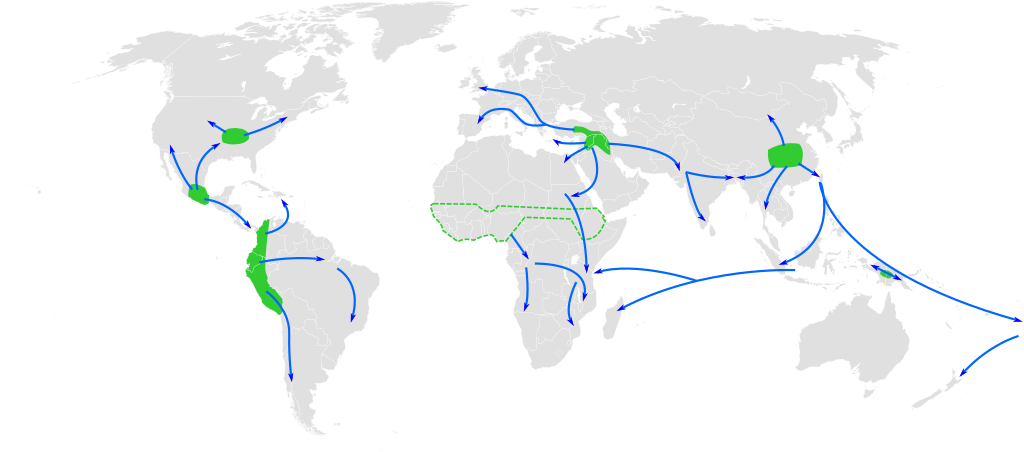
Here’s the thing, however. Pastoralist peoples do not develop the same mutation. The lactase persistence mutation that allowed the Indo-Europeans to spread so far is not the same lactase persistence mutation as that of East African pastoralists such as the Masai.
So, which mutation develops, and how long it takes to turn up, that clearly has a random element. But the choice of survival strategy sets up selection pressures that are not random. Hence there is more order in observed biology than can be explained by random mutation, as the survival strategies of organisms inject order into selection processes.
Homo selection was for adaptabilityThe answer to the question of what is the human diet? is: prepared, particularly cooked, food. All human populations cook their food. Even the Inuit, who have to go to considerable extra effort to do so. We are
cucinovores, food preparers, especially by cooking.
When we examine the diet of human populations, especially the pre-industrial diet, the striking thing about human diets—apart from food being actively prepared and frequently cooked—is the huge variety of human diets. Human beings can live and reproduce quite successfully on remarkably broad range of diets. (Problems with particular diet patterns usually don’t seriously kick in until after our reproductive peak.) This speaks to our adaptability as a species. An adaptability that has seen us permanently inhabit every single continent except Antarctica.
By adaptability I mean the capacity to choose and operate a variety of survival strategies (and therefore survive in a wide variety of ecological conditions). Prior to the development of farming and pastoralism, human beings were foragers, but there was considerable variety in those foraging strategies. And, of course, foraging then often led onto farming and pastoralism. Modes of living which also had considerable variety within them.
This adaptability has some manifestation across the
hominin line, but is what is particularly distinctive in the genus
Homo.
The combination of bipedalism and grasping hands led to tool using. This probably started with
Australopithecus picking up stones to split bones and skulls from the kills of other species to get at the fat and brain. Access to such nutrient-dense food allowed us to give up gut tissue for brain tissue (the
expensive tissue hypothesis).
We then moved on to making tools, increasing our adaptability. Choosing to scavenge in the middle of the day, when the major predators were resting, led to developing sweating and increased long-distance running capacity. We could then start running down animals with our expanded tool use, choosing hunting over scavenging. Giving us even more access to nutrient-dense food.
Being bipedal freed our hands for
communicating by gestures. Increased use of tools moved communication
to the face and mouth.
Use of fire and other food preparation both expanded the range of possible foods and further accelerated giving up gut tissue for brain tissue. At each stage, the expansion in capacities led to a greater range of possible survival strategies.
The predominant thing being selected for was that adaptability. Hence the rather prolix speciation of the
Homo line. Different populations would choose different survival strategies, leading to different selection pressures. Yet, the general pattern is clear: selection for adaptability won out. Homo sapiens were the most adaptable form to appear, and relatively rapidly became the last biped primate left standing in Africa.
Our margin of superior adaptability over
Homo neanderthalensis seems to have been
relatively thin, as Neanderthals successfully blocked our exit from Africa for many generations. But Homo sapiens had enough of an adaptability advantage to get past the Neanderthal block in two waves, around 80,000 years ago and again around 50,000 years ago. And we
Homo sapiens then became the last bipedal primate left standing anywhere by absorbing and replacing all other
Homo populations.
So we became the tool-making ape, the running-and-throwing ape, the gesturing-then-talking ape, the fire-using ape, the food-preparing and cooking ape, the trading ape, the artistic ape, the ritual ape ... All manifestations of being the adaptable ape. It was that adaptability which was being selected for. As the more adaptable, the greater the range and variability of ecology and climate we could successfully reproduce in and the greater range of ecological changes (some of us) could survive.
Defence mechanisms and healthy eatingThe prime defence mechanisms of animals is mobility. The prime defence mechanisms of plants, given they generally cannot move, is to wage
chemical and other biological warfare against their predators. A process that can include considerable production of
anti-nutrients.
Human evolution relied
at various crucial stages on access to animal food, particularly saturated fats and organ meats, because they are so nutrient-dense. (There is no plant food remotely as nutrient-dense
as liver.) For human nutrition, there are essential proteins, there are essential fats. There are no essential carbohydrates. With enough protein and fat, your body can produce all the glucose it needs.
We process animal foods for palatability. We process plant foods for palatability and to render them sufficiently non-toxic to consume.
So, thinking in evolutionary terms, how likely is it that saturated fats are not nutritionally sound for humans? How likely is it that plant-based foods are inherently or systematically nutritionally superior for humans than animal foods?
Markets and persuasion are also selection environments. How likely is it that selection for food-persuasion agendas is going to be for maximising extractable income? Which generates more corporate income, animal products or plant products?
So, does that raise questions about the anti-meat, pro-plant-based agendas being so assiduously pushed?
Norms economise on the effort required to sustain cooperationWhen looking at human sociality, the selfish-versus-altruistic division is not very useful. Our range of interactions with others is much more varied than that.
What is striking is how much we are a normative species. Our nearest genetic relatives, the other African great apes, show some (very limited) level of normative behaviour. Enough to sustain the level of sociality they display. We Homo sapiens show far more.
Norms economise on the effort to sustain cooperation. Once
a norm is established, interactions become much more predictable and therefore much more manageable. A whole lot of attention time and calculation effort is no longer required.
Attention and cognitive capacity are both scarce items. We have powerful tendencies to adopt mechanisms that allow us to economise on them. Hence the development of our normative capacity in situations where there were considerable pay-offs to cooperation. Cooperative payoffs that expanded as our normative capacities expanded.
Being so strongly the normative ape has permitted us to be much more complexly social. Which increased our adaptability. Which clearly increased the replication of our genes. A pattern of replication via cooperative sociality that we have spread to every continent, including temporary visits to Antarctica.
Norms can generate significant reciprocative behaviour. In fact,
quite complex patterns of such. But they can also generate significant altruism, even amazing levels of self-sacrifice. All of which is a by-product of norms’ ability to increase and spread populations, and thus greater gene replication, through greater social cooperation by economising on the effort to sustain cooperation.
Resources affect reproductive strategiesBirds tend to pair bond, with both parents contributing to raising the chicks. This is because eggs are fragile, chicks cannot feed themselves and once the egg is hatched, neither male nor female birds have an advantage in feeding the chicks. Given a certain level of difficulty in obtaining resources, the male and female expression of genes have equivalent cards to play in the replication game, despite the females producing the eggs. They are therefore equally invested in raising the chicks, if their genes are to replicate. Hence the frequency of not only pair bonding among birds, but of the Dad strategy: the male investing in the protection and feeding of the offspring. As distinct from the Cad strategy: deposit one's sperm but provide no other assistance in the raising of offspring.
In certain circumstances- - for instance, if laying the egg means the female bird needs immediate nutritional replenishment- - then the replication pressure may be for the male bird to do more of the post-egg-laying care. To, in effect, equalise energy expenditure in order for successful replication to be sufficiently likely.
If, however, resources are particularly abundant, then male birds will likely revert to a harem strategy. (I.e. a mate-guarding Cad strategy.) With sufficiently abundant resources, what cards the female-expressed genes have to play in the replication game is much less of a concern for the replication of the male-expressed genes. All the male bird has to do is feed himself and keep other males away. If a completely promiscuous strategy is used (a pure Cad strategy), they might not even have to do the latter. The replication pay-off of more impregnated females being greater than any loss from the drop in investment in individual chicks. Hence it is sufficiently easy for the male-expressed genes to stay in the game such that a replication strategy other than pair bonding is used. The females are thus stuck with the eggs, and so raising the chicks, while more intense male mate selection provides some replication compensation for the lack of male investment in raising the chicks.
The general propensity of birds to pair bond is very unlike mammals, where females have mammary glands (so the food is right there when the baby mammal pops out) and hence are far more inherently invested than male mammals in raising their offspring. Female mammals provide baby-feeding resources from their own body and food consumption. Thus, in mammals, the male and female expression of genes do not have equivalent cards to play in the replication game.
Hence male mammals are very rarely significantly involved in raising their offspring. They may be pure Cads, they may be mate-guarding Cads, or even coalition Cads (a group of males sharing a group of females), but they are very rarely Dads.
Homo sapien males are a conspicuous exception. They are an extreme case of successful replication strongly favouring male investing in offspring. The Homo sapien big-brain strategy has resulted in particularly helpless babies whose brains and cognitive capacities have to develop outside the womb. Hence
Homo sapien children take 15 years or more to be successfully raised to reproductive age.
In foraging societies, it is not practical to raise
Homo sapien children without male contribution to provision of resources and protection. Hence
Homo sapien males generating such a strong Dad strategy, contributing protection and resources to child-raising. (A few farming societies have an Uncle strategy instead - brothers contribute to raising their sister's children.)
With the dramatic expansion in mass prosperity, resource thresholds undermining the Dad strategy as described for birds has kicked in, but in a way that expresses human social complexity. At lower socio-economic levels of mass-prosperity human societies, the balance of resources compared to the cost of raising a (poorer) child has undermined the Dad strategy of investing in children. A Cad can still have children reach adulthood without bothering to contribute to their upbringing.
Conversely, women can abandon the Feeder strategy (seek to keep the guy around) in favour of a Breeder strategy (rely on their own income). Family law systems can also generate incentives, particularly if child custody is presumptively awarded to the mother, to move from a Feeder to a Breeder strategy. Especially as the state can be enlisted to extract income from fathers without that provision of income giving fathers any leverage for any role in their children's lives beyond cash-cow. They become a Shadow Dad - the financial costs without the participation, authority and status benefits of fatherhood.
All these factors encourage the rise in single motherhood, particularly among lower socio-economic levels of society.
These interactions
also mostly explain the 'gender gap' in US (and other developed democracies) politics. Single mothers and divorced women have an incentive to vote for the side of politics more favourable to welfare expenditure and for family law to favour women. The latter can include, but is not limited to: establishing fatherhood (but not motherhood) as a matter
of strict legal liability, giving mothers presumptive child custody, not requiring a DNA test to allocate paternal financial obligations, using the state to impose paternal financial obligations thereby (as noted above) profoundly undermining the leverage of fathers, not penalising
use of false accusations as a legal tactic.
At higher socio-economic levels of human societies, the cost of raising a child is considerably greater and the value of social connections and networking considerably higher. So the Dad strategy is still going strong.
Human marriage is the ritualising of human pair bonding to support the Dad strategy. The above patterns mean that marriage is keeping on keeping on in the upper levels of Anglo and Northern European society, but decaying in the lower levels. To the advantage of the children of the upper levels of society and the disadvantage of the children of the lower.
Same-sex attraction transposes a thoroughly normal characteristicA characteristic that about half the members of a species have is a thoroughly normal characteristic of the species.
About half the human species is sexually attracted to males. A small proportion of those with this normal characteristic are themselves male.
About half the human species is sexually attracted to females. A small proportion of those with this normal characteristic are themselves female.
The same-sex attracted have a characteristic that is normal for the other sex, but not for their own.
The question is with regard to same-sex attraction is not,
why does this male or female have this weird characteristic? It is,
why does this male or female have a characteristic that is so common in the other sex but rare in their own?
The trait itself does not need explanation, only the transposition. Moreover, if neither the trait nor its transposition is itself significantly genetic, then the gets in the way of genetic replication, if transposed to the other sex, issue becomes moot, as there would not be specific genes, or specific gene expression, that were being selected against by that transposition. There would be no need for an explanation in terms of the chances of specific genes replicating.
Same-sex activity, even same-sex pairing, is
much more common in nature than people generally realise. Which tends to weaken the expectation that same-sex attraction has a specific genetic cause rather than, say, an
epigenetic or a population-dynamics cause.
Once we realise that it is the transposition that requires explanation, it then becomes more likely to be a population-level question, rather than just something that is weird in an organism because it gets in the way of replicating their genes, so should not be persistent.
Especially as it is an empirical question how much same-sex attraction does actually get in the way of gene replication. Thus, in those human societies where marriage is essentially a universal expectation, any reduction in the propensity to replicate any specific genes due to same-sex attraction may well be quite muted.
Suppose the expression of the trait in the other sex is significantly genetic and same-sex attraction is a serious block to gene replication, which it is likely to be in societies where same-sex pairing is accepted. Why would same-sex attraction persist in a population?
One proposal is the ‘gay uncle’ hypothesis—same-sex attraction increases the reproductive success of the siblings of the same-sex attracted person. In societies with very strong kin-group patterns, this has some plausibility as a ‘survive in the gene pool’ mechanism. But while most human societies do have strong kin groups, this is not a human universal across human societies.
Attitudes to same-sex attraction are strikingly varied across human societies. It seems unlikely that mechanisms that occurs in some societies but not in others, or that have varying degrees of social intensity, would have much explanatory value in explaining a recurring pattern across human societies. Especially given that same-sex activity and pairing turns up in many other species. Which brings us back to population-level analysis.
We are a
significantly cognitively dimorphic species. That is, an overwhelming majority of men have a bundle of cognitive traits no woman has and an overwhelming majority of women have a bundle of cognitive traits no man has.
It seems likely that the same-sex attracted would disproportionately turn up in the cognitive-traits-bundles overlap group. This would imply that gay men would often display cognitive patterns that we more commonly associate with women and that gay women would often display cognitive patterns that we more commonly associate with men. (This in addition to having the attraction focus that we associate with the opposite sex.) Which is, of course, exactly what we do observe.
What makes us expect that the mechanism to associate cognitive traits with physical sex would operate to perfectly differentiate by physical sex? Why would it not sometimes cross-over? Same-sex attraction then becomes simply a transposition resulting from non-perfect association of cognitive phenotype with sexual phenotype.
Note that there is an interesting benefit to this pattern of overlap and transposition for us as a profoundly cultural species. Having a small, cognitively cross-matched group could assist in communication between the (cognitively dimorphic) sexes. Moreover, in a cultural species, having a small but persistent group more inclined to invest in cultural activity rather than children would also be collectively beneficial. In fact, these two features would run together.
It seems likely that the first occupation to split off, at least in part, from subsistence activities was
shaman. Shaman often come from the cognitively cross-matched, displaying same-sex attraction and other cross-gender behaviour. It seems unlikely that any specific pattern of genetic replication would be generated by this role. At the very least, however, having such a persistent cognitively-cross-matched minority would assist in sustaining the advantages that we get from being a cultural species.
A cognitively complex, yet significantly cognitive dimorphic, species would generate more dimensions across which cognitive traits common in one sex might get transposed to another. It is a sign of our adaptability as a species that this too could be turned into an advantage via sustaining cultural and social connections.
These musings are part of the intellectual scaffolding for a book to be published by Connor Court looking at the social dynamics of marriage. As they are somewhat a work in progress, these musings may be subject to ongoing fiddling.