Saturday, September 26, 2020

Trump, like Lincoln, may yet spark a civil war

Image for post


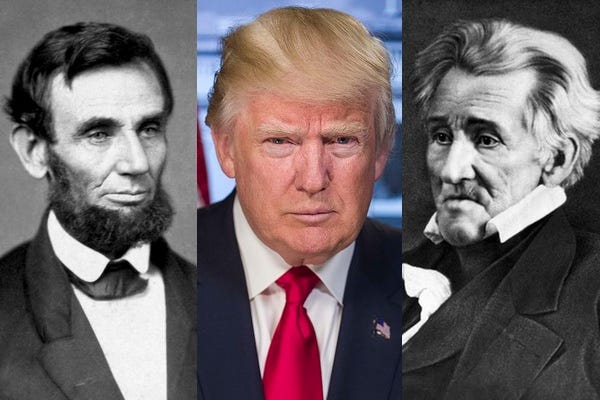
Searching through US history for a President like President Donald J. Trump, an obvious comparison is with the first Democrat President and seventh US President, Andrew Jackson (President 1829–1837).

Like Jackson, Trump is an outsider, despised, even hated, by much of the political establishment. Like Jackson, Trump is unashamed and blatant in his plebeian appeal. Like Jackson, he draws his strongest support from Greater Appalachia, the borderer (aka Scots-Irish or hillbilly) element of the US nation. Like Jackson, Trump draws wild enthusiasm from his partisans that seems both mysterious and aberrant to his (many) critics. Like Jackson, Trump brings a buccaneering style to politics that clashes with conventional notions of proper Presidential gravitas. While, unlike Jackson, Trump has not ignored the US Supreme Court, he has had some high profile clashes with the judiciary. Analysts of US politics still talk of Jacksonian politics, especially with reference to foreign policy. Trump is the strongest example of Jacksonian foreign policy in decades.

So, lots of similarities and analogies to be getting along with.

On the other hand, the United States managed to cope with a Jackson Presidency just fine. Indeed, so successful was Jackson that he was a key founder of the Democratic Party, the oldest still operating political Party in the world.

Thus, the Trump-Jackson analogies are striking, but not disturbing.

The disturbing analogy is with Abraham Lincoln, the 16th US President and the first Republican President (President 1861–5). Disturbing, because Lincoln is, of course, the Civil War President. It was his election, on 40% of the popular vote, that provoked the Southern States to secede.

Lincoln won the plurality of the popular vote against three major opponents with a clear victory in the Electoral College (180 out of 303). Trump was outpolled in the popular vote 46% to 48% but won a clear Electoral College victory (304 out of 538).

It is generally asserted that the South seceded because Lincoln was an anti-slavery President elected at the head of an anti-slavery Party. Yes and no. The US Civil War was absolutely about slavery. One only has to read the Confederate Constitution or transcripts of the secession debates to see that.

But it was not merely that Lincoln and the Republicans were against slavery that mattered. There had been anti-slavery Presidents before. It was the potential appeal of the Republican platform to ‘poor whites’ in the South that, added to the opposition to slavery, was the dire threat.

The Republican platform included what became the Homestead Acts, opening up landownership in the West to poorer settlers. The 1860 Republican platform also included tariffs and infrastructure projects, offering potential regular employment and higher wages. This was a program likely to be extremely attractive to the landless ‘masterless men’ of the American South.


With control of the Presidency, Lincoln could use federal government appointments to build up a Republican political base in the South. This was a nightmare scenario for the South’s plantation elite. Slavery depressed wages in the South and the status of manual labour. The worst possible outcome for the plantation elite was ‘poor whites’ and slaves (or, even worse, freed slaves) making common cause.

Hence Lincoln’s election sparked the secession of Southern States from the Union.

Fast forward, and the Democrat electoral coalition relies on keeping its extraordinarily high electoral support among African-Americans. If the Republicans can start making inroads among African-American voters, then it is very hard for the Democrats to put together a winning electoral coalition.

Since Trump’s election, his Administration, and his re-election campaign, have been attempting to target African-American voters, seeking to detach a sufficiently large minority from voting Democrat to voting Republican so as to overturn the Democrat electoral arithmetic.

The parade of minority speakers at the Republican National Convention was not some last minute add on, but the high point of an electoral outreach that has been underway throughout the Trump Presidency.

Which African-Americans?

African-Americans constitute three distinct groups. Descendants of Americans slaves, Afro-Caribbeans and recent African immigrants. Barack Obama was the son of a Kenyan immigrant. Democrat Vice-Presidential nominee Kamala Harris is mostly of Indian, and otherwise Jamaican (so Afro-Caribbean) descent.

Neither major US political Party has ever had the descendant of American slaves on their Presidential ticket. The African-ancestry candidates the Democrats have nominated have instead expressed the Democrat’s reliance on support from migrants.

This is an obvious weak point in the Democrat’s appeal to African-Americans. The descendants of American slaves do not noticeably benefit from migration. On the contrary, migrants and their descendants get to claim affirmative action benefits, crowding out the descendants of American slaves. Migrants congregate in major cities with significant African-American populations, where they compete for jobs, housing, and political access. Judged by who has, and has not, been represented on recent Democrat Presidential tickets, migrants have been winning the political competition.

Trump’s migration scepticism is a potential winner among African-Americans.

Another obvious weak point is that a significant number of African-Americans are conservative, and a strong majority identify as conservative or moderate. As the Democrat Party has moved in an increasingly progressive direction, that has widened the potential gap with many African-American voters. One reason why Biden won the Democrat nomination is that conservative and moderate African-Americans voted for him.

If Trump can open up the cultural distance between him and Biden, that is another potential winning point for him, particularly as he does not come across as a conventional Republican, but is very much a media-savvy culture warrior. Experience in the UK with Brexit and after shows that shaking up conventional politics along cultural lines is a way to detach former rusted-on voters, as well as the otherwise politically alienated. Riots and statue-topplings are potentially just such a cultural shocks.

The third potential weak point is, ironically, Black Lives Matter and the defund the police campaign. There is a long history of antagonism between police and African-American communities. But there are many African-Americans who do not want less policing, but more policing (or, more accurately, more effective policing). They are, for very good reason, deeply concerned about what would happen in their communities if police were withdrawn even further.

Fear of the consequences of the defund the police campaign is another potential winning point for Trump among African-Americans. It is true that Biden has explicitly not endorsed defunding the police, but many local Democrats have. Kamala Harris was a tough prosecutor, but that is a double-edged appeal in urban African-American communities.

Trump already has appeal among working Americans. Threatening to create an electoral coalition incorporating working Americans of both European and African ancestry: which President does that look like?

Threatened elites (again)

The networked elites of the major cities find identity politics very convenient. It breaks up citizens, residents and workers into competing groups based on identities that divide citizens, residents and workers. A lot of the metro-elite’s status-and-resource games would be upset if some bumptious upstart started putting together a citizen-worker-resident coalition.

The question is, how upset? How threatened?

The riots and statue-topplings suggest that there is a lot of political anger to harness. Given that the US’s ludicrously expensive university credentialing system leaves a lot of folk burdened with considerable debt and that restrictions on the supply of land for housing, and housing on land, creates ludicrously expensive urban housing markets that also shut lots of people out, there is much economic frustration being generated.

The US in the 1950s and 1960s was very socially stable. The combination of tight labour markets (so rising labour incomes) and loose property markets (so it was relatively easy to purchase middle class stability via home ownership) tends to encourage social stability. Thanks to migration, technological change and globalisation, plus the politics of zoning, aggravated by lockdowns, the US now has the opposite: loose labour markets and tight property markets. This is not a recipe for social stability.

Of course, it is the well-connected metro elites who have largely created or aggravated these problems. Supporting high migration AND land zoning drives up housing prices. Their universities create debt-burdened gimme courses in moral self-congratulation while new graduates in real disciplines have to compete with the educated of the entire globe.

The same well-connected metro elites whose long-term strategy of not providing sufficiently effective policing in African-American urban neighbourhoods results in much higher levels of violence in those communities. Violence that both stigmatises African-Americans and divides citizens, residents and workers from each other.

Violence, by the way, that is entirely an urban phenomena. There is no difference in homicide death rates in rural US between Americans of European and those of African descent.

No wonder the metro-elites love identity politics so much. No wonder also that the possibility of an ignoring-race coalition of local workers, residents and citizens must seem increasingly scary to them.

The question is, how scary? Are they as scared as the plantation elites of the Old South?

Or have they gestated from all this a network of genuinely revolutionary minded folk? A potentially explosive mixture of ideas that de-legitimise the American project with an over-supplied elite squeezed by under-supplied opportunities?

I guess we will find out, if Trump wins in November.

Imperial ideology: how elite networks push local connections and concerns out of the public space

Much of what has been going on Western societies is a struggle between the somewhere politics of local connections and the anywhere politics of elite networks.

Social analyst David Goodhart identifies the somewheres as people who are rooted in their local communities. Suppliers of labour, small business folk and others, often without university education, somewheres typically are born, live and die within the same local area. Anywheres are typically folk with university educations, so possess human capital, many with professional qualifications, who congregate in the major metropolises. They often travel for work and frequently reside in a very different community from where they grew up. They also often have more in common with anywheres in other countries than the somewheres of their own country. The dramatic fall in transport and communication costs have tended to expand and strengthen their networks.

It is the transnational nature of the networks of the anywheres, including their transnational commonalities in outlooks, perspectives and interests, that generates much of the rhetoric about globalism.

The decline of churchgoing, the decline of private sector unionism (and the takeover of the union apparatus by the university-educated), the decline of local sporting clubs and networks, the retreat into private entertainment, the flow of newcomers into urban neighbourhoods, the flow of the educated out of local neighbourhoods, the movement of women into the workforce (and so out of local networking), the decline of mass manufacturing, have all undermined local connections.

Thus, an interlocking web of economic, social and technological changes have tended to systematically undermine local connections and expand and empower elite networks. The anywheres, and their perspectives, more or less completely dominate the cultural commanding heights — arts and entertainment, media, IT, universities and much of education generally.

The one major political lever the somewheres still have is the vote. This is a less powerful lever than one might think, as having the vote on its own is not enough, there have to people to vote for who reflect your concerns and interests. As economist Thomas Piketty has nicely documented, politics has become increasingly dominated by a struggle between possessors of human capital (who he labels the Brahmin Left) and business capital (in his terms, the Merchant Right). That is two different set of anywheres trying to get the votes of the somewheres.

Increasingly, the somewheres do not hear their concerns and interests being articulated in the public and political spaces, so they retreat into not voting. Worse, attempts to articulate their concerns and interests are often de-legitimised; are construed as racist, xenophobic or otherwise beyond the moral pale.

Here we need to distinguish between being critical you are wrong because of (insert facts and logic) — and de-legitimisingonly evil and malicious people say such things. To de-legitimise a point or concern is to say that it does not belong in the public space at all. It is not even worth arguing over. De-legitimisation is all the more powerful if the person expressing such concerns is sanctioned for saying such things.

(As an aside, much of the hatred of President Trump can be explained by the way he deliberately, even gleefully, mocks such legitimacy plays.)

The phenomena of “cancel culture” (seeking to destroy livelihoods and reputations, seeking to exclude from the public space) is an attempt to impose social norms on what can be expressed in public (and private) via social sanctioning. To set the limits of opinion legitimacy. It is typically a form of mobbing, with all the problems that mobs, and mob “justice”, has. It is a mechanism of de-legitimising, not of criticism. It is, of course, fundamentally hostile to free speech.

It is also, fairly obviously, not a tactic of the somewheres, but of anywheres.

Throughout history, the possessors of human-and-cultural capital have been a significant class in complex societies. Their origins go all the way back to the shamans of foraging societies. They are often, but not only, priesthoods and religious scholars.

The Brahmins of Indian society are an example of possessors of human-and-cultural capital. So are the ulema, the religious scholars, of Islamic society. In both cases, they have traditionally controlled legitimacy: what it was, or was not, legitimate to do or say.

Granting-and-denying legitimacy is a standard social-dominance device of the possessors of human-and-cultural capital. Provided, of course, they can coordinate well enough to wield it. In contemporary society, much of the quality media fulfils that coordination role — selling a congenial sense of being informed around the opinions packaged as being what the good-and-smart people believe. In recent years, this coordination role has been hugely augmented by online media, particularly Twitter.

We live in an age with an ever-expanding list of linguistic and opinions taboos. Setting taboos is all about setting the limits of legitimacy. Piketty’s label of Brahmin Left is very much on-point.

It does not take much to see that granting-and-denying legitimacy is a powerful weapon in the hands of anywhere networks. If they can set the norms of legitimacy in a way that supports their status and resource claims, they can channel the votes of the somewheres, who outnumber them, into directions that minimise the conflict with anywhere interests.

Voting matters because it empowers social bargaining, it makes people’s concerns and interests matter. But if you can wield the weapons of setting legitimacy successfully, you can restrict the avenues of “legitimate” political bargaining in a way that systematically restricts, and so undermines, the value of the vote. Concerns that cannot be legitimately expressed can be quarantined off among designated political untouchables or simply do not enter into the processes of political bargaining in any effective way.

You can see this process at its most perfect in totalitarian states. The ruling Party completely controls what can be legitimately expressed, sanctioning (often severely) anyone who crosses the set lines. Elections are thus turned into rituals; rituals of dominance (we can get you to go through this ritual act) and of legitimacy (see, the people voted for us).

When people respond to the current American troubles by invoking comparisons with the Chinese Cultural Revolution or the Jacobin phase of the French Revolution, there are similarities in underlying dynamics to point to. Pulling down statues, censoring cultural products, having diversity(tm) struggle sessions, street violence, mock executions and so forth have an evocative similarity with those earlier social paroxysms. We are seeing networked efforts to so narrow what it is legitimate to say or do so as to establish the dominance of the wielders of yet another ideology of socially transformative virtue.

An ideology that manages to combine the worst of the Counter-Enlightenment — the primacy of emotion and feeling, the primacy of racial identity — and the worst of the Radical Enlightenment — the belief that social transformation is achieved by forcing everyone to act and believe together — in a single, highly potent, set of status claims presented as being what the virtuous believe. Virtue that requires adherence to a matrix of very specific assertions, paraded as moral necessities, opposition to which is declared to be inherently illegitimate.

As economist Glenn Loury and linguist John McWhorter have pointed out, the way racist! is currently being bandied about is much the same as previous uses of witch!. I would add in the examples of heretic!, infidel! and counter-revolutionary!. They are all ways of saying “evil and so not-legitimate”.

Even in its relatively mild forms, the politics of de-legitimising advantages the anywheres and disadvantages the somewheres.

Once the de-legitimising dynamic starts, however, it has no natural stopping point. On the contrary, it has an inherent tendency to spiral towards violence, as it empowers the virtuous to take any “necessary” actions to block those designated as evil and illegitimate.

Multiculturalism as cultural marker

In the struggle between the somewhere politics of local connection and the anywhere politics of elite networks, the shift in migration policy from assimilation to multiculturalism was a major cultural milestone.

The flood of new people into a local area can obviously break up local connections. The local connections that working folk in particular rely for various forms of social protection and ability to organise for common interests. The policy of assimilation was the implicit promise that newcomers would be brought in at a sufficiently low rate, from sufficiently diverse origins, and with strong expectations of “fitting in”, so as to minimise the disruption of local connections, either in their local communities or their workplaces.

While working-class concerns were still dominant in centre-left politics, migration was tied with assimilation.

With the postwar expansion of higher education, the number and reach of university-educated possessors of human-and-cultural capital steadily expanded. These were elite-network anywheres, not local-connection somewheres. Moreover, the social position of the anywheres is improved if their elite-network politics trumps local-connection politics.

As possessors of capital, anywheres generally get significantly more economic benefit from migration than do providers of labour. Migrants are much less likely to directly compete with anywheres (as anywhere skills are much more likely to be niche or otherwise remain relatively scarce). Generally migrants increase the demand for anywhere services/return on their capital (and do so whether or not the migrants work). The downward pressure on labour incomes increases access to goods and services by making them cheaper. An effect that is magnified, as anywheres have higher incomes.

So, on one hand, anywheres disproportionately benefit from migration. On the other, the disruption of local connections not only does not adversely affect them, it increases the relative power of their networks as against the politics of local connections.

It is not hard to see that anywheres will tend to be very pro-migration and not only indifferent to the costs of large-scale migration for local connections, but actually benefit from that disruption. It is even better if these effects can also be turned into a status play: such as getting a sense of moral prestige from one’s support of migration.

We see here a social selection opportunity laid out before us. A social selection opportunity that was, indeed, fulfilled.

Enter multiculturalism. (Or, as it has since become, diversity-inclusion-equity.)

Whereas the implicit promise of assimilation was that local connections would not be seriously disrupted, multiculturalism made no such promise. On the contrary, it rules any complaint about the newcomers not “fitting in” out of court. Their ability to do their own things in their own ways becomes sacrosanct. If newcomers come in in large numbers, if they stick to their own, that is just a wonderful contribution to cultural diversity, it being hard to maintain a culture in a new land without plenty of specific connections. And any complaints are clearly motivated by nothing more than racism and xenophobia.

Multiculturalism (and, in its expanded version, diversity-inclusion-equity) is more or less perfect anywhere politics. It serves anywhere economic interests. It serves their status interests — it being what good-and-smart people support and so shows their moral goodness. It breaks up local connection politics and elevates elite-network politics, not merely by relatively advantaging elite-network politics but by actively supporting and empowering such politics.

How so? By creating a multicultural bureaucracies, multicultural advocacy groups and multicultural political networks. (All now re-packaged as diversity bureaucracies, diversity advocacy groups, diversity training firms and diversity political networks.) All of them providing jobs, status and institutional power to the anywheres and their networks. A process nicely documented by political writer Ben Cobley in his book The Tribe.

Multiculturalism is an imperial ideology. It is so in two sense. First, because it can expand into almost any institutional or organisational space. As its expanded version, diversity, inclusion and equity, is currently demonstrating.

But multiculturalism is also an imperial ideology in a much more direct sense. All empires are, in one sense or another, multicultural. They are all diverse. It is inherent tendency of empire. It increases the number of subjects, it divides subjects into competing groups and generates jobs for imperial officials in managing those divisions.

When the British Empire imported Tamils into what is now Sri Lanka and Indians into East Africa, the West Indies, South Africa and Fiji, this was justified on the grounds that the newcomers would increase local commerce, local economic activity. Which they did. But scholars since have had no problem identifying that it also served imperial control by generating divide-and-dominate politics, creating competing groups that the imperial authorities could “manage” and who were unlikely to combine against the imperial authorities.

Well quite. But what is different about doing the very same thing in Birmingham, London’s East End or any major American city?

That it is being done within a democracy instead of an empire? Except, as we can see, it can be an excellent mechanism for breaking up the effective bargaining power of local, especially working class, voters.

So, how different is it really?

In American cities we can see rioters burning down local businesses in the name of classic anywhere diversity and anti-racism political tropes. This is not the somewheres fighting back (though there are now some signs of that), this is the next stage in anywhere politics. (With folk who like rioting along for the ride.)

And the politics of control through controlling legitimacy are not the politics of free speech, free citizens or open political bargaining.

We have in various forms, experienced patterns like these before. A good hard look at the events and patterns of the Cultural Revolution, and the Jacobin phase of the French Revolution, is entirely appropriate.

There is more to human evolution than African savannahs (and other problems of human nutrition)

Image for post


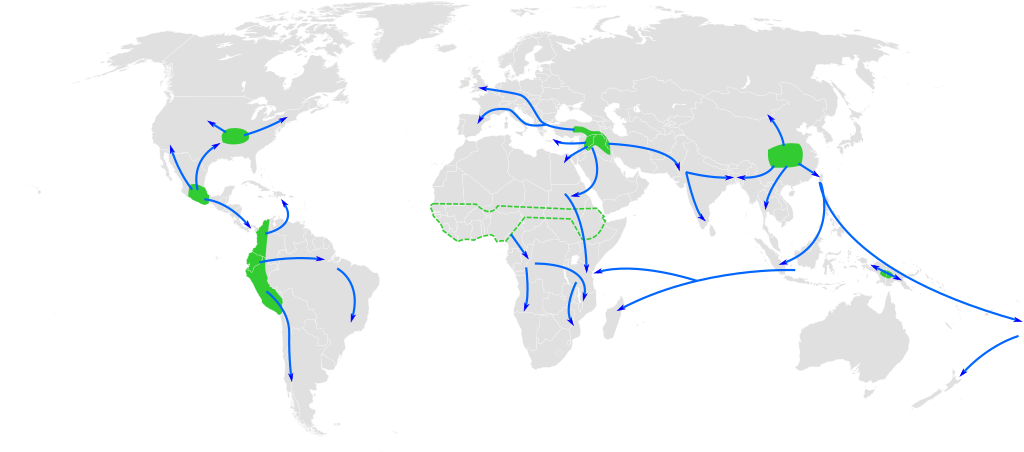
Spread of farming and farmers.

Humans, the genus Homo, evolved in Africa. For most of the history of our genus, even for most of the history of our species Homo sapiens, we were foragers in Africa.

Homo sapiens are probably about 300,000 or so years old as a species. We did not leave Africa until maybe 80,000 years ago, with another exit wave about 50,000 years ago. Our species then spread out, still being foragers, across every continent except Antarctica.

Around 10,000 years ago, some of our ancestors started farming. Farming was invented again and again. In each case, farmers spread out, absorbing and replacing (mostly replacing) foragers. Some foraging populations have persisted to the present day. Those populations have no history other than being foragers. But they are a tiny proportion of present day humans.

The genetic record suggests that farming (and a bit later pastoralism) sped up human evolution, rather than slowing it down. It sped it up because it changed the selection pressures dramatically. Farming was distinctly less healthy than foraging, but massively increased our access to usable calories, and so won the demographic struggle against foraging.

What were the effects of these changes? Many and varied. Among pastoralist populations, lactase persistence, the ability to consume milk as adults, evolved. It also seems that our normative capacity evolved, with a shift towards moral norms because that made group stability easier and so enabled us to operate in larger (and more hierarchical) groups.

It also, fairly clearly, increased the variety of our response to food. Different populations had systematically different food patterns and selection pressures from those food patterns.

Where does that leave us?

Understanding that the notion of nutrition guidelines, especially enforced nutrition guidelines, is a complete crock. First, humans are simply too varied in their responses to food for a one-size-fits-all set of nutrition guidelines to be sensible.

Human responses to nutrition will not be random, just varied. So, responses will be distributed, probably in a fairly normal Bell-curve pattern (though that is a guess, not an inference from clear evidence). Thus, there will be patterns, potentially strong ones, in human responses to nutrition. Though the patterns are still likely to be varied enough that one-size-fits-all guidelines are still going to be a bad idea.

That 10,000 years or so of farming experience (which in many populations is rather less than that), is hardly going to completely overwrite 300,000 years of experience of being foragers (plus all that prior evolution). With even those foragers had significant variety in their diets between groups.

But those patterns are unlikely to be remotely uniform enough to make nutrition guidelines useful as anything more than a very general guide for people to discover what works for them.

The other problem with nutrition guidelines is (1) nutrition science is difficult and (2) the chances of government nutrition guidelines being solidly based on good nutrition science are vanishingly small.

Nutrition science is difficult because our responses to food are somewhat varied, our food intake is very varied and food is not remotely the only thing that affects our health and longevity. So, trying to tease out the effects of different foods, different food groups, different eating patterns, on our health and longevity is inherently complex and so inherently difficult.

The sheer difficulty of doing good nutrition science actually makes problem (2) worse. If it is hard to do good nutrition science, it is easy to do it badly. If it is easy to do it badly, it is very easy to do it to support an agenda. There are massive income flows at stake in food, nutrition and health, so there are massive social selection pressures in play to support, sustain and expand access to those income flows.

Which is how we have ended up, across the Western world, with nutrition guidelines that clearly do NOT promote health and active longevity. That, on the contrary, are presiding over us collectively getting chronically sicker, particularly through the dramatic increases in metabolic syndrome, as that is what maximises income flows to a lot of interested parties.

Big Food Products that wants us to eat more and more, to eat to our (manipulated) palates not to our health. Big Pharma that wants to sell symptom suppression drugs so makes more money the more symptoms there are to suppress. Ordinary medicos who make more money prescribing symptom suppression drugs to the chronically metabolically ill. Big Health Advocacy whose income comes from Big Food Products and Big Pharma and who get more income and importance the bigger their issue is. Big Government Health Bureaucracies, whose revenues go up the more chronically sick we collectively are.

With all those selection processes at work, the likelihood of nutrition guidelines being actually based on the science and actually promoting health and active longevity is close to zero. As we have collectively experienced.

And this without considering the ideological pressures also in play, such as religious and other commitments to vegetarianism.

Government nutrition guidelines have been a serial disaster and were never a good idea in the first place. Our metabolisms were collectively much healthier when we were not afflicted with government nutrition guidelines.

Humans are too nutritionally varied, and the social selection processes operating on bureaucracies and political processes far too perverse, for government nutrition guidelines to be an idea that anyone should support.

Thursday, August 13, 2020

Capitalism, Socialism and other terms to be avoided

Capitalism is a term coined, or at least popularised, by the enemies of the system they labelled capitalism. It was understood from the start to have a pejorative connotation and the term’s use is still dominated by that pejorative connotation. Despite the efforts of supporters of capitalism-so-labelled to reclaim capitalism as a positive, or at least neutral, label; particularly based on historical experience.

One should always be wary of any term where the pejorative element built in. Even if you somehow do not let the pejorative element infect your own thought, it is going to be there in the mind of many, often most, readers.

Socialism is a term coined, or at least popularised, by the proponents of the system they labelled socialism. It was understood from the start to have a positive, indeed overwhelmingly positive, connotation and its use is still dominated in many quarters by that positive connotation. This despite the efforts of the opponents of “socialism” to give it thoroughly negative connotations, particularly based on historical experience.

Capitalism has at least has some vague consensus on what the term means. Socialism does not even have that, as recent American politics has demonstrated, thanks to the attempts of Sen. Bernie Sanders, self-proclaimed socialist, to win the Democratic Party nomination for President of the United States.

Capitalism has some vague consensus regarding what the term means because almost everyone agrees that there is currently, and has been, a lot of it. Apart from some labelling of command economies as state capitalism, there is a general consensus that we more or less know capitalism when we see it.

There is no such consensus around socialism, mainly because socialists typically want to dissociate the term from every command economy that has ever operated, or patent embarrassments such as Venezuela. Conversely, the enemies of socialism what to hang every command economy that has ever operated, and embarrassments such as Venezuela, on any use of socialism.

If socialism has never been “really” tried, then it can never have failed. Or if there is this new form or conception of socialism that has never been tried, then clearly it has nothing to do with any command economy that has ever operated, or any embarrassment such as Venezuela.

Of course, one might suspect that this attempt to constantly separate socialism from history might be a bit of a warning sign. Especially if folk want to play the game of comparing the ideal of socialism (carefully separated from history) with the practice of capitalism (often using carefully edited, selected or re-construed bits of history).

For me, there is a simple solution. Avoid, as much as possible, using either term. Then you can at least aspire to some analytical rigour.

Other possibilities

That does not remotely foreclose considering new social possibilities. It just means trying to do so with some analytical precision without dragging along the deadweight of fraught ideological conflicts.

Moreover, contemplating the social possibilities that do not seem to be much explored can be a very useful exercise. To consider the dogs that don’t bark in the night.

If not separating workers from the product of their labour, or simply having the workers in charge, is such a fine thing, one might think that would be entirely possible to set up worker-controlled companies. Then the non-alienated, self-controlled workers might be expected to produce so well that they can outcompete capital-owned firms in the market place.

Of course, if your notion of alienation covers any attempt to produce for exchange, then even in a worker-controlled firm workers will be alienated from their labour. Of course, not producing for exchange then reduces Homo sapiens to the economic level of every other species on the planet. One might consider the possibility that producing for exchange permits the scaling up of production and consumption far more extensively or efficiently than any other way of dealing with the issues of subsistence and surplus. So, perhaps giving up an advantage that may predate our emergence as a species is not a good move.

Let’s assume that something we have been doing for maybe 320,000 years or so (and certainly for 200,000 years), exchanging things we have produced, is not some alienating disaster, and go with worker control is good. Worker-controlled firms is still an entirely possible option. So, why don’t we see far more of such?

What is a firm? A firm is a mechanism for lowering transaction costs and dealing with risk. Do we want to dump risk on to labour or on to capital? Surely, on to capital. So, a labour-controlled firm is going to make the decisions, and is going to need capital, but will also want to dump the risk onto the holders of capital.

So, which firms are going to operate better? Those where control ultimately rests with those who have to deal with the risks or those where control ultimately rests with those who get to systematically dump risk on to others?

Clearly the former. The owners of a capital-owned firm get the residual income from the firm because they also cover the residual losses from the firms.

Moreover, when we say “worker controlled”, which workers? The original workers presumably. But what if you want to hire new staff, do they get the same control rights? Suppose the firm has too many workers, it needs to lay off staff, how do you decide that? What are the dynamics of a group of workers who every so often may have to vote on who gets to be ejected from the firm?

Capital-owned firms solve these problems by essentially having a market in control. The more you are willing to buy in, the more control you have. If you want to leave, you sell your control rights. Decisions about hiring and firing are left with those who are managing the firm. (And firms with mechanisms for workers to become shareholders are still capital-owned firms.)

What about coordination issues as a worker-controlled firm gets bigger?

At this point, we can see why the somewhat Darwinian selection processes of markets select for capital-owned firms and not worker-controlled ones. It is not that worker-controlled firms are illegal, it is that they represent a risk-and-decision profile that no one (including workers) are likely to invest in. The closest we get are partnerships, and they represent human-capital firms, not worker-control.

And about the state

Consider again the question: which firms are going to operate better? Those where control ultimately rests with those who have to deal with the risks or those where control ultimately rests with those who get to dump the risk on to others? Here’s something to conjure with. Is not: a structure where control ultimately rests with those who get to dump the risk on to others, a pretty good description of the state?

People (often with good reason) complain about the socialisation of losses and the privatisation of profits. But that is precisely what an awful lot of state politics is about. Shifting benefits to one group and costs, including risks, to another because the coercive power of the state makes that a game that can be played (and is obviously one with significant potential pay-offs). When one sees risks being shifted from capital to labour, there is generally some state action underlying it.

This is why the term state capitalism has a little bit of purchase behind it. If you squint just right.

In a command economy, the state owns all (or almost all) the capital. So, in a command economy, risk regularly gets dumped by the capital-owning state on to labour. Including risks of mass starvation or environmental degradation. But that is not because capital owns the state, but because the state owns the capital.

Lenin, Stalin, Mao, etc. did not control the state due to their ownership of capital, they controlled the creation and use of capital due to their control of the state. To call such capitalist or capitalism is to get the causal drivers entirely the wrong way around.

So, yes, it is significant that state owns the capital in a command economy. It affects its patterns of behaviour and means there is no significant non-state control of surplus, so no significant basis of institutional resistance to the power of (those who control) the state. But the capital is entirely subordinate to the state. So, the society is not capitalist.

And we are back with avoiding the use of terms so weighed down with emotionally-laden connotations. Because, without those connotations, there would be no incentive to so badly mis-characterise the relevant social, political and economic dynamics.

Single-Spouse Marriage Systems: the elite male problem

While most human marriages have been one husband, one wife, most human societies have permitted multiple-spouse marriages. Most commonly, they permitted a man to have more than one wife.

Since fathering a child takes rather less inherent biological effort than mothering one, it is hardly surprising that multiple wives (polygyny) is the most common deviation from single-spouse marriage.

In societies where women make substantial contributions to subsistence — almost invariably, hoe-farming societies — rates of polygyny can get very high. For the cost of adding extra wives is much less than in societies where males dominate subsistence activity: typically plough-farming and pastoralist societies.

Foraging societies tend to have low levels of polygyny, as subsistence contributions are relatively even (the subsistence contribution of women is more constant, that of men more nutrient dense) and entirely labour driven. There are no productive assets, beyond weapons and other hand-held tools.

The landscape management and foraging complexity of Aboriginal societies in Australia generated distinctive patterns of gerontocratic polygyny. Old men married young women, young men married their widows and, in their old age, married young women. It kept fertility down and fostered the transfer of complex foraging knowledge across the generations. They also developed some extraordinarily complex marriage-and-kin systems as part of complex landscape management, as that preserved a rolling network of kin connections.

If women control the main productive asset, and there is no other basis for elite male status, then there is no elite male problem. If that is not the case, then if a society is going to have compulsory single-spouse marriage systems, it is the elite males who have to be convinced. There seems to be two general reasons for the elite males to accept single-spouse marriage.

First, there are very strong pressures for social cohesion. If there is a need to have maximum internal cohesiveness against outside groups — specifically, if there is a need to include low-status males — then a single-spouse system minimises internal sexual competition and maximises the breadth of stakes in the success of the group. The fewer elite males there are, the lower the cohesion pressures need to be for such an arrangement to emerge.

This is the pattern that seems to explain the emergence of single-spouse systems in the classical Mediterranean and in groups such as the early Christians and the Alevis. In the case of classical Greece and Rome, access to slaves further reduced the cost of single-spouse marriage to elite males.

The second reason for single-spouse marriage being accepted by elite males is if the education cost of raising a child, particularly a son, to elite status is sufficiently high. Multiple-wife systems mean less investment by the father in individual children. If such an investment is at a premium, then a single wife is a better option.

This is the pattern you see in the Indian caste system and in the modern world. Brahmins could theoretically have multiple wives, but very rarely did, as the training investment in raising a Brahmin son was so high. Indeed, this very high training cost seems likely to be the reason why the jati system developed — to ensure the daughters of Brahmin, who understood the needs of raising a Brahmin son, were available to marry Brahmin grooms.

Single-spouse systems did not develop as territorial or population expansion devices. On the contrary, polygyny is a much better territorial expansion device because it creates a shortage of wives. Polygyny creates a shortage of wives as a woman who gets married leaves the marriage market, but her husband does not. So low-status men end up excluded from the marriage market. The classic response to this problem is “those people over there have women, take theirs”.

Islam sanctified this pattern, with the Quran explicitly endorsing sexual access to “those your right hand possesses” (Ma malakat aymanukum: i.e. women acquired by the sword). Sanctified sexual predation helped drive the territorial expansion of Islam for a thousand years. From its rise in C7th Arabia to the turning back of Islamic expansion into Europe after the Battle of Vienna, 12 September 1683. (And yes, that is apparently why 11 September was chosen in 2001.)

The Norse (Viking) raids also seemed to have been significantly fuelled by polygyny and died away as the Norse lands Christianised.

If external expansion is fuelled by low-status men seeking women that the local marriage market does not provide them, then elite males have no reason to accept a single-spouse system. Which comes back to; if one wants to explain why a single-spouse system is being accepted, then one has to explain why elite males have accepted the system, as they are giving up the benefits of multiple wives.


These musings are part of the intellectual scaffolding for a book to be published by Connor Court looking at the social dynamics of marriage. As they are somewhat a work in progress, they may be subject to ongoing fiddling.

Cooperative stability and the evolution of norms

Groups have been a somewhat vexed issue in evolutionary theory, with group selection, and now multi-level selection, (after the general rejection of group selection) being a hotly debated topic.

Foraging hunting bands are (and presumably were) somewhat fluid entities, although typically embedded in larger social groupings. Hunting bands split, they come together, people move between them.

While low-level normative behaviour has been observed in other species, Homo sapiens engage in levels of normative behaviour way in excess of any other species.

Such normative behaviour clearly originally evolved during our very long foraging history. Clear evidence of long distance exchange (over distances of up to 166km) has been found about the time Homo sapiens has clearly emerged as a species. Strongly suggestive evidence of exchange (over distances around 60km) may predate our emergence as a species. And exchange is a normative behaviour. The key element in exchange in being not “mine!” but “yours!”. Any chest-thumping ape can do “mine!”, it takes a normative species to systematically accept “yours!”.

Our long-term history can be understood as the spiralling up of cooperative, and thus normative, behaviour.

So, this distinctively human level of normative behaviour had to originally develop in a situation where it is likely there was some fluidity in groups. Indeed, normative behaviour can actually increase local group fluidity. First, to have norms that are more than just descriptive (I do it because everyone else does), requires sanctioning behaviour. And sanctioning behaviour can be a cause of group fluidity.

Second, norms economise on information and cognitive effort, facilitating cooperation. Thus having a common normative framework permits easier movement between local groups.

So, it is not clear that group stability was the basis or benefit of the spiralling-up emergence of normative behaviour.

Cooperative stability, is, however, another matter. Philosopher Cristina Bicchieri has developed a well-structured analytical framework for understanding norms and their dynamics. The framework is set out formally in her The Grammar of Society. It is set out more accessibly in her Norms in the Wild, which builds on the experience of herself and others in seeking to change social norms.

Social norms are built on social expectations — empirical expectations (what you expect others to do) and normative expectations (what you expect others to believe you should do). They operate on the basis of schemas (sets of belief) and scripts (patterns of action). They usually involve some system of sanctions.

Stable expectations and scripts make other people’s actions much more predictable, so make cooperation much easier to attain and sustain. Norms therefore generate (or at least anchor) cooperative stability. And cooperative stability can, depending on circumstance, promote group stability. But cooperative stability is what would have been originally selected for, even in situations of relative local group fluidity and even if such cooperative stability increased local group fluidity.

Thus, norms economise hugely on the cognitive and information effort required for cooperation. They are, in a sense, entrenched social bargains. (Or, at least, patterns that greatly reduce or structure the ambit of bargaining required for social cooperation.)

But what about moral norms? Moral norms are more absolute that social norms. As Prof. Bicchieri says, they have an element of unconditionality that social norms do not.

As we developed more sedentary living patterns, and then farming and pastoralism (a period during which our adaptive evolution seems to have sped up, presumably due to the dramatic changes in selective pressures), group stability would have acquired more survival and subsistence value. The absolute or unconditional nature of moral norms could have been selected for, as they promoted group stability. But were selected for by building on the existing capacity for social norms. Which themselves probably developed out of descriptive norms (a norm people prefer to conform to on the expectation that others do).

Thus, the claim is that normative behaviour in general developed out of its ability to foster cooperative stability. The argument by David C. Lahtia and Bret S. Weinstein that moral norms developed as group stability gained a higher survival and subsistence premium would be congruent with this, but as something that occurred relatively late in our evolutionary history. With what was being selected for being the ability to thrive in larger and more stable groups, even if those groups were not themselves stable enough as populations to provide specific evolutionary pressures.

A test for this hypothesis would be to check the relative importance of social norms and moral norms in different human populations. The more forager-based and fluid the social groups, the more dominant social norms can be expected to be. The more sedentary, stable and larger the social groups, the more significant moral norms can be expected to be.

With religions and faith systems, as structures of the sacred, reflecting this pattern in their development through time and across societies.

Prestige and dominance

There is also a likely connection to prestige and dominance. Prestige, bottom-up status, is a key social currency of human cooperation. Foraging societies generally display very strong anti-dominance patterns of behaviour, as dominance behaviour (top-down status) undermines local group cooperation. So, suppressing dominance behaviour would actually increase the capacity for, and the stability of, cooperative behaviour.

As more sedentary patterns of living, then farming and pastoralism, arose, dominance behaviour re-emerged. Including some very extreme patterns of dominance behaviour, such as human sacrifice as part of funeral rites. The more absolute nature of moral norms would more readily sustain dominance behaviour, especially extreme dominance, behaviour, than social norms.

Morality could, however, also provide some protections against dominance behaviour. The so-called golden rule of generalised reciprocity (treat others as you would be treated), forms of which develop as more obviously moralistic religions and faith systems emerge, is reasonably construed to be a social mechanism for dominance-mitigation and cooperation-enhancing (especially exchange-enhancing).

If this is correct, then undermining of any notion of a shared moral identity will be associated with intensified dominance behaviour.


These musings are part of the intellectual scaffolding for a book to be published by Connor Court looking at the social dynamics of marriage. As they are somewhat a work in progress, they may be subject to ongoing fiddling.

Big Tech, Big Food Products and Big Education: leveraging our tastes to stress our bodily and social metabolisms to destruction

We have an epidemic of evolutionary novelty and it is killing us
Bret Weinstein

Everybody is plugged into an apparatus that is sitting in between us, in the way conversation used to and, what it is doing, is that it is feeding us things that confirm what we actually believe, much of which is real, but that, in effect, people, smart scientific people, who know very well that the right way to think carefully is to be falsificationist, to look for things that disconfirm your beliefs, are being fed an overwhelmingly verificationist message and that is causing everybody to be dead sure they know what is going on, when very few of us have any clue.
Bret Weinstein

We Homo sapiens are remarkably adaptable, including in our diets. Human populations have lived for generations on a remarkably varied range of diets.

The consistent feature of human diets is food preparation and cooking. We are cucinivores, food preparers. With the last century or so seeing dramatic shifts in how we process food.

As our technological capacities have expanded, so has our capacity to process food. This has exposed a major weakness. What is palatable does not have a strong connection to what is nutritious. But it is far easier to sell to our palate than to our nutrition. Indeed, it is possible to sell to our palate in a way that actively misleads and misdirects our hunger signals.

This misfiring between palate, hunger sensations and nutrition has led to an increasingly metabolically unhealthy population. Something I have discussed previously.

But a similar mismatch is stressing our social metabolism. (A metabolism being a system for breaking things down — catabolic processes — and building things up — anabolic processes.)

Evolutionary biologists Heather Heying and Bret Weinstein have a nice short discussion of the Twitter recommendation algorithm not putting into their feed tweets from people that they follow that don’t conform to the recommendation algorithm’s apparent inferred positioning of their cognitive preferences. The Twitter algorithm is, in effect, trumping their choices about who to follow by its attempt to identify and target their cognitive palate.

This could be seen as shadow banning. I doubt that this is a significant phenomena, at least in a political context on large online platforms, as it would seem to involve a fair bit of effort. Especially as much the same apparent effect could be created simply by, in this instance, the Twitter algorithm targeting inferred cognitive palate.

The much bigger issue is that the Twitter algorithm is doing at least two noxious things. First, it is actively working against people’s attempts to have a broad range of information sources, at least regarding viewpoint diversity. So it is undermining cognitive nutrition.

Second, it is intensifying, and to some extent creating, information and viewpoint silo-ing. That is, people getting quite different, but patterned, streams of information. Not only patterned, but patterned in a way that separates people into systematically information-restricted-and-differentiated groups sharing common viewpoints.

It is well established in social science that the more conformity of viewpoint and opinion there is in a social group, the more intense the shared views are likely to become and the worse any decisions are likely to be. The former because what is common gets reinforced and intensified. The latter because more and more things that turn out to matter are likely not to be considered at all.

Social media algorithms acting to reinforce viewpoint-and-information narrowing are thereby actively deranging collective cognitive functioning. Or, as we might say, collective sense-making.

So, the recommendation algorithms are undermining attempts to maintain cognitive nutrition and actively assisting in deranging the collective cognitive metabolism. And they are doing it in a way analogous to how Big Food Products is undermining human metabolic health: by targeting our palate in ways disconnected to our nutrition and that also deranges our hunger signals. In the case of Big Tech, it is our cognitive palate, our cognitive nutrition and our social-emotional signals, but the underlying pattern is remarkably similar.

Big Tech are for-profit businesses. There are some inherent complexities involved in online media platform provision that Canadian YouTuber J. J. McCullough has an informative short discussion of. His discussion is specifically about YouTube, but has wider application.

Nevertheless, as with Big Food Products, income seeking encourages Big Tech to target (cognitive) palate when not only is (cognitive) palate not well connected to (cognitive) nutrition but the form of the targeting actively deranges our internal feedback signals. This is also clearly disastrous in its implications.

Especially as Twitter is, as more than one exiting media insider has pointed out, effectively becoming the editor for many mainstream media publications. Journalists are, after all, hardly immune to these patterns. (And those that are more resistant are increasingly bailing to their own, independent, operations using, ironically, online media.)

There was already a serious problem with narrative-driven journalism (see discussion of an obvious case here and a much more significant example here). The interaction of narrative-driven journalism with Big Tech is making the problem with both worse.

Disrupting the public sphere

Analyst Martin Gurri has explored the disruptive effects of new media in his book, originally published in 2014, The Revolt of the Public and the Crisis of Authority in the New Millennium. He also blogs about the issues he raises in the book. In a recent essay he wrote:

The collapse of trust in our leading institutions has exiled the 21st century to the Siberia of post-truth. I want to be clear about what this means. Reality has not changed. It’s still unyielding. Facts today are partial and contradictory — but that’s always been the case. Post-truth, as I define it, signifies a moment of sharply divergent perspectives on every subject or event, without a trusted authority in the room to settle the matter. A telling symptom is that we no longer care to persuade. We aim to impose our facts and annihilate theirs, a process closer to intellectual holy war than to critical thinking.

Historian Niall Ferguson has argued that the Internet has disrupted the public sphere in a way that is deeply analogous to the effect of the printing press on late medieval and early modern Europe.

As that was the time of the Reformation and the wars of religion, not a reassuring analogy.

Ferguson also notes that iconoclasm, tearing down statues and other public icons, is a typical manifestation of the disruption of the public sphere.

One wonders if that makes Robin DiAngelo’s bestseller White Fragility the contemporary equivalent of the C16th and C17th best seller, the Malleus Maleficarum, the Hammer of the Witches. Economist Glenn Loury and linguist John McWhorter have discussed how the current use of racist! is very like the past use of witch!. Or, indeed, the past use of heretic!.

Social psychologist Jonathan Haidt has already famously observed that morality blinds and binds: it brings people together around shared norms and values, but it also blinds their view of evidence and others. Having narrative-driven journalism interact with cognitive-palate-targeting social media makes this dynamic much worse.

Selecting for cognitive intensity


Moreover, any cognitive identity built around a system of belief is going to have some resistance to disconfirming or problematic facts. Create a large enough community of people with such a cognitive identity and a selection process is set up, selecting for mechanisms that protect that identity, that protect that intensified collective cognitive palate.

Something education is supposed to do is to help us make sense of the world around us. (That is something journalism is supposed to do too.) But educators (and journalists) are as prone to human foibles as the rest of us. In particular, they are likely to care about status.

The trouble with schools of education, and schools of journalism, in higher education, is that, to the extent that education or journalism can be said to be academic disciplines at all, they do not have much inherent intellectual heft or status to them. The temptation to compensate for that lack of intellectual heft or status by seeking some other form of status thus becomes very strong, with that very lack of intellectual heft providing little or no countervailing pressure. The obvious form of (compensating) status to embrace is moral status; to embrace some form of activism, of seeking to make the world a better place.

Schools of education and journalism then become strongly prone to shift from being centres of skill-based education (here’s tools to help you go about the tasks of teaching or reporting) to being centres of ideas-based indoctrination (here’s how you become a Good Person making the world a Better Place).

So, we get young people with little life experience who go to such schools of activism to become teachers or journalists, who take those attitudes to their workplaces, spreading such ideas among their students and any young readers, who then go to university … And so the cycle repeats and intensifies.

Moreover, there is nothing to stop this pattern being adopted in other parts of higher education. Hence the proliferation of so-called “grievance studies” courses and degrees, but which are rather better described as gimme degrees in moral self-congratulation. Which universities happily provide, because there’s money in it.

Their graduates then go out into workplaces and bureaucracies, including university administrations, and we get another round of the cycle.

Note that such is better described as status-hacking rather than status built on serious understanding or achievement.

This shifting from education in role-undertaking skills to indoctrination in status-providing ideas is, of course, another manifestation of appealing to cognitive palate rather than genuinely providing cognitive nutrition. With the emphasising on status-providing ideas over what actually works having the effect on the schooling of students that one might expect.

So, there is an expanding social environment in which selection takes place for memes (ideas that differentially replicate in a competitive environment, just like genes) that create status-providing cognitive identities that appeal to cognitive palates and which include protections from disconfirming facts, ideas or concerns.

Sooner or later, a set of super-replicating memes would be likely to evolve, helping to create and intensify narrative-driven journalism. Which then interact (disastrously) with social media structured to appeal to your cognitive palate but mislead and derange mechanisms of cognitive nutrition. (Such as dismissing science, a key provider of cognitive nutrition, as a patriarchal tool of white supremacy.)

Prestige, bottom-up status, is a key currency of human cooperation. In thriving societies and civilisations, prestige is typically harnessed for pro-social activities. In declining societies and civilisations, prestige is increasingly harnessed for anti-social activities. Including social dominance (i.e. top-down) status games.

And, as past waves of iconoclasm and social upheavals have demonstrated, people can be perfectly happy to destroy lots of physical, social and other capital if such destruction offers them status rewards.

Obviously (1) this is the situation we are now in. (2) this is not going to end well.

Health policy and debate misfire: how private corporations, non-profits, medical professionals and government health bureaucracies colonise our ill-health

We have an epidemic of evolutionary novelty, and it is killing us.
Bret Weinstein

Health policy is a matter of lively debate in the US, largely because the US political system has never fully settled on a coherent health system.

Health as a policy issue has all the factors that make for difficult public policy. It really matters to people. There are deep information asymmetries (lots of folk do not know what they need to know and have to rely on others). It can be ferociously expensive. Both public and private provision have obvious problems that the partisans of the other can point to. Lots of people’s incomes are at stake.

Something of a perfect storm of difficulties.

Health issues can be divided into acute (infections, accidents, violence) and chronic (everything else).

Western medicine is generally very good at dealing with acute conditions. Acute conditions have clear indicators of success; they are an immediate, identifiable problem; they fit in with the anatomical foundations of Western medicine; and there is a very broad incentive to get it right. There is certainly grounds for debate about how best to provide and fund acute care. Nevertheless, acute medicine is mostly a relatively straightforward provision-and-insurance problem.

If acute care was split off and dealt with specifically, I strongly suspect reasonable mechanisms with good incentives could be agreed on fairly easily. Mainly because the inherent incentives in acute care are success-oriented.

Chronic conditions are a very different matter. Western medicine has been far less successful at dealing with chronic conditions. Cancer is still often a death sentence and the metabolic health of Western populations (obesity, high blood pressure, diabetes, etc) has been steadily getting worse for decades.

Moreover, as noted here, most of those chronic conditions are related to the mismatch between how we evolved to live and how we do live.

Health expenditure has been consuming ever higher shares of GDP. There is a view that it is perfectly natural that health expenditure should go up. As people get richer, they want to fund better health, they live longer, so of course health expenditure goes up.

I want to suggest that is (mostly) bollocks. As we get richer and more knowledgeable, it should be easier to achieve and maintain good health. We should not be getting chronically sicker, which we are. Health expenditure is going up far more because we are getting chronically sicker than because of some preference for better health or the experience of increased longevity.

Incentives matter

Looked at dispassionately, the reason for the increasing chronic ill-health of Western populations is simple. That is precisely what the current incentives are structured to produce.

Start with Big Food Products. Their incentive is not to provide nutrition, their incentive is to get you to eat more. Since what you eat affects how much you eat, and because palatability and nutritional value are so weakly connected, getting us to eat more is both relatively easy and immensely profitable. If we eat more and more, if we eat more and more of what is palatable but not metabolically healthy, thereby increasing our metabolic stress, we will get more and more metabolically unhealthy. Which we are. But we will eat a lot more of Big Food Products’s multi-billion dollar income-earning offerings on our way.

People will do more of what makes their income go up. People are paid to do more of what makes their income to go up.

Consider Big Pharma. Their incentive is far more to provide suppression of symptoms than it is to provide cures. A genuine cure — you take this, the problem goes away, so you can stop taking this — is much less profitable than suppression of symptoms. For instance, tablets for high blood pressure do not cure what causes the high blood pressure, they suppress the symptoms. An amazing amount of prescriptions are not curative, they merely suppress symptoms.

People will do more of what makes their income go up. People are paid to do more of what makes their income to go up.

Consider health advocacy. The dominant donors for health advocacy non-profits such as heart associations, diabetes associations, and so on are Big Pharma and Big Food Products. Moreover, if those conditions actually went away, if they became insignificant, then so would the point of having those non-profit associations and the jobs they fund.

People will do more of what makes their income go up. People are paid to do more of what makes their income to go up.

Consider Official Psychiatry. What distinguishes psychiatrists from clinical psychologists is that psychiatrists can prescribe drugs. (And clinical psychology is more likely to have a stronger base in actual scientific evidence.) So, psychiatrists have a strong incentive to focus on the prescription of drugs.

Psychiatric drugs are almost invariably not curative. You generally do not take them, get cured by the drug, and stop taking them. We do not know enough about the interaction between neurophysiology, neurochemistry and cognitive patterns to reliably produce curative psychiatric drugs.

Psychiatric drugs typically suppress symptoms. Which means that they are often used much longer than an actual cure would be. Indeed, it is often not clear that they are any better than, and may be worse than, the passage of time. (They may be worse than the passage of time because of the possibility that they could be suppressing curative responses that might occur if things were allowed to run.) But suppression of symptoms can easily provide a more secure stream of income than an actual cure. With failing to ask awkward questions, or consider awkward data, being very successful income-and-authority self-defence devices.

People will do more of what makes their income go up. People are paid to do more of what makes their income to go up.

As an aside, and on a somewhat related issue, in the US, gender-affirming therapy plus the Dutch medical application model is the basis for treating gender dysphoria. This maximises the chance that anyone presenting with gender dysphoria will be medicalised and so become a permanent consumer of artificial hormones, with the more income to be made the earlier in life people transition. The gender-affirming medicalisation approach has been endorsed by various peak medical bodies, bypassing normal interrogation of the scientific evidence. (Once a viewpoint gets enough “this is what good people believe” oomph behind it, it can memetically capture institutions remarkably quickly, particularly if dissent is sanctioned.)

Getting back to chronic conditions in general, general practitioners, your ordinary medicos, are in much the same situation as psychiatrists. Suppression of symptoms can easily provide a more secure stream of income than an actual cure. With failing to ask awkward questions, or consider awkward data, being very successful income-and-authority self-defence devices.

Stop and consider what doctors in the past were paid to deliver as “cures”. It is clearly entirely possible to sustain a medical profession on a very poor knowledge base. Let alone a system that does successfully suppress symptoms, at least to a degree, and for significant amounts of time.

People will do more of what makes their income go up. People are paid to do more of what makes their income to go up.

Consider government health bureaucracies. Notionally, they spend money to improve the health of the populace. In reality, their revenue goes up the chronically sicker the populace gets. The behaviour that is selectively rewarded, by increasing their budgets, is behaviour that generates (or at least does not seriously stop) the populace getting chronically sicker.

Hence we see nutrition guidelines that have not been, and are not, grounded in the science, that make no evolutionary sense (our foraging ancestors did not eat breakfast, did not eat frequently during the day, did not eat much in the way of whole grains, did not eat seed oils and definitely ate a fair bit of fat) but do lead to a chronically sicker population, so increased government health budgets and larger health bureaucracies.

People will do more of what makes their income go up. People are paid to do more of what makes their income to go up.

It is striking how pervasive the effect of the official nutritional guidelines are. They affect all food provided by government agencies — including thereby undermining the metabolic health and capacity of armed service personnel — determine nutritional content of medical training and advice provided from large medical practises.

It is not that there is some malicious conspiracy to preside over ill-health. Instead, social selection processes operate, where access to income flows are what is being selected for. The incentives are to go with the income flows. They are certainly not to have less income.

Especially when huge sums are at stake, as they are, selection will be for ideas that are good at generating income, rather than selecting for truth or scientific accuracy.

To understand how dire the issue of nutrition is, consider this: calories in, calories out. This is at once an obviously true mantra — we have to be in calorie deficit to lose weight — and yet is so profoundly misleading as to effectively be a lie.

For here’s the thing: what we eat affects how much we eat, how much we move and how active our metabolism is. Calories are not remotely equal. There are essential proteins. There are essential fats. There are no essential carbohydrates. With enough fat and protein, your body will make all the glucose it needs. Any nutritional guidelines that encourage you to eat frequently, and to eat lots of carbohydrates, are encouraging you to eat more and to, for most people, metabolically stress your body.

Why would government health bureaucracies produce such nutrition guidelines? Consider what increases health expenditures and who has the most incentive to lobby hardest. Do not delude yourself that they are well-grounded in the scientific evidence, which is a difficult matter in nutrition, making it easier to select for convenient agendas and to maintain policy inertia.

Colonising ill-health

The calories in, calories out, mantra goes with “people are getting obese because we are getting greedier and lazier”. Apparently, something magical happen a few decades ago to destroy people’s culinary moral fibre. This is not an explanation, it is a justification for colonising people’s ill-health.

Consider that what you eat affects how much you eat, how much you move and how active our metabolism is. Consider that rising obesity, and other signs of metabolic disorder, coincide with the adoption of modern processed foods (with lots of seed oils). And then look again at the “greedy and lazy” pseudo-explanation. (At this point, anger is a reasonable reaction.)

Colonisers always claim that they are there, and that they are justified, because of the “problems” and “deficiencies” of the colonised.

We have an entire interlocking set of industries and professions that colonise people’s ill-health far more than they provide genuine cures. And the “greedy and lazy” explanation of obesity blames the victims for their profitable exploitation by those — corporations, non-profits and government bureaucracies — that are colonising our collective ill-health.

Who makes money from people eating less, eating less frequently, and perhaps fasting beneficially? Who makes money from the opposite? And how much?

People will do more of what makes their income go up. People are paid to do more of what makes their income to go up.

Another factor is that the anatomical-structure focus of Western medicine may be not well structured to deal with conditions that are far more about energy flows, about the energetics of the body, rather than its structures per se. Though to have so many incentives working for suppression (or even generation of) symptoms, rather than actual cures, hardly encourages adopting a more effective analytical paradigm. Hence the continuing scandal of the lack of serious nutritional training for doctors.

As has been observed, you take an animal to the vet and the vet will ask you what you have been feeding your pet. You go to your doctor, they are not likely to ask what you have been eating. If they do, there is a high probability they will not be asking from a knowledge base grounded in solid science. (A depressing amount of what passes for nutrition ‘science’ is of remarkably low scientific quality: associational studies in particular have a startling failure rate.)

What all this comes down to is Western populations getting chronically sicker and the budgetary burden of heath expenditures getting progressively worse. Because that is what the incentive structure of Big Food Products, Big Pharma, health advocacy, Official Psychiatry, standard medical practice and Big Health Bureaucracy are all structured to produce. They are structured to colonise our (increasing) mental and physical ill-health far more than providing good nutritional practices or actual cures. (Good nutritional practices and cure may often amount to the same thing.) With the flow of funds from corporations to research, advocacy groups and doctors aggravating the problems

So, where acute care is a relatively straightforward provision-and-insurance problem with generally pro-social incentives, chronic conditions are a profoundly dysfunctional mess that no system of provision will do more than generate ever higher expenditures, so long as that continues to be what the incentives structures are overwhelmingly set up to create.

The endless, deeply ideological, arguments (better characterised as memetic warfare) over public versus private provision in health are just arguments over how much private or public bodies will colonise the chronic ill-health of Western populations. Whether they will do so is not currently in dispute.

(And I agree, private providers will colonise our ill-health more efficiently and with more charm. They have to work harder than government bodies, colonisation generally being easier if folk are coerced into providing the income flow.)

Can anyone, in all the sound and fury over health policy, direct me to anything that suggest policy makers have even asked the right questions? Because if they have not even asked the right questions, how can we expect good answers?

But, then again, who has the incentives to ask the right questions?

Voices from the collapse of mainstream media

The ideas that catch on are the ones that win in narrative warfare. … That rivalrous game-theoretic environment is going to be selecting for what is effective, not what is true. And definitely not what is good for the whole.
Daniel Schmatchenberger


There is a mantra about of “go woke, go broke”. But Jessie Singal has suggested that in media, it is more “go broke, go woke” as the collapse of standard media business models makes it harder to sustain diversity of thought. He made the point in a Rebel Wisdom discussion.

The recent resignation of Arian Pekary from MSNBC speaks to Singal’s point:

But behind closed doors, industry leaders will admit the damage that’s being done.

“We are a cancer and there is no cure,” a successful and insightful TV veteran said to me. “But if you could find a cure, it would change the world.”

As it is, this cancer stokes national division, even in the middle of a civil rights crisis. The model blocks diversity of thought and content because the networks have incentive to amplify fringe voices and events, at the expense of others… all because it pumps up the ratings.

See also her follow up post on how Fox is also narrative driven.

Columnist Barbara Kay’s resignation from the National Post in Canada speaks on the conformity pressures now operating:

Since the early 2000s, journalists have anticipated the demise of their own industry. But we wrongly assumed that this decline would be driven exclusively by economic and technological factors. In recent months especially, it’s become clear that ideological purges have turned a gradual retreat into what now feels like a full-on rout. This is not a case of a lack of demand: The rise of popular new online sites shows that Canadians are eager for fresh voices and good reporting. Rather, legacy outlets are collapsing from within because they’ve outsourced editorial direction to a vocal internal minority that systematically weaponizes social media to destroy internal workplace hierarchies, and which presents its demands in Manichean terms. During the various iterations of political correctness that appeared since the 1990s, National Post editors fought against this trend. But as the public shaming of Rex Murphy shows, some now feel they have no choice but to throw down their weapons and sue for peace.

Bari Weiss’s resignation from the New York Times has been the most famous recent instance of conformity pressures leading to public exit.

Twitter is not on the masthead of The New York Times. But Twitter has become its ultimate editor. As the ethics and mores of that platform have become those of the paper, the paper itself has increasingly become a kind of performance space. Stories are chosen and told in a way to satisfy the narrowest of audiences, rather than to allow a curious public to read about the world and then draw their own conclusions. I was always taught that journalists were charged with writing the first rough draft of history. Now, history itself is one more ephemeral thing molded to fit the needs of a predetermined narrative.

My own forays into Wrongthink have made me the subject of constant bullying by colleagues who disagree with my views.


Andrew Sullivan made similar points in his last column for New York magazine:

What has happened, I think, is relatively simple: A critical mass of the staff and management at New York Magazine and Vox Media no longer want to associate with me, and, in a time of ever tightening budgets, I’m a luxury item they don’t want to afford. And that’s entirely their prerogative. They seem to believe, and this is increasingly the orthodoxy in mainstream media, that any writer not actively committed to critical theory in questions of race, gender, sexual orientation, and gender identity is actively, physically harming co-workers merely by existing in the same virtual space. Actually attacking, and even mocking, critical theory’s ideas and methods, as I have done continually in this space, is therefore out of sync with the values of Vox Media. That, to the best of my understanding, is why I’m out of here.

Matt Taibbi has reported on the general pattern:

Today no one with a salary will stand up for colleagues like Lee Fang. Our brave truth-tellers make great shows of shaking fists at our parody president, but not one of them will talk honestly about the fear running through their own newsrooms. People depend on us to tell them what we see, not what we think. What good are we if we’re afraid to do it?

Documentary film maker Christopher Rufo has recently described the process operating in his part of the media world:

I saw the ideology coming in, in a heavy way, about five years ago where the whole documentary industry was really kind of conforming to identity politics, the structure of identity politics and the reward system of identity politics. … making niche films that have no broad audience and which only please the activist gatekeepers. …

The accepted discourse was quite narrow … The economy of the documentary world is explicitly, and now almost solely, predicated on identity issues. …

I realised quickly that this [conference] was not a place for dialogue, this was a place for kind of sermonising.

Heather Heying, in a recent Dark Horse podcast, where she and her husband Bret Weinstein report on what is happening in Portland, specifically mourns Harper’s going with the standard trend of not-reporting the narrative-inconvenient bits of what is happening in Portland (peaceful protests in the day, riots at night). Not sure which podcast it was now, but this excerpt from a recent podcast provides eye-witness discussion.

But they saw the exclusion/inclusion patterns of narrative-driven media back in 2017 when the New York Times and similar media would not report (or not accurately) what was going on in Evergreen College because it was narrative-inconvenient but Fox and the Wall St Journal would report on it (and generally accurately) because it was narrative-convenient for them.

Jesse Singal, Matt Taibbi, Heather Heying, Bret Weinstein, Arian Pekary. These are not remotely right wing or conservative folk.

Jessie Singal’s “go broke, go woke” comment seems pretty spot on.

This is institutional rot. Going on right in front of us.

Tuesday, August 4, 2020

The Desperate Need to put Umpires Back Into the US System of Government

The American Republic is a political system run without umpires. The Presidents and Governors are elected, highly partisan officials. The Speaker of the US House of Representatives, and the equivalent presiding officers of the State legislatures, are highly partisan figures. As the increasingly existential struggles over Supreme Court nominations show, American judges are also partisan figures, though not quite as blatantly.

The American political order has only partisan figures at its centre. There is no institutional figure or authority that is not inherently political and cannot become consumed by processes of political polarisation. There are no umpires.

How has running a political system without umpires worked? Fairly badly. 72 years after the US Constitution came into operation in 1789, the United States were the disunited States, fighting a bitter civil war. 155 years after the end of that civil war, the American Republic is drifting towards another civil war. This is not an impressive record.

Moreover, even with this record, the United States is a relatively successful presidential republic. The overall track record of presidential republics is not impressive.

Fortunately, there is a straightforward solution to the lack of umpires problem. Become a Parliamentary Republic. This could be done very simply.

First, have the President elected by two-thirds vote of the Congress, in a secret ballot. Have the State Governors elected by two-thirds vote of their Legislatures, in a secret ballot. If two-thirds is not broad enough, make it a three-quarters vote.

Second, create an Executive Council. The members of the Executive Council would be the President or Governor, the Majority Leader of the lower house of the Congress or State legislature and such members of Congress or State legislature as the Majority Leader shall recommend. Require all acts of the President or Governor to be done on the advice of the Executive Council except such reserve powers that are necessary for the maintenance of responsible government. (There is a rich common law tradition of reserve powers: I am sure that US lawyers will be able to cope.)

Third, require all Cabinet officers to be members of the Congress or State Legislature.

Fourth, require all regulations be approved by the relevant committee of the Senate or Upper House of the State Legislature before they can have legal force. But permit the Executive Council to remove any regulation at any time.

This fourth element is not necessary to become a Parliamentary Republic, but it is required to bring some reasonable level of accountability to the administrative state. It would also be easy to systematically go through and remove existing regulations, forcing regulatory bodies to get direct legislative approval for any re-issuing of said regulations.

The US would, by these simple constitutional changes, be turned into a Parliamentary Republic. The President and Governors would become symbols of authority without having substantial power. The Power and the Glory would thereby be separated, one of the great virtues of constitutional monarchy. A virtue that Parliamentary republics can also manage.

Umpires would also thereby be inserted into the political system. Even better, the notion of umpires would be inserted into the political system. At the ceremonial heart of politics would be a non-political office.

Moreover, a Parliamentary state can be a thoroughly effective Great Power. Britain conquered about a quarter of the globe as a Parliamentary state.

The US notion of executive Governors was a quick-and-dirty fix to the problem of what do with the colonial Governors after the separation of the revolting colonies from allegiance to the British Crown. A quick-and-dirty fix given a theoretical framework by Montesquieu's hilariously inaccurate theorising about how the British political system worked.

A civil war and an ever-nearer civil war later, executive Presidents and executive Governors is a quick-and-dirty fix that is way past its used-by date. Especially given that presidential republics generally have remarkably poor records.

So, I say to the citizens of the American Republic: bring back umpires! Put a lid on the political polarisation! Become a Parliamentary Republic.

(Alternatively, go the whole hog and become a monarchy again. That seriously separates the power and the glory and creates a thoroughly non-political umpire. Princess Anne, the Princess Royal, is sensible, and potentially available. A former Olympian even. I am sure she wouldn't mind one-upping her brother.

However amusing a thought, doing the full monarchy option is not necessary.)

Becoming a Parliamentary Republic would be surprisingly constitutionally easy, and would put umpires back into a political system that desperately needs some limit to the processes of polarisation that are pulling the American Republic apart.