We are about three years away from the centenary of the (third) Palestine Arab Conference in December 1920 which demanded an end to Jewish migration into Palestine and just under three years from the centenary of the April 1920 Nebi Musa riots, the first fatal clash between Jews and Arabs in Palestine on the matter of Jewish migration and Zionism. (Though the March 1920 Battle of Tel Hai might also be regarded as the first clash.)
We are about four years away from the centenary of the appointment of Amin al-Husseini as Mufti (later Grand Mufti) of Jerusalem whose policy of total rejection of any negotiation with Jews, any acceptance of Jewish migration, or even the legitimacy of Jewish residence in Palestine, set the basis for Palestinian politics until the Oslo Accords (which, it turned out, involved negotiations with Israel but not any substantive movement on the other rejections).
 Almost 100 years later, the politics of Amin al-Husseini are almost entirely replicated in the politics of Hamas. An almost century which saw the almost three decades before the establishment of Israel, the two decades of Israel existing up to the 1967 war, the decades of the Israeli occupation of Gaza (until 2005) and the West Bank (with partial Israeli withdrawal in 1994). Yet Palestinian politics based explicitly on Islam is back where it started from. This does not suggest that Israeli policy and actions has much purchase on the underlying patterns of Palestinian politics.
The stream of Palestinian action represented by Fatah is different in aspects of its political rhetoric, as it has a history of using much more secular rhetoric based on Arab nationalism with elements of revolutionary socialism. But the difference is merely in the rhetoric, not the underlying politics. Even there, Amin al-Husseini also talked in pan-Arab terms, being involved in such politics before he took up the Palestinian cause. (Or, more accurately, the anti-Zionist cause, as the Palestinian identity has been created in the course of opposition to Zionism.) Claims that the public statements of Fatah aimed at Western audiences show some sort of acceptance of Israel, and any substantial Jewish presence in Israel-Palestine, are belied by what is taught in Palestinian schools and pushed in Palestinian media.
The Oslo disaster
Moreover, as Efraim Karsh points out, the Oslo Accords have been a disaster for both Israel and Palestinians. The level of violence since the Accords has been much higher than during the Israeli occupation of 1967-1993, the standard of living of Palestinians has become much lower than it was under the Israeli occupation, and Palestinians suffer under much more corrupt administration than they did under Israeli occupation. As both Fatah and Hamas have stopped having elections, while the Israelis permitted local elections, even democracy was better under Israeli occupation. Meanwhile, since the Accords, Israel has had more killing of its civilians, its security situation has worsened and its politics has been destabilised.
 Indeed, with the sole exception of the peace treaty with Egypt, every time Israel has withdrawn from territory (Southern Lebanon, Gaza, West Bank) its civilians have been attacked from that territory. Why would any more territorial withdrawals remotely seem like a good idea? Not to most Israelis any more, according to opinion polls.
The only even vaguely plausible basis for that being a good idea, would be if it brought peace. But that requires Palestinian acceptance of that such a peace, and there is no evidence whatever for that being a remotely plausible outcome. Indeed, apart from various statements aimed at Western opinion, the evidence is clearly against it. Not only the experience up to this time, but also the patterns of Palestinian opinion and the wider history of the Islamic Middle East.
Palestinian opinion
Regarding said opinion, a series of statistically reliable opinion polls of Palestinian opinion are available, though mostly in Arabic. Fortunately, political scientist Daniel Polisar has pored over those opinion poll results, distilling the results into two online essays, here and here.
So, what do Palestinians think the aims of Israel are?
The persistent refusal to grapple with the reality that Islam is a different civilisation, with profoundly different basic ideas and cultural and institutional legacy, is at the heart of much Western delusion about Middle Eastern politics and society in general and the Israel-Palestine dispute in particular. An essay, by a former Chief Justice of Saudi Arabia on jihad, apparently written between 1974 and 1981, on the nature and significance of jihad within Islamic law (pdf) provides a case in point. Nothing even remotely like it would be produced by any Western former chief justice.
 (As an aside, that so many Western commentators still do not understand that Islamic martyrdom--killing non-believers in pursuit of Sharia rule--is both the best, in the sense of highest status, the only guaranteed path to Paradise, and wipes away all sins and transgressions, is a pointed and repetitive example of such failure to inform oneself. Such a killer's previous impious behaviour does not in any way undermine the Islamic nature of such acts; on the contrary, it is precisely the putative ability of martyrdom to put all such past transgressions to naught which makes it attractive to "bad" Muslims: and pointing to such past transgressions as some evidence of it not being an "Islamic" act just parades one's own wilful ignorance.)
Palestinian politics
Muslim supremacy was also the outlook explicitly adopted, and sought to be acted upon, by the founder of Palestinian political movement, Amin al-Husseini, the Grand Mufti of Jerusalem when he began Palestinian rejectionism in 1921, that:
The only possible path to peace under the politics of the Grand Mufti and of Hamas is the destruction of any element of Jewish organised politics and the Jews accepting powerless subordination to believers. If that is the dominant Palestinian path to peace, then there is no path to peace available to Israel, no concession or cunning policy trick which will allow peace, on any terms remotely likely to be acceptable to Israelis.
So, what about "secular" Palestinian opinion, as represented by Fatah and the PLO? It and its supporters are products of the same cultural nexus, the same civilisation. It may have adopted a rhetorical Marxism--so, instead of Israel being destroyed because it is Jewish, Israel needed to be destroyed because it was it's a colonial imperialist project--but the declared aim didn't change. Hardly surprising given that it and its supporters are products of the same culture and civilisation and Fatah and the PLO never repudiated the Grand Mufti.
 Thus, organised Palestinian politics have swung from the Jews should be destroyed because they're being outrageously uppity (1921-48), to Israel should be destroyed because it's Jewish, to Israel should be destroyed be it's a colonial imperialist project, and back to Israel should be destroyed because it's Jewish.
The notion that the experience of defeat, humiliation and partial dispossession has somehow convinced Palestinians to embrace an entirely foreign view of Jews as their moral and political equals, in contradiction to 13 centuries of Islamic doctrine and practice, is not something that has manifested in any way in organised Palestinian politics. On the contrary, preaching, rhetoric, schooling and public culture within Palestinian Territories all point to the opposite--that they have systematically "doubled down" on the notion that the entire experience is a cosmic insult to be rectified at some future time when Jews will again be restored to their proper status as the powerless subordinates of their cosmic betters. As expatriate Iranian journalist Amir Taheri points out, this "nexus" of beliefs is very powerful and deeply resistant to change:
So, organised Palestinian politics is a bust in permitting a path to peace--which is why it has never been achieved, despite the fact that potential agreements have always been available. Available, that is, if one was willing to treat Jews as political equals; and that insult of equality was and remains a step way too far.
Palestinian opinion (2)
If organised Palestinian politics is a bust, perhaps there is some good news within Palestinian public opinion?
Not so much. Consider questions about who is to blame for various problems plaguing Palestinians:
Particularly as Palestinian opinion overwhelmingly denies Jews have any links to the land of Israel. Moreover:
It is also hardly surprising that Palestinian opinion strongly supports violence against Israel and Jews, and has a completely one-sided notion of what constitutes terrorism:
Nor is it surprising that perpetrators of violence are valorised:
The refusal of the Palestinian leadership to agree to recognise Israel as a Jewish state or to give up the right of return makes complete sense in this context.
Paid to be dysfunctional
As Israeli journalist Haviv Rettig Gur points out, the view of Palestinians as a powerless put-upon people also serves Palestinian interests, both in avoiding the burdens of responsibility and in selling a "blame Israel' narrative to everyone else. (Which Western progressivists are all too willing to buy.)
 The West, via UNWRA (which has an annual budget of over a US$1bn), pays billions of dollars and euros for the Palestinians to remain dysfunctional. The trick is done by a definition of refugee that only applies to Palestinians--to be a Palestinian "refugee" one has to have been resident for two years up to 1948 in the territories became Israel, or be a descendant of same. Palestinians are thus the world's only hereditary refugees. As hereditary refugees, they receive said billions in euros and dollars from the West. If the same definition of refugee as applies to everyone else was applied to Palestinians, not only would stop feeding into Palestinian view of unique victimhood, it would also force them to start collectively working for a living--which would make cooperation with Israel much more attractive.
If the US and the EU were serious about promoting Israel-Palestinian peace, they would do that immediately, at least in their own policy (getting the UN General Assembly to agree may be more difficult). If commentators on Israel-Palestinian peace were serious, they would advocate that. The seriousness of such efforts and commentary can be judged by whether they are even remotely aware of the issue, and the deeply perverse incentives this funding creates (which looms a great deal larger in Palestinian economies than does US aid to Israel in the Israeli economy).
That, after provoking conflict with Israel, Hamas received billions in pledges of rebuilding money is another case of Palestinians being paid to be dysfunctional, to be shielded from the consequences of their actions and attitudes.
The West (and particularly Europe) pays the Palestinians to have no incentive to adjust their attitudes, or make peace, and then wonders why Israel is resistant to their perspectives.
Palestinian popular rejectionism
As Daniel Polisar points out in his second online essay, while there has sometimes been Palestinian majority polling support for a two-state solution, it presumes the content of such an agreement to be such as to well beyond what any Israeli Government is likely to agree to. Support for a binational state is much lower. Moreover, even if not explicitly offered the option, a significant (and rising) minority opts for an Islamic/Palestinian state on the entire territory of Israel-Palestine as a write-in response. When explicitly offered the option, support is much higher (and far higher than the equivalent view among Israelis: but Palestinian opinion has always been more extreme, and Palestinian politics more violent, than Israeli opinion and politics), with an Palestinian state "from the river to the sea" being much the preferred option again and again. Unsurprisingly, a 2015 opinion poll found that:
Historical roots
We need to be quite clear that Palestinian attitudes do not spring from some reaction to Zionism but from much deeper sources. Under Western pressure, the Ottoman Empire in the later C19th began to move to equal legal rights and standing for Muslims and non-Muslims. The result were periodic "equal rights" massacres (such as Aleppo in 1850 and in Damascus in 1860), where, although often in part sparked by other factors, believers would also become homicidally enraged over the loss of (superior) status that equality with non-Muslims entailed.
This was a pattern the Ottoman state itself eventually embraced, as Muslims became an increasing majority within the shrinking Empire, with the Hamidian massacres of the 1890s, the Adana massacre of 1909 and the Armenian, Greek-Pontic and Assyrian genocides of the Great War. The pattern continued in Arab states in the interwar period, with various massacres of non-Muslim groups, such as the Simele massacre of 1933.
The massacres of Jews in Mandatory Palestine did not come out of nowhere. The Jews did show a willingness to kill back. One sometimes get utterly misleading claims that Palestinian terrorism represents "asymmetric warfare". That is nonsense on stilts--killing Jews was engaged in decades before Israel was born, when Muslims were a majority in Mandatory Palestine. Indeed, as noted above, we are approaching the centenary of the tactic in Israel-Palestine.
The agitation against Zionism did represent a shift in the pattern of massacre elsewhere in the Muslim Middle East--Jews became increasing targets, when Christians had mainly been the victims up to then, culminating in the Farhud pogrom in Baghdad. So, when antipathy to the actions of Christian Powers was the issue, local Christians were massacred. Once Zionism came along, more local Jews were massacred--which was actually a gain, in a sense, as Jewish populations were smaller and more urbanised, so such massacres involved less actual killings.
Palestinian politics helped build Israel
 In a way, Israel owes the Grand Mufti a debt: his homicidal enmity, and his ability to inspire and motivate support, was so clear that any Jews in Mandatory Palestine who had doubted the need for a Jewish state did so no longer. But his benefits to Israel extended beyond that. By absolutely confirming what their own local experience showed them, he and his movement greatly encouraged Jews from all over the Middle East to flee to the new country of Israel. Indeed, once Israel was established, and the prevailing Arab attitude to Jews being effective political actors was continually demonstrated, Middle Eastern Jews embraced Zionism much more thoroughly than European Jews did, with about two-thirds of them fleeing to Israel (the rest mainly fled to France and the US, leaving behind tiny remnants of communities with a longer history in the region than Islam) and did so without any local horror remotely on the scale of the Holocaust. (Though the various Ottoman genocides were powerful indicators in their own right, along with the responses to the creation of Israel.)
Of course, seeing Zionism as including any sort of response to Arab actions rather gets in the way of various progressivist pieties.
The modernising threat
Decades prior to the establishment of Israel, the Mufti, and the movement he led, responded to the new arrivals with a level of virulent contempt and violence wildly in excess of anything represented by current European populist nationalists towards Muslim migrants into Europe. And Mandatory Palestine in the 1920s was not remotely an over-populated place. The newcomers brought capital, labour, skills which resulted in an expanding economy that then drew people in from the rest of the Middle East--an unknown proportion of contemporary Palestinians only have any connection to Palestine because the Jews moved in.
But the newcomers also brought in modernisation; including beliefs about democracy and equal rights, about expanded possibilities for women. They were an affront to the traditionalist landlord class, with its debt bondage, and the associated clerical establishment, at so many levels. Deeply embedded notions of Muslim supremacy were a convenient lever to try and keep the modern world out--and fear and hatred of modernity is something Jew-hatred has had a strong association with over the last two centuries. Trying to fit some anti-colonialist story over the top of Palestinian, Arab and Muslim Jew-hatred obscures way more than it reveals.
Moreover, as the history of equal rights massacres in the Ottoman Empire, and the Hamidian massacres and the Armenian, Pontic-Greek and Assyrian genocides, the various minority massacres of the interwar years, including the Farhud, the Lebanese Civil War, the Algerian Civil War, the contemporary history of Iraq, Syria and Libya all attest, abandoning the Israeli Defence Forces (IDF) would be a suicidally stupid choice on the part of Israelis. Yet the elimination of the IDF is clearly a core Palestinian aim.
The case of Lebanon, originally a somewhat Christian-dominated state which failed to provoke remotely the same enmity as Israel, provides a revealing contrast: though set up as a multi-communal or confessional state with the Christian community in first position, Lebanon was not explicitly a Christian state, it did not involve non-Muslims moving into Muslim lands (in contradiction of the "proper" direction of history), the Christians were not bringing modernity with them and it all ended in civil war anyway, with peace only being achieved on the basis of a state weak enough not to be threatening but also too weak to perform basic functions.
The depressing reality
But looking at all this history is messy and awkward: it gets in the way of all sorts of neat, convenient narratives. It being a common contemporary progressive view that somewhere, somehow, history stopped and no one has inconvenient historical and cultural baggage--well, no non-Westerners. (The principle of Haan history most emphatically applies to the West: including, of course, Israel.)
Taking the broader perspective does lead us to a depressing place. But there is a reason we are not far from the centenary of the Jewish-Arab violence in Israel-Palestine. And the reason is not Zionism and the Jews, the reason is that the Palestinians have not remotely escaped from over 13 centuries of Islamic doctrine and cultural practice. Unless some mechanism is found to sort those who have from those who haven't, and and increase and keep the former and shrink and expel the latter (since even a hostile minority is enough to keep violence going), the no-peace just provisional arrangements situation will continue, indefinitely.
ADDENDA: Here is a New York Post piece on how much foreign aid to Palestine is spent on supporting violence against Israel. And a Strategy Page piece on the dysfunctional (and homicidal) political competition between Fatah and Hamas. Here is a scholarly piece which includes a discussion of (pdf) the role Muslim hostility to equality with non-Muslims contributed to mayhem and murder in the declining Ottoman Empire.
[Cross-posted at Skepticlawyer.]
We are about four years away from the centenary of the appointment of Amin al-Husseini as Mufti (later Grand Mufti) of Jerusalem whose policy of total rejection of any negotiation with Jews, any acceptance of Jewish migration, or even the legitimacy of Jewish residence in Palestine, set the basis for Palestinian politics until the Oslo Accords (which, it turned out, involved negotiations with Israel but not any substantive movement on the other rejections).

The stream of Palestinian action represented by Fatah is different in aspects of its political rhetoric, as it has a history of using much more secular rhetoric based on Arab nationalism with elements of revolutionary socialism. But the difference is merely in the rhetoric, not the underlying politics. Even there, Amin al-Husseini also talked in pan-Arab terms, being involved in such politics before he took up the Palestinian cause. (Or, more accurately, the anti-Zionist cause, as the Palestinian identity has been created in the course of opposition to Zionism.) Claims that the public statements of Fatah aimed at Western audiences show some sort of acceptance of Israel, and any substantial Jewish presence in Israel-Palestine, are belied by what is taught in Palestinian schools and pushed in Palestinian media.
The Oslo disaster
Moreover, as Efraim Karsh points out, the Oslo Accords have been a disaster for both Israel and Palestinians. The level of violence since the Accords has been much higher than during the Israeli occupation of 1967-1993, the standard of living of Palestinians has become much lower than it was under the Israeli occupation, and Palestinians suffer under much more corrupt administration than they did under Israeli occupation. As both Fatah and Hamas have stopped having elections, while the Israelis permitted local elections, even democracy was better under Israeli occupation. Meanwhile, since the Accords, Israel has had more killing of its civilians, its security situation has worsened and its politics has been destabilised.

Palestinian opinion
Regarding said opinion, a series of statistically reliable opinion polls of Palestinian opinion are available, though mostly in Arabic. Fortunately, political scientist Daniel Polisar has pored over those opinion poll results, distilling the results into two online essays, here and here.
So, what do Palestinians think the aims of Israel are?
On over two dozen occasions since 2009, PSR fieldworkers asked West Bank and Gaza residents, “What do you think are the aspirations of Israel for the long run?” With clock-like consistency, the options espoused by most of the parties represented in the Israeli Knesset and by consistent majorities of Israelis—namely, that Israel is seeking “withdrawal from all [or part] of the territories it occupied in 1967”—are chosen least often. More popular is the belief, held by one-fifth of Palestinians, that Israel’s goal is “Annexation of the West Bank while denying political rights of Palestinian citizens.” But the view commanding an absolute majority in all 25 polls, at an average of 59 percent, is that Israel’s aspirations are “Extending the borders of the state of Israel to cover all the area between the Jordan River and the Mediterranean Sea and expelling its Arab citizens.”What is their opinion of Jews?
Assuming one takes respondents at their word, three of every five Palestinians living next door to Israel believe its aspirations are to reconquer the Gaza Strip and the Arab-populated areas of the West Bank, annex them, and expel the more than four million Arab residents currently living there plus the 1.7 million Arab citizens of Israel. And this, despite the fact that in the past quarter-century, not a single Israeli Knesset member, respected public figure, or major media personality has advocated such a view in public or is reliably claimed to have expressed it in private.
In 2009, the Pew Research Center asked publics in two dozen countries how they viewed Muslims, Christians, and Jews. Regarding Jews, 94 percent of Palestinians reported a “very unfavorable” opinion. (Only 23 percent reported a very unfavorable opinion of Christians.) In this respect, Palestinian views are par for the course in the Arab world: between 92 and 95 percent of Lebanese, Egyptians, and Jordanians also expressed very unfavorable opinions of Jews. Two years later, Pew repeated the questions and achieved comparable results. In the latter survey, Pew also asked whether some religions were more prone than others to violence. More than half of Palestinians averred that this is the case, and of these, 88 percent fingered Judaism as the most violent. (The other choices were Islam, Christianity, and Hinduism.)Let us remember what 1300 years of Islamic doctrine and practice held--that it was a cosmic insult, literally against God, to treat Jews as the political equals of believers. This outlook was based profoundly on Islam's deep civilisational principle of Muslim supremacy, as embedded in law and in cultural practice; something deemed to be ordained by God. Such supremacy is explicitly the doctrine of Hamas.
The persistent refusal to grapple with the reality that Islam is a different civilisation, with profoundly different basic ideas and cultural and institutional legacy, is at the heart of much Western delusion about Middle Eastern politics and society in general and the Israel-Palestine dispute in particular. An essay, by a former Chief Justice of Saudi Arabia on jihad, apparently written between 1974 and 1981, on the nature and significance of jihad within Islamic law (pdf) provides a case in point. Nothing even remotely like it would be produced by any Western former chief justice.

Palestinian politics
Muslim supremacy was also the outlook explicitly adopted, and sought to be acted upon, by the founder of Palestinian political movement, Amin al-Husseini, the Grand Mufti of Jerusalem when he began Palestinian rejectionism in 1921, that:
demands that Palestinians (and beyond them, Arabs and Muslims) repudiate every aspect of Zionism: deny Jewish ties to the land of Israel, fight Jewish ownership of that land, refuse to recognize Jewish political power, refuse to trade with Zionists, murder Zionists where possible, and ally with any foreign power, including Nazi Germany and Soviet Russia, to eradicate Zionism.Hamas just represents a return to the original ideas motivating Palestinian politics. Hardly surprising, as they come from the same original sources and core ideas.
The only possible path to peace under the politics of the Grand Mufti and of Hamas is the destruction of any element of Jewish organised politics and the Jews accepting powerless subordination to believers. If that is the dominant Palestinian path to peace, then there is no path to peace available to Israel, no concession or cunning policy trick which will allow peace, on any terms remotely likely to be acceptable to Israelis.
So, what about "secular" Palestinian opinion, as represented by Fatah and the PLO? It and its supporters are products of the same cultural nexus, the same civilisation. It may have adopted a rhetorical Marxism--so, instead of Israel being destroyed because it is Jewish, Israel needed to be destroyed because it was it's a colonial imperialist project--but the declared aim didn't change. Hardly surprising given that it and its supporters are products of the same culture and civilisation and Fatah and the PLO never repudiated the Grand Mufti.

The notion that the experience of defeat, humiliation and partial dispossession has somehow convinced Palestinians to embrace an entirely foreign view of Jews as their moral and political equals, in contradiction to 13 centuries of Islamic doctrine and practice, is not something that has manifested in any way in organised Palestinian politics. On the contrary, preaching, rhetoric, schooling and public culture within Palestinian Territories all point to the opposite--that they have systematically "doubled down" on the notion that the entire experience is a cosmic insult to be rectified at some future time when Jews will again be restored to their proper status as the powerless subordinates of their cosmic betters. As expatriate Iranian journalist Amir Taheri points out, this "nexus" of beliefs is very powerful and deeply resistant to change:
As far as I know, one question has yet to be asked of Palestinians:But attending to such facts requires treating Islam as really being a different civilisation with different underlying ideas, history and cultural legacies. Palestinians are not WEIRD (Western Educated Industrialised Rich Democratic), not remotely. But treating them, by default, as if they are by not seriously examining Palestinian politics, opinion, schooling, preaching, media (or treating it as just blank-slate reaction to what Israelis do) is both congenial and reassuring to many Westerners.
Which would you prefer: (1) to see a Palestinian state on the map? (2) to see Israel wiped off the map?To judge by non-scientific, anecdotal evidence, most Palestinians want both. And this underscores the reality that no progress will be possible until and unless “Palestine” becomes a pragmatic political project rather than a religious-ideological cause célèbre. Until that day dawns, in poll after poll, the Palestinian nexus will continue to provide answers of the type that Daniel Polisar has analyzed with great talent and acumen.
So, organised Palestinian politics is a bust in permitting a path to peace--which is why it has never been achieved, despite the fact that potential agreements have always been available. Available, that is, if one was willing to treat Jews as political equals; and that insult of equality was and remains a step way too far.
Palestinian opinion (2)
If organised Palestinian politics is a bust, perhaps there is some good news within Palestinian public opinion?
Not so much. Consider questions about who is to blame for various problems plaguing Palestinians:
Over the years, there were also many questions posed about problems for which Israel wasn’t listed as a possible culprit; on these, respondents assigned blame to their government, to leading figures and parties, or to society as a whole. But when Israel was offered as an option, both where its culpability could plausibly be claimed and where doing so was farfetched in the extreme, more Palestinians passed responsibility to Israel than opted for any other answer. Whatever else this might say, it indicates a tendency to ascribe to Israel greater power than it actually wields—along with intentions so diabolical as to lead it to act in ways detrimental to the Jewish state’s own interests, so long as this will cause suffering to Palestinians.How could one possibly contemplate final peace with a state so malign? (Or a frame of mind which has failed to notice that they were actually better off under direct Israeli rule: but the cosmic insult of equality is too strong.)
Particularly as Palestinian opinion overwhelmingly denies Jews have any links to the land of Israel. Moreover:
This denial of Jewish roots and rights might help explain why Palestinians are skeptical that Israel, not yet three-quarters of a century old, will continue to exist as a Jewish state, or perhaps at all, in another generation. In 2011, the Greenberg poll asked Palestinians to choose which statement is more accurate: “I am certain Israel will exist 25 years from now as a Jewish state with a Jewish majority” or “I am not so certain . . . .” Over 60 percent doubted Israel would continue to exist as a Jewish state. In the 2015 Washington Institute poll, a similar question was asked, with different wording and a lengthened time horizon. In response, only a quarter of Palestinians believed Israel would continue to exist as a Jewish state “in another 30 or 40 years.” A comparable number thought it would exist as a bi-national state of Jews and Palestinians, while close to half said Israel would no longer exist either “because Arab or Muslim resistance will destroy it” or “because it will collapse from internal contradictions.”Why make peace (in contradiction of fundamental religious and cultural principles) with a malign state which, if one hangs onto one's hate for long enough, will just go away? Faced with this systematic rejection, it is hardly surprising that endless negotiations never end up with anything other than temporary truce agreements and provisional arrangements. For reasons which are not amenable to Israeli policy levers.
In sum, when the Palestinians look at Israel, they see a country of enormous power and influence that has done great harm to them, that seeks to displace them entirely from historical Palestine, and whose people are deficient as individuals and also lacking any collective rights to the land in general or to Jerusalem in particular.
It is also hardly surprising that Palestinian opinion strongly supports violence against Israel and Jews, and has a completely one-sided notion of what constitutes terrorism:
When asked hypothetically if Israel’s use of chemical or biological weapons against Palestinians would constitute terror, 93 percent said yes, but when the identical question was posed regarding the use of such weapons of mass destruction by Palestinians against Israelis, only 25 percent responded affirmatively.Indeed, Palestinians are much more positive towards Muslim terrorism in general than other Arabs:
Also in the same survey, Palestinians were asked whether “The destruction of the Twin Towers in New York City by people suspected to be members of Bin Laden’s organization” was terrorism. Only 41 percent were willing to say yes; 53 percent rejected the term. The same pattern crops up in surveys conducted between 2006 and 2009 by the Arab Barometer project, in which Palestinians consistently distinguished themselves from other Arabs in rejecting the term terrorism for such jihadist operations as the “Madrid train explosions” (March 2004, 191 killed) and the “London underground explosions” (July 2005, 52 dead). In both cases, a majority of Palestinians averred these were not acts of terror, whereas comparable figures in the other Arab publics ranged from 17 percent down to 2 percent. ...Violence against Israel is seen as effective:
Though the level of support varied widely among countries and across time, one constant is that the Palestinians were always the leaders in seeing suicide bombings and similar attacks as justified. On average, 59 percent saw them as being justified often or sometimes; no other Arab or Muslim public came close.
Similarly, Israeli decisions to pull out of previously held territory have been seen by Palestinians as a consequence of their “armed resistance” and not as a function of Israeli strategic interests, international pressure, or other factors. This was pointedly true regarding the decision by the government of Prime Minister Ariel Sharon to leave the Gaza Strip. When asked by PSR in September 2005, a month after the pullout, what was “the single most important factor” in the Israeli decision, 57 percent chose “attacks by Palestinian resistance.” Time and again in polls before and after the pullout, three-quarters on average would tell PSR they saw “Sharon’s plan to evacuate the Israeli settlements from Gaza as a victory for the Palestinian armed resistance against Israel.” ...Why make peace with a malign state against basic religious and cultural principles when violence continues to work? More to the point, if you are Israel, how do you negotiate any peace if every Israeli concession is seen as a sign of weakness, a presaging of Israel's eventual collapse and destruction? (Remember the history of Israeli withdrawals.)
West Bank and Gaza residents were asked: “Do you think that when Palestinians use violence that injures and kills Israeli civilians this makes the Israelis more willing or less willing to make compromises?” Sixty-four percent opted for “more willing,”and only 17 percent for “less willing.”
Nor is it surprising that perpetrators of violence are valorised:
In the poll, a substantial majority, 61 percent, thought it morally “right” to “nam[e] streets after Palestinian suicide bombers like Dalal al-Maghrabi who killed Israeli civilians within Israel.”There is support, according to various opinion polls, among Palestinians for various potential package deals and compromises, as David Pollock explains here. The bad news is that they fall into the temporary truce agreements and provisional arrangements category (which have always been sanctioned by Islamic doctrine), being allied to a strong belief that Israel will collapse or be destroyed.
The refusal of the Palestinian leadership to agree to recognise Israel as a Jewish state or to give up the right of return makes complete sense in this context.
Paid to be dysfunctional
As Israeli journalist Haviv Rettig Gur points out, the view of Palestinians as a powerless put-upon people also serves Palestinian interests, both in avoiding the burdens of responsibility and in selling a "blame Israel' narrative to everyone else. (Which Western progressivists are all too willing to buy.)

If the US and the EU were serious about promoting Israel-Palestinian peace, they would do that immediately, at least in their own policy (getting the UN General Assembly to agree may be more difficult). If commentators on Israel-Palestinian peace were serious, they would advocate that. The seriousness of such efforts and commentary can be judged by whether they are even remotely aware of the issue, and the deeply perverse incentives this funding creates (which looms a great deal larger in Palestinian economies than does US aid to Israel in the Israeli economy).
That, after provoking conflict with Israel, Hamas received billions in pledges of rebuilding money is another case of Palestinians being paid to be dysfunctional, to be shielded from the consequences of their actions and attitudes.
The West (and particularly Europe) pays the Palestinians to have no incentive to adjust their attitudes, or make peace, and then wonders why Israel is resistant to their perspectives.
Palestinian popular rejectionism
As Daniel Polisar points out in his second online essay, while there has sometimes been Palestinian majority polling support for a two-state solution, it presumes the content of such an agreement to be such as to well beyond what any Israeli Government is likely to agree to. Support for a binational state is much lower. Moreover, even if not explicitly offered the option, a significant (and rising) minority opts for an Islamic/Palestinian state on the entire territory of Israel-Palestine as a write-in response. When explicitly offered the option, support is much higher (and far higher than the equivalent view among Israelis: but Palestinian opinion has always been more extreme, and Palestinian politics more violent, than Israeli opinion and politics), with an Palestinian state "from the river to the sea" being much the preferred option again and again. Unsurprisingly, a 2015 opinion poll found that:
A tiny minority, 12 percent, said “Both Jews and Palestinians have rights to the land.” An overwhelming majority, including 81 percent of West Bankers and 88 percent of Gazans, answered unequivocally that “This is all Palestinian land and Jews have no rights to it.”So, even when we seem to be in the realm of compromise, the nexus fights back. This us-or-them mentality is nicely expressed by opinion poll results:
[In 2003] Only 17 percent of Palestinians believed Israel’s existence was compatible with the realization of their rights and needs, while 80 percent believed it incompatible. The identical question was asked in 2007, with similar results: 77 percent of Palestinians believed they could not achieve their national rights or meet their needs as long as Israel existed.Opposition to Israel's right to exist is overwhelming, and most so among young Palestinians, the product of the Palestinian education systems:
Indeed, when JMCC asked Palestinians in 1995, “Do you think Israel has the right to exist?,” 65 percent said no. In February 2007, Near East Consulting (NEC), a Ramallah-based survey research firm that differs from its peers in using telephone surveys rather than face-to-face interviews, asked the same question and reported that 75 percent of respondents answered in the negative. NEC asked the question again in May of that year and again the same percentage disagreed. Tellingly, the percentage of naysayers was highest among the young, reaching 92 percent among Palestinians between ages eighteen and twenty-four.Israeli scepticism about any putative peace process appears well grounded (as, for that matter, does scepticism regarding the establishment of a Palestinian state). Conversely, Western commentary which presumes some changes in Israeli policy would allow peace to be achieved appears deeply delusional. Israel can decide what it wants all it likes; short of simply expelling all the Palestinians from their borders, it is not in Israel's power to achieve any stable arrangement, merely varying degrees of tolerable ones. Particularly as the overwhelmingly preferred Palestinian outcome remains to expel all the Jews.
Historical roots
We need to be quite clear that Palestinian attitudes do not spring from some reaction to Zionism but from much deeper sources. Under Western pressure, the Ottoman Empire in the later C19th began to move to equal legal rights and standing for Muslims and non-Muslims. The result were periodic "equal rights" massacres (such as Aleppo in 1850 and in Damascus in 1860), where, although often in part sparked by other factors, believers would also become homicidally enraged over the loss of (superior) status that equality with non-Muslims entailed.
 |
| Armenian dead, Erzurum, 1895. |
The massacres of Jews in Mandatory Palestine did not come out of nowhere. The Jews did show a willingness to kill back. One sometimes get utterly misleading claims that Palestinian terrorism represents "asymmetric warfare". That is nonsense on stilts--killing Jews was engaged in decades before Israel was born, when Muslims were a majority in Mandatory Palestine. Indeed, as noted above, we are approaching the centenary of the tactic in Israel-Palestine.
The agitation against Zionism did represent a shift in the pattern of massacre elsewhere in the Muslim Middle East--Jews became increasing targets, when Christians had mainly been the victims up to then, culminating in the Farhud pogrom in Baghdad. So, when antipathy to the actions of Christian Powers was the issue, local Christians were massacred. Once Zionism came along, more local Jews were massacred--which was actually a gain, in a sense, as Jewish populations were smaller and more urbanised, so such massacres involved less actual killings.
Palestinian politics helped build Israel

Of course, seeing Zionism as including any sort of response to Arab actions rather gets in the way of various progressivist pieties.
The modernising threat
Decades prior to the establishment of Israel, the Mufti, and the movement he led, responded to the new arrivals with a level of virulent contempt and violence wildly in excess of anything represented by current European populist nationalists towards Muslim migrants into Europe. And Mandatory Palestine in the 1920s was not remotely an over-populated place. The newcomers brought capital, labour, skills which resulted in an expanding economy that then drew people in from the rest of the Middle East--an unknown proportion of contemporary Palestinians only have any connection to Palestine because the Jews moved in.
 |
| Kibbutz, 1941. |
Moreover, as the history of equal rights massacres in the Ottoman Empire, and the Hamidian massacres and the Armenian, Pontic-Greek and Assyrian genocides, the various minority massacres of the interwar years, including the Farhud, the Lebanese Civil War, the Algerian Civil War, the contemporary history of Iraq, Syria and Libya all attest, abandoning the Israeli Defence Forces (IDF) would be a suicidally stupid choice on the part of Israelis. Yet the elimination of the IDF is clearly a core Palestinian aim.
The case of Lebanon, originally a somewhat Christian-dominated state which failed to provoke remotely the same enmity as Israel, provides a revealing contrast: though set up as a multi-communal or confessional state with the Christian community in first position, Lebanon was not explicitly a Christian state, it did not involve non-Muslims moving into Muslim lands (in contradiction of the "proper" direction of history), the Christians were not bringing modernity with them and it all ended in civil war anyway, with peace only being achieved on the basis of a state weak enough not to be threatening but also too weak to perform basic functions.
Lebanon was also set up during the heyday of Arab nationalism, when Arab Christians in particular were at the forefront of an ideology which pushed the common status of Muslims and Christian Arabs as Arabs, hence Lebanon's role as a founder-member of the Arab League. As Arab nationalism tied itself to confrontation with Israel (which failed) and very strongly state-centred economic policies (which also largely failed) it has lost most of its popular and institutional base, while Arab Christians have found that agreeing with Muslim Arabs to exclude the Jews from Arab identity has, in the longer term, just meant they became next on the hit list, hence the steady emigration of Christians from Arab lands.
The role of blaming Israel as scapegoat had wide appeal in the Arab Middle East. Especially as, that a bunch of refugee Jews built a prosperous democracy not only showed up Arab failures, it is a cosmic insult. Hence the continuing refusal of Arab to accept "the Zionist entity" and the efforts of Arab regimes to divert popular attention and anger to the Zionists and the Jews (though that has proved a fading game). Hence also leaving the Palestinians as stateless sticks to beat Israel with.
The great success of Israel of taking in so many refugees and building a successful society, democracy and state has, ironically, obscured both the flight of Jews from Muslim countries and that so many Israeli Jews are of Middle Eastern, not European, origin. But is has also obscured that the Palestinians are the only case of people in a C20th population exchange who were not taken in and absorbed by their ethno-religious confreres. Any claim that it is Palestinian dispossession which drives Arab attitudes to Israel is disproved by the treatment of Palestinians by Arab countries. It is easier for a Palestinian to become a citizen of Western settler societies Canada, USA and Australia than of most Arab countries. (Kuwait, for example, expelled its Palestinian residents without any blowback.)
There is a great deal to Ruth R. Wisse's point that Zionism is unexceptional, it is anti-Zionism which is exceptional. Indeed, anti-Zionism is pervaded by exceptionalism--the Palestinians as permanent and hereditary refugees, as stateless sticks to beat Israel is rather than being accepted as citizens of Arab states, to be paid to be dysfunctional, as agentless victims who have no responsibility for the failure to achieve piece, as morally counting only when harmed by Israel.
Whatever the merit of separating anti-Zionism from anti-Semitism in the West, it has always been a distinction without a difference in the Arab world--which was anti-Zionist because it was pervaded with Jew-hatred. While European anti-Semitic tropes have found ready acceptance in the Arab world--most obviously, The Protocols of the Elders of Zion (whose first Arab translation was by an Arab Christian in the 1920s)--this was a Jew-hatred founded in Muslim supremacism: anything which implied that Jews had equal moral and political standing with believers was a cosmic insult. Which the existence of Israel most emphatically did entail, but so did implying Jews had any right to live in Israel.
The exceptionalism goes all the way back to end of the Israeli War for Independence, as Einat Wilf reminds us:
It is all about not accepting the existence of Israel as anything other than a temporary, and cosmically perverse, state of affairs. Cosmically perverse because the fundamental objection remains the same that it always has been--treating Jews as politically equal to Muslims and Arabs.
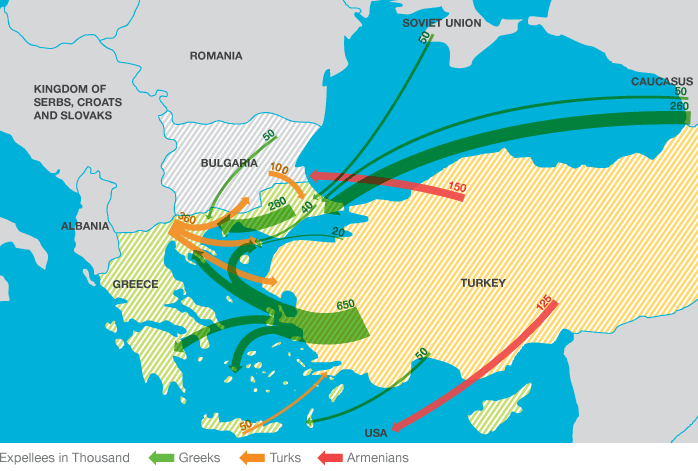 |
| Population exchanges, 1920s. |
The great success of Israel of taking in so many refugees and building a successful society, democracy and state has, ironically, obscured both the flight of Jews from Muslim countries and that so many Israeli Jews are of Middle Eastern, not European, origin. But is has also obscured that the Palestinians are the only case of people in a C20th population exchange who were not taken in and absorbed by their ethno-religious confreres. Any claim that it is Palestinian dispossession which drives Arab attitudes to Israel is disproved by the treatment of Palestinians by Arab countries. It is easier for a Palestinian to become a citizen of Western settler societies Canada, USA and Australia than of most Arab countries. (Kuwait, for example, expelled its Palestinian residents without any blowback.)
 |
| Europe in the late 1940s; mostly not voluntary moves (particularly the Germans). |
Whatever the merit of separating anti-Zionism from anti-Semitism in the West, it has always been a distinction without a difference in the Arab world--which was anti-Zionist because it was pervaded with Jew-hatred. While European anti-Semitic tropes have found ready acceptance in the Arab world--most obviously, The Protocols of the Elders of Zion (whose first Arab translation was by an Arab Christian in the 1920s)--this was a Jew-hatred founded in Muslim supremacism: anything which implied that Jews had equal moral and political standing with believers was a cosmic insult. Which the existence of Israel most emphatically did entail, but so did implying Jews had any right to live in Israel.
The exceptionalism goes all the way back to end of the Israeli War for Independence, as Einat Wilf reminds us:
In the negotiations following the war, the Arab negotiation teams not only refused to meet with representatives of the State of Israel, but took great pains to emphasise that the armistice lines separating the newly independent State from the Gaza Strip and the West Bank were not to be borders. Borders implied permanence. These were cease-fire lines only, because the war was not over. The message was clear: the Jewish people might have declared independence in the State of Israel, but sooner or later there would be another war that would erase that humiliating eyesore from the Arab region.
It is all about not accepting the existence of Israel as anything other than a temporary, and cosmically perverse, state of affairs. Cosmically perverse because the fundamental objection remains the same that it always has been--treating Jews as politically equal to Muslims and Arabs.
The main driver of Muslim, particularly Arab, attitudes in general, and Palestinian attitudes in particular to Israel and Jews, remains Muslim supremacism. It is not that absolutely every Muslim, Arab or Palestinian buys into all of it (or any of it); it is that Muslim supremacism retains the balance of presumption and opinion and continues to drive attitudes. But Muslim supremacism is central to most of the difficulties between Muslims and non-Muslims (and, for that matter, many of the problems between Muslims; though in such cases it is about what it entails, whether and how it should be adhered to, and who counts as a Muslim). In particular, Muslim supremacism is why the patterns of behaviour within Muslim communities tend to shift depending on their share of the population and their level of local population dominance.
The depressing reality
But looking at all this history is messy and awkward: it gets in the way of all sorts of neat, convenient narratives. It being a common contemporary progressive view that somewhere, somehow, history stopped and no one has inconvenient historical and cultural baggage--well, no non-Westerners. (The principle of Haan history most emphatically applies to the West: including, of course, Israel.)
Taking the broader perspective does lead us to a depressing place. But there is a reason we are not far from the centenary of the Jewish-Arab violence in Israel-Palestine. And the reason is not Zionism and the Jews, the reason is that the Palestinians have not remotely escaped from over 13 centuries of Islamic doctrine and cultural practice. Unless some mechanism is found to sort those who have from those who haven't, and and increase and keep the former and shrink and expel the latter (since even a hostile minority is enough to keep violence going), the no-peace just provisional arrangements situation will continue, indefinitely.
ADDENDA: Here is a New York Post piece on how much foreign aid to Palestine is spent on supporting violence against Israel. And a Strategy Page piece on the dysfunctional (and homicidal) political competition between Fatah and Hamas. Here is a scholarly piece which includes a discussion of (pdf) the role Muslim hostility to equality with non-Muslims contributed to mayhem and murder in the declining Ottoman Empire.