In his book War, Peace, War: The Life Cycle of Imperial Nations, historical demographer Peter Turchin argues that the mass slavery of the Roman Empire--which was at is most intense in Sicily and Southern Italy--is still depressing the social capital of the area centuries later; that the socially disintegrative effects of mass slavery can persist long after the institution has been abolished. When I read it, I thought it was a big claim. In looking into American homicide and the history of American racism, I have come to have rather more sympathy for the claim.
 It is not merely that the anti-black racism of the Americas and the Arab world originates in slavery and slavery across a colour line creates racism, and of a particularly invidious sort. (Racism does not cause slavery, as slavery long predates anything we might call racism.) It is that the legacy of slavery continues to poison societies and human interactions.
 Also highly suggestive is the success of Afro-Caribbean migrants and recent African migrants, and their children, in the US and the UK, as noted in this piece. I find the evidence on that much more interesting than the argument over IQ tests and the hereditary influence on intelligence (also, the piece does not understand regression to the mean).
On the other hand, the focus on ethnic groups is much more sensible than tired and pointless general racial comparisons--and the long-established African-American population in the US is clearly a specific ethnic group with a specific history and selection processes, an example of ethnogenesis. (They have a much longer grounding as a specific ethnic group than do, for example, Palestinians as a nation; which Palestinians clearly are now but weren't in, say, 1919.)
The success of Afro-Caribbean migrants and recent African migrants, and their children, in the US and the UK also gets in the way of racism as a blanket explanation for problematic social outcomes for the long-established African-American population: or even of reading too much into the observable phenomenon of unconscious discrimination and familiarity preference.
Note that racism is a classic analytical "silly putty", as it can be shaped to fit just about any pattern of observed differences by race or ethnicity. Something that its cachet in signalling Virtue exacerbates, though its precisely its apparent analytical ubiquity which makes it so useful in doing so: a utility which may well extend into published academic studies.
Yet the slavery-source countries have a population-weighted average homicide rate of 17.9, as the Democratic Republic of Congo (77.4m) and Nigeria (174.6m) are the demographic giants, accounting for two-thirds of the total population of the 11 countries and with the two highest homicide rates. So, on that basis, the African-American homicide rate looks rather more like that of their original source populations.
Even if we cast our comparison wider to the homicide rates of the 18 jurisdictions with a majority African slave origins, many of which have very small populations (Anguilla 7.5 per 100,000, Antigua & Barbuda 11.2, Bahamas 29.8, Barbados 7.4, British Virgin Islands 8.4, Bermuda 7.7, Dominica 21.1, Grenada 13.3, Guadeloupe 7.9, Haiti 10.2, Jamaica 39.3, Martinique 2.7, Montserrat 20.4, Saint Kitts & Nevis 33.6, Saint Lucia 21.6, Saint Vincent 25.6, Turks & Caicos 6.6, US Virgin Islands 52.6), 8 such jurisdictions have higher homicide rates than African-Americans. Nevertheless, the weighted average homicide rate of said jurisdictions is 16.5 (driven by Haiti--66% of the population--and Jamaica--19%), much the same as the African-American homicide rate and also rather like that of the source populations.
So, if not evidence for a slavery effect and its persistence, it does appear to be evidence for the importance of the source population in homicide rates. I would be sceptical, however, of any strong claim of genetic effects, as slavery was a very specific selection process, so it is very unlikely--even presuming a strong hereditary element in intelligence and other traits--that we could just infer across from source to slave populations. Conversely, even with the socially pulverising effect of slavery, culture would be significantly transferred. Social capital much less so, and would have to be rebuilt from a very low base after the abolition of slavery (1804 in independent Haiti, 1833-8 in British colonies, 1848 in French colonies, 1863 in Dutch colonies, 1865 in the US, 1869 Portuguese colonies, 1873 in Spanish Puerto Rico, 1886 in Spanish Cuba).
What it is clear evidence for, however, is that the elevated African-American homicide rates have little or nothing do with racism. Not only are they in line with jurisdictions with majority African or African-descent populations, they are compatible with jurisdictions which have had full black participation in political life for well over a century. Even in the US, they also occur in cities which have high levels of African-American participation in politics and policing.
On the other hand, the wide variety of homicide rates between jurisdictions and shifts over time suggest that there is nothing inevitable about the homicide rates experienced (another mark against genetic explanations). Merely that factors specific to the social dynamics of African-American communities are going to have to be identified and tackled if their homicide rates are going to be reduced.
Residential segregation
The wildly variant homicide rates between African-Americans and other Americans are sufficient, on their own, to explain residential segregation by race--indeed, enough to do so even if racism, unconscious discrimination or familiarity preference played no roles at all. Consider: you are a family living in a previously non-black neighbourhood. Black families start moving in, with this much higher average level of violence. Do you and your children continue to live in the neighbourhood, or do you leave? The question answers itself.

In the US, preferences on house size and proximity can lead to significant residential segregation by political outlook (the urban liberal/rural conservative effect). How much more powerfully will highly differentiated homicide rates lead to residential segregation? Zoning laws in the US partly had their origins as mechanisms of racial separation (pdf): while racism had a considerable amount to do with that history, current patterns sadly look more like rational parental concern.
Which goes how complex and tangled these issues are in the US.
Entrenched patterns of disadvantage
This does not mean I am buying into some "culture of poverty" explanation. That is just another form of analytical "silly putty". Not only do what characteristics one means have to be carefully delineated, the label provides a putative answer before asking the question. Especially as African-Americans are not predominantly poor even by US standards and are certainly not so by world standards.
African-Americans do have average incomes significantly lower than white Americans, yet higher than Hispanic Americans. According to US census data (pdf), African-Americans had a per capita income 68% of the overall US per capita income (for non-Hispanic whites 116%, Asian-Americans 112%, Hispanics 58%). Applying that percentage to World Bank data, that gives African-Americans about the same per capita income as Japan--or around 26th of the 185 jurisdictions covered by the World Bank data--and more than that of Italy, Spain, South Korea and Israel.

Nevertheless, there are clearly entrenched patterns of disadvantage: African-Americans are much more likely to live in communities with high levels of poverty and find it much harder than white Americans to escape from such communities. Much of African-American disadvantage is a African-American male disadvantage. The elevated homicide rates are overwhelmingly elevated male homicide rates. An unusual feature of African-American IQ results is that women do better than men. African-Americans males have a persistently low (if rising somewhat) college graduation rate of 35% in 2005: up from 28% in the early 1990s. African-American women have a college graduation rate of 46% in 2005: up from 34% in the early 1990s.
The African-American disadvantage in graduation rates continues. Which then feeds back into lower income opportunities and average incomes. Even though historically black colleges actually do a better job of getting students through than their intake demographics would suggest. Again, these issues are complex and tangled.
Particularly when one looks at school graduation rates, which are generally rising but with the gap between blacks and white males widening as that between white and Hispanics males is narrowing (remembering that Hispanics have significantly lower average incomes than African-Americans):
Where to look
Cultural factors and low social capital are much more plausible contenders. Especially as the higher levels of violence, particularly amongst male teenagers, disrupts social capital formation and education participation (the much higher homicide rate among black teenagers can also be expected to translate into a tendency for more disruptive behaviour in class) while also being a product of the same: once again, complex and tangled issues. There is, to put it mildly, not the same culture of courtesy and educational attainment one sees among East Asians or South Asians, for example. The disruptive effects of entrenched violence is likely to matter quite directly, as cooperation and networking are crucial to social capital and its formation (pdf).

Lower levels of school graduation mean lower levels of college entry and job opportunities. Lower levels of college entry and lower levels of college graduation have compounding effects in reducing African-American entry into professional and other high income jobs. Which means fewer examples of same, and so it goes around.
It also means that persistent negative stereotypes of African-Americans, while suffering the generic problem of stereotypes (people are not categories), are not entirely without foundation--which, of course, makes them harder to shift.
Jonathan Chait and Ta-Nehisi Coates had a revealing exchange over African-American history and disadvantage. In his responses Coates made some telling and powerful points but, once again, without some fairly precise delineation, his pointing to white supremacy is every bit analytical "silly putty" as culture of poverty. His essay The Case for Reparations tells of the grim history of American racism. Yet it is, in the end, looking for external redemption.
Slavery's poisonous legacy

I have no patience for the claim that the US Civil War was not about slavery--a simple reading of the Confederate Constitution disabuses one of that canard. (Particularly a clause-by-clause comparison.) What is slightly more odd is conservative resistance to the notion that slavery might have enduring effects. Surely much of the central point of conservatism is that cultural effects can be resilient and unexpected, hence being cautious about major social changes.
About culture
While I have long been sceptical about cultural explanations ("the last refuge of the analytically bereft"), especially as they can be used as the analytical equivalent of "silly putty"--put in any shape wanted and shoved in to fit any required analytical use--I have become more sympathetic to use of cultural explanations, if done carefully. In particular, when one looks at cultural friction effects--difficulties in communications and lack of shared expectations and preferences (see my post on problems with South Asian call centres)--and if one takes a careful and precise approach--as was done by Kenneth Pollack and his Ph.D dissertation (The influence of Arab culture on Arab military effectiveness) turned book (Arabs at War: Military Effectiveness, 1948-1991) culture can be a useful explanatory tool. (Though see here for a more critical take on Pollack's analysis.)
There also seems to be a difference between those aspects of culture which respond (often surprisingly quickly) to changes in incentives and those which are more resistant to change. A point emphasised by economist Deepak Lal. First, he tries to get some precision into the concept of culture (pdf):
... culture remains a murky concept. I have found particularly useful a definition adopted by ecologists (Colinvaux 1983). They emphasize that, unlike other animals, the human one is unique because its intelligence gives it the ability to change its environment by learning. It does not have to mutate into a new species to adapt to the changed environment. It learns new ways of surviving in the new environment and then fixes those ways by social customs. These form the culture of the relevant group and are transmitted to new members (mainly children) who then do not have to invent the “new” ways de novo for themselves.
Noting that:
This conception of culture fits in well with the economists’ notion of equilibrium. Frank Hahn (1973) describes an equilibrium state as one in which self-seeking agents learn nothing new, so that their behavior is routinized. It represents an adaptation by agents to the economic environment in which the economy “generates messages which do not cause agents to change the theories which they hold or the policies which they pursue”. Such routinized behavior closely resembles the ecologists’ notion of social custom, which creates a particular human niche.Lal goes on to distinguish two levels of culture:
It is useful to distinguish two major sorts of beliefs about the environment: the material and the cosmological beliefs of a particular culture. The former relate to ways of making a living and encompass beliefs about the material world, particularly about the economy. The latter are related to understanding mankind’s place in the world; they determine how people view the purpose and meaning of their lives and their relationship to others. There is considerable cross-cultural evidence that material beliefs are more malleable than cosmological ones. Material beliefs can change rapidly with changes in the material environment. There is greater hysteresis of cosmological beliefs, that is, of ideas about how, in Plato’s words, “one should live.” Moreover, the cross-cultural evidence shows that these worldviews correlate more closely with language groups (and thus with cultural origins) than with environments (Hallpike 1986).
A striking manifestation of culture mattering is a study comparing (pdf) US children of African descent raised by white mothers with those raised by black mothers. There is no reason to assume that African-Americans have the same cultural and social capital as wider American society, and much reason to think not. Having a white mother is likely to change both the (cultural) presumptions brought to child-raising and the networks one has access to (a large part of social capital) compared to being raised by a black mother. The study finds that being raised by a white mother massively reduces black-white differences in education and employment. That the study only compares African-Americans raised by white mothers with those raised by black mothers limits what one can infer from it. But it is highly suggestive.

On the other hand, the focus on ethnic groups is much more sensible than tired and pointless general racial comparisons--and the long-established African-American population in the US is clearly a specific ethnic group with a specific history and selection processes, an example of ethnogenesis. (They have a much longer grounding as a specific ethnic group than do, for example, Palestinians as a nation; which Palestinians clearly are now but weren't in, say, 1919.)
The success of Afro-Caribbean migrants and recent African migrants, and their children, in the US and the UK also gets in the way of racism as a blanket explanation for problematic social outcomes for the long-established African-American population: or even of reading too much into the observable phenomenon of unconscious discrimination and familiarity preference.
Note that racism is a classic analytical "silly putty", as it can be shaped to fit just about any pattern of observed differences by race or ethnicity. Something that its cachet in signalling Virtue exacerbates, though its precisely its apparent analytical ubiquity which makes it so useful in doing so: a utility which may well extend into published academic studies.
West African coast versus New World post-slavery homicide rates
Looking at comparative statistics on homicide rates, I had a strong suspicion that the legacy of slavery had a lot to do with the elevated African-American homicide rates. Looking more closely at the data, that does not seem to be the case.
If we look at homicide rates of the 11 countries from which over 80% of African slaves in the US came directly from (Angola 10.0 per 100,000, Cameroon 7.6, Congo 12.5, Gambia 10.2, Ghana 6.1, Ivory Coast 13.6, Liberia 3.2, Namibia 17.2, Nigeria 20.0, Democratic Republic of Congo 28.3), then African-Americans (15.2 per 100,000) have a higher homicide rate than all but three of those countries.
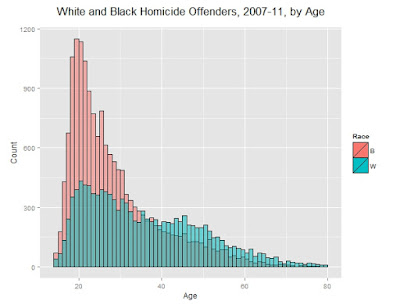
The paper comparing African-American children of black and white mothers suggests one mechanism for having a white mother making such a difference in speech patterns. Using distinctive African-American speech (aka "ghetto talk" or, more positively, ebonics) reduces employment opportunities because it signals difference from employers, their likely staff, clients and customers. It also invokes unhelpful associations. The most notorious of which is the much higher homicide rates for African-Americans--around 6 times higher than for other Americans: the differentiation between black and non-black teenagers being higher still (around 20 times higher).
Looking at comparative statistics on homicide rates, I had a strong suspicion that the legacy of slavery had a lot to do with the elevated African-American homicide rates. Looking more closely at the data, that does not seem to be the case.

If we look at homicide rates of the 11 countries from which over 80% of African slaves in the US came directly from (Angola 10.0 per 100,000, Cameroon 7.6, Congo 12.5, Gambia 10.2, Ghana 6.1, Ivory Coast 13.6, Liberia 3.2, Namibia 17.2, Nigeria 20.0, Democratic Republic of Congo 28.3), then African-Americans (15.2 per 100,000) have a higher homicide rate than all but three of those countries.
Yet the slavery-source countries have a population-weighted average homicide rate of 17.9, as the Democratic Republic of Congo (77.4m) and Nigeria (174.6m) are the demographic giants, accounting for two-thirds of the total population of the 11 countries and with the two highest homicide rates. So, on that basis, the African-American homicide rate looks rather more like that of their original source populations.
Even if we cast our comparison wider to the homicide rates of the 18 jurisdictions with a majority African slave origins, many of which have very small populations (Anguilla 7.5 per 100,000, Antigua & Barbuda 11.2, Bahamas 29.8, Barbados 7.4, British Virgin Islands 8.4, Bermuda 7.7, Dominica 21.1, Grenada 13.3, Guadeloupe 7.9, Haiti 10.2, Jamaica 39.3, Martinique 2.7, Montserrat 20.4, Saint Kitts & Nevis 33.6, Saint Lucia 21.6, Saint Vincent 25.6, Turks & Caicos 6.6, US Virgin Islands 52.6), 8 such jurisdictions have higher homicide rates than African-Americans. Nevertheless, the weighted average homicide rate of said jurisdictions is 16.5 (driven by Haiti--66% of the population--and Jamaica--19%), much the same as the African-American homicide rate and also rather like that of the source populations.
So, if not evidence for a slavery effect and its persistence, it does appear to be evidence for the importance of the source population in homicide rates. I would be sceptical, however, of any strong claim of genetic effects, as slavery was a very specific selection process, so it is very unlikely--even presuming a strong hereditary element in intelligence and other traits--that we could just infer across from source to slave populations. Conversely, even with the socially pulverising effect of slavery, culture would be significantly transferred. Social capital much less so, and would have to be rebuilt from a very low base after the abolition of slavery (1804 in independent Haiti, 1833-8 in British colonies, 1848 in French colonies, 1863 in Dutch colonies, 1865 in the US, 1869 Portuguese colonies, 1873 in Spanish Puerto Rico, 1886 in Spanish Cuba).
What it is clear evidence for, however, is that the elevated African-American homicide rates have little or nothing do with racism. Not only are they in line with jurisdictions with majority African or African-descent populations, they are compatible with jurisdictions which have had full black participation in political life for well over a century. Even in the US, they also occur in cities which have high levels of African-American participation in politics and policing.
On the other hand, the wide variety of homicide rates between jurisdictions and shifts over time suggest that there is nothing inevitable about the homicide rates experienced (another mark against genetic explanations). Merely that factors specific to the social dynamics of African-American communities are going to have to be identified and tackled if their homicide rates are going to be reduced.
Residential segregation
The wildly variant homicide rates between African-Americans and other Americans are sufficient, on their own, to explain residential segregation by race--indeed, enough to do so even if racism, unconscious discrimination or familiarity preference played no roles at all. Consider: you are a family living in a previously non-black neighbourhood. Black families start moving in, with this much higher average level of violence. Do you and your children continue to live in the neighbourhood, or do you leave? The question answers itself.

In the US, preferences on house size and proximity can lead to significant residential segregation by political outlook (the urban liberal/rural conservative effect). How much more powerfully will highly differentiated homicide rates lead to residential segregation? Zoning laws in the US partly had their origins as mechanisms of racial separation (pdf): while racism had a considerable amount to do with that history, current patterns sadly look more like rational parental concern.
Which goes how complex and tangled these issues are in the US.
Entrenched patterns of disadvantage
This does not mean I am buying into some "culture of poverty" explanation. That is just another form of analytical "silly putty". Not only do what characteristics one means have to be carefully delineated, the label provides a putative answer before asking the question. Especially as African-Americans are not predominantly poor even by US standards and are certainly not so by world standards.
African-Americans do have average incomes significantly lower than white Americans, yet higher than Hispanic Americans. According to US census data (pdf), African-Americans had a per capita income 68% of the overall US per capita income (for non-Hispanic whites 116%, Asian-Americans 112%, Hispanics 58%). Applying that percentage to World Bank data, that gives African-Americans about the same per capita income as Japan--or around 26th of the 185 jurisdictions covered by the World Bank data--and more than that of Italy, Spain, South Korea and Israel.

Nevertheless, there are clearly entrenched patterns of disadvantage: African-Americans are much more likely to live in communities with high levels of poverty and find it much harder than white Americans to escape from such communities. Much of African-American disadvantage is a African-American male disadvantage. The elevated homicide rates are overwhelmingly elevated male homicide rates. An unusual feature of African-American IQ results is that women do better than men. African-Americans males have a persistently low (if rising somewhat) college graduation rate of 35% in 2005: up from 28% in the early 1990s. African-American women have a college graduation rate of 46% in 2005: up from 34% in the early 1990s.
The African-American disadvantage in graduation rates continues. Which then feeds back into lower income opportunities and average incomes. Even though historically black colleges actually do a better job of getting students through than their intake demographics would suggest. Again, these issues are complex and tangled.
Particularly when one looks at school graduation rates, which are generally rising but with the gap between blacks and white males widening as that between white and Hispanics males is narrowing (remembering that Hispanics have significantly lower average incomes than African-Americans):
Since the last report in 2012, the gap between the four-year graduation rate for black males and white males widened from 19 points in the 2009-10 school year to 21 points in the 2012-13 year. For Latinos, the gap shrunk to 15 points from 20 during that same period, according to the report.Detroit: the social disaster that just keeps rolling along. Given that the city is 83% African-American, it is again hard to blame racism for that disastrous school graduation rate.
The national graduation rate for black males was 59 percent, 65 percent for Latinos, and 80 percent for white males for the 2012-13 school year, according to the report. Particularly striking was Detroit where only 20 percent of black males graduated on time in the 2011-12.
Where to look
Cultural factors and low social capital are much more plausible contenders. Especially as the higher levels of violence, particularly amongst male teenagers, disrupts social capital formation and education participation (the much higher homicide rate among black teenagers can also be expected to translate into a tendency for more disruptive behaviour in class) while also being a product of the same: once again, complex and tangled issues. There is, to put it mildly, not the same culture of courtesy and educational attainment one sees among East Asians or South Asians, for example. The disruptive effects of entrenched violence is likely to matter quite directly, as cooperation and networking are crucial to social capital and its formation (pdf).

Lower levels of school graduation mean lower levels of college entry and job opportunities. Lower levels of college entry and lower levels of college graduation have compounding effects in reducing African-American entry into professional and other high income jobs. Which means fewer examples of same, and so it goes around.
It also means that persistent negative stereotypes of African-Americans, while suffering the generic problem of stereotypes (people are not categories), are not entirely without foundation--which, of course, makes them harder to shift.
Jonathan Chait and Ta-Nehisi Coates had a revealing exchange over African-American history and disadvantage. In his responses Coates made some telling and powerful points but, once again, without some fairly precise delineation, his pointing to white supremacy is every bit analytical "silly putty" as culture of poverty. His essay The Case for Reparations tells of the grim history of American racism. Yet it is, in the end, looking for external redemption.
Slavery's poisonous legacy
The American South has lower levels (pdf) of social capital than the rest of the US. That is surely the legacy of slavery. Mass slavery is much longer ago in Italy, but social capital is also much lower in southern Italy. This is likely both an origins and a subsequent developments story, but part of that story is surely that previous structures affect future paths.
Then there is slavery and income inequality: the US has high income inequality by developed world standards, low inequality by the standards of former slave societies. There is evidence of persistent effects of slavery on unequal human capital formation. In a summary of another study:
Depending on where you are in the Americas, race or skin tone or some combination of both matters for income inequality (pdf). The authors note this shows the multidimensionality of race identities; but it also raises what is being signalled or is associated with what: remembering the effect of having a white mother.
Post-revolutionary Haitian society was promptly taken over by its mulatto and freedman elite, particularly after the massacre of the remaining white population (something which then fed into Southern fears in the lead up to the US Civil War). It is clear enough, however, that slavery has a persistent legacy and it is a socially divisive one.

The legacy of slavery also continues to retard (pdf) economic development decades later: and not just through initial unequal distributions of factors of production but through continuing effects--such as discouraging social capital formation and human capital acquisition.
For slavery's poisonous legacy in the US is also a bad faith story. American patriotism is based on heroic narratives, and slavery gets in the way of those narratives. As does Jim Crow and the history of American racism generally.
Amerindians and African-Americans were, along with American Tories, the big losers from American independence. The triumph of the North in the Civil War and the passing of the Thirteenth Amendment, the civil rights struggles, leading to the Acts of almost a century later, can somewhat repair the narrative, but they are easily countered, given that the Reconstruction Amendments did not deliver what they implied and African-Americans remain mired in patterns of disadvantage and outright repression.
American society does not bind across its history, it divides, and divides racially. That baggage still affects interactions between black and white Americans; an Australian going to the US can find that saying "g'day" a lot can elicit changes in responses from black Americans as they shed that legacy of expectations.
The combination of residential segregation, divided experiences, seriously different and differentiating expectations all combine to make social capital further racially differentiated. Another legacy of slavery and its effects down the decades.
Then there is slavery and income inequality: the US has high income inequality by developed world standards, low inequality by the standards of former slave societies. There is evidence of persistent effects of slavery on unequal human capital formation. In a summary of another study:
In other words, the share of slaves in the population in 1860 is also correlated with current racial inequality in school attainment. Since the quantity of human capital is the main determinant of earnings, it follows that the schooling gap has immediate repercussions on income inequality across races.Having a white mother means having a mother who is not part of that legacy.
Depending on where you are in the Americas, race or skin tone or some combination of both matters for income inequality (pdf). The authors note this shows the multidimensionality of race identities; but it also raises what is being signalled or is associated with what: remembering the effect of having a white mother.
Post-revolutionary Haitian society was promptly taken over by its mulatto and freedman elite, particularly after the massacre of the remaining white population (something which then fed into Southern fears in the lead up to the US Civil War). It is clear enough, however, that slavery has a persistent legacy and it is a socially divisive one.

The legacy of slavery also continues to retard (pdf) economic development decades later: and not just through initial unequal distributions of factors of production but through continuing effects--such as discouraging social capital formation and human capital acquisition.
For slavery's poisonous legacy in the US is also a bad faith story. American patriotism is based on heroic narratives, and slavery gets in the way of those narratives. As does Jim Crow and the history of American racism generally.
Amerindians and African-Americans were, along with American Tories, the big losers from American independence. The triumph of the North in the Civil War and the passing of the Thirteenth Amendment, the civil rights struggles, leading to the Acts of almost a century later, can somewhat repair the narrative, but they are easily countered, given that the Reconstruction Amendments did not deliver what they implied and African-Americans remain mired in patterns of disadvantage and outright repression.
American society does not bind across its history, it divides, and divides racially. That baggage still affects interactions between black and white Americans; an Australian going to the US can find that saying "g'day" a lot can elicit changes in responses from black Americans as they shed that legacy of expectations.
The combination of residential segregation, divided experiences, seriously different and differentiating expectations all combine to make social capital further racially differentiated. Another legacy of slavery and its effects down the decades.
It is easy to notice signs of a racially divided society and say "that's racism!". Yet it is hard to see what change in white behaviour will change a 20% black male school graduation rate in a city that is 83% black. It is hard to see what change in white behaviour will change African-Americans having a homicide rate 6 times that of other Americans, or the 20-fold difference in homicide rates between black teenager and white teenagers.
Even more so if having a white mother turns out to eliminate much of the education and employment disadvantage--people who deal with you don't see your mother. Even more so if having two black parents but being a recent Caribbean or African immigrant does the same.
Yes, it is very easy to take any pattern of racial difference--particularly of racial disadvantage--and way "that's racism!" Racism is analytical "silly putty"; you can shove it in to explain any such difference. Alas, it is not that simple, however comforting it might be to think it is. And perhaps a little condescending--because it also turns whites into the obligated redeemers of blacks. Informed understanding and equity in behaviour and policy--which definitely should be sought--not being quite the same thing.
[Cross-posted at Skepticlawyer.]