Showing posts with label technology. Show all posts

Tuesday, January 26, 2021

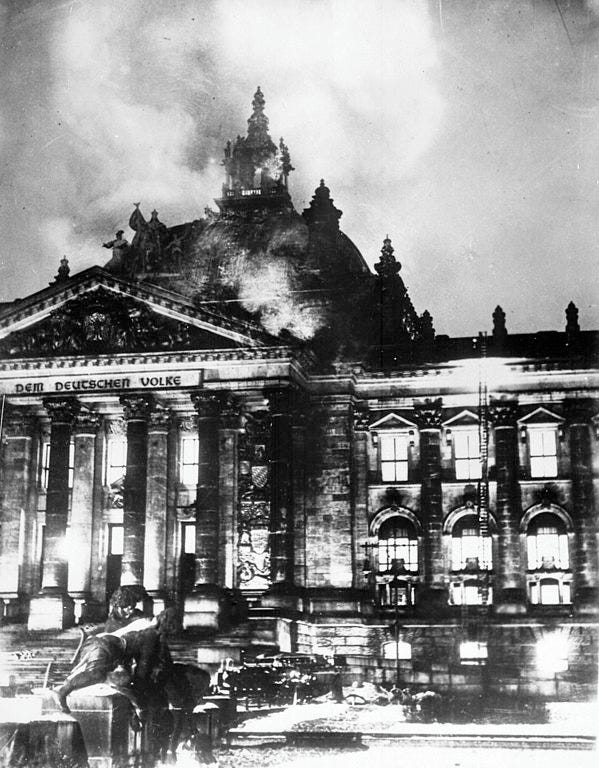
The Capitol riot: the Reichstag Fire of our time?

A shocking attack on a legislative building can be very useful.

On the 27th of February 1933, the Reichstag, the building where the legislature of the Weimar Republic met, caught fire. At no stage was the government of the Republic in danger. There was no loss of life.

Yet it was a shocking thing, especially as it was immediately presented as an act of arson (which it was; though by a lone arsonist, conveniently both foreign — Dutch — and communist). Such a shocking symbolic affront to the political order was too politically useful. So the new Chancellor of the Republic, who had taken office less than a month earlier, the leader of a coalition government and head of the largest political Party in the Reichstag, used the sense of shock and outrage to have President Hindenburg sign the Reichstag Fire decrees that enabled the new government to ram through a raft of repressive measures through the Reichstag, particularly the infamous Enabling Act. These were deployed to end Germany’s democratic experiment and turn it into a one-Party state.

The Reichkanzler in question was, of course, Adolf Hitler and his Party was the National Socialist German Worker’s Party (NSDAP). These actions did not take place in a political vacuum. Weimar politics had been wracked by intense political polarisation, street violence by paramilitary groups and much catastrophising rhetoric.

Germany’s economy had suffered greatly from the ravages of the Great Depression, with apparently entrenched mass unemployment. 10 years previously, the Great Inflation had wiped out the savings of the middle class.

As this thoughtful and disturbing essay points out, there are more than a few parallels with contemporary United States.

So, let us consider the Capitol riot. A shocking and disturbing attack on the building where Congress, the US legislature, meets that at no stage seriously threatened the government. One rioter was shot by police, a policeman was beaten to death with a fire hydrant, the other deaths seem to have been mostly misadventure. The deaths add to the sense of shock and outrage. Even though much of what happened seems to have been copied from the months of “black block” rioting that progressives have cheered, valorised or facilitated.

Just as some accused the Nazis of starting the fire themselves, so some have claimed Antifa activists were involved in the Capitol riot. The attitude to media rather contradicts that. While “black bloc” rioters tend to be fine with corporate media, as they tend to amenable to the narrative the “black bloc” wishes to present, but hostile to independents recording their activities, the Capitol rioters were precisely the opposite, attacking corporate media’s equipment but being much friendlier to individuals recording what was going on.

I refuse to call what happened at the Capitol an ‘insurrection’. Insurrections are not usually unarmed and they attempt to set up enduring control of territory. This was a riot happening in a place of great symbolic significance.

But, like the Reichstag Fire, the Capitol riot is being used to justify a raft of repressive measures. Shocking action from one side of politics being used to justify repressive action by the other side of politics.

If one wants to understand how Hitler was able to use a building being set alight to justify and mobilise support for his repressive measures, then the progressive cheering of the post-riot waves of censorship gives us excellent illustrative insight.

Of course, as we live in a time when Big Tech has attempted to swallow the public square, it is tech billionaires who are using the Capitol riot as their very own Reichstag Fire. To much “progressive” cheering. That the tech billionaires are clearly attempting to complete their swallowing of the public square for their own profit is apparently immaterial as long as they pander to progressive desires to control and censor.

(The natural endpoint of progressive worship of the splendour of what’s in their heads being the notion that everything will great if power is entirely in the hands of folk of such cognitive splendour. The more that is so, the more illegitimate disagreement will be held to be.)

History does not repeat. But we can watch it rhyme very, very strongly.

Friday, January 15, 2021

Policing the narrative

And devaluing your citizenship

Controlling public markers of legitimacy can be a powerful source of social leverage. It is one that naturally rests on devaluing citizenship.

A crucial driver of this process in contemporary society comes from the shifts in social power in modern developed democracies as the so-called ‘professional and managerial class’ reaches a sufficient critical mass to aspire to social dominance.

I do not much like the term managerial and professional class. The term is too specifically modern and so gets in the way of connecting current dynamics to past social patterns.

History does not repeat, but it can rhyme pretty strongly.

I much prefer the term human-and-cultural-capital class. First, because it identifies the group as being possessors of (human) capital, so having distinct differences in interests than does labour. This is particularly strongly so with respect to migration, but that is hardly the only point at which their interests diverge.

Secondly, it connects the contemporary social grouping with past manifestations — notably, every priestly class that has ever existed.

Thirdly, because the phrase more directly identifies their main point of social leverage — controlling, or seeking to control, the public markers of legitimacy.

About elite media

This is particularly obvious with respect to elite (“quality”) media. Once upon a time, journalism was a path for working-class folk to make good. Journalists were overwhelmingly not elite folk, and reported on elite doings in a somewhat interrogative fashion to a mass audience.

Nowadays, the elite media is elite in all senses of the word. It is dominated by graduates of elite universities who very much see themselves as members of the cultural elite and as either talking to other such folk or explaining to the masses what they should think.

While journalism has always tended to be narrative-driven — we humans love stories and having a set of narratives simplifies the presentation of facts and events — contemporary media has become narrative-driven to an increasingly intense degree.

For instance, narratives about the happenings at the US Capitol were being spun by the elite media before anyone who was actually there could have reported back in any serious or informed way.

A media that sees itself as part of the elite, and as controlling or setting the public markers of legitimacy, is a very different beast than a media which sees itself as interrogating elite actions on behalf of the public.

The attacks on Parler, on Gab, on any social media platform which does not go along with the preferred narrative, is this elite-control-of-legitimacy dynamic playing out in front of us.

As Google, Facebook and Twitter (and other platforms such as Discord) have shown themselves to be completely on-board with policing legitimacy, any rivals that fail to “get with the program” have to de-legitimised and closed down.

There is a standard pattern to this de-legitimisation, which is to tie any such platform to anathematised views. So they automatically become “far right” and are persistently labelled as such. Then they are tied to any anathematised events.

Having established that they do not adhere to the required markers of legitimacy, attempts to close them down are therefore also legitimised. (A nice short example of consistent hostility towards the failure to converge is here.)

Networked social credit

Given that so many people have become committed to being seen as members of the morally meritorious, either through genuine belief or through fear of being mobbed and abused as part of the process of anathematising dissent (or a mixture of both), this de-legitimisation strategy generates both active support and passive acquiescence.

Without such willing foot soldiers of conformity and convergence, the strategy would have little hope of succeeding.

In China, the social credit system is being created from the top down, as one would expect in a state run by a Leninist Party. In the West, we can see the equivalent being built in a far more networked fashion. (The Nazis, who pioneered totalitarian control in a market economy, called the process Gleichshaltung, or coordination.)

The meme that popped up after the disappearance from public view of China tech billionaire Jack Ma and Twitter’s ban of Donald Trump touches on this (In China, the President disappears tech billionaires. In the US, tech billionaires disappear the President.)

The Capitol riot and the Twitter ban of Trump provided a field day for Chinese media to denounce US hypocrisy.

Both China’s top-down social credit system and the networked version being constructed in the West are built on the systematic reduction of citizenship to having little status beyond determining which elite gets to control your online life in the name of which legitimating ideology.

(Cross-posted from Medium.)

Thursday, August 13, 2020

Cooperative stability and the evolution of norms

Groups have been a somewhat vexed issue in evolutionary theory, with group selection, and now multi-level selection, (after the general rejection of group selection) being a hotly debated topic.

Foraging hunting bands are (and presumably were) somewhat fluid entities, although typically embedded in larger social groupings. Hunting bands split, they come together, people move between them.

While low-level normative behaviour has been observed in other species, Homo sapiens engage in levels of normative behaviour way in excess of any other species.

Such normative behaviour clearly originally evolved during our very long foraging history. Clear evidence of long distance exchange (over distances of up to 166km) has been found about the time Homo sapiens has clearly emerged as a species. Strongly suggestive evidence of exchange (over distances around 60km) may predate our emergence as a species. And exchange is a normative behaviour. The key element in exchange in being not “mine!” but “yours!”. Any chest-thumping ape can do “mine!”, it takes a normative species to systematically accept “yours!”.

Our long-term history can be understood as the spiralling up of cooperative, and thus normative, behaviour.

So, this distinctively human level of normative behaviour had to originally develop in a situation where it is likely there was some fluidity in groups. Indeed, normative behaviour can actually increase local group fluidity. First, to have norms that are more than just descriptive (I do it because everyone else does), requires sanctioning behaviour. And sanctioning behaviour can be a cause of group fluidity.

Second, norms economise on information and cognitive effort, facilitating cooperation. Thus having a common normative framework permits easier movement between local groups.

So, it is not clear that group stability was the basis or benefit of the spiralling-up emergence of normative behaviour.

Cooperative stability, is, however, another matter. Philosopher Cristina Bicchieri has developed a well-structured analytical framework for understanding norms and their dynamics. The framework is set out formally in her The Grammar of Society. It is set out more accessibly in her Norms in the Wild, which builds on the experience of herself and others in seeking to change social norms.

Social norms are built on social expectations — empirical expectations (what you expect others to do) and normative expectations (what you expect others to believe you should do). They operate on the basis of schemas (sets of belief) and scripts (patterns of action). They usually involve some system of sanctions.

Stable expectations and scripts make other people’s actions much more predictable, so make cooperation much easier to attain and sustain. Norms therefore generate (or at least anchor) cooperative stability. And cooperative stability can, depending on circumstance, promote group stability. But cooperative stability is what would have been originally selected for, even in situations of relative local group fluidity and even if such cooperative stability increased local group fluidity.

Thus, norms economise hugely on the cognitive and information effort required for cooperation. They are, in a sense, entrenched social bargains. (Or, at least, patterns that greatly reduce or structure the ambit of bargaining required for social cooperation.)

But what about moral norms? Moral norms are more absolute that social norms. As Prof. Bicchieri says, they have an element of unconditionality that social norms do not.

As we developed more sedentary living patterns, and then farming and pastoralism (a period during which our adaptive evolution seems to have sped up, presumably due to the dramatic changes in selective pressures), group stability would have acquired more survival and subsistence value. The absolute or unconditional nature of moral norms could have been selected for, as they promoted group stability. But were selected for by building on the existing capacity for social norms. Which themselves probably developed out of descriptive norms (a norm people prefer to conform to on the expectation that others do).

Thus, the claim is that normative behaviour in general developed out of its ability to foster cooperative stability. The argument by David C. Lahtia and Bret S. Weinstein that moral norms developed as group stability gained a higher survival and subsistence premium would be congruent with this, but as something that occurred relatively late in our evolutionary history. With what was being selected for being the ability to thrive in larger and more stable groups, even if those groups were not themselves stable enough as populations to provide specific evolutionary pressures.

A test for this hypothesis would be to check the relative importance of social norms and moral norms in different human populations. The more forager-based and fluid the social groups, the more dominant social norms can be expected to be. The more sedentary, stable and larger the social groups, the more significant moral norms can be expected to be.

With religions and faith systems, as structures of the sacred, reflecting this pattern in their development through time and across societies.

Prestige and dominance

There is also a likely connection to prestige and dominance. Prestige, bottom-up status, is a key social currency of human cooperation. Foraging societies generally display very strong anti-dominance patterns of behaviour, as dominance behaviour (top-down status) undermines local group cooperation. So, suppressing dominance behaviour would actually increase the capacity for, and the stability of, cooperative behaviour.

As more sedentary patterns of living, then farming and pastoralism, arose, dominance behaviour re-emerged. Including some very extreme patterns of dominance behaviour, such as human sacrifice as part of funeral rites. The more absolute nature of moral norms would more readily sustain dominance behaviour, especially extreme dominance, behaviour, than social norms.

Morality could, however, also provide some protections against dominance behaviour. The so-called golden rule of generalised reciprocity (treat others as you would be treated), forms of which develop as more obviously moralistic religions and faith systems emerge, is reasonably construed to be a social mechanism for dominance-mitigation and cooperation-enhancing (especially exchange-enhancing).

If this is correct, then undermining of any notion of a shared moral identity will be associated with intensified dominance behaviour.


These musings are part of the intellectual scaffolding for a book to be published by Connor Court looking at the social dynamics of marriage. As they are somewhat a work in progress, they may be subject to ongoing fiddling.

Big Tech, Big Food Products and Big Education: leveraging our tastes to stress our bodily and social metabolisms to destruction

We have an epidemic of evolutionary novelty and it is killing us
Bret Weinstein

Everybody is plugged into an apparatus that is sitting in between us, in the way conversation used to and, what it is doing, is that it is feeding us things that confirm what we actually believe, much of which is real, but that, in effect, people, smart scientific people, who know very well that the right way to think carefully is to be falsificationist, to look for things that disconfirm your beliefs, are being fed an overwhelmingly verificationist message and that is causing everybody to be dead sure they know what is going on, when very few of us have any clue.
Bret Weinstein

We Homo sapiens are remarkably adaptable, including in our diets. Human populations have lived for generations on a remarkably varied range of diets.

The consistent feature of human diets is food preparation and cooking. We are cucinivores, food preparers. With the last century or so seeing dramatic shifts in how we process food.

As our technological capacities have expanded, so has our capacity to process food. This has exposed a major weakness. What is palatable does not have a strong connection to what is nutritious. But it is far easier to sell to our palate than to our nutrition. Indeed, it is possible to sell to our palate in a way that actively misleads and misdirects our hunger signals.

This misfiring between palate, hunger sensations and nutrition has led to an increasingly metabolically unhealthy population. Something I have discussed previously.

But a similar mismatch is stressing our social metabolism. (A metabolism being a system for breaking things down — catabolic processes — and building things up — anabolic processes.)

Evolutionary biologists Heather Heying and Bret Weinstein have a nice short discussion of the Twitter recommendation algorithm not putting into their feed tweets from people that they follow that don’t conform to the recommendation algorithm’s apparent inferred positioning of their cognitive preferences. The Twitter algorithm is, in effect, trumping their choices about who to follow by its attempt to identify and target their cognitive palate.

This could be seen as shadow banning. I doubt that this is a significant phenomena, at least in a political context on large online platforms, as it would seem to involve a fair bit of effort. Especially as much the same apparent effect could be created simply by, in this instance, the Twitter algorithm targeting inferred cognitive palate.

The much bigger issue is that the Twitter algorithm is doing at least two noxious things. First, it is actively working against people’s attempts to have a broad range of information sources, at least regarding viewpoint diversity. So it is undermining cognitive nutrition.

Second, it is intensifying, and to some extent creating, information and viewpoint silo-ing. That is, people getting quite different, but patterned, streams of information. Not only patterned, but patterned in a way that separates people into systematically information-restricted-and-differentiated groups sharing common viewpoints.

It is well established in social science that the more conformity of viewpoint and opinion there is in a social group, the more intense the shared views are likely to become and the worse any decisions are likely to be. The former because what is common gets reinforced and intensified. The latter because more and more things that turn out to matter are likely not to be considered at all.

Social media algorithms acting to reinforce viewpoint-and-information narrowing are thereby actively deranging collective cognitive functioning. Or, as we might say, collective sense-making.

So, the recommendation algorithms are undermining attempts to maintain cognitive nutrition and actively assisting in deranging the collective cognitive metabolism. And they are doing it in a way analogous to how Big Food Products is undermining human metabolic health: by targeting our palate in ways disconnected to our nutrition and that also deranges our hunger signals. In the case of Big Tech, it is our cognitive palate, our cognitive nutrition and our social-emotional signals, but the underlying pattern is remarkably similar.

Big Tech are for-profit businesses. There are some inherent complexities involved in online media platform provision that Canadian YouTuber J. J. McCullough has an informative short discussion of. His discussion is specifically about YouTube, but has wider application.

Nevertheless, as with Big Food Products, income seeking encourages Big Tech to target (cognitive) palate when not only is (cognitive) palate not well connected to (cognitive) nutrition but the form of the targeting actively deranges our internal feedback signals. This is also clearly disastrous in its implications.

Especially as Twitter is, as more than one exiting media insider has pointed out, effectively becoming the editor for many mainstream media publications. Journalists are, after all, hardly immune to these patterns. (And those that are more resistant are increasingly bailing to their own, independent, operations using, ironically, online media.)

There was already a serious problem with narrative-driven journalism (see discussion of an obvious case here and a much more significant example here). The interaction of narrative-driven journalism with Big Tech is making the problem with both worse.

Disrupting the public sphere

Analyst Martin Gurri has explored the disruptive effects of new media in his book, originally published in 2014, The Revolt of the Public and the Crisis of Authority in the New Millennium. He also blogs about the issues he raises in the book. In a recent essay he wrote:

The collapse of trust in our leading institutions has exiled the 21st century to the Siberia of post-truth. I want to be clear about what this means. Reality has not changed. It’s still unyielding. Facts today are partial and contradictory — but that’s always been the case. Post-truth, as I define it, signifies a moment of sharply divergent perspectives on every subject or event, without a trusted authority in the room to settle the matter. A telling symptom is that we no longer care to persuade. We aim to impose our facts and annihilate theirs, a process closer to intellectual holy war than to critical thinking.

Historian Niall Ferguson has argued that the Internet has disrupted the public sphere in a way that is deeply analogous to the effect of the printing press on late medieval and early modern Europe.

As that was the time of the Reformation and the wars of religion, not a reassuring analogy.

Ferguson also notes that iconoclasm, tearing down statues and other public icons, is a typical manifestation of the disruption of the public sphere.

One wonders if that makes Robin DiAngelo’s bestseller White Fragility the contemporary equivalent of the C16th and C17th best seller, the Malleus Maleficarum, the Hammer of the Witches. Economist Glenn Loury and linguist John McWhorter have discussed how the current use of racist! is very like the past use of witch!. Or, indeed, the past use of heretic!.

Social psychologist Jonathan Haidt has already famously observed that morality blinds and binds: it brings people together around shared norms and values, but it also blinds their view of evidence and others. Having narrative-driven journalism interact with cognitive-palate-targeting social media makes this dynamic much worse.

Selecting for cognitive intensity


Moreover, any cognitive identity built around a system of belief is going to have some resistance to disconfirming or problematic facts. Create a large enough community of people with such a cognitive identity and a selection process is set up, selecting for mechanisms that protect that identity, that protect that intensified collective cognitive palate.

Something education is supposed to do is to help us make sense of the world around us. (That is something journalism is supposed to do too.) But educators (and journalists) are as prone to human foibles as the rest of us. In particular, they are likely to care about status.

The trouble with schools of education, and schools of journalism, in higher education, is that, to the extent that education or journalism can be said to be academic disciplines at all, they do not have much inherent intellectual heft or status to them. The temptation to compensate for that lack of intellectual heft or status by seeking some other form of status thus becomes very strong, with that very lack of intellectual heft providing little or no countervailing pressure. The obvious form of (compensating) status to embrace is moral status; to embrace some form of activism, of seeking to make the world a better place.

Schools of education and journalism then become strongly prone to shift from being centres of skill-based education (here’s tools to help you go about the tasks of teaching or reporting) to being centres of ideas-based indoctrination (here’s how you become a Good Person making the world a Better Place).

So, we get young people with little life experience who go to such schools of activism to become teachers or journalists, who take those attitudes to their workplaces, spreading such ideas among their students and any young readers, who then go to university … And so the cycle repeats and intensifies.

Moreover, there is nothing to stop this pattern being adopted in other parts of higher education. Hence the proliferation of so-called “grievance studies” courses and degrees, but which are rather better described as gimme degrees in moral self-congratulation. Which universities happily provide, because there’s money in it.

Their graduates then go out into workplaces and bureaucracies, including university administrations, and we get another round of the cycle.

Note that such is better described as status-hacking rather than status built on serious understanding or achievement.

This shifting from education in role-undertaking skills to indoctrination in status-providing ideas is, of course, another manifestation of appealing to cognitive palate rather than genuinely providing cognitive nutrition. With the emphasising on status-providing ideas over what actually works having the effect on the schooling of students that one might expect.

So, there is an expanding social environment in which selection takes place for memes (ideas that differentially replicate in a competitive environment, just like genes) that create status-providing cognitive identities that appeal to cognitive palates and which include protections from disconfirming facts, ideas or concerns.

Sooner or later, a set of super-replicating memes would be likely to evolve, helping to create and intensify narrative-driven journalism. Which then interact (disastrously) with social media structured to appeal to your cognitive palate but mislead and derange mechanisms of cognitive nutrition. (Such as dismissing science, a key provider of cognitive nutrition, as a patriarchal tool of white supremacy.)

Prestige, bottom-up status, is a key currency of human cooperation. In thriving societies and civilisations, prestige is typically harnessed for pro-social activities. In declining societies and civilisations, prestige is increasingly harnessed for anti-social activities. Including social dominance (i.e. top-down) status games.

And, as past waves of iconoclasm and social upheavals have demonstrated, people can be perfectly happy to destroy lots of physical, social and other capital if such destruction offers them status rewards.

Obviously (1) this is the situation we are now in. (2) this is not going to end well.
Saturday, September 30, 2017

Sunday, September 11, 2016

Are we heading towards peak globalisation? The ages of trade, globalisation and IT

This is based on a comment I made here.

The history of (long distance) trade can be divided into 4 eras, one of which is regional and transitional:
Continental-coastal: outside local areas, trade was limited to thin networks of high value items with some (highly fluctuating) upward tendency in the extent of such networks, but no significant link between Afro-Eurasian trade systems and American trade systems. 
Oceanic-global: Europeans link the globe via exploitation of routes their explorations opened up, with silver the dominant trade item and non-local trade still limited to thin (though expanding) networks of high value items. 
Atlantic-transition: Huge increases in the level of shipping (including through greatly expanded canal networks) creates an Atlantic economy on the cusp of mass trade, a matter of quantity having a quality all of its own. 
Globalised: From the 1820s onwards, steam (via steamships and railways) sets off an era of mass trade, which means Rogowski factor income (pdf) dynamics come to dominate the political economy of trade.
With mass trade (without which there is not globalisation worth the name), trade seriously impacts the income of general factors of production (land, labour, capital). Outside the Atlantic economy, there is no globalisation worth the name until the 1820s (pdf) because the technology did not support the required level of mass trade. According to Angus Maddison's calculations (pdf), in 1800, merchandise exports were about 1% of world GDP: by 1913 they were 8%.

One can tell that the Atlantic economy (particularly Britain) was on the cusp of mass trade as wheat prices converged (pdf)--wheat prices within the Atlantic economy (expressed in silver) narrowed from a range of 6.66:1 around 1400 to a range of 1.88:1 around 1750--and, in Britain particularly, free trade v protectionism starts becoming a political issue.

Before that, the political economy of trade was about fighting over the rents from thin trade networks of high value items because trade was not "mass enough" to affect general factor incomes. Though such trade was disproportionately important for state revenues. Trade was overwhelming non-competing items, because transport costs were so high, it was very unlikely traded items could compete with local production.

(As an aside, I have suggested that the change to mass trade and cheap communication matters for the history of monetary theory: in particular why the price-specie flow mechanism made sense to David Hume but rather less so later.)

Once transport technology advances enough for mass trade, then scarce factors of production want trade protection to protect their scarcity premium from foreign competition. If an economy is importing a factor of production (or its products), then that factor of production is scarce in the local economy. So, importing food implies land is scarce, importing capital implies capital is scarce, importing labour implies labour is scarce (in the local economy).

Plentiful factors of production want free trade to get access to wider markets, increasing their income (by increasing their sales and by reducing their costs through not having to pay local scarcity premiums). If an economy is exporting a factor of production (or its products) then it is plentiful in the local economy. So exporting food implies land is plentiful, exporting capital implies capital is plentiful, exporting labour implies labour is plentiful (in the local economy).

In an era of mass politics, two out of three factors of production wins (domestic) political economy fights. Hence the broad patterns of the political economy of trade in the first globalisation era from the 1820s until the Great War. Britain exported capital and labour and imported food. Capital and labour were plentiful and imposed free trade against the wishes of (locally scarce) land. Germany imported food and capital and exported labour. Capital and land were (locally) scarce and imposed protection against the wishes of (plentiful) labour.

The Anglo settler societies (Canada, US, Australia, New Zealand) exported food (and minerals) and imported capital and labour. Capital and labour were (locally) scarce and imposed protection against the wishes of (plentiful) land. Latin America had weak states, which relied on (easily imposed and collected) tariffs for revenue but also imported labour and capital, so moved to protection whenever powerful land interests could be overcome.

Very few countries exported capital in the period before 1913, and as the combination of having both plentiful land and plentiful labour is (to say the least) odd, the general tendency was towards protection among countries able to set their own trade policies. (Which European colonies, and various countries subject to European power, generally were not.)

There was retreat from, and stagnation of, globalisation in the 1914 to 1945 period, largely due to the huge shocks to the global trade system of the two World Wars and the Great Depression. There was also some interruption to the pattern of declining sea transport costs (though vastly increased uncertainty may have been a factor in that also by affecting research and investment decisions).

Over the long term, the 1914-1945 globalisation-retreat interlude turned out to be an interruption in the process of globalisation; though a major interruption, it took until the 1970s for world trade to recover to the level it would have reached if the pre 1913 trends had continued. (The latter observation is taken, as is much of the information in this post, from an excellent history of trade over the last millennium,  Power and Plenty: Trade, War and the World Economy in the Second Millennium by economic historians Ronald Findlay and Kevin O'Rourke.)

Globalisation continued to be driven by falling transport (mainly in air transport) and communication costs.* Which, along with other aspects of technology, began to have some unexpected effects on the patterns of mass trade. (Paul Krugman's Nobel memorial lecture is an excellent summary of that.) As factors of production became more internally differentiated, this tended to favour free trade interests by breaking up pro-protection coalitions. 

As the breakdown in international trade was strongly associated with the disasters of the 1914-1945 period, this generated increased public policy commitment among the developed democracies to liberalising trade as part of  a commitment to a more stable international order. (Capital-importing countries outside the developed world generally continued to tend towards protectionism.) Just as the dominant naval power of the 1815-1913 period, Britain, supported a liberal trading order, so, after 1945 did the succeeding dominant naval power of the US.

Also, if your income is not directly affected by trade, you will tend to favour freer trade as it broadens choices and tends to lower prices. So, electorates with large public sectors and more welfare-dependent or retired folk are likely to tend to be more favourable to freer trade.

As information technology (IT) develops, and communication costs become tiny, we start getting not merely wholesaling of films and TV but retailing of films and TV as well as huge growth in computer games. Intellectual property (IP) becomes a big deal as new forms of rents from trade become available. In the words of the post by econblogger Scott Summer that inspired this post:
Because the US is the dominant producer of intellectual property, the US government (both liberal and conservative administrations) will argue for low overseas taxes on multinational earnings, weak anti-trust laws to preserve the profits of US companies with patents, copyrights and/or large network externalities, and strong intellectual property rights, to extract money from non-American consumers of stuff developed in California.
You might wonder why even liberal American politicians would defend the robber barons of California. The answer is simple; these firms produce lots of tax revenue for the US, and for California. They don’t want to kill the goose that lays the golden eggs. Nor do they want to share eggs with Europe and Asia. It doesn’t matter if our firms exploit consumers in Asia or taxpayers in Europe, as long as they share 30% of the loot with public employees in the US.
And these industries are a very big deal, particularly for the US. Computer games are a multi-billion dollar industry, apparently overtaking films for export income. It is plausible to argue that it is precisely because we have global markets, that protection of IP by states in return for taxing the income therefrom has become a feature of international politics.

On the horizon, we can see the rise of artificial intelligence (AI) and 3D printing. This seems likely to make the IP issues more salient, not less; both in their use and as the two technologies may well undermine mass trade in goods and services.

Globalisation has been fundamentally driven by technology: in particular, falling transport and communication costs. Public policy certainly can affect (profoundly) how specific countries have interacted with the pressures and consequences of said falling transport and communication costs. Major breakdowns of the international political and economic order can even more so.

Nevertheless, those falling costs created pressures and expanding opportunities that public policy responded to.

If technology now starts to strongly favour localisation, then that pressure will be reversed as technology will no longer be encouraging global connections in production and distribution of goods and services. If that is so, at least in terms of mass trade in goods and services, we may be approaching peak globalisation.


* As air transport has increasingly bled off high value items (including people), this has tended to limit shifts in real sea transport rates, as technological improvement in sea transport is being applied to cheaper and cheaper (in aggregate) products.

ADDENDA. A dramatic effect of the European created Oceanic-global trade era was the Columbian Exchange; but that was, in the spreading across the globe of crops and animals, more a matter of changing local production patterns than trade as such.

One of the high value items tending towards mass trade in the Atlantic economy was the Atlantic slave trade, in itself partly a result of the population collapse in the Americas due to the importing of the Eurasian disease pool to the Americas as part of the Columbian exchange. The Atlantic slave trade manage to move across the Atlantic likely similar magnitudes of African slaves as the Saharan slave trade had across the Sahara (with likely similar death rates, particularly when the death rates from creating eunuchs are included) but in just over three centuries rather than twelve.

[Cross-posted at Skepticlawyer.]

Thursday, June 30, 2016

Free trade, expanding prosperity and technology dynamism are good things: but not everyone wins all the time.

The following things are very much good things: free trade, technological dynamism and expanding global prosperity. Free trade because it gives more people to sell to and buy from, to engage in gains from trade with. Technological dynamism because it allows more and more people to live longer and (in some very basic senses) freer and more prosperous lives. Expanding global prosperity, because it means living millions upon millions of people out of the grinding constraints of poverty.

But none of these good things happen without costs. Free trade expands some industries in some places and retards or destroys them in others. Technological dynamism creates new industries and devastates some existing ones. Expanding global prosperity effectively expands the global labour market (even without movement of people) and puts pressure on labour incomes in already prosperous societies--particularly at the bottom end of the skill level.

It is not enough to point to the good these things do, if that provides an excuse to ignore the costs they also create. It is true that their benefits are so great that it is easily possible to compensate losers and still make everyone materially better off. But that it is easily possible does not mean that it is actually being done.

Which where the need for attentive social policy comes in. Attentive in a range of senses: attentive to who is losing, how and why. Attentive to concerns of people disoriented by change. Attentive to how policy can make things better for those who are on the losing any of economic and technological change. Attentive to how existing policies may be getting in the way of doing that, or even exacerbating the negative effects of such changes.


Added to these waves of change has been social changes, particularly the Emancipation Sequence. This has been going on in the West for over two centuries now, but with considerable acceleration in recent decades. This adds to the disorientation, particularly through loss of previous assumptions and presumptions. Such changes take time to absorb and are not helped by folk on the side of such changes being vicious winners: that is, not showing some charity and accepting a reasonable transition period but instead insisting on full public endorsement of every possible aspect of changes by everyone while being extremely intolerant of any lingering commitment to previous patterns, no matter how deeply rooted in tradition and belief such may be.

Migrating disorientation
Part of the accelerating social change has been a broadening of migration patterns into Western countries. In some places, notably Australia and Canada, such migration has been generally well-managed and led to remarkably little social angst, despite high rates of migration. In the US less so. In Europe, immigration has generally been managed quite poorly.

Well-managed migration is diverse in its origins, involves high level of border control, and does not adversely shift the labour/capital balance (mainly by importing people with relatively high level of human capital). It also involves making the case and in terms that resonate widely with voters. Moral hectoring is not making the case, it is self-indulgent posturing in place of the effort of persuading.

Poorly managed migration involves a lack of border control (giving many people the feeling of having no say over something with the capacity to profoundly change their society), imports large lumps from particular sources (making the resident culture less obviously dominant and more challenged) of people with lower human capital (shifting the economic balance to capital and away from labour, putting more stress on labour markets and welfare systems) and fails to make the case that resonates broadly with voters. How migration is, or is not, managed makes a huge difference.

Poison and block
But if migration is turned into a Virtue signal where one has to be "for migration" to be Virtuous, then the problems are exacerbated. The complexities are flattened out--by failing to differentiate between attitudes to legal and illegal immigration; deprecating considering costs from migration; refusing to consider that different sources and selection criteria make a difference, that migrants are not, in fact, interchangeable and undifferentiated. Rather than a public debate, one ends up with a public shouting match between an undifferentiated acceptance deemed Virtuous and any concern over any aspect being Vicious (and subject to the rhetoric of denunciation: racist, nativist, xenophobic, etc). Using, as I noted in my previous post, the shouting of bigot! as a weapon of bigotry (opinion-bigotry, but still bigotry). Worse, it encourages a tendency towards poor policy by inhibiting attention to social costs and concerns.

One can see this nicely illustrated by George Soros being dismissive of voices of opposition before the Brexit vote. He, at least, is being wise after the fact about the effect of mismanaged migration. Many are so attached to their markers of Virtue that they continue to shriek after the fact: Bourbons of Virtue, who forget nothing and learn nothing--"correcting" others, not themselves.

Connected to this, supporting multiculturalism has become a particularly strong Virtue signal. But the reality is that multiculturalism is a social and policy experiment, which may not work. Nor is it remotely a morally compulsory policy for every society.

The problem with using policies as Virtue signals is not only does that poison debate, it also blocks consideration of facts deemed to be Virtue-awkward (or even Virtue-hostile). This is both potentially disastrous in terms of social outcomes (facts do not go away merely by being deemed wrong to mention) and helps further poison public debate, since ignoring facts on the ground inevitably becomes a process of ignoring, or even demonising, those concerned by said facts.

Stripping away social ballast
What also doesn't help is systematic attacks on common identities. A sense of national and cultural belonging can provide a sense of stability and even control: such things as, in the words of a recent post on the post-Brexit problems of the British Labour Party:
tradition, a respect for settled ways of life, a sense of place and belonging, a desire for home and rootedness, the continuity of relationships at work and in one’s neighbourhood.
provide a ballast against the disorienting effects of change. Attacking such identities as irretrievably stained with past sins (but somehow not attached to past achievements) attempts to knock away a comforting and stabilising part of social order, increasing the costs of social change--particularly their disorienting effect.

Creating unfortunate opportunities
Attentive policy flows out of listening politics. A political Party relies on balancing three things--rhetoric used, policies delivered and attention to voter concerns. The US Republican Party has got itself into The Donald mess because (at least at a federal level) it failed to pay sufficient attention to actual voter concerns while failing to match rhetoric to actions and actions to rhetoric.

But the Republican Party was also operating within a wider political and policy debate dynamic: part of the problem may well have been that its cosmopolitan operatives were inhibited from seeing how things seemed to its more traditionalist voters. As economist Luigi Zingales notes, if trust has been lost, the trick is not to blame those who no longer trust you (that just exacerbates the problem), but to work to rebuilt trust.

Which requires paying attention. Using policy positions as Virtue-markers blocks bothering to pay attention to--both the listening and attending to awkward facts. The result is an increase in political and policy dysfunction and, in particular, an increase in the numbers of angry and resentful voters. Who will inevitably start looking for folk willing to pay attention and who do not sneer at, or demonise, their concerns. Given enough economic and social stress, that gives an opportunity for people who, in more normal times, with sufficiently broadly attentive politics, would not get their chance.

Once such political entrepreneurs begin to get traction, it is further gist to the Virtue-demonising mill. And so the cycle builds with another spiral of Virtue-signalling and Vicious-demonising.

Once the spiral is underway, it is easy to point to the political entrepreneurs of angry and resentful politics and say "the problem is those dreadful people".  No, the problem is the refusal to pay attention by those whose proper role that is. Blaming others is so much easier than entertaining the problem that folk like oneself, folk with the beliefs which are so obviously Virtuous, are actually seriously problematic grit in the mechanisms of social adaptation via status-mongering and pseudo-comprehending contempt for those with different experiences and concerns.

Congenial framing as pseudo-comprehension
I say pseudo-comprehending because part of the game of Virtue is imposing a framing on folk and opinions which builds in dismissal of the opinion Other. It creates a crippled epistemology (pdf) which blocks attention and engagement with those outside the magic circle of the Virtuous. The illusion of knowing (and which deploying the rhetoric of denunciation expresses) blocks the capacity to genuinely see, let alone pay attention to: that's how systems of bigotry work.

But framings provide comfort: they are our go-to ways of making sense of the world. The illusion of knowing is a very comforting illusion, particularly if it flatters one's self-esteem. A British journalist's mordant tweet:
Notice we in the press went from: "OMG we never saw this coming!!" right into "We're experts on why they voted this way & what it means."?
provides an illustration of the easy go-to comfort of our framings.

As journalist Damon Linker has noted, the contradiction of the secular faith of Progressivism--that history has a particular direction, which the Virtuous know and are leading their cognitive inferiors into--has taken a major knock, hence the outrage of frustrated faith. But it is a really bad idea to turn politics into your substitute religion, given how antipathetic dogmatic faith can be to the give and take of persuasion and reasoned debate. Just as it is not good to lose sight of how one's sense of identity and attendant social experiences can be very different than other people's: and if you are attached to your identity, why wouldn't other people be attached to theirs?

Not everyone is a winner from the waves of globalisation and social change.  Refusing to pay attention to those who are not--demonising them for being, in effect, those disproportionately bearing the material and psychic costs of change--in itself, increases the costs to them and to the wider society. At little less smug moral self-satisfaction, and bit more open-minded attention, would go a long way to make things better.

But that would require giving up the psychic benefits of the aforementioned self-satisfaction, and its attendant sneering contempt for fellow citizens, in exchange for rather more moral humility and paying attention: thereby being better citizens and better participants in the wider society. Which requires breaking through considerable epistemic barriers and giving up considerable psychic benefits. Even incurring some social costs as one departs from (and so chips away at) the collective game of smug self-satisfaction.

And, as the song says, breaking up is hard to do.


[Cross-posted at Skepticlawyer.]

Saturday, September 19, 2015

History and surplus: 10,000 years in one blog post

Human history has largely been driven by the creation and use of surplus production -- that is, production beyond subsistence. (Subsistence meaning sufficient to sustain life and reproduction.) The change from prehistory to history is very much a matter of the generation and use of surplus production.

There are essentially only three ways for such surplus to be created.

(1) Labour scarcity
If the scarcity of labour compared to land and capital increases, then the return to labour rises as the marginal productivity of labour increases (since there is more land and/or capital per unit of labour) and so labour income can rise above subsistence. A demographic disaster such as the Black Death creates such labour scarcity.

Given the historical norm of low levels of capital in human societies, such labour scarcity as did occur was predominantly increased scarcity relative to available land. For most of human history, demographic disaster was the dominant way for labour scarcity to occur, apart from a sufficiently quick increase in the ease of calorie production (such as the introduction of potatoes and other crop transfers from the Columbian Exchange) raising the productivity of land.

Sufficiently quick because, in the normal course of events, any labour scarcity would be (literally) eaten away by increased production of babies. What is known as Malthusian dynamics. (The most accessible discussion of Malthusian dynamics is in Gregory Clark's A Farewell to Alms; though see Deidre McCloskey's response to his [pdf] explanation for the onset of the Industrial Revolution.)

Historically, most labour scarcity generating occurrences were once-off events with, due to Malthusian dynamics, temporary effects on labour scarcity. Hence, after the Black Death, across most of Europe (but strikingly not in NW Europe), wage rates declined back to their pre-Black Death level.

Until the Growth Revolution (i.e. the Industrial Revolution and associated changes), growth in production mainly went into increased population. That is the essence of Malthusian dynamics.

There were some exceptions, periods of economic efflorescence that various scholars have noted: the Greek city states; the Roman Republic and Early Empire; early Abbasid Mesopotamia; C18th Qing China; Tokugawa Japan; early modern NW Europe. But these periods and places were historically unusual (and are matters of lively debate among scholars) and were generally followed by return to Malthusian norms. Long-term population growth was very low -- slightly over 2 surviving children per woman.

Increased labour scarcity (relative to other factors of production) is the only mechanism for increasing average returns to labour other than increasing productivity of existing factors of production (which historically mean land, as capital was so limited) through technological change (e.g. increased calories production via new crops).

(2) Capital intensity
If resources are set aside from consumption, capital (the produced means of production) can be created. That setting aside creates an initial surplus. It can be done as a setting aside from reproduction -- say, to support religious devotions. It can also be done as a deliberate investment in higher quality children (i.e. with more human capital) rather than simply more children.

Whatever the motive for the original setting aside, capital so created can then generate surplus production and do so for the owners of the capital (for, if it does not, there won't be much capital creation). It, however, will only generate a surplus for the holders of capital unless the production of capital is of such a scale as to increase general labour scarcity.  (I.e. sufficient capital per unit of labour to raise labour productivity, giving labour a scarcity premium above subsistence.) Even then, the production of capital will only have a continuing effect if the resultant increase in the ratio of capital to labour is persistent: if the labour force is growing, that then requires capital to be created at the same, or faster rate, than the growth of the labour force. 

Central to the Growth Revolution was capital being continually created at a higher rate than the growth in the labour force; including investment in higher quality children. The latter effect eventually led to the demographic transition -- a dramatic drop in fertility rates. Especially as a drop in child mortality rates encouraged greater investment in child quality, rather than more children, while the increased role of capital in production, and concomitant increased labour scarcity, led to expanding economic role and status for women (who disproportionately bear the costs of child rearing; so giving them more say and options can be expected to lower fertility rates). The expansion of the importance of human capital further broadened benefits from capital deepening and increased capital complexity; both effects then moving societies even further away (pdf) from any worker-capitalist class dynamic.

As Adam Smith famously noted with his example of division of labour in pin manufacture, specialisation increases production; this, of itself, does not increase incomes above subsistence, apart from some initial labour scarcity effects eaten away by normal Malthusian dynamics. If specialisation does increase incomes above subsistence in any persistent way, it is usually to the owners of the capital involved, and may also involve some combination of human capital, specific-location resources, advantages in information and risk management. Specialisation increases the scope and scale of production and, typically, of markets but does not, thereby, increase labour income.

Note: one should generally not use the term capital accumulation to describe the process of expansion of capital. Capital does not "accumulate" like dust bunnies under the bed. Capital is the produced means of production; someone has to make the conscious decision to use resources to produce capital rather than simply consuming the resources; and to produce some specific capital. Who is making such a decision, why and in what circumstances is not some mere bagatelle, it is utterly central to understand any process of capital formation. The phrase capital accumulation does not put capital into history, it takes it out of history--that is, out of the realm of contingent human action.

Note also: in the Growth Revolution, innovation hugely dominated allocation. That is, it was not merely that resources were set aside for the production of capital, it was that--due to the invention and application of technology that we call innovation--the range and productivity of capital (and thus labour) that could be, and was, produced hugely expanded; notably through the expansion in access to, and use of, energy. The increase in the range and productivity of capital then further encouraged the further creation of capital and innovation, creating a reinforcing upward spiral.

It was not merely the "piling up" of capital that counted, but the institutions and habits for the expanding creation, and effective use, of capital. (The importance of effective use is a major reason why foreign aid has often had such disappointing results--including the, often dreadful, incentives it generates for authoritarian rulers.)

Economic historian Deidre McCloskey has written extensively on how innovation, and the habits and institutions thereof, came to dominate allocation; but the more general point of innovation hugely dominating allocation in explaining growth and expanded capacities of the Growth Revolution is widely acknowledged by those who attend seriously to the history of such matters. In Gregory Clark's words:
investments in knowledge capital that generate efficiency growth not only explain most modern economic growth at a proximate level, they explain all modern growth (p.207).
Thus, given any significant degree of potential technological dynamism, the costs of any scheme which sacrifices innovation for allocation (including redistribution) will expand dramatically over time.

NB: This section has been slightly expanded to (hopefully) clarify the importance of efficiency growth in the Growth Revolution.

(3) Expropriation
The third way to generate a surplus is to seize production before it can be use to support reproduction. That is, to expropriate it.

Mere increased production does not generate a surplus above subsistence. The normal historical effect of increased production is simply to support more babies. Expropriation allows production to be seized and diverted (pdf) before it supports more babies, thereby creating a social surplus.

Across human history, from the development of farming around 11,000 years ago until the Growth Revolution, what was the dominant way to create a social surplus? Expropriation.

Leaving aside low level thievery and brigandage, by far the dominant expropriators were wielders of organised violence. Which is why the history of major human constructions prior to the Growth Revolution is utterly dominated by such wielders. Either the rulers of states, or their agents, or those holding expropriation franchises under them.

Hence also, the production of enough stored food able to be so expropriated is basic to the development of ranked societies, and social hierarchy more generally. Thus social hierarchies, and ultimately states, evolved where (pdf) cereals (which are highly seasonal, so have to be stored, so can be expropriated) dominated farming and not where non-seasonal tubers (which don't have to be stored, so can't be sufficiently expropriated) dominated farming -- potatoes, being seasonal, had the same dynamics as cereals.

All of which meant that elite social position tended to be much more about one's (direct) relationship to the process of expropriation than to (what might be a quite indirect) relationship to the means of production. Thus, in medieval societies, that mounted armoured warriors were capable of dominating (and expropriating surplus from) local peasants was much more central to their social position than simply holding land--especially as, in the case of Islamic societies, they held tax grants, not land as such. (Tax grants were used rather than land grants, as owned land would be subject to Sharia inheritance laws, requiring division between heirs into holdings not large enough to support a mounted armoured warrior).

But even those who were directly involved in production had their lives profoundly affected by the processes of expropriation. Indeed, anthropologist and political scientist James C Scott has written a brilliant book on how basic mode of production (farming, horticulture, foraging), and even cultural identities, resulted from different social strategies regarding the process of expropriation. (Seriously, if you have any interest whatsoever in historical dynamics, one really should read Scott's The Art of Not Being Governed: An Anarchist History of Upland Southeast Asia.)

Expropriation could also be a way of blocking labour from enjoying the benefits of labour scarcity--through operation of human bondage (i.e. slavery or serfdom).

Providing so as to extract
It would be incorrect, however, to think that expropriation was merely extraction. To have stable expropriation, a certain amount of public goods had to be provided to establish and maintain the social order needed for routine expropriation.

State societies (societies with a dominant wielder of violence) were safer than non-state societies and societies where the state was the effective monopoly wielder of violence tended to be safer still. There was an implicit protection deal attached to state expropriation, as live-and-productive farmers provided so much more to expropriate than dead-or-devestated ones.

That the state both expropriates and protects (and protects in order to expropriate) is the basis of the paradox of politics or paradox of rulership. The fundamental idea was expressed by Ibn Khaldun (1332-1406):
[The residents] are thus prevented by the influence of force and governmental authority from mutual injustice, save such injustice as comes from the ruler himself (p.97).
The paradox can be expressed more generally:
We need the state to protect us from social predators but the state itself is the most dangerous of social predators.
A paradox that can never be solved, only managed more or less well. (Lebanon represents the technique of avoiding state predation by having a state so weak it fails to provide basic public goods.) The delusion that one has solved the paradox of politics typically just leads to much greater levels of state predation, since said delusion generally leads to abandonment of checks and balances on wielding state power. (The entire history of Leninism is one long, dreadful, series of examples of this principle.)

The struggle over expropriation
Until the Growth Revolution, production was overwhelmingly dominated by land (i.e. farming, fishing, mining); expropriation dominated the creation of social surpluses; and organised violence dominated expropriation. Therefore, violent struggles over land productive enough to support expropriation were a hardy perennial of human affairs. Even in our time, high value production fixed in location (such as oil or diamonds) is disproportionately important in promoting armed conflict (pdf).

Historically, trade complicated but did not transform matters. Trade was potentially mobile, so it was a somewhat more difficult expropriation problem than fleecing stationary standard-crops farmers, as trade typically required more specific provision of public goods.

But precisely because trade could swell or shrink in ways sensitive to state action (such as provision of public goods of what quality over what territory), and given its nodes-and-routes network structure and effects, trade almost certainly had positive economies of scale for revenue collection--unlike land, whose revenue possibilities likely simply scaled up proportionately for any given quality of land. Trade was thus likely disproportionately important for the size and scale of state activity; as revenue from trade counteracted diseconomies of scale in costs of control over territory while revenue from land generally did not. (Even gold and silver mining mostly got its revenue benefits from the value of gold and silver as trade goods.)

But taxing trade was not so much more difficult an exercise than fleecing stationary farmers that states did not also use organised violence to seize key trade nodes and attempt to dominate trade routes. This was the world aptly described by Nicolo Machiavelli (1469-1527) in his Discourses on Livy:
... it is not gold, as is vulgarly supposed, that is the sinews of war, but good soldiers; for while gold by itself will not gain you good soldiers, good soldiers may readily get you gold.
A transformed dynamic
The Growth Revolution's dramatic increase in the role of capital, especially given the diverse (i.e. heterogeneous) nature of capital, did transform matters. Expansion in the ways of producing social surplus made expropriation much more derivative in accessing any surplus, as it became much more about taxing surplus production after it was generated rather than creating surplus by seizing production before it was used to support reproduction.

But becoming more derivative did not mean that the return to expropriation declined. On the contrary, the Growth Revolution's expansion of documented employment arrangements has massively increased tax's share of total production (especially in societies which have adopted the full Growth Revolution deal), by making production much more transparent to the state and turning firms into agents of the expropriation process. But that is about accessing surplus production, not creating surplus by removal, so seriously shifts the expropriation incentives in dealing with those from whom production is to be expropriated.

Thus, the potential return to production-fostering (rather than production-seizing) government greatly increased (with the caveat about fixed-location resources noted above; though even there a certain competence in managing the resource is also required). Effects that have been further increased by innovation dominating allocation in expanding production. All of which has encouraged a strong tendency to broadening of political bargaining and participation.

The shift to taxing income (much of it labour or human capital income), the increased density and complexity of production, the political organising and bargaining implications thereof; all increased dramatically the return to linguistic homogeneity, and ethnic homogeneity more generally, for states. Linguistic and ethnic homogeneity increased the costs of exit, allowing higher taxation. Ethnic homogeneity reduced diversity in framings and preferences, allowing more efficient public good provision; while linguistic homogeneity improved the ability to negotiate taxation-public good trade-offs.

In other words, abstracting from other factors, the more ethnically homogeneous the citizens of a state are, the higher the taxation-expenditure trade-off can be expected to be; the less ethnically homogeneous the citizens of a state are, the lower the taxation-expenditure trade-off can be expected to be.

One of the inherent problems of the EU is that -- due to its ethnic and linguistic diversity -- it lacks a functional demos, a shared realm of political bargaining among citizens.

It is not surprising that the first political-organisation effect of the Growth Revolution -- massive increases in trade due to railways and steamships -- led to a surge in imperial expansion (i.e. territorially larger states) while the second political-organisation effect of the Growth Revolution -- particularly given the massive expansion in literacy-based markets -- was a dramatic surge in nationalism.

The latter effect, combined with the dramatic drop in the relative importance of land per se as a revenue source, then massively undermined territorial imperialism.  That is, territory became both less specifically important and more problematically differentiated (at least in the sense of resident populations): though a solution to the latter has been population exchange so as to achieve ethnolinguistic homogeneity.

More recently, globalisation of culture and the evolution of English as something of a global lingua franca has weakened these effects, at least in the developed democracies.

Expansion of political nations to include all adult citizens has tended to make such democratic states more squeamish about casualties from warfare. While the expansion of welfare states meant that colonisation of their own societies came to massively dominate colonisation of other societies as a source of expropriation-funded career paths (especially given externalisation of the welfare model -- i.e. foreign aid).

But, even among authoritarian states, the decline in the return to seizing land in general, and linguistically divergent populations in particular, probably has something to do with the general drop in violence, particularly wars, as well as the shift in wars being much more intrastate (i.e. fighting over access to, and direction of, existing expropriation processes) than interstate (disruptively seizing production). One notes that regions where various states share a single language, often without much deeper history as states (the Middle East), or where borders have a high rate of failure to match ethno-linguistic patterns (Africa) have been prone to higher levels of violent conflict.

It is also not surprising that states organised to expropriate labour surplus (i.e. all command economies)* have been more highly militarised than states with broader production of social surplus (and the politics that tend to evolve with that).

On the other hand, the decline in the material return to violence tends to make other motives more salient in the violence that does occur; motives such as status (notably avoiding or achieving domination) and search for transcendence (whether secular or religious).

Even so, that we live in a world where the production of social surpluses above subsistence is not dominated by expropriation (and violent struggles over the same) is just one of several ways we live in a very different world than did those before the Growth Revolution.


* Command economies control prices and wages. That means that prices and wages can be set so that basic wages are below subsistence, but "bonuses" from extra production push wages above subsistence, increasing the systematic extraction of labour surplus beyond merely paying subsistence wages. (Public choice economist Mancur Olson explains the mechanics nicely in his posthumous Power and Prosperity: Outgrowing Communist And Capitalist Dictatorships.) Hence command economies typically blocked exit--all labour surplus extraction systems rely on blocking alternatives for workers. (So, yes, exit-blocking command economies are in the same game as slavery and, especially, serfdom.) It is also why states that continue to have Leninist regimes (China and Vietnam) open their borders as they move away from being command economies; (1) they extract revenue from a widening range of transactions, so wish to expand the number of transactions, which closed borders militate against and (2) the less they rely on extracting labour surplus, the more the benefit in blocking exit declines.

[Cross-posted at Skepticlawyer.]