Showing posts with label commerce. Show all posts

Tuesday, July 5, 2022

Alienation, Commodification and Other Distractions

Ever since their inception, states have dominated the extraction of surplus.

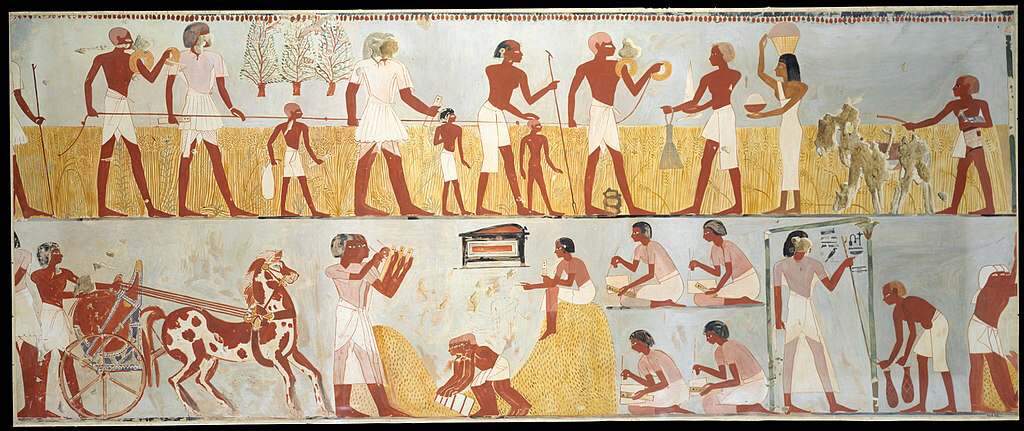
Tomb of Menna, Wikipedia commons.

Two concepts that, in their anti-commerce forms, get in the way of understanding social dynamics are commodification and alienation.

Regarding commodification (turning things into objects of exchange) we have been exchanging goods outside our immediate groups for perhaps as long as we have been Homo sapiens. Given that the only ways to get hold of something that you do not already have are to make it, take it or trade for it and that (1) we have not been generally able to individually make everything we need since we adopted a cooperative subsistence strategy (something which helped make us human) and (2) we probably want to discourage too much of the take option, that leaves trade. It is not remotely a coincidence that our material prosperity, capacity to engage in social life, personal freedom and autonomy, have all expanded as our trading has.

There are certainly questions about what should or should not be traded, and in what circumstances. But everything useful has boundaries, albeit often fuzzy ones, beyond which it stops being beneficial. That comes from living in a universe where constraints are built into the structure of reality. Constraints that we navigate by engaging in various trade-offs.

As for alienation, given that we have been trading for possibly our entire history as a species, it can reasonably be said to be incorporated within our evolved capacities, rather than being some psychic maiming. More specifically, the notion that there is something specifically bad about profit because it represents the extraction of surplus, of income that the providers of labour are otherwise entitled to, is a ludicrously simpleminded notion of profit.

We direct our labour towards what we value, but there is always the risk of consuming (or otherwise using) more value than we produce. As commercial activity thus runs the risk of loss, covering said risk of loss is a commercially necessary function that folk generally are not going to do for free.

Mistaking that labour is directed towards what we value for labour being the determinant of value obscures the central role of risk in structuring commercial activity. Those covering the risk have the greatest incentive to organise production so as to maximise the creation of value (and so minimise the risk of loss). This is why ownership of commercial enterprises by those covering the risk of loss has evolved in every commercially active society. Indeed, what exchanges are, or are not, going to be covered in that way by a particular firm is a question that helps set the boundaries of firms.

Surplus through limiting subsistence

It is also a mistake to regard such normal commercial activity as the prime method of generating surplus (i.e., production in excess of subsistence) in human societies. Ever since their inception, states have overwhelmingly dominated the actual extraction of surplus, and still do. In every developed society, the tax share of GDP is far larger than the profit share.

It is a myth that farming, the shift from taking food from the environment to making it by growing plants or raising animals, generates significant surplus on its own. What farming generates is a greater population: i.e., more babies. Hence farming’s ability to overwhelm and replace foraging across arable lands as farming populations swamped foraging populations.

In order for farming, for food production, to generate significant surplus, said surplus has to appropriated before it goes to supporting more babies. In all state societies, the overwhelmingly dominant mechanism for extracting surplus has been taxation: that is, appropriation by the state. How can we look at the Pyramids of Giza, the Great Wall of China, Angkor Wat etc, etc, etc and not realise that states dominate the creation and extraction of surplus?

Someone deriving their income from taxes gains it by a far more pure “extraction of surplus” than does anyone in business. Unless the business uses coerced labour. But labour bondage is, in effect, private taxation: using coercion to extract the scarcity premium of labour.

Businesses can leach off the surplus-extracting capacity of the state. This is known as crony capitalism. Crony capitalism harnesses the exploitative possibilities of the state through collusion between actors within business and within the state for the benefit of both, and the detriment of the wider society. Such colluding application, into the private sector, of the exploitative possibilities of the state is another manifestation of state dominance of the extraction of surplus.

The existence of states do create incentives to privatise profits and socialise losses. But through the surplus-extracting nature of the state.

Alienation and commodification may be useful mechanisms to generate an ennobling narrative of oneself as a fighter against metaphysical evils, and to de-legitimise rival (commercial) elites. In their anti-commerce forms, they are, however, not helpful for understanding social dynamics.

References

Yoram Barzel, Economic Analysis of Property Rights, Cambridge University Press, [1989], 1997.

Jared Diamond, Peter Bellwood, ‘Farmers and Their Languages: The First Expansions’, Science, 25 April 2003, Vol. 300, Issue 5619, pp. 597–603.

N. Blegen, ‘The earliest long-distance obsidian transport: Evidence from the ∼200 ka Middle Stone Age Sibilo School Road Site, Baringo, Kenya’, Journal of Human Evolution, 103 (2017) 1e19.

Amory Gethin, Clara Martínez-Toledano, Thomas Piketty, ‘Brahmin Left versus Merchant Right: Changing Political Cleavages in 21 Western Democracies, 1948–2020’, World Inequality Lab Working Paper N° 2021/15, May 2021.

Joram Mayshar, Omer Moav, & Zvika Neman, ‘Geography, Transparency, and Institutions’, American Political Science Review, 2017, 111(3), 622–636.

Saturday, September 30, 2017

Saturday, December 5, 2015

Why gold/currency ratios mattered in the interwar period

This is based on a comment I made here.


I have been enjoying Scott Sumner's history of the Great Depression, The Midas Paradox: Financial Markets, Government Policy Shocks, and the Great Depression. Sumner provides a key ideas summary for the book here. The book is an examination of dramatic macroeconomic instability under a gold standard.

In The Midas Paradox, Sumner gives the gold/currency ratio (the ratio of gold reserve to currency) central place in his analysis.

 A gold standard sets a value in gold to the unit of account, making gold the medium of account. So, no matter how many (for instance) currency dollars are in circulation, the value of gold sets their value. If gold rises in value (relative to output of goods and services, hereafter just output), the value of money rises relative to a given level of output (so there is deflation or a falling price level). If gold falls in value (relative to output), the value of money falls relative to a given level of output (so there is inflation or a rising price level).

Hence prominent interwar Swedish monetary economist Gustav Cassel's post-WWI concern about the future path of gold supply not keeping up with the future path of output, for if output growth systematically outstripped gold production, that would systematically raise the output-value of gold, having a deflationary effect, i.e. driving down the price level, driving down expenditure, and so incomes, and increasing the burden of debts.

For deflation comes in three varieties; the good (falling prices due to increased productivity, such as in the IT industry), the bad (a fall in spending, relative to output, pushing down incomes, and raising debt burdens) and the ugly (such sharp shifts to holding money that expenditure collapses, so do incomes, massively increasing debt burdens, leading to a surge in bankruptcies and bad debts and so to financial crisis).

Insufficient gold production turned out not to be a problem and, while fluctuations in the relative paths of gold and output did produce inflationary and deflationary swings in the C19th, they were relatively minor. Indeed, the upsurge in demand for gold from the French/German/US switch to the gold standard in the 1870s was more important. (The French/German switch is discussed here [pdf], the US switch here [pdf].) Over the course of the C19th, the inflationary and deflationary swings from shifts in the relative path of output and gold production cancelled out.

So, while the currency in circulation can fluctuate according to the "needs of trade", gold provides the anchor for the output-value of money. (Hence, the plausibility of the "real bills" doctrine.)

Hard money man on horseback.
Why would the gold/currency ratio matter?

(1) The plausibility of the gold-peg. If currency in circulation becomes sufficiently large that the guarantee to redeem in gold is in doubt, that could be seriously de-stabilising. Hence the gold standard constrains currency issue, hence states abandon the gold standard when they go to war. (Unless you are Napoleon; an autocrat who does not want to invoke recent dire memories of French Revolutionary hyperinflation, so you run a strict bullion--gold & silver--standard financed by looting Europe while your Parliamentary opponent--Britain--goes off the gold standard for the duration because it does not have the same credibility problems.)

(2) The output-value of gold. Having more gold in the vaults than is needed to ensure the plausibility of the peg tends to raise the value of gold relative to a given level of output. And the more so, the more so. Since the central banks so dominated gold holdings in the interwar period, they dominated the output-price of gold, with the gold/currency ratio being an indicator of their "gold stance". A factor enhanced if private folk began to also hoard gold.

Scott Sumner responded to my original description in the comment section of his blog, and the question whether it was a fair description, as follows:
Yes, central banks had a big effect on the real demand for gold, and hence the value of gold. They held a large proportion of all gold mined since the beginning of time (I think over 50%.) The real demand for gold is equal to the gold ratio times the real demand for currency. So if the public’s real demand for currency is stable, and the gold ratio rises by 9%, then the real demand for gold rises by 9%. This reduces the global price level by 9%, ceteris paribus. It’s roughly what happened between October 1929 and October 1930. After that, big rises in the real demand for currency created a higher derived demand for gold.
Which pushed the gold-standard price level down further.

Wikipedia tells us that:
The real demand for money is defined as the nominal [face value] amount of money demanded divided by the price level.
In other words, real demand is demand in terms of output, as the nominal value of total production is output x the price level, so dividing the money value of production by the price level leaves us with output. This is what statistical authorities such as the ABS do to calculate real GDP and so economic growth.  They assemble statistics on money value of production and use various price deflators to calculate shifts in actual output of goods and services.

In The Midas Paradox, Scott Sumner uses as simple model to analyse the operations of the gold standard. The nominal value of the gold stock (Gs) = the Price level (P) x the real demand for monetary gold (g).

Gs = Pg

Since, if you divide by prices, you are left with output or output-value.

Re-arranging that,

P = Gs/g

So, as Sumner points out, under a gold standard, monetary policy mainly operates through the demand side, not the supply of currency. Real demand for monetary gold (g) can be segmented into the gold reserve ratio (r)--the ratio of gold reserves to currency--and the real demand for currency (md). Giving us,

P = Gs x (1/r) x (1/md)

To quote from The Midas Paradox:
an increase in the price level [P] can be generated by one of three factors: an increase in the monetary gold stock, a decrease in the gold reserve ratio, and/or a decrease in the real demand for currency. The rate of inflation [i.e. rate of change of P] is the percentage increase in the gold stock [Gs], minus the percentage increase in the gold reserve ratio [r], minus the percentage increase in the real demand for currency [md]. At this level of abstraction the term "gold standard" simply refers to a monetary regime where the nominal price of gold is fixed. As long as the nominal price of gold is constant and the real value of gold is set in free [i.e. competitive] markets, then we can apply the gold standard model without making any further assumptions about policymakers following "the rules of the game"; that is, we do not need to assume a stable gold reserve ratio, or in fact any relationship between the monetary gold stock and the currency stock (Pp28-9).
Which does simplify analysis greatly. So the model Sumner provides does what good models are supposed to do--make analysis of the phenomenon more tractable.

As central to having a gold standard is to create a stable value for money--and so a stable price level--by setting a gold value to the unit of account, shifts in the price level will reflect directly shifts in the output-value of gold. In his specific response to my original comment, Sumner is being more explicit about the mechanics and invoking the above equations and explanations from The Midas Paradox.

Chart courtesy of Marcus Nunes.
In The Midas Paradox, Scott Sumner elucidates the central story of the Great Depression as it has been developing in the economic literature. That is, a story of disastrous central bank monetary policies, particularly by the Federal Reserve (the Fed) and the Bank of France. In the case of the US, FDR actually pulled the US out of the Depression with his unconventional monetary policy and then put the US right back into economic stagnation with his National Industrial Recovery Act (NIRA), a strong negative supply-side policy shock to the economy. When the US Supreme Court struck down NIRA as unconstitutional, economic recovery picked up again, until further destructive monetary policies (pdf) created the severe 1937-38 downturn.

So, it was all about bad public policy, not some inherent problems with capitalism or market economies. And in The Midas Paradox, Scott Sumner takes us through the twists and turns of that.


[Cross-posted at Skepticlawyer.]

Sunday, December 14, 2014

Culture and rationality: or why South Asian call centres can be so infuriating

I recently read Kenneth Pollack's Ph.D dissertation on The Influence of Arab culture on Arab Military Effectiveness (which later became a book). It is a very fine piece of social science which, alas, I doubt any important member of either the Obama or Bush II Administrations has read. The burden of his analysis is that Arab culture strongly militates against having effective junior offices or tactical flexibility. Arab armies can be stubborn in defence (until breakthroughs happen), and can execute meticulously planned and rehearsed offensives, showing considerable individual bravery and unit cohesion. But they are typically very bad at any sort of free-style manoeuvre, innovation or coping with the unexpected. In particular, information flows can be stunningly unreliable, as people hide failure behind false reports.

Providing the Iraqi army with lots of American equipment and training still dramatically failed in the first military test in much the way one might have expected, if anyone in either the Bush II or Obama Administrations had read Pollack's dissertation. (Particularly the discussion of how the Libyan Army was defeated by Chadian forces.)

I used to describe cultural explanations as the last refuge of the analytically bereft. I am still dubious about cultural explanations which are not properly "fleshed out" but simply "thrown at" analytical problems as sort of analytical "silly putty"--something that can be used to fit any required (analytical) hole. But, as Pollack's dissertation shows, cultural explanations--done carefully--can be enlightening.

In his conclusion, Pollack makes the following observation:
It is a peculiarly American cultural trait that we dogmatically refuse to accept the importance of culture as an influence on behavior. Only Americans could assume that all men and women are purely rational beings upon whom societal values have only minor influence. For this reason, Americans have tended to dismiss culture as a potential influence on military effectiveness. We assume that any given state will conduct its military operations in exactly the same fashion as we would because we assert that our own behavior--at least in military operations--are governed entirely purely by reason and the objective conditions of our situation, but not by cultural values. As a result, we consistently misread the capabilities and intentions of foreign powers and are baffled when they consistently conduct military operations better, worse, or just different from our own (p.764).
This failure is not so surprising. Those who migrate to the US typically do so to play the game of being American, a game which is open to anyone to play. So, Americans see folk from many different cultures (14% of American residents are foreign born) coming to be Americans and learn to discount culture; or, rather, to expect a generalised "rationality" which cannot see its own emotionality and particularity. (Contemporary scholarship on the history of emotions--Australian centre here--has been revealing how Western post-Enlightenment concepts of rationality are somewhat more emotionally based and culturally particular than is often realised: Hume's dictum that reason is, and ought only to be the slave of the passions, and can never pretend to any other office than to serve and obey them has great force.) Australians are perhaps a little more inclined to see differences--if only from an awareness of not being Americans--but some of the same effects apply, as Australia is even more (proportionally, 28% of Australian residents are foreign born) full of people coming to play the game of being Australian.

Cultural exasperations
Which brings me to South Asian call centres. Companies use them because South Asian labour is much cheaper than US, Australian or other Western labour and because modern telecommunication is so cheap, that the saving in labour costs dwarfs the expense in international calls.

There are, however, some (inter-related) problems with this. One is that South Asian labour is also less productive than Western labour. Second, the folk in the call centres simply do not have the same life experiences as the Westerners they are dealing with. Third, differences in culture can lead to very unhappy customers. The notion that one just pays South Asians to do "the same job" as would Westerners falls down if, for cultural reasons, they do not see things the same way as their Western customers: i.e. they do not share a common "commercial rationality". Such as not actually seeing "the job" itself in the same way.

Indian commercial mythologist/chief belief office Devdutt Pattanaik, in the course of a TED talk on culture (transcript here), says of culture that:
Culture is a reaction to nature, and this understanding of our ancestors is transmitted generation from generation in the form of stories, symbols and rituals, which are always indifferent to rationality. And so, when you study it, you realize that different people of the world have a different understanding of the world. Different people see things differently -- different viewpoints.
He contrasts one-life cultures with many-life cultures:
Take a look. If you live only once, in one-life cultures around the world, you will see an obsession with binary logic, absolute truth, standardization, absoluteness, linear patterns in design. But if you look at cultures which have cyclical and based on infinite lives, you will see a comfort with fuzzy logic, with opinion, with contextual thinking, with everything is relative, sort of -- (Laughter) mostly. (Laughter)
Reading Kenneth Pollack's dissertation happened to coincide with both my business and a friend having very annoying experience with two Australian telco's using South Asian call centres.

Telco non-communications
Case 1:
My business is part of a complicated arrangement with Optus. Last year, we moved our office. We have found it is apparently quite difficult to tell modern corporations your business has moved. Which leads to bills not being sent to where they will be paid, so they aren't. I had got some calls from Optus, and I kept telling them I was not the person to talk to, since I did not handle those aspects of the business. One Monday, my business partner spent two hours on the phone with Optus and was assured, at the end of the conversation, everything was now fixed.

The next day (Tuesday), Optus rang me while I was driving (so I did not pick up). I found later my phone had been cut off. I rang back (on another phone, since my would not connect to Optus), getting a nice lady who could not work out what was the problem, put me on hold and said she would get someone from the Finance area to talk to me: I was on hold for a while (too long, apparently) and dropped into another call centre person, who said the account as fully paid up and re-connected my phone.

The following Monday, Optus rang me while I was driving (so I did not pick up). I found subsequently that my phone had been cut off. I was on the way to a job, so could not deal with it. I got one of my fellow presenters to text my business partner and then, at lunch time, used another presenter's phone to ring my business partner who was very aware of the problem since his wife's phone had also been cut off (being part of the same plan), this while deeply personal things were happening and friends needed to be contacted. Our office manager spent a couple of hours on the phone with Optus and was assured at the end of that that everything was fixed. She rang me and told me that if I powered off my phone, it should be fine when I powered it back up. Verily, this was so.

The next day (Tuesday) Optus rang me. For once, I was not driving. We had a pointed discussion about telling them not to ring me and that we had been assured everything was fixed. I gave him my business partner's phone number, who later texted me back that he had a "pointed discussion" where he was assured everything was fixed (by my count the fourth such assurance in a little over a week) and he assured them that, if there was any recurrence, we were going to the Ombudsman.

So, our experience with a telecommunications company that apparently cannot communicate or handle communication. How much cultural issues played in the recurring screw-up, hard to say.

Case 2
Meanwhile, a friend of mine was moving between states. She rang her telecommunications company, Telstra, to tell them she was moving (and gave them the dates) and enquire about getting internet at her new (non-metropolitan) address. She later found her internet had been cut off (extremely inconvenient given how much information searching, ticket arranging, etc one nowadays does over the net). She rang Telstra and was told that it had been cut off because she was moving. She informed them that yes, but she had given them the dates and still needed internet access. After bouncing around South Asians who were not helpful, she finally got an Australian lady who reconnected her.

She subsequently found that, once again, her internet had been cut off. After more bouncing around South Asians at a call centre, where she had to explain the problem, over and over again, she finally got the same Australian lady who expressed puzzlement about what folk (in Telstra) thought they were doing, and reconnected her.  So, in the middle of packing and arranging an inter-state move, she spent hours on the phone simply because her telco couldn't apparently cope with the idea of moving at a date they had been informed of. Another telecommunications company that apparently cannot handle communication.

But, of course, communication is more difficult when people do not have the same life experiences; not merely individually, but also collectively. (I am guessing that Indians moving probably do not do very much arranging matters over the internet.) What my friend found added an extra level of annoyance was that the call centre folk she talked to did not use the language of responsibility; she got no sense at all that they thought of themselves as representatives or agents of Telstra. She found talking to the Australian lady much more satisfactory, as she used the language of being responsible representative and then acted on the same.

Culture matters
But that is also a matter of life experience and culture; the things that affect the way you see the world and think about it, other people and yourself in relation to same. Devdutt Pattanaik again:
Indian music, for example, does not have the concept of harmony. There is no orchestra conductor. There is one performer standing there, and everybody follows. And you can never replicate that performance twice. It is not about documentation and contract. It's about conversation and faith. It's not about compliance. It's about setting, getting the job done, by bending or breaking the rules -- just look at your Indian people around here, you'll see them smile; they know what it is. (Laughter) And then look at people who have done business in India, you'll see the exasperation on their faces. (Laughter) (Applause)
Remembering that even the concept of "the job" can be culturally specific. Kenneth Pollack defines culture as:
as the set of learned, shared values, patterns of behavior, and cognitive processes, developed by a community over the course of its history. ... it is acquired behavior, learned by members of the community over the course of their lives (p.38).
Culture matters for individual behaviour because:
Culture influences an individual's preferences and priorities. By defining what the individual is likely to consider important, culture shapes an individual's preferred outcome in a given situation. ... Similarly, culture will shape the courses of action and methods an individual is predisposed to employ to secure a goal. Culture has a tendency to suggest that certain ways of doing things are better than others, thus culture shapes both ends and means. Finally, culture may actually shape the way in which an individual thinks and how he or she approaches different situations.
In addition to its impact on the individual, culture also influences the behavior of groups by shaping interpersonal behavior. It teaches members of a society how to treat other people and how the individual should behave when part of a group. It establishes what is permissible and what is desirable behavior in public or within smaller groups (Pp38-9).
So culture establishes tendencies in behaviour rather than rigidly determining individual actions; tendencies that, as Pollack points out, will be clearer the larger the groups of people, and the longer the time frame, being examined.

Devdutt Pattanaik talks of one-life versus many-life cultures. But one can also talk of limited versus generalised morality, nicely defined by economists Avner Greif and Guido Tabellini as clan versus city (pdf): 
In a clan, moral obligations are stronger but are limited in scope, as they apply only toward kin. In a city, moral obligations are generalized towards all citizens irrespective of lineage, but they are weaker, as identification is more difficult in a larger and more heterogeneous group.
Christianity and Buddhism encourage generalised morality, Confucianism and Hinduism encourage limited morality. Islam is a limited morality with universalised ambit. What folk in the West think of as "common sense" rests to a significant degree on generalised morality and putting yourself in the other person's situation. Limited morality cultures tend to not have the same "common sense". 

A way to think about culture is a set of economising heuristics where the alignment of one's perspectives, expectations and preferences with those of others decreases cognitive effort and reduces social friction (i.e. transaction costs). The more said heuristics align with social success (marriage, income, reputation; i.e. have strategic complementarity [pdf]) the more they will be reinforced, and so persevere. Conversely, persistent and socially significant shifts in pay-offs will lead cultures to change (as they do). 

So, you hire folk who continue to live in their culture to deal with practical and personal aspects of people's lives who live in a quite different culture with quite different collective life experiences. How is that going to work out, in the customer satisfaction stakes?

Helping to create telecommunication companies that handle communication really quite badly, apparently. 

[Cross-posted at Skepticlawyer.]

Wednesday, January 15, 2014

The reactionary effect of Marxism

Who make up the one group that humanities and social science academics typically feel entitled to analyse and pontificate about without actually studying them in any serious sense? Without talking to them, following them around, examining their letters, documents and memoirs, or reading the work of anyone who has.

That would be business folk.

(And it is slightly scary how many economists only don't fall into this category because they have read Ronald Coase's seminal 1937 article The Nature of the Firm [pdf].)

I was reminded of this recently when I started reading Charles Tilly's Coercion, Capital and European States: AD 990 - 1992, which has become the modern classic analysis of European state formation. I can see good reasons why -- the book is clearly written, asks excellent questions, shows a nice sense of the diversity of European state development, seeks to balance economic and political analysis.

Doing the pander
Alas, I can also see bad reasons why it has been an academic success -- it panders to the apparently endless desire of humanities academics in particular to sneer at commerce and business folk. Such pandering can and has propelled far more mediocre efforts to academic prominence. A nice Australian example being Michael Pusey's Economic Rationalism in Canberra: A Nation-building State Changes Its Mind whose content and academic success in Australia is a triumph of pandering over understanding. (Economic rationalism is not a term used much nowadays, but Gregory Whitwell -- author of the excellent The Treasury Line -- provides a nice discussion of its meanings here.)

Reviews of Pusey's opus by Fred Argy (in Economic Papers), Richard Blandy (in The Australian Quarterly) and John Stone (in Quadrant) covered the failings of Pusey's analysis (using the term loosely) fairly thoroughly. A data-rich explanation of the shift in Oz public policy is provided here (pdf), including a side-swipe at Pusey; though the combination of Howard-Costello tax reforms and RBA stabilisation policy led to better outcomes than the paper implies.

An upside of Pusey's efforts is that it did help inspire William Coleman's magisterial Economics and Its Enemies: Two Centuries of Anti-Economics.

Capital capers
Tilly seeks to create an analytical paralleling of capital and coercion. The former being the realm of "exploitation" and the latter of "domination".

Really?
coercion-capital-european-states-ad-990-1992-charles-tilly-paperback-cover-art

So the more capital, the more "exploitation"? So an American worker is more "exploited" than a landless peasant on a latifundium in a capital-starved agrarian society? Do people who write this stuff -- and those who buy into it -- listen to themselves?

That increasing the level of capital in a society increases the return to labour -- since it increases the scarcity of labour compared to capital -- would seem to imply (in Tilly's analytical framework) that workers are the more exploited the more prosperous they are.  At which point one can only agree with Andre the Giant's Fezzik [Inigo Montoya]-- that word, I do not think it means what you think it means.

One also wonders where, in this analytical universe, one puts slavery, serfdom and other forms of human bondage -- the point of which is precisely that they are the operation of coercive domination to deny labour its scarcity returns above that necessary for subsistence.

Furthermore, in Tilly's analytical universe, capital does not get created, it "accumulates". Capital -- the accumulated scum of economic exploitation.
Of course, if one uses the language of capital being created, then business folk become creators and, clearly, we can't have that!

Nor see commerce as a realm of consent, because that might generate a rather disturbing contrast with the realm of coercion. Though perhaps not as disturbing as all that -- one can talk of gains from order as well as gains from trade. And Tilly's analysis of the path of state formation does include a very important role for implicit or explicit social bargaining, while he never loses sight of the fact that the state is, at its core, always a coercive structure.
Tilly defines capital thusly:
Let us think of capital generously, including any tangible mobile resources, and enforceable claims on such resources. Capitalists, then, are people who specialise in the accumulation, purchase and sale of capital. They occupy the realm of exploitation, where the relations of production and exchange yield surpluses, and capitalists capture them (p.17).
Perhaps factories are also capital, even though they are not terribly mobile? And, if they are not capital, what are they?

Risky business
But leave that aside; Tilly buys into the perennial notion of surpluses as just being "yielded" by the processes of "production and exchange". Yet a driving factor in commerce is that there are no guarantees of such "surpluses". The risk of loss is a real one and much commercial activity is structured to deal with it; to deal with risks in general. A huge part of the story of the Commercial Revolution in Europe is precisely the secular drop in risks -- particularly as reflected in interest rates. A drop in risk levels from the interaction between technology and institutional change that is at the heart of the Commercial Revolution and which made the creation of capital strikingly easier over time.

European global dominance starts with the Commercial Revolution, though it was pushed along by the Scientific Revolution and sealed by the Industrial Revolution. Until, of course, the patterns thereof started to be exported elsewhere and the further consequences of the Industrial Revolution began to undermine imperial rule.

That Tilly does not really "get" commerce is particularly clear when he discusses the interaction between capital and cities -- he sees the development of cities as coming from the accumulation and concentration of capital, thereby paralleling the development of states from the accumulation and concentration of coercion. Since, in his analytical framework, capital "accumulates" rather than being created, the notion of cities as being good places to transact is obscured. By contrast, medieval lords were well aware that providing protection and ease of transaction could promote a new city as a node of trade and commerce -- the medieval notion of a (new) borough was strikingly similar to the modern notion of enterprise zone.  At times, capital in Tilly's analysis seems perilously close to an exogenous force that drives social phenomena.

Status games
In all this, Tilly is just part of the at least 2,500 year tradition of clerics, clerisies and intellectuals dating back at least to PlatoAristotle and Kong Qiu despising commerce and merchants as vulgar and amoral. Though the tradition went into something of a regression from the mid C17th to the mid C19th -- from John to John; from John Locke to John Stuart Mill (plus a nod to the great C19th populariser of liberal political thought, Herbert Spencer). (A review of a book on this tradition is here [pdf].)

But the tradition resurged with a vengeance with the intellectual popularity of Marxism. To the extent that most academic writing about economics and commerce which is not explicitly based on various forms of economics is largely derivative from Marxism. An analysis which gets in the way of understanding actual commerce and the importance of gains from trade (why do people keep coming back?), transaction costs and risk management.

In its status-driven antipathy to business folk and commerce, Marxism has proved to be quite reactionary. Though, that is hardly the only way it turned out to be so. That Leninism (or derivatives thereof) proved to be the only effective way to politically operationalise Marxism led to elite politics of the most ruthless and entitled kind. With its reintroduction of slavery (in the labour camps), serfdom (the ban on leaving a workplace without its permission -- the essence of serfdom) and extremely controlling and hierarchical politics, Leninism was much more a very nasty throwback to the monumentalist labour service autocracies of Pharaonic Egypt or the Khmer Empire than to anything that can plausibly labelled "progressive".

Nor were Leninist states modernising in anything except the most banally technological sense. The essence of modernity is about expanding possibilities -- very much what Leninist states have not been about. Which is why they are mostly no longer with us. They may have been the political embodiment of high modernism, but actual modernity has proved to be too much for them. Apart from the bizarre North Korean dynastic theocracy -- the most atavistic of the lot -- the remaining notionally Leninist states are in the process of living the Eastern European joke. (What is socialism? The hardest and most difficult road from capitalism to capitalism.)

161713502
Honouring the divine ruling family
In reinvigorating the long tradition of status-driven sneering at commerce and merchants, Marxism proved to be deeply reactionary. Indeed, pervasively reactionary.

But dressing up old ideas in allegedly "cutting edge" language and declaring them progressive has continued to be a fun game for intellectuals. Consider post-moderism -- indeterminacy of meaning was a hot topic for Socrates and the boys. As it was in medieval discussions of the problems of translation. (One Orthodox theologian is supposed to have joked that he could not translate the doctrine of the Trinity from Greek to Latin without committing several heresies.)

They might also consider how "progressive" al-Ghazali's embracing of what we would now call Humean scepticism proved to be for Islamic science.

I understand the enduring status-appeal of sneering at commerce and merchants. But watching a first class mind trip over its analytical framework -- as in Tilly's Coercion, Capital and European States -- remains an unfortunate sight.

[Cross-posted at Skepticlawyer.]

Thursday, September 26, 2013

Thompson troubles


Economist Earl Thompson (1938-2010) developed a theory which (pdf) postulated that defense externalities are what made (pdf) taxing imported consumer durables such a common tax policy. The idea being that build-up of local capital made a taxing-jurisdiction more of a target for aggression, so taxing such goods and various forms of capital adjusted for the increased danger; it internalised the costs of said danger. A "coveted capital" theory of taxation. A theory extended to postulating the role of guilds (pdf) as limiting capital formation to reduce the "coveted capital" defense externality, providing a city defense force and a source of emergency war finance.

Easy tax targets
As someone conversant in Australian political history (pdf), and aware of how well Ronald Rogowski's application (pdf) of the Stolper-Samuelson theorem and Heckscher-Ohlin analysis (abundant factors of production favour free trade, scarce factors favour protection) explains patterns of C19th trade policies, I find the thesis on the levying of tariffs deeply unpersuasive. (Do we really want to postulate that protectionist Victoria felt more vulnerable to aggression than free trade New South Wales or Western Australia?)  This is not helped by Thompson's fantasy economic history which sees competition for productive individuals as a fundamental driver of historical taxation strategies.

Earl Thompson
Earl Thompson
Firstly, the classic response to serious competition for productive individuals--that is, labour scarcity--was bondage; serfdom or slavery. Serfdom if the targeted population was local (it required less effort than slavery and did not affect fertility), slavery if the labour needed to be imported (as they were stripped of any connections--enslaving was "social death", typically in situations where actual death was the alternative--it was easier to make people property and they could be replenished by further imports).

Moreover, consumer durables are an easy taxation target (hence export or import tariffs being levied on them at different times and places). Given the historical importance of administrative costs in driving policy (particularly tax collection), no further explanation is needed for taxation to target high-value, relatively easily spotted, goods. Particularly as, before the Industrial Revolution, land and trade were the dominant (pdf) revenue sources and the dominant targets of aggression. (Nomad peoples had their herds, but they were difficult targets except from other nomad peoples.) Any accumulations of capital were overwhelmingly trade-derived. Thus, accumulating consumer durables and fixed capital were by-products of much more basic targets for aggression. People did not think folk magically acquired wealth. Walls around cities not only protected residents and their wealth, they also protected the trade-nodes, and provided a base to dominate the farm lands, which generated said wealth.

Hoping to acquire some moveable wealth
To the extent that Thompson has a point, it would make rather more sense to say that taxing imported consumer durables, or structuring your tax system so as to target wealth concentrations, is aiming for an optimal trade-off of where the revenue is most accessible and who has most to lose from successful aggression against the state and its trading interests (internal or external). One does not have to postulate some extra defense externality, given that defense and public order are already public goods. Especially as states were generally keen to grab what trade or land income they could. Indeed, the revenue value of trade and land generally dominated fixed capital or moveable wealth quite strongly for those organised to extract same. Thieves, raiders and looting soldiers would be more attracted by moveable wealth (rather than the fixed capital that Thompson focuses on), but that goes back to who had most to lose.

Missing the past
Since Thompson claimed his original insight came from looking at the American tax system, he may have simply failed to grasp how relatively unimportant capital was as a source of wealth and revenue in pre-industrial societies compared to capital's post-Industrial Revolution dominance of both. He certainly does not seem to have grasped the importance of the labour/capital ratio for wage levels, given his speculations about (pdf) wages possibly heading back to subsistence levels. (Regarding the importance of land/factor ratios, bondage systems were typically attempts to evade the return-to-labour implications of high land-to-labour ratios and/or trade effects driving up the value of easily-supervised labour.)

As for competing for productive individuals via tax policy; where competitive jurisdictions operated, far more basic matters of protection of person, property and commerce were typically much bigger factors in policy competition than mere tax policy. Indeed, places which offered the best protections of person, property and commerce could typically tax significantly more than places which did less well at such. Hence parliaments provided a taxing advantage (pdf) as they allowed negotiation of higher tax-benefits trade-offs. The extreme example being the United Kingdom at the time of the Opium Wars squeezing close to fifty times more (pdf) taxes per head out of its population than did Qing China--taxing a richer population (itself not an outcome independent of Parliamentary mechanisms) about nine times the Qing rate per head--such that the central government of the United Kingdom had four times the gross income as did the central government of Qing China.

Guilding the lily
Thompson seems to regularly fall into a trap that is perhaps natural for modern analysts--to discount how pervasive and basic concerns for internal public order, and how constraining administrative costs, were for past societies. His discussion, in his analysis of the defense role of guilds (pdf), of the length of time apprentices were bound to their masters misses the point, for example, that young men without family or property attachments were, quite reasonably, regarded as prime threats to social order. Legislating to bind them to their masters until they were 25 might indeed have provided a pool of military manpower for a town or city (though surely not a particularly large one; the role of craftsman in city defense extends well beyond just apprentices) but it also acted as a mechanism of social control. While standard periods and ages for indentures reduced transaction costs for enforcement in societies where enforcement was a serious issue.

Guild members using their fixed capital
There is also something of a tension in arguing that guild restrictions reduced the "coveted capital" defense externality by reducing capital formation (internalising the increased defense risk) while also claiming that guilds were a key source of emergency war finance. (A role which, along with the contribution of apprentices to city defense, is postulated but never quantified; even for rough orders of magnitude.) In the medieval period, general tax levies and bankers were the dominant sources of war finance. The most obvious exception being Venice developing the first bonds, the prestitiin 1171. That in a city with, as Thompson notes, a strong guild system.

Moreover, indentureship was a widespread mechanism across complex societies which had the normal effect that binding to a workplace did--it reduced the cost of labour. In the case of apprenticeships of various forms, it helped to generate a more reliable return from training. Arguing, as Thompson does, that the negotiated upfront lump sum used to purchase an indentureship blocked the effect misses the role that the lump sum played in compensating the master for risks involved in the untested aptitude, character and commitment of the (very) young apprentice-to-be. After all, if the upfront lump sum used to purchase the indenture could deal with the return-to-training-effort, why bother with any set indenture time at all? Conversely, if time-required covered the risks, why bother with the upfront lump sum? (There is some analogy here with charging both a base fee to enter a network plus a fee for usage.)

Even for training systems aimed explicitly at training warriors, time-serving requirements seem to have been dominated by return-for-effort considerations. The page-squire foster-training system of the knights was less time-serving constrained than apprenticeship typically was because part of the trade-off was establishing connections between knightly families (and the knight provided training but not their squire's equipment). Conversely, slave-soldier systems (notably mamluks) were (far) more time-serving constrained than apprentices (mamluks stopped being slaves once trained but their obligation to serve continued) as the cost of training and equipping a mounted armoured warrior was so high and there were typically no outside connections to trade-off against (precisely the attraction, but also the danger, of such warriors).

Guild heraldry showed who they were protecting
The most curious absence from Thompson's analysis of guilds as the apparently absolutely militarily and economically crucial institution from the early medieval period to as late as 1900 in Russia is; what was in it for the guild members? As Thompson points out, guilds typically set maximum prices and minimum quality standards (the reverse of what a conventional monopolist would do) and limited the ability of masters to expand their operations. Since guilds only made sense if they helped their members, surely the first place to look is to ask what benefit such provisions provided to guild members.

Limiting the scale of operations spread the commercial joy, making it easier to cooperate, and increased the number of masters (and journeymen), giving them more collective weight in city affairs. (Unions make similar trade-offs when, for example, teacher unions agitate for limits on class sizes.)

Moreover, a guild could not be a conventional monopolist because it was not a single firm but a collection thereof. Any restrictions had to benefit all the members without requiring excessively costly negotiation of distribution of gains or enforcement costs; a guild was at best a cartel rather than a conventional monopoly. One, moreover, that could not ensure complete exclusion of outsiders, as city authorities could, and periodically did, grant the "freedom of the city" to crafters refused guild membership. Maximum prices and minimum quality standards provided positive branding for guild members and had much lower enforcement costs than did the reverse. This gave guilds standing, which made them much more effective as political organising and protection devices for their members. Highly desirable to have in a medieval world of expanding trade and complex jurisdictional interactions.

Guilds were first and foremost embedded in the commercial life of cities, and it is there that analysis has to look first to to explain their characteristics; not the taxing of postulated extra defense externalities which also contradict their (completely unquantified) alleged value as sources of emergency finance. Especially as church and merchants were more important concentrations of urban wealth than crafters.

Thompson is also quite wrong to claim that tax levels rose to tax away (pdf) the labour scarcity effects of the Black Death; the later C14th and C15th were periods of sustained higher incomes for peasants and workers across most of Europe. (Not so much in Spain [pdf], but that was because it disrupting trading networks in what was already a labour-scarcity economy.) Neither the standard "labour trapping" techniques of bondage or walls were employed--likely not the former because European states lacked the military incentive to support re-introduction of bondage while the latter was not a practical option. So competition for labour drove wages up.

Missing the present
Even on contemporary dynamics, Thompson's characterisation of the Western victory in the Cold War as reducing competition for (pdf) productive individuals also seems wrong-headed. Yes, it has weakened the bargaining position of states vis-a-vis the US and Western-supported international organisations, but competition for productive individuals seems to have, if anything, become more intense; it is just that the effect has been more than counteracted by the massive broadening of labour supply for globally-traded goods. Contra Thompson, in explaining the US experiencing prolonged economic expansion in the 1990s without median wage growth, December 1978 is a much more important date than November 1989 or December 1991.

Similarly, his suggestion that (pdf) US support for policies which produced the German and Japanese economic miracles were a form of "hostage" wealth rather misses the point that it was in the US interest for countries bordering Command economies (West Germany, South Korea, Japan, Taiwan) to do as well as possible to sharpen the competition and that there was an explicit US defense guarantee for all four countries precisely because they were border states. (The outbreak of the Korean War being a salutary lesson in what happens when one fails to be explicit about such matters.)

Missing both
The first time Thompson's economic history annoyed me was when he characterised China as (pdf) having been on the gold standard. Apart from the southern Warring State of Chu, gold has not been (pdf) a significant monetary metal in China. Silver was often a medium of account in Chinese history, but characterising that as a "gold standard" for definitional simplicity is to feed the way overdone mystique of gold.

Thompson dismisses free rider issues with remarkable abandon when convenient, treating notions of collectively-acting ruling classes and providers of "ideology" as unproblematic. Given the challenge the work of Mancur Olson posed on the difficulty of collective action, the work of Elinor Ostrom on what is required for effective management of common property, and the work of Peter Turchin (building on the original insights of Ibn Khaldun) on the difficulties in generating and maintaining asabiyyah (common feeling or group coherence), this is not a persuasive way to proceed. Moreover, Thompson treats the issue of the power of "ruling classes" over policy and institutions as unproblematic whenever convenient but it suddenly becomes contestable when that is convenient. Indeed, Thompson's notion of (pdf) "poison pill" asset bubbles designed to forestall revolution descends into history-as-conspiracy. (Just think about the information control requirements, let alone the wider coordination issues, for such a putative policy.)

Given that autocracy has been historically the most common political form, the principal-agent problems all have rulers faced, and how contested political power perennially is within and between power groups, Thompson assumes away much of the stuff of history--particularly in the evolution of institutions and public policy. It is one thing to analyse, for example, status behaviour as a club good; quite another to postulate high levels of collective action in situations of intense competition for power (or, for that matter, intellectual prominence). Some of the analytical consequences of doing so, such as his "bad economic theory" explanations (pdf) for the collapse of the (Western) Roman Empire and French Revolution, are just bizarre. Thompson's apparent notion that laissez faire free trading views have been the prime significantly policy-distorting beliefs (apart from what he calls Hellenism*) is not much better.

Thompson's use of democratic and democracy is also unfortunately loose; he applies the labels to times and places which were not remotely democratic in any serious meaning of the term. Thus, when C19th thinkers argued that democracies could not manage, let alone survive, great crises (such as wars and civil wars), the success of the United Kingdom in its Second Hundred Years War with France was, quite reasonably, not counted as a counter-example. Thompson calling the 1688 Glorious Revolution "democratic" is, to put it mildly, a stretch. Using the far more accurate term Parliamentary might have productively expanded Thompson's concern for coordinating mechanisms. While referring to (pdf):
Byzantium's unique form of democracy (p.162)
is simply bizarre. Referring to (pdf):
an early-ninth-century renaissance in ancient Chinese religion and effective democracy (p.1)
is hardly less so. Whatever he meant by the term, it does not have much connection to anything resembling normal usage.

I am also not much impressed by claims such as that his brilliant insight on taxing to deal with defense externalities was rejected because (pdf) it upset the preconceptions of, and demand for, economists. The Austrians play this game about why economists in the 1930s, after a brief surge of interest, rejected the Mises-Hayek Austrian business cycle explanation of the Great Depression. However flattering it is to the adherents of the theory ("we are so much more public-spirited than you lot") I find a much simpler explanation to be that neither theory is a persuasive explanation of what it purports to explain. And my income or potential income does not depend in the slightest on whether I agree, or disagree, with either theory.

Earl Thompson is fondly remembered by various prominent economists, was clearly an original thinker and his papers on monetary matters (pdf) in particular (pdf) can be read with profit (pdf); though I prefer David Glasner's reworking of Thompson's discussion of classical monetary theory. Thompson also has a rather delicious (pdf) rational expectations and efficient market analysis of the 1630s Dutch Tulip mania. Thompson's more general economic history is, however, not to be relied upon. He seems to have become far too wrapped up in his "coveted capital" theory of taxation, the explanatory power of its alleged defense externality and the analytical presumptions needed to make it all hang together.

Note
Hellenism (pdf) (the curse of Plato, Aristotle and Socrates):
... gives a social thinker a hubristic, unrealistically positive, self-image, and a similarly unrealistic image in the eyes of a similarly educated employer ... Its effect on bureaucratic decision making has been to give bureaucrats a license to interpret facts so as to benefit the classes of people they consider most deserving. In particular, a bias against successful investors is observed among Hellenists (p.152).

[Cross-posted at Skepticlawyer.]