What began as a critique of Marxism grew into a series of essays, now under the title of Worshipping the Future. I briefly explain how they grew into an essay series covering way more than just Marxism on my Substack.
A common trope of commentary, both inside and outside the US, for some years now (even before the Trump-apocalypse) was that the Republican Party had shifted rightwards. The trouble is, this is mostly not true.
Republican voters have become more consistently conservative in their views, which has pulled the median Republican voter away from the centre. But the shift away from the centre of the median Democrat voter has been much stronger.
As the above graphic demonstrates, in 2016 Democrat voters were much more clustered away from the centre in economic policy, and somewhat more clustered away from the centre in cultural politics, than were Republican voters. Movement in Democrat opinion has been driven by shifts among liberal and college-educated Democrats, which began before Trump’s candidacy.
So, from whence comes this view that the Republicans have become “much” more right wing?
Partly, as Damon Linker points out, from increased used of brinkmanship by the Congressional Republicans. But this shift in tactics is not really a shift in opinion (though it may reflect a consolidation of opinion among Republicans).
Mostly, however, it comes from the mainstream media, especially the “quality” media. The views of the mainstream media, especially the “quality” media, have shifted sharply, and increasingly intolerantly, leftwards in cultural politics. The result is, even with minimal shifting among Republicans, the distance between the views of the mainstream media, especially the “quality” media, and those of Republicans has steadily grown.
As the mainstream media, especially the “quality” media, is the lens through which many Americans, and even more international media and their audiences, see US politics, the increasing expression by many American journalists of their growing distance from Republicans have created the illusion of the Republicans becoming “much more” right wing.
It is a parallax effect. If there are two poles, and you are moving so that one seems closer and closer and other seems further and further away, it can look as if the receding pole is shifting, when it is your point of view that is actually shifting. Similarly, if you are retaining the same distance away from one pole that is shifting further and further away from another (stationary) pole, that can also create the illusion that the stationary pole is moving.
Looking at US politics through a mainstream media, particularly a “quality” media, that has been shifting leftwards (in cultural politics), has created the illusion of shifts in Republican opinion that are much larger than they actually have been. Meanwhile, the same process has obscured the reality that leftward shifts in Democrat opinion have been significantly larger than any rightward shifts in Republican opinion.
The collapse in advertising revenues has created something of a “go broke, go woke” phenomena in the US media, where falling revenues has led to smaller newsrooms that are more easily captured by the intolerant conformity of recent university graduates. This is making much of the media an ever more distorting lens through which to view US politics. Or US society in general. Or any public policy issues that touch on cultural politics.
In his book A Conflict of Visions, economist Thomas Sowell sets out two visions of human nature and social possibilities that drive much of politics: the unconstrained or utopian vision, whereby human society could achieve unparalleled harmony and felicity if people were freed from various social constraints, and the constrained or tragic vision, whereby human nature, the demands of creating and maintaining social order and of wresting wealth from nature, operate as fundamental constraints that any social order has to deal with.
What are indeed enduring constraints, and how amenable particular constraints are to human action, is not always obvious and can change over time. Western civilisation has gone through the emancipation sequence — abolishing the slave trade and slavery, Jewish emancipation, adult male suffrage, votes for women, women’s liberation, civil rights, gay liberation — largely because constraints changed, including increasing ability to contest claims about what are, or are not, enduring constraints and what trade-offs should be accepted.
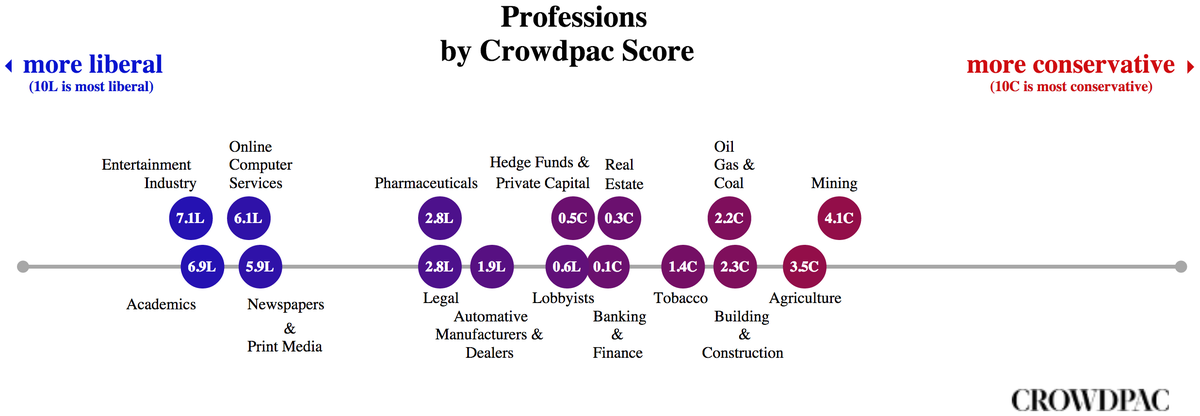
The above chart summarising the pattern of political donations by industry and occupation, shows this conflict between the constrained and unconstrained visions playing out in contemporary US politics. Though there is no reason to think that the patterns are much different in other developed democracies.
Progressivism trumping liberalism
As contemporary progressivism has become increasingly, indeed, in its source writings, proudly, illiberal, I am going to mostly substitute progressive for the liberal label above, as it far better describes the dynamics of politics which derives from the unconstrained vision. In particular, how much such politics is directed to, or derived from, a notion of the transformative golden future (progressivism) rather than a commitment to general human freedom and autonomy (liberalism). Though inflated notions of harms from words, so that restrictions on speech and ideas are claimed to be needed to defend human autonomy (at the cost of restricting human autonomy, but only “bad” autonomy) can be a bridge from liberal to progressive politics.
The transformative golden future is not the mere wish that the future be better than the past, but that it be so profoundly better as to eliminate social ills entirely. To the extent that problems of creating and sustaining order that human societies have had to contend with can be largely or entirely superseded.
A fundamental concept of critical theory and derivatives, the various critical constructivist theories such as critical race theory, is that true social harmony and felicity can only be achieved if all oppressive ideas and structures are eliminated. With oppressive ideas being defined as anything that is taken to inhibit “progress”: that is, achievement of the transformative golden future. This explicitly includes any dissent from the precepts of, or derived from, critical theories. Hence, any politics derived from critical theory or its derivatives, as contemporary progressivism increasingly is, is thereby fundamentally opposed to freedom of speech and thought. This is very clear in writings such as Herbert Marcuse’s seminal, and increasingly influential, essay Repressive Tolerance. (The essay is available online here.)
Attempting to, and regularly succeeding, in getting people sacked or suspended for violating linguistic taboos, is a profoundly illiberal style of politics. But it fits perfectly in with the idea that a transformative golden future is possible if oppressive ideas and structures — that is any ideas or structures that are not directed to, or that fail to facilitate, achievement of said transformative golden future — are eliminated.
It is also a logical inference from Michel Foucault claiming that social dynamics are fundamentally matters of power. If arguments are not about trying to find the truth, or bargaining to achieve mutually compatible ends, but just expressions of power in a society dominated by oppressor-oppressed relations, then of course the “proper” thing to do is to suppress all those who express or “support” the “power relations” of oppression.
As I have previously discussed, the politics of the commitment to the transformative golden future has an enormous rhetorical advantage. For the transformative golden future, being a thing of the imagination, can be far more morally perfect than anything that is a result of the inevitable trade-offs trying to build something in the world must entail.
Indeed, there is a ready-made, and oft-applied, pattern of critique by progressives of anything that does, or has, existed. Take some such thing, ignore why it exists, what trade-offs and constraints it has had to deal with. Then compare it to some moral principle or principles without any serious consideration of its function or the constraints it has had to deal with. Prove that it fails to entirely conform to the nominated moral principles and condemn it as illegitimate for doing so.
To someone committed to the transformative golden future, this is a perfectly reasonable way to proceed, as all such constraints can be superseded when the golden future is achieved. If you are more concerned with how and why things work (or don’t), it is less impressive.
Commitment to the transformative future has powerful motivation behind it. Not only does it have unbeatable moral grandeur because of its imagined lack of moral blemish, commitment to such moral grandeur reflects its splendour back on to those so committed. This further motivates dismissing as impermanent and dispensable all constraints that might dim said grandeur.
Pursuit of the transformative golden future is held to be inherently morally ennobling. (Above all, by those so committed.) Political activism, specifically progressive political activism, becomes the highest moral calling, as it is directed towards achieving the transformative golden future that is the ground of all morality and of all positive meaning.
Yes, this is a faith system.
There is no information from the future and so it can be imagined to be as perfect as one likes. The golden transformative future thus acts as God in monotheism — the source of meaning, the ground of morality and the ultimate authority. Indeed, it operates as a source of divine authority: the divine being the realm of ultimate authority from which there is no accuracy feedback.
Political activism to bring about the golden transformation future thus operates as a priesthood and key theorists as its prophets. We are absolutely dealing with a faith-system operating according to religious dynamics. With heretics, blasphemy, infidels and, if institutional circumstances permit, inquisitions.
Markers of being of the smart and the good
This energising motivation, grounded in an imagined future so much better than anything that has or does exist, reaches beyond those explicitly committed to the transformative golden future, or to any particular theory of the transformative golden future. For derivations of these theories emerge out of this highly motivated reasoning and activism and are re-packaged as being what the smart and the good believe.
Once such derivative beliefs are established as markers of being smart and being good, then anyone who aspires to being of the smart and good has profound status, cognitive identity and self-image reasons to buy into such marker-precepts. (And to be seen to so buy into.) In doing so, they also buy into the required-for-such-status consequence that those who fail to endorse what the smart and the good believe are morally and cognitively delinquent, as it must follow that they are either not smart, not good, or both.* This has become central to how prestige media functions — it sells narratives that tell you what the smart and good folk believe, and who (as being of the smart and the good) you therefore get to despise for not being of the smart and the good.
In order to protect the signal of being of the smart and the good, dissent has to be de-legitimised. Hence pile-ones against those who dissent, because if such dissent is accepted as legitimate, then the markers of being of the smart and good lose their value. Pile-ons and denigration of dissent and dissenters are ways to protect the strength of the signals of being of the smart and the good.
Having bought into these markers of being of the smart and the good, folk have then also bought into being motivated to block themselves from noticing anything that casts doubt on the precepts that define the smart and the good. This is bad for the general health of public and intellectual discourse, but excellent for the smart-and-good status strategy. A salient example of this pattern is that the more highly educated, “liberal” (i.e., progressive) one is, and the more trusting of the mainstream media, the worse informed one is of the patterns of police shootings in the US.
It is not only a problem of a general pattern of not-noticing. Much of the mainstream media is playing, and playing to, the same status strategy. A playing, and playing to, that is manifested in the huge increase in recent years in the use of racial terms in US mainstream media. This is a measure of the expanding influence of critical race theory, and its derivative status strategy of anti-racism as being a prime marker of being of the smart and the good.
Abstracting progressivism
If one works in an occupation or industry that deals with abstract ideas, or other products of the imagination, then faith in the transformative golden future, and its derivative markers to establish one is of the smart and good, is a very natural fit. Particularly if being of the smart is very much a matter of professional self-image. Who does not want to see themselves as being of the smart and the good?
Looking at the chart of political donations above, we can see that not only are the industries and occupations of abstraction and imagination strongly predominantly progressive in their politics, they are far more intensively progressive than any industry or occupation leans conservative. The industries and occupations of the cultural commanding heights are, in terms of active politics, overwhelmingly progressive. If politics is downstream of culture, then much of the patterns of contemporary institutional and public politics makes sense.
Those who buy into the unconstrained vision (or its derivatives) are very likely to be more motivated to care about, and be active in, politics. Their very sense of status and cognitive identity is strongly inclined to be activated by, and motivate, political action. Much more so than folk with different views of the world, of society, of human possibilities, of politics.
The social power of being more systematically motivated about politics is real, as this thoughtful piece on the institutional spread of “wokeness” (i.e., contemporary progressivism derived from critical constructivist theories) sets out. The piece is, however, marred by the silly claim that progressives care more about the future of their society than do conservatives. Being much more motivated to engage in political action, because it is tied up with one’s sense of status and cognitive identity, is not remotely the same as caring more about the future of your society. Indeed, a profound contempt for one’s own society, and its heritage, can be extremely politically motivating. Especially as part of rejecting present and past in the service of the transformative golden future.
There is a sense in which wanting to de-legitimise and overturn the American project is very much caring about the future of the society you are currently in, but not in the sense that of identifying with the society as it is, or has been. This is not about a continuing future for that society, but a radical break from what has come before, and all the achievements and strivings that embodies.
Caring more about politics is not the same as caring more about the future of one’s country. Politics is not the only way to care about, or invest in, the future of one’s society. Indeed, the more pervasive and intense competition over the positional goods of politics are in a society, the worse that society is likely to become.
Status games
The unconstrained vision is very well set up for status and power games. Precisely because the animating vision is so morally splendid, it is very easy to generate a sense of profound moral commitment, but also a sense of moral grandeur. This can then be parlayed into a sense of moral prestige and, in order to achieve the golden future, patterns of social dominance.
The grandeur of the moral claims can, however, also lead to a pervasive cheapening of moral discourse. For instance, the notion that, say, a lesbian of African descent with a tenured position in an elite university is “marginalised” and “oppressed” profoundly impoverishes moral language. If such a person is “marginalised” and “oppressed”, what are we to say about the situation of a slave, or the inhabitant of a labour camp, or the experience of a Russian serf?
The appropriation of the language of oppression by not merely inhabitants of the most prosperous, most technologically capable, socially free societies in human history but by particularly institutionally advantaged members of such societies is profoundly offensive and highly self-indulgent. It is self-indulgent self-aggrandisement (“look at me, I am so oppressed!” “look at me, I am speaking for the oppressed!” “look at me, I am fighting oppression!”) that hugely cheapens the public moral compass in the service of a performative collective narcissism, an ostentatious display of moral status. It also has a (likely not coincidentally) disorienting effect on anyone who might want to express different views and concerns.
Being very effective status strategies, very effective to harnessing prestige and wielding dominance, is at the core of how critical theory, and its derivatives, are also mechanisms of career advancement and social domination by holders of the “correct” sort of human capital. Ones that are particularly suited for, indeed likely to select for, toxic actors. Any powerful status strategy, particularly one with such minimal signalling costs, will attract, indeed select for, toxic actors.
There is a very strong element of self-deception involved, so that people see the moral splendour they commit to and don’t see the status plays they are engaged in. This self-deception is carried off by manipulating salience, especially moral salience, so as to hide what is going on from others and from themselves. As a Polish psychiatrist observed, having spent decades observing the putatively “progressive” politics of Stalinist and post-Stalinist Poland dominated by pathological personalities:
Unconscious psychological processes outstrip conscious reasoning, both in time and in scope, which makes many psychological phenomena possible…
Andrew M. Lobaczewski, Political Ponerolology: A Science on the Nature of Evil Adjusted for Political Purposes, p.163.
By being very consciously aware of the moral grandeur of the vision, and moral commitment involved, a lot of status games can be played without ever acknowledging to oneself or others that that is what is also going on. Indeed, that such status plays may be providing a great deal of the reinforcing feedback and incentives.
We can tell, however, that the status strategy is, at bottom, a much stronger motivator than moral concern because, in any clash between the two, the status strategy, with its very strong protection-from-conformity-effects, almost invariably wins. Indeed, one of the things that distinguishes dissenters on the “left” is their refusal to play the status strategy.
There are other consequences from this focus on the transformative future and expansive conceptions of oppression. If you define all constraints as oppression, so as being malign social constructs, that naturally leads to various levels of science denialism, as science explores the structures of things and constraints flow from the structure of things.
The notion that constraints are embedded in structure of things (as science demonstrates in various ways) is inherently opposed to the unconstrained vision. Lysenkoism is an inherent, pathological tendency of golden, transformative-future progressivism. As, for example, trans activism is currently demonstrating. Though the Lysenkoist implications of transformative-future progressivism are invading medicine much more widely.
Enduring constraints
Which brings us to the tragic or constrained vision. This cannot be simply labelled “right wing” or conservative, as some very liberal-minded or politically progressive (but not progressivist in the sense defined above) folk operate within this vision. Anyone who accepts that we are products of, and still subject to, evolutionary processes buys into a key element of the tragic or constrained vision, no matter how “left” their politics are.
Nevertheless, conservative thought is very much grounded in the tragic or constrained vision. But so is the liberal tradition.
The basis of the tragic or constrained vision is that constraints are real. That there are features of reality, and of us, that are not seriously plastic to human action and that we have to simply deal with, and act within, if we are to be effective. Particularly, if we are to be effective in promoting human flourishing or any achievable notion of the good.
Now what those constraints actually are, and how plastic or not they are to human action, is much debated. This is much of the ground of dispute between liberals, conservatives and various tragic-vision authoritarians. While they may argue over the constraints, and where the practical limits are, that there are such constraints and practical limits is a bedrock assumption all these traditions share.
Looking at the chart of patterns of political donations by industry above, we can see that the most politically conservative (so most constrained-vision) industries are mining and agriculture. They are immersed in the effort to wrest value from nature. They deal with the reality of physical constraints every day. Their daily feedback from their work tells them that constraints are real and pervasive. Of course they are much more inclined to conservative politics.
The higher the “social constraints” elements of the work of an industry, the more politically liberal it tends to be. Social constraints are, at least to some degree, amenable to human action. The stronger, therefore, is likely to be the appeal of supporting human autonomy. Especially a notion of human autonomy less grounded in the constraints of tradition. Hence the more liberal patterns of politics in such industries.
Liberalism, autonomy and discovery
But liberalism does not deny the reality of constraints. It is grounded in a view of human nature that both exalts human autonomy while also holding a certain, grounding suspicion about human nature and respect for the limitations of human action. Why do liberals push freedom? Because that respects human autonomy but also entails denying that there is some group out there who can be trusted with systematic power over others.
Liberalism famously sees public discourse as a vehicle for discovery. We are constrained by what we do not yet know, but might yet find out. Testing ideas in open discourse permits, given such constraints, discovery to take place. Liberalism has been comfortable with private property and markets because they support human autonomy, operate as far more effective discovery mechanisms and limit the power of some over others.
There is much truth in the liberal vision. For instance, markets and commerce are not good mechanisms to promote bigotry. It is why oppressive systems have always sought to impose limits on the market and commerce. Racial segregation, for example, required systematic state action because market processes will not deliver segregation. Indeed, various oppressed groups have often found the consensual patterns of commerce much kinder to them than the coercive structures of politics.
One of the great rhetorical advantages of the unconstrained vision, the politics of the golden transformative future, is that it de-legitimises all the grounds from which one might derive liberal or conservative politics. Pointing to any constraint that gets in the way of the golden future can so easily be portrayed as complicity in whatever ills the golden transformative future will dispense with, as being a sign of being an -ist or a -phobe.
Whether it is claiming that human nature limits what is possible, that wresting value from nature limits what is possible, or that the requirements of social order limit what is possible, any such argument can be charged as being complicity in oppression. If appeal to the constraints of human nature, the constraints of social order, the constraints of wresting value from nature, are all illegitimate due to being complicity in oppression, then there is no ground from which liberal or conservative arguments can be made. There is nothing for them to gain purchase from that upholders of the progressive faith need pay any attention to.
Of course, attempting to argue people out of a faith system is a notoriously unfruitful activity.
Unconstrained imagination
From mining and agriculture to law and pharmaceuticals, there is fairly clear more-conservative-to-more-liberal pattern of industries, directly connected to what sort of feedback their workplaces have to deal with, from the more physical to the more social.
Then we come to four industries clustered together that are much more intensely skewed in their politics than the 12 conservative-to-liberal industries: newspapers and print media, online computer services, academics and the entertainment industry. These are, in the contemporary world, the cultural commanding heights industries. They are also extremely social industries that do not directly have to deal much with wresting value from the physical world or (in any strong feedback way) problems of social order. That is done for them by other industries.
They are industries of the abstract and the imagined above all else. They are made for the politics of the unconstrained vision. Especially for belief in a golden transformative future. The combination of abstraction and lack of reality-feedback naturally encourages the idea that all constraints that in any way impede the golden transformative future are dispensable.
Their attenuated reality-feedback also means that they are also made for status-strategy politics based on markers of being of the smart and the good. Especially given their intensely social nature, and their focus on abstraction and imagination. There is much greater capacity to select for agreement over competence, as what is “good work” has a high “what other folk in this industry believe is good work” element to it.
Especially for claims that have no direct feedback-from-reality penalty for being wrong, but have a potentially high fail-to-conform-penalty.
For instance, in terms of how career advancement works, an academic is only wrong if other academics agree that they are wrong. But that also applies to a somewhat startling extent within media, as the years of the Russiagate nonsense taught those who were paying attention.
An extreme instance of lack of reality-feedback is provided within academe by education faculties, where pedagogical ideas repeatedly demonstrated not to work are nevertheless simply re-packaged and re-pushed. Mainly because they are too convenient for status strategies based on a sense of moral grandeur from transformative activism. Which have been imparted in ever more intense forms to generations of school teachers and university administrators.
One would think that box-office receipts might provide strong feedback in the Entertainment industry, but the flow of funds are so high that there is patently considerable cushioning effect from such box-office feedback. (If one is publicly funded, then that effect is almost entirely eliminated.)
The flow-of-funds cushioning effect is even more pronounced in Big Tech. The motivation-feedbacks of the combination of moral self-image and status strategy have turned out to be, again and again, far more powerful than market feedback.
Asking the question, what are the reality feedbacks in this industry? turns out to explain a lot about the patterns of politics in an industry.
* Applying the language of Curtis Yarvin (aka Mencius Moldbug), wielding the weapon of setting what it is the good and smart people believe is a key way what he calls the Cathedral operates.
If believing X makes one a good person, then avoiding evidence to the contrary preserves one’s virtue.
Don’t see, hear or speak anything that threatens my identity and standing.
Contemporary progressivism regularly treats failure to embrace various beliefs or narratives as a sign of intellectual or moral delinquency (or both). The various -ist or -phobe terms that get bandied about label people as suffering morally crippling cognitive delinquency.* At its most trenchant, this attitude to dissent leads directly into an ongoing pattern of “submit or be stigmatised”: either accept claim X or be stigmatised as an -ist or a -phobe.
The claim that those who significantly disagree are morally delinquent is often also tied to a claim of intellectual delinquency: that there are either (1) obvious facts or truths about the world that such dissenters are ignoring or denying. Or (2) that there are facts or truths about the world that folk clever enough to notice understand and yet those who disagree are ignorant of. Moreover, ignorant of in a way that is typically taken to either condemn them, or elevate those who do so understand, or both.
Both sorts of claims are claims about being well-informed. That the folk making such judgements are so very well informed about how the world is, what other’s beliefs are, how the crucial factors work, and so on. Such claims imply a certain willingness to make an effort to be so informed.
It is therefore quite striking to see a pattern of quite the opposite. A pattern of people using various techniques to not be informed. Or, more precisely, to not be inconveniently informed. Comedian Konstantin Kisin has observed that, in the Soviet Union, you would avoiding looking at (or into) certain things, for if you did, that would lead to wrong-thinking, which was dangerous. A similar pattern has become increasingly pervasive in Western societies.**
The protective flaw The most common technique I have observed to avoid being inconveniently informed is finding some reason why some commentator, publication or other source is so inherently flawed that nothing that they say can be taken seriously. What that typically means in practice is that the source in question does not adhere to the correct narratives and perspectives.***
As a way of self-policing the information one receives, it is excellent. As a way of genuinely understanding what is happening the world around us, it is dreadful. Even if the alleged flaws ascribed to the source are actually in some serious sense a problem, just because a source has problem X it does not mean it is not an accurate source about Y. For instance, just because Sir Isaac Newton engaged in numerological examination of Biblical texts does not mean that he was not a great scientist.
Statements should be judged on their factual merits. But this is precisely what is not being done. Instead, their author or bearer’s alleged position in the moral universe is taken to eliminate the possibility of them providing useful information.
This is both a very bad strategy to being genuinely informed about the world and an attitude that is deeply corrosive to freedom, democracy and science. If a person, group, publication or whatever can be so comprehensively dismissed, then their entire participation in public discourse becomes “problematic”. The narratives of virtue are apparently so powerful, that it enables people and sources to be entirely cognitively dismissed in advance. While that is a deeply self-flattering attitude to take, it is also utterly incompatible with any serious commitment to freedom, democracy and science in its utter dismissal of any legitimacy for dissent and its blocking of anything resembling serious discovery processes.
A version of this strategy is to dismiss some perspective or analysis because of who also endorses, propounds or agrees with it. This is, if anything, even worse because it makes cognitive and moral illegitimacy contagious.
Such strategies are very obviously products of status strategies. They exemplify a sense of being profoundly morally and cognitively superior to any proponents of dissent.
Hijacking science As part of the rhetoric of moral dominance, the hijacking of science to support narratives of virtue has become a recurring pattern. Such hijacking is a perversion of science in the service of establishing moral authority and narrative dominance. Philosopher Matthew B. Crawford, author of Shopcraft as Soulcraft (a nice review of which is here), expresses the fundamental conceptual error involved well:
You can’t really follow the science because science does not lead anywhere. It can illuminate various courses of action, for example by quantifying the risks that attend each, to specify the trade-offs. But it can’t make the choices for us.
Via such slogans as “follow the science”, science is being used as a rhetorical bludgeon in service of moral presumption. Any notion of rule by or through experts, including alleged moral experts, has to involve some moral framework, typically embedded in some legitimating discourse, that frames and directs the expertise. By pretending proper social action is a matter of “following” “the” science, the underlying moral framework is both hidden behind science (or claims about “the” science) and elevated out of the realm of the legitimately contestable.
As Crawford points out, falsifiability is a key to what makes science, science. Authority, on the other hand, requires certainty (or, at least, an aura of certainty). Turning science into a tool and prop of authority means trading in what makes science, science in the service of generating deference. Science becomes incorporated in alleged certainties, so a faith system, so becomes something more like a religion.
To wield science in such a way is to profoundly undermine it as a discovery process. This undermining is very congenial to all those who regard science as a tool of patriarchal, heteronormative, white supremacy. It is not remotely a path that is in any way good for the health of science. Nor for freedom of thought, nor for democracy, as any dissent becomes “anti-science” and so illegitimate.
Crawford makes the point that the expanding rule-by-expertise, which is also to a significant degree rule through emergency, involves:
... a de-legitimising of common sense as a guide to action.
This fits in very nicely with “woke” progressivism, which characterises the entire existing society as a set of moral emergencies due to being a structure of power, oppression and marginalisation. Such progressivism also pushes moral narratives regarded as of such obvious moral power that any significant dissent is inherently delinquent. It grounds its justifications in complex theory. It sets up a structure of ever-evolving linguistic taboos developed by, and selected for, the highly educated in a way that naturally tends to exclude those who are less educated from the realm of legitimate public discourse. “Follow the science” and the de-legitimising of common sense supports all these elements.
One of the reasons I have trouble identifying contemporary critical constructivist (i.e. “woke”) progressivism as “left” is because it is so profoundly antithetic to popular, and particularly working class, participation in public debate.
Identity self-protection This hijacking of science as a moral bludgeon in the service of the prestige-and-dominance plays that are central to contemporary progressivism fits in very well with narrative self-enforcement. If progressivism is just “follow the science”, then any dissent must be “anti-science”. Anything that is “anti-science” is clearly not worth attending to, so can be excluded from one’s consideration, thereby protecting your adherence to the narratives that establish one as one of the smart and good people.
Such narrative self-enforcement, such not noticing, is required to sustain the claim that one has to believe X to be a good person, the more so the more particular to a time and place such a belief is. And many of the current you-have-to-believe X-to-be-a-good-person claims are very particular to this time and place. Such as all the results of conflating sex (which gametes your body is structured to produce) with gender (the sets of behaviours, expectations and cultural narratives associated with how your body is structured).
When folk wonder how mad and destructive claims keep spreading, the short answer is because so many folk have come to believe that either endorsing them is required to show you are a good person, that you are an informed person, that you are a smart person, or that adversely noticing their spread deprives you of such status. So long as such claims, or such avoidings of noticing, continue to be successfully paraded as being what the smart-and-good-people believe and do, people will continue to practice narrative self-enforcement so that they can stay within the set of persons who constitute the smart and the good.
If I wanted to summarise contemporary progressivism in one sentence it would be (1): the systematic sacrifice of discovery processes in the service of moral status. (Including shielding one's moral status.) Or (2) the possessors of human capital and the possessors of commercial capital getting together to screw over the working class. (But that is a pattern for another time.)
Narrative self-enforcement, blocking one’s own acquisition of inconvenient facts or confronting realisations, is engaging in such systematic, sacrifice of discovery so as to protect one’s sense of being one of the smart and the good. Doing so, so as to clothe oneself in the protective public status of being such.
I used to wonder how people in the past could not notice that the social system, or key parts thereof, that they relied upon was threatening to, or was, collapsing around them. I now realise that it can be remarkably easy to simply refuse to see what is too cognitively threatening to notice.
ADDENDA
*For instance, finding some statement that, if you squint at it in just the right way, can be derided as racist, thereby discrediting everything from that person or source.
**Commentator Steve Sailer has just about built a career on noticing how (progressive) folk refuse to notice.
***This can be used to discount an individual, a group of individuals or an entire organisation.
The UK Court of Appeal continues the march to give up on all three.
In a recent decision, the UIK Court of Appeal has decided it was fine to ends someone’s employment if they expressed public support for Christian views of sex and marriage, as such views may offend people.
Christians should not be surprised by this. After all, Jesus was nailed to a cross because what he said and did offended people.
Citizens of the United States should not be surprised by the notion that saying things may offend people. After all, the Declaration of Independence offended many, many people. Starting with King George III and most of the British Parliament.
It would be hard to find any major democratic movement, or any fundamental shift in science, that did not offend someone.
What is remarkable is granting such authority to the claim, or even the hypothetical possibility, of being offended so as to affect the employment of others. Loss of employment is surely a much greater harm than a few words, unless they are remarkably powerful words.
The essence of freedom of speech is that our status as citizens trumps the status of words, except in the most extraordinary circumstances. Hence we are free to speak.
The converse of freedom of speech is the heckler’s veto. The right to block the speech of others.
If given sufficient authority, it can extend to the ability to punish the speech of others.
This decision of the UK Court of Appeal is clearly a case of a heckler’s veto. A veto over speech of others that is remarkably empowered by such decisions but also highly selectively available. For granting a universal “right” not to be offended would obviously either bring public discourse to a halt or render it so anodyne as to pointless; any statement of substantive content being likely to, or being able to, offend someone.
What the notion of “offensive” speech does, under a very thin veneer of alleged concern, is set up a limited class of empowered people and perspectives that are granted the authority of the heckler’s veto. An authority that will clearly be used, and in an increasingly restrictive way, as the incentive is to use it, and so to expand its ambit so it can be used even more.
When people talk of “offensive” they mean offensive to right-thinking people. It is an instrument of cultural hegemony, thinly disguised as concern for others.
Indeed, it naturally transmutes into thinly camouflaged social thuggery: camouflaged, above all, for those engaged in it or acquiescing in it so they can, self-righteously avoid or deny any sense of being engaged in restrictive social thuggery. Social thuggery that the UK Court of Appeals has now given aid and comfort to.
In the words of Lord Justice Underhill, the motivating concern was:
... that the expression by the Appellant in the national media of his views about homosexuality risked impairing the willingness of gay people with mental health difficulties to engage with its services.
The Employment Tribunal, whose decision was being appealed, found that:
11.6 Both parties accepted in evidence that lesbian, gay, bisexual and transgender (‘LGBT’) members of the community suffer disproportionately from mental health problems. Both parties also accept that there have been significant difficulties with a lack of willingness on the part of LGBT members of the community to engage with mental health services such as those provided by the Trust.
11.7 The Trust (and the Respondent) see it as vital that its staff and Board should not do or say anything that could be perceived as giving rise to a risk of losing the confidence of trust of any section of the community it serves, including those, such as LGBT individuals, where there has been historic distrust and difficulty with engagement. The Claimant accepted that it was vital that LGBT members of the community should feel welcome in the Trust and should be encouraged to access its services if they need them.
In other words, the greater the deemed vulnerability, the greater the authority of the heckler’s veto.
As the Lord Justice Underhill says:
... they included opinions also on same-sex marriage and “homosexual activity” and were accordingly the more likely to cause offence or invite misinterpretation.
A simple statement that the views of one non-Executive Director about marriage, parenting and adoption do not represent the views of Trust or staff was not sufficient. His words had to punished by termination, they could not countered by other, more authoritative words. The judgement is saying that the only demonstrated harm from the words, the termination of employment of the utterer, is reasonable and lawful.
In particular, that it was the Appellant who had to acknowledge the problem with his statement of what he believed:
... the Appellant’s conduct made it in practice impossible to try to find a way forward that might have respected both parties’ interests … but for him to acknowledge the sensitivities and the consequent potential for damage of the kind noted above, and to engage with the Trust about how to best to address those sensitivities.
That the Appellant offered other reasons for his views apparently meant that their religious grounding was no longer sufficient protection:
The fact that that belief is rooted in his religious faith is part of the context, but the interview cannot be characterised as a “direct expression” of the Appellant’s Christianity.
So, the addition of reasoning beyond the religious was sufficient to remove the religious protection. A remarkable piece of legal reasoning that surely renders the protection for religious belief and expression rather moot. It is even more remarkable in this instance as it is, after all, true that children are statistically much safer if they are raised by both biological parents.
Lord Justice Underhill distinguishes between the belief and the objectionable manifestation of the belief. This is apparently based in recent case law, but it is a usage that should surely make one nervous. It makes it much easier to claim not to be restricting freedom of speech, or punishing beliefs, just their “objectionable manifestation”. A distinction that could easily amount to remarkably little difference.
This is a free speech issue. As the Lord Justice Underhill says:
The issue raised by this case is not about what beliefs such a person holds but about the limits on their public expression. …there are circumstances in which it is right to expect Christians (and others) who work for an institution, especially if they hold a high-profile position, to accept some limitations on how they express in public their beliefs on matters of particular sensitivity. …This is a decision on the facts of a particular case, and wider conclusions should not be drawn from it.
But, of course, they will be. The expression of Christian beliefs can lead to lawful sacking. The UK Court of Appeal has found so.
Freedom of speech is the freedom to be in error. If error has no rights, there is no freedom, just complete power being held by those with the authority to declare what is in error.
Causing offence is simply a way to be deemed to in error, and to be declared to be such.
Democracy, freedom and science all require the clash of ideas so error can be detected by emergent processes, not top-down diktat. The robust operation of democracy, of freedom and of science must entail offending people. Consider how many people were offended by Darwin’s ideas about natural selection.
Consider how many people are still offended by taking evolutionary biology seriously.
Judges of the United Kingdom swear (by the relevant ultimate religious authority) or affirm a Judicial oath of office, that:
I, ____________ , do solemnly sincerely and truly declare and affirm that I will well and truly serve our Sovereign Lady Queen Elizabeth the Second in the office of ____________ , and I will do right to all manner of people after the laws and usages of this Realm without fear or favour, affection or ill will.
Freedom, science and democracy are surely part of the laws and usages of the Realm. Perhaps British judges should not continue to march along the road of giving up on all three?
The remarkable thing about European imperialism is how ancillary it was to European states and societies.
The East India Company iron steam ship Nemesis, commanded by Lieutenant W. H. Hall, with boats from the Sulphur, Calliope, Larne and Starling, destroying the Chinese war junks in Anson’s Bay, on 7 January 1841.
Imperialism is what states do, and it is what they do, if they can. Imperialism expands a state’s revenue base and access to resources, to the benefit of rulers and officials and those seeking their favour. As soon as there were states, there began to be imperialism. Without some notion of there being some “rightful” limit to a state, an imperial state is just a particularly successful state. Perhaps with some notion of ruling over sufficiently diverse peoples to count as “imperial”.
What is most distinctive about European imperialism is not its success but its ancillary nature. Across human history, in the normal course of imperial expansion, imperial conquest was the central military activity of any imperial state, requiring the application of the bulk, often the overwhelming bulk, of its military forces. Empire becomes the central focus of the state.
What is striking about European imperialism is how much it did not involve the majority of European military forces. On the contrary, it was generally true that the bulk of the military forces of European imperial powers remained within Europe and its environs, facing the much greater threat of other European powers.
The British Indian Army was a very partial exception to this as, except for its officers, it was an Indian force. It was a European-officered and organised Asian army. It is the origin force for the Indian, Pakistani and Bangladeshi armies. Only the Gurkhas transferred to the British Army proper.
The rare occasions when the bulk of the military forces of a European imperial power were deployed outside Europe, it was because they were fighting other Europeans. In the case of Britain, during the American War of Independence and the Boer War. They lost the first because France and other European powers intervened. They won the second because no other European powers intervened. Given the overwhelming dominance of the Royal Navy at the time, none were in a position to.
European imperialism (outside Europe) was an ancillary activity because European states had such organisational (and increasingly) technological dominance. That dominance led to European imperialism being both startlingly successful and being an ancillary activity of European states, even in military terms.
Imbalance in state capacity The most dramatic example of this huge imbalance in state capacity is the first Opium War (1839–1842). The Qing Emperor ruled over about a third of humanity, and about a third of world GDP. Yet the British state had over four times the income of the Qing central government (who had very little silver reserves), plus the capacity to borrow money, which the Qing government did not.
Chinese forces (numbering over 220,000) were defending their home territory against a British expeditionary force (of 19,000 troops and 37 ships, including only 3 ships of the line) that was a fraction of the British military capacity and yet the Qing forces were crushingly defeated. The British lost 69 killed in battle, plus another 197 prisoners executed (apparently by imperial order) and 87 who died of ill-treatment while in captivity. The Qing forces lost 3,100 killed in battle.
The European state most dependent on empire was the Spanish state due to the importance of American silver for its revenue. Over the longer term, this was not a strength but a weakness, as reliance on silver flows undermined the vitality of Spanish commerce and institutions, so that Spanish economic and institutional capacity increasingly fell behind those of other European states.
Dynamic capacity As a result of competition between them, in a particular institutional context, European states had become hugely more capable than non-European states and increasing ruled over far more technologically and commercially vibrant societies. Imperialism was a by-product of the increased state capacity arising from dynamics interior to European states, economies and societies. Hence, European states abandoned or retreated from empire and yet their societies continued to become richer. The loss of empire caused remarkably little social or economic stress.
To see the colonial or imperial experience as central to European states, societies or culture is to misunderstand the state-driven nature of imperialism, the reasons for the success of European imperialism, and the dynamics of European societies that generated that imperial success. An imperial success that was as an ancillary derivative of their interactive dynamics within Europe.
This applied even to issues of imperial administration. The structure that the crown of Castile and Aragon used to administer its territories outside Europe was developed from the mechanisms the Kingdom of Aragon had developed to administer its island holdings in the Mediterranean.
Understanding European imperialism requires close attention to patterns and dynamics internal to Europe. Dynamics that were, to a remarkable degree, and despite the feedback of imperial revenues and imperial rivalry, independent of the dynamics of empire outside Europe.
Postcolonial theory, with its tendency to turn the imperial experience into the central reality of Western, well, everything is little more than self-righteous self-indulgence erected on bad history.
A shocking attack on a legislative building can be very useful.
On the 27th of February 1933, the Reichstag, the building where the legislature of the Weimar Republic met, caught fire. At no stage was the government of the Republic in danger. There was no loss of life.
Yet it was a shocking thing, especially as it was immediately presented as an act of arson (which it was; though by a lone arsonist, conveniently both foreign — Dutch — and communist). Such a shocking symbolic affront to the political order was too politically useful. So the new Chancellor of the Republic, who had taken office less than a month earlier, the leader of a coalition government and head of the largest political Party in the Reichstag, used the sense of shock and outrage to have President Hindenburg sign the Reichstag Fire decrees that enabled the new government to ram through a raft of repressive measures through the Reichstag, particularly the infamous Enabling Act. These were deployed to end Germany’s democratic experiment and turn it into a one-Party state.
The Reichkanzler in question was, of course, Adolf Hitler and his Party was the National Socialist German Worker’s Party (NSDAP). These actions did not take place in a political vacuum. Weimar politics had been wracked by intense political polarisation, street violence by paramilitary groups and much catastrophising rhetoric.
Germany’s economy had suffered greatly from the ravages of the Great Depression, with apparently entrenched mass unemployment. 10 years previously, the Great Inflation had wiped out the savings of the middle class.
So, let us consider the Capitol riot. A shocking and disturbing attack on the building where Congress, the US legislature, meets that at no stage seriously threatened the government. One rioter was shot by police, a policeman was beaten to death with a fire hydrant, the other deaths seem to have been mostly misadventure. The deaths add to the sense of shock and outrage. Even though much of what happened seems to have been copied from the months of “black block” rioting that progressives have cheered, valorised or facilitated.
Just as some accused the Nazis of starting the fire themselves, so some have claimed Antifa activists were involved in the Capitol riot. The attitude to media rather contradicts that. While “black bloc” rioters tend to be fine with corporate media, as they tend to amenable to the narrative the “black bloc” wishes to present, but hostile to independents recording their activities, the Capitol rioters were precisely the opposite, attacking corporate media’s equipment but being much friendlier to individuals recording what was going on.
I refuse to call what happened at the Capitol an ‘insurrection’. Insurrections are not usually unarmed and they attempt to set up enduring control of territory. This was a riot happening in a place of great symbolic significance.
But, like the Reichstag Fire, the Capitol riot is being used to justify a raft of repressive measures. Shocking action from one side of politics being used to justify repressive action by the other side of politics.
If one wants to understand how Hitler was able to use a building being set alight to justify and mobilise support for his repressive measures, then the progressive cheering of the post-riot waves of censorship gives us excellent illustrative insight.
Of course, as we live in a time when Big Tech has attempted to swallow the public square, it is tech billionaires who are using the Capitol riot as their very own Reichstag Fire. To much “progressive” cheering. That the tech billionaires are clearly attempting to complete their swallowing of the public square for their own profit is apparently immaterial as long as they pander to progressive desires to control and censor.
(The natural endpoint of progressive worship of the splendour of what’s in their heads being the notion that everything will great if power is entirely in the hands of folk of such cognitive splendour. The more that is so, the more illegitimate disagreement will be held to be.)
History does not repeat. But we can watch it rhyme very, very strongly.
Controlling public markers of legitimacy can be a powerful source of social leverage. It is one that naturally rests on devaluing citizenship.
A crucial driver of this process in contemporary society comes from the shifts in social power in modern developed democracies as the so-called ‘professional and managerial class’ reaches a sufficient critical mass to aspire to social dominance.
I do not much like the term managerial and professional class. The term is too specifically modern andso gets in the way of connecting current dynamics to past social patterns.
History does not repeat, but it can rhyme pretty strongly.
I much prefer the term human-and-cultural-capital class. First, because it identifies the group as being possessors of (human) capital, so having distinct differences in interests than does labour. This is particularly strongly so with respect to migration, but that is hardly the only point at which their interests diverge.
Secondly, it connects the contemporary social grouping with past manifestations — notably, every priestly class that has ever existed.
Thirdly, because the phrase more directly identifies their main point of social leverage — controlling, or seeking to control, the public markers of legitimacy.
About elite media
This is particularly obvious with respect to elite (“quality”) media. Once upon a time, journalism was a path for working-class folk to make good. Journalists were overwhelmingly not elite folk, and reported on elite doings in a somewhat interrogative fashion to a mass audience.
Nowadays, the elite media is elite in all senses of the word. It is dominated by graduates of elite universities who very much see themselves as members of the cultural elite and as either talking to other such folk or explaining to the masses what they should think.
While journalism has always tended to be narrative-driven — we humans love stories and having a set of narratives simplifies the presentation of facts and events — contemporary media has become narrative-driven to an increasingly intense degree.
For instance, narratives about the happenings at the US Capitol were being spun by the elite media before anyone who was actually there could have reported back in any serious or informed way.
A media that sees itself as part of the elite, and as controlling or setting the public markers of legitimacy, is a very different beast than a media which sees itself as interrogating elite actions on behalf of the public.
The attacks on Parler, on Gab, on any social media platform which does not go along with the preferred narrative, is this elite-control-of-legitimacy dynamic playing out in front of us.
As Google, Facebook and Twitter (and other platforms such as Discord) have shown themselves to be completely on-board with policing legitimacy, any rivals that fail to “get with the program” have to de-legitimised and closed down.
There is a standard pattern to this de-legitimisation, which is to tie any such platform to anathematised views. So they automatically become “far right” and are persistently labelled as such. Then they are tied to any anathematised events.
Having established that they do not adhere to the required markers of legitimacy, attempts to close them down are therefore also legitimised. (A nice short example of consistent hostility towards the failure to converge is here.)
Networked social credit
Given that so many people have become committed to being seen as members of the morally meritorious, either through genuine belief or through fear of being mobbed and abused as part of the process of anathematising dissent (or a mixture of both), this de-legitimisation strategy generates both active support and passive acquiescence.
Without such willing foot soldiers of conformity and convergence, the strategy would have little hope of succeeding.
In China, the social credit system is being created from the top down, as one would expect in a state run by a Leninist Party. In the West, we can see the equivalent being built in a far more networked fashion. (The Nazis, who pioneered totalitarian control in a market economy, called the process Gleichshaltung, or coordination.)
The meme that popped up after the disappearance from public view of China tech billionaire Jack Ma and Twitter’s ban of Donald Trump touches on this (In China, the President disappears tech billionaires. In the US, tech billionaires disappear the President.)
The Capitol riot and the Twitter ban of Trump provided a field day for Chinese media to denounce US hypocrisy.
Both China’s top-down social credit system and the networked version being constructed in the West are built on the systematic reduction of citizenship to having little status beyond determining which elite gets to control your online life in the name of which legitimating ideology.
The pervasive attack on citizenship is part of a divide-and-dominate strategy.
Citizens of contemporary developed democracies live within an imperial order, but not in the way folk often claim.
There is an historical fable about the history of Western states that goes like this: once upon a time, Western states colonised the rest of the world, but then they morally advanced and retreated from imperialism, becoming welfare states instead.
I would put it slightly differently. Western states colonised the rest of the world because they could. Imperialism is what states do when they can, as more power and revenue is always preferable to less. But territorial imperialism became increasingly costly and the normative support for it collapsed. So, now Western states colonise their own societies (as more power and revenue remains preferable to less): we call this self-colonisation the welfare state.
Within the welfare state, it is useful to distinguish between the income-transfer state and the government-services-and-regulation state. The existence of complex societies generate unearned — I would say emergent — benefits that are wildly unevenly distributed.
It is reasonable for governments to tax those emergent benefits and distribute them more evenly. There are obviously questions about what taxes to levy and what transfers to make, but the underlying reasonableness of some level of income transfer is clear. Universal basic income (UBI) proposals simply seek to do such re-distribution of society’s emergent benefits systematically and comprehensively.
Problems of accountability
The government-services-and-regulation state is a rather different matter to such income transfers. That governments are generally not efficient regulators is clear: they have a general tendency to over-regulate and to poorly regulate.
The bureaucratic imperative is for more authority and ambit of activity, because that justifies bigger budgets, expanded career paths and higher status. (More revenue and authority is preferable to less.) Added to this is the tendency for regulatory activity to favour organised interests over the general interest, as organised interests can target the regulatory process more effectively. Hence the general tendency towards over-regulation and skewed-regulation. (For an amusing analysis of perverse regulation politics, see Bootleggers and Baptists.)
Part of the problem is one of scale. The more government does, the more whatever effective accountability mechanisms are in play are stretched. It is clearly easy for the regulatory state to expand beyond the level of effective accountability. (And the weaker the accountability mechanisms, the more dysfunctional government’s regulatory efforts are likely to be — the history of Latin America in a nutshell.) There is, after all, no automatic feedback from the effects of the regulation back to the regulatory process. Indeed, the tendency to judge regulations by their stated intentions (as that is easy and rhetorically convenient) often impede enquiry into their actual effects.
The same points apply to government services. Clearly, they can also easily expand beyond the effectiveness of accountability mechanisms. The bureaucratic push for more authority and greater ambit of activity is the same as for regulation, with extra incentive to increase revenue (i.e. expenditure). It is important to remember that what is government expenditure to the general public is revenue to the spending organisation. Nevertheless, the tendency to favour organised interests over the general interest applies as it does for regulation.
There is also the general bureaucratic incentive to favour concern for process over concern for effectiveness or efficiency. Process is easy to follow and easy to measure. The ease and regularity involved in rendering social action via regularised processes is why bureaucracy tends to be so ubiquitous. Accountability for efficiency and effectiveness of bureaucratic action is much harder to institutionalise and to measure. Bureaucracies will always tend to favour the ease of process over the awkwardness of accurately and systematically ascertaining effect.
Accountability mechanisms also tend to be centralised, so subject to information bottle-necks. Chinese dynasties tried for centuries to develop procedural mechanisms to achieve systematic accountability for government bureaucrats. They failed.
As economist Douglas Allen explains in his splendid study The Institutional Revolution (his analysis of the incentive structure of the Royal Navy in particular is well worth reading), systematic accountability mechanisms were achieved in early modern England. They were primarily a mixture of feedback from Parliament, hostage social capital (expensive mansions in out-of-the-way places that were investments in wasteful loneliness if no one visited), and duelling (a way of testing for unobserved social capital). Mechanisms that made patronage appointments and purchase of position generally work in the wider interest of the political nation due to the pressure for normative commitment and tests of character operating on office-holders.
Duelling meant that people were prepared to defend their reputation at the risk of their life: it was a test of character and commitment. Building expensive mansions in out-of-the-way places surrounded by unproductive display parks was a sunk cost demonstrating commitment to the norms that generated a good reputation — if no one visited, those mansions and display parks were very expensive investments in loneliness and social isolation.
But these character-and-commitment mechanisms operated for relatively small bureaucracies embedded in extensive social networks with powerful reputation effects and a strong sense of common culture (so a strong framework of norms and expectations). This is not the situation that contemporary developed democracies find themselves in.
Mass production (so standardised products) and greatly expanded measurement capacity resulted in a shift to meritocracy. But, in the absence of pervasive mechanisms to test character and commitment, with serious problems of measuring effectiveness and efficiency, and the centralisation of accountability mechanisms (with resulting information bottle-necks problems), it is clear that the government-services-and-regulatory-state has expanded beyond the point where accountability mechanisms are reliably effective.
It is not good enough to wave the democratic wand and claim that of course government bureaucracies work in the public interest. There is no of course about and it is pure institutional romanticism to suggest that they automatically do so.(Though, very convenient institutional romanticism for the bureaucracies themselves and for favoured interest groups.)
Indeed, we live in the first period in Western history when there are no systematic tests for character and commitment involved in selecting officials, whether elected or unelected. Apart from the minimal test of having sufficient persistence to acquire credentials.
Selecting for the ability to gain credentials is selecting for a very narrow sense of merit that, apart from the aforementioned credential-scoring persistence, does not select for character or commitment. It is hardly surprising that we end up either with spineless officials who capitulate at the first hint they might be called bad words or conformist adherents to the dominant mode of mimetic moralising. Or both. Hence we are increasingly governed by an unfortunate mixture of mimetic zealots and spineless weathercocks, leavened by the odd bombastic demagogue.
Mimetic zealots being folk who copy moral positions off each other, converging on whatever prestige opinions are deemed to make one a member of the morally meritorious. Such mimetic zealotry is typically engaged in by people whose prime (sometimes only) achievement is to collectively worship the splendour of what is in their heads; the splendour of their ostentatious good intentions. A pattern of moralised status-seeking oneupmanship that naturally generates increasingly bizarre and toxic purity spirals.
So, disabusing ourselves of the presumption of government policy and services acting systematically in the public interest, let us take a more clear-eyed view of the way migration, and migration policy, operates. After a slight detour into the social dynamics of democracy and citizenship.
The social dynamics of democracy
Socially and historically, there is, outside frontier societies, only one reason to have a democratic political system: to give the working class a say in the political process. That was true back in Ancient Greece, when democracies were states that gave the demos, the free poor, the vote. (Typically, because they needed them to row the war galleys.) It is true today. There is no deep association between any ideological tendency and democracy that is more powerful than seeking working-class votes.
In the C19th, frontier societies tended to be more democratic because they wanted more settlers and because they needed to be able to mobilise willing upholders of the peace. Needing people to fight, to settle, to work, are all powerful reasons to give them the vote. (Not so much for indigenous folk, of course, as they were the ones being supplanted.)
Concerning citizenship
Deeply tied in with democracy as a vehicle for incorporating the working class into politics is the notion of the citizen. As a general (though not universal) rule, citizenship has generally been strongly associated with political participation: and often armed political participation.
Democracy tied the status of citizen to all adults (well, all adult males originally) and political participation to citizenship. Being a citizen was tied to the right to participate, to speak, to articulate one’s concerns, to vote. To participate in the full range of political bargaining. You were the citizen of a specific polity, tying yourself to its history, its heritage, its institutions, its conventions and social norms.
Bringing new people into a citizenship polity is a fraught business. They potentially dilute the votes of the existing citizens and they may have loyalties and normative attachments that are at cross-purposes with their new place of residence. (The newcomers in the settler societies of the Americas and the Antipodes had very different allegiances and normative attachments than did the indigenous inhabitants.) For instance, if migrants move to a country with a different religious majority, it has tended to increase, rather than decrease, their identification with their heritage religion, at least among pioneer migrants, though patterns can vary among later waves of migrants. The dramatic falls in transport and communication costs also make it easier for migrants to maintain connections back to their communities of origin.
Hence, some period of residence is usually required before one can become a citizen. It is also why public oaths of allegiance — a ritual of adopting a new identity and loyalty — are required of new citizens.
An extra complication is the issue of attachments within a polity. As migrants tend to concentrate in particular localities, notably large metropolises, significant levels of movement of people into a society can affect the political balance within that society. It is very obvious that mass migration into the US, France and the UK is sharpening (and partly creating) a metropolitan-provincial split in those societies, with seriously polarising effects. Not only does it mean people have very different experiences of migration, but it can set up a fear-and-arrogance dynamic where one part of a polity thinks it can ignore the concerns of another part because the numbers are increasingly on its side. Conversely, the side that is facing demographic eclipse may get increasingly desperate.
This is not a theoretical scenario, it is precisely the dynamic that led to the American Civil War, as economic historian (and Nobel Memorial Laureate) Paul Fogel explains in his very revealing Without Consent or Contract. However shameful and abhorrent slavery was, the reality was the American republic coped fine with being partly slave and partly free for decades. It was the flood of new migrants, after the development of steamships and railways enormously reduced transport costs, that set up political dynamic that led to the creation of the Republican Party and the secession of the Southern states. A secession due to the plantation elite staring demographic (and so political) eclipse in the face.
It was not merely that the Republican Party was anti-slavery. There had been anti-slavery Presidents prior to Abraham Lincoln’s election. It was the Republican Party platform of also offering land to landless citizens and improving labour income that was potentially highly attractive to poor Southern “whites”. This threatened a potential alliance between freed slaves and poor “whites”. An alliance that the divide-and-dominate strategies of the Southern plantation elite was structured to frustrate. Indeed, that the politics of Democrat-dominated US cities are still structured to frustrate. (The book that makes the dynamics of Southern secession very clear is Kerri Leigh Meritt’s Masterless Men.)
There is another social divide that overlays the metropolitan/provincial divide, one that is picked up nicely in social analyst David Goodhart’s The Road to Somewhere. That is between networked elites (David Goodhart’s Anywheres: folk who are happy living anywhere there is a decent cafe culture) and those anchored in dense local connections (David Goodhart’s Somewheres). It is the difference between the transactional Gesellschaft world and the relational Gemeinschaft world.
One of the ongoing problems in social dynamics and political polarisation in contemporary developed democracies is that the highly transactional Anywheres include academics and social scientists. They use transactional techniques of social analysis that are often very bad at noticing dense local connections or their significance. The Anywhere academics in particular, often have very little sense of how Somewheres live, how they view the world and why. Anywhere academics often have startlingly little sense, despite their social science credentials. of what they do not know, do not see and do not ask about.
There really are only two mechanisms for working-class social power. One is unionism and the other is the vote. These mechanisms only have any chance of working in the interests of the working class if they rest on strong local patterns of connection. Without strong patterns of local connections, their unions and their political parties are likely to become dominated by university graduates; by members of the human-and-cultural capital class (aka professional and managerial class).
You can only vote according to choices offered to you, and without those strong local connections, working-class folk are likely to have very little say in what is offered. As political economist Thomas Piketty has pointed out, democratic politics has become dominated by the division between human-and-cultural capital (who he labels the Brahmin Left) and commercial capital (the Merchant Right), with working class concerns and perspectives being largely shut out. “Defund the police” may represent a resurgence of the anarchist strain in radical politics but it also represents members of the human-and-cultural capital class attacking the last bastion of working class authority — police forces.
Networks of local connections also provide information and resilience mechanisms. Without such connections, genuinely local community action and control is next to impossible. (So-called community organisers are typically university graduates, working for purposes they find congenial: they are far more local servants of the human-and-cultural-capital class than anything resembling working-class action.)
In two classic studies, (‘The Strength of Weak Ties’, 1973, and ‘The Strength of Weak Ties: A Network Theory Revisited’, 1983) sociologist Mark Granvotteer outlined very clearly the importance of these local connections, particularly if locals are to have any effective say over their community. These patterns of local connections provide what economists call social capital and anthropologists call relational wealth. Any social processes that break up these local connections will very much work against the interests of the resident working class. Which brings us to the matter of migration.
Mass migration
Australia and Canada have had a very different experience of mass migration than the US, UK or France. That is because (1) Australia and Canada are highly urbanised societies, without much of a metropolitan/provincial split. (Or, more precisely, the major urban centres are so demographically dominant, that provincial discontent is swamped.) And (2), due to their geography, Australia and Canada can control their borders relatively easily and have no neighbouring source of migrants, so can (and do) very deliberately seek to have a very diverse range of migrants.
In the case of Australia, despite migrants being about 25% of the population (a much bigger share than the 13% or so of the US), the Anglo-Celtic core has remained by far the dominant group, with migrants divided among many groups of highly diverse origins. This means that Anglo-Celtic norms are much more readily picked up by incoming migrants, as none of them have achieved that critical mass that makes it easier to sustain a resistant mass identity. There are attempts to do so within the Muslim community, but as members of that community clearly keep alerting the security forces to would-be jihadis, it is only having limited success. (This is also true in the US and Canada.) Would-be jihadis have much greater success operating within the much larger Muslim communities of the UK and Europe, where resistant identities are clearly flourishing.
The original mass migration policy was one of assimilation. Assimilation as a social ideal is based on democracy, citizenship and attending to the interests of the working class. It prioritises encouraging attachment by migrants to their new home and their integration into a common political culture. It also implicitly promises the working class that there would be minimal threat to their local connections; to the connections that made their communities work as communities and provided them with effective political levers.
The rejection of assimilation and the switch to multiculturalism (now diversity) was a switch to a very different migration policy. It was a switch from a democracy-and-citizenship to a socially imperial migration policy. Any implicit or explicit promise that migration would attend to the interests of the working class was withdrawn. On the contrary, migration policy would now not only be happy to break up the grounded-in-locality social capital/relational wealth of working-class residents, it would also denigrate them for complaining about it. Any attempt to defend local communities, and the connections that sustain them, can expect to be castigated as xenophobic and racist.
Given that the resident working class was overwhelmingly of Northern and Western European origin, even in the Anglo-settler societies, ANY newcomers were likely to be of a different skin colour. Thus it was easy to shut down any attempt to defend working-class communities, and the social capital/relational wealth embedded in them, as “racist! xenophobic!”.
This is an imperial migration policy. Both in the sense of manifesting the social imperialism of the holders of capital and the state apparatus and in the sense of replicating policies of imperial powers. When European empires imported en masse new people into one of their colonies, due to their economic skills or commercial utility, scholars have had no problem analysing such policies as divide-and-dominate policies. Domestic multiculturalism (pursued in the interests of the scholars’ own class) does not get such critical examination. Yet importing people of a different culture or cultures en masse is a divide-and-dominate strategy, whether it is done in Fiji, East Africa, Sri Lanka, the West Indies or in London, Birmingham, Paris or New York. The colonial authorities would even use the same arguments as modern multiculturalists — the newcomers have initiative, they have skills, they work hard, they increase commerce. Often true, just as it was also true that the newcomers made and make excellent vehicles for divide-and-dominate strategies.
Locality-based identities are grounded in lifetime investments in local connections. Thus, importing lots of people who have no prior connection to a locality or its people, lack common experience, lack common norms and expectations and may well have language differences inevitably frays the dense networks of local connections working-class people typically rely on for effective social action. The newcomers are not part of their local pattern of connections: on the contrary, they will fray, undermine and replace them.
Swamping communities with a mass of incoming migrants who are actively encouraged to continue to identify with their existing cultures, with existing residents being expected to make whatever adjustments required for that, systematically undermines the social capital/relational wealth of the existing residents. It makes it easier for members of the human-and-cultural capital class, working through unions, NGOs, government bureaucracies and corporations, to ensure that their perspectives and networks become dominant.
What the shift from assimilation to multiculturalism-cum-diversity has done is to marry the social imperialism of the human-and-cultural-capital class to the bureaucratic imperialism of the government-services-and-regulation state. With a whole lot of knock-on effects.
For example, official support for the existing heritage and culture is increasingly withdrawn, on the grounds it is not the heritage and culture of the newcomers. Meanwhile, the newcomer’s heritages and cultures do get explicit official support, in what political scientist Eric Kaufmann nicely calls asymmetrical multiculturalism.
But the social imperialism of the human-and-cultural-capital class increasingly goes beyond that to, in true imperial style, condemning the heritage of the local working class as being a benighted one. So benighted that their cultural superiors will rescue us all from it and, again in true imperial style, sneer at the locals for being attached to their reactionary heritage. Thereby replicating recurring imperial attitudes to “native” cultures and heritages.
Every imperial order deems itself to be normatively superior to those it rules over. In this case, we can observe a social and cultural imperialism that is justified by the splendour of what’s in their heads: their prestige opinions and ostentatious good intentions that mark them off as the morally meritorious. An internal imperialism that manifests a sense of not only being a cognitive meritocracy, but being the morally meritorious as well. Of being profoundly justified, indeed morally entitled, due to the perfection of their shared visions of the future that, of course, is so much morally grander than the cultural inheritances of a benighted past.
Hence their collective, massive sense of moral entitlement, where everyone must respect and defer to their moral perspectives while they regularly display their contempt for the moral perspectives of anyone who thinks inconveniently differently for their prestige plays (though rather more conveniently so, because of said contempt, for their dominance plays).
The most vivid way one shows oneself to be a member of the morally meritorious is via contempt for those who think differently. Displaying such contempt is also the easiest way to show commitment. A pattern that encourages convergence to avoid censure but also profoundly devalues the status of citizen.
Claiming to speak for, or on the behalf of, designated marginalised groups is easily used to undermine the existing cultural and institutional order. This form of cultural politics has become very obvious in comic franchises and increasingly obvious in movie franchises.
Imperial orders love multiculturalism/diversity: it means more subjects, and more divided subjects, easier to dominate. A unified citizenry, with common norms and expectations activated through dense networks of local connections, is a much harder (and more demanding) to deal with than a populace divided into different identity groups that the imperial bureaucracy and imperial cultural class will arbitrate between.
This was the strategy of the plantation elite of the Antebellum South. It was the strategy of the Southern elite during Jim Crow. It is the strategy of urban elites in contemporary US cities. It is becoming the strategy in “cosmopolitan” London.
The various versions have used very different rhetorics, but the underlying patterns remain remarkably similar. Telling the Euro-American (“white”) working class that you will “defend” them from the violent “black barbarians” is every bit a divide-and-dominate strategy as telling migrants and those of African descent that you will defend them from “white racists” and “white supremacy”.
Race is very, very useful for divide-and-dominate strategies.
As an analytical category, race makes no sense, as it identifies neither breeding populations nor cultural groups. Political scientist Adolph Reed Jr. is quite correct to tell his students “when you hear the word ‘race’ think unicorn, because it is the same thing”. But the physical markers of race are obvious, so it makes it an easy way to divide people.
The recent British Home Office report on group-based child sexual exploitation is a case in point. Sexual exploitation of minors has absolutely nothing to do with race, but by introducing race as a analytical category, inconvenient associations with valorised minorities can be buried, even though we have the testimony from victims of (overwhelmingly Muslim) gangs that their abusers cited religious justifications. But the report is not compiled by servants of the British citizenry, but by officials of the imperial state attempting to minimise discontent among the “natives”.
The Home Office would find identifying a specifically Muslim problem very awkward from a policy perspective and for officials’ membership of the morally meritorious. There is a very clear elite preference to deny any notion of their being a specifically Muslim problem. In such circumstances, as is so often the case nowadays, the analytically useless concept of race can be a very useful distractor.
As David Goodhart outlines in The British Dream, and Ben Cobley discusses in The Tribe, British administrators moved easily from the colonial model of administering multicultural societies to a domestic version of the same, where they do not identify with any group but arbitrate above and between them.
Divide-and-dominate strategies often actively prefer newcomers or minority groups, as they are more disruptive of the capacity to resist domination, and less threatening to the strategy of domination. In the past, that has often elevated the status of market-minorities, sometimes warrior-minorities. Nowadays, it is a range of welfare-, low-wage- and skilled-minorities that are so treated.
Islam is a very convenient weapon to undermine existing heritage, given that heritage is Christian in its origins. (The concerns of Christian migrants, for example, do not get anywhere near such tender attention from progressive possessors of human-and-cultural capital as do Muslim sensibilities.)
As part of the discounting of working-class concerns, it is sometimes claimed that there is nothing specific to migrants demand on welfare services, so complaints about migrants using welfare services are actually cover for complaining about migrants. The reality is rather more complex than that. The argument that migrants, in themselves, make no significant difference to demand presumes that there is no welfare or government services infrastructure, or that such infrastructure responds smoothly to population surges. This is incorrect. There is welfare and government services infrastructure and such infrastructure notoriously does not respond smoothly to population surges. Moreover, different language, norms and expectations increase transaction costs in using welfare systems, putting further stress on them.
The argument also relies on the notion that there are no positional goods in welfare provision and that is simply not so. Social capital/relational wealth is riddled with connections to positional goods.
So, there is a legitimate basis for complaining about migrant pressure on welfare and government services. Particularly in the case of public housing, where need-based criteria often result in family and other connections in a locality being broken up.
The lack of attention to, or concern for, locality or connection creates societies that easier to dominate, but are also less resilient as it frays social bonds and creates mass disaffection.
A pervasive attach on citizenship
In service of this divide-and-dominate strategy, a pervasive attack on citizenship has developed. Partly this is a product of the development of internet technology. As the major tech platforms have come to dominate access to information, a series of private platforms have largely swallowed the public space. One does not interact or use these platforms as citizens but as users. Being private platforms, they are largely outside the protections that have developed to protect the ability of citizens to express themselves in the public space.
In the online world, we are not citizens, we are all just internet users.
But the use of the status as private providers to attempt to “prune” online opinion would not have got anywhere near as far if there was not a much broader attack on the status of citizenship underway.
The imperial nature of this attack shows up in odd places. Such as contempt for the small (e.g. florists, bakers, etc. who fail to conform to the designated prestige opinions and whose services are easily replaced) and worship of the powerful (the tech giants “proper” management of online opinion and whose services are much less replaceable).
More broadly, the previous notion of civil liberties bodies — that even Nazis are citizens too — has been replaced by the pervasive attack on the status of citizenship based on valorised groups and stigmatised opinions. “Punch a Nazi” is a very different approach. One that normalises (political) violence against anyone deemed beyond the moral pale, regardless of their citizenship status. The attempt to drive declared racists, transphobes, etc out of workplaces, business and the public sphere says expressing the correct opinions is much more important than your status as a citizen.
The problem with the concept of citizenship is that has too much status and specific heritage to it, too much cultural depth. The prestige opinions that grant status as being of the morally meritorious are much thinner gruel. Especially given the religion-shaped-hole in contemporary developed democracies. Religion has historically provided a web of rituals, norms, expectations and social connections that tie societies together, ground common norms and expectations, provide frameworks of meaning and purpose. The retreat of religion provides space for something new to fill that space, as the convergent self-worship of a shared sense of moral merit is evolving to do so.
The consequence of the rejection of the cultural depth of our received heritage is that it easily leaves people with a thin, insecure, even paranoid, sense of self. A form of collective narcissism is natural to such a thin sense of self. Words become expressions of, and threats to, this thin, emotional, affirmative-display self. So threatening, that we get the concomitant demands for social purity in any social milieu that those participating in the new faith system of convergent self-worship are in or associate with.
Sticks and stones may break my bones but names can never hurt me is a mantra of a robust citizenship culture with robust discovery mechanisms. The constant invoking of being offended, and (highly selectively) avoiding offence, has rather different implications.
From this convergent collective narcissism based on worship of the splendour of what’s in their heads develops mimetic zealotry and purity spirals. With the selective attention and self-serving narratives that are so much a part of narcissism. And the associated hostility to discovery processes. No narcissist wants to be constrained or wounded by the stings of truth.
Inconvenient science is rejected because science requires doubt and the risk of not supporting the narratives of moral merit, of moral purity. Inconvenient speech and intellectual inquiry is rejected for the same reason. As is inconvenient voting.
Protecting conformity to the markers of moral merit is the point. Hence the aforementioned hostility to discovery processes. The mimetic moralisers, in the apt comments of YouTuber Benjamin Boyce, have intentions that are so good that they cannot doubt themselves.
Migration fits in so well with all of this; if done “properly”, which is to say imperially.
To defend assimilation as a policy is to cast oneself outside the realm of moral merit. But imperial orders always hate the idea that the divided-and-dominated might cohere in ways that demand attention to their interests and concerns.
The logic of divide-and-dominate is not a democratic logic. Nor is a logic for good public policy or resilient societies. But it is excellent for those who so dominate the cultural commanding heights.
Welcome to TrumpGPT
-
A story from this morning drives home that Donald Trump’s foreign policy
(perhaps ‘policy’ is too optimistic a word) has descended into farce:
Russia att...
Online Philosophy Resources Weekly Update
-
This is the report on new and revised entries at online philosophy
resources, new reviews of philosophy books, new podcast episodes, recently
published o...
You’d Need a Heart of Stone
-
Not to laugh. Police forces are set to be handed ‘Big Brother’ powers to
raid the homes of drivers suspected of dodging Labour’s new pay-per-mile
[...]
45 Trump achievements the MSM largely ignore
-
As we draw closer to the 2026 US Congressional mid-term elections (where
all US House of Representatives and 1/3 of Senators are up for re-election
along w...
Fragments
-
Back in Australia, somewhat jetlagged, somewhat mobbed by grandchildren.
I’ve been struck by just how niche their interests are. Yes, they follow
peer grou...
Book review: Not in Narrow Seas
-
It's been a while since my last book review, back in August. And that's
because I read a couple of novels, and after that I've been working my way
throug...
Santiago – ACX Meetups Everywhere Fall 2026
-
This is the Santiago meetup for ACX Meetups Everywhere Fall 2026, organized
by Iñaki.
*Location:* Mesas afuera de la entrada poniente del MUT, voy a esta...
Reader’s Links for oct. 12, 2026
-
Each day at just after midnight Eastern, a post like this one is created
for contributors and readers of this site to upload news links and video
links on ...
The selfish meme
-
313 – 417 In the first decades after the crucifixion of Jesus, the number
of those who worshiped him as a resurrected savior was at most a few
thousand, an...
The AI Economy Still Needs Beginners
-
Editor’s note: This is the second of three essays in a joint series by
Minding the Campus and the James G. Martin Center for Academic Renewal
examining a...
Albo’s inflation own goal
-
On 1 October, Prime Minister Anthony Albanese boasted on social media that
banning card surcharges at stores would save Australians $1.6 billion a
year: ...
History of 20 Sources of Moral Authority
-
Though three weeks ago I outlined a story of the long-term history of
changes to moral authority, I decided to study this in a bit more detail.
Where are the Pagans in Seattle?
-
[image: Where are the Pagans in Seattle?]
After a recent move to Seattle, Sprocket Wagner was surprised to find a
lack of active public Pagan groups. She s...
Crime: Real and imagined
-
“Imaginary evil is romantic and varied; real evil is gloomy, monotonous,
barren, boring.” —Simone Weil, Gravity and Grace
Theodore Dalrymple (AKA Antho...
Game over
-
Anarchy is not cuddly.
Serving in public office in the United States is dangerous. From state and
local government to Congress, an unending river of viol...
Part I of the Global Entitlement Crisis
-
I wrote a two-part series about the western world’s looming fiscal crisis
in 2024 and 2025. Now it’s time for an entire week on the issue. Starting
tomorro...
JP-7 is a unique fuel
-
When he worked at NASA in the 1990s, Tim Conners was the lead propulsion
engineer for the agency’s Blackbird program. He discusses getting the SR-71
flying...
Links #849
-
I’ve never seen [corruption] like this outside…of a TV show. – Mark
Begnaud I recently remembered another favorite from Sesame Street, and it’s
even seaso...
Open Thread: Navarātri and Durgā Pūjā
-
The Open Thread for Navarātri and Durgā Pūjā, with a note on fixing the
site’s back end, and why Brown Pundits readers and commenters want such
different t...
View From A Hotel Window, Cleveland: 10/10/2026
-
Bet you weren’t expecting a View From A Hotel Window double feature today,
were you?! While my father is in New York City, I find myself in..
Cleveland! Ya...
Fall, my favorite season
-
Ever since I was a little girl, fall has been my favorite season – despite
the fact that it represented going back to school, something I dreaded. But
fa...
Trump sells Ukraine down the Dnieper
-
Just as Russia steps up terrorist raids on Ukrainian cities, Trump has
shown yet again where his loyalties lie. In no particular order, they lie
in self-ag...
The Bloody Awfulness of War
-
And the Awful Idea of Killing as “Winning” BILL ASTORE OCT 08, 2026 Today,
I talked about the decline and fall of the citizen-soldier ideal in America
with...
#350 – Taiping 25: Rings Within Rings
-
In the summer of 1861, the strangest siege of the war took shape on the
banks of the Yangtze. As Heaven itself sent forth cosmic signs – of victory
or disa...
More On MOND And Mach
-
More exploration of one possible "fundiMOND" explanation for why MOND/dark
matter phenomena are observed appears in a new preprint.
Mach's principle is th...
Giving One's Life
-
[Content warning: suicide]
This will be a morbid post; forgive me. It will be hard to write this well.
I will write it badly.
You are young or middle aged...
Don't eat the food of the dead
-
Hades, the god of the underworld fell in love with beautiful Persephone,
daughter of Zeus and Demeter. He asked his brother Zeus for permission to
marry ...
Congratulations to Francis Halzen!
-
The 2026 Physics Nobel Prize was awarded this week, going to Francis Halzen
for the work that led to the IceCube Neutrino Observatory. Does that image
look...
Stop looking for the next Marshall and Eisenhower
-
The recently announced Joint Warfighting Evaluation (JWE) will fail to
produce the next Marshall and Eisenhower for two primary reasons: Firstly,
the JWE w...
Hedge Funds and Financial Stability
-
IMF’s GFSR Oct-2026 edition has a chapter on hedge funds Hedge funds have
become increasingly important participants in global financial markets.
Although ...
What’s Next for Iraq?
-
U.S. troops have withdrawn from Iraq, putting an end to American military
presence that began following 9/11. So, what’s next for Iraq? It’s not all
suns...
Weekend Knowledge Dump- October 9, 2026
-
Knowledge to make your life better. If you have some free time, check out
some of these links this weekend. Run It Like A Violin – Shotgun Reloads
Until...
10 Lessons It Took Me 10 Years To Understand
-
I’d put in my hours. 482 weeks. 3,379 days. That’s how long I’d been
studying the Stoics when I sat down to write the Daily Stoic. I was 29
years old and I...
FROM RUSSIA WITH LOVE…
-
It’s like the camera pulls back further and further as you get older. And
you get a bigger view. More complete. Like from a higher vantage point.
Everythi...
The Mathocalypse
-
Last night my 9-year-old son was taunting my wife, complexity theorist Dana
Moshkovitz, as follows: “mommy, I heard you got cooked! I heard that a
robot so...
The Mathocalypse
-
Last night my 9-year-old son was taunting my wife, complexity theorist Dana
Moshkovitz, as follows: “mommy, I heard you got cooked! I heard that a
robot so...
Who really believes in magic?
-
By Neil Levy, Rob Ross and Ryan McKa. Cross-posted from Human Behaviour and
Society. Anthropology must steer a narrow course between twin dangers. On
the...
Debt and Profit
-
An ordinary person can earn a paycheque, pay her taxes, cover living costs
and mortgage payments, and perhaps even add to her savings — and at the end
of...
Vacation update 2
-
Nothing exciting to report - which is the point of a vacation, after all!
We've spent a while on the beach, enjoying the pleasantly warm (rather than
...
Eichmann in the Ivy
-
Three weeks after Jane Doe was gang raped at a frat house at Cornell, she
phoned one of her alleged rapists, sophomore Winston Lee. According to
records re...
Galileo – History and Myth
-
Everyone knows the story of Galileo. He is the avatar of the brave
rationalist who stands tall against the stupidity and oppression of
religious ignoramu...
EV Listening
-
The Honda Prologue has a hovering, suffusing melody, with a low rhythmic
pulse and a subtle, epiphanic wash. It sounds like a computer game lifting
you in...
Review: The Recovery Agent
-
[image: The Recovery Agent] The Recovery Agent by Janet Evanovich
My rating: 3 of 5 stars
This was fun, but superficial. Gabriela Rose recovers items for i...
Tee Em Eye
-
I remember from my school assignments, or those intelligence tests,
somewhere in those years there were sections of “Too much information.”
This wasn’t a r...
Kingsnorth and Quay on transhumanism (Updated)
-
My review of Grayson Quay’s *The Transhumanist Temptation* and Paul
Kingsnorth’s *Against the Machine: On the Unmaking of Humanity* appears in
the Fall 2...
I don't need no doctor, part 2
-
In August, I had a post about confidence in Anthony Fauci to provide
reliable information on the coronavirus. In March 2020, it was high among
Republic...
Where are we going wrong?
-
My grandfathers were of the great generation. Neither had a particularly
distinguished war. My paternal grandfather broke his back in an accident on
a troo...
What's the Point of AI, Anyway?
-
*The point of AI is profit, dependence and dominance cloaked with Happy
Story Hoopla about super-abundance. We have a super-abundance already--of
malicious...
The Cure for Cancer Is Not a Pure Math Benchmark
-
*PERHAPS SILICON VALLEY'S BRIGHTEST* have miscalculated. I suspect those
leading and investing in the AI labs have underestimated—vastly
underestimated—th...
Blog migrating to Substack
-
Thank you to everyone who has followed this blog over the years. It has
been a busy last few years, but I will be reviving it in the coming weeks.
Rather t...
Answer To Euthyphro
-
In the Euthyphro Plato has Socrates ask whether things are good because God
wills them, or that God wills them because they are good. The former is
rejecte...
Hamas Plays for Time in Gaza
-
Spectator, 19/8: The current, troubled and glacial diplomatic process
between Israel, the US/‘Board of Peace’ and the de facto Hamas authority in
Gaza is a...
The Race to Serfdom
-
20 years ago, it was common to hear people say something like “I love
Hayek, but The Road to Serfdom is a bit embarrassing. Clearly not every
intervention ...
Precognition Purchase
-
Finding that past me had bought an item and squirreled it away, that is now
hard to find and triple the price is pretty much my win of the summer. Go,
me!
Brief Note on Military Applications of Big Data
-
One of my students brought up the military uses of big data. Here's my
response.
Warning: major oversimplifications ahead!
In the mid-2000s, the Army to...
Western Europe Is Richer Than the US
-
Originally published at People’s Policy Project By Matt Bruenig There has
been a weird debate over the last few months about whether the United
States is...
Real talk about the exchange rate
-
(This post reproduces a thread I wrote on Twitter/X on July 29.) A lot of
the discussion about the depreciation of/undervaluation of China’s real
effective...
I Wrote This on Ólafr's Day, or the Saint in Runes
-
Door from Rauland church with runic inscription on the upper iron fitting.
Photo J. Jesch 2023.
Today is the feast day of the holy King Ólafr Haraldsson, wh...
InCognito (All Content Moved)
-
It is a bit late (almost 2 years), but now is a better time than never to
share that I have moved my blogging to InCognito.
The G25 Proto-Indo-European master sheet
-
I'm putting together a G25 Proto-Indo-European master sheet that I'll be
using in a future blog post about the Indo-European, or, if you wish,
Indo-Anatoli...
The Cognitive Barrier to Teaching
-
When people want to mock ed schools and the low IQ of the students within
them, they often go straight to the coursework. Millions of pages mocking
absurd ...
They’re Not Rape Gangs…
-
Of course there was a cover-up. Of course it continues—witness the
deafening silence of the legacy media in response to Rupert Lowe’s
crowdfunded Rape Gang...
Syria, Revolt and War in the Digital Age
-
World War I saw the emergence of the soldier's camera; the American side of
the Vietnam conflict marked the first televised war; the Kuwait War
inaugurated...
Lessons We Learn from Donald Trump
-
As I compose this sentence, Donald Trump appears beleaguered: thrashing
about trying to escape being labeled Loser of the Iran War, facing
basement-level a...
My (Mostly Contrarian) Thoughts on AI
-
I am not an expert in AI, but I have seen a lot of waves software-based
productivity innovations in my lifetime, and have developed some intuition
as to ho...
Climate Etc. is now an archive
-
Climate Etc. closed in June 2026 and this site is preserved as a read-only
archive. This feed will not update again -- visit the homepage for where to
find...
Mysterianism: Broadened
-
Mysterianism. Mysterianism (or: the new mysterianism) is an idea that has
been kicking around philosophy of mind circles at least since 1989, the
year Coli...
Fred’s Utterly Necessary New Books
-
A tale of woe, though not very woeful, but I believe in straining for an
effect: After decades of inciting insurrection, sedition, and the
corruption of y...
Fred’s Utterly Necessary New Books
-
A tale of woe, though not very woeful, but I believe in straining for an
effect: After decades of inciting insurrection, sedition, and the
corruption of y...
Podcast interview scam
-
Podcast interview scam padraig Tue, 05/26/2026 - 09:49
Dear readers and authors
Several authors have made the Little Atoms team aware of emails, claiming ...
Maybe Europe is winning after all?
-
Today when I should have been enjoying the non-monetary benefits of
Wimbledon Common I was instead getting depressed by The Economist, which I
listen to as...
Regression to the mean
-
Sports fans in particular mis-use the idea of "regression to the mean,"
speaking of it, as though it were some causal power, impacting real,
physical eve...
Moving to Qatar: The Hidden Guide
-
There are many online guides about moving to Qatar and settling in.
Employers also often provide instructions and assessments. This is not a
replacement fo...
-
-
Here is a photo of my family. I love them more than anything.
Images have power, I hope. Normally we try to be pretty private, but in
this case I am shar...
Rabbit Season (UPDATED)
-
Well, last night’s Super Bowl made me nostalgic for my youth because it
reminded me of every bad game from the ’80s. I had better things to do than
watch t...
Green Door Post- Draft 6/24/25
-
“We liberated Europe from fascism, but they will never forgive us for it”
is often attributed to Georgy Zhukov, the great Soviet general during the
Great P...
Against the Strawman God
-
Stellan Skarsgård, the famous Swedish actor, reportedly declared that the
question of G-d’s existence is “absurd and completely uninteresting”
because if a...
Collected Posts on NSSF SHOT Show
-
I have only been to the National Shooting Sports Foundation (NSSF) SHOT
Show (Shooting, Hunting, and Outdoor Trade Show) once. I am attending the
show, hel...
4 Simple Steps to Change Your Life
-
If you want to change your life—like really, seriously, no bullshit,
actually change your life—do this:
Step 1: Write down everything you care about.
Ste...
Disraeli Left Me Tariffs?
-
In a recent piece for National Review (“Why I Will Never Be A Free Trader“)
writer Michael Brendan Dougherty builds the core of his argument around the
o...
GDP Marches On!
-
A discussion has been had over on X about how GDP sucks, and is also
better than measures of happiness.
I was moved to song. To the tune of “Battle Hymn...
OPERA, ELITISM AND THE WORKING CLASS
-
This is the opening to my essay on the forgotten relationship between opera
and the working class, published in the Observer on 12 October 2025. You
can re...
A Nobel for Innovation: Mokyr, Aghion, Howitt
-
This site is currently inactive; however, an A Fine Theorem post about the
2025 Nobel can be found on my personal site at
https://kevinbryanecon.com/mokyra...
Meet the new Prawfs, same as the old Prawfs
-
After twenty years at Typepad, we have completed our move to WordPress and
to PrawfsBlawg.com. We have exported all our posts (thanks to Typepad and
the IP...
The crisis of UK democracy
-
Conventional UK politics is in crisis. By this I don't mean merely that
things are bad. I mean that destabilizing forces have strengthened and
stabilizing ...
Footprints in the Firmament is on sale now!
-
Fresh boxes of both softcovers and hardcovers arrived today. If you’d like
a signed, personalized copy of my new short fiction treasury, Footprints in
the
...
Obiter dictum
-
There is a peculiar form of human idiocy, unusually common on the political
Left but not, alas, unheard of in any segment of society: the assumption
that i...
I’ll say it: I told you so
-
(Transplanting a post from DeviantArt) So British and EU censorship laws
have dropped, and especially on X, people are hitting the roof as every
adult flag...
Incredible Lessons I’ve Learned About
-
Auto Diagnostics: The Key to Understanding Your Vehicle’s Health In today’s
fast-paced automotive world, understanding the health of your vehicle is
more c...
The ideas of Liberal liberals
-
Nearly 30 years ago now I dropped out of a PhD exploring the communitarian
critique of liberalism. My interest in liberalism continued through
articles, ch...
-
I did not consent to have my blog stored in the wayback machine - see the
following link for a list of URLs currently captured on your site - and as
copy...
Never let facts stand in the way of a good story
-
“South Africa’s most decorated combat soldier, Colonel Jan Breytenbach, has
died in his homeland at 91” So, proclaimed Mr. John Elsegood in an article
on O...
The End
-
I started this blog back in 2008. What a ride it's been! Thanks to all who
took the time to interact with me -- I profited greatly from the
experience. And...
New location and new horizons
-
*The Travelling Companions*, 1862, Augustus Egg (1816-1863)
I'm now blogging at *Peter Frost's Newsletter.* Please drop by and offer
your comments:
...
General Preparedness Discussion–9MAR2025
-
It’s been said that most American households only have enough food on hand
for 2-3 days worth of meals. We tend to see this as factual, because of the
run ...
Algeria
-
The Algerians were mostly pirates at first. They preyed on European
commerce and enslaved tens of thousands of Europeans. They ransomed what
they could and...
Deepseek gets F+ in Econ
-
LLMs have trouble with this pretty-basic economics question:
Prompt: “*Is this factually accurate?*
*Positively correlated price-quantity pairs reveal th...
The Revitalization of the Cherokee Language
-
The Cherokee language is a key part of the rich and diverse history of the
Cherokee people. This unique language, with its syllabary alphabet created
by ...
The Humanoids by Jack Willamson
-
I had my hopes up for this one. After all, “With Folded Hands” is a bona
fide super-classic short story. Yeah, sure. Isaac Asimov was onto something
when h...
Joy!
-
Genuine, heartfelt joy, REAL joy, that is. Look close, Kumala, so’s you’ll
always know it when you see it from now on. ‘This Is What Victory Feels
Like!’ M...
To be young, perchance to dream
-
*He got to the river quay, or more exactly to the sidewalk on the other
side of the paved road running along the river, in the late morning. Too
many ...
Institutional Economics on Bluesky
-
I have a Bluesky account you may wish to follow. Also a reminder to
subscribe to my Substack newsletter if you have not already done so. The
back-end of th...
Ribbonfarm is Retiring
-
After several years of keeping it going in semi-retired, keep-the-lights-on
(KTLO) mode, I’ve decided to officially fully retire this blog. The
ribbonfarm....
Podcast Review of “Avoidant”
-
I’ve been trying out AI assistance in marketing. This is an excellent
example of what you can do, and it’s amazingly good at bringing out the
value of th...
(WATCH) NATO
-
The US is one of 32 nations belonging to the North Atlantic Treaty
Organization or NATO. The alliance is 75 years old this year. Because of
the Russia-Uk...
China has much to teach us. John Roberts does not.
-
So, I don’t really write here any more. I write at drafts.interfluidity.com
instead. Please follow that feed or subscribe by e-mail. I do still offer
perio...
A long strange trip
-
For readers who don’t already know this, my new blog is over at Substack:
scottsumner.substack.com This will be my final Money Illusion post. The
blog bega...
Dear Friends
-
Dear Friends: Ten years after I started this blog, circumstances are making
it impossible for me to continue with it. So I am going to suspend it, at
lea...
Sanity Fair
-
*"Antifascist" demonstration Portland, Oregon. August 17, 2019. *
The two sides squared off across a field, defined by police cordons at each
end, like dis...
The Deep-State Strikes Back
-
Biden is out. Kamala is in. Democracy and laws be damned. Biden through
Saturday night was insisting he would stay in the presidential race to the
end su...
A Better Stablecoin on a Perp DEX
-
Creating a stablecoin position on a perp exchange is hard, but it should
be easy. It not only caters to demand, but it also adds liquidity to perp
marke...
Sitzkrieg?
-
Several People have inquired why I have not written a column for TR in some
time. Let me assure them I am in good health and face no lack of material
as o...
Speaking trip this April
-
I'm speaking at Libertycon in Tbilisi on April 20th, will probably either
go or come via London. Anyone interested in a talk? I'll probably be in
Europe ...
Recent work
-
The New Labor Antitrust, SSRN The Trump Indictment and America’s Political
Order, Project Syndicate, June 14, 2023 The Revised Merger Guidelines Will
Resto...
ASHTON PARKS’ DIRTY “SNACKS” ADDICTION
-
Snacks, aka “Bread” or “The Louisiana Succubus”, is infamous within the
sector.…
The post ASHTON PARKS’ DIRTY “SNACKS” ADDICTION appeared first on
TheRa...
New Yorkers are Getting What They Deserve
-
They are paying the just tax for willful self-enstupidation. Vote Democrat,
get more crime. The morally decent should leave NYC, and indeed every
Democrat-...
"Realist Jurisprudence: Selected Essays"
-
A Spanish translation by Dr. Francisco M. Mora-Sifuentes of eight of my
essays on realist jurisprudence and related topics (with a new preface by
me and an...
A pyramid scheme of misery
-
Róisín Michaux at The Critic on the mothers who affirm their children's
trans identities: I’ve spent the last couple of years lurking on their
online fora....
Thatcherism is dead: Thatcherism lives
-
Thatcherism is dead. It has ceased to be. It has expired and gone to meet
its maker. It has kicked the bucket, shuffled off this mortal coil and
joined the...
U.S. Openly Militarizes Space
-
The media have noticed that the new USSF Doctrine is more focused on
aligning space activity with the twelve principles of warfare as a whole
The post U....
Rochester gets burned over
-
Fenster writes: The burned over district: The term “burned-over district”
refers to the western and central regions of New York State in the early
19th cen...
Russia: Defend Boris Kagarlitsky!
-
News of Kagarlitsky's arrest has sparked anger and empathy among a wide
range of activists. People may perish, but ideas do not, and Kagarlitsky
has done...
Draco Layer Four: The Anagogic or Mystical Sense
-
Here be dragons. And doves.
Human beings long for transcendence. Such longing is, for the world, always
out of fashion because, of course, it is not a long...
UN Special Rapporteur Releases Guantánamo Report
-
On June 26, United Nations Special Rapporteur on Human Rights and
Counter-Terrorism Fionnuala Ní Aoláin released her report following a technical
visit ...
Conversations With Cabbies
-
Many a foreign correspondent, sent to an obscure country of which he knows
nothing but which has suddenly drawn the world’s attention to itself by a
terrib...
Moving to Substack
-
Hi all, this is a pointer to direct you over to Substack. I’m moving the
Econ Growth Blog over there, with the hopes of creating a little more
interactio...
A Few Quick Announcements
-
By James As I wrote a couple of years ago, I don’t post here anymore. I
just have a couple of updates for people who subscribe and may be
interested in my ...
Breaking my Flag
-
For those who missed the previous announcements, please read the previous
posts for the details, but after 18 2/3 years here, I will no longer be
posti...
Understanding the Rise of Transgender Identities
-
The social dynamics of girls’ and women’s friendship groups, including a
desire to fit in and avoid conflict, may make them more susceptible to
social cont...
AI Will Kill Literature, and AI Will Resurrect It
-
The literary novel, as far as genres go, is not old: novels have existed in
our culture for about three hundred years. If you had a time machine, you
could...
Subscribe to my Substack
-
For most intents and purposes, this blog is dead. Comments are still
permitted and errors will be corrected if pointed out. Nevertheless, all
new writing w...
Blog Migration!
-
Birds migrate, butterflies migrate, whales migrate, and this blog is
migrating! It's being moved over from Blogger to Substack. The URL is
currently http...
Have the Baby Boomers Ruined Society?
-
Introduction.The author is a young energetic historian who has entertaining
and insightful ideas. His exuberance on occasion leads him astray, he can
be to...
As Good As A Rest, They Said
-
Or, The Cause Of All The Banging And Salty Epithets. After close to sixteen
years, this blog has a new home. Come see. Bring cake.
Another one bites the dust.
-
I don’t usually cover the events of the day, because one loses track of the
big picture. The events of the day only reveal their meaning when viewed
months...
10 Predictions for the next 5 to 10 years
-
A friend asked what the big trends in American society over the next five
to ten years would be. This is a fun time frame to think about, because you
don’t...
Getting Down To Basics with
-
Bar Mitzvah Food Catering – Tips For Budget-Conscious Caterers For lots of,
bar mitzvah food catering is a high-ticket item. […]
The post Getting Down To...
Who Cares About Diversity?
-
All across the Academy, schools are requiring “Diversity Statements” as a
condition for new hires. Everyone has to submit a statement explaining how
they a...
Moving to Substack . . .
-
The times, they are a changin'. Going forward, I will primarily be blogging
on Substack: https://stevewinkler.substack.com.
Bryan Caplan, who else, convin...
My Final Post
-
For various reasons, I have decided to quit blogging. For one thing, my
numbers are down to a level that it doesn’t seem worth it to continue,
though let m...
AdSense became unusable
-
For several months, I have been getting direct censorship requests from
Google AdSense. In recent days, the frequency increased to "several
articles to be ...
RIP, Amy's Blog: 1997 to 2021
-
I have two intense books I'm completing, and I've been increasingly unable
to put the effort into blogging that I have done for years...
Filtering For Truth In The Age Of Google
-
Over the years, I’ve met several individuals of immense capacity for
logical deduction, genuinely impressive education, and sky-high IQ (we’re
talking well...
The shameful silence on the Waukesha massacre
-
Is silence still violence? If it is, then a whole lot of people, from the
Hollywood set to the virtue-signalling left, are guilty of some serious
violenc...
Customer Agent Rendering
-
A customer representative or perhaps buyer broker is the strategy of a
brokerage or property broker symbolizing a client in an financial
commitment transac...
The blog has moved
-
It is now on substack (In My Tribe). There is still no charge to read it. I
am trying to maintain the feel of this blog, including the daily scheduled
post...
Good Chart Checklist
-
Note: this was prepared for my ECON 3403 students, and is a list of all of
the mistakes I commonly see in student charts. Please add your suggestions
for t...
Hotel Bar Sessions, Ep 31: Whose History?
-
The HBS hosts sit down with Dr. Charles McKinney, Jr. to talk about whose
history is (and isn't) being taught.
Following on the heels of a recent and ...
Thank You
-
[image: 11032021Thanks1]
Thank you for supporting my work. As you know, my work is vital,
difficult, and sometimes – well, in wars, dangerous.
There ...
Thank You
-
[image: 11032021Thanks1]
Thank you for supporting my work. As you know, my work is vital,
difficult, and sometimes – well, in wars, dangerous.
There ...
What does Lisa Birnbach say about preppy cars?
-
I happen to have a copy of The Official Preppy Handbook, and it seems that
preppy cars barely changed at all since the book was written in 1980.
That’s 41 ...
18 Theses on Poetry
-
The principal purpose of poetry is to lay bare the hidden powers of the
language in which it is written. These powers are found both at the level
of the ph...
Dr. John McAdams
-
*October 26th, 1945 - April 15th, 2021*
Dr. John Charles McAdams passed away on Thursday, April 15th, 2021, at the
age of 75. He was a devoted husband, ...
health care
-
These two graphs really say it all:
A few years ago I got a freak knee infection that landed me in the
hospital. The experience was so smooth, non-st...
A new legend
-
Unauthorized is very, very pleased to announce that MADE BY JIMBOB has
joined the intellectual outlaws of the Internet. Look for his videos on the
Made b...
A handy guide to getting pinged
-
The NHS App could be expanded to help us make ‘informed decisions’ in all
kinds of everyday scenarios. AI algorithms would replace the flawed notion
of ‘wo...
The Sad, Discordant Ballad of Husham al-Hashimi
-
The man who pulled the trigger on Husham al-Hashimi—by first misfiring an
assault rifle and then pulling out his pistol to shoot the victim at
point-blank ...
IEA World Congress 2021
-
A few words on the International Economics’ Association online World
Congress, July 2-6, on the theme “Equity, Sustainability and Prosperity in
a Fractured...
Money “Front & Center”
-
This is a note to my long time readers that I have earlier this year moved
my blogging to Substack. At Substack, posts are called newsletters, and so
no on...
the future
-
Hey gang, I’m excited to say that Substack approached me recently and made
an attractive financial offer for me to blog over there. Given that I’ve
been ou...
Finito Sic Semper Tyrannis
-
We are done here. turcopolier.com is working now. I have cancelled all
guest author ships here. RSS is enabled on the new blog. Comments will no
longer be ...
‘Feel Our Pain,’ Politicians Demand
-
Congress is increasingly not a place where the average member partakes in
what’s generally understood as legislative activity, but rather engages in
a va...
Introducing Astral Codex Ten
-
Thanks for bearing with me the past few months. My new blog is at
https://astralcodexten.substack.com/. I’ll try to have a less unwieldy
domain name workin...
We lost. Now what?
-
I was preparing this post, anticipating that nothing would happen on
January 6, that the certification of Biden would go forward with minor
bluster and maj...
‘Test & Trace’ is a mirage
-
Lockdown II thoughts: Day 1 Opposition politicians have been banging on
about the need for a ‘working’ Test & Trace system even more loudly than
the govern...
Review of Rod Dreher’s “Live Not By Lies”
-
Two years ago, when reviewing “The Benedict Option”, I wrote, “Almost all
Dreher’s critics accuse him of crying wolf or being a Chicken Little at
best … Me...
A Letter to TAI’s Subscribers and Readers
-
Dear TAI readers,Due primarily to financing difficulties, The American
Interest is taking a hiatus from publishing new material.We are glad that
there is...
Biotin for hair: what can this vitamin do to hair?
-
What is this vitamin? How does it act on the wires? Does it make hair grow
faster? For more insights jump to: best biotin shampoo
We know that our hair l...
Humanity’s second “cradle” in Southeast Asia
-
Pleistocene Sundaland
This week on The Insight (Apple Podcasts, Spotify, Stitcher, and Google
Podcasts) Razib and Spencer talk about a topic which they hav...
The spin on the spin
-
There's been something of a triumph of spin on the EU's MFF share-out. Oh I
don't mean the headlines, which we summarised last week, but the rationale.
Spa...
Migrating the blog
-
It should be back soon. If you really want it find something right now,
it’s all still there, just hiding at a slightly different (temporary)
address: http...
The End
-
Back in 2011, a group of academic philosophers started a blog called
“Bleeding Heart Libertarians.” The idea behind that blog was simple, but
also somewh...
A good run: Overlawyered, 1999-2020
-
I published the first Overlawyered post on July 1, 1999, and I expect this
post on May 31, 2020 will be the last. As someone in the entertainment
world o...
Cold War 2 Propaganda
-
So it seems that hostility to China is now official American policy.
Redgov, i.e. the Military Industrial Complex has been pushing it for quite
a while, ...
Recent writing
-
I haven’t written recently on this blog. I wrote for a year at The American
Conservative. All the pieces are available here. I also wrote a piece
Covid-19 ...
One flu over the cuckold’s nest
-
There have been a few articles like this doing the rounds: What It’s Like
to Isolate With Your Girlfriend and Her Other Boyfriend Humiliating and
degrading...
The real problem is also nominal
-
The real problem is also nominal
March 15, 2020
*Confidence level (?): thinking out loud*
If I closed my eyes and completely wiped from my mind the fac...
Outbreak: Anatomy of a Plague
-
[ by Charles Cameron — scientific [precision meets human error in cases of
outbreak — with links to a terrific science thread by Palli Thordarson
@PalliTho...
Coronavirus, the Great Reality Check
-
I’ve been watching the situation in China for nearly a month now, and I
don’t think there are really words for how bad things are over there. I
really am...
Podcast on Maritime Policy
-
I recently recorded an episode of The Economics Detective podcast with
Garrett Petersen. The subject of the podcast is my paper, “U.S. Maritime
Policy and ...
Book Review: Not Born Yesterday by Hugo Mercier
-
There are two core arguments put forward in *Not Born Yesterday*, the
latest book by cognitive scientist Hugo Mercier. The first argument, one
which I be...
Steno Majesty
-
This beautiful lady, known as the White Rose, was Queen Consort Geraldine
of Albania in the 1930s. Don’t look closely into her politics – she and her
husba...
Mike Bloomberg and is “Stop and Frisk” Racist?
-
With the entry of former New York Mayor Mike Bloomberg into the race to be
the Democratic Party presidential nominee, we have the inevitable. The
other r...
An Alternative Proposal for the BBC
-
by Douglas Carter I want to pay more money for product from the BBC.
That’s not an intentionally incendiary sentiment. In terms, it’s exactly
the correct ...
Free College: Not So Extreme
-
I’ve complained that for the most part, self-identified centrists and
moderates prefer not to engage in direct arguments about their policy
preferences in ...
Trashed Hotel rooms and horny groupies
-
Hey y'all, starting on April first, I am hitting the virtual road on my
first blog tour to support Feral Creatures. Over 14 days, we will be making
twenty...
Coronavirus - radical thoughts.
-
On January 25th, Neil Ferguson said that it was sensible to plan for the
eventuality that containment efforts will not succeed:
I think the evidence now s...
Forgiveness is only appropriate after repentance
-
The people who tried to thwart the implementation of a vote they lost must
not be forgiven until they repent. People like Jolyon Maugham QC could have
push...
New Book: ESCAPING PATERNALISM
-
by Mario J. Rizzo and Glen Whitman Book description The burgeoning field of
behavioral economics has produced a new set of justifications for
paternalism. ...
Message heard.
-
I’ve been deeply moved and humbled by the overwhelming response to my post
announcing that I planned on shutting down the blog. I’ve reconsidered and
deci...
Is evolutionary psychology impossible?
-
p.caption { font-size: 0.7em; } Subrena Smith recently argued that
“evolutionary psychology, as it is currently understood, is…impossible”
(Smith 2019). I ...
I now blog on the Volokh Conspiracy
-
For the past few months, I have blogged at the Volokh Conspiracy, hosted by
Reason. I had hoped to give to give this blog, which I founded in September
200...
The midrise obesity crisis in North America
-
Well, it's been a long while since my last post. A combination of a busy
life, a feeling that I had said most of what I felt comfortable saying and
a des...
Gender is not just a Social Construct
-
As the decade ends, I’m still pondering gender. Everything was so different
in 2010. No intersectionality. No rape culture. No toxic masculinity. No
incels...
On the nature of forgiveness
-
Forgiveness is not an emotion or a single action. It is rather a change in
your ontological* orientation towards the forgiven person, removing
them fro...
Refuge Seeking in Relative Safety
-
There is a common misconception among Christians in particular that I’ve
been mulling over these past weeks. As usual, my thoughts have been
straying to Aa...
2019: The year revolt went global
-
Revolt as Consumer Backlash Beyond Washington DC, Donald Trump, and
impeachment, there lies a great big world – and that world, at the moment,
is being con...
“Goodnight, and Good Luck”
-
My February 2016 valedictory editorial note on the home page of Al Jazeera
America the day we closed down. Still proud of the work we did, and the way
we c...
Dictators
-
In my corner of Twitter, I recently became obliquely aware of a kerfuffle
about Michael Bloomberg saying that “Xi Jinping is not a dictator”.
(Twitter is f...
Links 1-30 November 2019
-
Tab dump.
-
Moral Leadership and the Lebanese Military | Carnegie
-
Reforming Tunisia’s military courts | Brookings
-
Ira...
Announcing New Books from Jerry Pournelle
-
Jerry’s son Alex has asked that we let you know of exciting book news for
fans of Dr. Jerry Pournelle’s fiction. The “Best of Jerry Pournelle” is
available...
Some Nice Praise in the Midst of Curses
-
I am well used to getting trashed on the internet. It comes with the job.
And truth be told, I […]
The post Some Nice Praise in the Midst of Curses appea...
Nature Author's Oddball Piece on Bioethics
-
The journal Nature has published a lengthy Commentary piece by a UK based
sociologist on Bioethics (the field, not the journal). It's part of a
series of...
From lesbian and gay liberation to equality
-
Ruth Hunt, for her hundred thousand a year pieces of silver, has sold out
lesbians and gay men out to girl dick and corporate cock.
The post From lesbia...
Allan Meltzer's Life Work
-
The Hoover Press and the Mercatus Center have just released a new book on
Allan Meltzer's contributions to economics. The book is comprised of papers
th...
THE DEFENSE OF FORT DAVIS, Chapter 4
-
Chapter 4 Six miles west of Fort Davis, Fall 1881 Chief Victorio blew into
his clenched hands, rubbed them together and held them toward the flames.
Even w...
Why Trump Is a Potential Tyrant: A Comparative Look
-
The question is not about whether Trump will be a tyrant, but that he wants
to. Trump wants to be a tyrant, his behavior shows he's behaving like other
tyr...
The CTRL ALT Revolt Controversy
-
The Original Blog Post and some Thoughts on the Crisis of Where We Find
Ourselves As the current culture war escalates into a series of
asymmetrical engage...
CNN Debate Math
-
The Democratic debates on July 30 and 31 were a little less than 3 hours
long each. A conservative estimate would be 150 minutes.
150 minutes /10 candidat...
Important: Nintil.com is moving!
-
IMPORTANT NOTICE: I’ve been making changes to the way the blog looks like,
making it load faster, and adding it a much needed feature, browsing by
category...
A Glimpse of Hell
-
Via Religion News: HOT SPRINGS, N.C. (RNS) — For years, liberals — even
liberal people of faith — have been wary of fusions of faith and politics,
careful ...
Crypto-Current (064)
-
§5.8612 — Decentralization of the ledger requires massive multiplication,
and thus an effective method of compression. Only in this way does it
become trac...
Blog moving to Spandrell.com
-
***This blog is moving to Spandrell.com ***Please update your bookmarks/RSS
readers. Spandrell.com, two ls. First they banned Youtubers, but I didn’t
say a...
The Rebel Sell at 15
-
A funny thing about the book that Andrew and I wrote, *The Rebel Sell*, is
that it was a bestseller in Spain. We recently did an interview with Manuel
Ma...
The Economic Contribution of Recent Immigrants
-
(This essay was published in Hong Kong Economic Journal on 24 April 2019.)
Expanding the youthful population through immigration is incredibly
important fo...
Socialist Monetary Policy
-
Consider a command economy that doesn't fully dispense with money but
rather pays wages to the workers in all of the nationalized industries and
charges th...
Version 1.3.2 now uploaded
-
Version 1.3.2 now uploaded A new version of the NIQ dataset was completed
yesterday and uploaded today. It now includes 669 samples with a total of
617,581...
Boston Marathon Training Update, new podcasts
-
The last time I updated my marathon training, things were going great. I
had steadily increased my mileage, and by the end of January did my first
half-mar...
The Institutional Foundations of Antisemitism
-
Antisemitism has returned to mainstream politics in Europe and America. One
fundamental misconception about antisemitism is that it is simply another
for...
Physicists, sex differences, and a new inquisition
-
When a book entitled 100 authors against Einstein came out in Germany in
1931, Einstein allegedly exclaimed: “If I were wrong, then one [author]
would have...
Momentum needs to talk to its members about Israel
-
On Thursday afternoon, the left-wing activist group Momentum released a
video designed to educate its members about anti-Semitism. It's the kind of
init...
Seumas Milne and the Stasi
-
Spectator Few noticed in 2015 when Seumas Milne excused the tyranny that
held East Germany in its power from the Soviet Invasion in 1945 until the
fall of ...
Diversity’s Dilemma
-
There’s a sort of prisoner’s dilemma now facing a federal judge in the
ongoing Harvard race discrimination court battle. As you know, the
prisoner’s dilemm...
Weekend update: Tedx restored to youtube
-
Apparently the original posting of this (staggeringly brief) talk suffered
from imperfect audio (I never listened to it, so I can't say first-hand
whethe...
European Court’s Anti-Muslim Ruling
-
In a decision made this October, the European Court of Human Rights (ECHR)
has neglected the basic principle of freedom of speech to uphold the “right
of o...
The Authoritarian Power Base
-
As I’ve written, political power is, in essence, the capacity for violence
and the will to use it. The power of a leader comes from his authority
over, his...
Saudi Arabia Lightens Up on Women – A Little
-
Saudi Arabia is about to become slightly less like a Taliban state.
Hardline Sunni Wahhabis have long enforced strict gender segregation and
the veiling ...
Waking Up to Issues in the Atheist Scene
-
Not long ago, similar emails to the one I'll share below were only sent to
me by Muslims questioning their faith, scripture and double standards, etc.
I s...
Dragon Ball series teaches valuable life lessons
-
Watching the Dragon Ball series life lesson nostalgia. Every episode hints
at hidden esoteric gems. Allow me to provide a high-level overview of
what’s r...
The era of ‘soft’ central planning
-
More than a decade ago, The Economist (at the time still a classical
liberal publication – how times change…) published an excellent article on
‘soft pater...
Calling for Violent Jihad in Australia
-
This Blog Post has been moved – click HERE to read it.
* Subscribe to markdurie.com blog by email. This text may be reposted or
forwarded so long as it is ...
What is the meaning of an accusation of racism?
-
Guy comes up to you on the street and says: “I know who you are. You may
look like a human, but I know that’s a disguise. You have taken over the
body of a...
The Power of Positive Persistence
-
Strategies to flip negative attacks by Republicans into positive progress
for Americans Like some foreign dictator, the Republican in the White House
will ...
Review of "Weep For Day" by Indrapramit Das (2012)
-
*Introduction: *Being well aware that this story was probably put at the
head of the *Best New SF 26* anthology to highlight some sort of
committment to "...
A living fossil, back to GNXP.COM
-
Just a note. I am moving back to the original Gene Expression domain. If
you consume my content through my Twitter auto feed (not my main Twitter
account) ...
The Stormtrooper Marksmanship Myth
-
[Jonathan Jeckell is a regenerated U.S. Army officer striving find unique
ways to remain useful to his country.] Stormtroopers have been the butt of
jokes ...
Ideas Generation and Behavioural Insights
-
Here is the ideas grid I use when working with local authorities to
co-produce ways of using behavioural insights. Each effect has a ‘how can
we use it?’ c...
CHAPTER 34. Glasgow and the Exhibition
-
I tried to get permission for the ladies to accompany me, but that was not
given and when I got into the yards I saw how utterly impossible it would
be for...
New Immigration Blog
-
Long time no see! Just popping in to point toward a new immigration blog
fresh on the ‘blogosphere’ (is that still a thing?). It’s infrequent, maybe
a post...
Labour relations & textiles: addenda
-
This post contains related topics and disjointed observations as addenda to
“Labour repression & the Indo-Japanese divergence” in cotton textiles.
(Lack of...
Innovation in Economics Pedagogy and Publishing
-
Well, it's Labor Day weekend, which means that Barnard and Columbia
students are back on campus and classes are about to begin. This semester
I'm teaching...
The Morality of Faith Schools
-
On Wednesday July 19 I appeared on BBC Radio 4’s Moral Maze to discuss the
Al-Hijrah school controversy. A long-running legal battle between Ofsted
and the...
Moderate rebels and augmented reality
-
A common characteristic of the multiple regime change interventions in the
Middle East is the financial, military, and moral support given by Western
gov...
This blog is now closed...
-
...and I'm now blogging at http://www.ecosophia.net. All of the posts that
appeared here during the eleven-year run of *The Archdruid Report* will be
issu...
The Sovereign Myth
-
States have never had full control over their outcomes — a fact we tend to
ignore only while things are going well.
The post The Sovereign Myth appeared ...
On the Importance of Voting
-
On this Thursday, 8th of June 2017, millions of people will be going to
polling stations throughout the United Kingdom in order to cast their vote
in t...
How the Democrats can Rebuild
-
Appearing in:
Orange County Register
Numerous commentaries from both the political left and right have expounded
the parlous state of the Democratic Part...
Military Power in an Age of Raiding
-
I was lucky enough to be invited to speak as part of the Ministry of
Defence’s new ‘Force Exploration’ Cadre. Here it is. I’m so grateful and
honoured to b...
Africa and the cold beauty of Maths
-
[image: Africa TIMMS equipercentile]
Things move fast. A published paper comes to the attention of Steve Sailer
and suddenly a section of a puzzle get...
Moving house
-
People connected to me have justifiably asked that I move my blog to a more
anonymous platform. Although I’ve made an effort to remove my name from
this bl...
“The Intel On This Wasn’t 100 Percent”
-
Gee. Ya think? Mr. Welch, the father of two daughters, said he woke up
Sunday morning and told his family he had some things to do. He left
“Smallsbury,” a...
Europe is collapsing
-
A mini Brexit is happening in Italy and socialist policies are slowly going
down, one by...
The post Europe is collapsing appeared first on The Gorka Bri...
Anarchism
-
Anarchisms are highly diverse in their visions of the society to replace
both the State and other forms of social life which they judge undesirable,
inclu...
501 Treasures of Byzantium: No. 41-50.
-
No.41: Troyes casket with emperors and hunters, 10th century, Catherdral of
Troyes, France. This surprising treasure resides in the Cathedral of
Troyes, in...
Heroic Age Papers!
-
Merovingians and Their Neighbors
Sponsor: *The Heroic Age*
Session Organizer: Deanna Forsman
Contact: Deanna Forsman North Hennepin Community College 7411 ...
Teen Wolf – Ranking the Seasons
-
MTV’s hit show Teen Wolf returns this fall for it’s final season. It’s an
emotional time for its fans. So I decided to take a look back at the
seasons and ...
THINGS ARE MOVING - AGAIN
-
The WSJ’s Peggy Noonan checks US election numbers: The polls are tightening
and no one is sure why. A Reuters/Ipsos poll through…
The Redistribution of Humiliation
-
The recent EU referendum in the UK has drawn a great deal of attention to
voters who had previously been ignored. Communities left behind by the 21st
Centu...
Posiitive progress for Venezuelan Socialism
-
“We have been impressed by the great effort that your government has taken
to improve the living standards of the majority of Venezuelans. … what
Venezuela...
Fiscal Policy and the ZLB
-
I have been doing some reading for my undergraduate thesis, which looks at
the role of credit-supply shocks in the Spain during its housing boom and
bust, ...
Every day should be International Women’s Day
-
Every day should be International Women’s Day Bread and Roses TV with
Maryam Namazie and Fariborz Pooya 8 March 2016 Interview with Bangladeshi
Author and ...
Samurai Gifts
-
The book's third chapter examines the role of gift exchange and other
ritual performances in the politics of warrior relations in the late
sixteenth and ...
Where are the “devaluationists”?
-
A Resolution Foundation report on UK monetary policy reminds me of
the near absence of discussion about devaluation. The report has a section
on policy op...
Treasure and mystery in Byzantine Cappadocia.
-
Before the Romans, other ancient civilisations, notably the Achaemenid
Empire, once inhabited the mountainous region of central Anatolia called
Cappadocia....
Salvaging the Tatters of the Obama Doctrine
-
When president Obama told George Stephanopoulos only hours before the Paris
attack that his administration had “contained ISIS” he may have been wrong
but ...
The Sumner Also Rises (to the task)
-
We again interrupt our blogging hiatus, to acknowledge some fine work by
Bentley University economist Scott Sumner (who is also the Ralph G. Hawtrey
Chair ...
We've Moved
-
The Mischiefs of Faction is now located at mischiefsoffaction.com. Here's
how to follow us:
All our posts will appear on our new homepage, here.
You can...
A Koku of Rice
-
Lately, I’ve been fascinated by the concept of a koku (石) of rice: I find
it pretty neat. A koku was a Japanese unit of volume (of rice) in use
especially ...
Book Review: Intelligence (2015) by Stuart Ritchie
-
An Uphill Battle It’s no easy task to explain why intelligence is so
important. The reason for this is oddly enough that many highly intelligent
people i...
A CryptoFiction
-
Here’s a micro-story I started with the Access Crypto Summit flash fiction
prompt in mind, left half done, and then belatedly finished off anyway,
because ...
Getting Medieval on George R. R. Martin
-
As my fellow medievalists around the world will attest, telling people that
you specialize in the Middle Ages (roughly dated from 500 to 1500 CE) is a
de...
Canada Day, 2015. Mahsie, Nika Illahie.
-
Further to my Canada Day column Finding the Right Words for Canada’s
History I thought I’d put this up. It’s from Rain Language, a long poem in
translation...
Why Mothers Are So Special
-
Mothers hold a privileged status within the human experience. I address
some of the foundational evolutionary principles that explain the
mother-child bond...
The Years Of Writing Dangerously
-
Thirteen years ago, as I was starting to experiment with this blogging
thing, I wrote the following: [T]he speed with which an idea in your head
reaches th...
Obama’s comments on the Great Barrier Reef
-
In the last few days I’ve carefully read comments emanating from the
Coalition government that suggested an undue intervention in Australian
politics by Pr...
Our first virtual Screenwriting Workshop!
-
T woke up on Monday with the idea,
bubbling with notions, and I think it's
a fabulous way to explore the new
media potentials for a virtual classroom.
We c...
Taxation vs. Expropriation
-
What’s the difference between a 50% marginal tax rate on income vs. 50%
expropriation by a kleptocratic ruler or corrupt officials? Some models
might sug...
18c – a win for Sally Sensitive
-
Sadly, it looks like 18c is not going to be done away with in a hurry. It’s
a shame, because making a crime out of causing offence to someone is an
utte...
By: Anonymous
-
Great article, however, I don't see yet a study explaining the effects of
Cannabis being freed completely overnight, lifting all restrictions and
allowing ...
Governance, aesthetics and architecture
-
I have been meaning to write up a few thoughts that came out of a
beer-fueled conversation with a friend some weeks ago. We both lived in
Austin, TX for so...
Norman Geras: 1943-2013
-
I am very sad to announce that Norm died in Addenbrooke's hospital in
Cambridge in the early hours of this morning. Writing this blog, and
communicating wi...
OxcOOd1199 Error
-
Windows Media Player is a great way to view your favorite movie content.
However, with the program comes the risk of the occasional OxcOOd1199 error
occuri...
Jide Who Played Jesus to be Ordained
-
*MEDIA *INFORMATION
*NEWS FROM THE EAST HAM TEAM*
For Immediate Use
11 June 2013
*Jide who played Jesus to be ordained*
The man who played Jesus in the N...
Skill Scores: Re: Nick Rowe
-
But if both forecasters are imperfect, how do we use the data to tell us
which forecaster was better? Or how good each one is on a scale with pure
gue...
An Independent Wild Hunt
-
We at the Patheos Pagan channel bid The Wild Hunt much luck in its new
phase as an independent website. To catch the latest from TWH, please check
out wild...
“Three panics and a nonevent”
-
While exploring Blogs yesterday I came across this one from John Cochran at
The Circle Bastiat: In a comment at Coordination Problem, “Is This How the
Myth...
Actually, maybe it is the NGDP after all
-
I’ve gotten a lot of really smart pushback on my claims about the UK
economy, and I think I have significantly underestimated what I already
believed to be...
Moving to FTB!
-
Today I am freezing my Blogger account and moving my blog to Freethought
Blogs, a prominent all-atheist venture. This move will help me earn an
income doin...
Sharia law, universal rights and secularism
-
See my speech and the ensuing discussion at a meeting organised by the
Danish Atheist Association in Copenhagen, Denmark on 27 September 2011.
There was a ...
The tax forum as a platform for a grand bargain?
-
In his Challenges of Federation speech we referred to in a previous article,
Prime Minister’s Department Secretary Terry Moran said:
*There are business l...
The satisfaction of learning a new skill
-
Today I learned how to do short row shaping in knitting. It's a technique
that is easy to do, and hard to explain. I've tried several times in the
past. so...
The Rand Paul reality for gays
-
Some Republicans are trying to brush it off as the kind of debate you have
in you freshman dorm at 2 a.m. Not so for us gays. The objection raised by
Rand ...
-
EVEN THE LIBERAL NEW REPUBLIC... (PART II): The cover of the current issue
of the New Republic blares, The Battle for Tora Bora: The Untold Story.
It's a g...



 The
The