Showing posts with label medieval. Show all posts

Monday, July 12, 2021

Ancestry, ethnicity and the hopeless confusions of race

Yes, ancestry matters but not in the way that makes race talk sensible.

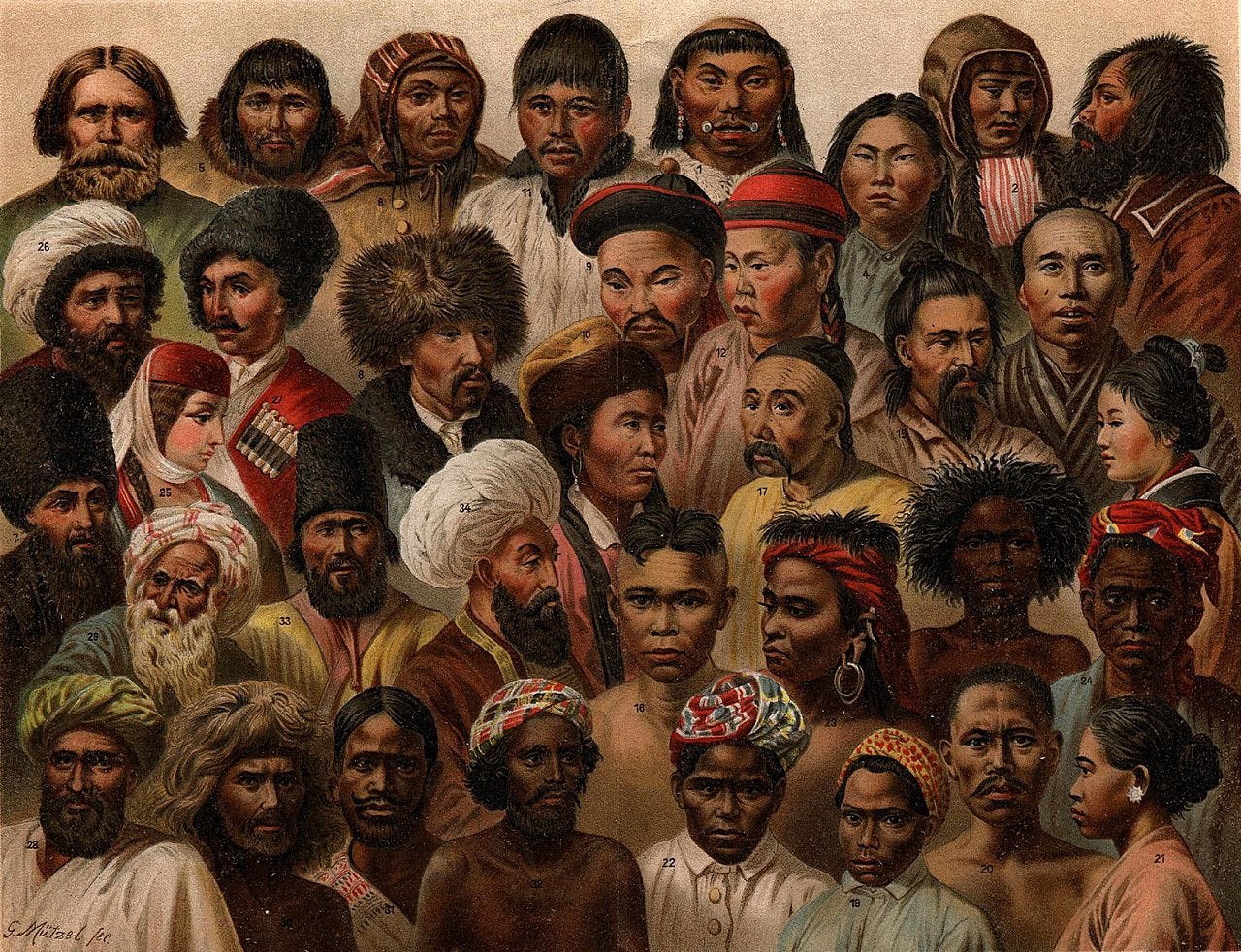
A 1904 depiction of Asian ethnicities.

The early medieval scholar Regino of Prum wrote the following:
Diversae nationes popularum interse discrepant genere moribus lingua legibus.
For those (such as myself) not up on the their Latin, that translates as:
The peoples of various nations differ by origin, customs, languages and laws.
This quote has been much cited since. Its fourfold formula was frequently used by medieval writers. For instance, Bishop Bernard of St David’s wrote to Pope Innocent II referring to:
populos nostre provincie natione, lingua, legibus et moribus, iudiciis et consuetudinibus discrepare
In English,
the peoples of our province are distinct in nation, language, laws and customs, judgements and manners
But manners are part of customs and laws entail judgements, so it is a more poetic version of the same fourfold formula.

About law
This was a region and an era where your law could be as much about which group you belonged to as where you lived. A single sovereignty could readily entail a variety of systems of law. A single system of law (e.g. Brehon law) could operate across several sovereignties. A non-resident in a city involved in a legal dispute might be asked what laws he lived under.

For much of the medieval period in Europe, particularly early in the medieval period, law was: the custom of the area. Which tended to mean: whatever we remember doing, last time this came up.

Henry II, the first Plantagenet king of England, used his Chancery and royal judges to develop what became the common law precisely because different people in different parts of England had different law (Norman, Saxon, Danish), with local variations. Royal judges would offer judgements that were both common across England and sought to synthesise the common elements between existing local laws, creating the common law of England.

Common law can be understood as evolving customary law. One of its many fine features is that it provides a structure of law without any Parliament, or other legislating authority, having to issue any specific law. A system of law with, moreover, an inherent tendency to move towards consistency. Something that is not a notable feature of statutory law.

In the modern era, law is very much a matter of state jurisdictions. So, setting law aside, that leaves us with origin (so descent or ancestry), customs and language as identifying an ethnic group. (Nation is ambiguous between state and people, but it is ethnicity that we are concerned with here.)

Ethnicity is something that develops in a mixture of separation (you overwhelmingly interact with members of the same group) and differentiation (there is one or more other groups that are identified as not being of the same group). Geographical separation means that folk can much more easily have specific customs and a specific language. (And, of course, specific laws.)

Ancestry matters because it is how customs and language are transferred across the generations. Yet the key thing is connections between people and common features that arise from the patterns of connection. A child adopted as a baby will be raised in the ethnicity of their adoptive parents and local community, regardless of their genetic ancestry. People are overwhelmingly raised by one or more biological parents, or adopted within the same group, so ancestry tracks ethnicity very strongly. But it does not drive ethnicity.

The overwhelmingly dominant connection between ancestry and the ethnicity in which folk are raised, drives some muddy thinking about ethnicity (and race). The notion that DNA tests can determine ethnicity, particularly for policing boundaries between ethnicities in intermingled communities, is deeply confused thinking. The bits of ethnicity that matter are your customs, your language, your expectations, your received framings, your patterns of connection. None of that is genetic or genetically defined.

Ethnicities can arise and fade away while genetic lineages continue. In his The Art of Not Being Governed: An Anarchist History of Upland Southeast Asia, James C. Scott notes that people and families in Southeast Asia would periodically choose new cultural identities, creating “crazy quilt” ethnic enclaves that ethnographers found perplexing. Ethnicities are nowhere near as primordial as is often pretended and ethnic identities can often be situational and strategic.

Race has come to refer to continental ancestry and the concept, and its associated social meanings, has had the most social power when folk of different continental ancestry interact. Most notoriously in the Americas where settlers from one continent (Europe) invaded another continent (North or South America, as the case may be), imported slaves from a third continent (Africa) and then received migrants from a fourth continent (Asia). That skin tone and other physical features were strong indicators of continental ancestry interacted with these very different social roles to make race talk an easy, and sadly convenient, option.

Yet continental ancestry on its own does not tell us what customs or languages you, or anyone else, has. No continental group, including Australian Aborigines, is a single ethnic or cultural group or users of a single language. Nor are they a single breeding population. Hence the speciousness of race — continental ancestry — as an analytical category, however socially convenient it has been for various folk to invest social meanings in physical markers of ancestry. Particularly as a divide-and-dominate dynamic.

Race as continental ancestry is also a long way from the C14th chronicler John of Fordun describing Scotland as a land of one nation but two races:
Mores autem Scotorum secundum diversitatem linguarum variantur ; duabus enim utuntur linguis, Scotica videlicet et Theutonica, cuius linguae gens maritimas possidet et planas regiones, Scoticae vero montanas inhabitat et insulas ulteriores. Maritima quoque domestica gens est et culta, fida, patiens et urbana, vestitu siquidem honesta, civilis atque pacifica, circa cultum divinum devota, sed et obviandis hostium iniuriis semper prona. Insulana vero sive montana, ferina gens est et indomita, rudis et immorigerata, raptu capax, otium diligens, ingenio docilis et callida, forma spectabilis, sed amictu deformis, populo quidem Anglorum et linguae, sed et propriae nationi, propter linguarum diversitatem, infesta iugiter et crudelis. Regi tamen et regno fidelis et obediens, necnon faciliter legibus subdita, si regatur.
Or, in English:
The manners of the Scots vary according to their language, for they employ two languages, Scottish [Gaelic] and Teutonic [Scots/English]. The race of Teutonic language has the sea coasts and lowlands, that of Scottish language inhabits the mountainous areas and the outer isles. The race of the sea coasts is domesticated, civilized, faithful, patient, cultivated, decently dressed, refined and peaceable, devout in church worship, yet always ready to withstand any harm done by its enemies. The island or mountain race, however, is wild, untamed, primitive, intractable, inclined to plunder, leisure-loving, quick to learn, skilful, handsome in appearance but vilely dressed, and continually fiercely opposed to the English people and language, but also to their own nation, on account of the difference of language. Nevertheless they are loyal and obedient to the king and the kingdom, and also easily subdued to the laws, if they are ruled properly.
Intermingling
DNA as a convenient sorting mechanism is only likely to be reached for if people of different ethnicities (so different ancestries) are intermingling. If everyone lives in villages of the same ethnicity, but are aware of there being villages of a different ethnicity over there, the issue does not arise. It is only if folk within the same larger community have varied ancestries (and so varied ethnicities) that it is going to seem sensible to look for some “sure” marker, such as biological ancestry or (once the technology exists) DNA testing.

The problems of maintaining separate identities in a situation of intermingling is what led to the development of the “one drop” rule in the US. If you had any element of African ancestry you were “black” (i.e. not “white”). It is a sign of how intense the stigmatising social meanings attached to being “black” were, the extension of the inherited dishonour of slavery onto their descendants, that no mulatto or mixed-race identity emerged in the US, in contrast to much of the rest of the Americas.

Ironically, this pattern was largely because electoral politics — who could vote and for whom — mattered so much more in the US. In societies with proportionately smaller settler elites, where voting was not much of an issue, it tended to be convenient to have an intermediary group as social buffer and suppliers of services. In such situations, one gets gradations of ancestry rather than sharp continental-ancestry (“race”) divisions, where elite ancestry provides the most benefits and slave or indigenous ancestry the most handicaps.

With the current attempts within the US and the wider Anglosphere to stigmatise the social meaning of “whiteness”, we are nowadays getting the same one-drop rule exclusion working in contemporary society, but going the other way so that any degree of non-European ancestry confers a presumptive moral advantage, making one “a person of colour”. But this just flips the pejorative effect while also wrestling with the problem of differentiation in intermingled societies. Situations of intermingling are much more likely to see situational or strategic use of ethnic (or racial) identities. 

It looks "racial" as the elite came from Europe and the slaves from Africa. But all elite structures have a strong element of ancestry in them (including in Leninist states). It is just that differing continental origins associated and associate different physical markers with different social/class status.

To impose simple, dividing, categories on intermingled populations requires systematically ignoring (inconvenient) ancestry. The original “one-drop” rule in the US meant ignoring any European ancestry among those with African ancestry. The new version similarly generally involves ignoring any European ancestry among “persons of colour”.

There is a long history of ignoring inconvenient ancestry. Patrilineal kin-groups generally ignored maternal ancestry, as matrilineal kin-groups generally ignored paternal ancestry. But the point in such cases was also very much to enforce differentiating boundaries.

The great advantage of DNA is that it reveals the complexities of ancestry. It does not track the complexities of culture. It does, however, point to how genetic lineages pass through, and into, cultures.

Segregation
The use of public policy to impose residential segregation in the US, to the extent of attempting to break up integrated neighbourhoods, was another way of wrestling with problems of differentiation among intermingled folk.

The enforced spread of residential segregation in the US, including attempts to segregate previously integrated neighbourhoods, is set out in Richard Rothstein’s The Color of Law. A note in the book quantifies the path of residential segregation, including its intensification under FDR’s New Deal. In the ten largest US cities:
in 1880, the neighbourhood (block) on which the typical African American lived was only 15 percent black; by 1910 it was 30 percent, and by 1930, even after the Great Migration, it was still only about 60 percent black. By 1940 the local neighborhood where the typical African American lived was 75 percent black.
Reducing intermixing by residential (and other) segregation is an obvious way to sharpen identity differentiation in a mixed society. This is typically done by giving one group a greater say than another. Whether it was such things as hostile zoning and resident activism in the US producing the aforementioned residential segregation, shuffling people off into reservations or giving one group claims over land that others cannot have.

Such segregation can indeed sharpen identity, but at the cost of giving up the benefits of interaction with the wider society. Denying folk such benefits has often been the purpose of such segregation. It is likely to be the effect of it, regardless of intention.

Marriage
As is well known, intermarriage, a very intimate form of intermingling, blurs ethnic identity. Hence groups that wish to retain their separate identity either block intermarriage or require outside spouses to convert to their group. Such marriage boundaries then provide a way to continue intense patterns of connection that differentiate the group from outsiders.

Religions have often been very much involved in setting up and policing such boundaries. As Nassim Nicholas Taleb notes, the right sort of boundary laws can turn a minority into a majority:
the spread of Islam in the Near East where Christianity was heavily entrenched (it was born there) can be attributed to two simple asymmetries. The original Islamic rulers weren’t particularly interested in converting Christians as these provided them with tax revenues — the proselytism of Islam did not address those called “people of the book”, i.e. individuals of Abrahamic faith. In fact, my ancestors who survived thirteen centuries under Muslim rule saw advantages in not being Muslim: mostly in the avoidance of military conscription.
The two asymmetric rules were are as follows. First, if a non Muslim man under the rule of Islam marries a Muslim woman, he needs to convert to Islam — and if either parents of a child happens to be Muslim, the child will be Muslim. Second, becoming Muslim is irreversible, as apostasy is the heaviest crime under the religion, sanctioned by the death penalty. 

The famous Egyptian actor Omar Sharif, born Mikhael Demetri Shalhoub, was of Lebanese Christian origins. He converted to Islam to marry a famous Egyptian actress and had to change his name to an Arabic one. He later divorced, but did not revert to the faith of his ancestors.

Under these two asymmetric rules, one can do simple simulations and see how a small Islamic group occupying Christian (Coptic) Egypt can lead, over the centuries, to the Copts becoming a tiny minority. All one needs is a small but continuing rate of interfaith marriages and little or no defection from the group folk are marrying into.

Such boundaries and group identities have often been reinforced by participation in common rituals.

Vanishing heritage
John Wood Jnr has observed that, on the Euro-American (“white”) side of his family, folk can talk about a heritage reaching back to Europe. As can Asians with Asia or recent African immigrants with Africa. On the (slave-descended) African-American side of his family, there is a striking absence of such. The descendants of American slaves have no such identifiable specific ancestral heritage(s), as slavery mixed ethnicities together while slaves had no family rights.

As sociologist Orlando Patterson has pointed out, the social death that slavery entailed, and the consequent natal alienation, separating slaves from any acknowledged line of ancestry or family rights, defined the slave far more then being property did. (Medieval serfs, for example did not suffer any such social death, any such alienation from family and heritage.) The process of Transatlantic exile of slaves, and their descendants, was a process of exile much more profound than that experienced by others arriving in the US and the rest of the Americas.

The descendants of slaves imported into the Americas have the most “American” identities, as they have had to create their identities within the Americas and within the context of European settlement. (Indigenous Americans have identities that reach back before European settlement, so are not anchored in the creation of new societies that American implies.) It is not accidental that various quintessential American cultural forms, such as Jazz and Blues, are grounded in the experience of American slaves and their descendants.

Within the US, the descendants of American slaves were an ethnic identity defined by “race”, i.e. African ancestry. They are now an identity submerged by “race”, as Afro-Caribbeans and recent African immigrants are both also “black”. (Though there is some evidence that American-born generations of such migrants may be at last somewhat socialised into attitudes of the descendants of American slaves; another instance of the effects of intermingling.)

That no descendant of American slaves has graced the Presidential nomination ticket of either major US Party is very much obscured by focusing on race rather than ethnicity. (President Obama and Vice-President Harris are both examples of migrant heritage, not US slave heritage.)

Custom
Culture is a notoriously ambiguous term, with literally hundreds of definitions being offered by social scientists. Custom also suffers from a certain ambiguity. Fortunately, philosopher Cristina Bicchieri has done the work, setting out a rigorous theory of norms that helps clarify thinking on these matters. This is done formally in The Grammar of Society and with a more practical focus in Norms in the Wild.

Using Prof. Bicchieri’s definitions:
Customs are things you regularly do because they work for you. They may generate expectations among other folk but they are not driven by such expectations.
Conventions are things you do because other people do them. They both generate, and are driven by, expectations. Language and fashion are classic convention-driven activities. Conventions allow people to coordinate with each other.
Social norms drive things you do because other people expect you to do them and are likely to sanction you if you do not.
Moral norms drive things you do because you believe it is the right thing to do regardless of the expectations of others.
The use of custom by Regino of Prum as quoted above clearly covers customs, conventions and social norms. In mixed societies, folk adopt and lose customs. They adopt and lose conventions. Both customs and conventions lose their distinctiveness, blurring identity. Similarly with social norms. So, once again, we can see the power of connection and the problems of intermingling.

Thinking in terms of custom, convention and social norms brings out the power of religion as a creator and preserver of identity. For participating in common rituals can be a great binding and a differentiating mechanism. Indeed, they are much of the social effect of ritual.

Corrosive contradictions
But thinking in terms of custom, convention and social norms also brings out how much politicising and legalising identity becomes a morass of corrosive contradictions. Such attempts to differentiate seek to draw lines in ways that social intermingling must undermine.

One ends up being at war with such intermingling — and so at war with any overarching common identity — while creating endless possibilities for strategic game-playing that is likely to be highly socially corrosive in its effects. Such identity-games can create simple categories that are appealing in their simplicity and disastrous in their lack of nuanced realism.

Ethnicities evolve. They change, emerge, weaken, strengthen, mingle and divide according to circumstances. Attempting to create a legal, moral and political order based on primordial, unmixed and fixed identities is to build a series of noxious fictions into the social order that are at war with the complexities of the human in ways that invite bad, even disastrous, outcomes.

There is no good form of identity politics. What look to be such (e.g. the various agitations for civil rights, whether for women, African-Americans, indigenous people, same-sex attracted …) have been attempts to gain the benefits of a common status, not a divided and differentiated one. To be judged by the content of one’s character, not some general, differentiated, category. That is true of every emancipation struggle, from the campaigns against slavery onwards.

Intermingling strengthens the case for a common humanity and a common citizenship. Contemporary identity politics do not represent the completion of the processes of celebrating a common humanity, and building a common citizenship, but the overturning of them. Hence contemporary identity politics replicating and adapting past methods for forcing differentiation on intermingled communities. But, then, divide-and-dominate retains its appeal to elites and forcing differentiation has always been very useful for that. As it still is.

[Cross-posted, somewhat improved, from Medium.]

Thursday, June 10, 2021

Feminism is grounded in Christian social dynamics

The Women’s movement is a product of conditions that existed in Western society but nowhere else.


Feminism was a product of North-Western Europe (and the settler Anglosphere) for very specific cultural and institutional reasons. The women’s movement had to come out of a culture which already gave women’s choices sufficient standing, where elite women could organise and deploy resources, where kin-group loyalties did not dominate and constrain, and where explicit political bargaining was already part of the institutional landscape. This combination of features occurred in no other cultures other than in the societies that descended from Medieval Latin Christendom.

As I noted in my previous post, European and Chinese settlers in the American West provided a revealing natural experiment about the difference in that status of, and possibilities for, women in a society that had sanctified single-spouse marriage and (apart from some fringe regions) eliminated kin groups (Christian Europe and its descendant societies) as against a society with polygynous marriage and powerful kin groups (China).

The Church’s sanctification of a women’s consent as necessary for marriage elevated the status of women’s choices. As did the Church’s (admittedly bequest-hungry) support for the property and testamentary rights of women. Single-spouse marriage meant that elite women habitually had access to resources and were acknowledged as public organisers of resources.

The lack of kin groups required the development of alternative mechanisms for social cooperation. It also meant that women’s fertility was not an asset of their kin group, so giving more power to their consent being required for marriage.

Women’s fertility being an asset of their kin group — and connections within the kin group being essential for social standing, risk management, income prospects, wealth protection, etc — are fundamental drivers of (dis)honour killings; fatal enforcement of the restrictions on choices for women, with family members killing their own daughters in order to protect their standing within the kin group and local community.

Open source law
That in Christian Europe law was human (i.e. was not based on revelation) meant that those cooperative mechanisms could be entrenched in law, and so could the bargains they came to. A long history of explicit political bargaining developed with associated institutional structures. Structures that were most extensively established in what became Parliamentary states.

In both Islam and Brahmin civilisation, law was based on revelation and dominated by religious scholars (ulema) or priestly castes (Brahmins). A legal system can create new precedents. It cannot create new revelations. While the varying capacity to enforce rulings on people and groups affects the evolution of revelation-based legal systems, as does having to deal with new circumstances, it is not possible within revelation-based law to get together and legally create, ratify or entrench new social bargains. This made it much harder to develop alternative social-cooperation mechanisms to kin groups.

Moreover, neither Sharia nor Brahmin law were positive for the status of women. Sharia famously weights the testimony of male and female witnesses differently. While Manusmrti, the most famous Brahmin legal source, explicitly banned women from being independent and required wives to threat their husbands as if they were gods. This is, after, the legal-religious culture that gave us suttee (aka sati).

Between kin groups treating the fertility of women as an asset, dishonour killings, polygynous marriage lowering the status of women, and law enforcing (even sanctifying) subordinate status on women, other state-society civilisations were far more patriarchal than Christian Europe and its derivatives.

In the Christian Eurosphere (Europe plus the regions where European settlers became the dominant population), the women’s movement utilised available social status, patterns and resources in new ways. It was still, however, very much a mobilising of the cultural and institutional resources that were available to be used in such a way. Hence, there is often relatively little time gap in Western societies between all men getting the vote and women getting the vote.

The emancipation sequence
The women’s movement was part of what we might call the Emancipation Sequence (banning the slave trade, banning slavery, Jewish Emancipation, Catholic Emancipation, adult male suffrage, women’s suffrage, second-wave feminism, civil rights, queer emancipation …). Two centuries of mass movements organised to expand the legal rights and social participation of previously excluded groups, utilising the structures and possibilities within societies based on Christian social dynamics.

Other civilisations produced mass movements, but they were invariably organised around religious and mystical (even occult) ideas, as other civilisations lacked well-established mechanisms for such explicit political bargaining.

The key fight of second-wave feminism in the 1960s and 1970s was over women getting unilateral control over their fertility. This put second-wave feminism in direct opposition to the Church and Christian sexual mores and teachings. This has obscured how much the women’s movement was very much a product of specifically Christian doctrines and consequent social dynamics. Hence feminism in other cultures being both derivative, and somewhat pale shadows, of its Western origins.

The retreat from moral universalism that used to be a feature of progressive politics has seen Western feminists increasingly retreat from concern for women from other cultures, using the “but that is their culture” excuse. How far would the Western women’s movement have got if their opponents could simply close down their claims with “but that is our culture”? The women’s movement may have arising in Western societies but it also did very much seek to change key aspects of Western culture. It is very odd for contemporary feminists to deny that opportunity and lever to women from other cultures.

The women’s movement was also built on the Christian roots of Western culture and social dynamics. History, it’s complicated.


[Cross-posted from Medium.]

Thursday, April 11, 2019

Bravado in the absence of order

Areo magazine has published another essay of mine, Bravado in the Absence of Order, which examines why African-American urban communities have such high rates of homicide and other violence. The essay uses medieval history, and contemporary societies other than the US, to illuminate social patterns that are less clear if one just looks at the US in isolation.

Wednesday, December 20, 2017

Islam as Philosophical Dead End

Classical (622 to c.940) and early medieval Islam was a civilisation and period with a rich philosophical tradition. Yet Islam became a philosophical dead end, an example of how societies, indeed, an entire civilisation, can stop supporting philosophy as a significant autonomous realm of enquiry. Islam is a civilisation where religion swallowed philosophy, with consequences we are still living with.

That Islam as a civilisation developed a rich philosophical tradition is obvious and well-documented. Thinkers writing in Arabic were particularly important in reconciling Aristotelianism with monotheism. Ibn Rushd (Averroes) (1126-1198) in particular was very influential in Latin Christendom. So much so that St Thomas Aquinas (1225-1274), in his writings, would refer to Aristotle (384-322 BC) as The Philosopher and Ibn Rushd (Averroes) as The Commentator.

Yet that rich philosophical tradition dwindled away to vanishing point. It did so as the result of interaction between ideas and social change.

The social dwindling

The social change was the dwindling away of any basis for supporting scholarship and learning outside explicitly Islamic religious schools. The movement to a fief-based military administration reduced administrative bureaucracies, by far the most significant basis for non-religious intellectual life within Islamic societies, while dominance by Turkish-speaking warlords, from the time of the Seljuqs (1037-1153) onwards, led to a surge in ostentatious support for religion by rulers making up for their non-Arabness via ostentatious religious adherence and patronage.

The shock and devastation of the Mongol invasion (much larger and far more traumatic than Crusader seizure of narrow coastal strips), including the sack of Baghdad (1258), the only time the capital of a living Caliph had fallen to non-Muslims, aggravated these trends. The Mongol invasion and conquests, particularly the violent ending of the Abbasid Caliphate, apart from a sad shadow-line in Cairo, both disrupted what non-religious scholarly networks remained and encouraged a retreat into an intensified Islamic identity. These processes are well set out in Lost Enlightenment: Central Asia's Golden Age from the Arab Conquest to Tamerlane by S. Frederick Starr.

The religious trumping
The two philosophy-swallowing ideas developed from the Ash'ari Islamic school, being given their civilisation-winning form by al-Ghazali (c.1058-1111). The moral claim was that revelation was the only ground for ethical judgement. This effectively eliminates moral arguments as the West understands them (indeed, as all the origin civilisations for philosophy—the Hellenic world, northern India and China — understood them). It is why Islamic states are the only ones who have seen fit to issue an adjusted form of the UN's Universal Declaration of Human Rights, the Cairo Declaration on Human Rights in Islam, because all ethical arguments and claims have to be grounded in revelation.

The metaphysical claim is that Allah is the source of all non-human causation. Not merely the ground of causation in the Aristotelian sense, but literally the immediate cause of everything that happens. Allah remakes the world at every moment; what we see as causal patterns are merely the habits of Allah, which Allah can change at any moment.

Unsurprisingly, the dwindling away of philosophy also saw the dwindling away of science within Islam, as intellectual effort was directed back into religion. Especially as law was part of religion and religious scholarship, apart from elements (qanun) allowed to operate in the silences of Sharia.

In this way, Islam pre-eliminates competition to itself from within Islamic society. It does so by eliminating the category of moral arguments beyond itself and allocating all non-human causation to Allah. So the levers to replace religious grounding of social and physical understanding which led to the Western Enlightenment are absent within mainstream Islam, as they have no resting points. Especially as the Quran is held to be the literal word of God, a manifested miracle, written in a single language and, according to mainstream Sunni thought, outside time, so far more insulated from critical scholarship than the Christian scriptures.

Adoption aborted
The expansion of the non-religious intelligentsia from the early C19th onwards that the (much delayed) spread of the printing press and efforts of modernising rulers created in the Middle East appeared to give the basis for Islam as a civilisation to “catch up” with the West. A modernising intelligentsia did develop, but largely as a by-product and support for modernising regimes and states.

This centrally-organised, copycat modernisation largely failed to put down deep roots in Islamic societies. Worse, it became tied to success of those states and regimes. (In some ways, a repeat of what happened to the original wave of reason-based modernisers, the Mu'tazila of Classical Islam: Islam is a civilisation of strong recurring patterns.)

Islamic Enlightenment: the Struggle between Faith and Reason, 1798 to Modern Times by Christopher de Bellaigue provides a history of this modern abortive Enlightenment: an informative and perceptive review is here.

The Islamic world became dominated by fascist-analogue regimes. But defeat in the Dictators’ War (1939-1945) had rather discredited Fascism and the Soviet bloc was willing to supply arms and support to friendly regimes, so socialism became the dominant rhetorical flavour of non-monarchical regimes in the Islamic world. (Note that I mean socialism in its command economy sense rather than its “free-floating good intentions insulated from any failures” sense.)

But Arab socialism fared no better than its alternatives elsewhere; though, being less actually socialist, rather less catastrophically so. In the West, the failure of socialism led to postmodernism and its close associates, such as Critical Theory. In Islam, the failure of socialism led to political Islam (Islamiyya) and to a search for a purified Islam (notably the Salafi and Deobandi movements).

This was somewhat less of a difference than it might appear, as al-Ghazali’s causal analysis was grounded in essentially the same epistemologically sceptical argument about what we can know from observation later developed by Hume (1711-1776), which so influenced Kant (1724-1804) and from there led to postmodernism.

Moreover, Critical Theory permits no moral argument beyond itself, as the purpose of all “proper” intellectual endeavour is to support the struggle against oppression and any critique of that goal is, by definition, illegitimate defence of exploitation and oppression. An attitude which has seeped into the wider society (particularly the "cultural commanding height" industries of media, education, entertainment and IT) to the extent that start-up entrepreneur Sam Altman can report that it is easier to discuss heretical ideas in China (under a Leninist regime) than in Silicon Valley in California.

Monarchy, mosque and military
So both mainstream Islam and PoMo progressivism pre-eliminate competition. In Islam, outside the monarchical societies, the weakness of civil society leaves politics suspended between mosque and military. (The monarchies tend to have richer civil societies precisely because the monarchies both incorporate and balance between mosque and military and failed to wage quite the war on traditional society that the modernising military regimes did.)

The revival of the headscarf both speaks to the power of Islam and the revival of political Islam. (Trying to spin it as some sort of manifestation of female power is pathetic, even given that reveiling has largely been driven by [pdf] expanded education and employment opportunities for women, as it is a response responding to the power of Islamic belief.) That the Islamic world still has significant patches of relatively low literacy rates (especially for women), and (in the case of the Arab world) a strikingly low rate of translation of non-Arabic books, does not help the develop of non-religious thinking and ideas within Islamic civilisation.

What intellectual life there is within Islam remains trapped within the concerns of the early Western Enlightenment—how to replace and overcome religious grounding of social and physical understandings versus how to insulate religion from the pressures of modernity—and remains without the levers that the Western Enlightenment relied on. While there is some dim possibility of a moderate modernising approach developing, Islam is not likely to stop being mostly a philosophical dead-end civilisation any time soon.

[Cross-posted at Skepticlawyer.]

Saturday, September 19, 2015

History and surplus: 10,000 years in one blog post

Human history has largely been driven by the creation and use of surplus production -- that is, production beyond subsistence. (Subsistence meaning sufficient to sustain life and reproduction.) The change from prehistory to history is very much a matter of the generation and use of surplus production.

There are essentially only three ways for such surplus to be created.

(1) Labour scarcity
If the scarcity of labour compared to land and capital increases, then the return to labour rises as the marginal productivity of labour increases (since there is more land and/or capital per unit of labour) and so labour income can rise above subsistence. A demographic disaster such as the Black Death creates such labour scarcity.

Given the historical norm of low levels of capital in human societies, such labour scarcity as did occur was predominantly increased scarcity relative to available land. For most of human history, demographic disaster was the dominant way for labour scarcity to occur, apart from a sufficiently quick increase in the ease of calorie production (such as the introduction of potatoes and other crop transfers from the Columbian Exchange) raising the productivity of land.

Sufficiently quick because, in the normal course of events, any labour scarcity would be (literally) eaten away by increased production of babies. What is known as Malthusian dynamics. (The most accessible discussion of Malthusian dynamics is in Gregory Clark's A Farewell to Alms; though see Deidre McCloskey's response to his [pdf] explanation for the onset of the Industrial Revolution.)

Historically, most labour scarcity generating occurrences were once-off events with, due to Malthusian dynamics, temporary effects on labour scarcity. Hence, after the Black Death, across most of Europe (but strikingly not in NW Europe), wage rates declined back to their pre-Black Death level.

Until the Growth Revolution (i.e. the Industrial Revolution and associated changes), growth in production mainly went into increased population. That is the essence of Malthusian dynamics.

There were some exceptions, periods of economic efflorescence that various scholars have noted: the Greek city states; the Roman Republic and Early Empire; early Abbasid Mesopotamia; C18th Qing China; Tokugawa Japan; early modern NW Europe. But these periods and places were historically unusual (and are matters of lively debate among scholars) and were generally followed by return to Malthusian norms. Long-term population growth was very low -- slightly over 2 surviving children per woman.

Increased labour scarcity (relative to other factors of production) is the only mechanism for increasing average returns to labour other than increasing productivity of existing factors of production (which historically mean land, as capital was so limited) through technological change (e.g. increased calories production via new crops).

(2) Capital intensity
If resources are set aside from consumption, capital (the produced means of production) can be created. That setting aside creates an initial surplus. It can be done as a setting aside from reproduction -- say, to support religious devotions. It can also be done as a deliberate investment in higher quality children (i.e. with more human capital) rather than simply more children.

Whatever the motive for the original setting aside, capital so created can then generate surplus production and do so for the owners of the capital (for, if it does not, there won't be much capital creation). It, however, will only generate a surplus for the holders of capital unless the production of capital is of such a scale as to increase general labour scarcity.  (I.e. sufficient capital per unit of labour to raise labour productivity, giving labour a scarcity premium above subsistence.) Even then, the production of capital will only have a continuing effect if the resultant increase in the ratio of capital to labour is persistent: if the labour force is growing, that then requires capital to be created at the same, or faster rate, than the growth of the labour force. 

Central to the Growth Revolution was capital being continually created at a higher rate than the growth in the labour force; including investment in higher quality children. The latter effect eventually led to the demographic transition -- a dramatic drop in fertility rates. Especially as a drop in child mortality rates encouraged greater investment in child quality, rather than more children, while the increased role of capital in production, and concomitant increased labour scarcity, led to expanding economic role and status for women (who disproportionately bear the costs of child rearing; so giving them more say and options can be expected to lower fertility rates). The expansion of the importance of human capital further broadened benefits from capital deepening and increased capital complexity; both effects then moving societies even further away (pdf) from any worker-capitalist class dynamic.

As Adam Smith famously noted with his example of division of labour in pin manufacture, specialisation increases production; this, of itself, does not increase incomes above subsistence, apart from some initial labour scarcity effects eaten away by normal Malthusian dynamics. If specialisation does increase incomes above subsistence in any persistent way, it is usually to the owners of the capital involved, and may also involve some combination of human capital, specific-location resources, advantages in information and risk management. Specialisation increases the scope and scale of production and, typically, of markets but does not, thereby, increase labour income.

Note: one should generally not use the term capital accumulation to describe the process of expansion of capital. Capital does not "accumulate" like dust bunnies under the bed. Capital is the produced means of production; someone has to make the conscious decision to use resources to produce capital rather than simply consuming the resources; and to produce some specific capital. Who is making such a decision, why and in what circumstances is not some mere bagatelle, it is utterly central to understand any process of capital formation. The phrase capital accumulation does not put capital into history, it takes it out of history--that is, out of the realm of contingent human action.

Note also: in the Growth Revolution, innovation hugely dominated allocation. That is, it was not merely that resources were set aside for the production of capital, it was that--due to the invention and application of technology that we call innovation--the range and productivity of capital (and thus labour) that could be, and was, produced hugely expanded; notably through the expansion in access to, and use of, energy. The increase in the range and productivity of capital then further encouraged the further creation of capital and innovation, creating a reinforcing upward spiral.

It was not merely the "piling up" of capital that counted, but the institutions and habits for the expanding creation, and effective use, of capital. (The importance of effective use is a major reason why foreign aid has often had such disappointing results--including the, often dreadful, incentives it generates for authoritarian rulers.)

Economic historian Deidre McCloskey has written extensively on how innovation, and the habits and institutions thereof, came to dominate allocation; but the more general point of innovation hugely dominating allocation in explaining growth and expanded capacities of the Growth Revolution is widely acknowledged by those who attend seriously to the history of such matters. In Gregory Clark's words:
investments in knowledge capital that generate efficiency growth not only explain most modern economic growth at a proximate level, they explain all modern growth (p.207).
Thus, given any significant degree of potential technological dynamism, the costs of any scheme which sacrifices innovation for allocation (including redistribution) will expand dramatically over time.

NB: This section has been slightly expanded to (hopefully) clarify the importance of efficiency growth in the Growth Revolution.

(3) Expropriation
The third way to generate a surplus is to seize production before it can be use to support reproduction. That is, to expropriate it.

Mere increased production does not generate a surplus above subsistence. The normal historical effect of increased production is simply to support more babies. Expropriation allows production to be seized and diverted (pdf) before it supports more babies, thereby creating a social surplus.

Across human history, from the development of farming around 11,000 years ago until the Growth Revolution, what was the dominant way to create a social surplus? Expropriation.

Leaving aside low level thievery and brigandage, by far the dominant expropriators were wielders of organised violence. Which is why the history of major human constructions prior to the Growth Revolution is utterly dominated by such wielders. Either the rulers of states, or their agents, or those holding expropriation franchises under them.

Hence also, the production of enough stored food able to be so expropriated is basic to the development of ranked societies, and social hierarchy more generally. Thus social hierarchies, and ultimately states, evolved where (pdf) cereals (which are highly seasonal, so have to be stored, so can be expropriated) dominated farming and not where non-seasonal tubers (which don't have to be stored, so can't be sufficiently expropriated) dominated farming -- potatoes, being seasonal, had the same dynamics as cereals.

All of which meant that elite social position tended to be much more about one's (direct) relationship to the process of expropriation than to (what might be a quite indirect) relationship to the means of production. Thus, in medieval societies, that mounted armoured warriors were capable of dominating (and expropriating surplus from) local peasants was much more central to their social position than simply holding land--especially as, in the case of Islamic societies, they held tax grants, not land as such. (Tax grants were used rather than land grants, as owned land would be subject to Sharia inheritance laws, requiring division between heirs into holdings not large enough to support a mounted armoured warrior).

But even those who were directly involved in production had their lives profoundly affected by the processes of expropriation. Indeed, anthropologist and political scientist James C Scott has written a brilliant book on how basic mode of production (farming, horticulture, foraging), and even cultural identities, resulted from different social strategies regarding the process of expropriation. (Seriously, if you have any interest whatsoever in historical dynamics, one really should read Scott's The Art of Not Being Governed: An Anarchist History of Upland Southeast Asia.)

Expropriation could also be a way of blocking labour from enjoying the benefits of labour scarcity--through operation of human bondage (i.e. slavery or serfdom).

Providing so as to extract
It would be incorrect, however, to think that expropriation was merely extraction. To have stable expropriation, a certain amount of public goods had to be provided to establish and maintain the social order needed for routine expropriation.

State societies (societies with a dominant wielder of violence) were safer than non-state societies and societies where the state was the effective monopoly wielder of violence tended to be safer still. There was an implicit protection deal attached to state expropriation, as live-and-productive farmers provided so much more to expropriate than dead-or-devestated ones.

That the state both expropriates and protects (and protects in order to expropriate) is the basis of the paradox of politics or paradox of rulership. The fundamental idea was expressed by Ibn Khaldun (1332-1406):
[The residents] are thus prevented by the influence of force and governmental authority from mutual injustice, save such injustice as comes from the ruler himself (p.97).
The paradox can be expressed more generally:
We need the state to protect us from social predators but the state itself is the most dangerous of social predators.
A paradox that can never be solved, only managed more or less well. (Lebanon represents the technique of avoiding state predation by having a state so weak it fails to provide basic public goods.) The delusion that one has solved the paradox of politics typically just leads to much greater levels of state predation, since said delusion generally leads to abandonment of checks and balances on wielding state power. (The entire history of Leninism is one long, dreadful, series of examples of this principle.)

The struggle over expropriation
Until the Growth Revolution, production was overwhelmingly dominated by land (i.e. farming, fishing, mining); expropriation dominated the creation of social surpluses; and organised violence dominated expropriation. Therefore, violent struggles over land productive enough to support expropriation were a hardy perennial of human affairs. Even in our time, high value production fixed in location (such as oil or diamonds) is disproportionately important in promoting armed conflict (pdf).

Historically, trade complicated but did not transform matters. Trade was potentially mobile, so it was a somewhat more difficult expropriation problem than fleecing stationary standard-crops farmers, as trade typically required more specific provision of public goods.

But precisely because trade could swell or shrink in ways sensitive to state action (such as provision of public goods of what quality over what territory), and given its nodes-and-routes network structure and effects, trade almost certainly had positive economies of scale for revenue collection--unlike land, whose revenue possibilities likely simply scaled up proportionately for any given quality of land. Trade was thus likely disproportionately important for the size and scale of state activity; as revenue from trade counteracted diseconomies of scale in costs of control over territory while revenue from land generally did not. (Even gold and silver mining mostly got its revenue benefits from the value of gold and silver as trade goods.)

But taxing trade was not so much more difficult an exercise than fleecing stationary farmers that states did not also use organised violence to seize key trade nodes and attempt to dominate trade routes. This was the world aptly described by Nicolo Machiavelli (1469-1527) in his Discourses on Livy:
... it is not gold, as is vulgarly supposed, that is the sinews of war, but good soldiers; for while gold by itself will not gain you good soldiers, good soldiers may readily get you gold.
A transformed dynamic
The Growth Revolution's dramatic increase in the role of capital, especially given the diverse (i.e. heterogeneous) nature of capital, did transform matters. Expansion in the ways of producing social surplus made expropriation much more derivative in accessing any surplus, as it became much more about taxing surplus production after it was generated rather than creating surplus by seizing production before it was used to support reproduction.

But becoming more derivative did not mean that the return to expropriation declined. On the contrary, the Growth Revolution's expansion of documented employment arrangements has massively increased tax's share of total production (especially in societies which have adopted the full Growth Revolution deal), by making production much more transparent to the state and turning firms into agents of the expropriation process. But that is about accessing surplus production, not creating surplus by removal, so seriously shifts the expropriation incentives in dealing with those from whom production is to be expropriated.

Thus, the potential return to production-fostering (rather than production-seizing) government greatly increased (with the caveat about fixed-location resources noted above; though even there a certain competence in managing the resource is also required). Effects that have been further increased by innovation dominating allocation in expanding production. All of which has encouraged a strong tendency to broadening of political bargaining and participation.

The shift to taxing income (much of it labour or human capital income), the increased density and complexity of production, the political organising and bargaining implications thereof; all increased dramatically the return to linguistic homogeneity, and ethnic homogeneity more generally, for states. Linguistic and ethnic homogeneity increased the costs of exit, allowing higher taxation. Ethnic homogeneity reduced diversity in framings and preferences, allowing more efficient public good provision; while linguistic homogeneity improved the ability to negotiate taxation-public good trade-offs.

In other words, abstracting from other factors, the more ethnically homogeneous the citizens of a state are, the higher the taxation-expenditure trade-off can be expected to be; the less ethnically homogeneous the citizens of a state are, the lower the taxation-expenditure trade-off can be expected to be.

One of the inherent problems of the EU is that -- due to its ethnic and linguistic diversity -- it lacks a functional demos, a shared realm of political bargaining among citizens.

It is not surprising that the first political-organisation effect of the Growth Revolution -- massive increases in trade due to railways and steamships -- led to a surge in imperial expansion (i.e. territorially larger states) while the second political-organisation effect of the Growth Revolution -- particularly given the massive expansion in literacy-based markets -- was a dramatic surge in nationalism.

The latter effect, combined with the dramatic drop in the relative importance of land per se as a revenue source, then massively undermined territorial imperialism.  That is, territory became both less specifically important and more problematically differentiated (at least in the sense of resident populations): though a solution to the latter has been population exchange so as to achieve ethnolinguistic homogeneity.

More recently, globalisation of culture and the evolution of English as something of a global lingua franca has weakened these effects, at least in the developed democracies.

Expansion of political nations to include all adult citizens has tended to make such democratic states more squeamish about casualties from warfare. While the expansion of welfare states meant that colonisation of their own societies came to massively dominate colonisation of other societies as a source of expropriation-funded career paths (especially given externalisation of the welfare model -- i.e. foreign aid).

But, even among authoritarian states, the decline in the return to seizing land in general, and linguistically divergent populations in particular, probably has something to do with the general drop in violence, particularly wars, as well as the shift in wars being much more intrastate (i.e. fighting over access to, and direction of, existing expropriation processes) than interstate (disruptively seizing production). One notes that regions where various states share a single language, often without much deeper history as states (the Middle East), or where borders have a high rate of failure to match ethno-linguistic patterns (Africa) have been prone to higher levels of violent conflict.

It is also not surprising that states organised to expropriate labour surplus (i.e. all command economies)* have been more highly militarised than states with broader production of social surplus (and the politics that tend to evolve with that).

On the other hand, the decline in the material return to violence tends to make other motives more salient in the violence that does occur; motives such as status (notably avoiding or achieving domination) and search for transcendence (whether secular or religious).

Even so, that we live in a world where the production of social surpluses above subsistence is not dominated by expropriation (and violent struggles over the same) is just one of several ways we live in a very different world than did those before the Growth Revolution.


* Command economies control prices and wages. That means that prices and wages can be set so that basic wages are below subsistence, but "bonuses" from extra production push wages above subsistence, increasing the systematic extraction of labour surplus beyond merely paying subsistence wages. (Public choice economist Mancur Olson explains the mechanics nicely in his posthumous Power and Prosperity: Outgrowing Communist And Capitalist Dictatorships.) Hence command economies typically blocked exit--all labour surplus extraction systems rely on blocking alternatives for workers. (So, yes, exit-blocking command economies are in the same game as slavery and, especially, serfdom.) It is also why states that continue to have Leninist regimes (China and Vietnam) open their borders as they move away from being command economies; (1) they extract revenue from a widening range of transactions, so wish to expand the number of transactions, which closed borders militate against and (2) the less they rely on extracting labour surplus, the more the benefit in blocking exit declines.

[Cross-posted at Skepticlawyer.]

Saturday, August 8, 2015

The hollow states of Islam

Reading Norman Davies's Vanished Kingdoms, it struck me how much Islamic states--across most of the history of Islam--resembled the fluid warlord states of Europe in the centuries immediately after the collapse of the Western Roman Empire, but did not resemble the institutionally resilient Christian states of the later medieval period. These divergent paths came from the very different internal dynamics of Islamic and Christian states, particularly, the very different roles of law within the two civilisations.

Subjects but not participants
Once the Abbasid revolution (750) had broken the link between the Arab tribes and the Caliphate, by establishing the common status of all believers, Islamic states became very poorly linked to the subjects they ruled. Law was overwhelmingly the province of Islamic scholars, so Islamic states could not use law as an integrative mechanism. Sharia mandated the division of inheritance among heirs, which blocked the creation of substantive warrior aristocracies or powerful merchant families. Sharia did not recognise juristic persons, which blocked the creation of corporate bodies able to bargain with rulers. As law was overwhelmingly the province of Islamic scholars, but derived from the words and example of Muhammad, that meant there was no group of people who could sit down and change the law.

So Islamic rulers did not face powerful interest groups outside the state apparatus with whom they could bargain (or be forced to bargain) while what they could putatively bargain over was hugely attenuated. Thus Islam remained dominated by ruler-and-agents states where political processes and decision making were essentially entirely interior to the state apparatus.

Hence, until the late C19th, Islam never moved (with the exception of the Ottoman Empire, of which more below) beyond the fluid warlord states analogous to those of Christian Europe in the centuries immediately after the collapse of the Western Roman Empire. For example, there was continuously a state in Egypt; the Fatimid, Ayyubid and Mamluk states from the Fatimid conquest in 969 to the Ottoman conquest in 1517. But the ruling dynasties, their soldiers and warriors were all overwhelmingly (and continually) foreign. There was a state in Egypt, but there was no Egyptian state.

Which was the typical Islamic pattern, especially anywhere slave soldiers were used in significant numbers (mamluks, ghilman, janissaries). But not only there. Thus, whenever the dominant Islamic state in Iberia collapsed, it would fracture into the small taifa states. There was none of the institutional resilience or continuity of a kingdom of England, or France or, for that matter, a kingdom of Castile or Aragon.

Which gave the Christian states a decisive and continuing advantage over the Muslim warlords, hence the Reconquista. But Christian rulers dealt with warrior aristocracies, continuing merchant families, legal persons, had states with specific laws and could bargain with all the former over the latter.  Of course the Christian states were much more resilient; they had far deeper institutional links with the societies they ruled.

Ottoman (partial) exception
The Ottomans were able to develop a state that balanced sipahi tax-collector mounted armoured warriors with royal sipahi household cavalry and Janissary slave soldiers. The Janissary corps was founded in 1383 and abolished in 1826. It was primarily recruited (until 1683) by the devşirme child-levy.

The Ottoman state was organised in its internal operations by Kanun (state law operating in the silences of Sharia). The combination meant that the Ottoman dynasty and its agents could organise a state large and durable enough to successfully compete with Christian states. So successfully, that the Ottoman Empire advanced steadily into Europe until the disastrous Battle of Vienna in 1683.

Especially by using ghazis on the borders to continually soften up Christian borderlands by raiding (including slave raiding) them. Once the population and revenue of the Christian borderlands had been degraded or driven away, invasion and incorporation into the Ottoman Empire would follow. Whereupon the ghazis moved to the new border and the cycle would repeat.

Which worked fine, until the Serene Republic of Venice and the Habsburg Monarchy recruited grenz Serb peasant militia to hold the border, the Military Frontier. After that, the superior institutional power of the Habsburg monarchy (and the Romanov monarchy) were able to continually push the Ottomans out of Europe. Eventually, even relatively minor European states could do so. Processes which essentially replicated the dynamics of the Iberian Reconquista, except that the Ottoman state never fractured.

Note that I am not claiming the Ottoman state was more or better institutionally engaged with its subjects than other Islamic states; merely that the Ottoman state apparatus itself was more capable and resilient than was normal for Islamic states. Indeed, a recent paper (pdf) found that being ruled by the Ottoman Empire after the signing of the Treaty of Karlowitz (1699) has persistent (negative) effects today in higher rates of corruption and lower economic development.

Institutionally attenuated
All of which meant that Islam did not indigenously develop the institutionally resilient, social bargaining states of Christendom. Indeed, significant strands of Islamic thought reject the entire approach. In the words of the most prominent Salafi scholar of the C20th, Muhammad Nasir-ud-Din al-Albani (1914-1999):
Elections according to democracy are unlawful, and parliaments that do not govern in accordance with the Qur’an and the Sunna [orally transmitted traditions of Muhammad], but rather on the basis of the majority’s arbitrariness, are tyrannical. Parliaments cannot be recognized and Muslims can neither seek nor cooperate to found them, for they contend (combat) God’s revelation. And they are a Western technique made by the Jews and the Christians, who cannot be legally emulated (p.37). 
It is harder to develop democracy when the entrenched habits of social bargaining are, at best, only weakly developed and significant strains of belief reject the entire enterprise. The point is not whether many Muslims support democracy--they do, which is precisely what horrifies and enrages the Salafi. The point is whether the social habits and institutional patterns exist to support the politics of broad social bargaining and how strongly.

Not very, which does much to explain the serial conflicts and tyrannies of the Middle East. Though the examples of Malaysia, Bangladesh and Indonesia all suggest that Islam can get there, eventually.


ADDENDA: Not only was law not a mechanism that Islamic states could use to integrate their societies, it tended to work against such integration because the actions of rulers were often seen as against the letter or spirit of Sharia, of God's law. As the great Muslim thinker Ibn Khaldun wrote in The Muqaddinmah:
Royal authority … requires superiority and force, which express the wrathfulness and animality (of human nature). The decisions of the ruler will therefore, as a rule, deviate from what is right (p.154).
Lacking means to engage in compensating social bargaining, this tended to encourage withdrawal by pious Muslims from political life. Historian Daniel Pipes argues that the conflict between what Muslim rulers did and what Sharia rule was supposed to entail encouraged the development of slave warriors (pdf) by Muslim rulers, as they could not induce systematic loyalty from local Muslims. I would argue that the gulf between rulers and subjects had broader causes, but would agree that said gulf did encourage developing slave warriors: warriors whose scale of use, and status, were very much distinctive to Islam.

[Cross-posted at Skepticlawyer.]