Showing posts with label imperialism. Show all posts

Thursday, November 18, 2021

The Out-of Expansions

There have been four major out-of expansions by Homo sapiens.

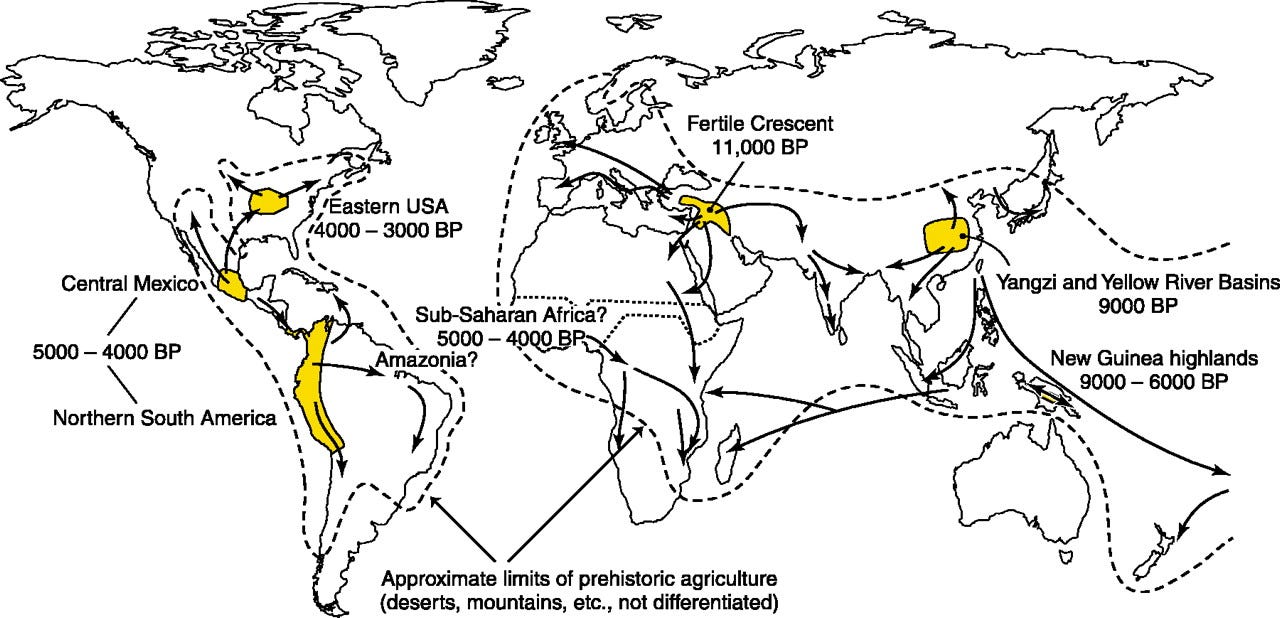
Source: Jared Diamond, Peter Bellwood, Farmers and Their Languages: The First Expansions, Science, 2003, Vol. 300, Issue 5619, pp. 597–603.

Four great out-of population expansions have widely dispersed Homo sapien populations. The out-of-Africa expansion of foragers; the out-of-the-river-valley expansion of farmers; the out-of-the-steppe expansion of pastoralists; and the out-of-Europe expansion of settler empires and states.

Out of Africa: the expansion of Homo sapiens

Whether an exit from Africa around 100,000 years ago was successful or not is still debated. From around 60-50,000 years ago, there was a sustained exit from Africa. Homo sapiens spread to occupy all continents except Antarctica, absorbing and replacing all other Homo populations. These foragers spread at a rate of about 10km a year, at least in areas without existing Homo populations.(1)

Homo sapiens are more gracile than other Homo, so likely lower in reactive aggression and thus more cooperative. Though the delay in the exit(s) from Africa, and the long period of coterminous occupation of Eurasia (maybe 20,000 years), suggest only a marginal advantage over Neanderthals, although this may have changed over time. This spreading of Homo sapien foragers concluded with the settling of southern regions of South America around 14,600 years ago.

Out of the river valleys: the expansion of farmers

Starting around 11,000 years ago, farming populations expanded across arable land, absorbing and replacing foragers. The process is still going on in Africa, Amazonia and elsewhere. In Oceania, farmers occupied islands without previous human habitation, reaching New Zealand probably around the year 1320.

The transmission from foraging to farming was a lengthy one. While not generally more productive per hour of effort than foraging, farming was able to extract many times more calories from arable land, lowered the cost of child-rearing and created an increased protection problem, encouraging the development of more coercive capacity.(2) Hence the continuing expansion, and dispersal, of farming populations.(3) Farmers and farming generally spread across arable land at a rate of around 1km a year.(4) The development of farming also had significant adverse health consequences, with deteriorations in dental health, loss of height, increased infectious disease and more signs of metabolic stress.(5)

Farmers seem to have traded-off less food-search time (food search being more difficult for child-minding) for more food-processing time (easier for child-minding) and more immediate access to energy (calories) (so quicker weaning of children) for less long-term access to nutrients. 

The flesh of plants are much more likely to be toxic to humans than is the flesh of animals while plant calories and nutrients are often significantly less bio-available than are animal calories and nutrients. Hence the increased need for processing to use plant foods. Hence also the existence of an calorie/nutrient trade-off when shifting from a more animal-based diet (as foraging diets generally have been) to the plant-based diet of farming. (Much of modern food culture has been systematically trading-off taste and calories against nutrient quality.)

With the development of farming and pastoralism, there was a dramatic narrowing in male genetic lineages. The rate of elimination of male lineages varied by region. Overall, only about 1-in-17 male lineages survived this harrowing of male lineages. (Female lineages were almost entirely unaffected.)(6) This harrowing of male lineages was a result of the expansion among agro-pastoral peoples of the (social) technology of aggression against fellow humans.

The development of pastoralism intensified the pattern of elimination of male lineages.(7) The harrowing of male lineages largely came to an end with the development of chiefdoms and states. That is, when the technology of exploitation overtook the technology of aggression — conquered males became providers of tribute and taxes, so were worth protecting. 

The biggest single thing states do after extracting surplus (taxing) is pacify: they don't want their taxpayers killing each other.

Out of the steppes: the Indo-European pastoralist expansion


Pastoralist populations from the Pontic-Caspian steppe domesticated the horse (though the Botai people further east may have domesticated horses earlier) and, from about 5,000ya, and continuing until about 3,000ya, expanded into Europe, the Iranian plateau, the Tarim Basin and Northern India. During these surges of settlement, Indo-Iranians develop the horse-drawn chariot (c.4,000ya).

The steppe-descended pastoralist population eventually expanded across all of Europe, interbreeding with the Neolithic farmers. Though not in the Basque Country and Sardinia.(8)

The original steppe pastoralist population had, like various other pastoralist populations have, developed a mutation for lactase persistence. This enabled much higher metabolic return from post-infancy consumption of milk. Different pastoralist populations in Afro-Eurasia have developed different lactase persistence mutations.(9)

Dairying broadens access to nutrients and enables the extraction of around five times as much calories from grassland as could be done via ruminant meat consumption.(10) This biological advantage likely enabled millennia of expansion, resulting in Indo-European languages, and cultural patterns ultimately derived from steppe pastoralism, covering Europe, the Iranian plateau and Northern India.

After the Indo-Europeans settlement surges had petered out, Indo-Iranian peoples also pioneered horse archers and heavy lancers (c.2,700ya). Later pastoralist peoples continued to periodically ravage, or even conquer, agrarian peoples. Only the Arab and Turkic dispersals resulted in large-scale demographic expansion beyond pastoralist heartlands. In both cases, settlement following imperial conquest.

Out of Europe: the empires-and-settlers expansion

Beginning c.1500 and petering out c.1960, European populations expanded across Siberia, the Americas and the Antipodes.

The combination of competitive jurisdictions, single-spouse marriage, the abolition of kin groups (requiring the development of replacement mechanisms of social cooperation), as well as being able to entrench social and political bargains in law (as law was not based in revelation, unlike Sharia and Brahmin law) meant that Europe had far more variety of political institutions than elsewhere. This gave the selection processes of history far more to work with, resulting in Europe developing more effective states. Christian Europe’s swift adoption of the printing press after 1450 greatly aided the dissemination and development of information and technology while reducing administrative costs.

With gunpowder, the compass, and ocean-going sail technology, Europeans spread out from Europe in a largely maritime out-of expansion. The out-of-Europe expansion included waves of settlement. (The Russian conquest and settling of Siberia did not need the maritime step, though riverine expansion was important in parts of Siberia.)

Settlement generally followed, sometimes preceded, imperial expansion. Both the Russian and American nation-building-through-settlement were also imperial projects, although animated by rather different ideas and institutions.

The Europeans acquired a portmanteau biota of supporting plant and animal species. Where their portmanteau biota became dominant, Europeans became the dominant human population, creating neo-Europes. Where the biota failed to do so, they did not.(11)

Being Eurasian, so resistant to the Eurasian disease pool, gave Europeans a disease advantage in the Americas and the Antipodes. Having much more effective states was their advantage within Afro-Eurasia and allowed them to exploit their disease advantage far more completely and speedily outside it. Their advantage in state (and other cooperative) organisation eventually (albeit temporarily) expanded their control across regions where they were systematically disease-disadvantaged (including Sub-Saharan Africa).

The Homo sapien advantage is non-kin cooperation. Medieval European Christian civilisation put non-kin cooperation “on steroids” and so Europeans equipped with compass, gunpowder, ocean-going maritime technology and the printing press created the Eurosphere across four continents plus Siberia and ended up dominating the planet — until other peoples learnt their tricks.

In general


The expansions have been getting faster: taking at least 35,000 years; 11,000 years; 2,000 years; 500 years.

The, currently underway, fifth great out-of expansion — the out-of-the-countryside movement to the cities — is a series of concentrations, rather than a dispersal.

Each of the out-of dispersals has its specific characteristics, but each represents Homo sapiens behaving like Homo sapiens. Indeed, behaving like any biological population with access to new resources, including new abilities to access resources.

[An earlier version was posted on Medium.]

Endnotes
  1. B. Llamas, L. Fehren-Schmitz, G. Valverde, J. Soubrier, S. Mallick, N. Rohland, S. Nordenfelt, C. Valdiosera, S. M. Richards, A. Rohrlach, M. I. B. Romero, I. F. Espinoza, E. T. Cagigao, L. W. Jiménez, K. Makowski, I. S. L. Reyna, J. M. Lory, J. A. B. Torrez, M. A. Rivera, R. L. Burger, M. C. Ceruti, J. Reinhard, R. S. Wells, G. Politis, C. M. Santoro, V. G. Standen, C. Smith, D. Reich, S. Y. W. Ho, A. Cooper, W. Haak, ‘Ancient mitochondrial DNA provides high-resolution time scale of the peopling of the America’s,’ Science Advances, April 2016, Vol.2, №4, e1501385, suggests that it took 1.4kya to people the length of the Americas. As this is a distance of roughly 14,000km, that is an expansion rate of around 10km a year.
  2. Samuel Bowles, ‘Cultivation of cereals by the first farmers was not more productive than foraging,’ Proceedings of the National Academy of Sciences, March 2011, 108 (12) 4760–4765.
  3. Jared Diamond, Peter Bellwood, ‘Farmers and Their Languages: The First Expansions,’ Science, 25 April 2003, Vol. 300, Issue 5619, pp. 597–603.
  4. Joaquin Fort, ‘Demic and cultural diffusion propagated the Neolithic transition across different regions of Europe,’ Journal of the Royal Society Interface, 2015, 12: 20150166.
  5. Katherine J. Latham, ‘Human Health and the Neolithic Revolution: an Overview of Impacts of the Agricultural Transition on Oral Health, Epidemiology, and the Human Body,’ Nebraska Anthropologist, 2013, 187.
  6. Tian Chen Zeng, Alan K. Aw & Marcus W. Feldman, ‘Cultural hitchhiking and competition between patrilineal kin groups explain the post-Neolithic Y-chromosome bottleneck,’ Nature Communications, 9 Article number: 2077 (2018), published 25 May 2018.
  7. Patricia Balaresque, Nicolas Poulet, Sylvain Cussat-Blanc, Patrice Gerard, Lluis Quintana-Murci, Evelyne Heyer & Mark A. Jobling, ‘Y-chromosome descent clusters and male differential reproductive success: Young lineage expansions dominate Asian pastoral nomadic populations,’ European Journal of Human Genetics, January 2015.
  8. Iosif Lazaridis, ‘The evolutionary history of human populations in Europe,’ arXiv 1805.01579, submitted on 4 May 2018.
  9. Hadi Charati, Min-Sheng Peng, Wei Chen, Xing-Yan Yang, Roghayeh Jabbari Ori, Mohsen Aghajanpour-Mir, Ali Esmailizadeh and Ya-Ping Zhang, ‘The evolutionary genetics of lactase persistence in seven ethnic groups across the Iranian plateau,’ Human Genomics, (2019) 13:7. Scholarly discussions of lactase persistence in Europe often pay remarkably little attention to the same specific lactase-persistence mutation occurring in Europe, Iran and Northern India, so must have spread by a pastoralist, not a farming, population.
  10. Latham, op cit. Morton O. Cooper and W. J. Spillman, ‘Human Food from an Acre of Staple Farm Products,’ Farmers’ Bulletin, №877, October 1917, U.S. Department of Agriculture. Gregory Cochran and Henry Harpending, The 10,000 year explosion: how civilization accelerated human evolution, Basic Books [2009] (2010) cite the Bulletin for their discussion in Chapter 6 of the Indo-European expansion, including the role of lactase persistence.
  11. Alfred W. Crosby, Ecological Imperialism: The Biological Expansion of Europe, 900–1900, Cambridge University Press, [1986] (1993).

Saturday, September 18, 2021

Why Americans are F***-ed in the head over race

The history of the US has generated persistent racial derangement. It has been far more of a case of structures generating racism than of racism generating structures.

Source.

People have a pretty good understanding of their own continental ancestry. People are also relatively accurate at picking out other people’s continental ancestry.

This is not surprising. There was not much mixing of lineages across continents until relatively recently, at least outside continental border regions. This was due to the limitations of technology: specifically very limited transport capacitie. Moreover, thousands of years of separate genetic lineages, with genetic bottlenecks creating relatively small founder populations for various continents, meant that there are fuzzy-boundary, but relatively clear, patterns of physical markers of continental ancestry.

So, a folk concept of race based on continental ancestry has some, relatively straightforward, patterns of physical-markers to work off. Hence the history of skin-tone descriptors of race. With race becoming to be understood as being continental, or some significant sub-continental region, ancestry. (Medieval Europeans had a rather different concept of race, one much more language based — so it made sense for a C14th commentator to talk of Scotland being one nation with two races: highlanders and lowlanders as thy spoke different languages.)

The US in particular has a long history of obsessing over race because continental origin coincided with fundamentally different roles in colonial society (the settlers, the dispossessed and the enslaved). Different roles that persisted into the country created by the American Revolution.

Slavery, settlement and racism

As continents produce neither single cultures per continent nor single breeding populations per continent, analytically, remarkably little follows from physical markers of continental ancestry being relatively clear. But as physical markers of continental ancestry are collectively visually relatively clear, they can, very easily, have social meanings attached to them. Which, of course, has happened repeatedly. Especially when one region has systematically enslaved people from region(s) with different general patterns of physical markers. Or when folk from one continent have populated another. We can call these the slavery effect and the settlement effect.

Both have proved to be powerful generators of racism: attaching normative ranking to continental (or region thereof) origin. That is, positive social meaning to one’s own group and (especially) pejorative social meaning to those with a different continental origin (and so a different social role).

A third generator of racism has been imperialism: domination of a state created by one continental origin group over folk with differing continental origins. This has been a rather stronger generator of elite or theoretical racism than more general racism, as imperialism is mostly an elite activity. (A 2018 study found that the UK and Portugal, the two surveyed countries with the longest histories of colonialism, had generally the lowest levels of racism among the surveyed European countries.) Though all racism, and race talk, starts off as an elite discourse.

The fourth generator of racism has been ethnicised religion. The classic version of this being racialised Jew-hatred.

None of these factors are sufficient in themselves to generate racism. The Romans were mass-enslaving imperialists who settled new areas and tended to dislike Jews. Racism was not a feature of their culture.

For the Romans were not a xenophobic culture regarding descent. Folk of any origin could become Roman citizens, including ex-slaves. Their slaves could be of any origin. Their society and their thought did not structurally differentiate by continental origin.

Moreover, Romans traditionally were not moral universalists. So, they did not have to generate some generalised story about why some folk were slaves. Slaves were simply losers and if they were freed, and became Roman citizens, then they became winners. Folk would put that they were freedmen (i.e., ex-slaves) on their tombstones, as that showed how much of a winner they had become.

Islam and racism

The first significant discourse grading people as cognitively deficient, based on physical markers of continental origin, came out of Islam. Islam being an imperial, evangelising monotheist (so morally universalist) religious civilisation that systematically enslaved people to their north (including Europeans, notably Slavs) and people to their south (Sub-Saharan Africans).

Folk of such origins were repeatedly characterised by Islamic writers as being cognitively deficient. Often either due to too little sun (Northern Europeans) or too much sun (Sub-Saharan Africans). So, in Chapter Three of his Tabaqāt al-ʼUmam (Categories of Nations), geographer Sa’id al-Andalusi (1029–1070) wrote:
The rest of this category, which showed no interest in science, resembles animals more than human beings. Those among them who live in the extreme North, between the last of the seven regions and the end of the populated world to the north, suffered from being too far from the sun; their air is cold and their skies are cloudy. As a result, their temperament is cool and their behaviour is rude. Consequently, their bodies become enormous, their colour turned white, and their hair drooped down. They have lost keenness of understanding and sharpness of perception. They were overcome by ignorance, and laziness, and infested by fatigue and stupidity. Such are the Slavonians, Bulgarians and neighbouring peoples.
(The English word slave likely derives from Slav.)

The patterns of castrating male slaves, and of incorporating the children of Muslim fathers into the umma, the Muslim community, meant that centuries of mass slavery failed to generate an ex-slave underclass within Islamic lands. But there are still linguistic traces of these centuries of mass slaving: abd in Arabic can both refer to slave (as in Abdullah, slave of Allah) and to Sub-Saharan African.

Christianity and racism

The Americas were subject to imperialism and mass settlement from Christian Europe. Added to this imperialism and settlement, millions of slaves were imported from Africa. This made continental origins socially salient in the Americas and did so from within a morally universalising religious perspective Christianity). This was a situation made for racism to develop. Which it duly did.

Hence the confused interaction between Christianity and racism. On one hand, the Gospel of Love applies to everyone. Indeed, from the earliest days of Christian European settlement of the Americas, there were devout Christians who spoke and agitated on behalf of the moral status of the inhabitants of the Americas as children of God.

An early, and important, manifestation of this was the 1537 Papal Encyclical Sublimus Dei declaring that the inhabitants of the discovered lands, even if they did not know Christ, were children of God with natural rights and could not be enslaved. In the words of Pope Paul III:
… the said Indians and all other people who may later be discovered by Christians, are by no means to be deprived of their liberty or the possession of their property, even though they be outside the faith of Jesus Christ; and that they may and should, freely and legitimately, enjoy their liberty and the possession of their property; nor should they be in any way enslaved; should the contrary happen, it shall be null and have no effect.
This did not bar owning slaves someone else had enslaved. As African rulers were more than happy to take care of that stage of the process, Sublimus Dei had little effect on the Atlantic slave trade. 

The moral claims and reasoning of the Papal Encyclical were, however, in rather direct contrast with Sharia, which is entirely fine with enslaving non-Muslims who have not submitted to rule by Sharia (i.e. by Muslims), including sexually exploiting captured women. The last being endorsed no less than 15 times in the Quran and by the example (sira) and the acts and sayings (hadith) of the Prophet. A principle of Sharia is that the marriage of any woman captured by a Muslim man is automatically annulled by the act of capture.

The Anglosphere abolitionist movement in the C18th and C19th had strong Christian roots. As did the US civil rights movement of the mid C20th.

On the other hand, Christianity is a morally universalist religion. Like Islam, it required some justifying story about why you were systematically enslaving the children of God from Africa. It required some justifying story about why you were dispossessing the children of God in the Americas. 

Christian moral universalism later also required some justifying story why you were systematically denying the descendants of slaves political and other civil rights. These were never going to be good stories about the dispossessed, the enslaved, and the excluded. There were plenty of people who were racist, not despite being Christian, but because they were Christian.

Enlightenment thought, which was also morally universalising, had much the same confused interaction with race and racism as Christianity. On one hand, the scientific impulse to categorise could be, and was, mobilised to propagate racist ideas. On the other hand, seeing the world as a shared globe inhabited by a single human species, along with a sense of expanding human capacities, made slavery morally problematic on a scale never seen before. Hence the rise of the abolitionist movements.

As for the settlement effect, so long as the Amerindians were being dispossessed (and feared) by the settlers from Europe, the structural reasons to be racist against them remained strong. After they were subjugated and shoved into reserves, the underlying structural motives to be racist against them lost strength. The effortless virtue, and pleasures of contempt, that bigotry provides may linger, but the general social retreat from, and anathematising, of racism has further weakened what was already a form of racism in structural retreat. As the eminent political career of Herbert Hoover’s Amerindian Vice President, Charles Curtis, demonstrated.

The intensities of slavery

Slavery and its aftermath proved to be a different matter to self-justifying antipathy to Amerindians, who always had a certain warrior vigour going for them. As sociologist Orlando Paterson has brilliantly analysed, slavery does much more then reduce people to property, it imposes on the slave a form of social death. They have no social standing, no family standing nor heritage to be acknowledged. Slavery is profoundly stigmatising and dishonouring, as it deprives the slave of the capacity to have honour or any status that casts doubt on being a slave.

The slave States of the US operated one of the most closed slave systems in history. It became legally hard to manumit a slave and the stigmatising dishonour of slavery was not excised by freedom. A process of stigmatisation greatly helped by the slaves being of a different continental origin than the settlers. The generalised theories that justified slavery could not allow space for some moral transformation from not being a slave anymore.

Roman slavery, not having that justificatory burden, and not being divided by continental ancestry, was far more open. Hence ex-slaves could become citizens and would even boast of how far they had come from their former slave status.

In much of the Americas, an intermediary mulatto or mixed race (i.e. mixed continental origins) identity grew up. Such folk served useful intermediary roles between a small settler elite and large slave or indigenous population. This did not happen in the slave South of the US, as the political importance of voting, and the scale of European settlement, worked against a mixed-race identity emerging.

There was no particularly useful social role that a mixed-race group could fulfil that was not already being filled by folk of European ancestry. Moreover, if ex-slaves and their descendants began voting in any numbers, they could begin to wield political power. Which was both politically threatening and an affront to the justifications for slavery. The result was the “one-drop” rule, whereby any African ancestry identified your slave origins, with all the associated stigmas and exclusions.

These structures served the divide-and-dominate politics of the plantation elite. Before the Civil War, the plantation elite used a range of mechanisms to repress poor “whites”, the masterless men, who had no stake in the slave system but who traded and socialised with the slaves. After the Civil War, and the failure of Reconstruction, the plantation elite used the same range of mechanisms to repress the ex-slaves and their descendants. They simply racialised the operation of exactly the same repressive mechanisms that had operated against the masterless men before the Civil War into what became known as Jim Crow. The former masterless men were now on the “right” side of the exclusions, and were thereby incorporated into the Southern system.

As African-Americans migrated to the industrialising cities, a version of such divide-and-dominate strategies turned out to be congenial to, and adaptable by, urban elites. Public policy was wielded to generate increasing residential segregation, as such segregation makes divide-and-dominate tactics far more effective.

A note in Richard Rothstein’s revelatory The Color of Law, sets out the path of residential segregation. Residential segregation that was driven by public policy. Including intensifying under FDR’s New Deal. In the ten largest US cities:
…in 1880, the neighborhood (block) on which the typical African-American lived was only 15 percent black; by 1910 it was 30 percent, and by 1930, even after the Great Migration, it was still only about 60 percent black. By 1940 the local neighborhood where the typical African-American lived was 75 percent black.
At all stages, such divide-and-dominate politics only worked because people bought into the political framings and discourses that legitimated them. Far more of our thinking and decision-making is unconscious than we realise. Social selection processes work on information and feedback: but not necessarily fully conscious, or sufficiently critically examined, information and feedback.

Weakening racism


The experience of the Second World War, both the mass mobilisation for a common purpose and the horrors of Nazi imperialism and racism, as well as the pressures of the Cold War, increased, both domestically and internationally, the embarrassment that American racism generated. At the same time, the continuing fail in transport and communication costs made it easier for marginal groups to organise, as did increased urbanisation and suburbanisation.

So, the structural supports for divide-and-dominate racism weakened. The civil rights movement, and particularly Martin Luther King, brilliantly played up the moral embarrassment of racial exclusion. Both the Christian moral embarrassment and the American-ideals moral embarrassment. With mass communications making it easier to reach people for persuasive effect.

Hence the successes of the civil rights movement and the retreat of racism from being pervasive within American society to being a moral shame. Though, as Glenn Loury makes clear in The Anatomy of Racial Inequality, complex patterns of stigma have been rather more stubbornly persistent.

From this history, we can see that structural racism (or analogues such as systemic racism) is generally not a useful term. For it has been far more the case that structures generate and mobilise racism than that racism generates structures. Nor are such structures a necessary part of the social system. They are more about bending the social system in a particular direction.

After the civil rights movement

Which brings us to the graph at the top of this post and its odd pattern whereby “white” (i.e. Euro-American) Democrats were very much more likely to say that they knew someone who was racist in 2015 than in 2006, but “black” (African-American) and Hispanic Democrats were apparently somewhat less likely to say they knew someone who was racist in 2015 than in 2006.

If someone knows more people they regard as racist than someone else, that can be because (1) they are more likely to meet racists; (2) they are better at identifying racism; (3) they are more expansive in their characterising of racism; or (4) some combination thereof.

So, taking the 2006 results in the graph above, it could be that Euro-American Democrats were more likely to meet racists than Hispanic Democrats or Euro-American Republicans. Or that they are better at identifying them than Hispanic Democrats and Euro-American Republicans. Or that they have a more expansive definition of racism than do Hispanic Democrats and Euro-American Republicans. Or some combination of the above.

If we move to the 2015 results, Euro-American Democrats were far more likely to believe they knew a racist than were African-American Democrats, Hispanic Democrats or Euro-American Republicans. They were also the only group who increased their likelihood of knowing a racist since 2006, and did so dramatically. By contrast, both African-American Democrats and Hispanic Democrats became, if anything, less likely to believe they knew a racist. (The shifts were not statistically significant but do accord with long term patterns of declining racism.)

The most plausible read of this data is that racism has declined somewhat in the US (in accordance with long-term trends) but Euro-American Democrats have acquired dramatically more expansive definition(s) of racism. (Unless they are registering dramatically increased anti-white racism — we can reasonably give that low probability.)

So, by 2015, Euro-American Democrats apparently lived in a US of significantly more racists among the people they interacted with, while African-American Democrats and Hispanic Democrats did not.

If fluctuations in racism are largely driven by changes in structural factors, as history strongly suggests, that suggests a change in structural factors that is particularly affecting Euro-American Democrats, but not other folk. Something that is making race much more salient to them.

An obvious factor is the massive increase, since around 2010, in the use of racial terms by US elite media. As Democrats have far more confidence in elite media than do Republicans (a long-term tendency that increased dramatically from 2015), the dramatic upsurge in the media’s use of racial terms could be accounting for much of the “more people know a racist” effect.

Especially as there clearly has been an expansion of what counts, within elite race talk, as racism. Partly because our concept of a phenomena tends to expand as the prevalence of that phenomena shrinks. There has been, for example, a creeping expansion of what is labelled as harm in Psychology. But there has also been an expansion of the concept of racism due to the expanding influence of intersectionality and critical race theory. Especially in the education of increasing numbers of younger journalists.

Is there a structural reason for this increased focus on race? One is fairly obvious: the value of anti-racism as a status play. The more intense one’s opposition to racism, the greater the moral prestige in being ostentatiously anti-racist and, conversely, the greater the moral shame from failing to appropriately oppose racism. So, a status-play purity spiral gets set up. One that can be used to lever folk out of jobs. The bottom-up (but still elite) prestige play then becomes a dominance play. In a situation of elite over-production, such status-plays are a very useful weapon in struggles over opportunities and resources.

Ostentatious anti-racism can make one reluctant to admit that racism has declined or to give credence to other factors in explaining social dynamics. One becomes invested in continuing to ascribe social meanings to race. The surge in hate crime hoaxes fits in with this.

Function does not require intent
Unconscious psychological processes outstrip conscious reasoning, both in time and in scope, which makes many psychological phenomena possible… 
Andrew M. Lobaczewski, Political Ponerolology: A Science on the Nature of Evil Adjusted for Political Purposes, p.163.
The other reason for increased focus on race is less obvious, but has a longer historical pedigree. Overt racism might have become embarrassing, but the advantages to urban elites of divide-and-dominate politics has never gone away, so social selection pressures will continue to favour such politics. The more divided residents, workers and citizens are on racial grounds, the less elites have to deal with competing (against them) claims on resources. Symbolic race-identity politics are way cheaper for elites than politics that delivers good government. That is as true today in urban US as it was in the Antebellum or Jim Crow South. Hence racially-divided US cities are (by developed democracy standards) comparatively ill-governed, just as the Antebellum and Jim Crow South were in their time.

If anti-racism can be turned into a racialised divide-and-dominate strategy, as clearly it can, then all the better for opportunity-hoarding elites. Especially for elites facing intensified internal competition for resources and opportunities.

Intersectionality and critical race theory are very much elite products, coming out of places such as Harvard Law School. Nor do they have to be originally developed as divide-and-dominate mechanisms for social selection pressures to adapt them into divide-and-dominate mechanisms.

Moral concern easily becomes status plays. Status plays are naturally divisive. Moral dominion easily becomes social dominion. Such feedback loops provide much for social selection processes to work on.

Such outlooks and patterns of action do not have appear to their active proponents to be divide-and-dominate politics in order to function as such. Remembering that such framings and discourses work much better if folk can be convinced to go along with them, while social selection processes do not have to be entirely conscious. Especially as the prime mechanisms for self-deception are by manipulating salience. Particularly moral salience.

One cannot force oneself to believe what one doesn’t believe. We can, however, use focus on, for example, image-self-protection, to block paying attention to awkward facts or considerations. This is especially easy to do with highly moralised concerns and self-images. Both because of their emotional power and because it is inherent in moral claims that they be normative trumps. That one has an ostentatious image of oneself as being not-oppressive does not guarantee that one is not buying into politics that are, in fact, oppressive or self-serving.

Coverage by elite media of deaths in police custody, or at the hands of police, is particularly revealing. There is a general problem of police training and accountability in the US. One that varies far more by jurisdiction than it does by race (whether of police or civilian protagonist). If media had reported these things accurately, then a broad coalition could have been built up to improve police training and accountability.

Instead, by intensely and selectively racialising their coverage, the “racist cops” narrative was firmly established by elite media. Turning this into a specifically African-American-and-police problem rather than a general accountability-to-the-citizenry problem and allowing those propagating, and those accepting, the narrative to thereby parade their ostentatious anti-racism. A way easier, and more immediate, social and cognitive reward than doing the hard work of increasing police training and accountability. Hence “defund the police”: a simplistic but convenient symbolic politics that was way easier to pander to than improved police training and accountability.

Revitalising divide-and-dominate

Even better, one of the key mechanisms for divide-and-dominate has been to fail to provide effective policing in African-American urban communities (as measured by homicide clearance rates), thereby generating much higher homicide rates in those communities. (In rural US, Euro-Americans and African-Americans have identical homicide rates.) These differential levels of violence do more to racially divide US cities than any other factor.

The “racist cops” media narrative, and activism, so congenial to moralised self-image, and their associated status plays, has increased the level of violence in those localities and so increased the most racially divisive element in US cities. If one was seeking to revitalise divide-and-dominate politics, it would be hard to do better.

A recent study found that the more educated you were, the more politically progressive you were, and the more you trusted the media, the less well informed you were on police shootings. (But the more conveniently you believed, as far as divide-and-dominate politics went.)

Social intent does not entail social function. Social function does not entail social intent.

Elite race talk is always a divide-and-dominate mechanism. Elite race talk has, historically, been racist. Indeed, racist discourses have always started off as elite theories. But anti-racist race talk works just as well as a divide-and-dominate mechanism, provided one continues to ascribe social meanings to race and do so in pejorative ways. Which, of course, is what all the talk about whiteness, white supremacy, white racism, etc. does.

It is still a case of structures generating the assigning of divisive social meanings to race, far more than the reverse, seeking to bend the social system to their benefit. Even doing so within ostentatiously anti-racist rhetoric and moral framings.

What is that French saying? plus ça change, plus c’est la même chose: The more it changes, the more it’s the same thing …

(An earlier version was posted on Medium.)

Tuesday, January 9, 2018

The founding falsities of postcolonialism

In his discussion with anthropologist Philip Carl Salzman, evolutionary psychologist and YouTuber Gad Saad offers (at 8.48) the following:
By the way, in terms of generative grammar, whenever when I see the word 'post' before anything then that raises a flag that it's bullshit. So post = bullshit; postmodernism, postcolonialism, post-structuralism. So, maybe Chomsky can one day weigh in on why the introduction of post implies that we are going to generate nonsense.
As it happens, Chomsky is not a fan of postmodernism: he is too much of a member of the Enlightenment left for that.

I have been less than impressed with my encounters with postcolonialism. It seems to be based on three fundamental errors: the Marx Mistake, the Lenin Error and the Fanon Fallacy.

The Marx Mistake
Marx's conception of the state, so memorably set out in Chapter 1 of The Communist Manifesto (pdf) (1848) held that:
The executive of the modern state is but a committee for managing the common affairs of the whole bourgeoisie.
A useful (if somewhat grammatically challenged) summary-discussion of the Marxist approach to the state is here and a pithy summary is here. At its simplest, the underlying causal structure is that the production technology produces the class structure which produces the state. So that, while there is some scope for independent action by holders of state power, the class structure is prior to, and helps structure, the state.

Which is, for most of human history, simply false. For most of human history, the dominant creator of class structure was the state itself because the state was, until very recently, the dominant generator of surplus (that is, resources beyond the needs of basic subsistence) and surplus is the basis of social hierarchy.

Human societies, up until the break out of human productive capacity beginning in the 1820s, were basically Malthusian in their dynamics. More production led to more babies. The only way to systematically extract surplus was to extract resources before they were used to support more babies and, until very recently in human history, by far the dominant extractor of surplus was the state itself.

The state was originally an extractive parasite which needed to keep its host population controlled (or at least docile) and producing, as set out nicely in historical anthropologist James C. Scott's recent work Against the Grain: A Deep History of the Earlist States. Political economist Omer Moav and his colleagues have been developing models of original states as using coercive extraction to get (pdf) around Malthusian constraints including the importance of how vulnerable crops were to expropriation (pdf).

As an aside, whether states have stopped, and to what degree, being extractive parasites requiring docile-and-producing populations is very much a live question. One can, for example, reasonably see the decay of Detroit as a parasitic (mainly city) state apparatus bleeding the life out of a weak civil society undermined by economic changes that the state impedes adjustment to.

Historically, the only competitors to state taxation in producing surplus was various forms of non-state labour bondage (serfdom and slavery) and trade. The former because key to labour bondage is to extract surplus from labour generally paid at subsistence levels; expropriating, as much as is practicable, any scarcity premium from labour. (There is some complexity with regard to use of slaves in more skilled situations [pdf], but it is still about coercive extraction of surplus.) Some of the surplus was then used to maintain the control over those in bondage, the rest to support elite social niches.

While this could create social groups that the state had reasons to bargain with, the support of the state itself was usually required to maintain the labour bondage. The Black Death (which greatly increased the scarcity value of labour because it killed people, not land, machines or coins) failed to see a return to serfdom in Western Europe as the various crowns failed to support the smaller landlords in their demands to re-impose serfdom because it was not in the various crowns' interests to do so.

Trade also produced surplus because it was too variable (essentially, too risky) to be reliably babied-away and often required larger (i.e. surplus-including) social niches to operate.

Even in societies with significant non-state control of surplus, avoiding autocracy and tyranny was a perennial concern, precisely because of the continuing power of the state apparatus. But the entire issue of how to manage state power becomes a non-issue if one believes altering the class structure eliminates the problem, because the state "ultimately reflects" the underlying class structure. The entire history of Leninist tyranny flows from that misconception, in tandem with the necessity to hugely concentrate power to achieve the justifying social transformation.

By stripping away private economic activity, Leninist states were not being cutting edge modernisers, they were being profoundly atavistic. So much so, that the one remaining full-deal Leninist state is a hereditary theocratic autocracy (with deified rulers--an eternal President and eternal Secretary-General): the most atavistic version of the state.

So, a founding mistake of post-colonialism has been to fail to see the state as an structure with its own support and dynamics, not as some reflection of class or race. (Note that class-analysis is inherently superior to race-analysis because class analysis does actually connect to, or bundle together, things which could reasonably be causal units: race does not.)

The Lenin Error
The Lenin Error flows from the Marx Mistake. This was to see imperialism as primarily an economic-class phenomenon.

Imperialism is fundamentally a state phenomenon. Imperialism is what states do, whenever they able to do so in an extraction-positive way. States of all types of social arrangements and economic bases have engaged in imperialism. As soon as there was states, there was imperialism.

As historian Niall Ferguson has observed, imperialism is the least distinctive feature of Western civilisation. The remarkable things about Western territorial imperialism are:
  1. How successful it was.
  2. How comparatively little effort that success required.
  3. How much richer post-Imperial Western societies became.
Atlantic littoral European states (plus Russia) managed to occupy, directly or via neo-Europes, most of the globe. That is a striking level of success, unparalleled in human history.

Yet, at no stage, was the major military effort of any European society deployed against a non-European or neo-European society. European global expansion was achieved while European military forces mostly faced off against other European military forces.

Both these features are products of the same feature: Europe developed incredibly effective states. Since imperialism is what states do, those European states with avenues of geographic expansion (Atlantic littoral states and Russia) produced very, very successful imperialism. Hence also the greatest danger to European states being other European states, and so being where most European military effort was focused.

Looking at the alliance structure among the European Great Powers prior to the Dynasts' War (1914-1918), if extra-European imperialism was the key thing, Britain should not have been allied to France and Russia, who were its main imperial rivals outside Europe. It was internal European state dynamics which drove the alliance structure because the biggest threat to any European state was other European states.

And what happened when the European states abandoned those territorial empires? They got richer. Indeed, some of the richest European states never had any colonial possessions outside Europe (Switzerland being the most striking example). While the state with the longest extra-European empire (Portugal) was one of the least-rich of European societies by the time it lost its empire. 

Imperialism had much less to do with the wealth of European societies than trade (which did not require an empire; though sufficient state effectiveness and military power could certainly motivate imperial expansion to capture revenue from trade) and production within Europe (which also did not require an extra-European empire). 

If we see imperialism for what it is, a manifestation of state action, then the history of European imperialism becomes much more explicable. Moreover, one can see that European imperialism is an unusual manifestation of imperialism (albeit still state-based), which is a much wider historical phenomenon that has no intrinsic connection to being European, to "whiteness", or to capitalism. 

Not that Western states entirely gave up imperialism as they gave up their colonies. It is just that Westerners were, and remain, much better revenue-extraction targets than non-Westerners, so Western states shifted more to colonising their own societies. That Otto von Bismarck (1815-1898), as Chancellor of the Second Reich, and Eduard von Taffe (1833-1895), as Minister-President of the Austrian Empire, were founders of the welfare state is something to pay a bit more attention to.

Successful imperialism came late to Euro-Mediterranean Christendom cum Western Civilisation. From the C7th to the C16th, it mostly lost ground to a civilisation genuinely structured, from its origins, for imperialism, Islam. But, if one is committed to the Lenin error of imperialism as an economic-class phenomenon, then the imperialism of Islam vanishes from sight, as it is based on religion; particularly Sharia (from its origins, and in its nature, an imperial legal system), marriage laws and the consequences of polygyny in generating predatory males with no local wife prospects whose external aggression was then sanctified (including expropriating infidel women). Hence Islam, which was born in imperialism, aggressing against every culture and civilisation it came up against in its first millennia: something it never rejected, it just came up against European states who had (after a millennia) evolved into better predators. Mainstream Islam is a religion of dominance: which is the source of all the difficulties Islam is currently generating. 

The Fanon Fallacy
The Fanon fallacy comes from Frantz Fanon's (1925-1961) writings, particularly his The Wretched of the Earth (1961): some apposite quotes are here. The Fanon Fallacy is to mistake rhetorical justification for something's underlying nature. In particular, to see imperialism as a "white" phenomenon.

First, race is not a causal actor. It does not even bundle causal units together in a useful way. Plenty of Europeans were the victims of imperialism by European states (the Irish, Highland Scots, Welsh, Bretons, Basques, Catalans, Corsicans, Slovenes, Slovaks, Czechs, Croats, Estonians, Lithuanians, Latvians, Finns, Poles, Ukrainians ...).  Hardly surprising, as imperialism is what states do, not races.

Indeed, the Dynasts' War (1914-1918) was not sparked by extra-European imperialism, it was sparked by intra-European imperialism.

I call it the Dynasts' War because it was sparked by dynastic regimes under pressure from social changes, regimes that attempted to harness mass sentiment to preserve their regimes and ended up being swallowed by those sentiments: having mobilised mass sentiment requiring vindication-by-victory, they were then trapped by those same sentiments, so forced to continue the war to the bitter end (of their regimes). I dislike the term World War because the War of the Austrian Succession (1740-1748) and the Seven Years War (1756-1763) were at least as global as the 1914-1918 conflict.

It is true that racial arguments came to be used (mostly after the fact of conquest) to explain and justify European and neo-European imperialism. But justificatory rhetoric says something about audience for the rhetoric and the purposes of those using the rhetoric, it does not explain the underlying thing. Moreover, it is normal for imperialisms to have a central group who are mobilised to support the imperial project by status, career, resources and rhetoric.

In particular, it is normal for imperial state societies to generate justificatory rhetoric which exults the imperial culture and denigrates external or peripheral cultures. Chinese intellectuals, for example, did so for millennia; something that James C. Scott discusses in his wonderful The Art of Not Being Governed: An Anarchist History of Upland Southeast Asia.

The Fanon Fallacy takes the (largely ex-post) imperial rationalisation and sees it as structurally central: it functionally accepts (though morally reversing) the racial framing of later European imperialism and mistakes it for the underlying causal reality.

In fact, race is a counter-productive rhetoric for imperialism to adopt, as it seriously impedes incorporating the conquered into the imperial project. Racial conceptions of imperialism--compared to, say, religious or cultural ones--generate a much sharper contrast between conquerors and conquered while obscuring the nature of imperial conquest, turning it from a state action into a race action.

What destroyed European territorial imperialism was the consequences of the Dictators' War (1939-1945), particularly the interruption of colonial control due to conquest of European metropoles and Japanese expansion and Nazi imperialism giving imperialism a bad name among the populations of imperial powers while validating resistance to imperialism. Other factors included: the increased cost (both physical and moral) of control due to the spread of communication, transport and military technology; the falling benefit of territorial control due to both the expansion of communication and transport technology and (despite the two great wars) continuing expansion of productive capacity in Europe and the neo-Europes relative to many imperial holdings (particularly in Africa).

US naval hegemony providing a guarantee of access to oceanic trade also helped to reduce the benefit of extra-European territorial control. Inside Europe, the consolidation of ethnic nations meant that states could achieve a higher revenue/expenditure trade-off if their citizens shared a common language and culture. All of which was about the dynamics of states and domestic politics and nothing to do with race.

Between the Marx Mistake of failing to see that states have generally been central to class structures (a pattern that Leninist states, ironically returned to and exemplified), the Lenin Error of seeing imperialism as class-economic phenomenon rather than first and foremost a state one and the Fanon Fallacy of mistaking the largely ex-post imperial rationalisation of race as a causal feature of imperialism, it is not surprising that I have been serially underwhelmed by post-colonialism as a basis for analysis.

The Wiped Slate
But wait, there's more. There is considerable scholarly evidence that pre-colonial patterns and institutions have continuing effects on contemporary human societies (see here, here, here, here, and here). Including that whether a culture used plough-based farming or not influences contemporary attitudes on the status of women. Or that the length of time since a human population adopted farming has a significant long-term impact on average life expectancy.

This is not to claim imperialism and colonialism had no continuing effects--see here (pdf) for a study on how being ruled by the Ottomans continues to have adverse institutional effects. But there is an obvious importance gain for postcolonial studies to talk up the effect of colonialism on previously subject peoples. Which leads to what we might call the Wiped Slate Effect: treating colonialism as if it was by far the dominant moulding experience of colonial societies and that experience as unrelievedly negative. Clearly not true--Afghanistan (until the Soviet-Afghan War of 1979-1989), Iran (apart from the brief Anglo-Soviet occupation 1941-6) and Thailand were never subject to European territorial occupation, yet are hardly profoundly different from their neighbours, who were subject to such occupation.

The Lenin Error and the Fanon Fallacy both encourage tendencies to the Wiped Slate Effect. But so does Marx's view of modes of production being socially dominant, as in this 1853 piece on British rule in India:
All the civil wars, invasions, revolutions, conquests, famines, strangely complex, rapid, and destructive as the successive action in Hindostan may appear, did not go deeper than its surface. England has broken down the entire framework of Indian society, without any symptoms of reconstitution yet appearing. This loss of his old world, with no gain of a new one, imparts a particular kind of melancholy to the present misery of the Hindoo, and separates Hindostan, ruled by Britain, from all its ancient traditions, and from the whole of its past history. ...
Those family-communities were based on domestic industry, in that peculiar combination of hand-weaving, hands-spinning and hand-tilling agriculture which gave them self-supporting power. English interference having placed the spinner in Lancashire and the weaver in Bengal, or sweeping away both Hindoo spinner and weaver, dissolved these small semi-barbarian, semi-civilized communities, by blowing up their economical basis, and thus produced the greatest, and to speak the truth, the only social revolution ever heard of in Asia.
Lenin, of course, derived his analysis from Marx.

Which is not to say that Marx in anyway romanticised what the British found in India:
we must not forget that these idyllic village-communities, inoffensive though they may appear, had always been the solid foundation of Oriental despotism, that they restrained the human mind within the smallest possible compass, making it the unresisting tool of superstition, enslaving it beneath traditional rules, depriving it of all grandeur and historical energies. We must not forget the barbarian egotism which, concentrating on some miserable patch of land, had quietly witnessed the ruin of empires, the perpetration of unspeakable cruelties, the massacre of the population of large towns, with no other consideration bestowed upon them than on natural events, itself the helpless prey of any aggressor who deigned to notice it at all. We must not forget that this undignified, stagnatory, and vegetative life, that this passive sort of existence evoked on the other part, in contradistinction, wild, aimless, unbounded forces of destruction and rendered murder itself a religious rite in Hindostan. We must not forget that these little communities were contaminated by distinctions of caste and by slavery, that they subjugated man to external circumstances instead of elevating man the sovereign of circumstances, that they transformed a self-developing social state into never changing natural destiny, and thus brought about a brutalizing worship of nature, exhibiting its degradation in the fact that man, the sovereign of nature, fell down on his knees in adoration of Kanuman, the monkey, and Sabbala, the cow.
The British were part of the arc of history heading in the proper direction:
England, it is true, in causing a social revolution in Hindostan, was actuated only by the vilest interests, and was stupid in her manner of enforcing them. But that is not the question. The question is, can mankind fulfil its destiny without a fundamental revolution in the social state of Asia? If not, whatever may have been the crimes of England she was the unconscious tool of history in bringing about that revolution.
Here we see Marx the historicist, who did so much to infect the social science and humanities with the bug of moralised ideology, where approved (typically highly moralised) framing dominate fact and evidence, whose proponents look for footnotes to fit in with the framing rather than following the evidence wherever it leads. Framing dominating fact is something that the Marx Mistake, the Lenin Error and the Fanon Fallacy are all manifestations of and which post-colonialist analysis is pervaded with.

Fortunately, there is still plenty of empirical scholarship out there which is far more useful in understanding the world around us than any amount of portentous post-colonialism parading as useful scholarship.


[Also posted at Skepticlawyer.]

Thursday, July 19, 2012

Debt and Boom


The slogan for this post is: don't think debt, think safe assets.

(This post is partly provoked by this post by Paul Krugman responded to by Scott Sumner and by Marcus Nunes.)

In my Debt, Doom and Despair post I noted that a hugely debt-burdened post-Napoleonic Wars UK (where the national public debt was probably about 250% of GDP or about 25 times the revenue of the British government) went on to an amazing surge in population and mass prosperity.  (In fact, by far the most remarkable in all of human history up to that time.)

What if it was not a coincidence? What if the debt burden actually encouraged said surge?  After all, WWII left the British, Australian and US governments all highly indebted (at about 240%, 150% and 120% of GDP respectively) yet all experienced amazing postwar surges in population and prosperity. All surges marked by high rates of productivity increases from expanding technology and global trade.

One's persons debt is another person's asset.What were the British, US and Australian governments doing in running up such huge debts? They were creating a huge level of safe assets, given that none of these three governments have defaulted on their bonds, ever.  One reason why Britain went back on gold in 1925 at the pre-war (over-valued) parity was to "keep faith" with its bondholders.

So, those high levels of public debt were also creating high levels of income from safe assets. If you are, for example, 1815 Britain, and debt is 250% of GDP, then a significant amount of income, compared to total production, is flowing from said safe assets.

Expropriating risk managers
There are two basic things states do: they expropriate and they manage risk. The latter is necessary for the former and goes back to the origins of rulership--dead farmers cannot pay taxes.  In ibn Kaldun's definition, cited and admired by Ernest Gellner, government is:
an institution which prevents injustice other than such as it commits itself.
This the paradox of politics or the paradox of rulership--we need the state to protect us from social predators but the state itself is the most potentially dangerous of social predators. It is a paradox that can never be fixed, only managed more or less well.

One of the tricks of rulership, refined by medieval rulers such as Alfonso IX of Leon, and Edward I of England, is that, if you get consent for your taxation, you can do a higher level of taxation because it lowers the "resistance cost". Democratic welfare states have taken the consent-benefit trade-off up to record levels (for any non-patrimonial or totalitarian polities; i.e. for societies with any free element). Welfarism is the domestic aggrandisement of the expropriating state as imperialism is its external aggrandisement. (One of the ways we can tell that welfarism is, at least in part, an excuse for state aggrandisement is how weakly expenditure is tested against effectiveness in improving social outcomes; conversely if there is less inherent nobility in welfarism than appears, there were also positives in imperialism, albeit at wildly varying levels.)

But the public goods, and latterly welfare, provided by the state in return for implicit or explicit consent for its expropriations are overwhelmingly about risk-management. And risk management is a genuine service. Consider protection of life, person and property; or mitigating the risks of unemployment, sickness, disability, old age.

Balancing risks
For any given level of risk aversion by potential investors, creating a safe income stream raises the risk threshold for further investment. People will be more willing to tolerate higher levels of risk in their other investments.

Such as in highly uncertain investment in new technology. True, that leaves one open to asset booms and busts (pdf). Nevertheless, net economic outcome is likely to be a long term acceleration in productivity (pdf). And the surge in population and prosperity such involves.


[Read the rest at Skepticlawyer or at Critical Thinking Applied.]

Wednesday, July 11, 2012

Imperialism, it is what rulerships do


I came across (via) this very silly statement:
The very idea of empire was created in ancient Rome ...
That would be news to the Persians, the Chaldeans, the Assyrians, the Babylonians, the Hittites, the Egyptians, the House of Ur, the Gutians, the Akkadians, the ... And that is just the Middle East.

When revenue was based on control of farmers and trade, then imperialism was what all rulerships did to the limits of territory they could control and which generated a positive return. It was about optimising expropriation, both intensively (pdf) and extensively.  What else would one have expected?  It is not possible to understand the history of farming-and-trade rulerships until one understands what a natural feature of rulership imperialism was.

Of course, creating a serious empire was not easy. You had to have the organisational and military power to seize and hold significant territory. So, what you could do, what those around you could do, what the geography was, all mattered. But, within those constraints, imperialism came naturally to farming-and-trade rulerships.

May the best predator win
As river-valley rulerships arose, there tended to be a fairly Darwinian "survival of the fittest" process of expansion and elimination until one rulership dominated a river valley. It was a bit like putting a whole lot of yabbies in a fish tank and leaving them; the stronger predators eat the weaker until you are left with one uber-yabbie or, in this case, uber-rulership. (The post-Roman British Isles displayed a not dissimilar pattern, until the English Crown ruled the lot.) The process could take a long time (from the start of the Kingdom of Wessex to the union of the British Isles under one monarch, about a thousand years, although English absorption of Wales and domination of Ireland predated the full unification by centuries).

As organisational capacities improved, this domination of a river valley could expand until you dominated several river valleys or, in the case of the Roman Empire, an entire sea, their Mare Nostrum("Our Sea"). Empires tended to be river-and-coasts-based because rivers and coasts were where the fertile land was and water transport was a lot cheaper and quicker than land transport--the rough estimate is that water transport was about 15 times cheaper than land transport, so travelling 100km by land was the equivalent of travelling about 1500km by water. Hence, rivers and coasts were where the farming and the trade that rulers expropriated to fund their rulerships were and where control could be maintained.

It is not surprising that the largest (and longest surviving) Empire of the above series was the one that was spectacularly good at road building. But it was still based on a sea.

The exceptions to this coast-and-rivers pattern were the horse-archer empires of Central Eurasia. But they were based on flat plains and lots of horses. Cavalry could easily go 40km in a day, so you could send a cavalry force 1000km in 25 days and couriers much quicker. They also had the Silk Road trade system to manage and exploit.

Problems of empire
All such empires ran into what modern economics calls principal-agent problems, the difficulty of maintaining stable internal control, and organisational advantage problems--those you interacted with learn from you. So, maintaining internal coherence and external effectiveness was a difficult balancing act.

Ibn Khaldun famously set out the pattern for the rise and fall of farming-and-trade rulerships. First, a group bound by common feeling seizes power. Then the ruler separates himself from the original group to entrench his own power. The regime slowly decays as group solidarity fades and corruption (the ruler's agents enriching themselves in ways that undermine the ruler's expropriation) erodes social resilience and regime power. Until the regime finally collapses.

Lest one think this a relic from the past, let's match the most recent Eurasian empire to rise and fall (the Soviet Empire) against the pattern: a group bound by common feeling seizes power (Lenin 1917-1924). The ruler separates himself from the original group to entrench his own power (Stalin 1924-1953). The regime slowly decays as group solidarity fades and corruption erodes social resilience and regime power (Khruschev to Chernenko 1953-1985). Until the regime finally collapses (Gorbachev1985-1991).


[Read the rest at Skepticlawyer or at Critical Thinking Applied.]

Monday, July 9, 2012

Why did the Canadian colonies not revolt in 1776?

This is based on a comment I made here.


One of the striking questions about the American Revolution is why the Canadian colonies did not join in the revolt against the British Crown, as they suffered as much "no taxation without representation" as did the colonies further South.

A plausible explanation is that they did not care about the implications of Somersett's Case, as slavery was not significant, their population was too low for serious land-hunger, so they did not care about the Royal Proclamation of 1763 protecting Amerindian land, and the division between British and French colonists gave the British Crown a useful role as mediator and protector.

By contrast, the colonies further South did have slaves in significant numbers, did want to grab Amerindian land and did not feel territorially threatened after the smashing British victory in North America in the Seven Years War. So their lack of say in British decisions mattered much more for them and they did not feel they needed British Imperial forces anymore. A judgement summed up brilliantly in the slogan "no taxation without representation"; code for, "we do not get a say in decisions which matter for us, so the Imperial deal does not work for us anymore".

The (slave) colonies, further South in the Caribbean, still felt territorially threatened, so the Imperial deal was still working for them, so they did not revolt.

This analysis also makes the American Civil War very much a continuation of the above. North and South were in dispute over expanding into Amerindian land and the South wanted to protect slavery. So, the American Union deal was no longer working for the South, so they seceded from the Union just as the original 13 colonies had seceded from the British Crown. When the South claimed it was just re-doing the American Revolution, they had a point.

But not as much of one as they liked to claim. After all, they had plenty of representation in the United States. The Southern Revolt was a re-run of the American Revolution, just without the bits that gave the American War of Independence far more resonance than a squabble over keeping slaves and stealing land. On the contrary, where the American Revolt had had the US Declaration of Independence, the writings of Thomas PainePatrick Henry's Give me liberty or give me death speech, it was the Northern cause which produced the Gettysburg Address and Lincoln's Second Inaugural Address, major contributions to the formulation of modern political democracy. 

There are some unlovely themes in American history, but that is far from all there is.