Showing posts with label American. Show all posts

Friday, April 22, 2022

The Media Parallax View

The problem with using a distorting social lens.


A common trope of commentary, both inside and outside the US, for some years now (even before the Trump-apocalypse) was that the Republican Party had shifted rightwards. The trouble is, this is mostly not true.

The views of Republican voters has changed very little in recent decades. The views of Democrat voters have shifted notably to the left. 

Republican voters have become more consistently conservative in their views, which has pulled the median Republican voter away from the centre. But the shift away from the centre of the median Democrat voter has been much stronger. 

As the above graphic demonstrates, in 2016 Democrat voters were much more clustered away from the centre in economic policy, and somewhat more clustered away from the centre in cultural politics, than were Republican voters. Movement in Democrat opinion has been driven by shifts among liberal and college-educated Democrats, which began before Trump’s candidacy.

So, from whence comes this view that the Republicans have become “much” more right wing?

Partly, as Damon Linker points out, from increased used of brinkmanship by the Congressional Republicans. But this shift in tactics is not really a shift in opinion (though it may reflect a consolidation of opinion among Republicans).

Mostly, however, it comes from the mainstream media, especially the “quality” media. The views of the mainstream media, especially the “quality” media, have shifted sharply, and increasingly intolerantly, leftwards in cultural politics. The result is, even with minimal shifting among Republicans, the distance between the views of the mainstream media, especially the “quality” media, and those of Republicans has steadily grown. 

As the mainstream media, especially the “quality” media, is the lens through which many Americans, and even more international media and their audiences, see US politics, the increasing expression by many American journalists of their growing distance from Republicans have created the illusion of the Republicans becoming “much more” right wing.

It is a parallax effect. If there are two poles, and you are moving so that one seems closer and closer and other seems further and further away, it can look as if the receding pole is shifting, when it is your point of view that is actually shifting. Similarly, if you are retaining the same distance away from one pole that is shifting further and further away from another (stationary) pole, that can also create the illusion that the stationary pole is moving.

Looking at US politics through a mainstream media, particularly a “quality” media, that has been shifting leftwards (in cultural politics), has created the illusion of shifts in Republican opinion that are much larger than they actually have been. Meanwhile, the same process has obscured the reality that leftward shifts in Democrat opinion have been significantly larger than any rightward shifts in Republican opinion.

The collapse in advertising revenues has created something of a “go broke, go woke” phenomena in the US media, where falling revenues has led to smaller newsrooms that are more easily captured by the intolerant conformity of recent university graduates. This is making much of the media an ever more distorting lens through which to view US politics. Or US society in general. Or any public policy issues that touch on cultural politics.

[An earlier version of this was posted on Medium.]

Saturday, September 18, 2021

Why Americans are F***-ed in the head over race

The history of the US has generated persistent racial derangement. It has been far more of a case of structures generating racism than of racism generating structures.

Source.

People have a pretty good understanding of their own continental ancestry. People are also relatively accurate at picking out other people’s continental ancestry.

This is not surprising. There was not much mixing of lineages across continents until relatively recently, at least outside continental border regions. This was due to the limitations of technology: specifically very limited transport capacitie. Moreover, thousands of years of separate genetic lineages, with genetic bottlenecks creating relatively small founder populations for various continents, meant that there are fuzzy-boundary, but relatively clear, patterns of physical markers of continental ancestry.

So, a folk concept of race based on continental ancestry has some, relatively straightforward, patterns of physical-markers to work off. Hence the history of skin-tone descriptors of race. With race becoming to be understood as being continental, or some significant sub-continental region, ancestry. (Medieval Europeans had a rather different concept of race, one much more language based — so it made sense for a C14th commentator to talk of Scotland being one nation with two races: highlanders and lowlanders as thy spoke different languages.)

The US in particular has a long history of obsessing over race because continental origin coincided with fundamentally different roles in colonial society (the settlers, the dispossessed and the enslaved). Different roles that persisted into the country created by the American Revolution.

Slavery, settlement and racism

As continents produce neither single cultures per continent nor single breeding populations per continent, analytically, remarkably little follows from physical markers of continental ancestry being relatively clear. But as physical markers of continental ancestry are collectively visually relatively clear, they can, very easily, have social meanings attached to them. Which, of course, has happened repeatedly. Especially when one region has systematically enslaved people from region(s) with different general patterns of physical markers. Or when folk from one continent have populated another. We can call these the slavery effect and the settlement effect.

Both have proved to be powerful generators of racism: attaching normative ranking to continental (or region thereof) origin. That is, positive social meaning to one’s own group and (especially) pejorative social meaning to those with a different continental origin (and so a different social role).

A third generator of racism has been imperialism: domination of a state created by one continental origin group over folk with differing continental origins. This has been a rather stronger generator of elite or theoretical racism than more general racism, as imperialism is mostly an elite activity. (A 2018 study found that the UK and Portugal, the two surveyed countries with the longest histories of colonialism, had generally the lowest levels of racism among the surveyed European countries.) Though all racism, and race talk, starts off as an elite discourse.

The fourth generator of racism has been ethnicised religion. The classic version of this being racialised Jew-hatred.

None of these factors are sufficient in themselves to generate racism. The Romans were mass-enslaving imperialists who settled new areas and tended to dislike Jews. Racism was not a feature of their culture.

For the Romans were not a xenophobic culture regarding descent. Folk of any origin could become Roman citizens, including ex-slaves. Their slaves could be of any origin. Their society and their thought did not structurally differentiate by continental origin.

Moreover, Romans traditionally were not moral universalists. So, they did not have to generate some generalised story about why some folk were slaves. Slaves were simply losers and if they were freed, and became Roman citizens, then they became winners. Folk would put that they were freedmen (i.e., ex-slaves) on their tombstones, as that showed how much of a winner they had become.

Islam and racism

The first significant discourse grading people as cognitively deficient, based on physical markers of continental origin, came out of Islam. Islam being an imperial, evangelising monotheist (so morally universalist) religious civilisation that systematically enslaved people to their north (including Europeans, notably Slavs) and people to their south (Sub-Saharan Africans).

Folk of such origins were repeatedly characterised by Islamic writers as being cognitively deficient. Often either due to too little sun (Northern Europeans) or too much sun (Sub-Saharan Africans). So, in Chapter Three of his Tabaqāt al-ʼUmam (Categories of Nations), geographer Sa’id al-Andalusi (1029–1070) wrote:
The rest of this category, which showed no interest in science, resembles animals more than human beings. Those among them who live in the extreme North, between the last of the seven regions and the end of the populated world to the north, suffered from being too far from the sun; their air is cold and their skies are cloudy. As a result, their temperament is cool and their behaviour is rude. Consequently, their bodies become enormous, their colour turned white, and their hair drooped down. They have lost keenness of understanding and sharpness of perception. They were overcome by ignorance, and laziness, and infested by fatigue and stupidity. Such are the Slavonians, Bulgarians and neighbouring peoples.
(The English word slave likely derives from Slav.)

The patterns of castrating male slaves, and of incorporating the children of Muslim fathers into the umma, the Muslim community, meant that centuries of mass slavery failed to generate an ex-slave underclass within Islamic lands. But there are still linguistic traces of these centuries of mass slaving: abd in Arabic can both refer to slave (as in Abdullah, slave of Allah) and to Sub-Saharan African.

Christianity and racism

The Americas were subject to imperialism and mass settlement from Christian Europe. Added to this imperialism and settlement, millions of slaves were imported from Africa. This made continental origins socially salient in the Americas and did so from within a morally universalising religious perspective Christianity). This was a situation made for racism to develop. Which it duly did.

Hence the confused interaction between Christianity and racism. On one hand, the Gospel of Love applies to everyone. Indeed, from the earliest days of Christian European settlement of the Americas, there were devout Christians who spoke and agitated on behalf of the moral status of the inhabitants of the Americas as children of God.

An early, and important, manifestation of this was the 1537 Papal Encyclical Sublimus Dei declaring that the inhabitants of the discovered lands, even if they did not know Christ, were children of God with natural rights and could not be enslaved. In the words of Pope Paul III:
… the said Indians and all other people who may later be discovered by Christians, are by no means to be deprived of their liberty or the possession of their property, even though they be outside the faith of Jesus Christ; and that they may and should, freely and legitimately, enjoy their liberty and the possession of their property; nor should they be in any way enslaved; should the contrary happen, it shall be null and have no effect.
This did not bar owning slaves someone else had enslaved. As African rulers were more than happy to take care of that stage of the process, Sublimus Dei had little effect on the Atlantic slave trade. 

The moral claims and reasoning of the Papal Encyclical were, however, in rather direct contrast with Sharia, which is entirely fine with enslaving non-Muslims who have not submitted to rule by Sharia (i.e. by Muslims), including sexually exploiting captured women. The last being endorsed no less than 15 times in the Quran and by the example (sira) and the acts and sayings (hadith) of the Prophet. A principle of Sharia is that the marriage of any woman captured by a Muslim man is automatically annulled by the act of capture.

The Anglosphere abolitionist movement in the C18th and C19th had strong Christian roots. As did the US civil rights movement of the mid C20th.

On the other hand, Christianity is a morally universalist religion. Like Islam, it required some justifying story about why you were systematically enslaving the children of God from Africa. It required some justifying story about why you were dispossessing the children of God in the Americas. 

Christian moral universalism later also required some justifying story why you were systematically denying the descendants of slaves political and other civil rights. These were never going to be good stories about the dispossessed, the enslaved, and the excluded. There were plenty of people who were racist, not despite being Christian, but because they were Christian.

Enlightenment thought, which was also morally universalising, had much the same confused interaction with race and racism as Christianity. On one hand, the scientific impulse to categorise could be, and was, mobilised to propagate racist ideas. On the other hand, seeing the world as a shared globe inhabited by a single human species, along with a sense of expanding human capacities, made slavery morally problematic on a scale never seen before. Hence the rise of the abolitionist movements.

As for the settlement effect, so long as the Amerindians were being dispossessed (and feared) by the settlers from Europe, the structural reasons to be racist against them remained strong. After they were subjugated and shoved into reserves, the underlying structural motives to be racist against them lost strength. The effortless virtue, and pleasures of contempt, that bigotry provides may linger, but the general social retreat from, and anathematising, of racism has further weakened what was already a form of racism in structural retreat. As the eminent political career of Herbert Hoover’s Amerindian Vice President, Charles Curtis, demonstrated.

The intensities of slavery

Slavery and its aftermath proved to be a different matter to self-justifying antipathy to Amerindians, who always had a certain warrior vigour going for them. As sociologist Orlando Paterson has brilliantly analysed, slavery does much more then reduce people to property, it imposes on the slave a form of social death. They have no social standing, no family standing nor heritage to be acknowledged. Slavery is profoundly stigmatising and dishonouring, as it deprives the slave of the capacity to have honour or any status that casts doubt on being a slave.

The slave States of the US operated one of the most closed slave systems in history. It became legally hard to manumit a slave and the stigmatising dishonour of slavery was not excised by freedom. A process of stigmatisation greatly helped by the slaves being of a different continental origin than the settlers. The generalised theories that justified slavery could not allow space for some moral transformation from not being a slave anymore.

Roman slavery, not having that justificatory burden, and not being divided by continental ancestry, was far more open. Hence ex-slaves could become citizens and would even boast of how far they had come from their former slave status.

In much of the Americas, an intermediary mulatto or mixed race (i.e. mixed continental origins) identity grew up. Such folk served useful intermediary roles between a small settler elite and large slave or indigenous population. This did not happen in the slave South of the US, as the political importance of voting, and the scale of European settlement, worked against a mixed-race identity emerging.

There was no particularly useful social role that a mixed-race group could fulfil that was not already being filled by folk of European ancestry. Moreover, if ex-slaves and their descendants began voting in any numbers, they could begin to wield political power. Which was both politically threatening and an affront to the justifications for slavery. The result was the “one-drop” rule, whereby any African ancestry identified your slave origins, with all the associated stigmas and exclusions.

These structures served the divide-and-dominate politics of the plantation elite. Before the Civil War, the plantation elite used a range of mechanisms to repress poor “whites”, the masterless men, who had no stake in the slave system but who traded and socialised with the slaves. After the Civil War, and the failure of Reconstruction, the plantation elite used the same range of mechanisms to repress the ex-slaves and their descendants. They simply racialised the operation of exactly the same repressive mechanisms that had operated against the masterless men before the Civil War into what became known as Jim Crow. The former masterless men were now on the “right” side of the exclusions, and were thereby incorporated into the Southern system.

As African-Americans migrated to the industrialising cities, a version of such divide-and-dominate strategies turned out to be congenial to, and adaptable by, urban elites. Public policy was wielded to generate increasing residential segregation, as such segregation makes divide-and-dominate tactics far more effective.

A note in Richard Rothstein’s revelatory The Color of Law, sets out the path of residential segregation. Residential segregation that was driven by public policy. Including intensifying under FDR’s New Deal. In the ten largest US cities:
…in 1880, the neighborhood (block) on which the typical African-American lived was only 15 percent black; by 1910 it was 30 percent, and by 1930, even after the Great Migration, it was still only about 60 percent black. By 1940 the local neighborhood where the typical African-American lived was 75 percent black.
At all stages, such divide-and-dominate politics only worked because people bought into the political framings and discourses that legitimated them. Far more of our thinking and decision-making is unconscious than we realise. Social selection processes work on information and feedback: but not necessarily fully conscious, or sufficiently critically examined, information and feedback.

Weakening racism


The experience of the Second World War, both the mass mobilisation for a common purpose and the horrors of Nazi imperialism and racism, as well as the pressures of the Cold War, increased, both domestically and internationally, the embarrassment that American racism generated. At the same time, the continuing fail in transport and communication costs made it easier for marginal groups to organise, as did increased urbanisation and suburbanisation.

So, the structural supports for divide-and-dominate racism weakened. The civil rights movement, and particularly Martin Luther King, brilliantly played up the moral embarrassment of racial exclusion. Both the Christian moral embarrassment and the American-ideals moral embarrassment. With mass communications making it easier to reach people for persuasive effect.

Hence the successes of the civil rights movement and the retreat of racism from being pervasive within American society to being a moral shame. Though, as Glenn Loury makes clear in The Anatomy of Racial Inequality, complex patterns of stigma have been rather more stubbornly persistent.

From this history, we can see that structural racism (or analogues such as systemic racism) is generally not a useful term. For it has been far more the case that structures generate and mobilise racism than that racism generates structures. Nor are such structures a necessary part of the social system. They are more about bending the social system in a particular direction.

After the civil rights movement

Which brings us to the graph at the top of this post and its odd pattern whereby “white” (i.e. Euro-American) Democrats were very much more likely to say that they knew someone who was racist in 2015 than in 2006, but “black” (African-American) and Hispanic Democrats were apparently somewhat less likely to say they knew someone who was racist in 2015 than in 2006.

If someone knows more people they regard as racist than someone else, that can be because (1) they are more likely to meet racists; (2) they are better at identifying racism; (3) they are more expansive in their characterising of racism; or (4) some combination thereof.

So, taking the 2006 results in the graph above, it could be that Euro-American Democrats were more likely to meet racists than Hispanic Democrats or Euro-American Republicans. Or that they are better at identifying them than Hispanic Democrats and Euro-American Republicans. Or that they have a more expansive definition of racism than do Hispanic Democrats and Euro-American Republicans. Or some combination of the above.

If we move to the 2015 results, Euro-American Democrats were far more likely to believe they knew a racist than were African-American Democrats, Hispanic Democrats or Euro-American Republicans. They were also the only group who increased their likelihood of knowing a racist since 2006, and did so dramatically. By contrast, both African-American Democrats and Hispanic Democrats became, if anything, less likely to believe they knew a racist. (The shifts were not statistically significant but do accord with long term patterns of declining racism.)

The most plausible read of this data is that racism has declined somewhat in the US (in accordance with long-term trends) but Euro-American Democrats have acquired dramatically more expansive definition(s) of racism. (Unless they are registering dramatically increased anti-white racism — we can reasonably give that low probability.)

So, by 2015, Euro-American Democrats apparently lived in a US of significantly more racists among the people they interacted with, while African-American Democrats and Hispanic Democrats did not.

If fluctuations in racism are largely driven by changes in structural factors, as history strongly suggests, that suggests a change in structural factors that is particularly affecting Euro-American Democrats, but not other folk. Something that is making race much more salient to them.

An obvious factor is the massive increase, since around 2010, in the use of racial terms by US elite media. As Democrats have far more confidence in elite media than do Republicans (a long-term tendency that increased dramatically from 2015), the dramatic upsurge in the media’s use of racial terms could be accounting for much of the “more people know a racist” effect.

Especially as there clearly has been an expansion of what counts, within elite race talk, as racism. Partly because our concept of a phenomena tends to expand as the prevalence of that phenomena shrinks. There has been, for example, a creeping expansion of what is labelled as harm in Psychology. But there has also been an expansion of the concept of racism due to the expanding influence of intersectionality and critical race theory. Especially in the education of increasing numbers of younger journalists.

Is there a structural reason for this increased focus on race? One is fairly obvious: the value of anti-racism as a status play. The more intense one’s opposition to racism, the greater the moral prestige in being ostentatiously anti-racist and, conversely, the greater the moral shame from failing to appropriately oppose racism. So, a status-play purity spiral gets set up. One that can be used to lever folk out of jobs. The bottom-up (but still elite) prestige play then becomes a dominance play. In a situation of elite over-production, such status-plays are a very useful weapon in struggles over opportunities and resources.

Ostentatious anti-racism can make one reluctant to admit that racism has declined or to give credence to other factors in explaining social dynamics. One becomes invested in continuing to ascribe social meanings to race. The surge in hate crime hoaxes fits in with this.

Function does not require intent
Unconscious psychological processes outstrip conscious reasoning, both in time and in scope, which makes many psychological phenomena possible… 
Andrew M. Lobaczewski, Political Ponerolology: A Science on the Nature of Evil Adjusted for Political Purposes, p.163.
The other reason for increased focus on race is less obvious, but has a longer historical pedigree. Overt racism might have become embarrassing, but the advantages to urban elites of divide-and-dominate politics has never gone away, so social selection pressures will continue to favour such politics. The more divided residents, workers and citizens are on racial grounds, the less elites have to deal with competing (against them) claims on resources. Symbolic race-identity politics are way cheaper for elites than politics that delivers good government. That is as true today in urban US as it was in the Antebellum or Jim Crow South. Hence racially-divided US cities are (by developed democracy standards) comparatively ill-governed, just as the Antebellum and Jim Crow South were in their time.

If anti-racism can be turned into a racialised divide-and-dominate strategy, as clearly it can, then all the better for opportunity-hoarding elites. Especially for elites facing intensified internal competition for resources and opportunities.

Intersectionality and critical race theory are very much elite products, coming out of places such as Harvard Law School. Nor do they have to be originally developed as divide-and-dominate mechanisms for social selection pressures to adapt them into divide-and-dominate mechanisms.

Moral concern easily becomes status plays. Status plays are naturally divisive. Moral dominion easily becomes social dominion. Such feedback loops provide much for social selection processes to work on.

Such outlooks and patterns of action do not have appear to their active proponents to be divide-and-dominate politics in order to function as such. Remembering that such framings and discourses work much better if folk can be convinced to go along with them, while social selection processes do not have to be entirely conscious. Especially as the prime mechanisms for self-deception are by manipulating salience. Particularly moral salience.

One cannot force oneself to believe what one doesn’t believe. We can, however, use focus on, for example, image-self-protection, to block paying attention to awkward facts or considerations. This is especially easy to do with highly moralised concerns and self-images. Both because of their emotional power and because it is inherent in moral claims that they be normative trumps. That one has an ostentatious image of oneself as being not-oppressive does not guarantee that one is not buying into politics that are, in fact, oppressive or self-serving.

Coverage by elite media of deaths in police custody, or at the hands of police, is particularly revealing. There is a general problem of police training and accountability in the US. One that varies far more by jurisdiction than it does by race (whether of police or civilian protagonist). If media had reported these things accurately, then a broad coalition could have been built up to improve police training and accountability.

Instead, by intensely and selectively racialising their coverage, the “racist cops” narrative was firmly established by elite media. Turning this into a specifically African-American-and-police problem rather than a general accountability-to-the-citizenry problem and allowing those propagating, and those accepting, the narrative to thereby parade their ostentatious anti-racism. A way easier, and more immediate, social and cognitive reward than doing the hard work of increasing police training and accountability. Hence “defund the police”: a simplistic but convenient symbolic politics that was way easier to pander to than improved police training and accountability.

Revitalising divide-and-dominate

Even better, one of the key mechanisms for divide-and-dominate has been to fail to provide effective policing in African-American urban communities (as measured by homicide clearance rates), thereby generating much higher homicide rates in those communities. (In rural US, Euro-Americans and African-Americans have identical homicide rates.) These differential levels of violence do more to racially divide US cities than any other factor.

The “racist cops” media narrative, and activism, so congenial to moralised self-image, and their associated status plays, has increased the level of violence in those localities and so increased the most racially divisive element in US cities. If one was seeking to revitalise divide-and-dominate politics, it would be hard to do better.

A recent study found that the more educated you were, the more politically progressive you were, and the more you trusted the media, the less well informed you were on police shootings. (But the more conveniently you believed, as far as divide-and-dominate politics went.)

Social intent does not entail social function. Social function does not entail social intent.

Elite race talk is always a divide-and-dominate mechanism. Elite race talk has, historically, been racist. Indeed, racist discourses have always started off as elite theories. But anti-racist race talk works just as well as a divide-and-dominate mechanism, provided one continues to ascribe social meanings to race and do so in pejorative ways. Which, of course, is what all the talk about whiteness, white supremacy, white racism, etc. does.

It is still a case of structures generating the assigning of divisive social meanings to race, far more than the reverse, seeking to bend the social system to their benefit. Even doing so within ostentatiously anti-racist rhetoric and moral framings.

What is that French saying? plus ça change, plus c’est la même chose: The more it changes, the more it’s the same thing …

(An earlier version was posted on Medium.)

Wednesday, June 9, 2021

The Wild West as natural experiment

In the American West, both Euro-American and Chinese-American societies had a shortage of women: but that had very different consequences for women.

Annie Oakley in the 1880s.

Thanks to the Christian sanctification of single-spouse marriage, its insistence that a woman’s consent was required for a valid marriage, and the disappearance (under the pressure of Christianity and manorialism) of kin groups from Europe (apart from the Celtic and Balkan fringes, where manorialism did not reach), women had much higher status in Euro-American society than was the pattern in polygynous societies with kin groups, such as Islam (which permitted multiple wives) and China (which permitted multiple concubines).

In polygynous societies, particularly ones where men controlled the productive assets, and so wives were dependant on the incomes of their husbands, the wives (and concubines) of an elite male competed with each other for the prospects for their children. (Mistresses are concubines within a single-spouse marital system whose children therefore have no inheritance rights.)

In kin-group societies, particularly patrilineal kin-group societies, the fertility of women was an asset of their kin group. So, women tended to be married off early, to maximise the value of their fertility and to minimise the chance of something unfortunate happening. Frequently to significantly older men. Especially as it often took time for men to get together the assets and social standing to make them good (multiple) marriage prospects.

By contrast, in Christian society, an elite man would only have one wife, the joint parent of his heir and other legitimate children. She did not have to share that status of her husband with any other woman. It was thus common for even elite European Christian men to leave their wife in charge when they travelled. (Not something that was sensible for a husband with multiple wives to do.) 

A Christian wife, including of an elite male, was typically responsible for managing the household. Women having publicly acknowledged control of significant resources was a normal part of social dynamics. Both the Latin (Catholic) and Greek (Orthodox) Church held that a woman’s consent was required for marriage, with the lack of kin groups giving that consent greater weight.

In the American Wild West in the later part of the C19th, it being a frontier society, there was a shortage of women. This was true among both settlers of European origins and those of Chinese origins. The consequences for the women of this shortage, however, differed dramatically between the two cultures.

In Euro-American society in the West, married women tended to be treated with considerable deference. There was prostitution, but it was run by women. The prostitutes often made good incomes and pioneered social freedoms that contemporary American and Western women take for granted. The madams were often successful businesspeople: frequently, one of the most successful business people in their town. (Thaddeus Russell’s A Renegade History of the United States is a useful source for this social history.)

Western States pioneered votes for women, explicitly in the hope of attracting more women to their State. (The main argument against votes for women was that they would vote for Prohibition: which, of course, turned out to be true.)

In other words, in Euro-American frontier society, the women reaped the benefits of their scarcity premium.

The picture in polygynous-with-kin-groups (i.e. clans) Chinese society in the American West was very different. There, elite Chinese men mate-hoarded, regularly having a wife and concubines. The remaining women were largely forced into prostitution, controlled by the tongs or triads (which are substitute clans). So, in Chinese-American society in the American West, the scarcity premium of women was largely harvested by men.

As the natural experiment of the American Wild West demonstrated, what marriage system a culture had, whether it was polygynous or had a single-spouse marriage system, and whether it was based on kin groups (particularly patrilineal ones) or not, had quite dramatic effects on the status and prospects for women.

[Cross-posted from Medium.]

Saturday, October 31, 2020

The Silence of the Lambs and the contemporary American elite


Source.

The Silence of the Lambs is almost 30 years old. But it is one of those classic films that has entered the general culture so that people who weren’t alive when the film came out can recognise classic lines or moments from the film.

Who does not get the resonance of “it rubs the lotion on its skin or else it gets the hose again”?

Members of the contemporary American elite, who are too settled and senior in some network or hierarchy to see themselves as Clarice, the plucky young FBI agent played by Jodie Foster, surely would identify with Jack Crawford. The wise, experienced and perceptive defeater of monsters; mentor to the Clarice’s who come into their orbit. Scott Glenn gave the character an engaged and engaging gravitas, who would not want to identify with him?

If the American elite, particularly the progressive elite, were made up of Jack Crawford’s, the US would be in much better shape.

But neither Clarice nor Jack Crawford is the character from the film classic who best describes the typical member of the contemporary American elite. That goes to Dr Frederick Chiltern, played with such wonderfully sleazy arrogance by Anthony Heald.

It is all there. The condescension. The arrogance. The overblown sense of understanding. The destructive careerism. The false sense of being in control, of being able to use the monster of the moment for their own benefit.

And what happens to him in the end? Having let the monster loose through this own self-serving careerism, the last we see of Frederick Chiltern is his frightened flight to a false sanctuary, the monster he let loose wandering, unhurried, after him, toward that fatal consumption that Lector’s line to Clarice (“I am having an old friend for dinner”) moments earlier foreshadows with such delicious menace.

As we have watched US cities burn in nightly riots, and new forms of the totalitarian urge rampage through US institutions, the statues expressing American heritage be torn down, the explicit wish to abolish the American, Western and Enlightenment projects be violently proclaimed, much of the US mainstream media turn itself into vehicles of cult activism, people be intimidated into going along with moral urgency of the moment, for fear they will get the hose of mobbing stigmatisation, the lesson of Frederick Chiltern is there for those with eyes to see. This has all got as far as it has because an army of Fredrick Chilterns thought that the monsters would be useful for their careers, that they would remain in control and so could prosper from letting moralised rage do its thing.

That is not how these patterns play out.

How many will find out that they were not noble Jack Crawford’s but Frederick Chiltern’s, destroyed by their own careerist arrogance? And will they have that moment of self-realisation before the monsters they let loose come for them?

Cross-posted from Medium.

Thursday, October 22, 2020

Reasons to expect Trump to lose


Source.

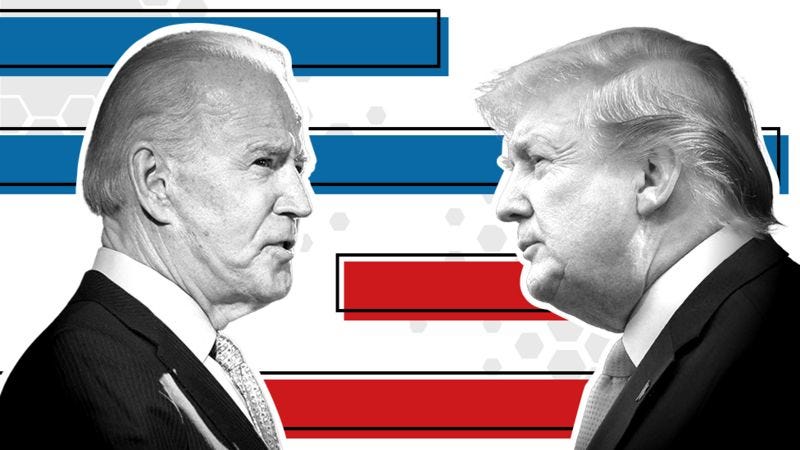
The US is having a very strange election, at so many levels. By all the indicators of enthusiasm, President Trump is way ahead of Vice President Biden. Biden-the-candidate has none of the enthusiasm of Barack Obama in 2008. He seems to have even weaker levels of on-the-ground enthusiasm than did Hillary Clinton 2016. Yet the polls have been telling a consistent story for months: he is going to win the popular vote and the Electoral College handily.

While there are reasons to be sceptical of the polls, for them to be systematically wrong on the level required for President Trump to be re-elected would be truly remarkable. And would say very disturbing things about the state of US politics and institutions. So, what reasons do we have to think the polls might be fundamentally correct?

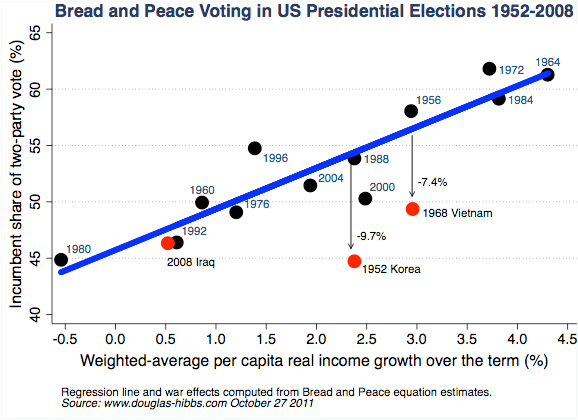
Peace and Bread: the Peace and Bread equation is a model of US presidential voting developed by economist Douglas Hibbs. It predicts the share of the total Democrat-Republican Presidential vote of the incumbent Party nominee based on the performance of the US economy in the lead up to the election and war casualties.

If we treat the 226,000 or so Coronavirus deaths (682 deaths per million) as war casualties and consider the depressive effect on the US economy of the lockdown measures, then we would predict the incumbent Party nominee (Donald Trump) to be defeated. President Trump is also very poor at the tribal-leader gravitas that US Presidents are expected to provide. Something, in their different ways, both Ronald Reagan and Barack Obama were skilled at. Which has a great deal to do with why they were the notably electorally successful nominees for their respective Parties.

So, if the US election is decided by relatively low-information voters, you add in economic effects, Coronavirus deaths and not fulfilling Presidential gravitas expectations, and even hope for quieter politics, and it is easy to see how the polls would be correct and President Trump would fail to get re-elected. A plausible reading, moreover, that does not require any hint of Trump Derangement Syndrome.

Since the election of President Eisenhower in 1952, the US has had a pretty strong rhythm of two-term Administrations. Eisenhower (1953–61), Kennedy-Johnson (1961–1969), Nixon-Ford (1969–77), Reagan (1981–1989), Clinton (1993–2001), Bush II (2001–2009), Obama (2009–2017) all fulfilled this pattern. The exceptions are Bush I (1989–1993), who was going for the fourth successive term for the same Party: a big ask that economic recession and the third-Party candidacy of Ross Perot put paid to, and Carter (1977–1981).

If Donald Trump turns out to be a one-term President, in a single-term Party incumbency in the White House, that puts him in the same category as President Jimmy Carter and no other postwar President. We can see from the above, that there are reasons to think that he might be so. Though Joe Biden in 2020 seems a very different candidate, at so many levels, than Ronald Reagan in 1980. Then again, President Trump does not look much like President Carter either.

So, the short answer to why we might expect President Trump to lose is the Pandemic. This is ironic at so many levels. Clearly, the economy was going Trump’s way before the Pandemic. Moreover, President Trump has been the least militaristically adventurous President the US has had in decades. He patently would prefer the US to be less involved in overseas military actions. His most notable military action, the drone-strike killing of Iranian general Solemeini, seems to have had a stabilising, rather than de-stabilising, effect on the Middle East.

[ADDENDA: This discussion of results from focus groups accords with the above analysis.]

President Trump has been in office for almost four years. So, he has a record we can examine. What it is clear is the depiction of him as a would-be authoritarian dictator is nonsense. The Pandemic and the riots gave him any number of “Reichstag fire” moments, and he took none of them. Indeed, his response to both the Pandemic and the riots has been notably federalist. Possibly too federalist for his electoral prospects.

Part of what has been going on has been an advocacy economy that desperately needs to identify great social evils to keep the donations and hirings flowing. Between advocacy non-profits, and diversity and similar trainers, billions of dollars rest on characterising US society as pervaded by endless social evils. President Trump, as the Make-America-Great-Again President, has ostentatiously failed to go along with this political economy of moral catastrophising.

Ironically, the desire to have the moral authority of the civil rights movement, and of second-wave feminism, requires that the advocacy economy pretend that the civil rights movement and second-wave feminism were not effective. Which, of course, they were; to striking and startling degrees. But unless the participants in the advocacy economy are still fighting the moral equivalent of Jim Crow and Patriarchy, it is a bit hard to justify those enormous money flows. Having a incumbent President who fails to defer to this advocacy game — on the contrary, pokes at it continually — accounts for much of the animus towards Trump. He threatens both their cognitive identity, as fighters against great social evils, and their income flows. Especially with his Executive Order against critical race theory.

Trump’s defeat would be a great win for the advocacy economy. Even though, if he is defeated, they will probably have had very little to do with him losing.

On the other hand, if it turns out that the polls are systematically wrong, then the advocacy economy is precisely where we should look for the reasons why. The systematic stigmatising and sanctioning of dissenting opinion is a regime of censorship. A regime of censorship there is good reason to think is widely resented. Regimes of censorship create distrustful and dissembling societies. If people are lying to pollsters, systematically not responding to pollsters, or the pattern of voters is systematically different from who the pollsters have been sampling, that will be why.

In which case, Trump being re-elected would not only be a major defeat for the advocacy economy, it would also be a marker of its corrosive effect on American society and institutions. Having billions of dollars of income resting on denying the reality of genuine social progress, and systematically exaggerating or mischaracterising social problems, is not good for the health of any society, or its politics.

Cross-posted from Medium.

Saturday, September 26, 2020

Trump, like Lincoln, may yet spark a civil war

Image for post


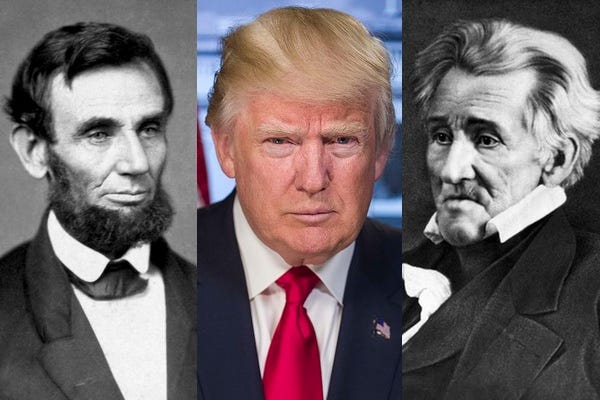
Searching through US history for a President like President Donald J. Trump, an obvious comparison is with the first Democrat President and seventh US President, Andrew Jackson (President 1829–1837).

Like Jackson, Trump is an outsider, despised, even hated, by much of the political establishment. Like Jackson, Trump is unashamed and blatant in his plebeian appeal. Like Jackson, he draws his strongest support from Greater Appalachia, the borderer (aka Scots-Irish or hillbilly) element of the US nation. Like Jackson, Trump draws wild enthusiasm from his partisans that seems both mysterious and aberrant to his (many) critics. Like Jackson, Trump brings a buccaneering style to politics that clashes with conventional notions of proper Presidential gravitas. While, unlike Jackson, Trump has not ignored the US Supreme Court, he has had some high profile clashes with the judiciary. Analysts of US politics still talk of Jacksonian politics, especially with reference to foreign policy. Trump is the strongest example of Jacksonian foreign policy in decades.

So, lots of similarities and analogies to be getting along with.

On the other hand, the United States managed to cope with a Jackson Presidency just fine. Indeed, so successful was Jackson that he was a key founder of the Democratic Party, the oldest still operating political Party in the world.

Thus, the Trump-Jackson analogies are striking, but not disturbing.

The disturbing analogy is with Abraham Lincoln, the 16th US President and the first Republican President (President 1861–5). Disturbing, because Lincoln is, of course, the Civil War President. It was his election, on 40% of the popular vote, that provoked the Southern States to secede.

Lincoln won the plurality of the popular vote against three major opponents with a clear victory in the Electoral College (180 out of 303). Trump was outpolled in the popular vote 46% to 48% but won a clear Electoral College victory (304 out of 538).

It is generally asserted that the South seceded because Lincoln was an anti-slavery President elected at the head of an anti-slavery Party. Yes and no. The US Civil War was absolutely about slavery. One only has to read the Confederate Constitution or transcripts of the secession debates to see that.

But it was not merely that Lincoln and the Republicans were against slavery that mattered. There had been anti-slavery Presidents before. It was the potential appeal of the Republican platform to ‘poor whites’ in the South that, added to the opposition to slavery, was the dire threat.

The Republican platform included what became the Homestead Acts, opening up landownership in the West to poorer settlers. The 1860 Republican platform also included tariffs and infrastructure projects, offering potential regular employment and higher wages. This was a program likely to be extremely attractive to the landless ‘masterless men’ of the American South.


With control of the Presidency, Lincoln could use federal government appointments to build up a Republican political base in the South. This was a nightmare scenario for the South’s plantation elite. Slavery depressed wages in the South and the status of manual labour. The worst possible outcome for the plantation elite was ‘poor whites’ and slaves (or, even worse, freed slaves) making common cause.

Hence Lincoln’s election sparked the secession of Southern States from the Union.

Fast forward, and the Democrat electoral coalition relies on keeping its extraordinarily high electoral support among African-Americans. If the Republicans can start making inroads among African-American voters, then it is very hard for the Democrats to put together a winning electoral coalition.

Since Trump’s election, his Administration, and his re-election campaign, have been attempting to target African-American voters, seeking to detach a sufficiently large minority from voting Democrat to voting Republican so as to overturn the Democrat electoral arithmetic.

The parade of minority speakers at the Republican National Convention was not some last minute add on, but the high point of an electoral outreach that has been underway throughout the Trump Presidency.

Which African-Americans?

African-Americans constitute three distinct groups. Descendants of Americans slaves, Afro-Caribbeans and recent African immigrants. Barack Obama was the son of a Kenyan immigrant. Democrat Vice-Presidential nominee Kamala Harris is mostly of Indian, and otherwise Jamaican (so Afro-Caribbean) descent.

Neither major US political Party has ever had the descendant of American slaves on their Presidential ticket. The African-ancestry candidates the Democrats have nominated have instead expressed the Democrat’s reliance on support from migrants.

This is an obvious weak point in the Democrat’s appeal to African-Americans. The descendants of American slaves do not noticeably benefit from migration. On the contrary, migrants and their descendants get to claim affirmative action benefits, crowding out the descendants of American slaves. Migrants congregate in major cities with significant African-American populations, where they compete for jobs, housing, and political access. Judged by who has, and has not, been represented on recent Democrat Presidential tickets, migrants have been winning the political competition.

Trump’s migration scepticism is a potential winner among African-Americans.

Another obvious weak point is that a significant number of African-Americans are conservative, and a strong majority identify as conservative or moderate. As the Democrat Party has moved in an increasingly progressive direction, that has widened the potential gap with many African-American voters. One reason why Biden won the Democrat nomination is that conservative and moderate African-Americans voted for him.

If Trump can open up the cultural distance between him and Biden, that is another potential winning point for him, particularly as he does not come across as a conventional Republican, but is very much a media-savvy culture warrior. Experience in the UK with Brexit and after shows that shaking up conventional politics along cultural lines is a way to detach former rusted-on voters, as well as the otherwise politically alienated. Riots and statue-topplings are potentially just such a cultural shocks.

The third potential weak point is, ironically, Black Lives Matter and the defund the police campaign. There is a long history of antagonism between police and African-American communities. But there are many African-Americans who do not want less policing, but more policing (or, more accurately, more effective policing). They are, for very good reason, deeply concerned about what would happen in their communities if police were withdrawn even further.

Fear of the consequences of the defund the police campaign is another potential winning point for Trump among African-Americans. It is true that Biden has explicitly not endorsed defunding the police, but many local Democrats have. Kamala Harris was a tough prosecutor, but that is a double-edged appeal in urban African-American communities.

Trump already has appeal among working Americans. Threatening to create an electoral coalition incorporating working Americans of both European and African ancestry: which President does that look like?

Threatened elites (again)

The networked elites of the major cities find identity politics very convenient. It breaks up citizens, residents and workers into competing groups based on identities that divide citizens, residents and workers. A lot of the metro-elite’s status-and-resource games would be upset if some bumptious upstart started putting together a citizen-worker-resident coalition.

The question is, how upset? How threatened?

The riots and statue-topplings suggest that there is a lot of political anger to harness. Given that the US’s ludicrously expensive university credentialing system leaves a lot of folk burdened with considerable debt and that restrictions on the supply of land for housing, and housing on land, creates ludicrously expensive urban housing markets that also shut lots of people out, there is much economic frustration being generated.

The US in the 1950s and 1960s was very socially stable. The combination of tight labour markets (so rising labour incomes) and loose property markets (so it was relatively easy to purchase middle class stability via home ownership) tends to encourage social stability. Thanks to migration, technological change and globalisation, plus the politics of zoning, aggravated by lockdowns, the US now has the opposite: loose labour markets and tight property markets. This is not a recipe for social stability.

Of course, it is the well-connected metro elites who have largely created or aggravated these problems. Supporting high migration AND land zoning drives up housing prices. Their universities create debt-burdened gimme courses in moral self-congratulation while new graduates in real disciplines have to compete with the educated of the entire globe.

The same well-connected metro elites whose long-term strategy of not providing sufficiently effective policing in African-American urban neighbourhoods results in much higher levels of violence in those communities. Violence that both stigmatises African-Americans and divides citizens, residents and workers from each other.

Violence, by the way, that is entirely an urban phenomena. There is no difference in homicide death rates in rural US between Americans of European and those of African descent.

No wonder the metro-elites love identity politics so much. No wonder also that the possibility of an ignoring-race coalition of local workers, residents and citizens must seem increasingly scary to them.

The question is, how scary? Are they as scared as the plantation elites of the Old South?

Or have they gestated from all this a network of genuinely revolutionary minded folk? A potentially explosive mixture of ideas that de-legitimise the American project with an over-supplied elite squeezed by under-supplied opportunities?

I guess we will find out, if Trump wins in November.

Tuesday, August 4, 2020

The Desperate Need to put Umpires Back Into the US System of Government

The American Republic is a political system run without umpires. The Presidents and Governors are elected, highly partisan officials. The Speaker of the US House of Representatives, and the equivalent presiding officers of the State legislatures, are highly partisan figures. As the increasingly existential struggles over Supreme Court nominations show, American judges are also partisan figures, though not quite as blatantly.

The American political order has only partisan figures at its centre. There is no institutional figure or authority that is not inherently political and cannot become consumed by processes of political polarisation. There are no umpires.

How has running a political system without umpires worked? Fairly badly. 72 years after the US Constitution came into operation in 1789, the United States were the disunited States, fighting a bitter civil war. 155 years after the end of that civil war, the American Republic is drifting towards another civil war. This is not an impressive record.

Moreover, even with this record, the United States is a relatively successful presidential republic. The overall track record of presidential republics is not impressive.

Fortunately, there is a straightforward solution to the lack of umpires problem. Become a Parliamentary Republic. This could be done very simply.

First, have the President elected by two-thirds vote of the Congress, in a secret ballot. Have the State Governors elected by two-thirds vote of their Legislatures, in a secret ballot. If two-thirds is not broad enough, make it a three-quarters vote.

Second, create an Executive Council. The members of the Executive Council would be the President or Governor, the Majority Leader of the lower house of the Congress or State legislature and such members of Congress or State legislature as the Majority Leader shall recommend. Require all acts of the President or Governor to be done on the advice of the Executive Council except such reserve powers that are necessary for the maintenance of responsible government. (There is a rich common law tradition of reserve powers: I am sure that US lawyers will be able to cope.)

Third, require all Cabinet officers to be members of the Congress or State Legislature.

Fourth, require all regulations be approved by the relevant committee of the Senate or Upper House of the State Legislature before they can have legal force. But permit the Executive Council to remove any regulation at any time.

This fourth element is not necessary to become a Parliamentary Republic, but it is required to bring some reasonable level of accountability to the administrative state. It would also be easy to systematically go through and remove existing regulations, forcing regulatory bodies to get direct legislative approval for any re-issuing of said regulations.

The US would, by these simple constitutional changes, be turned into a Parliamentary Republic. The President and Governors would become symbols of authority without having substantial power. The Power and the Glory would thereby be separated, one of the great virtues of constitutional monarchy. A virtue that Parliamentary republics can also manage.

Umpires would also thereby be inserted into the political system. Even better, the notion of umpires would be inserted into the political system. At the ceremonial heart of politics would be a non-political office.

Moreover, a Parliamentary state can be a thoroughly effective Great Power. Britain conquered about a quarter of the globe as a Parliamentary state.

The US notion of executive Governors was a quick-and-dirty fix to the problem of what do with the colonial Governors after the separation of the revolting colonies from allegiance to the British Crown. A quick-and-dirty fix given a theoretical framework by Montesquieu's hilariously inaccurate theorising about how the British political system worked.

A civil war and an ever-nearer civil war later, executive Presidents and executive Governors is a quick-and-dirty fix that is way past its used-by date. Especially given that presidential republics generally have remarkably poor records.

So, I say to the citizens of the American Republic: bring back umpires! Put a lid on the political polarisation! Become a Parliamentary Republic.

(Alternatively, go the whole hog and become a monarchy again. That seriously separates the power and the glory and creates a thoroughly non-political umpire. Princess Anne, the Princess Royal, is sensible, and potentially available. A former Olympian even. I am sure she wouldn't mind one-upping her brother.

However amusing a thought, doing the full monarchy option is not necessary.)

Becoming a Parliamentary Republic would be surprisingly constitutionally easy, and would put umpires back into a political system that desperately needs some limit to the processes of polarisation that are pulling the American Republic apart.

Wednesday, October 23, 2019

Montesquieu and the US: explaining the US's Presidential aberration

That pioneer political scientist Montesquieu's theory of the separation of powers was both a very odd take on the English system of government (which he claimed it to be) but also very influential in the drafting of the US Constitution.

Listening to a paper on considerations of Montesquieu's The Spirit of Laws by Louis Althusser and Albert Hirschman, a plausible reason for the appeal of Montesquieu to the US Founding Fathers occurred to me. The notion of executive, legislature and judiciary as separate and balancing branches of government solved a problem the separating US colonies had: what to do with the office of governor in each of the revolting colonies.

Source.
The 13 colonies that revolted against British rule had the normal government pattern of British colonies. There was a governor, appointed by the Crown, and a locally elected/selected legislature.

Separation from Britain was separation from the Crown. So, how was the governor to be appointed and what did his office mean and do? Having the governor elected by the local populace and heading the executive branch of government was an obvious solution, one that Montesquieu's theory gave an intellectual framing to.

Hence, the governor-and-local-legislature pattern leads to gubernatorial/presidential government in the US but parliamentary government everywhere else that began as British colonies, because they either do not separate from the Crown at all (Canada, Australia, New Zealand, etc) or do so after an initial period of still having the crown (India, Pakistan, Malta, etc) and so, in the latter cases, ended up with a figurehead President and a Prime Minister with the real power--provided they have a majority in the lower house of the Parliament.

A late C19th newspaper wrote:
Great Britain is a republic, with a hereditary president, while the United States is a monarchy with an elective king.
The notion being that in Great Britain, the Parliament is the seat of power and members of Parliament run the government while, in the US, voters elect a ruler who has a status approaching that of ruling monarch. (And the dynastic principle keeps popping up.)

The English Parliament
Montesquieu's notion of the separation of powers was not a very sensible analysis of British government. (Historian David Starkey is characteristically rude about Montesquieu and even more so here.) The office of Lord Chancellor, who was the presiding officer of the House of Lords, head of the judiciary and a member of Cabinet, was as great an offense against separation of powers as can be imagined. 

Moreover, the notion of the separation of powers gets quite wrong why the English Parliament survived when most of the comparable medieval legislatures were eventually abolished. It was precisely because in England, the executive and the legislature were not separated. The members of Henry VIII's Privy Council were members of either the House of Lords or the House of Commons. The Parliament was where the political nation met the government and therefore operated as a central instrument of government. A pattern that continued. It was the breakdown of that pattern under the first two Stuart monarchs, but particularly Charles I, that led to the (English and other) Civil Wars in the British Isles.

In the C12th century, Song Dynasty China had one imperial official per 15,000 people. In 1750, Qing China averaged one civilian official per 11,250 people while there was one per 10,000 people in Tsarist Russia.

C16th England could manage an official per 4000 people (pdf), making it by far the most intensely governed of contemporary territorial states. It could have such a level of official penetration because the information flows from the society, and about such officials, was strong enough to make it work, and the deep involvement of the executive government in the Parliament was the essential capstone of that. British colonial governments replicated the pattern (albeit initially with appointed members of the Legislature Councils) because those information flows were so central to making the system work,

The American Revolution
Only 13 of 35 British colonies in the Americas revolted in 1775-6. The 13 colonies that revolted were the 13 that least needed the Crown--that is, they least needed the protection of the Royal Navy against French or Spanish aggression. 

Island colonies did not revolt, as, without the protection of the Royal Navy, they would be desperately vulnerable to French or Spanish naval power. The Canadian colonies did not revolt, as they needed the Crown to arbitrate between British and French settlers. It was the "in between" colonies who revolted.

While various taxes and Navigation Acts were definitely irritants to all the colonies, the notion of no taxation without representation was a brilliant formulation of deeper issues. The wish within the seceding colonies to appropriate Amerindian land, blocked by the Royal Proclamation of 1763, and to defend slavery, threatened by Somersett's case (1772), generated much more visceral reasons to not defer to authority in London if and only if the need for Royal Navy protection was no longer a constraining factor. 

But keeping slavery, and seizing Amerindian land, does not make for grand legitimacy--most needed, if one was going to revolt against the Crown. Hence the necessary utility of no taxation without representation, which has the great advantage of being a perfectly reasonable take on the British constitution. The underlying intent might have been to grab land and keep slaves, but the engine of justification used as cover (above all, to themselves) had much greater implications, implications that still resonate through American history down to the present.

Slavery clearly deformed the US Founding, but it did not invalidate it because the Founders were forced to erect this notion of a government by consent to justify (including to themselves) what they were about. The ejection of the US Tories meant there was no substantial internal objection to the Revolution Settlement, an advantage of that the Glorious Revolution of 1688 did not have achieve, with resistance to its Revolutionary Settlement still prompting armed rebellion in 1745. Nor did the French Revolution, which parts of France have never reconciled themselves to.

With the status of the American Revolution uncontested within the US, both sides of the US Civil War invoked the Revolution in its defence; the North as defending the Union created by the Revolution and the ideals that underpinned it; the South as defending the right to withdraw consent (so as to, of course, defend the interest of slavery against distressingly natural extension of the legitimating ideas of the American Revolution).

Contemporary slavery posing
The current fascination with slavery is a simplistic narrative designed to feed the arrogance of the progressivist human capital (education) elite by reinforcing how inadequate the past was (and so what we have received from the past) because it was not blessed by such moral and intellectual paragons as themselves. (Folk spouting ideas utterly conventional in their own social milieus pretending to themselves, and others, that they would not been equally conventionally conformist if they had lived back then is a risible sight.)

Canada, Australia and New Zealand had no slavery but ended up very similar societies to the US (though without its enormous geographical advantages for sustaining a prosperous population). The section of the US which had no slavery was much productive than the section that did, something that de Tocqueville remarked upon of 1830s US. The United Kingdom abolished the slave trade in 1807 and slavery in the Empire in 1833-4 and proceeded to become much richer.

Mass slavery or serfdom was what happened across human history when labour is much more valuable than land so bondage can eliminate their scarcity premium and force them down to subsistence wages (plus the costs of imposing the bondage). If the population is local, you get some form of serfdom (binding them to the land or the landowner). If the labour has to be imported, you get slavery (turning people into property, so they can be moved around). This pattern of mass human bondage occurs again and again in such circumstances, the only sizeable exceptions to the pattern across the whole of human history being (1) the failure to have re-enserfment in medieval Europe after the Black Death and (2) the abolition of slavery in the C19th. Both achievements of Eurosphere civilisation and no other. [EDIT: Other societies have abolished slavery, but not mass slavery and have not evangelically pursued that abolition, as Britain and the Royal Navy did the slave trade.]

Sub-Saharan Africa was a centre of slavery because it was where humans evolved, so there were many diseases and predators who preyed on humans, which kept the human population down and so labour more valuable than land, leading to pervasive slavery. Something intensified by, first, the Arab-Muslim slave trade and then the Atlantic slave trade that the British Empire, through the Royal Navy, eventually sought (successfully) to suppress. For example, the British forced all the signatories to the Congress of Vienna treaties to agree to the abolition of the slave trade.

Source.
The striking thing about slavery and Eurosphere civilisation was not that slavery occurred, it was not even the scale of slavery (that just reflected the expansive capacities of that civilisation), it was the (ultimately successful) campaigns to abolish it. In the UK, it was the first of what became the Emancipation Sequence, which starts with abolition of slavery and ends with queer emancipation.

In the case of the US, abolitionism led to the creation of the Republican Party as an anti-slavery Party and Abraham Lincoln in particular mobilising the rhetoric, and legitimating ideas, of the American Revolution against one of its basic motivations, the preservation of slavery. Those ideas have, admittedly somewhat fitfully, and often far too tardily, continually trumped slavery and its destructive legacies (notably Jim Crow). Which is a remarkable legacy from an enterprise whose founding documents were largely written by slave owners.

As economic historian and Nobel memorial Laureate Robert Fogel pointed out in his Without Consent or Contract: the Rise and Fall of American Slavery, in the US in the 1840s and 1850s, mass migration was adversely affecting the income of resident workers in the US (so seriously it can be seen in declining height of local National Guard recruits), leading to strong support for Nativism. But there were too many immigrants for that to be a viable election strategy, so the Republican Party finessed Nativism by supporting trade protection and focussing hostile attention on "the Slave Power". In other words, the Republicans finessed the pressures of mass migration by demonising (Southern) slave interests and politics. (A very easy target, it has to be said: and just because it was good electoral strategy does not mean the revulsion against slavery was anything other than sincere.)

The most bloody trumping of the legitimating ideas of the American Revolution over slavery being, of course, the American Civil War itself. There are persistent nonsense claims that the American Civil War was not about slavery. It absolutely was, one can tell simply by reading the Confederate Constitution (pdf) and the debates of the various secession conventions of the seceding states.

The Presidential capstone
The normal claim is that the North, the Union, won the Civil War because it had a greater and more productive population (even though it took 4 bloody years to do so). Well, yes, but that obscures the reason why that was so--it was because the North retained the Presidency. Not all the slave states seceded, substantial sections of the Southern population remained loyal to the Union, and a key residue of the armed forces remain loyal to their Commander-in-Chief. If, say, anti-slavery New England had revolted against the Union under a Southern president, then the balance of advantage would have been with the pro-slavery forces.

Source.
There is increasing speculation in the US about the possibility of another civil war, given the intense political and territorial polarisation. See, for example, this podcast. Or these YouTubes. The idea being that it would be the urban archipelago up against the ruralist homeland.

A similarity with the lead up to the original Civil War that is not much noted is that, once again, political interests within a Party with their base in New England and the West Coast are demonising the supporters of a Party with much of its base on the South as a strategy to finesse mass migration. They are even using the taint of slavery to do so. History may not repeat, but it can sometimes rhyme pretty strongly.

Both sides in this putative civil war have some clear advantages and disadvantages. The ruralist homeland has better geography, a more armed populace and controls the domestic food supply. The urban archipelago has more economic activity and the march-through-institutions leaves the progressivist side with better organising capacity. If such a war did break out, I would again predict that, again, whoever retained the Presidency would win, though far more slowly and bloodily than people would expect.

But a strong argument can be made that the Presidential system is much of the problem. That putting so much power and status in the hands of a single figure actually helps the polarisation. After all, Clinton Derangement Syndrome has been followed by Bush Derangement Syndrome, Obama Derangement Syndrome and, the most intense of all, Trump Derangement Syndrome (most intense because there are so many legitimate grounds of criticism of President Donald).

There could be a very strong cost for the US Founders using Montesquieu's (daft) theory about the English constitution to give the newly Crownless colonial governors a role and a legitimacy.

[Cross-posted at Skepticlawyer.]