Showing posts with label evolution. Show all posts

Thursday, November 18, 2021

The Out-of Expansions

There have been four major out-of expansions by Homo sapiens.

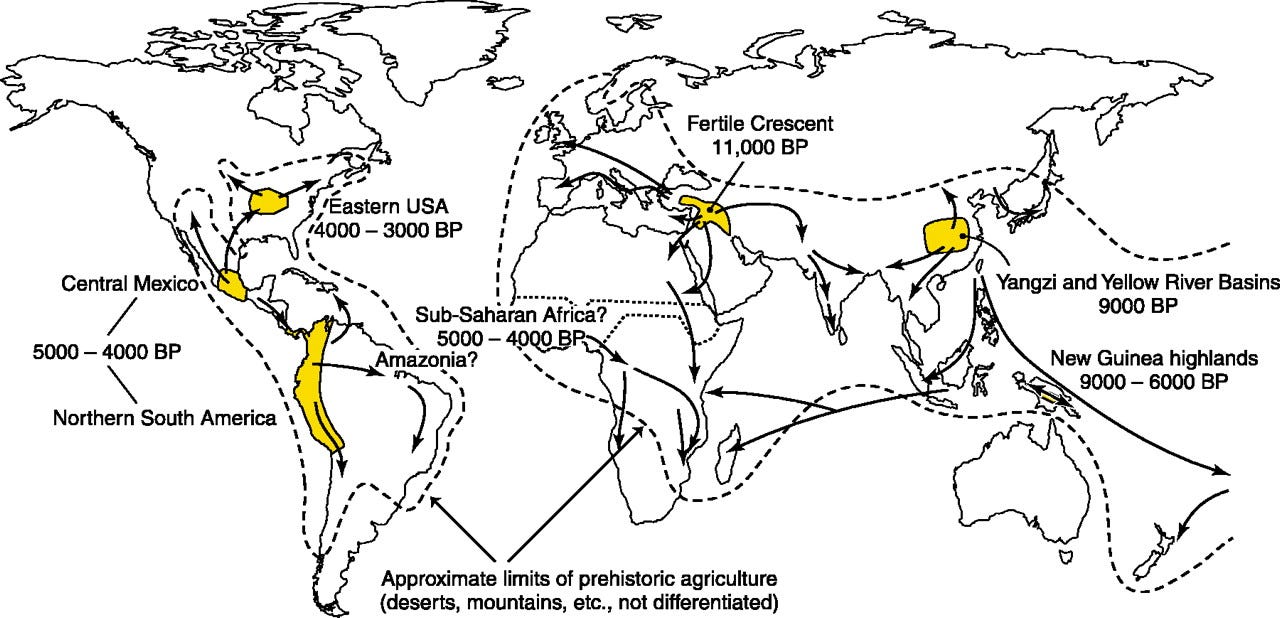
Source: Jared Diamond, Peter Bellwood, Farmers and Their Languages: The First Expansions, Science, 2003, Vol. 300, Issue 5619, pp. 597–603.

Four great out-of population expansions have widely dispersed Homo sapien populations. The out-of-Africa expansion of foragers; the out-of-the-river-valley expansion of farmers; the out-of-the-steppe expansion of pastoralists; and the out-of-Europe expansion of settler empires and states.

Out of Africa: the expansion of Homo sapiens

Whether an exit from Africa around 100,000 years ago was successful or not is still debated. From around 60-50,000 years ago, there was a sustained exit from Africa. Homo sapiens spread to occupy all continents except Antarctica, absorbing and replacing all other Homo populations. These foragers spread at a rate of about 10km a year, at least in areas without existing Homo populations.(1)

Homo sapiens are more gracile than other Homo, so likely lower in reactive aggression and thus more cooperative. Though the delay in the exit(s) from Africa, and the long period of coterminous occupation of Eurasia (maybe 20,000 years), suggest only a marginal advantage over Neanderthals, although this may have changed over time. This spreading of Homo sapien foragers concluded with the settling of southern regions of South America around 14,600 years ago.

Out of the river valleys: the expansion of farmers

Starting around 11,000 years ago, farming populations expanded across arable land, absorbing and replacing foragers. The process is still going on in Africa, Amazonia and elsewhere. In Oceania, farmers occupied islands without previous human habitation, reaching New Zealand probably around the year 1320.

The transmission from foraging to farming was a lengthy one. While not generally more productive per hour of effort than foraging, farming was able to extract many times more calories from arable land, lowered the cost of child-rearing and created an increased protection problem, encouraging the development of more coercive capacity.(2) Hence the continuing expansion, and dispersal, of farming populations.(3) Farmers and farming generally spread across arable land at a rate of around 1km a year.(4) The development of farming also had significant adverse health consequences, with deteriorations in dental health, loss of height, increased infectious disease and more signs of metabolic stress.(5)

Farmers seem to have traded-off less food-search time (food search being more difficult for child-minding) for more food-processing time (easier for child-minding) and more immediate access to energy (calories) (so quicker weaning of children) for less long-term access to nutrients. 

The flesh of plants are much more likely to be toxic to humans than is the flesh of animals while plant calories and nutrients are often significantly less bio-available than are animal calories and nutrients. Hence the increased need for processing to use plant foods. Hence also the existence of an calorie/nutrient trade-off when shifting from a more animal-based diet (as foraging diets generally have been) to the plant-based diet of farming. (Much of modern food culture has been systematically trading-off taste and calories against nutrient quality.)

With the development of farming and pastoralism, there was a dramatic narrowing in male genetic lineages. The rate of elimination of male lineages varied by region. Overall, only about 1-in-17 male lineages survived this harrowing of male lineages. (Female lineages were almost entirely unaffected.)(6) This harrowing of male lineages was a result of the expansion among agro-pastoral peoples of the (social) technology of aggression against fellow humans.

The development of pastoralism intensified the pattern of elimination of male lineages.(7) The harrowing of male lineages largely came to an end with the development of chiefdoms and states. That is, when the technology of exploitation overtook the technology of aggression — conquered males became providers of tribute and taxes, so were worth protecting. 

The biggest single thing states do after extracting surplus (taxing) is pacify: they don't want their taxpayers killing each other.

Out of the steppes: the Indo-European pastoralist expansion


Pastoralist populations from the Pontic-Caspian steppe domesticated the horse (though the Botai people further east may have domesticated horses earlier) and, from about 5,000ya, and continuing until about 3,000ya, expanded into Europe, the Iranian plateau, the Tarim Basin and Northern India. During these surges of settlement, Indo-Iranians develop the horse-drawn chariot (c.4,000ya).

The steppe-descended pastoralist population eventually expanded across all of Europe, interbreeding with the Neolithic farmers. Though not in the Basque Country and Sardinia.(8)

The original steppe pastoralist population had, like various other pastoralist populations have, developed a mutation for lactase persistence. This enabled much higher metabolic return from post-infancy consumption of milk. Different pastoralist populations in Afro-Eurasia have developed different lactase persistence mutations.(9)

Dairying broadens access to nutrients and enables the extraction of around five times as much calories from grassland as could be done via ruminant meat consumption.(10) This biological advantage likely enabled millennia of expansion, resulting in Indo-European languages, and cultural patterns ultimately derived from steppe pastoralism, covering Europe, the Iranian plateau and Northern India.

After the Indo-Europeans settlement surges had petered out, Indo-Iranian peoples also pioneered horse archers and heavy lancers (c.2,700ya). Later pastoralist peoples continued to periodically ravage, or even conquer, agrarian peoples. Only the Arab and Turkic dispersals resulted in large-scale demographic expansion beyond pastoralist heartlands. In both cases, settlement following imperial conquest.

Out of Europe: the empires-and-settlers expansion

Beginning c.1500 and petering out c.1960, European populations expanded across Siberia, the Americas and the Antipodes.

The combination of competitive jurisdictions, single-spouse marriage, the abolition of kin groups (requiring the development of replacement mechanisms of social cooperation), as well as being able to entrench social and political bargains in law (as law was not based in revelation, unlike Sharia and Brahmin law) meant that Europe had far more variety of political institutions than elsewhere. This gave the selection processes of history far more to work with, resulting in Europe developing more effective states. Christian Europe’s swift adoption of the printing press after 1450 greatly aided the dissemination and development of information and technology while reducing administrative costs.

With gunpowder, the compass, and ocean-going sail technology, Europeans spread out from Europe in a largely maritime out-of expansion. The out-of-Europe expansion included waves of settlement. (The Russian conquest and settling of Siberia did not need the maritime step, though riverine expansion was important in parts of Siberia.)

Settlement generally followed, sometimes preceded, imperial expansion. Both the Russian and American nation-building-through-settlement were also imperial projects, although animated by rather different ideas and institutions.

The Europeans acquired a portmanteau biota of supporting plant and animal species. Where their portmanteau biota became dominant, Europeans became the dominant human population, creating neo-Europes. Where the biota failed to do so, they did not.(11)

Being Eurasian, so resistant to the Eurasian disease pool, gave Europeans a disease advantage in the Americas and the Antipodes. Having much more effective states was their advantage within Afro-Eurasia and allowed them to exploit their disease advantage far more completely and speedily outside it. Their advantage in state (and other cooperative) organisation eventually (albeit temporarily) expanded their control across regions where they were systematically disease-disadvantaged (including Sub-Saharan Africa).

The Homo sapien advantage is non-kin cooperation. Medieval European Christian civilisation put non-kin cooperation “on steroids” and so Europeans equipped with compass, gunpowder, ocean-going maritime technology and the printing press created the Eurosphere across four continents plus Siberia and ended up dominating the planet — until other peoples learnt their tricks.

In general


The expansions have been getting faster: taking at least 35,000 years; 11,000 years; 2,000 years; 500 years.

The, currently underway, fifth great out-of expansion — the out-of-the-countryside movement to the cities — is a series of concentrations, rather than a dispersal.

Each of the out-of dispersals has its specific characteristics, but each represents Homo sapiens behaving like Homo sapiens. Indeed, behaving like any biological population with access to new resources, including new abilities to access resources.

[An earlier version was posted on Medium.]

Endnotes
  1. B. Llamas, L. Fehren-Schmitz, G. Valverde, J. Soubrier, S. Mallick, N. Rohland, S. Nordenfelt, C. Valdiosera, S. M. Richards, A. Rohrlach, M. I. B. Romero, I. F. Espinoza, E. T. Cagigao, L. W. Jiménez, K. Makowski, I. S. L. Reyna, J. M. Lory, J. A. B. Torrez, M. A. Rivera, R. L. Burger, M. C. Ceruti, J. Reinhard, R. S. Wells, G. Politis, C. M. Santoro, V. G. Standen, C. Smith, D. Reich, S. Y. W. Ho, A. Cooper, W. Haak, ‘Ancient mitochondrial DNA provides high-resolution time scale of the peopling of the America’s,’ Science Advances, April 2016, Vol.2, №4, e1501385, suggests that it took 1.4kya to people the length of the Americas. As this is a distance of roughly 14,000km, that is an expansion rate of around 10km a year.
  2. Samuel Bowles, ‘Cultivation of cereals by the first farmers was not more productive than foraging,’ Proceedings of the National Academy of Sciences, March 2011, 108 (12) 4760–4765.
  3. Jared Diamond, Peter Bellwood, ‘Farmers and Their Languages: The First Expansions,’ Science, 25 April 2003, Vol. 300, Issue 5619, pp. 597–603.
  4. Joaquin Fort, ‘Demic and cultural diffusion propagated the Neolithic transition across different regions of Europe,’ Journal of the Royal Society Interface, 2015, 12: 20150166.
  5. Katherine J. Latham, ‘Human Health and the Neolithic Revolution: an Overview of Impacts of the Agricultural Transition on Oral Health, Epidemiology, and the Human Body,’ Nebraska Anthropologist, 2013, 187.
  6. Tian Chen Zeng, Alan K. Aw & Marcus W. Feldman, ‘Cultural hitchhiking and competition between patrilineal kin groups explain the post-Neolithic Y-chromosome bottleneck,’ Nature Communications, 9 Article number: 2077 (2018), published 25 May 2018.
  7. Patricia Balaresque, Nicolas Poulet, Sylvain Cussat-Blanc, Patrice Gerard, Lluis Quintana-Murci, Evelyne Heyer & Mark A. Jobling, ‘Y-chromosome descent clusters and male differential reproductive success: Young lineage expansions dominate Asian pastoral nomadic populations,’ European Journal of Human Genetics, January 2015.
  8. Iosif Lazaridis, ‘The evolutionary history of human populations in Europe,’ arXiv 1805.01579, submitted on 4 May 2018.
  9. Hadi Charati, Min-Sheng Peng, Wei Chen, Xing-Yan Yang, Roghayeh Jabbari Ori, Mohsen Aghajanpour-Mir, Ali Esmailizadeh and Ya-Ping Zhang, ‘The evolutionary genetics of lactase persistence in seven ethnic groups across the Iranian plateau,’ Human Genomics, (2019) 13:7. Scholarly discussions of lactase persistence in Europe often pay remarkably little attention to the same specific lactase-persistence mutation occurring in Europe, Iran and Northern India, so must have spread by a pastoralist, not a farming, population.
  10. Latham, op cit. Morton O. Cooper and W. J. Spillman, ‘Human Food from an Acre of Staple Farm Products,’ Farmers’ Bulletin, №877, October 1917, U.S. Department of Agriculture. Gregory Cochran and Henry Harpending, The 10,000 year explosion: how civilization accelerated human evolution, Basic Books [2009] (2010) cite the Bulletin for their discussion in Chapter 6 of the Indo-European expansion, including the role of lactase persistence.
  11. Alfred W. Crosby, Ecological Imperialism: The Biological Expansion of Europe, 900–1900, Cambridge University Press, [1986] (1993).

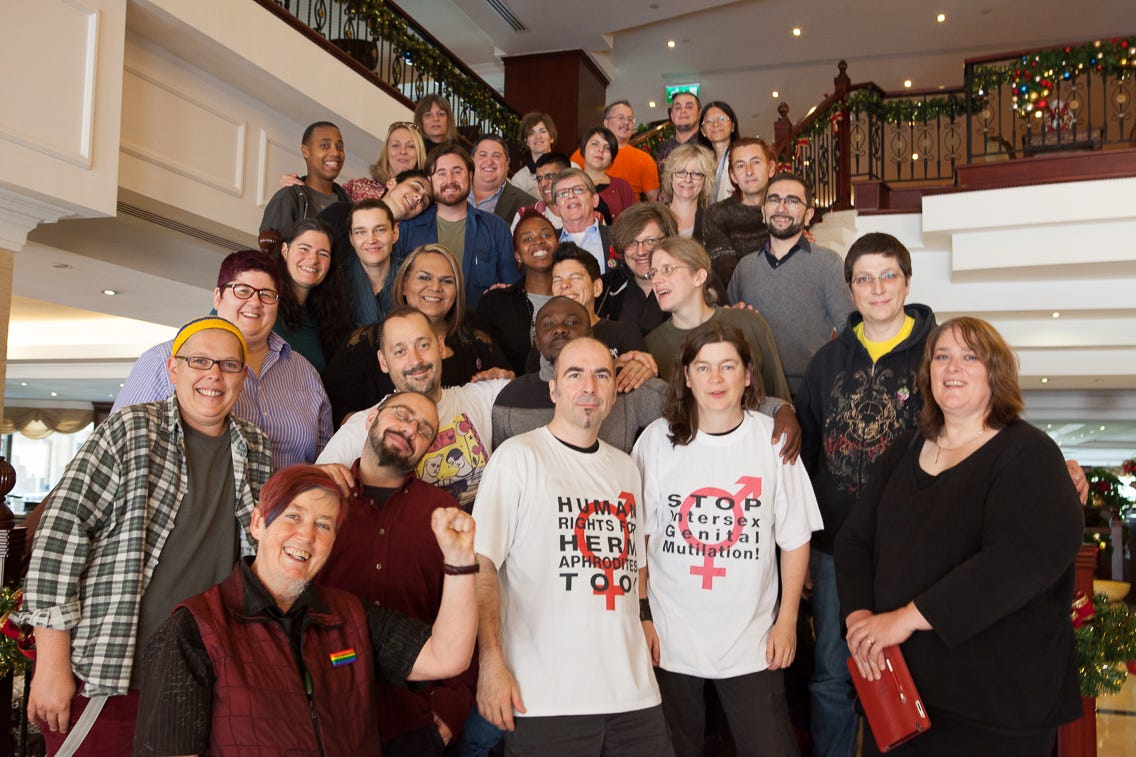
Wednesday, October 13, 2021

The existence of intersex people illustrates how sex is biological and binary

Folk are intersex because of how their biology is within complex and varied manifestations of two sexes.

Participants at the third International Intersex Forum held in Malta, December 2013.

There is this rather tedious game that is sometimes played where the existence of intersex people is somehow taken to indicate that either sex is not biological or that sex is not binary.

Any suggestion along the former lines is easily dealt with: a person is intersex if they have a specific type of pattern of biological features. That is, in the words of the UN OHCHR (the UN Human Rights Office):
Intersex people are born with sex characteristics (including genitals, gonads and chromosome patterns) that do not fit typical binary notions of male or female bodies.
Those sex characteristics are, of course, biological. It is the biological structure of their body that makes someone intersex.

Use-referent confusion

The wording typical binary notions of male or female bodies is a genuflection towards sex as a socially constructed category. That categorisation within a language is a social act does not make the thing being referred to thereby socially constructed. To act as if it does is to confuse use of a term with the referent of the term.

This use-and-referent confusion, this confusion between category and object, is not a case of failing to distinguish between use (“I like eating cheese”) and mention (“'cheese' has six letters”), but it is similar level of logical error. That the practice has evolved of calling a particular set of dairy products cheese does not mean those dairy products are socially constructed by that act of categorising. However socially embedded cheese-making may be, such dairy products are created by a series of physical processes and have a physical existence not dependant on the categorising conventions of particular languages.

Both types of logical error come from the aboutness of language and thought; from us using language to speak, and categories to think, about other things.

Sex existed long before anyone was developing categories about sex. Sex continues in the biological world all around us, regardless of what categories we may choose to use, and how.

It’s all about the gametes

If your body is structured to produce small, self-moving (motile) gametes, you are male; regardless of whether any viable gametes are actually produced. If your body is structured to produce large, not self-moving (sessile) gametes, you are female. Also regardless of whether any viable gametes are actually produced. A gun does not stop being a gun by removing its firing pin or filling in the barrel.

At its base, sex is defined by reproductive function. Such a pattern of only two types of gametes means that sex is, at its base, in its biological function, binary.

If the evolutionary die were to be thrown to generate new genetic combinations, there had to be at least two gametes. If there were more than two gametes, that would greatly increase the difficulty in successfully reproducing. If there was going to be two gametes, one that was injected (so was small and self-moving) and one that received (so was large and not self-moving) also maximised the chance of successful reproduction. Hence, male and female gametes.

Given certain basic conditions, if a species reproduces through the combining of gametes (i.e. reproduces sexually) then having two types of gametes — small, self-moving (motile) gametes and large, not-self-moving (sessile) gametes — is the only evolutionary stable outcome. Hence, in our biosphere, sex is binary because there are only two types of gametes.

Thus, there is no third sex at the level of gametes. There are neuter forms of females in eusocial insects. In some species, an individual can change sex. But there are only two sexes in the sense of only being structured to produce one of two types of gametes. Some individuals partake of characteristics typical of both sexes. That does not make them a third sex.

While, in its base evolutionary function, sex is binary, the manifestations of the binary nature of sex in organisms can get quite complex. That sex is binary doesn’t mean that bodies are. In a way, that is probably the evolutionary point. A widely accepted hypothesis among biologists about why species adopt sexual reproduction via gametes is that it was an evolutionary adaptation to deal with pathogens. By sexually reproducing, the genetic die are being thrown again and again, giving sexually reproducing species a much better chance of having genetic lineages that could survive a particular pathogen.

In us Homo sapiens, as mammals, there is a set of characteristics that are specifically typical of the male-body structure and a set of characteristics that is specifically typical of the female-body structure. If you have some characteristics from both sets, you are intersex. But it is precisely the existence of these two sets of sex-typical biological characteristics that creates (1) the possibility of being intersex and (2) enables identification as intersex.

So, the existence of intersex people does not confound either the biological or the binary nature of sex. On the contrary, it refers to a set of people with various patterns of biological characteristics that can only be identified as falling within the set of intersex people because of the binary and biological nature of sex. Human bodies are bimodally distributed, but with sufficiently fuzzy boundaries that some folk are intersex, they overlap the distributions somewhat.

Evolutionary pressure

Arguments about, for instance, the concept of binary being binary — something is either perfectly binary or it is not binary — are ways of avoiding grappling with the biology. For biology has lots of fuzzy boundary concepts (e.g. species). Defining binary in a way that means nothing biological of any complexity is likely to meet it is not a proof that sex is not binary. The small self-moving gamete/large not-self-moving gamete difference is binary in the sense that counts in terms of reproductive function. Reproductive function that is subject to, and shaped by, evolutionary pressures.

It is that evolutionary pressure that makes, sex, in its base evolutionary function, binary and its physical manifestation in human bodies bimodally distributed. 

If there were actual hermaphrodites in a species with males and females, there would be grounds for calling them a third sex, as their bodies would be structured to produce both gametes. That would not, however, change the binary nature of sex in its evolutionary function.

The key confusion is failing to grasp that the binary nature of sex applies to its evolutionary function. If conjoining gametes is how reproduction happens, and there are only two sorts of gametes in play, then sex is binary. It is that simple.

This is not a claim that individual organisms cannot have a mixture of features. It is not even a claim that individual organisms cannot move across the boundary from one sex to another. It is also not a claim about animals conforming absolutely to to two, and only two, rigidly distinguished physical structures. It does not even preclude an organism producing both types of gametes, either sequentially or simultaneously.

The binary nature of sex is not defined from structures of bodies inwards. It arises from reproductive function outwards. As a biological process, reproduction has consequences for physical structures, but these can be quite complex and varied. A complexity and variance that does not in anyway change the binary nature of sex, though it does considerably complicate its expression in biological structures.

Animals have sex roles: the behavioural manifestation of sex. The manifestation of sex in a deeply cultural species is even more complex, hence gender: the cultural expression of sex. With gender we are in much more varied, and culturally evolved, territory.

In summary, there are only two sexes at the level of basic reproductive dynamics, defined by there being only two types of gametes. There is no third sex at the level of reproductive dynamics because there is no third type of gamete. Hence, sex is binary, however complex the manifestations in bodies of that underlying only-two-types-of-gametes pattern may be.

So, when folk say that sex is binary, what they should mean is that there are two types of gametes. And when folk say that sex is not binary, what they should mean is that the biological expression in actual bodies of the binary nature of sex is bimodal rather than binary. Though it is a clumsy and misleading way of doing so.

The rest is just tedious word games, with more than a dash of logical confusion.

[Previous version posted on Medium.]

Thursday, October 7, 2021

Wielding the mask of science

Official health has a persistent pattern of presenting as science-based things that are not.

Source. Taken from here, original research and data from here.

Despite the efforts of the wilder shores of critical theory and its critical constructivist derivatives (such as critical race theory) to present science as white, patriarchal, heteronormative and similar morally-disabling things, science retains a great deal of authority in Western societies. Particularly in areas of policy concern that clearly should be based on good science. Hence public policy, and policy advocacy, regularly presents itself as being based on sound science.

Thus uses of terms and phrases such as trust the science, scientific consensus and, as terms of de-legitimisation, science denialism.

The evolution test

In areas such as health, nutrition, medicine, dentistry there is, in fact, a pretty reasonable rule-of-thumb to apply about how well science is being applied: the evolutionary lens. Ask yourself: does this claim make sense in the light of human evolutionary history? If the answer is no, there is a good chance that it is wrong. If the answer is yes, there is a much higher chance of it being correct.

So, if humans have been eating something for thousands of generations (meat, fish, saturated fat, salt, tubers) then there is a good chance that it is fine in your diet. (Nutritional-value or health-risk claims against them typically have very poor evidentiary bases.) Though differences in how they are cooked or when, including how often, they are eaten provides a complicating factor.

If humans have been eating something for only a few decades (seed oils, ultra-processed food), then there is an good chance that it is not good for you.

A similar point applies to eating patterns. If an eating pattern has been common for thousands of generations (one, two, maybe three, meals a day, little or no snacking), it is probably good for you. If an eating pattern is much, much more recent (eating several times a day due to regular snacking), then it is probably not good for you.

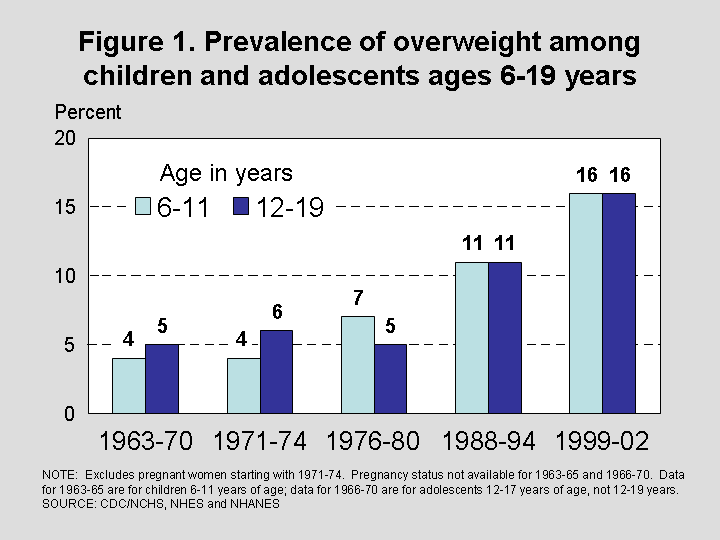
Modern Westerners have about the same daily energy expenditure as hunter-gatherers, so levels of physical activity are less of a factor in explaining rising obesity than one might expect. Which strongly suggests that changes in diet and eating habits has been the main factor in rising obesity.

It is frightening how much of the nutrition advice from official health sources does not pass the test of the evolutionary lens. Then again, a fair bit of medicine and dentistry also fails the test of the evolutionary lens. (For instance, the silly claim that it makes evolutionary sense that we grow redundant teeth, especially as foraging populations are generally known for their wide jaws and healthy teeth.)

The mask of science (nutrition)

Much of the nutrition advice from official health (i.e. government health departments and regulatory bodies) wields the mask of science. It presents itself as being based on the science, when it is not. Or, at least, is not based on good science.

The problem is, it is hard to do nutrition science well, because of nutrition’s inherent complexity. That means it is easy to do nutrition science badly, and even easier to do it to an agenda.

As the food industry (using the term ‘food’ somewhat loosely) is huge, there are enormous revenues at stake. So the capacity to fund, present and cherry-pick poor or misleading science is great. And, indeed, frequently done.

Unfortunately, official health also has perverse incentives. Not only are there the pressures of very well-funded influence-peddling but there are the inherently perverse incentives due to the tax-funding of health departments.

We pay organisations to do what makes their income go up, because that will have by far the strongest reinforcing incentives and feedbacks on what they do. If the metabolic health of the population gets worse, then health expenditure, including tax-funded health expenditure, goes up.

So, official health gets more revenue if they give us metabolically counter-productive advice and they get less revenue if they give us metabolically sound advice.

This is what economists call perverse incentives. Evolutionary biologists would call it adverse selection.

Unfortunately, welfare states are full of perverse incentives and processes of adverse selection. We can define the welfare state as:
a structure whereby taxes are spent to reduce or ameliorate social harms via various tax-funded bureaucracies that receive more revenue if the social pathologies tend to increase and less if they tend to decrease.
If we want to define the welfare state in terms of the state apparatus itself, then the welfare state represents:
a process whereby the state apparatus colonises (i.e., expands into, and receives increased revenue from) its own society rather than other societies.
Government health departments, in effect, colonise our collective ill-health. It is perhaps not a shock that the metabolic health of Western populations has been getting worse, and has been getting worse faster since governments started promulgating official nutrition guidelines in 1980.


If you are wondering what specific mechanisms have led to the official nutrition guidelines making our collective metabolic health worse, they can be summarised as:
  1. Encouraging us to eat more frequently, leading to our bodies being chronically flooded with insulin, driving up rates of insulin resistance.
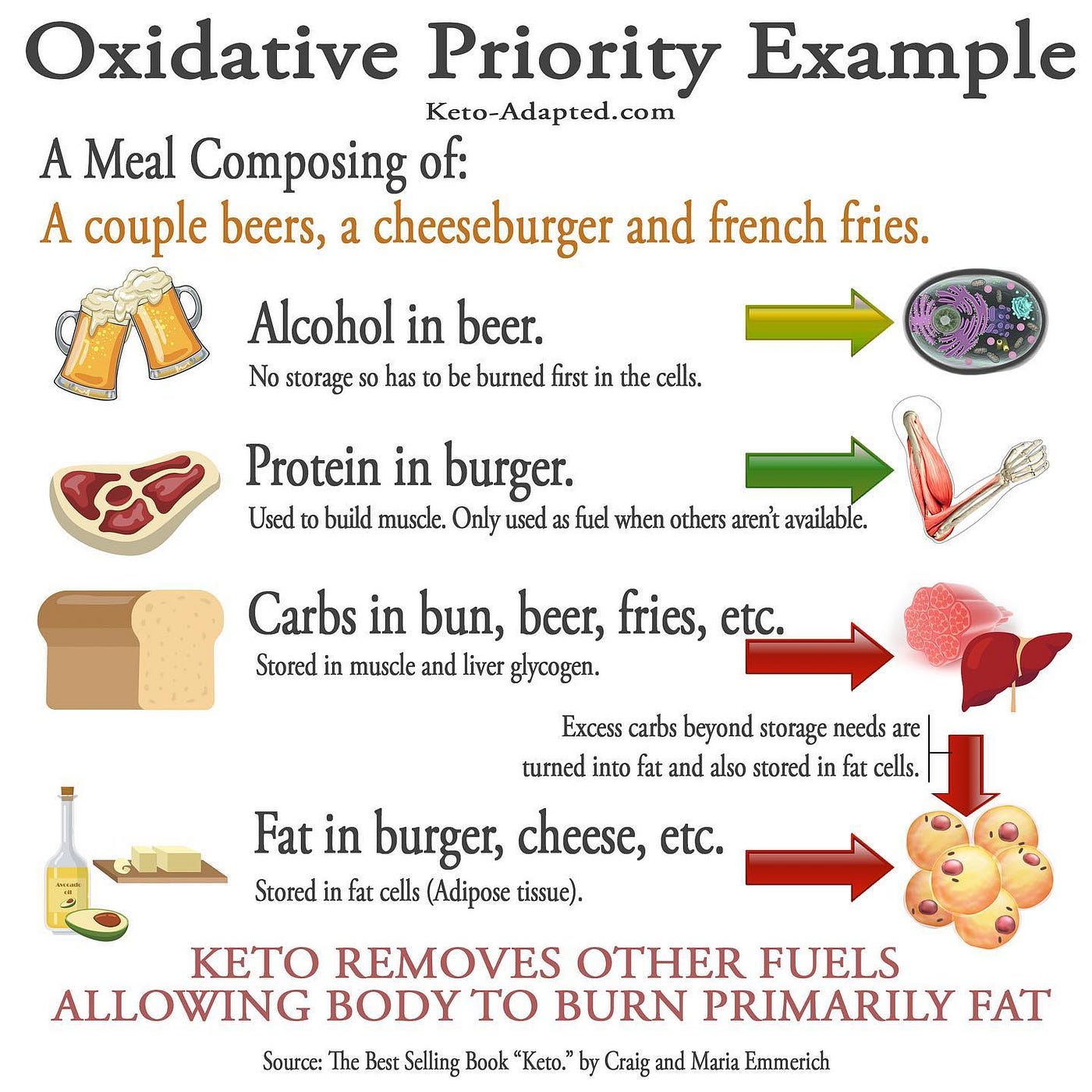
  2. Encouraging more consumption of carbohydrates, leading to more fat storage (as set out in the chart at the top of this post).
  3. Paying no attention to the massive increase in use of (highly inflammatory) seed oils.
  4. Demonising saturated fat on the basis of no good scientific evidence. (And eating less fat means eating more carbohydrates.)
The official nutrition guidelines have been structured, by feedback and selection processes, to generate deteriorating metabolic health in a way that permits the use of the mask of science to cover nutrition guidelines that no one concerned for their health, or the health of their family, should actually follow. US defence forces, for example, are suffering adverse health consequences, likely due to following the official nutrition guidelines.

Indeed, without the mask of science, more folk would be come aware of what a diabolically bad job the nutrition guidelines have done, if improving the health of the population was the goal.

Of course, if the aim is to increase government health expenditure, then they have been excellently effective. Which appears to be precisely how the selection pressures have operated.

As we contemplate the deteriorating metabolic health of Western populations, Thomas Jefferson proved to be prophetic in his 1787 Notes on the State of Virginia:
Was the government to prescribe to us our medicine and diet, our bodies would be in such keeping as our souls are now.
The mask of science (Covid 19)

We can also see the mask of science being use to cover policies not grounded in good science in the official responses to the Covid-19 pandemic.

Covid-19 is a respiratory (so seasonal) illness of metabolic distress. That is likely why children and adolescents have been largely immune: their metabolisms are generally sufficiently healthy that they are far less vulnerable.

One of the things that became clear relatively early is that outdoor transmission is not a significant vector for spreading the virus. Conversely, Vitamin D deficiency is a vector for increasing the likelihood of suffering badly from the virus. (Likely a major factor in why darker-skinned folk in northern latitudes had higher rates of illness and death.) Also, social interaction is well known to reduce stress and so increase capacity to resist disease.

So, we should not have been telling people to stay out of the sun and the fresh air, or to wear masks outdoors, as airborne transmission risk is about effective volume of air. Yet, using the mask of science, this is precisely what has been done in many jurisdictions. The case for lockdowns is also much weaker than is often recognised. (See also here.)

Masks do, however, operate as a strong social signal. A signal that gets its power from use of the mask of science.

A tale of two (US) States

Florida and California are both large population US states, (21m to 40m people) at similar latitudes (so similar seasonal patterns). Florida has a higher population density, though California’s population is slightly more urbanised (95% to Florida’s 91.2%). Florida has an older population (median age of 42.5 to 37) as you would expect from a well-known retirement destination.

So, other things being equal, you would expect Florida to have a higher pandemic death rate than California. California has a death rate of 1,595 per million people. Florida has a death rate of 1,721 per million people. So, higher, as one would expect. But not very much higher: 126 more deaths per million or 8% higher. Rather less of a difference than one might expect, given that Florida’s median age is 15% higher than California’s.

Yet the measures in California to combat the pandemic have been way more intrusive and expensive than what has been done in Florida. Moreover, California’s death rate has been closing on Florida’s, as California’s second (seasonal) wave was much worse than its first.

Florida not discouraging people to go outside and enjoy the sun, and not requiring masking outside, does not seem to have had significantly adverse effects. As, one would expect, if one was following the actual science rather than those wielding the mask of science.

The systematic attempts to suppress any public consideration of the lab leak hypothesis was another, particularly egregious, case of the use of the mask of science against actual science. Also egregious has been the suppression of discussion of a potentially viable treatment for Covid-19, Ivermectin (longer discussion here). I have no idea about whether Ivermectin is effective, or in what circumstances. But suppression the discussion is nonsense and not in any way "doing science". 

Advice not given

It was clear relatively early on in the pandemic that Covid-19 was a respiratory (thus seasonal) disease of metabolic distress, with poor metabolic health greatly increasing your risk factors. By changing your eating habits, you can improve some markers of metabolic health in a few days, some in a few weeks, the rest within a few months.

These changes needn’t be all that expensive. Indeed, simply eating less frequently (aka time-restricted eating or intermittent fasting) to give your body a rest from being flooded with insulin can be very effective.

As far as I am aware, at no stage did official health tell us that. Either they didn’t know the above or they didn’t want to admit what crap their official nutrition guidelines are.

Either way, the selection processes operating on official health did not favour optimising the policy response to the pandemic. But they certainly did involve much use of the mask of science. Rather less use of actual science.

Stop and consider how many unnecessary deaths there may have been from the Covid-19 pandemic because official health has perverse/adverse incentives.

They are a mere fraction of the premature deaths every year from using the mask of science to push bureaucratically (and corporately) convenient nutrition guidelines rather than providing nutrition advice well-grounded in our evolutionary history, so in actual science.

[An earlier version was posted on Medium.]

Wednesday, February 3, 2021

Piling up pathology by pretending that biological sex is incidental

Treating disagreement as delinquent does not mean that things are working

Here’s a striking result: according to happiness research, since 1970 the pattern in Western societies has shifted from women being generally happier than men, to men being generally happier than women.

Given the triumph of second-wave feminism in changing law, social mores and public policy this may seem a surprising result. Actually, it makes sense.

First, men have less responsibility as providers. They are no longer expected to be the sole provider for their family. As part of feminism setting matching-what-men-do as the benchmark of female progress, women are now expected to do paid work, and so contribute to the income of the household.

Second, the price of sex has fallen dramatically. The moral language of virginity and chastity has almost entirely evaporated. Casual sex is much more respectable. Erotica and pornography is far more available. Since sex, as a social exchange, has usually been based on men doing things to earn sex from women, lowering the social price of sex is generally good for men.

Feminists have long advocated women taking control of their sexuality and being more sexually assertive. In other words, once again, setting matching-what-men-do as the benchmark of female progress. As is the standard pattern for setting matching-what-men-do as the benchmark of social progress, it implies having a uterus, ovaries and mammaries is incidental to being a woman.

Yet, as we shall see, men and women continue to display different patterns when it comes to sex. As Harper’s magazine put it: “Women are inclined to regret the sex they had, and men the sex they didn’t.” While former sex researcher and science journalist Debra Soh has suggested that the extraordinary surge in teenage girls identifying as trans might be, at least in part, them taking refuge from hyper-sexualisation.

About courtship and chivalry

In a huge array of species, the males display courting behaviour. That is, the sex with small, mobile gametes (males) court members of the sex with large, immobile gametes (females). In other words, the sex taking less risks, and with less intrinsic investment in the process of reproduction, has to prove their fitness/seriousness to the sex taking more risks and with more intrinsic investment in the process of reproduction.

As psychologist Marco Del Giudice points out:

The biological definition of sex is not just one option among many, or a matter of arbitrary preference: the very existence of differentiated males and females in a species depends on the existence of two gamete types. Chromosomes and hormones participate in the mechanics of sex determination and sexual differentiation, but do not play the same foundational role. Crucially, anisogamy gives rise to a true sex binary at the species level: even if a given individual may fail to produce viable gametes, there are only two gamete types with no meaningful intermediate forms. This dichotomy is functional rather than statistical, and is not challenged by the existence of intersex conditions (regardless of their frequency), nonbinary gender identities, and other apparent exceptions. And yet, anisogamy is rarely discussed — or even mentioned — in the social science literature on sex and gender, with the obvious exceptions of evolutionary psychology and anthropology (emphasis added).

Fancy that!

Homo sapien childbirth is unusually risky and, as I have previously discussed, Homo sapien children are unusually biologically expensive to raise. The combination has (until recently) created a particularly intense risk-differential by sex.

As a predictable consequence, human courtship has frequently been an elaborate process. Especially as it is often the parents of the bride (or of both bride and groom) who have to be convinced. A complication of being the cultural species. (A complication that evolutionary psychology often appears to fail to grapple with.)

Dowries (payment to the husband), dowers (payment to the bride), groom price (payment to the groom’s family), bride price (payment to the bride’s family) or bride wealth (some mixture of bride price and surety) can be part of, or substitutes for, the courtship process. As anthropologist George Dalton observed:

Bridewealth paid at marriage has different functions in different societies and may have several in the same society: to indemnify the girl’s family for the loss of her services, as an earnest of good intentions on the part of the groom and his family, to solidify the new affinal bonds created by marriage, and to legitimize children born to the union.

These transfers are often more an investment in connection (so gifts) than merely an exchange.

Given the dramatic drop in the risk-differential by sex due to modern medicine, welfare systems and unilateral female control of fertility (via the Pill and legalised abortion), some reduction in the level of effort in courtship was likely. Especially as unilateral female control of fertility permitted more female investment in human capital and in credentials, increasing women’s access to income.

The normative language of chastity and virginity, and the social rituals of courtship, were, of course, intimately tied together, as both imply a relatively high social-exchange price for sex. The circumstances that led to the evaporation of the former also led to the attenuation of the latter.

Setting matching-what-men-do as the benchmark of female progress led to an attack on the rituals of chivalry and courtship. They were re-interpreted as implying female incapacity or otherwise being affronts to equality between the sexes.

What the rituals actually did was to allow men to signal respect for women in situations of unequal vulnerability. While the vulnerability gap had certainly lessened significantly due to the above changes, it did not disappear.

Stripping away the rituals of acknowledgement without the vulnerability gap actually being eliminated created somewhat delusional social circumstances, where the vulnerability gap persisted but was not allowed to be handled by social mechanisms that had evolved to do so.

If the functional is not permitted, then the pathological will fill the gap. Much of the “toxic masculinity” nonsense is a response to the statistical evidence that the vulnerability gap persists while also attacking the socially-evolved mechanisms to deal with it.

To put it another way, of course the man should pay for the first date. Pathologising chivalrous politeness removes a whole set of socially-evolved markers of respect for women based on acknowledging the vulnerability gap. Of course trying to replace that by new norms that use evidence for the vulnerability gap to pathologise men and masculinity, while insisting that paying everyday attention to the vulnerability gap is an attack on equality, is not going to lead to good or sensible replacement mechanisms.

Nor is extending matching-what-men-do as the sign of female progress to matters of sex and dating. There is no reason to expect women to have the same attitude to sex as men and many reasons to expect rather different (if somewhat overlapping) patterns of response. This is an area where it is particularly silly to treat having a uterus, ovaries and mammaries as being incidental to being a woman.

One of the features of the modern dating market is massive inequality between (young) men and women. The dating-app data shows that (1) women’s rating of the sexual attractiveness of men is way more skewed than is men’s rating of the sexual attractiveness of women and (2) this female advantage in breadth of attraction is extremely age-dependent. That is, as they age, men can retain relatively high levels of sexual attractiveness much better than women do.

This is entirely predictable, flowing from the large-gamete sex (1) being comparatively more interested in the resource and status value of their potential mates, and (2) requiring a higher marks-of-attractiveness bar to peak their interest. While (3) the small-gamete sex is more interested in signs of fertility.

This creates a dramatically asymmetrical dating market, where women go from being in high demand followed by a dramatic drop-off in their sexual cachet as they age while most men struggle in the dating market but have the capacity to improve their relative standing as they age.

The pretence that having a uterus, ovaries and mammaries is incidental to being a woman — as female progress is measured by matching-what-men-do — makes it much harder to evolve mechanisms to sensibly cope with these asymmetries. Especially as the pressure to pretend all male-female differences are products of “patriarchy”, “toxic masculinity”, or some other sin-generating-secular-demon, creates a stilted public discussion.

About fatherhood

Homo sapiens evolved two primary mechanisms to deal with our biologically very expensive children. Grandmothers (females who live for decades after menopause) and fatherhood (as a social mechanism, not merely as sperm donor).

Grandmothers represented experienced females who stopped having their own children and so could invest in the children of their children. Fatherhood entailed men who invested in raising their children. (Or, in a few societies, unclehood — men who invested in raising the children of their sisters.) The paternal investment was presumptively in their own children, as otherwise it would have been very hard to stably select for such behaviour.

The rise of mass manufacturing led to the golden age of working-class fatherhood, as working-class men found it comparatively easy to take on the provider role. As manufacturing employment has collapsed in developed democracies, working-class fatherhood has also declined.

The growth of services employment has enabled many women to achieve a high level of income independence. The trade-off the loss of independence that marriage involves for the income advantages of live-in husband and father has significantly declined in value. The “cheaper” children are, the lower the woman’s reservation income and the more the connections of wife and husband overlap, the less value the husband-as-father has to offer. So lower-income-and-status men struggle to be accepted as fathers. Meanwhile, marriage and fatherhood is fine (indeed, never healthier) in the upper reaches of society. There, due to higher expectations, children are more expensive, reservation incomes are higher and the husband and wife’s networks are more likely to be complementary, hence the husband-as-father trade-off is much stronger.

State policy has tended to further undermine the advantages of the live-in husband and father. Both through tax and welfare policies that tend to penalise marriage (and so fatherhood) and through enabling women to get unilateral access, on behalf of their children, to the income of their exes through the garnishing of wages by the state.

The latter is a replacement for the social mechanism of shotgun weddings, which have collapsed. With the supporting rhetoric about “deadbeat Dads”, and supporting theory about patriarchal power, compulsory paternal child support though state garnishing of wages is a much more pathological mechanism than the shotgun weddings that it replaced.

Shotgun weddings traded-off the biological father stepping up to his paternal responsibilities with him getting the status and authority of being a father and husband. By contrast, compulsory paternal child support through garnishing his wages puts a man at the financial behest of his ex without any trade-off whatsoever. No paternal rights, no sex, no status, no authority. He is essentially turned into a bonded source of income.

The worse his income prospects, the more proportionately onerous such obligations become. To support the system, being gaoled for debt has been re-instituted. If he is gaoled due to failure to pay, his debt continues to accumulate. This fundamentally pathological arrangement is a systematic attack on working-class fatherhood.

In much of the US, such purely-financial fatherhood is a matter of strict liability. It does not matter if he was underage when the child was conceived (and so he could not form the legal intention to have sex). It does not matter if his sperm was harvested during a non-conceptive sex act and then used to impregnate the woman. The only thing that matters is that his sperm was used to conceive.

In some circumstances, it does not even have to be his sperm. DNA tests are rarely used to establish paternity and if, after some years, a man does find out it was not his sperm that conceived the child, he may be informed that does not matter, as he “accepted” (the compulsory) financial responsibility for the child.

By contrast, a mother can always give up her financial obligations to a child through adoption. Where, elsewhere, the benchmark of female progress is matching what men do, in this area the systematic exploitation of men, on the grounds of women’s greater vulnerability and superior parenting status, is public policy. So, in this areas, having a uterus, ovaries and mammaries really counts.

No dissent allowed

An approach that veers between pretending that having a uterus, ovaries and mammaries is incidental to being a woman — because the benchmark of female progress is to match-what-men-do — and justifying systematic financial exploitation of men on the grounds of women’s greater vulnerability and superior parenting status (so having a uterus, ovaries and mammaries really really matters) has, as we have seen, all sorts of problems.

But these problems generally lack any social or policy salience. The difficulty is straightforward: criticism of (establishment) feminism is regarded as inherently delinquent. If, for example, you start noticing the pathological nature of the child support system you are, clearly, a “men’s rights advocate” and so a misogynist supporter of patriarchy.

The combination of capture of public policy (and so the coercive capacity of the state) and dominance of the cultural commanding heights (so dissent is de-legitimised) permits pathological policy and social patterns to continue to entrench themselves. Such mechanisms do not, however, eliminate the consequences of such entrenched pathologies.

A situation that cannot continue, won’t. While the present level of social dysfunction in these matters probably has considerable life in it yet, it is very unlikely that these are stable long-term patterns.

In the very long-term, the replacing response is probably going to be a religious one, as the religious are consistently more fertile than the non-religious. In the shorter term, these pathologies will continue to generate alienation and eat away at the resilience of our societies.

Either way, the feminist pretence that female progress comes from matching what men do, and that having a uterus, ovaries and mammaries is incidental to being a woman, except when it is convenient to claim the opposite so as to undermine (working-class) fatherhood, is very unlikely to wear well.

(Cross-posted from Medium.)

Wednesday, January 20, 2021

Human social dynamics and our (biologically) expensive children

From our helpless infants to the need to learn and be socialised, the years of effort required to raise human children has shaped our biological and social evolution.


The most important single biological fact in understanding human social dynamics is that we have the biosphere’s most expensive children.

A Homo sapien child does not complete the process of biological maturity until their early 20s. To get them to the stage where they can become parents is at least a 15-year investment, though longer is better.

It is not merely the length of Homo sapien childhood and adolescence that makes our children such orders of magnitude higher level of investment than the children of any other species. It is that our infants are incredibly helpless; that our toddlers need to be fed by their parents; that to be effective at being a Homo sapien, our offspring need years of learning and training. For we are the cultural species, who rely on learning to replace the instincts we mostly don’t have.

Expensive offspring to support expensive brains

All the above is both enabled and driven by us being a big-brained species. The scale of brain needed to be an effective Homo sapien means our brains have to do a lot of growing outside our mother’s womb. As it is, the size of a baby’s brain (and thus head) significantly raises the risks of childbirth for Homo sapien mothers.

Our infants are so helpless because their head is so large compared to their bodies. They need to feed voraciously to grow a body able to move our outsize brain around effectively while also continuing to develop our energy-hog brains.

Our babies have evolved for attention-grabbing cuteness to maximise the chance we will invest in them. We have the strikingly unusual pattern of maternal infanticide, as human mothers have to judge whether they have the social support to raise this child.

We are the longest-lived ape, because female Homo sapiens live for decades after menopause, so that they can switch from investing in their own children to helping invest in the children of their children. (This is known as the grandmother effect.) It allowed us to have longer childhoods.

While we are, along with chimpanzees (Pan troglodytes) the most proactively aggressive ape, we are the least reactively aggressive ape. This created sufficiently peaceful and cooperative social spaces within which to raise our expensive children.

We generally rely on prestige (bottom-up status) far more than dominance (top-down status) because our forager ancestors spent hundreds of millennia suppressing dominance behaviour. This enabled sufficiently peaceful and cooperative social spaces to raise our expensive children.

It is likely that our female forager ancestors experienced far fewer periods than modern women do, due to spending much more of their lives either pregnant or lactating. That the onset of puberty was probably later (than the more recent tendency for earlier-onset puberty) increased the effect.

As menstruation was a mark of fertility, yet was likely relatively rare, it is not surprising that it tended to be highly ritualised. For women and girls, menstruation and its ritualisation took the role that manhood initiation did for men and boys.

We are the only species whose females have breasts that are enlarged when not lactating. This is likely a signal of having the spare resources required for successfully bearing and raising our (expensive) children. Human males having relatively small testes but relatively large (but plain) penises are likely also connected to pair bonding due to having high investment offspring.

We have a history of presumptive sex roles that predates our emergence as a species because human children require constant attendance, so that human females did low-risk gathering and hunting (e.g. of lizards) that could be done while minding children. Meanwhile human males did the high-risk hunting and gathering (e.g. for honey) that needed to be done away from the kids.

We are a group-living, pair-bonding species — a very unusual combination. We pair bond so that each child presumptively had a mother and father to personally invest in their raising. (In the few societies that did not have marriage, that became mother and uncle(s).)

We are group-living species to better able to handle the risks of expensive children via expanded cooperation. Though it is probably more the case that we remained a group-living species, despite developing pair-bonding, to raise our expensive children, given that all our near-relative species are group-living species, hence our common ancestor probably was too.

None of our near relatives pair bond in the way we do, however. Gorillas are a harem species while among chimpanzees and bonobos, groups of males share groups of females.

So much of these evolutionary outcomes were likely interactive processes, for what enables also permits. Patterns that may have, at least in part, evolved for other reasons persisted because of how expensive human children became.

All these features of being a cooperative cultural species that relied on learning enabled us to become the technological species. We were tool users before our genus evolved, and tool makers before our species evolved.

All these things enabled us to become the cultural species, which required expensive brains which meant expensive offspring. For not only does what enables also permit, what permits can also enable.

Evolutionary novelty

As a consequence of the evolution of our technology, we now live in the first societies in human history without presumptive sex roles. This is an amazing evolutionary novelty for our species.

We also have people claiming that people who have never had, and will never have, a uterus and ovaries are nevertheless women. This is, of course, completely nuts.

This is in no way to deny trans identity. Many human societies have had trans identities. Such identities have thousands of years of history to them. Trans is clearly a human thing. But none of those societies thought a (male-to-female) trans person was a woman, because trans folk did not menstruate and could not get pregnant. Such identities were and are, very much, trans identities. They were crossing identities.

In societies where all or most people lived subsistence lives, who could and could not get pregnant was a desperately important issue. It had to be, given how expensive Homo sapien children were and how profoundly that affected the social dynamics of every human society.

How identity as a woman has come to be notionally separated from having ovaries, a uterus and functioning mammaries is a matter for separate examination. For now, let us simply take note of how important our amazingly expensive offspring are for human social dynamics and how important that has been for our evolution as the cultural species.

(Cross-posted from Medium.)

Saturday, September 26, 2020

The PoMo Tango: Partial Adaptation Is Not Complete Adoption

Image for post


Rationality is a tool that you better have if you want to achieve anything. You may as well have some grasp of what the real world is like. If you give up on that you can be an easy victim for any outside force.
Noam Chomsky

Vox commentator Matt Yglesias came up with a great term for the profound shift in attitudes that has been sweeping through American cultural institutions and, to varying and generally decreasing degrees, cultural institutions in the Anglosphere and the Eurosphere more widely. He called it The Great Awokening, a play off the Great Awakenings, the various waves of religious revivals in US history.

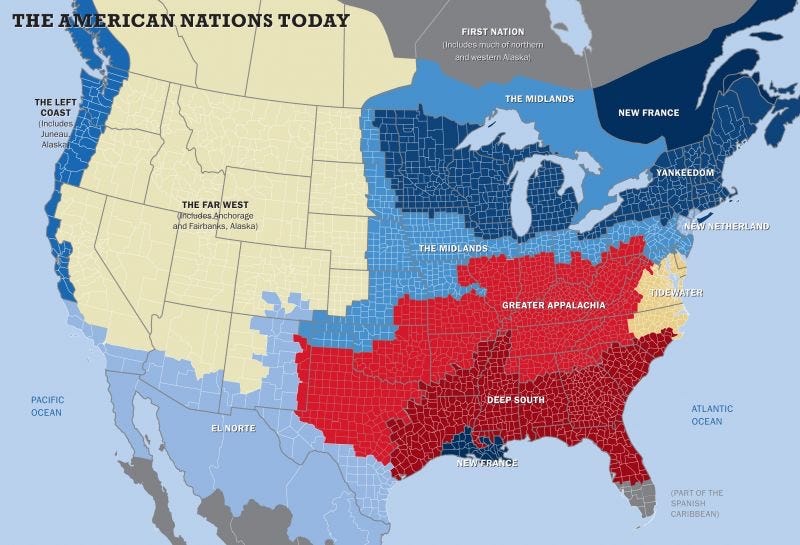
The term Great Awokening is apt at many levels. First, is it clearly about intensification of beliefs reacting to a sinful society. Second, we are dealing with what can reasonably be called a faith system. Critics are fond of treating “wokeness”, and critical social theory which underpins it, as a cult and it does act somewhat as a religion-substitute, though without the supernatural claims we associate with religion. Third, like the previous religious revivals, it has been particularly intense in the Atlantic Northeast of the US: i.e. what we might call Greater New England or Greater Yankeedom. (Yes, the US West Coast is also an epicentre, but the West Coast, particularly the Pacific Northwest, is to a significant degree an outgrowth of the Greater New England.) Fourth, it is ultimately an American phenomenon, driven by American obsessions and coming out of American theorising. It also has a specifically US history. Both the Social Gospel movement, which is a clear precursor to modern social justice ideology, and what political scientist Eric Kaufmann calls Left Modernism, largely came out of the Atlantic/Great Lakes Northeast of the US.

So, why do folk who criticise wokeness and critical social theory tend to go on about Postmodernism and various French thinkers? Why bring up a bunch of French theorists?

Good question. The fact that we are dealing with an overwhelmingly US-centred phenomena — not only that, significantly regional-US phenomena — does surely raise questions about Blaming The French. Really, it is not hard to see a secularised Yankee Puritanism underlying a lot of wokeness. And if French theorists are such an issue, why has not wokeness and critical social theory swept France? Why do all the key figures in critical social theory itself appear to be US residents or citizens? Why do very American obsessions with race seem to loom so large?

There is a whole stream of commentary which argues that those folk pointing their fingers are Postmodernism and French Theory do not properly understand either Postmodernism or French theory. A good example of this line of commentary is found here.

If the argument is that wokeness and critical social theory do not represent accurate or complete adoptions of the ideas of various French theorists — notably Jean Baudrillard (1929–2007), Jacques Derrida (1930–2004) and Paul-Michel Foucault (1926–1984) — then surely the claim is correct. Neither wokeness nor critical social theory is remotely built on a sophisticated or accurate adoption of the corpus of these French thinkers. Apart from anything else, the principle enunciated by intellectual historian Etienne Gilson is in play: the conclusions of the master are the premises of the disciples. Nor is there any reason why what is adapted from those thinkers has to be accurate and fully nuanced adoptions thereof.

Have, however, various American theorists adapted ideas or themes they have taken from such thinkers into their own theorising? Yes. It is those adaptations that are in play, rather than nuanced, full-range, incorporations. To critique those adaptations is not going to be, or require, a full grappling with the thought of Baudrillard, Derrida or Foucault. It is generally much more to the point to criticise the key (US) contributors to critical social theory, as philosopher Martha Nussbaum did so memorably with queer theorist Judith Butler, than to tango with various French thinkers.

The discussion between YouTuber Benjamin Boyce and Twitter commentator Wokal Distance is a good entry point to those adaptations and what has been done with them. Key adaptations from these thinkers include:
Jean Baudrillard: we are trapped in our social bubble, the map is the territory, and you might not be able to get out of our social bubble.
Jacques Derrida: words are only defined in terms of other words.
Paul-Michel Foucault: arguments are about jockeying for power, which is the fundamental constituent dynamic of society.

The question is not whether the above are accurate and nuanced adoptions of the ideas of these French thinkers, but rather whether these are the adapted takeaways from these thinkers that operate within critical social theory.

Which is not to say there is no point in considering the thought of these thinkers. Something that strikes me, even when reading or listening to sympathetic renditions of the ideas of Baudrillard, Derrida and Foucault, is that their thinking is very much pre-Darwinian.

Noam Chomsky has noted about French thinkers that the French Communist Party (which had an entire associated intellectual culture) was and remained Stalinist, with those who rejected Stalinism often adopting Maoism, while French biology had largely failed to adopt Darwinian evolutionary thinking. So, French thinkers tend to be pre-Darwinian in the sense of not incorporating the insights of evolutionary theory. But that is a more general failing.

Baudrillard, Derrida and Foucault were all born in the period 1926–1930. They grew up in the 1930s Depression and in wartime France, during the most destructive war in history. They were in their late 20s when the East German uprising, the Hungarian Revolt and Khruschev’s secret speech occurred. The 1950s and 1960s were age of mass prosperity and low unemployment. Western empires were in retreat and Europe was dominated by an extra-European power (the US) and a peripheral European power (the Soviet Union). Solzhenitsyn’s The Gulag Archipelago hit the persistent Stalinism and Maoism of French intellectual life like a thunderbolt, made all the more resonant by the horrors of Cambodia’s Year Zero, which had been unleashed by folk who had had French educations.

History was not following the Marxist script. Scepticism about meta-narratives, and the claims they are based upon, is not surprising in such circumstances.

On the pre-Darwinian nature of their theorising, consider a simple question: why did we evolve the capacity for language? Yes, being able to persuade our fellow Homo sapiens was likely crucial, but persuade them to do what in what context? We had to evolve a voice box able to create a very wide range of fairly precisely controlled sounds. That took persistent, adaptive feedback from the world around us to successfully evolve such a capacity. Does that make either the idea that (1) language is self-contained or (2) our perceptual apparatus does not give high quality feedback about the world around us, in any way plausible?

Consider the notion that society is made up of power relations. Now, to be fair to Foucault, his concept of power seems to have been something more like human action. But society as being constituted by power relations is the notion that has been incorporated into critical social theory.

Well, power relations to do what? When foragers got together, were they forming hunting bands as exercises in power relations? Or was the point to successfully interact with the world so as to eat, live and raise children? Do we not consistently act in the world to do things? To be purposeful? Are those feedbacks from physical reality not real and significant?


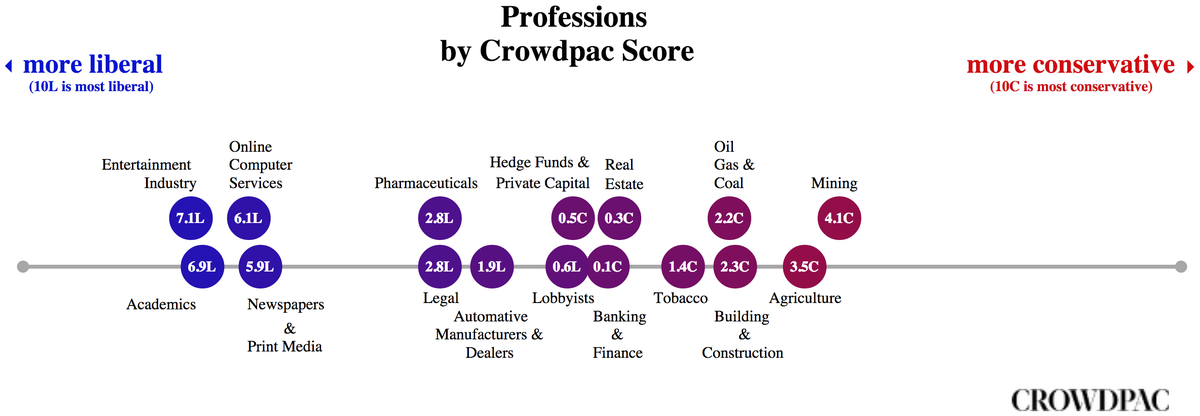
Source.

It is rather conspicuous that the more people make a living from dealing with brute physical reality, the more their industry/occupation leans towards conservatism. Conversely, the more abstract and imaginative the profession, the more progressive (and now woke) they tend to be. Raising questions about feedback and functionality does not encourage embracing critical social theory.

One of my analytical principles is that political ideologies often ask very good questions. The answers they give are often much less useful, but the questions are typically good ones. The effective elimination of conservative voices from large parts of academe, education, IT and media means the conservative questions of how do we achieve social order?, what do we seek social order for?, what can we learn from past achievements and failures? what constraints did they face? do not get asked. The lack is increasingly obvious and pervades critical social theory.

Evolutionary theory forces one to consider the functionality of things, in a very broad sense, and what feedbacks are operating. Critical social theory rests on a whole host of narrowings that make no sense from an evolutionary perspective. But those perverse narrowings are things they did adopt from French theory, albeit without a full nuance transplant. French theory was a source for such, because Baudrillard, Derrida and Foucault are, in a real sense, all pre-Darwinian thinkers.

Historians often make much of the impact of Charles Darwin and evolutionary thinking on modern thought and social history. But considering French Theory, and critical social theory, it is obvious that the myth or icon of Darwin has had much more impact than has evolutionary thinking itself. To a startling degree, human sciences (such as, for example, medicine, dentistry and nutrition) still do not incorporate the evolutionary lens. The further one gets away from the sciences, the more that is true.

The pre-Darwinian nature of such French theorising makes them rather unfortunate places from which to adopt the building blocks of a world view.

But to hold them, or even their ideas, responsible for the intersection between various partial takeaways of their thought with rather specifically American cultural and intellectual patterns is to misdiagnose what has been going on. Ideas have to resonate in order to replicate, and critical social theory, and wokeness, are very much ideas resonating, and replicating, first and foremost in American, and then Anglo, contexts.

Once the pre-Darwinian nature of the sources of critical social theory, and that critical social theory is also pre-Darwinian, has been spotted, there is not a lot of further benefit to be had in dancing with French theorists, or simulacra of them, in the Pomo Tango.

Cross-posted from Medium.

There is more to human evolution than African savannahs (and other problems of human nutrition)

Image for post


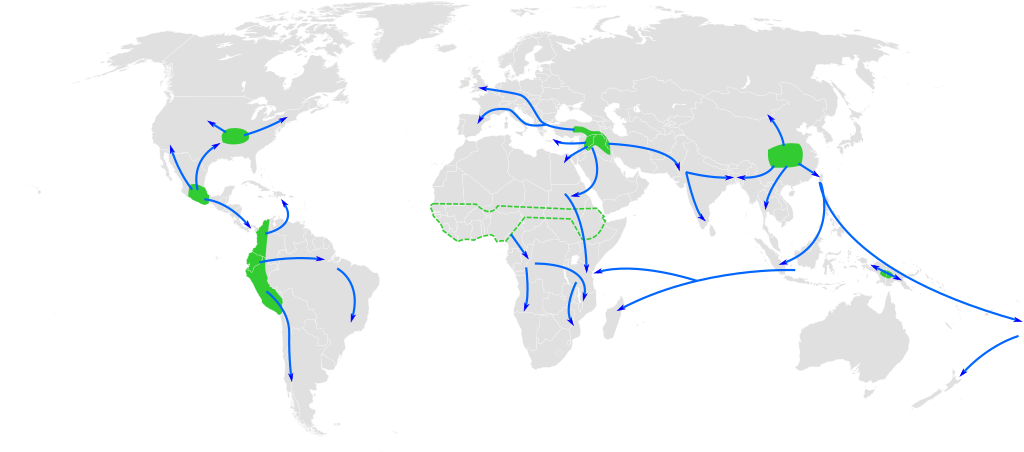
Spread of farming and farmers.

Humans, the genus Homo, evolved in Africa. For most of the history of our genus, even for most of the history of our species Homo sapiens, we were foragers in Africa.

Homo sapiens are probably about 300,000 or so years old as a species. We did not leave Africa until maybe 80,000 years ago, with another exit wave about 50,000 years ago. Our species then spread out, still being foragers, across every continent except Antarctica.

Around 10,000 years ago, some of our ancestors started farming. Farming was invented again and again. In each case, farmers spread out, absorbing and replacing (mostly replacing) foragers. Some foraging populations have persisted to the present day. Those populations have no history other than being foragers. But they are a tiny proportion of present day humans.

The genetic record suggests that farming (and a bit later pastoralism) sped up human evolution, rather than slowing it down. It sped it up because it changed the selection pressures dramatically. Farming was distinctly less healthy than foraging, but massively increased our access to usable calories, and so won the demographic struggle against foraging.

What were the effects of these changes? Many and varied. Among pastoralist populations, lactase persistence, the ability to consume milk as adults, evolved. It also seems that our normative capacity evolved, with a shift towards moral norms because that made group stability easier and so enabled us to operate in larger (and more hierarchical) groups.

It also, fairly clearly, increased the variety of our response to food. Different populations had systematically different food patterns and selection pressures from those food patterns.

Where does that leave us?

Understanding that the notion of nutrition guidelines, especially enforced nutrition guidelines, is a complete crock. First, humans are simply too varied in their responses to food for a one-size-fits-all set of nutrition guidelines to be sensible.

Human responses to nutrition will not be random, just varied. So, responses will be distributed, probably in a fairly normal Bell-curve pattern (though that is a guess, not an inference from clear evidence). Thus, there will be patterns, potentially strong ones, in human responses to nutrition. Though the patterns are still likely to be varied enough that one-size-fits-all guidelines are still going to be a bad idea.

That 10,000 years or so of farming experience (which in many populations is rather less than that), is hardly going to completely overwrite 300,000 years of experience of being foragers (plus all that prior evolution). With even those foragers had significant variety in their diets between groups.

But those patterns are unlikely to be remotely uniform enough to make nutrition guidelines useful as anything more than a very general guide for people to discover what works for them.

The other problem with nutrition guidelines is (1) nutrition science is difficult and (2) the chances of government nutrition guidelines being solidly based on good nutrition science are vanishingly small.

Nutrition science is difficult because our responses to food are somewhat varied, our food intake is very varied and food is not remotely the only thing that affects our health and longevity. So, trying to tease out the effects of different foods, different food groups, different eating patterns, on our health and longevity is inherently complex and so inherently difficult.

The sheer difficulty of doing good nutrition science actually makes problem (2) worse. If it is hard to do good nutrition science, it is easy to do it badly. If it is easy to do it badly, it is very easy to do it to support an agenda. There are massive income flows at stake in food, nutrition and health, so there are massive social selection pressures in play to support, sustain and expand access to those income flows.

Which is how we have ended up, across the Western world, with nutrition guidelines that clearly do NOT promote health and active longevity. That, on the contrary, are presiding over us collectively getting chronically sicker, particularly through the dramatic increases in metabolic syndrome, as that is what maximises income flows to a lot of interested parties.

Big Food Products that wants us to eat more and more, to eat to our (manipulated) palates not to our health. Big Pharma that wants to sell symptom suppression drugs so makes more money the more symptoms there are to suppress. Ordinary medicos who make more money prescribing symptom suppression drugs to the chronically metabolically ill. Big Health Advocacy whose income comes from Big Food Products and Big Pharma and who get more income and importance the bigger their issue is. Big Government Health Bureaucracies, whose revenues go up the more chronically sick we collectively are.

With all those selection processes at work, the likelihood of nutrition guidelines being actually based on the science and actually promoting health and active longevity is close to zero. As we have collectively experienced.

And this without considering the ideological pressures also in play, such as religious and other commitments to vegetarianism.

Government nutrition guidelines have been a serial disaster and were never a good idea in the first place. Our metabolisms were collectively much healthier when we were not afflicted with government nutrition guidelines.

Humans are too nutritionally varied, and the social selection processes operating on bureaucracies and political processes far too perverse, for government nutrition guidelines to be an idea that anyone should support.